
Leadership and MotivationPresented by:-Soumyodeep Sahu       Soumyonath banerjeeSourin MukherjeeSubhadeep GhoshSudipta DasSumana Dutta0
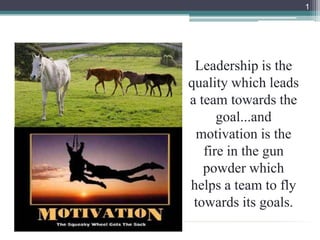
Leadership is the quality which leads a team towards the goal...and motivation is the fire in the gun powder which helps a team to fly towards its goals.1
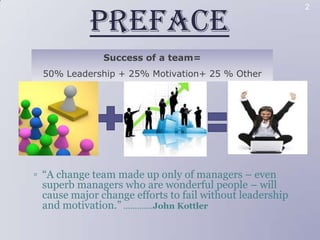
Preface“A change team made up only of managers – even superb managers who are wonderful people – will cause major change efforts to fail without leadership and motivation.” ………….John Kottler2Success of a team=50% Leadership + 25% Motivation+ 25 % Other
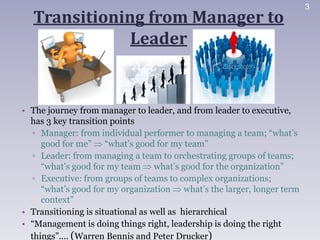
Transitioning from Manager to LeaderThe journey from manager to leader, and from leader to executive, has 3 key transition pointsManager: from individual performer to managing a team; “what’s good for me”  “what’s good for my team”Leader: from managing a team to orchestrating groups of teams; “what’s good for my team  what’s good for the organization”Executive: from groups of teams to complex organizations; “what’s good for my organization  what’s the larger, longer term context”Transitioning is situational as well as  hierarchical“Management is doing things right, leadership is doing the right things”.... (Warren Bennis and Peter Drucker)3
4Overwhelmed!Don’t have any controlToo focused on operational and tactical issuesDon’t understand how5.	Cannot get in . . .No clearly defined organizational pathPerformance not good enoughDon’t want it !Problem of a manager who don’t have leadership quality
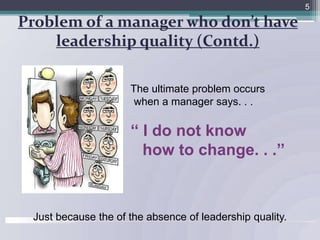
Problem of a manager who don’t have leadership quality (Contd.)5			The ultimate problem occurs 		        when a manager says. . .		   ‘‘ I do not know 				how to change. . .’’       Just because the of the absence of leadership quality.
Types of Leadership Style:-Autocratic:Leader makes decisions without reference to anyone elseHigh degree of dependency on the leaderCan create de-motivation and alienation of staffMay be valuable in some types of business where decisions need to be made quickly and decisively
Types of Leadership Style:-Democratic:   Encourages decision making from different  perspectives – leadership may be emphasised throughout the organisationConsultative: process of consultation before  				    decisions are takenPersuasive: Leader takes decision and seeks to 			           persuade others that the decision                            is correct
Types of Leadership Style:-Paternalistic:Leader acts as a ‘FATHER FIGURE’Paternalistic leader makes decision but may consultBelieves in the need to support staff
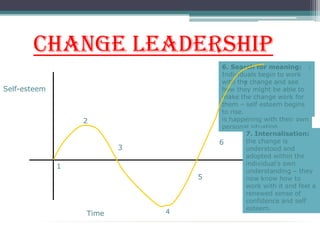
Change Leadership        1. Immobilisation – as rumours of the change circulate, the individual feels some sense of shock and possible disbelief – so much so that they deem it worthy of doing nothing.2. Minimisation: As the change becomes clearer, people try to fit in the change with their own personal position and may try to believe that it will not affect them.3. Depression: as reality begins to dawn staff may feel alienated and angry, feelings of a lack of control of events overtake people and they feel depressed as they try to reconcile what is happening with their own personal situation.4. Acceptance/letting go: The lowest point in self-esteem finally sees people starting to accept the inevitable. Fear of the future is a feature of this stage.5. Testing out: Individuals begin to interact with the change, they start to ask questions to see how they might work with the change.6. Search for meaning: Individuals begin to work with the change and see how they might be able to make the change work for them – self esteem begins to rise.7Self-esteem27. Internalisation: the change is understood and adopted within the individual’s own understanding – they now know how to work with it and feel a renewed sense of confidence and self esteem.63154Time
Overcoming Challenges10“You must be the change you wish to see in the world.”Mahatma Gandhi –	   Indian Leader
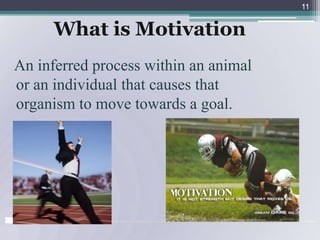
What is Motivation  An inferred process within an animal or an individual that causes that organism to move towards a goal.11
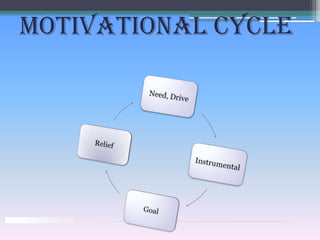
Motivational cycle
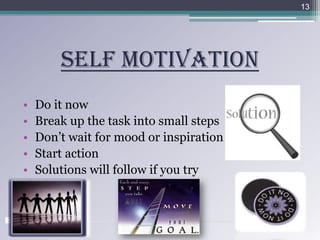
Self motivation Do it now
 Break up the task into small steps
 Don’t wait for mood or inspiration
 Start action
 Solutions will follow if you try13
Motivational techniquesLeads themReal examples are quicker than advice	Way to influencing peopleAppeal to benefitsCan motivate	Mutual benefits to both of youAppeal to emotionsPeople act quickly to emotions	Positive mannerAppeal to expertiseAbilities enhance his self-worth	Put best effort to seek approval

Mgmt andldrship072406

  • 1.
    Leadership and MotivationPresentedby:-Soumyodeep Sahu Soumyonath banerjeeSourin MukherjeeSubhadeep GhoshSudipta DasSumana Dutta0
  • 2.
    Leadership is thequality which leads a team towards the goal...and motivation is the fire in the gun powder which helps a team to fly towards its goals.1
  • 3.
    Preface“A change teammade up only of managers – even superb managers who are wonderful people – will cause major change efforts to fail without leadership and motivation.” ………….John Kottler2Success of a team=50% Leadership + 25% Motivation+ 25 % Other
  • 4.
    Transitioning from Managerto LeaderThe journey from manager to leader, and from leader to executive, has 3 key transition pointsManager: from individual performer to managing a team; “what’s good for me”  “what’s good for my team”Leader: from managing a team to orchestrating groups of teams; “what’s good for my team  what’s good for the organization”Executive: from groups of teams to complex organizations; “what’s good for my organization  what’s the larger, longer term context”Transitioning is situational as well as hierarchical“Management is doing things right, leadership is doing the right things”.... (Warren Bennis and Peter Drucker)3
  • 5.
    4Overwhelmed!Don’t have anycontrolToo focused on operational and tactical issuesDon’t understand how5. Cannot get in . . .No clearly defined organizational pathPerformance not good enoughDon’t want it !Problem of a manager who don’t have leadership quality
  • 6.
    Problem of amanager who don’t have leadership quality (Contd.)5 The ultimate problem occurs when a manager says. . . ‘‘ I do not know how to change. . .’’ Just because the of the absence of leadership quality.
  • 7.
    Types of LeadershipStyle:-Autocratic:Leader makes decisions without reference to anyone elseHigh degree of dependency on the leaderCan create de-motivation and alienation of staffMay be valuable in some types of business where decisions need to be made quickly and decisively
  • 8.
    Types of LeadershipStyle:-Democratic: Encourages decision making from different perspectives – leadership may be emphasised throughout the organisationConsultative: process of consultation before decisions are takenPersuasive: Leader takes decision and seeks to persuade others that the decision is correct
  • 9.
    Types of LeadershipStyle:-Paternalistic:Leader acts as a ‘FATHER FIGURE’Paternalistic leader makes decision but may consultBelieves in the need to support staff
  • 10.
    Change Leadership 1. Immobilisation – as rumours of the change circulate, the individual feels some sense of shock and possible disbelief – so much so that they deem it worthy of doing nothing.2. Minimisation: As the change becomes clearer, people try to fit in the change with their own personal position and may try to believe that it will not affect them.3. Depression: as reality begins to dawn staff may feel alienated and angry, feelings of a lack of control of events overtake people and they feel depressed as they try to reconcile what is happening with their own personal situation.4. Acceptance/letting go: The lowest point in self-esteem finally sees people starting to accept the inevitable. Fear of the future is a feature of this stage.5. Testing out: Individuals begin to interact with the change, they start to ask questions to see how they might work with the change.6. Search for meaning: Individuals begin to work with the change and see how they might be able to make the change work for them – self esteem begins to rise.7Self-esteem27. Internalisation: the change is understood and adopted within the individual’s own understanding – they now know how to work with it and feel a renewed sense of confidence and self esteem.63154Time
  • 11.
    Overcoming Challenges10“You mustbe the change you wish to see in the world.”Mahatma Gandhi – Indian Leader
  • 12.
    What is Motivation An inferred process within an animal or an individual that causes that organism to move towards a goal.11
  • 13.
  • 14.
  • 15.
    Break upthe task into small steps
  • 16.
    Don’t waitfor mood or inspiration
  • 17.
  • 18.
    Solutions willfollow if you try13
  • 19.
    Motivational techniquesLeads themRealexamples are quicker than advice Way to influencing peopleAppeal to benefitsCan motivate Mutual benefits to both of youAppeal to emotionsPeople act quickly to emotions Positive mannerAppeal to expertiseAbilities enhance his self-worth Put best effort to seek approval