Concept and Definition of
Sustainable Development
• In terms of not compromising future needs.
• So, sustainability roadmap demanding intergenerational
replication
• 2 major concepts to address.
NIL-NL
• Requires implementation of several things
Bird War-BRDWR
• Need of Development for achieving sustainability
1. Social
2. Environmental
3. Economical
• Some important definitions of Sustainable
Development
1. Brundtland Commission
2. Hamilton-Wentworth Regional Council
3. World Business Council on Sustainable
Development
4. Interfaith Center on Corporate Responsibility
Need and Importance of Sustainable
Development
• Provision of basic Human needs
• Agricultural Necessity
• Control Climate Change
• Provide Financial stability
• Sustain Biodiverity
Education for Sustainable Development
• Education according to the Nelson Mandela
• Include key sustainable issues into teaching
learning process
• Education will promote like competencies
• ESD can be viewed as an umbrella
• Some bases for ESD
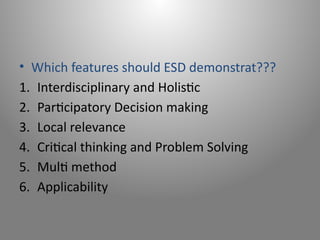
• Which features should ESD demonstrat???
1. Interdisciplinary and Holistic
2. Participatory Decision making
3. Local relevance
4. Critical thinking and Problem Solving
5. Multi method
6. Applicability
Philosophical Development and
Sustainable Development
• 3 broader groups of conceptions i. e the
philosophies of sustainability (Dobson 1998)
1. Sustainability Conception A(Critical Nature
Capital)
2. Sustainability Conception B(Irreversible
Nature)
3. Sustainability Conception C(Value of Nature)
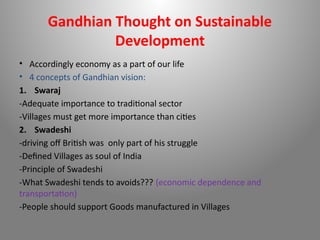
Gandhian Thought on Sustainable
Development
• Accordingly economy as a part of our life
• 4 concepts of Gandhian vision:
1. Swaraj
-Adequate importance to traditional sector
-Villages must get more importance than cities
2. Swadeshi
-driving off British was only part of his struggle
-Defined Villages as soul of India
-Principle of Swadeshi
-What Swadeshi tends to avoids??? (economic dependence and
transportation)
-People should support Goods manufactured in Villages
• Also Gandhi does not reject foreign trade.
3. Trusteeship
- Based on first sloka of Isopanishad
- Gandhis faith on Law of non-possession
- Who actually is Trustee???
- Does not recognize Right of Property
- Marxian and Gandhian concept difference
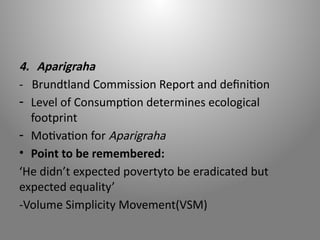
4. Aparigraha
- Brundtland Commission Report and definition
- Level of Consumption determines ecological
footprint
- Motivation for Aparigraha
• Point to be remembered:
‘He didn’t expected povertyto be eradicated but
expected equality’
-Volume Simplicity Movement(VSM)
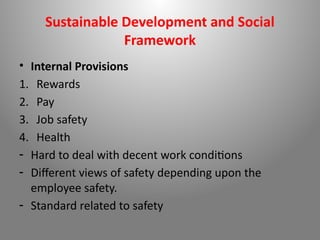
Sustainable Development and Social
Framework
• Internal Provisions
1. Rewards
2. Pay
3. Job safety
4. Health
- Hard to deal with decent work conditions
- Different views of safety depending upon the
employee safety.
- Standard related to safety
• External Provisions
- Definition of Corporate Citizenship by Logan
- Azapagic definition of social Accountability
- How Business for Social Responsibility considers it?
Meeting or exceeding expectations
- External Factors playing role
- Meulenberg definition
- Cohen and Ethical Consumers (spends 300 billion
upwards every year)
Sustainable Development and Equitable
Distribution
• Nothing but resource distribution keeping in
ming intergenerational equity
• Rich countries should make available financial
and technical resources available
• Developers should see resources spent in a
prioritized manner
• Not only what resources used and how they are
used only important but also how effects
distributed to concerned
Sustainable Vs. Green Development
• What according to Jim Newman, NCG ?
• Green- considerations limited to direct
exposures or product or services
• Sustainable- implications of products over
much longer period of time
Criticisms to Sustainable Development
1. Growth (keep the name Dingler in mind)
2. Efficiency, De- coupling and Dematerialisation
3. Environmental Management (pseudo nature
of possibility to collect all information about
specific ecosystem)
4. Poverty and Population Growth (in contrast
lifestyle of industrialized countrymen)
5. Needs (of future generation)
6. Divergence between ecological and
economical developments
7. Scientification and Technocentrism (Gore)
Stakeholder impact
• Meaning of Stakeholder, Types of Stakeholders
(learn it as it from the first chapter)
• Role of Stakeholders in Business
The CID- DCID
D-Direct Management
C-Corporate Concience
I-Investors
D-Direct management
Powers of Stakeholders
• VELP
V-Voting Power
E-Economic Power
L-Legal Power
P-Political Power
Managing the Downside
• Case of Du PONT
• Green to Gold Play 1(Eco-efficiency: Improve
Resource Productivity)
• Green to Gold Play 2 (Eco-expense reduction: Cut
Environmental Costs and Regulatory Burden)
• Green to Gold Play 3 (Eco-Valuechain: Lower
upstream and downstram costs)
• Green to Gold Play 4 (Eco-Risk Control:Manage
Environmentally Driven Business Risk)
Managing the Upside
• Green to God Play 5 (Eco-Design: Meet
customers environmental needs)
• Green to Gold Play 6 (Eco-sales and
Marketing :Building product position and
customer loyalty)
• Green to Gold Play 7 (Eco-Market Space:Promote
Valur Innovation and Breakthrough Products)
• Green to Gold Play 8 (Intangible Value: Build
Corporate reputation and trusted brands)

mfsunit sustainable development concept.pptx

  • 1.
    Concept and Definitionof Sustainable Development • In terms of not compromising future needs. • So, sustainability roadmap demanding intergenerational replication • 2 major concepts to address. NIL-NL • Requires implementation of several things Bird War-BRDWR • Need of Development for achieving sustainability 1. Social 2. Environmental 3. Economical
  • 2.
    • Some importantdefinitions of Sustainable Development 1. Brundtland Commission 2. Hamilton-Wentworth Regional Council 3. World Business Council on Sustainable Development 4. Interfaith Center on Corporate Responsibility
  • 3.
    Need and Importanceof Sustainable Development • Provision of basic Human needs • Agricultural Necessity • Control Climate Change • Provide Financial stability • Sustain Biodiverity
  • 4.
    Education for SustainableDevelopment • Education according to the Nelson Mandela • Include key sustainable issues into teaching learning process • Education will promote like competencies • ESD can be viewed as an umbrella • Some bases for ESD
  • 5.
    • Which featuresshould ESD demonstrat??? 1. Interdisciplinary and Holistic 2. Participatory Decision making 3. Local relevance 4. Critical thinking and Problem Solving 5. Multi method 6. Applicability
  • 6.
    Philosophical Development and SustainableDevelopment • 3 broader groups of conceptions i. e the philosophies of sustainability (Dobson 1998) 1. Sustainability Conception A(Critical Nature Capital) 2. Sustainability Conception B(Irreversible Nature) 3. Sustainability Conception C(Value of Nature)
  • 7.
    Gandhian Thought onSustainable Development • Accordingly economy as a part of our life • 4 concepts of Gandhian vision: 1. Swaraj -Adequate importance to traditional sector -Villages must get more importance than cities 2. Swadeshi -driving off British was only part of his struggle -Defined Villages as soul of India -Principle of Swadeshi -What Swadeshi tends to avoids??? (economic dependence and transportation) -People should support Goods manufactured in Villages
  • 8.
    • Also Gandhidoes not reject foreign trade. 3. Trusteeship - Based on first sloka of Isopanishad - Gandhis faith on Law of non-possession - Who actually is Trustee??? - Does not recognize Right of Property - Marxian and Gandhian concept difference
  • 9.
    4. Aparigraha - BrundtlandCommission Report and definition - Level of Consumption determines ecological footprint - Motivation for Aparigraha • Point to be remembered: ‘He didn’t expected povertyto be eradicated but expected equality’ -Volume Simplicity Movement(VSM)
  • 10.
    Sustainable Development andSocial Framework • Internal Provisions 1. Rewards 2. Pay 3. Job safety 4. Health - Hard to deal with decent work conditions - Different views of safety depending upon the employee safety. - Standard related to safety
  • 11.
    • External Provisions -Definition of Corporate Citizenship by Logan - Azapagic definition of social Accountability - How Business for Social Responsibility considers it? Meeting or exceeding expectations - External Factors playing role - Meulenberg definition - Cohen and Ethical Consumers (spends 300 billion upwards every year)
  • 12.
    Sustainable Development andEquitable Distribution • Nothing but resource distribution keeping in ming intergenerational equity • Rich countries should make available financial and technical resources available • Developers should see resources spent in a prioritized manner • Not only what resources used and how they are used only important but also how effects distributed to concerned
  • 13.
    Sustainable Vs. GreenDevelopment • What according to Jim Newman, NCG ? • Green- considerations limited to direct exposures or product or services • Sustainable- implications of products over much longer period of time
  • 14.
    Criticisms to SustainableDevelopment 1. Growth (keep the name Dingler in mind) 2. Efficiency, De- coupling and Dematerialisation 3. Environmental Management (pseudo nature of possibility to collect all information about specific ecosystem) 4. Poverty and Population Growth (in contrast lifestyle of industrialized countrymen) 5. Needs (of future generation)
  • 15.
    6. Divergence betweenecological and economical developments 7. Scientification and Technocentrism (Gore)
  • 16.
    Stakeholder impact • Meaningof Stakeholder, Types of Stakeholders (learn it as it from the first chapter) • Role of Stakeholders in Business The CID- DCID D-Direct Management C-Corporate Concience I-Investors D-Direct management
  • 17.
    Powers of Stakeholders •VELP V-Voting Power E-Economic Power L-Legal Power P-Political Power
  • 18.
    Managing the Downside •Case of Du PONT • Green to Gold Play 1(Eco-efficiency: Improve Resource Productivity) • Green to Gold Play 2 (Eco-expense reduction: Cut Environmental Costs and Regulatory Burden) • Green to Gold Play 3 (Eco-Valuechain: Lower upstream and downstram costs) • Green to Gold Play 4 (Eco-Risk Control:Manage Environmentally Driven Business Risk)
  • 19.
    Managing the Upside •Green to God Play 5 (Eco-Design: Meet customers environmental needs) • Green to Gold Play 6 (Eco-sales and Marketing :Building product position and customer loyalty) • Green to Gold Play 7 (Eco-Market Space:Promote Valur Innovation and Breakthrough Products) • Green to Gold Play 8 (Intangible Value: Build Corporate reputation and trusted brands)