CONCEPT OF SUSTAINABLE
DEVELOPMENT
AND BRUNDTLAND
COMMISSION
REPORT
EVOLUTION OF THE PRINCIPLE
OF SUSTAINABLE DEVELOPMENT
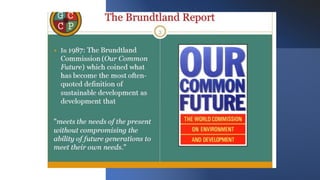
• Sustainable development is development that meets the needs of the present without compromising the
ability of future generations to meet their own needs... Sustainable development requires meeting the basic
needs of all and extending to the opportunity to satisfy their aspirations for a better life.- Our Common
Future (Report of the World Commission on Environment and Development), 43-44 (1987).
• Journey started with the introduction of the concept at Stockholm Conference 1972
• Our Common Future, the influential 1987 Brundtland Report, sought for solutions to parallel problems of
global environmental degradation and global lack of social and economic development, by asking for these
challenges to be addressed in an integrated way, for the interests of present and future generations.
• At the United Nations Conference on Environment and Development, in the 1992 Rio Declaration, States
committed to “the further development of international law in the field of sustainable development”
(Principle 27).”
• The document Caring for the Earth defines the term, “improving the quality of human life while living
within carrying capacity of supporting ecosystems.”
INTRODUCTION
PRINCIPLE
OF SUSTAINABLE
DEVELOPMENT
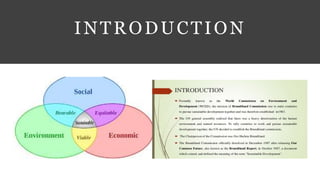
Sustainable development is the development that meets the
needs of the present without compromising the ability of
future generations to meet their own needs... Sustainable
development requires meeting the basic needs of all and
extending to the opportunity to satisfy their aspirations for a
better life.- Our Common Future (Report of the World
Commission on Environment and Development), 43-44
(1987).
This definition emphasises two core principles:
• Firstly, the concept of 'needs', in particular the essential
needs of the world's poor, to which overriding priority
should be given, and, Secondly, the idea of limitations
imposed on the environment's ability to meet present
and future needs.
• The term ‘sustainable development law’ describes an
emerging corpus of international legal principles and
instruments which address the intersections between
international economic, environmental and social law
(including human rights law), towards development that
can last for the benefit of present and future generations.
SUSTAINABLE
DEVELOPMENT AND ITS
VARIOUS PRINCIPLES
The declaration identified the following
salient features of sustainable development:
(1) Inter-generational equity;
(2) Use and conservation of natural
resources;
(3) Environmental protection;
(4) The precautionary principle;
(5) The ‘Polluter Pays’ principle;
(6) Principle of liability to help and co-
operate;
(7) Poverty eradication; and
(8) Principle of ‘public trust’.
JUDICIAL
OVERVIEW
• Vellore Citizen Welfare Forum vs. Union of India, AIR 1996 SC 2715- The
doctrine of Sustainable Development was implemented by the Supreme Court of
India
• In Narmada Bachao Andolan vs. Union of India, (2000) 10 SCC 664- observed
that "Sustainable Development means what type or extent of development can
take place, which can be sustained by nature or ecology with or without
mitigation".
• In T.N. Godavaraman Thirumulpad vs. Union of India, (2008) 2 SCC 222, the
Hon'ble Supreme Court said "as a matter of preface, we may state that
adherence to the principle of Sustainable Development is now a constitutional
requirement. How much damage to the environment and ecology has got to be
decided on the facts of each case"?
• In Indian Council of Enviro-Legal Action vs. Union of India, 1996 (5) SCC
281 the Apex Court held: "while economic development should not be allowed
to take place at the cost of ecology or by causing widespread environment
destruction and violation; at the same time, the necessity to preserve ecology
and environment should not hamper economic and other developments".
NATIONAL GREEN TRIBUNAL AND
DECISIONS
• Under Section 19 of the Act, NGT has been empowered to hear all the civil matters related to the
environment.
• Under Section 20 of the Act, the NGT should apply the principles of Sustainable Development, the
precautionary principle and the polluter pays principle.
• The NGT in the case of Prafulla Samantray vs. Union of India, Appeal No. 8 of 2011, NGT(POSCO
Case), ordered the suspension of the establishment of the POSCO steel plant in Odisha, as in the opinion of
the NGT, though there is a need for industrial development, and employment opportunities created by
projects such as Posco's steel plant, but at the very same time, such development should be within the
parameters of environmental concerns and should satisfy the principles of sustainable development.
• The Hon'ble Tribunal in the case of Sarang Yadhwakar and others vs. The Commissioner, Appeal No. 2 of
2013, NGT held, "the principle of sustainable development takes within its ambit the application of the
'principle of proportionality' and the 'precautionary principle'.
NATIONAL GREEN TRIBUNAL AND DECISIONS
• The NGT in various cases has held in favour of project/ industries where an
industry/project has taken adequate preventive steps, mitigatory measures and are
armed with detailed Environment Management Plan backed by scientific studies.
• In Sterlite Industries (India) Pvt. Ltd. vs. Tamil Nadu Pollution Control Board and
ors., Appeal No. 57 and 58 of 2013, NGT the NGT while giving certain directions held in
favour of the industry and stated, "The environmental restrictions must operate with all
their rigour but no action should be suspicion-based which itself is not well-founded.
Precautionary principle should be invoked when the reasonable scientific data
suggests that without taking appropriate preventive measures there is a plausible
indication of some environmental injury or health hazard."
SUSTAINABLE
DEVELOPMENT
GOALS
• The United Nations Conference on Sustainable
Development in Rio de Janeiro in 2012 laid down
seventeen Sustainable Development Goals (SDGs)
to encounter the urgent environmental, economic
and political challenges being faced by the world.
Seventeen goals were set: to end poverty; zero
hunger; quality education; gender equality; clean
water and sanitation; affordable and clean energy;
decent work and economic growth; industry
innovation and infrastructure; reduced
inequalities; sustainable cities and communities;
responsible consumption and production; climate
action; life below water; life on land; peace, justice
and strong institutions and partnership for the
goals.
SUSTAINABLE DEVELOPMENT
GOALS
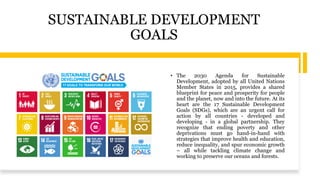
• The 2030 Agenda for Sustainable
Development, adopted by all United Nations
Member States in 2015, provides a shared
blueprint for peace and prosperity for people
and the planet, now and into the future. At its
heart are the 17 Sustainable Development
Goals (SDGs), which are an urgent call for
action by all countries - developed and
developing - in a global partnership. They
recognize that ending poverty and other
deprivations must go hand-in-hand with
strategies that improve health and education,
reduce inequality, and spur economic growth
– all while tackling climate change and
working to preserve our oceans and forests.
SUSTAINABLE DEVELOPMENT GOALS
• The Sustainable Development Goals (SDGs) were born at the United Nations Conference on
Sustainable Development in Rio de Janeiro in 2012. The objective was to produce a set of
universal goals that meet the urgent environmental, political and economic challenges facing
our world.
• The SDGs replace the Millennium Development Goals (MDGs), which started a global effort
in 2000 to tackle the indignity of poverty. The MDGs established measurable, universally-
agreed objectives for tackling extreme poverty and hunger, preventing deadly diseases, and
expanding primary education to all children, among other development priorities
• The idea for the SDGs was born at the 2012 Rio+20 Summit in Brazil. At the summit,
government leaders began creating a set of universal goals to tackle poverty, ill health,
inequality and environmental degradation. The idea was to use the SDGs as a new agreement
to replace the eight Millennium Development Goals (MDGs), which expired in 2015.

Sustainable Development.pptx

  • 1.
    CONCEPT OF SUSTAINABLE DEVELOPMENT ANDBRUNDTLAND COMMISSION REPORT
  • 2.
    EVOLUTION OF THEPRINCIPLE OF SUSTAINABLE DEVELOPMENT • Sustainable development is development that meets the needs of the present without compromising the ability of future generations to meet their own needs... Sustainable development requires meeting the basic needs of all and extending to the opportunity to satisfy their aspirations for a better life.- Our Common Future (Report of the World Commission on Environment and Development), 43-44 (1987). • Journey started with the introduction of the concept at Stockholm Conference 1972 • Our Common Future, the influential 1987 Brundtland Report, sought for solutions to parallel problems of global environmental degradation and global lack of social and economic development, by asking for these challenges to be addressed in an integrated way, for the interests of present and future generations. • At the United Nations Conference on Environment and Development, in the 1992 Rio Declaration, States committed to “the further development of international law in the field of sustainable development” (Principle 27).” • The document Caring for the Earth defines the term, “improving the quality of human life while living within carrying capacity of supporting ecosystems.”
  • 3.
  • 5.
    PRINCIPLE OF SUSTAINABLE DEVELOPMENT Sustainable developmentis the development that meets the needs of the present without compromising the ability of future generations to meet their own needs... Sustainable development requires meeting the basic needs of all and extending to the opportunity to satisfy their aspirations for a better life.- Our Common Future (Report of the World Commission on Environment and Development), 43-44 (1987). This definition emphasises two core principles: • Firstly, the concept of 'needs', in particular the essential needs of the world's poor, to which overriding priority should be given, and, Secondly, the idea of limitations imposed on the environment's ability to meet present and future needs. • The term ‘sustainable development law’ describes an emerging corpus of international legal principles and instruments which address the intersections between international economic, environmental and social law (including human rights law), towards development that can last for the benefit of present and future generations.
  • 6.
    SUSTAINABLE DEVELOPMENT AND ITS VARIOUSPRINCIPLES The declaration identified the following salient features of sustainable development: (1) Inter-generational equity; (2) Use and conservation of natural resources; (3) Environmental protection; (4) The precautionary principle; (5) The ‘Polluter Pays’ principle; (6) Principle of liability to help and co- operate; (7) Poverty eradication; and (8) Principle of ‘public trust’.
  • 7.
    JUDICIAL OVERVIEW • Vellore CitizenWelfare Forum vs. Union of India, AIR 1996 SC 2715- The doctrine of Sustainable Development was implemented by the Supreme Court of India • In Narmada Bachao Andolan vs. Union of India, (2000) 10 SCC 664- observed that "Sustainable Development means what type or extent of development can take place, which can be sustained by nature or ecology with or without mitigation". • In T.N. Godavaraman Thirumulpad vs. Union of India, (2008) 2 SCC 222, the Hon'ble Supreme Court said "as a matter of preface, we may state that adherence to the principle of Sustainable Development is now a constitutional requirement. How much damage to the environment and ecology has got to be decided on the facts of each case"? • In Indian Council of Enviro-Legal Action vs. Union of India, 1996 (5) SCC 281 the Apex Court held: "while economic development should not be allowed to take place at the cost of ecology or by causing widespread environment destruction and violation; at the same time, the necessity to preserve ecology and environment should not hamper economic and other developments".
  • 8.
    NATIONAL GREEN TRIBUNALAND DECISIONS • Under Section 19 of the Act, NGT has been empowered to hear all the civil matters related to the environment. • Under Section 20 of the Act, the NGT should apply the principles of Sustainable Development, the precautionary principle and the polluter pays principle. • The NGT in the case of Prafulla Samantray vs. Union of India, Appeal No. 8 of 2011, NGT(POSCO Case), ordered the suspension of the establishment of the POSCO steel plant in Odisha, as in the opinion of the NGT, though there is a need for industrial development, and employment opportunities created by projects such as Posco's steel plant, but at the very same time, such development should be within the parameters of environmental concerns and should satisfy the principles of sustainable development. • The Hon'ble Tribunal in the case of Sarang Yadhwakar and others vs. The Commissioner, Appeal No. 2 of 2013, NGT held, "the principle of sustainable development takes within its ambit the application of the 'principle of proportionality' and the 'precautionary principle'.
  • 9.
    NATIONAL GREEN TRIBUNALAND DECISIONS • The NGT in various cases has held in favour of project/ industries where an industry/project has taken adequate preventive steps, mitigatory measures and are armed with detailed Environment Management Plan backed by scientific studies. • In Sterlite Industries (India) Pvt. Ltd. vs. Tamil Nadu Pollution Control Board and ors., Appeal No. 57 and 58 of 2013, NGT the NGT while giving certain directions held in favour of the industry and stated, "The environmental restrictions must operate with all their rigour but no action should be suspicion-based which itself is not well-founded. Precautionary principle should be invoked when the reasonable scientific data suggests that without taking appropriate preventive measures there is a plausible indication of some environmental injury or health hazard."
  • 10.
    SUSTAINABLE DEVELOPMENT GOALS • The UnitedNations Conference on Sustainable Development in Rio de Janeiro in 2012 laid down seventeen Sustainable Development Goals (SDGs) to encounter the urgent environmental, economic and political challenges being faced by the world. Seventeen goals were set: to end poverty; zero hunger; quality education; gender equality; clean water and sanitation; affordable and clean energy; decent work and economic growth; industry innovation and infrastructure; reduced inequalities; sustainable cities and communities; responsible consumption and production; climate action; life below water; life on land; peace, justice and strong institutions and partnership for the goals.
  • 11.
    SUSTAINABLE DEVELOPMENT GOALS • The2030 Agenda for Sustainable Development, adopted by all United Nations Member States in 2015, provides a shared blueprint for peace and prosperity for people and the planet, now and into the future. At its heart are the 17 Sustainable Development Goals (SDGs), which are an urgent call for action by all countries - developed and developing - in a global partnership. They recognize that ending poverty and other deprivations must go hand-in-hand with strategies that improve health and education, reduce inequality, and spur economic growth – all while tackling climate change and working to preserve our oceans and forests.
  • 12.
    SUSTAINABLE DEVELOPMENT GOALS •The Sustainable Development Goals (SDGs) were born at the United Nations Conference on Sustainable Development in Rio de Janeiro in 2012. The objective was to produce a set of universal goals that meet the urgent environmental, political and economic challenges facing our world. • The SDGs replace the Millennium Development Goals (MDGs), which started a global effort in 2000 to tackle the indignity of poverty. The MDGs established measurable, universally- agreed objectives for tackling extreme poverty and hunger, preventing deadly diseases, and expanding primary education to all children, among other development priorities • The idea for the SDGs was born at the 2012 Rio+20 Summit in Brazil. At the summit, government leaders began creating a set of universal goals to tackle poverty, ill health, inequality and environmental degradation. The idea was to use the SDGs as a new agreement to replace the eight Millennium Development Goals (MDGs), which expired in 2015.