mezzanine capital

   Nishant Desai
    Vivek Sahay
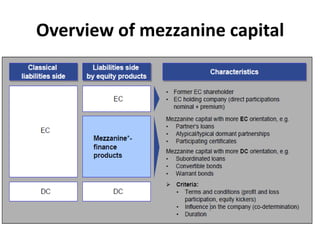
Definition of mezzanine capital
• There is no definition of the term mezzanine capital
  either in economics or in jurisprudence.
• The word ‘mezzanine‘ is actually a term used in
  architecture and means intermediate storey. Applied to
  financing aspects, mezzanine capital forms an
  intermediate (economical) form between equity and
  debt capital.
• Despite the ability to clearly allocate it legally to either
  equity or debt capital, it always has characteristics of
  the other kind. In other words:
   – mezzanine capital (when considered on its own) is capital
     that is not provided by partners/shareholders but more or
     less strongly has near equity attributes.
Characteristics of mezzanine capital
• Lower ranking compared to other creditors in the event
  of insolvency
• Senior ranking compared with the “true“ equity capital
• Temporal limitation of the provision of capital (usually
  5 to 10 years)
• Flexibility and versatility as regards the arrangement of
  the terms of the contract
• Tax deductibility of interest as operating expenses
  under commercial and tax law (Note: no deductibility
  under business tax for atypical dormant partnerships)
Uses
• Leveraged buyouts
   – In leveraged buyouts, mezzanine capital is used in
     conjunction with other securities to fund the
     purchase price of the company being acquired.
   – Financial sponsors will seek to use mezzanine capital
     in a leveraged buyout in order to reduce the amount
     of the capital invested by the private equity firm.
     Because mezzanine lenders typically have a lower
     target cost of capital than the private equity
     investor, using mezzanine capital can potentially
     enhance the private equity firm's investment returns.
Uses
• Real estate finance
   – In real estate finance, mezzanine loans are often used by
     developers to secure supplementary financing for
     development projects (typically in cases where the
     primary mortgage or construction loan equity
     requirements are larger than 10%)
   – These sorts of mezzanine loans are often collateralized by
     the stock of the development company rather than the
     developed property itself (as would be the case with a
     traditional mortgage).
   – This allows the lender to engage in a more rapid seizure
     of underlying collateral in the event of default and
     foreclosure
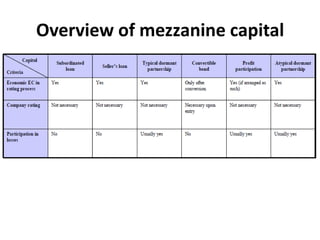
Overview of mezzanine capital
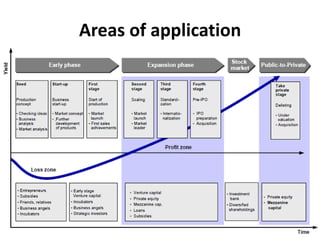
Areas of application
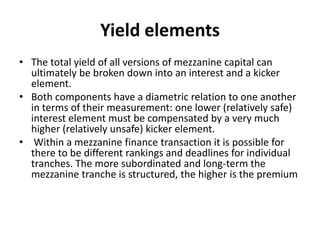
Yield elements
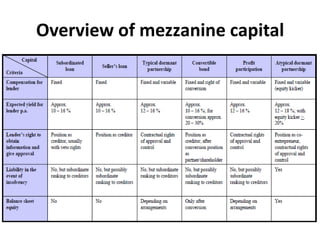
• The total yield of all versions of mezzanine capital can
  ultimately be broken down into an interest and a kicker
  element.
• Both components have a diametric relation to one another
  in terms of their measurement: one lower (relatively safe)
  interest element must be compensated by a very much
  higher (relatively unsafe) kicker element.
• Within a mezzanine finance transaction it is possible for
  there to be different rankings and deadlines for individual
  tranches. The more subordinated and long-term the
  mezzanine tranche is structured, the higher is the premium
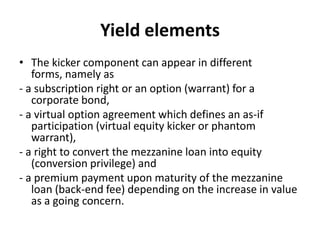
Yield elements
• The kicker component can appear in different
   forms, namely as
- a subscription right or an option (warrant) for a
   corporate bond,
- a virtual option agreement which defines an as-if
   participation (virtual equity kicker or phantom
   warrant),
- a right to convert the mezzanine loan into equity
   (conversion privilege) and
- a premium payment upon maturity of the mezzanine
   loan (back-end fee) depending on the increase in value
   as a going concern.
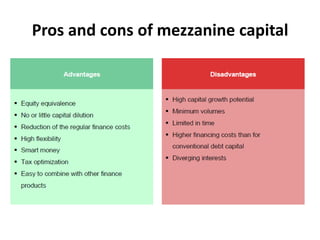
Pros and cons of mezzanine capital
Conclusion
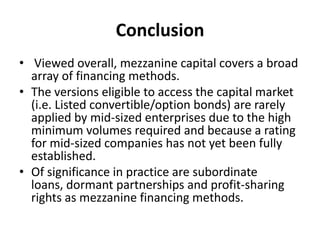
• Viewed overall, mezzanine capital covers a broad
  array of financing methods.
• The versions eligible to access the capital market
  (i.e. Listed convertible/option bonds) are rarely
  applied by mid-sized enterprises due to the high
  minimum volumes required and because a rating
  for mid-sized companies has not yet been fully
  established.
• Of significance in practice are subordinate
  loans, dormant partnerships and profit-sharing
  rights as mezzanine financing methods.
Questions???

Mezzanine

  • 1.
    mezzanine capital Nishant Desai Vivek Sahay
  • 2.
    Definition of mezzaninecapital • There is no definition of the term mezzanine capital either in economics or in jurisprudence. • The word ‘mezzanine‘ is actually a term used in architecture and means intermediate storey. Applied to financing aspects, mezzanine capital forms an intermediate (economical) form between equity and debt capital. • Despite the ability to clearly allocate it legally to either equity or debt capital, it always has characteristics of the other kind. In other words: – mezzanine capital (when considered on its own) is capital that is not provided by partners/shareholders but more or less strongly has near equity attributes.
  • 3.
    Characteristics of mezzaninecapital • Lower ranking compared to other creditors in the event of insolvency • Senior ranking compared with the “true“ equity capital • Temporal limitation of the provision of capital (usually 5 to 10 years) • Flexibility and versatility as regards the arrangement of the terms of the contract • Tax deductibility of interest as operating expenses under commercial and tax law (Note: no deductibility under business tax for atypical dormant partnerships)
  • 4.
    Uses • Leveraged buyouts – In leveraged buyouts, mezzanine capital is used in conjunction with other securities to fund the purchase price of the company being acquired. – Financial sponsors will seek to use mezzanine capital in a leveraged buyout in order to reduce the amount of the capital invested by the private equity firm. Because mezzanine lenders typically have a lower target cost of capital than the private equity investor, using mezzanine capital can potentially enhance the private equity firm's investment returns.
  • 5.
    Uses • Real estatefinance – In real estate finance, mezzanine loans are often used by developers to secure supplementary financing for development projects (typically in cases where the primary mortgage or construction loan equity requirements are larger than 10%) – These sorts of mezzanine loans are often collateralized by the stock of the development company rather than the developed property itself (as would be the case with a traditional mortgage). – This allows the lender to engage in a more rapid seizure of underlying collateral in the event of default and foreclosure
  • 6.
  • 7.
  • 8.
  • 9.
  • 10.
    Yield elements • Thetotal yield of all versions of mezzanine capital can ultimately be broken down into an interest and a kicker element. • Both components have a diametric relation to one another in terms of their measurement: one lower (relatively safe) interest element must be compensated by a very much higher (relatively unsafe) kicker element. • Within a mezzanine finance transaction it is possible for there to be different rankings and deadlines for individual tranches. The more subordinated and long-term the mezzanine tranche is structured, the higher is the premium
  • 11.
    Yield elements • Thekicker component can appear in different forms, namely as - a subscription right or an option (warrant) for a corporate bond, - a virtual option agreement which defines an as-if participation (virtual equity kicker or phantom warrant), - a right to convert the mezzanine loan into equity (conversion privilege) and - a premium payment upon maturity of the mezzanine loan (back-end fee) depending on the increase in value as a going concern.
  • 12.
    Pros and consof mezzanine capital
  • 13.
    Conclusion • Viewed overall,mezzanine capital covers a broad array of financing methods. • The versions eligible to access the capital market (i.e. Listed convertible/option bonds) are rarely applied by mid-sized enterprises due to the high minimum volumes required and because a rating for mid-sized companies has not yet been fully established. • Of significance in practice are subordinate loans, dormant partnerships and profit-sharing rights as mezzanine financing methods.
  • 14.

Editor's Notes

  • #4 (Note: no deductibility under business tax for atypical dormant partnerships)