Marine Insurance
INTRODUCTION
Insurance connected with the risks of
transportation of goods, is one of the oldest and
most important forms of insurance. The value of
goods shipped by the business firms each year cost
billions of rupees. These goods are exposed to
damage or loss from numerous perils associated
with transportation. These goods can be protected
by marine insurance contracts.
It is an important element of the general insurance
industry .
It essentially provides cover for the losses suffered
due to marine perils.
History
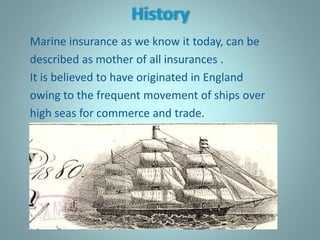
Marine insurance as we know it today, can be
described as mother of all insurances .
It is believed to have originated in England
owing to the frequent movement of ships over
high seas for commerce and trade.
In India, the marine insurance is regulated
By the Indian ‘maritime insurance act, 1963’.
Which is based on the original ‘marine insurance
Act, 1906’.
Prior to the development of marine insurance,
the people across the world, had a system of
pooling their contributions so that if any one of
them suffers loss during voyage, he would be
compensated from the pool.
 Today marine insurance has assumed a vast
dimensions due to ever expanding trade across
the globe.
 It involves large shipping companies that require
protection, not only for their costly fleet against
the perils of the sea, but also to the cargo being
carried in each of these ships.
 The value of each ship and the cargo carried
therein, may be costing millions of rupees to the
owners.
DEFINITION OF MARINE INSURANCE
Marine insurance is a contract under which the
insurer undertakes to indemnify the insured in the
manner and to the extent thereby agreed against
marine losses, incidental to marine adventures. It
may be defined as a form of insurance covering loss
or damage to ‘vessels’ or to ‘cargo’ during
transportation.
Types Of Marine Insurance
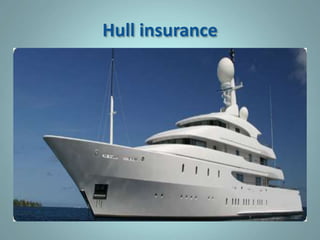
 Hull insurance
Insurance of the ship (vessel and its equipments)
 Cargo insurance
Insurance of the goods transported through ship.
 Freight insurance
The amount to be paid to the shipping company on
the safe arrival of goods.
Hull insurance
FEATURES OF MARINE INSURANCE
 It is based on ‘Utmost Good Faith’
i.e. Both the insured and the insurer’s must
disclose everything which is in their knowledge
and can affect the contract of insurance.
 It is a contract of ‘Indemnity’
i.e. the insured is entitled to recover only the
actual amount of loss from the insurer.
‘Insurable Interest’ in the subject matter insured
must exist at the time of the loss, it need not exist
when the insurance policy was taken under marine
insurance.
The following persons would deemed to have
‘insurable interest’:
• the owner of the ship
• the owner of the cargo
• a creditor who has advanced money on the security
of the ship or cargo
• the mortgagor and mortgagee
• the master and crew of the ship have ‘insurable
interest’ in respect of: their wages and
• in case of advance freight: the person advancing the
freight has an ‘insurable interest’ if such freight is not
repayable in case of loss.
 ‘Warranty’ is a promise by the assured to the
underwriter that something shall or shall not
be done or certain of affairs does or does not
arise. A warranty must be and literally
complied with, as otherwise the insurer may
avoid all liability, from the date of breach.
Warranty is in effect a ‘safety valve’ of the
insurers.
TYPES OF WARRANTIES
 Expressed warranty
 Implied warranty
Expressed Warranties
These are appearing in the policy itself and needs
to be complied with.
For example:
o Warranted packed in new gunny bags
o Warranted new drums
o Warranted professionally packed
o Warranted sailing within seven days
o Warranted shipped under deck
o Warranted surveyed before shipping etc.
Implied Warranties
These are not mentioned in the policy but are fully
binding as express warranties.
For example:
o Seaworthiness of the vessel at the commencement
of the voyage.
o Legality of the adventure.
o Non-deviation
Subrogation/Contribution
 Corollary to the principle of indemnity.
 Applies to policies, which are contracts of indemnity.
The purpose of both of these are to ensure that the
assured shall not make profit out of a loss, either
wholly or partly, from another source.
In marine insurance, the right of subrogation arises
only after payment has been made. It is not
customary as in fire and accident insurance, to alter
this by means of a condition to provide for the
exercise of subrogation right before payment of
claim.
 Proximate cause
 It is actual cause of loss
 The insure will not be liable for any loss
proximately caused by peril insured against.
 There must be direct and non-intervening
cause.
World’s biggest passenger ship
 Royal Caribbean’s Oasis of the Seas is the
world’s largest passenger vessel ever built.
 4300 passenger capacity.
 Five times larger than the Titanic.

marine-insurance.ppt

  • 1.
  • 2.
    INTRODUCTION Insurance connected withthe risks of transportation of goods, is one of the oldest and most important forms of insurance. The value of goods shipped by the business firms each year cost billions of rupees. These goods are exposed to damage or loss from numerous perils associated with transportation. These goods can be protected by marine insurance contracts. It is an important element of the general insurance industry . It essentially provides cover for the losses suffered due to marine perils.
  • 3.
    History Marine insurance aswe know it today, can be described as mother of all insurances . It is believed to have originated in England owing to the frequent movement of ships over high seas for commerce and trade.
  • 4.
    In India, themarine insurance is regulated By the Indian ‘maritime insurance act, 1963’. Which is based on the original ‘marine insurance Act, 1906’. Prior to the development of marine insurance, the people across the world, had a system of pooling their contributions so that if any one of them suffers loss during voyage, he would be compensated from the pool.
  • 5.
     Today marineinsurance has assumed a vast dimensions due to ever expanding trade across the globe.  It involves large shipping companies that require protection, not only for their costly fleet against the perils of the sea, but also to the cargo being carried in each of these ships.  The value of each ship and the cargo carried therein, may be costing millions of rupees to the owners.
  • 6.
    DEFINITION OF MARINEINSURANCE Marine insurance is a contract under which the insurer undertakes to indemnify the insured in the manner and to the extent thereby agreed against marine losses, incidental to marine adventures. It may be defined as a form of insurance covering loss or damage to ‘vessels’ or to ‘cargo’ during transportation.
  • 7.
    Types Of MarineInsurance  Hull insurance Insurance of the ship (vessel and its equipments)  Cargo insurance Insurance of the goods transported through ship.  Freight insurance The amount to be paid to the shipping company on the safe arrival of goods.
  • 8.
  • 10.
    FEATURES OF MARINEINSURANCE  It is based on ‘Utmost Good Faith’ i.e. Both the insured and the insurer’s must disclose everything which is in their knowledge and can affect the contract of insurance.  It is a contract of ‘Indemnity’ i.e. the insured is entitled to recover only the actual amount of loss from the insurer.
  • 11.
    ‘Insurable Interest’ inthe subject matter insured must exist at the time of the loss, it need not exist when the insurance policy was taken under marine insurance. The following persons would deemed to have ‘insurable interest’: • the owner of the ship • the owner of the cargo • a creditor who has advanced money on the security of the ship or cargo • the mortgagor and mortgagee • the master and crew of the ship have ‘insurable interest’ in respect of: their wages and • in case of advance freight: the person advancing the freight has an ‘insurable interest’ if such freight is not repayable in case of loss.
  • 12.
     ‘Warranty’ isa promise by the assured to the underwriter that something shall or shall not be done or certain of affairs does or does not arise. A warranty must be and literally complied with, as otherwise the insurer may avoid all liability, from the date of breach. Warranty is in effect a ‘safety valve’ of the insurers.
  • 13.
    TYPES OF WARRANTIES Expressed warranty  Implied warranty
  • 14.
    Expressed Warranties These areappearing in the policy itself and needs to be complied with. For example: o Warranted packed in new gunny bags o Warranted new drums o Warranted professionally packed o Warranted sailing within seven days o Warranted shipped under deck o Warranted surveyed before shipping etc.
  • 15.
    Implied Warranties These arenot mentioned in the policy but are fully binding as express warranties. For example: o Seaworthiness of the vessel at the commencement of the voyage. o Legality of the adventure. o Non-deviation
  • 16.
    Subrogation/Contribution  Corollary tothe principle of indemnity.  Applies to policies, which are contracts of indemnity. The purpose of both of these are to ensure that the assured shall not make profit out of a loss, either wholly or partly, from another source. In marine insurance, the right of subrogation arises only after payment has been made. It is not customary as in fire and accident insurance, to alter this by means of a condition to provide for the exercise of subrogation right before payment of claim.
  • 17.
     Proximate cause It is actual cause of loss  The insure will not be liable for any loss proximately caused by peril insured against.  There must be direct and non-intervening cause.
  • 19.
    World’s biggest passengership  Royal Caribbean’s Oasis of the Seas is the world’s largest passenger vessel ever built.  4300 passenger capacity.  Five times larger than the Titanic.