Mexico
Culture
• Mainly they are
speaking in Mestizo
(American-Spanish)
and Amerindian or
predominantly
Amerindian .
• Between 90 and 95
percent of the
Mexican people are
Roman Catholics.
Culture
Practice and
belief
• Values and
norms
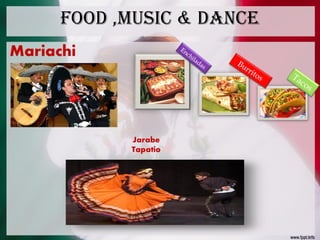
Food ,MusiC & danCe
Enchiladas Burritos Tacos
Sports
*Bullfighting: Mexico has the largest
venue for bullfighting in the world –
* The Plaza de toros in Mexico City
which seats 48,000 people
Mexico’s national football team
ranks as one of the best in Latin
America and it qualified for 15
FIFA World Cups. The country
also hosted the World Cup
tournament twice, in 1970 and
1986.
Holidays
• Effective as of
January 1, 1994
• A trade agreement
between
• Canada, Mexico and
United States.
ECONOMIC INTEGRATIONECONOMIC INTEGRATION
Background
• Removed barriers for
investment among the
United States, Canada, and
Mexico.
• All non-tariff barriers to
agricultural trade between
the United States and
Mexico were eliminated.
• created the world's largest
free trade area, which now
links 444 million people and
producing $17 trillion worth
of goods and services.
Advantages
• Greater product specialization and
efficiency.
• Agricultural trade increased in both
directions(U.S.-Mexico) under NAFTA
from $7.3 billion in 1994 to $20.1 billion in
2016.
• Wider variety of goods and services in
lower prices.
• Jobs created.
TRADING POLICY AND TRADE PARTNER
Mexico joined GATT in 1986 and has been active
and participate in multilateral trading system and
WTO . Mexico is also member of APEC,TPP,PA.
TRADE Partner:
Us, Japan, Colombia, Argentina, Brazil.
Export
Motor vehicles, oil, natural gas, machinery parts.
Import :organic chemicals, medical technical
equipment, machine, engine and pumps, rubber.
Travel to MEXICO
Playa del Carmen
Huatulco
Mexico City
Attractiveness of foreign investor
• Automobiles
• Mexico is projected to be the world’s fifth-
largest vehicle producer by 2020.
• Volkswagon’s is the company’s second largest
worldwide, exporting vehicles
• General Motors announced to invest US$5
billion & Nissan will invest US$1.5 billion. Honda
and Mazda have begun production whereas,
Benz luxury vehicles beginning in 2017.
MoreoverKia Motors is building a plant & Audi
AG is planning a new plant
• Energy: Oil
• Petroleum Mexicanos (Pemex) seemed likely to
attract a heady surge of foreign investment—an
estimated US$50 billion in FDI by 2020
• Even with oil currently trading near US$50 a barrel
• serious competition will materialize for the 14 blocks
in the Gulf of Mexico that the government has
opened for bid in 2015
Attractiveness of foreign investor
• Electronics and aerospace
• Today, the electronics sector is concentrated in 10 main clusters focusing on a
diverse set of products.
• A cluster focuses on supplying parts used in the nearby aerospace, automotive
plants, in computers, high-tech goods, and appliances
• The largest cluster is set up around Guadalajara, home to more than 400
manufacturers
• About 300 manufacturers operate across five Mexican states and its keep
growing
• A large cluster of factories producing engine components for aviation has been
constructed around Guaymas
• Big U.S. companies with operations in Mexico include Gulfstream
Aerospace/General Dynamics, General Electric, Textron, and Honeywell
15
Comparative advantage
Mexico has cheap labor, which attracts foreign
companies to shift their production in Mexico. Because
of the cheap labor availability, Mexican GDP is $800
above than Colombia. Their Govt. exenditure, business
freedom, investment accessibility is better than
Colombia. Moreover, cheap labor was one of the major
elements for which Mexico was included in NAFTA.
E.g: MAZDA shifted their production from Columbia
to Mexico for these advantages.
16
Comparative advantage
Mexico produces corns about (23 percent) of
the world production where Colombia
accounts for only (9 percent). Demand for
the corn of MAXICO is very higher because
of their high production quality.
Mexico has comparative advantage over Tomato
production. Because of cheap labor and
availability of agricultural land, they can enjoy
comparative advantage over tomato production
where as Colombia has disadvantages.
Corruption index
• Corruption is a significant risk for companies operating in Mexico. Bribery is
widespread in the country's judiciary and police, and business registration processes,
including getting construction permits and licenses, are negatively influenced by
Corruption
MOST CORRUPTION SECTION IN MEXICO:
• Judicial System
• Tax Administration
• Civil Society
Corruption index
• Corruption perception index:
• Mexico scored 35 points out of
100 on the 2015 Corruption
Perceptions Index reported by
Transparency International.
Corruption Index in Mexico
averaged 33.69 Points from 1995
until 2015, reaching an all time
high of 37 Points in 2001 and a
record low of 26.60 Points in 1997.
Corruption Index in Mexico is
reported by the Transparency
International
• Thank you

Mexico

  • 1.
  • 3.
    Culture • Mainly theyare speaking in Mestizo (American-Spanish) and Amerindian or predominantly Amerindian . • Between 90 and 95 percent of the Mexican people are Roman Catholics.
  • 4.
  • 5.
    Food ,MusiC &danCe Enchiladas Burritos Tacos
  • 6.
    Sports *Bullfighting: Mexico hasthe largest venue for bullfighting in the world – * The Plaza de toros in Mexico City which seats 48,000 people Mexico’s national football team ranks as one of the best in Latin America and it qualified for 15 FIFA World Cups. The country also hosted the World Cup tournament twice, in 1970 and 1986.
  • 7.
  • 8.
    • Effective asof January 1, 1994 • A trade agreement between • Canada, Mexico and United States. ECONOMIC INTEGRATIONECONOMIC INTEGRATION
  • 9.
    Background • Removed barriersfor investment among the United States, Canada, and Mexico. • All non-tariff barriers to agricultural trade between the United States and Mexico were eliminated. • created the world's largest free trade area, which now links 444 million people and producing $17 trillion worth of goods and services.
  • 10.
    Advantages • Greater productspecialization and efficiency. • Agricultural trade increased in both directions(U.S.-Mexico) under NAFTA from $7.3 billion in 1994 to $20.1 billion in 2016. • Wider variety of goods and services in lower prices. • Jobs created.
  • 11.
    TRADING POLICY ANDTRADE PARTNER Mexico joined GATT in 1986 and has been active and participate in multilateral trading system and WTO . Mexico is also member of APEC,TPP,PA. TRADE Partner: Us, Japan, Colombia, Argentina, Brazil. Export Motor vehicles, oil, natural gas, machinery parts. Import :organic chemicals, medical technical equipment, machine, engine and pumps, rubber.
  • 12.
    Travel to MEXICO Playadel Carmen Huatulco Mexico City
  • 13.
    Attractiveness of foreigninvestor • Automobiles • Mexico is projected to be the world’s fifth- largest vehicle producer by 2020. • Volkswagon’s is the company’s second largest worldwide, exporting vehicles • General Motors announced to invest US$5 billion & Nissan will invest US$1.5 billion. Honda and Mazda have begun production whereas, Benz luxury vehicles beginning in 2017. MoreoverKia Motors is building a plant & Audi AG is planning a new plant • Energy: Oil • Petroleum Mexicanos (Pemex) seemed likely to attract a heady surge of foreign investment—an estimated US$50 billion in FDI by 2020 • Even with oil currently trading near US$50 a barrel • serious competition will materialize for the 14 blocks in the Gulf of Mexico that the government has opened for bid in 2015
  • 14.
    Attractiveness of foreigninvestor • Electronics and aerospace • Today, the electronics sector is concentrated in 10 main clusters focusing on a diverse set of products. • A cluster focuses on supplying parts used in the nearby aerospace, automotive plants, in computers, high-tech goods, and appliances • The largest cluster is set up around Guadalajara, home to more than 400 manufacturers • About 300 manufacturers operate across five Mexican states and its keep growing • A large cluster of factories producing engine components for aviation has been constructed around Guaymas • Big U.S. companies with operations in Mexico include Gulfstream Aerospace/General Dynamics, General Electric, Textron, and Honeywell
  • 15.
    15 Comparative advantage Mexico hascheap labor, which attracts foreign companies to shift their production in Mexico. Because of the cheap labor availability, Mexican GDP is $800 above than Colombia. Their Govt. exenditure, business freedom, investment accessibility is better than Colombia. Moreover, cheap labor was one of the major elements for which Mexico was included in NAFTA. E.g: MAZDA shifted their production from Columbia to Mexico for these advantages.
  • 16.
    16 Comparative advantage Mexico producescorns about (23 percent) of the world production where Colombia accounts for only (9 percent). Demand for the corn of MAXICO is very higher because of their high production quality. Mexico has comparative advantage over Tomato production. Because of cheap labor and availability of agricultural land, they can enjoy comparative advantage over tomato production where as Colombia has disadvantages.
  • 17.
    Corruption index • Corruptionis a significant risk for companies operating in Mexico. Bribery is widespread in the country's judiciary and police, and business registration processes, including getting construction permits and licenses, are negatively influenced by Corruption MOST CORRUPTION SECTION IN MEXICO: • Judicial System • Tax Administration • Civil Society
  • 18.
    Corruption index • Corruptionperception index: • Mexico scored 35 points out of 100 on the 2015 Corruption Perceptions Index reported by Transparency International. Corruption Index in Mexico averaged 33.69 Points from 1995 until 2015, reaching an all time high of 37 Points in 2001 and a record low of 26.60 Points in 1997. Corruption Index in Mexico is reported by the Transparency International
  • 19.