Work At Heights
Toolkit
for Supervisors
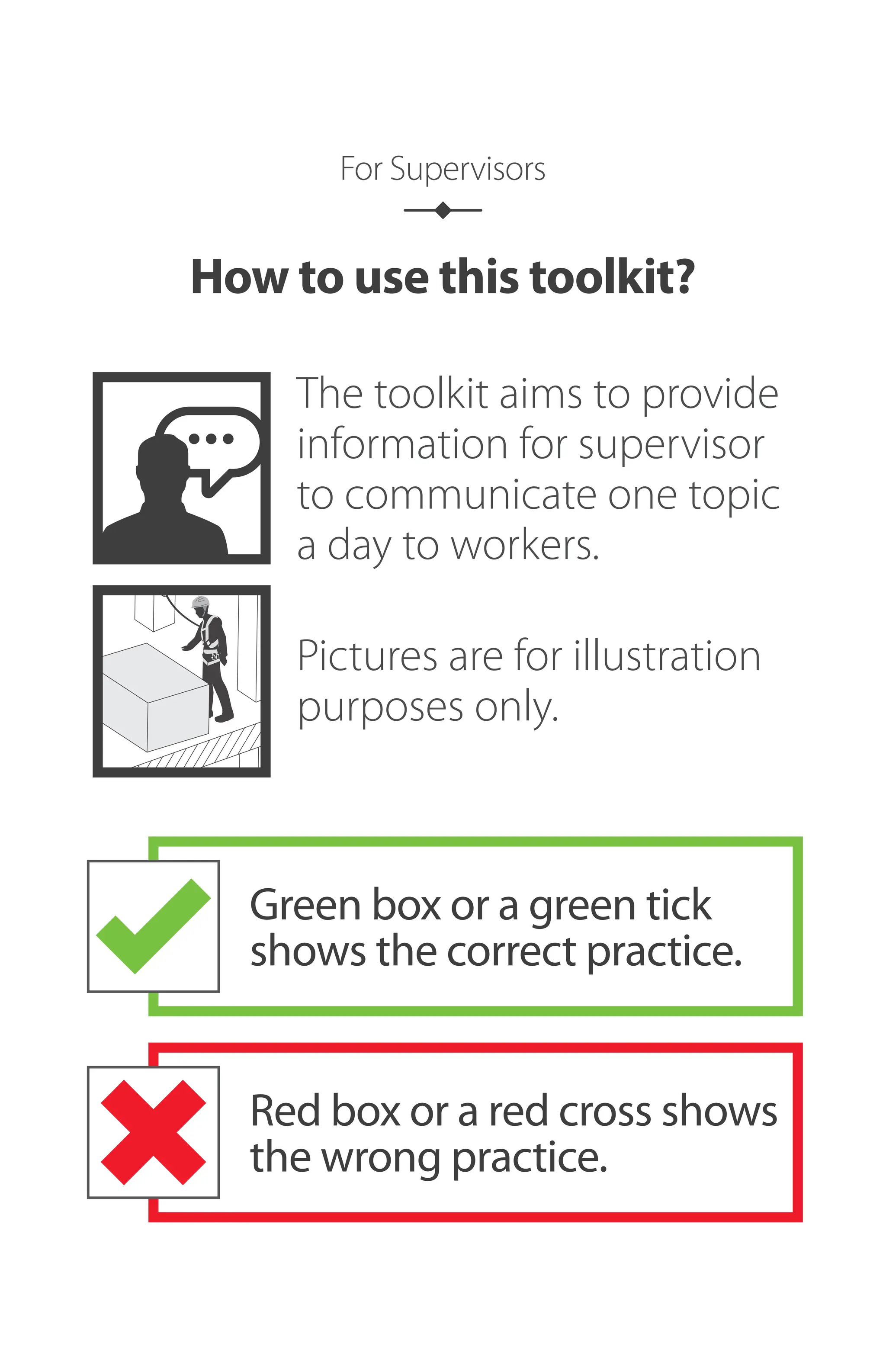
The toolkit aims to provide
information for supervisor
to communicate one topic
a day to workers.
Pictures are for illustration
purposes only.
How to use this toolkit?
For Supervisors
Red box or a red cross shows
the wrong practice.
Green box or a green tick
shows the correct practice.
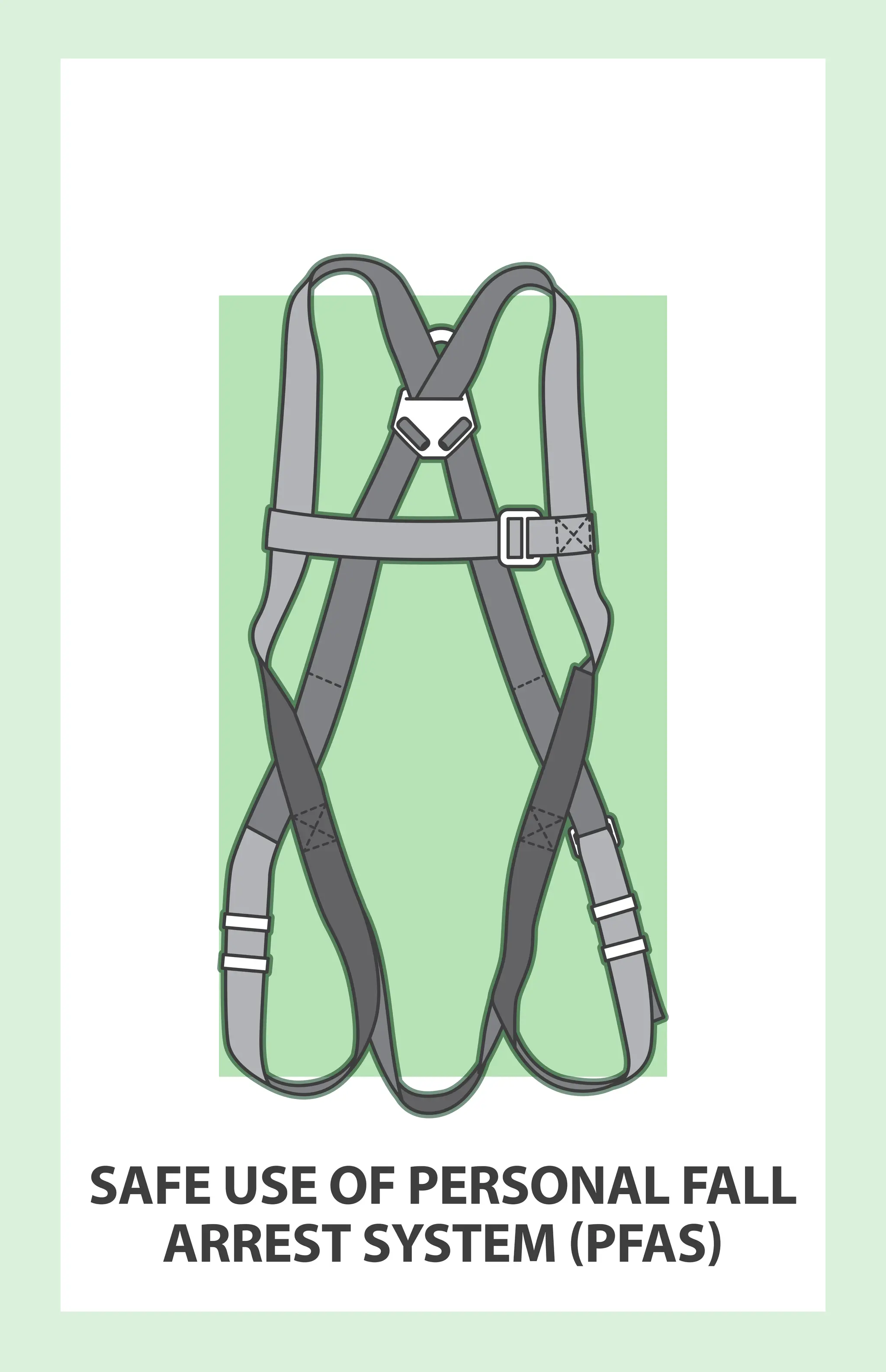
SAFE USE OF PERSONAL FALL
ARREST SYSTEM (PFAS)
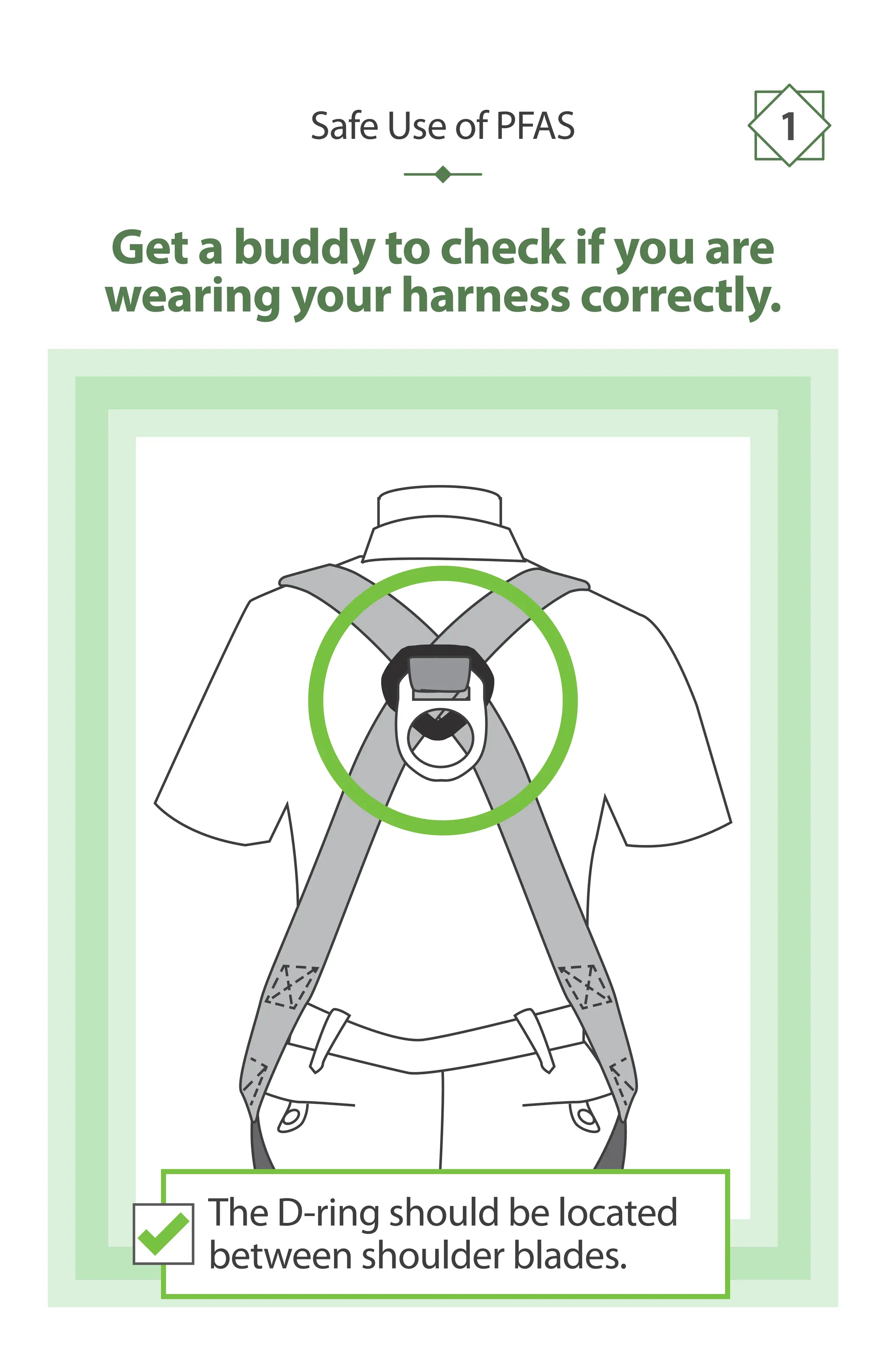
Get a buddy to check if you are
wearing your harness correctly.
Safe Use of PFAS 1
The D-ring should be located
between shoulder blades.
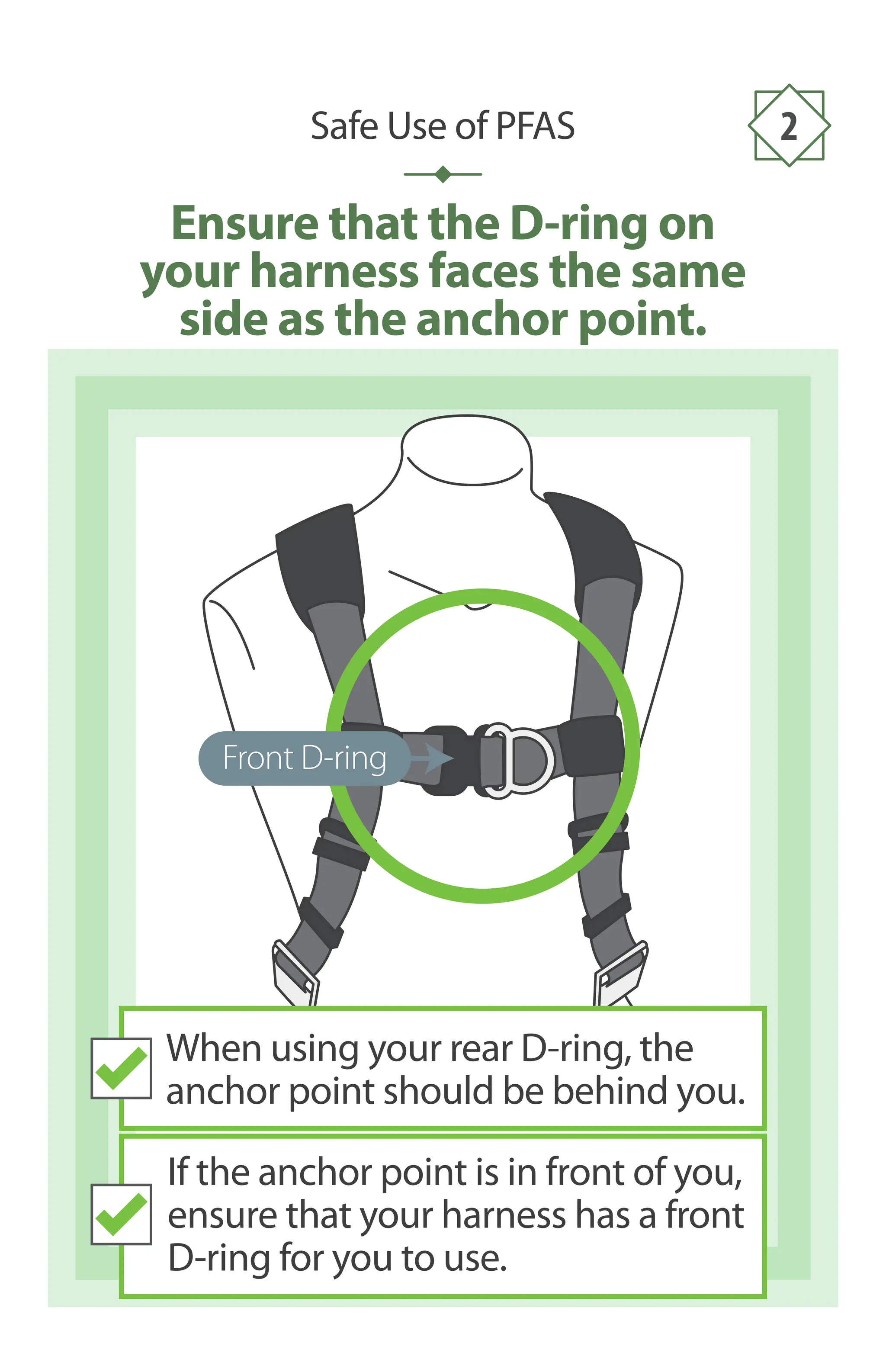
Ensure that the D-ring on
your harness faces the same
side as the anchor point.
Front D-ring
Safe Use of PFAS 2
If the anchor point is in front of you,
ensure that your harness has a front
D-ring for you to use.
When using your rear D-ring, the
anchor point should be behind you.
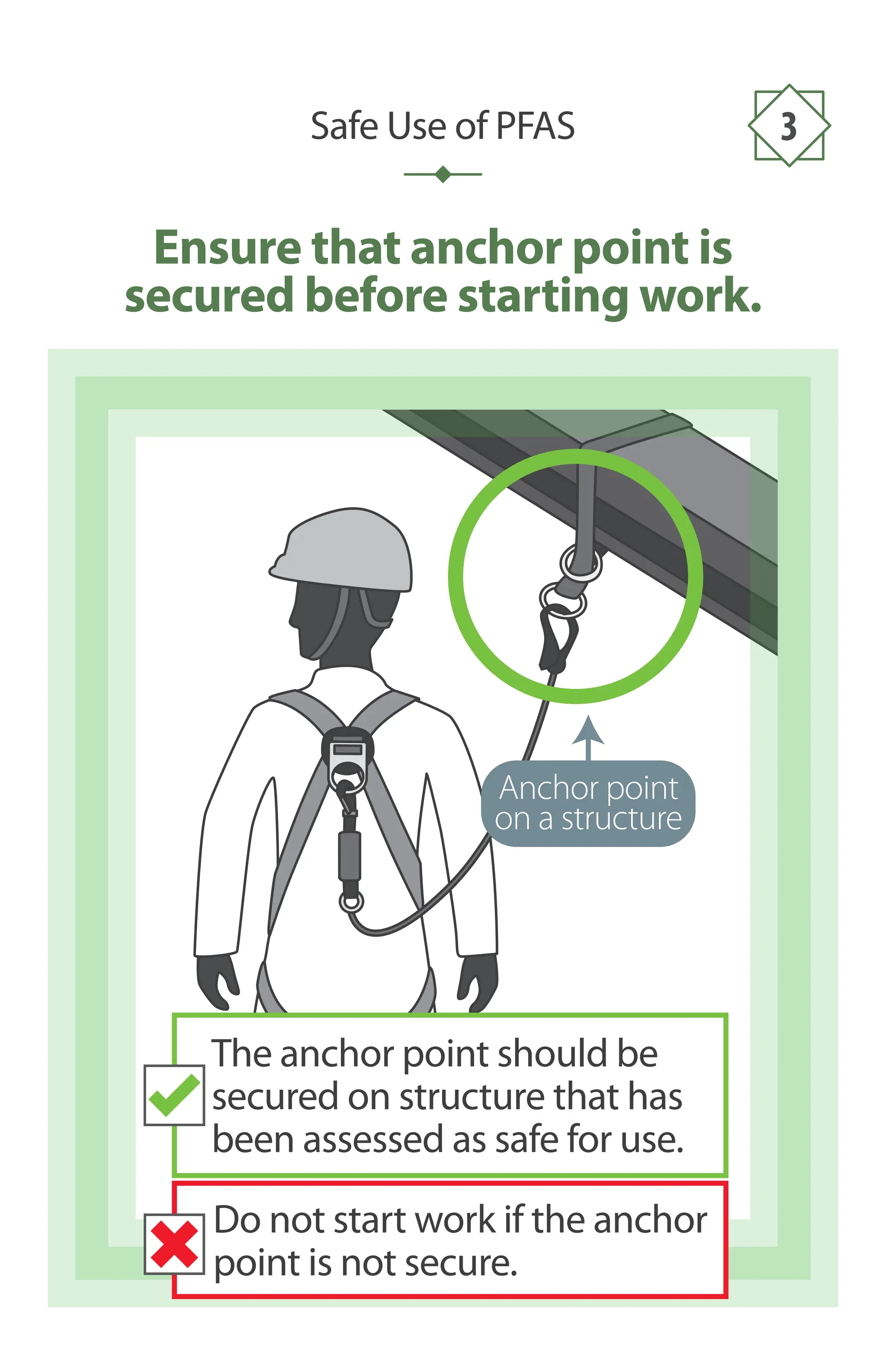
Ensure that anchor point is
secured before starting work.
Anchor point
on a structure
Do not start work if the anchor
point is not secure.
The anchor point should be
secured on structure that has
been assessed as safe for use.
Safe Use of PFAS 3
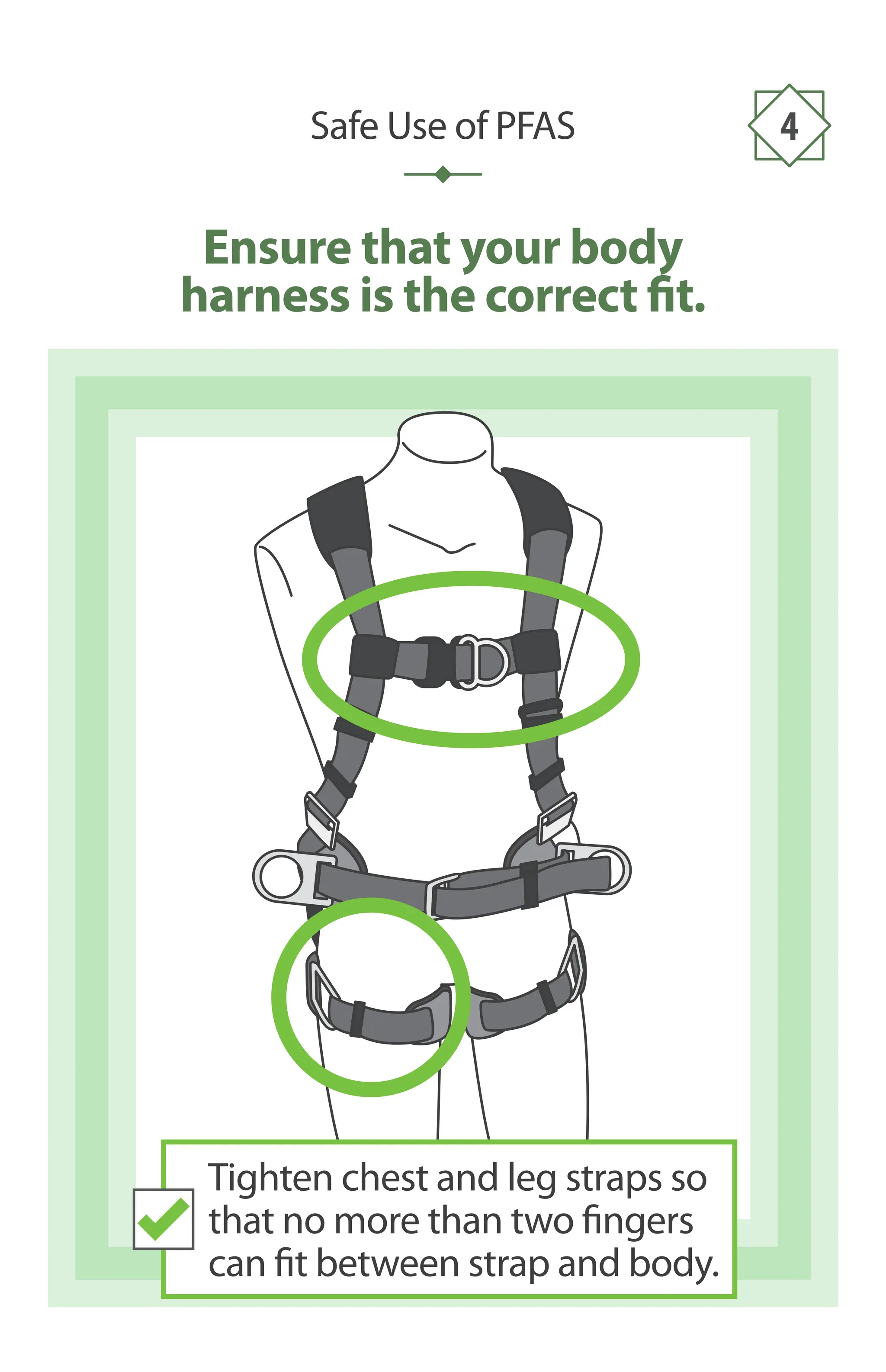
Ensure that your body
harness is the correct fit.
Safe Use of PFAS 4
Tighten chest and leg straps so
that no more than two fingers
can fit between strap and body.
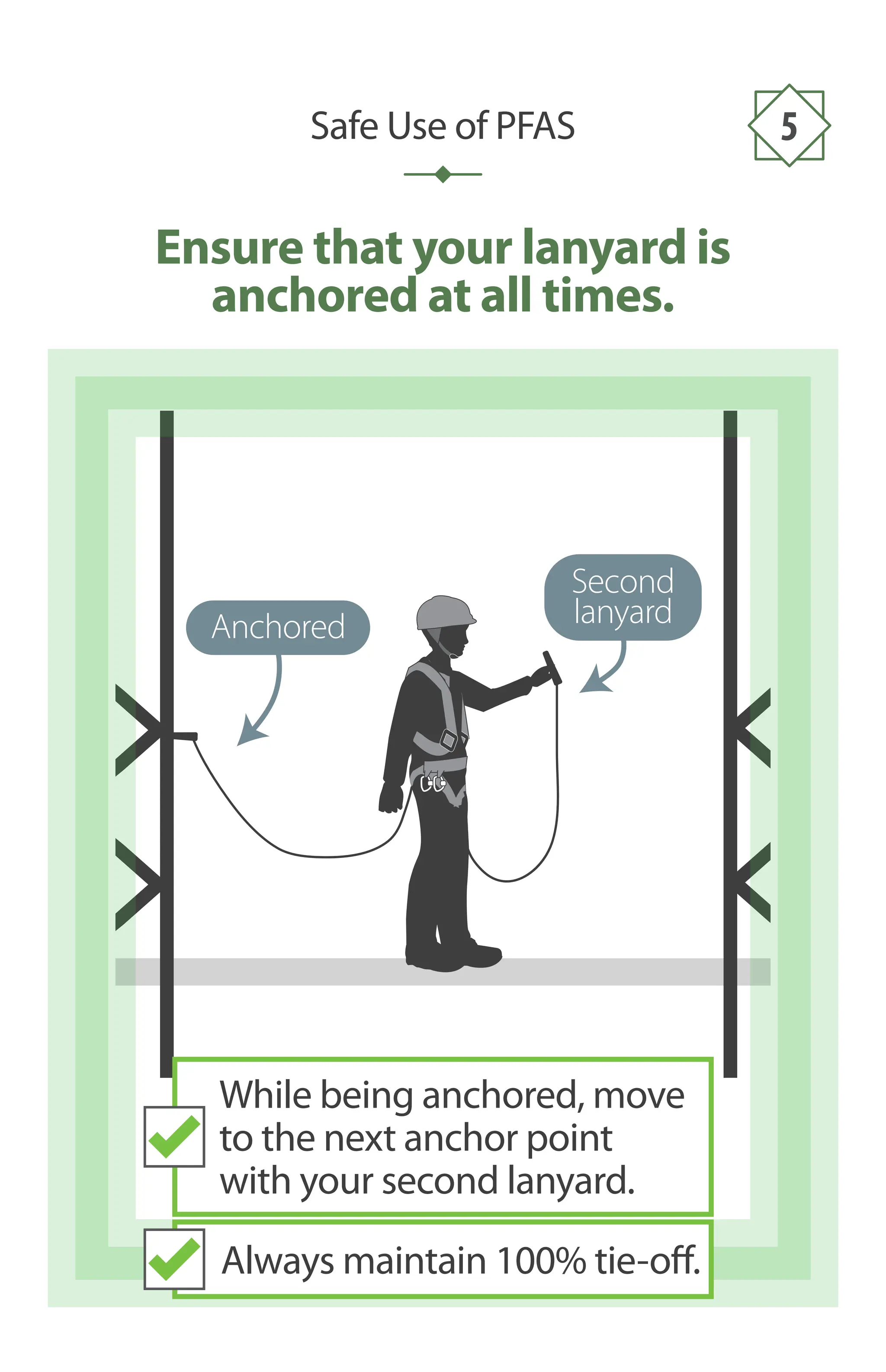
Ensure that your lanyard is
anchored at all times.
Anchored
Second
lanyard
Safe Use of PFAS 5
Always maintain 100% tie-off.
While being anchored, move
to the next anchor point
with your second lanyard.
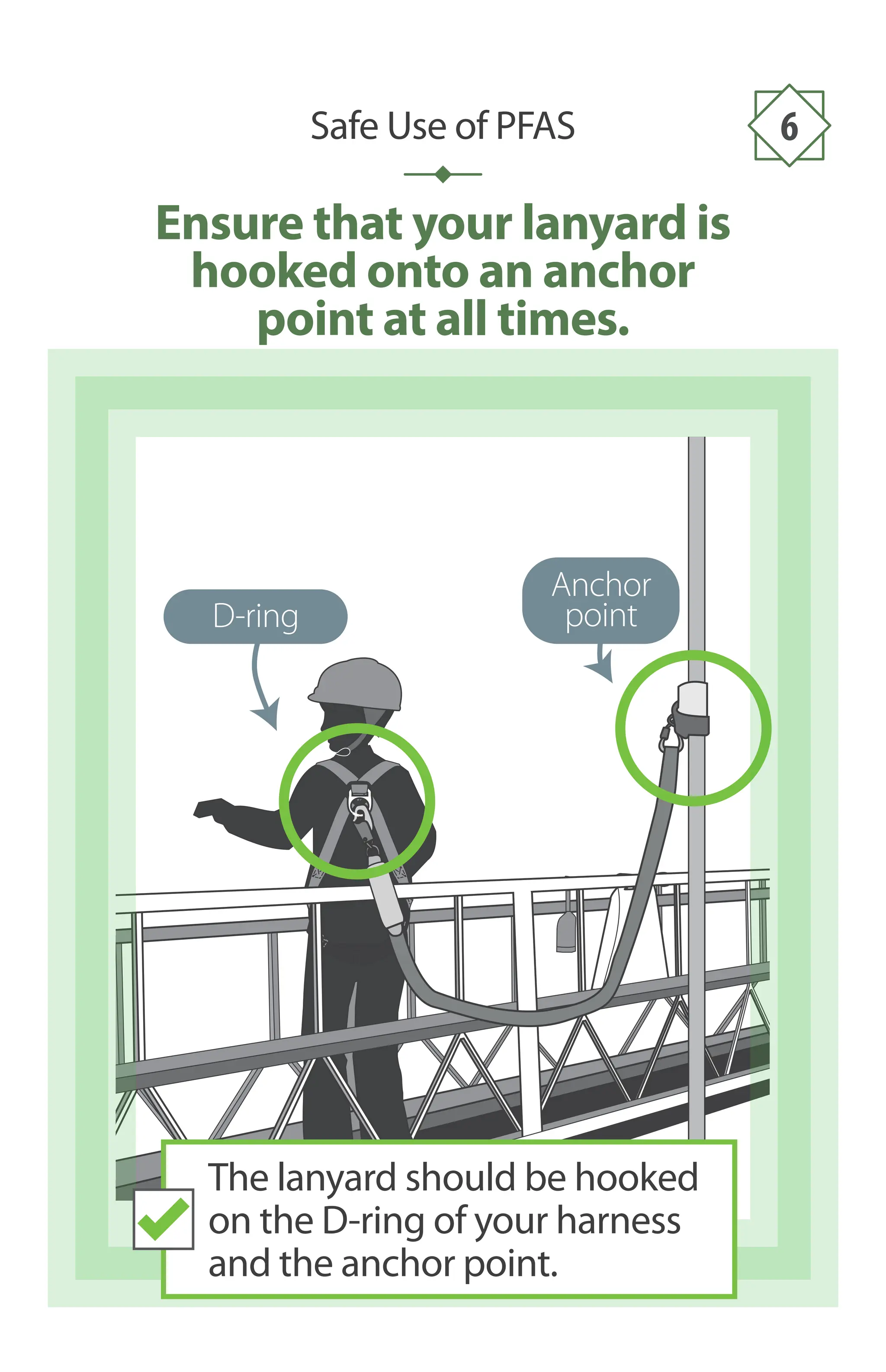
D-ring
Anchor
point
Safe Use of PFAS 6
Ensure that your lanyard is
hooked onto an anchor
point at all times.
The lanyard should be hooked
on the D-ring of your harness
and the anchor point.
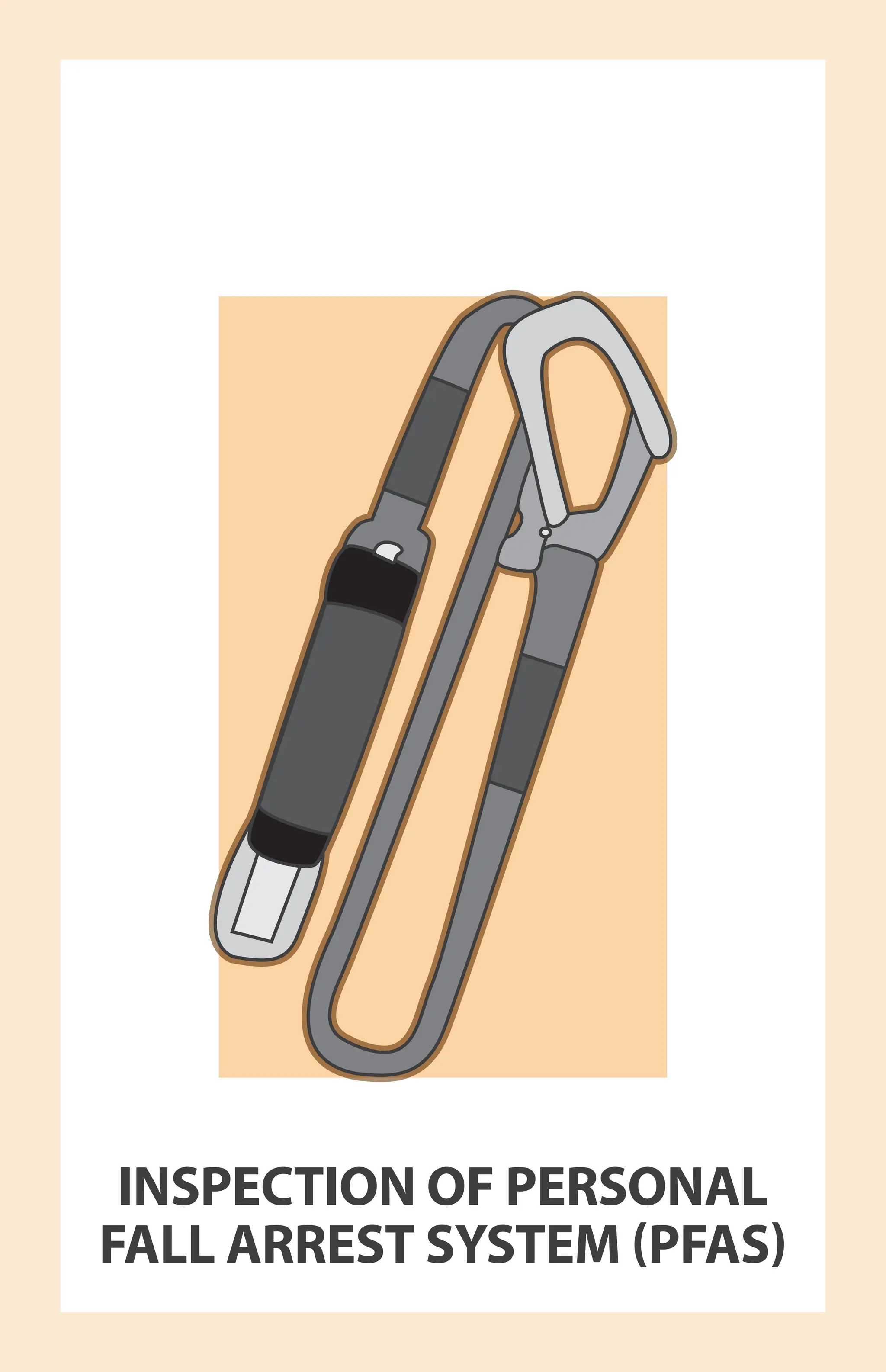
INSPECTION OF PERSONAL
FALL ARREST SYSTEM (PFAS)
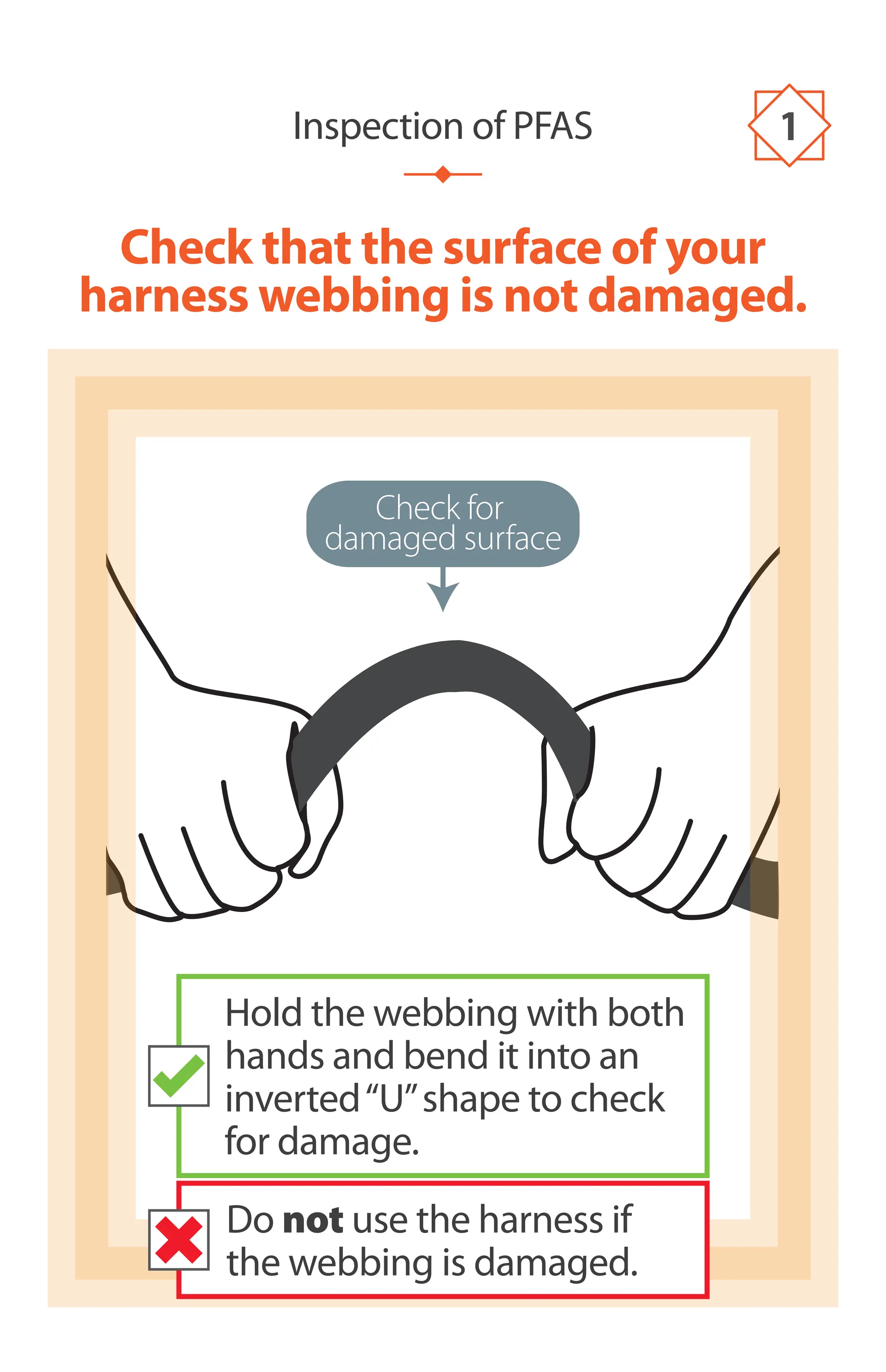
Check for
damaged surface
Check that the surface of your
harness webbing is not damaged.
Inspection of PFAS 1
Do not use the harness if
the webbing is damaged.
Hold the webbing with both
hands and bend it into an
inverted“U”shape to check
for damage.
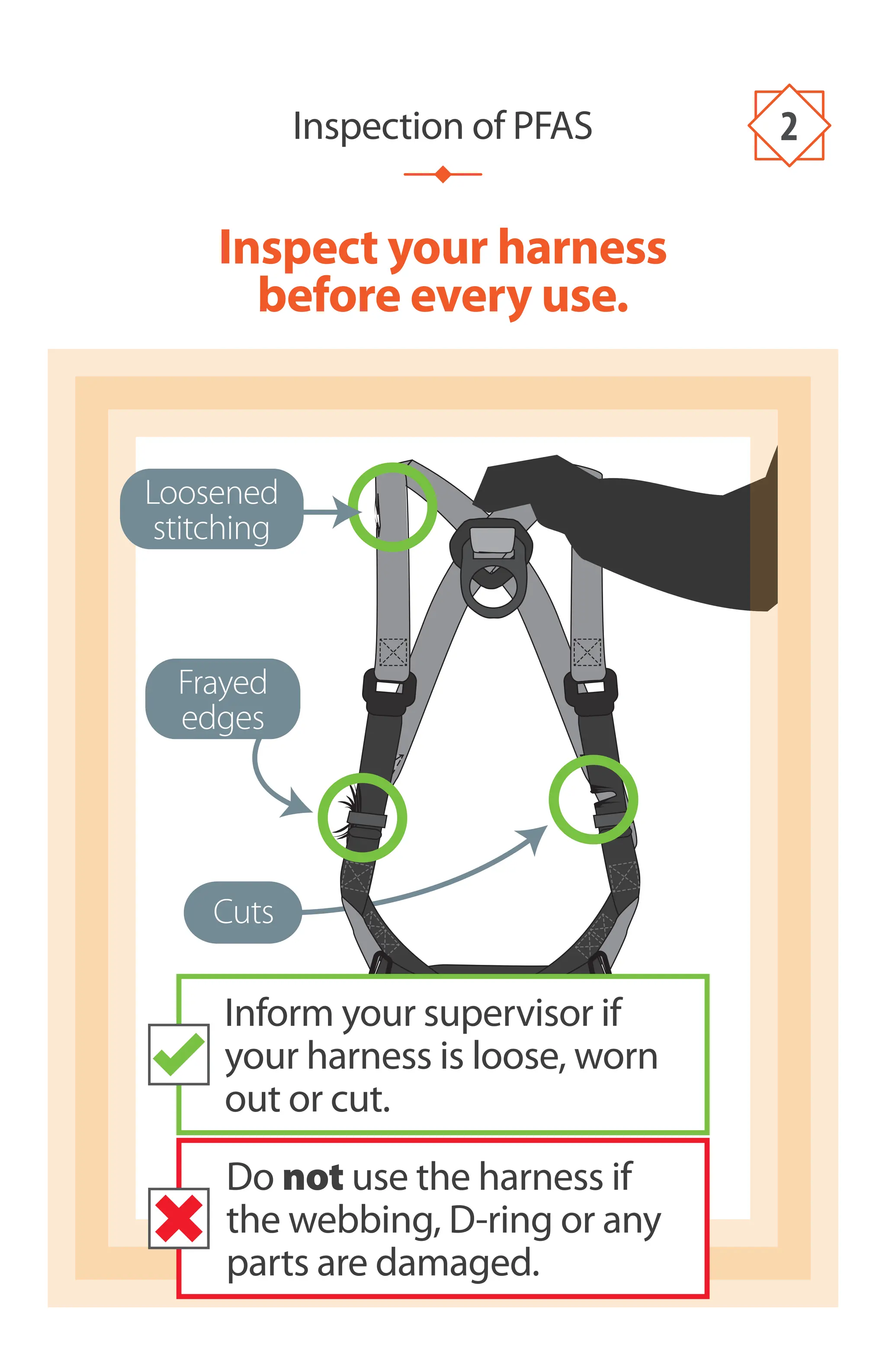
Frayed
edges
Cuts
Inspect your harness
before every use.
Inspection of PFAS 2
Loosened
stitching
Do not use the harness if
the webbing, D-ring or any
parts are damaged.
Inform your supervisor if
your harness is loose, worn
out or cut.
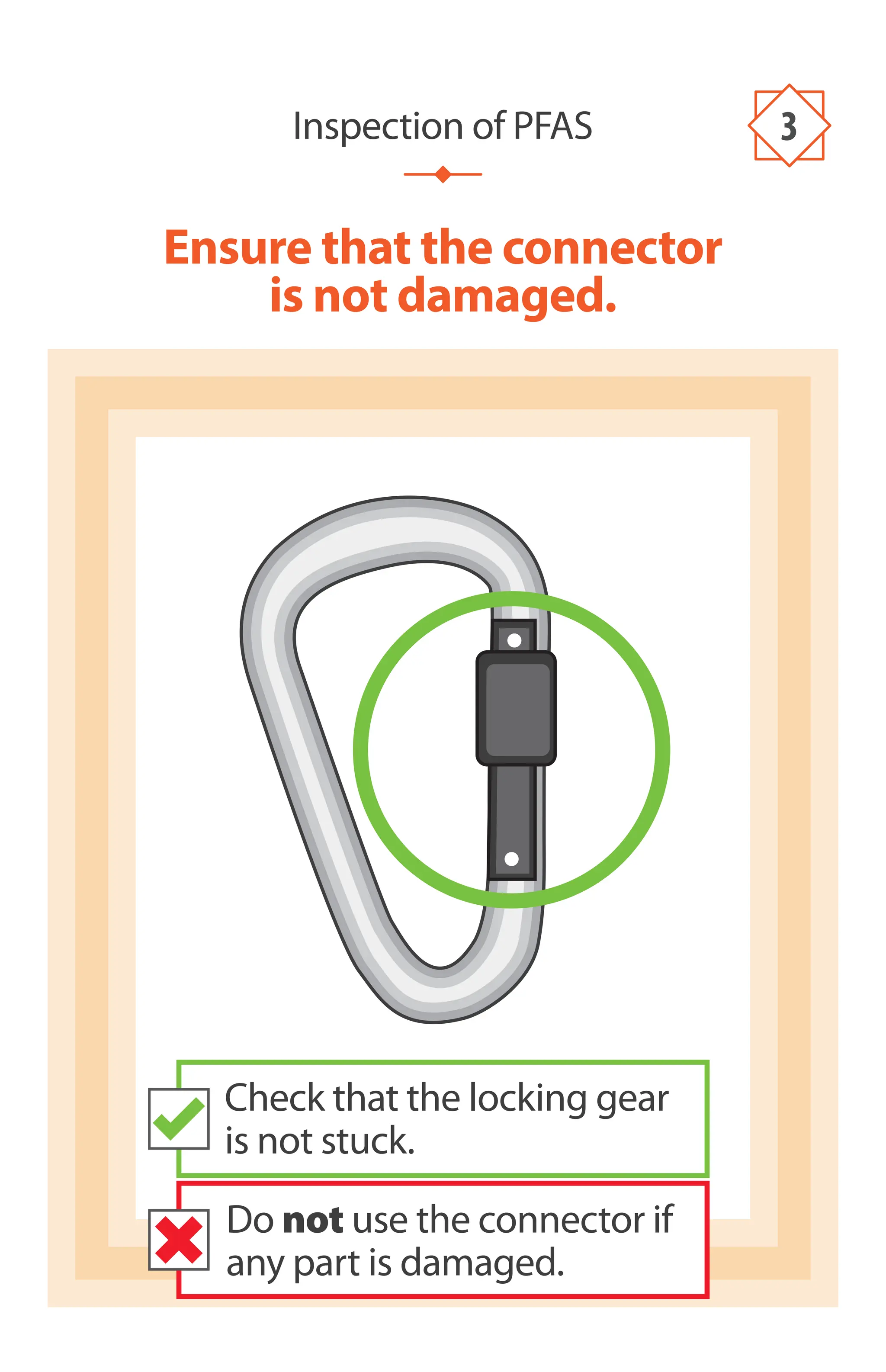
Ensure that the connector
is not damaged.
Inspection of PFAS 3
Do not use the connector if
any part is damaged.
Check that the locking gear
is not stuck.
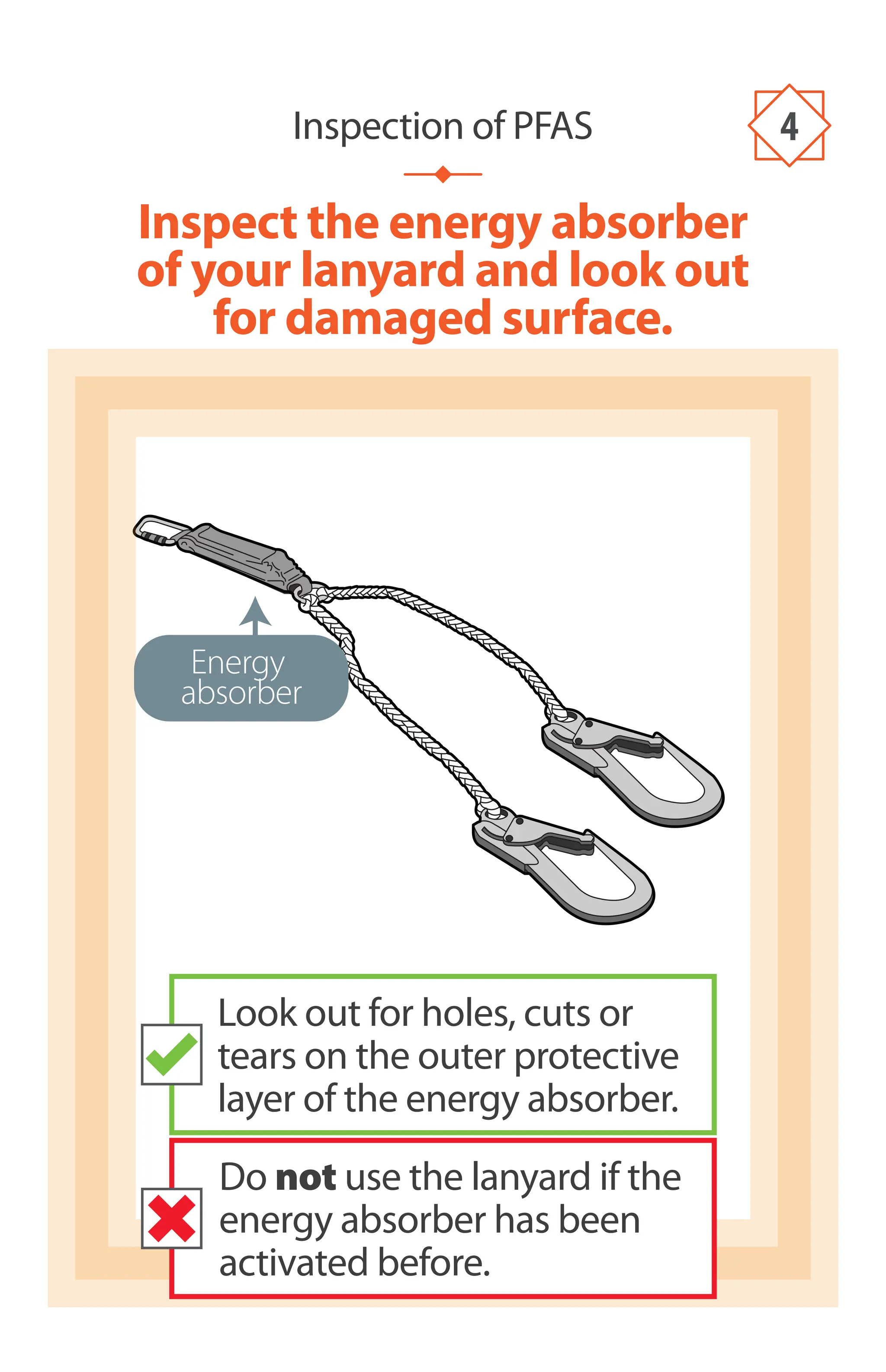
Inspection of PFAS 4
Inspect the energy absorber
of your lanyard and look out
for damaged surface.
Energy
absorber
Do not use the lanyard if the
energy absorber has been
activated before.
Look out for holes, cuts or
tears on the outer protective
layer of the energy absorber.
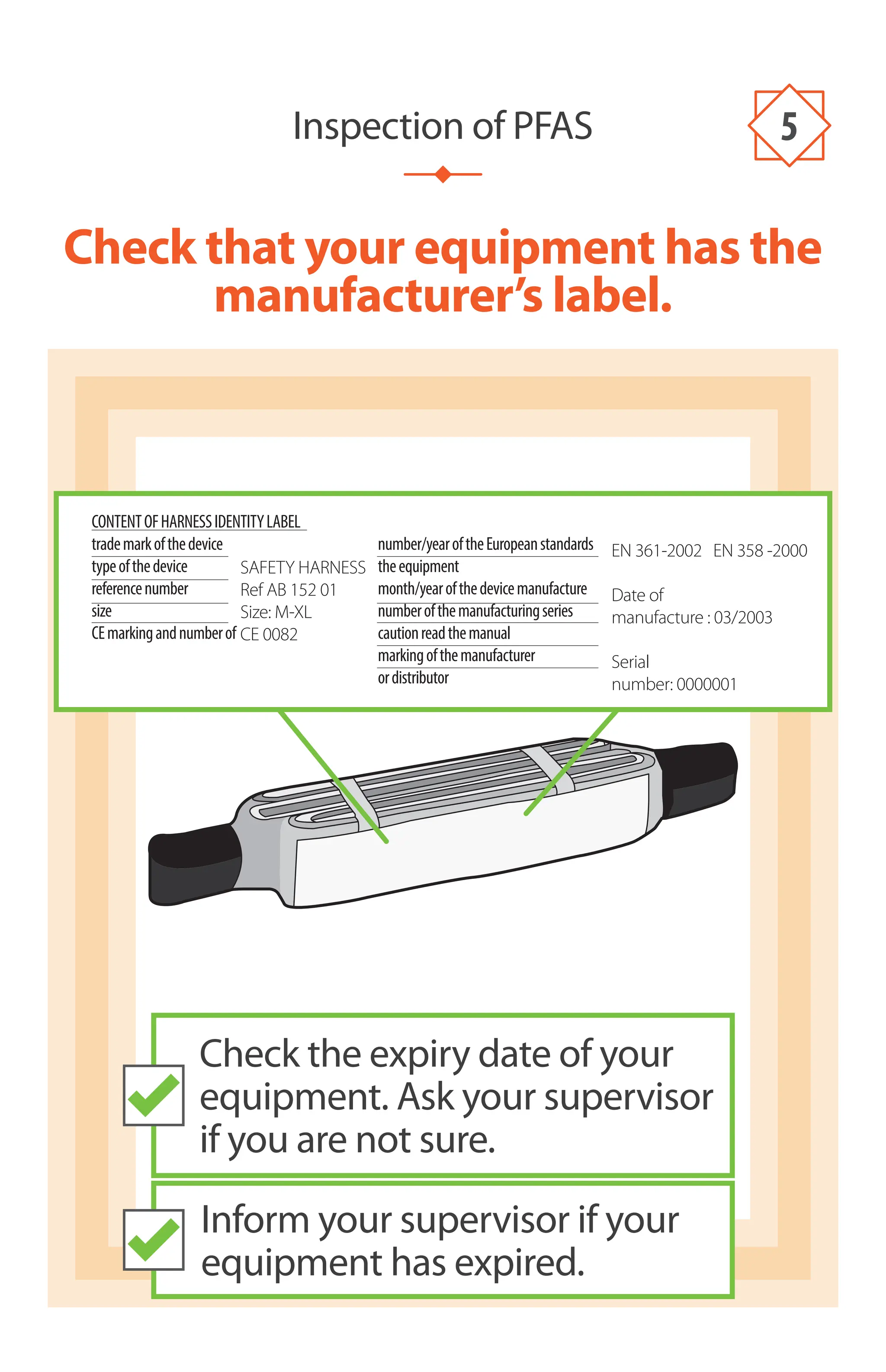
Check that your equipment has the
manufacturer’s label.
Inspection of PFAS 5
Inform your supervisor if your
equipment has expired.
Check the expiry date of your
equipment. Ask your supervisor
if you are not sure.
CONTENTOFHARNESSIDENTITYLABEL
trademarkofthedevice number/yearoftheEuropeanstandards
typeofthedevice theequipment
referencenumber month/yearofthedevicemanufacture
size numberofthemanufacturingseries
CEmarkingandnumberof cautionreadthemanual
markingofthemanufacturer
ordistributor
SAFETY HARNESS
Ref AB 152 01
Size: M-XL
CE 0082
EN 361-2002 EN 358 -2000
Date of
manufacture : 03/2003
Serial
number: 0000001
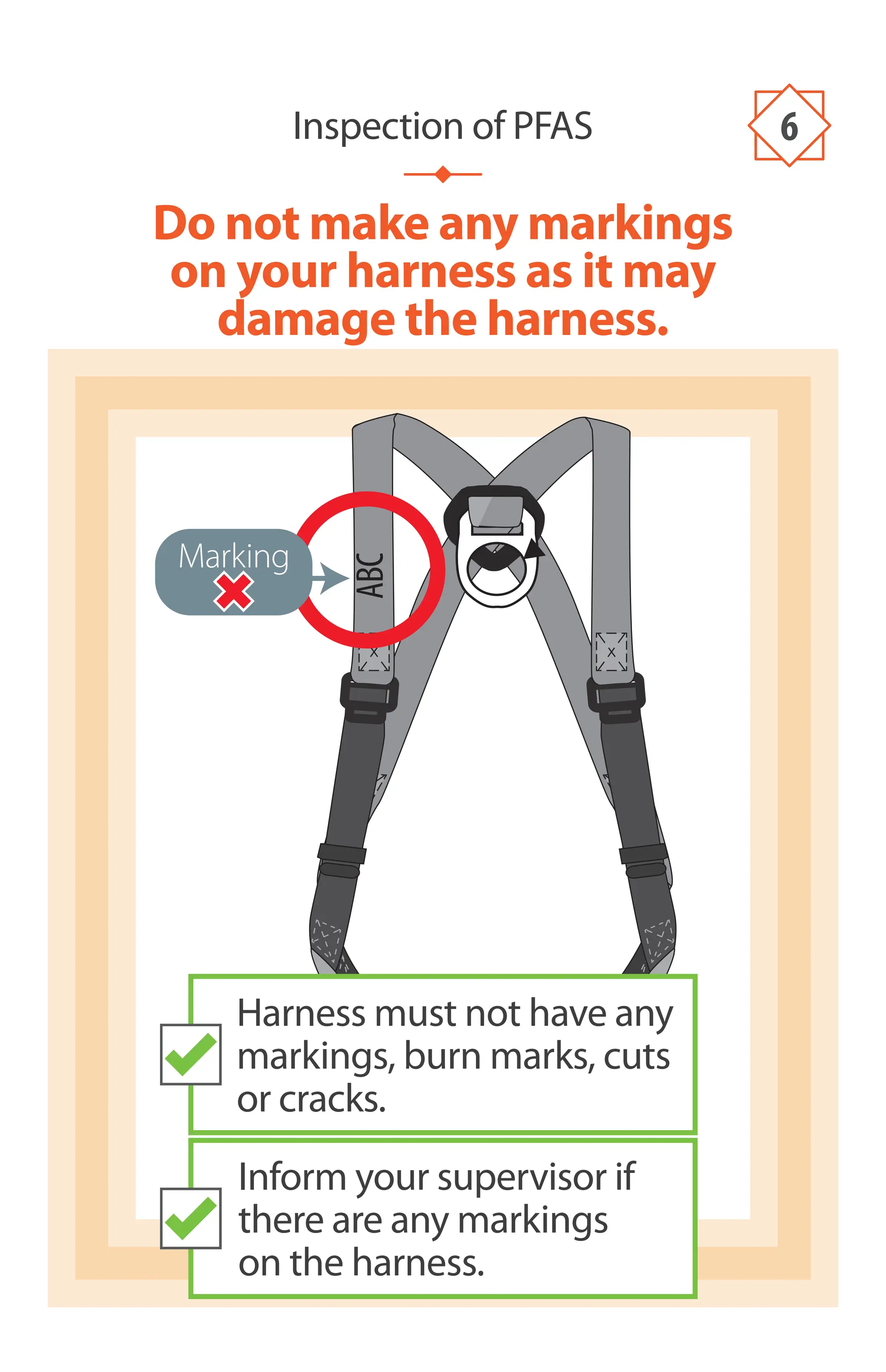
Do not make any markings
on your harness as it may
damage the harness.
Inspection of PFAS 6
ABC
Inform your supervisor if
there are any markings
on the harness.
Harness must not have any
markings, burn marks, cuts
or cracks.
Marking
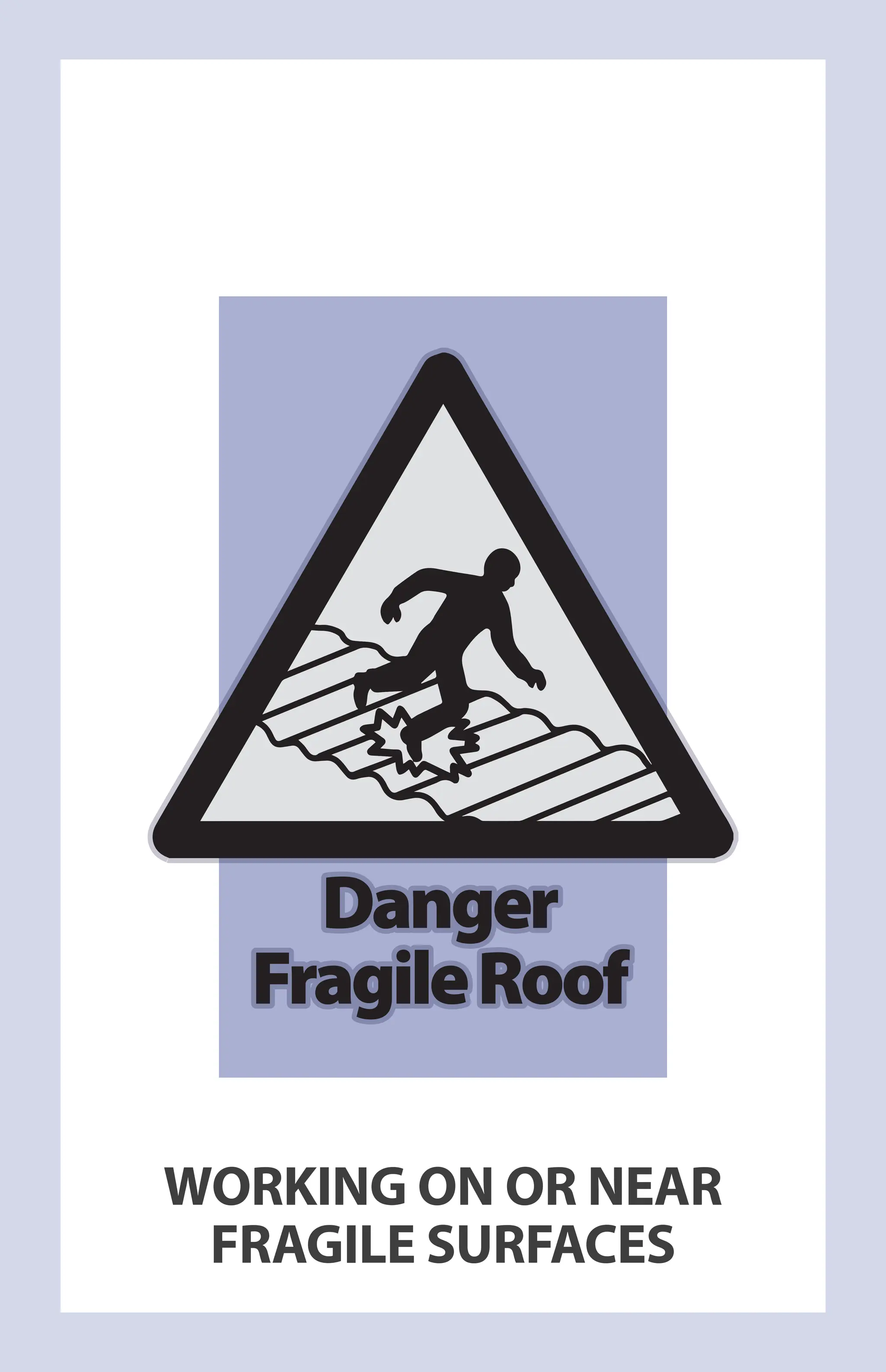
WORKING ON OR NEAR
FRAGILE SURFACES
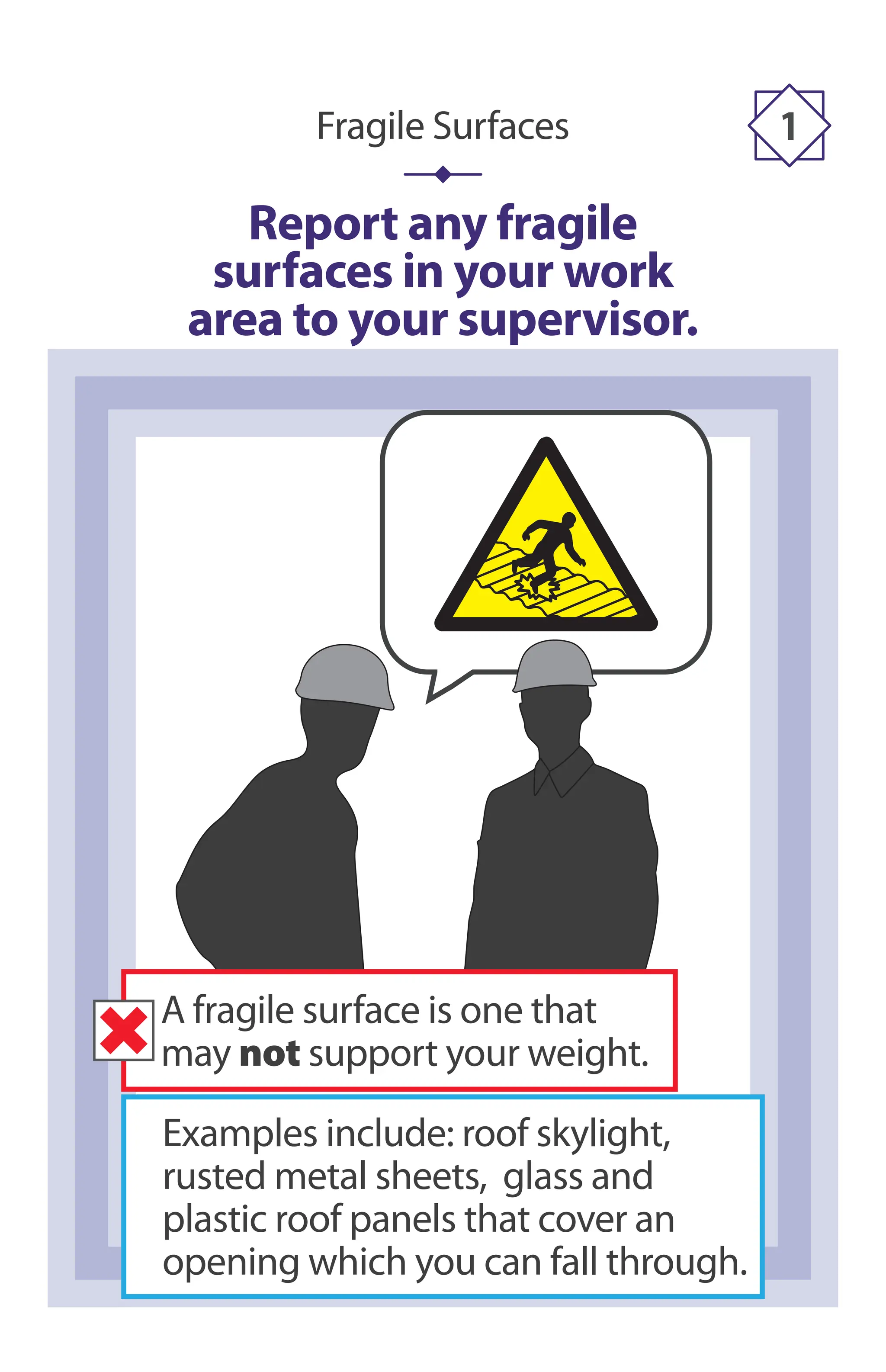
Report any fragile
surfaces in your work
area to your supervisor.
Fragile Surfaces 1
Examples include: roof skylight,
rusted metal sheets, glass and
plastic roof panels that cover an
opening which you can fall through.
A fragile surface is one that
may not support your weight.
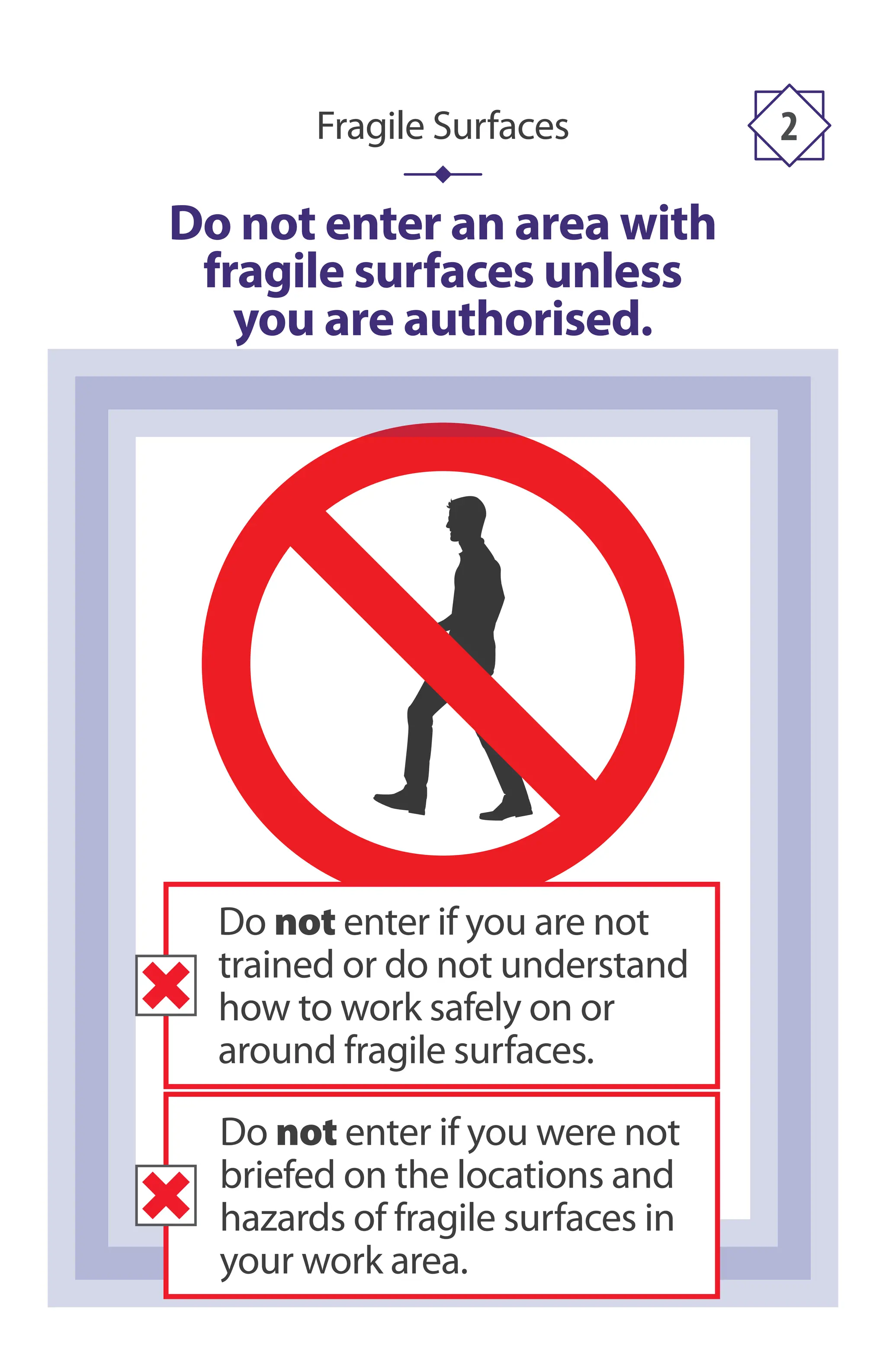
Do not enter an area with
fragile surfaces unless
you are authorised.
Fragile Surfaces 2
Do not enter if you were not
briefed on the locations and
hazards of fragile surfaces in
your work area.
Do not enter if you are not
trained or do not understand
how to work safely on or
around fragile surfaces.
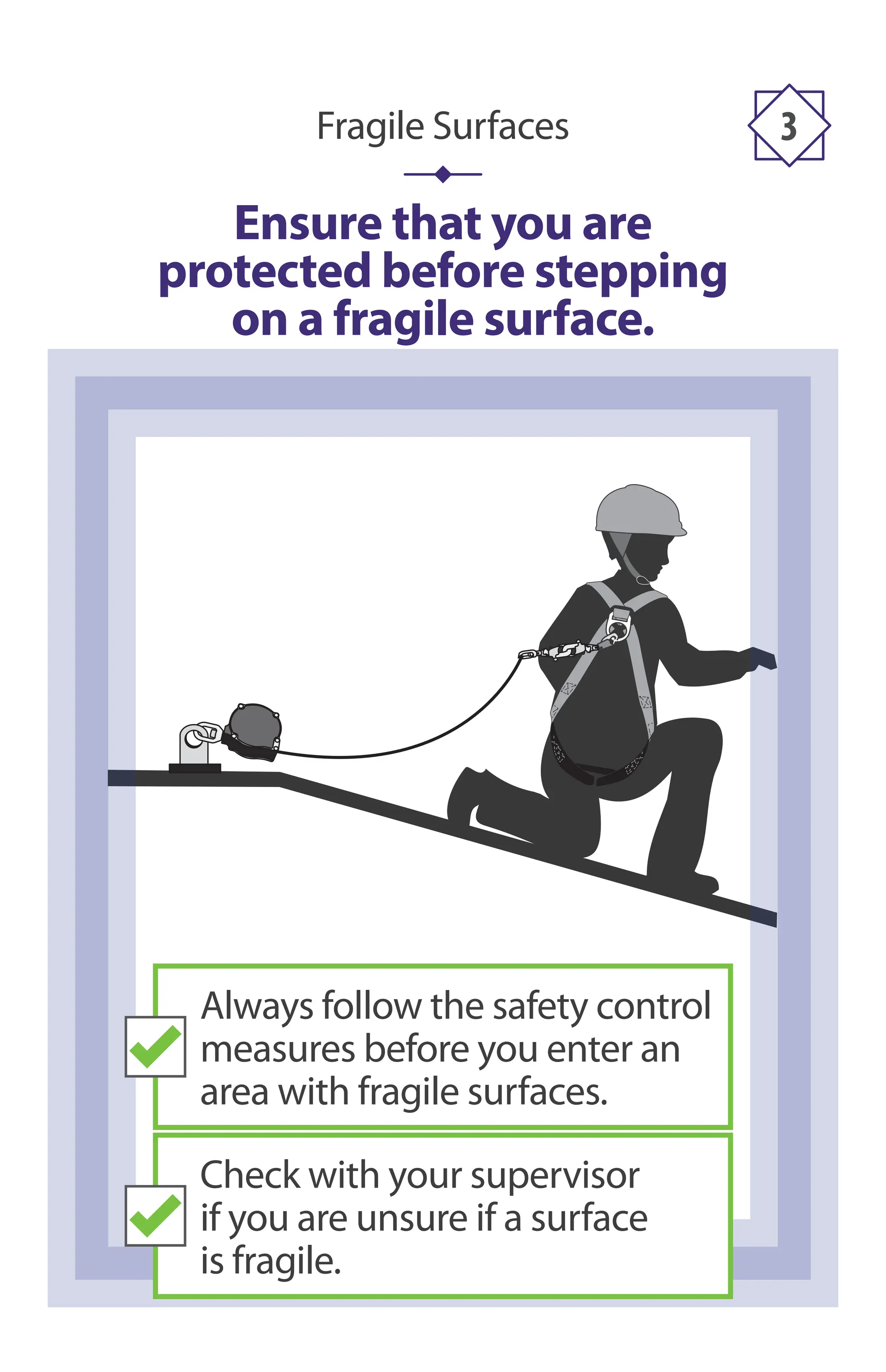
Ensure that you are
protected before stepping
on a fragile surface.
Fragile Surfaces 3
Always follow the safety control
measures before you enter an
area with fragile surfaces.
Check with your supervisor
if you are unsure if a surface
is fragile.
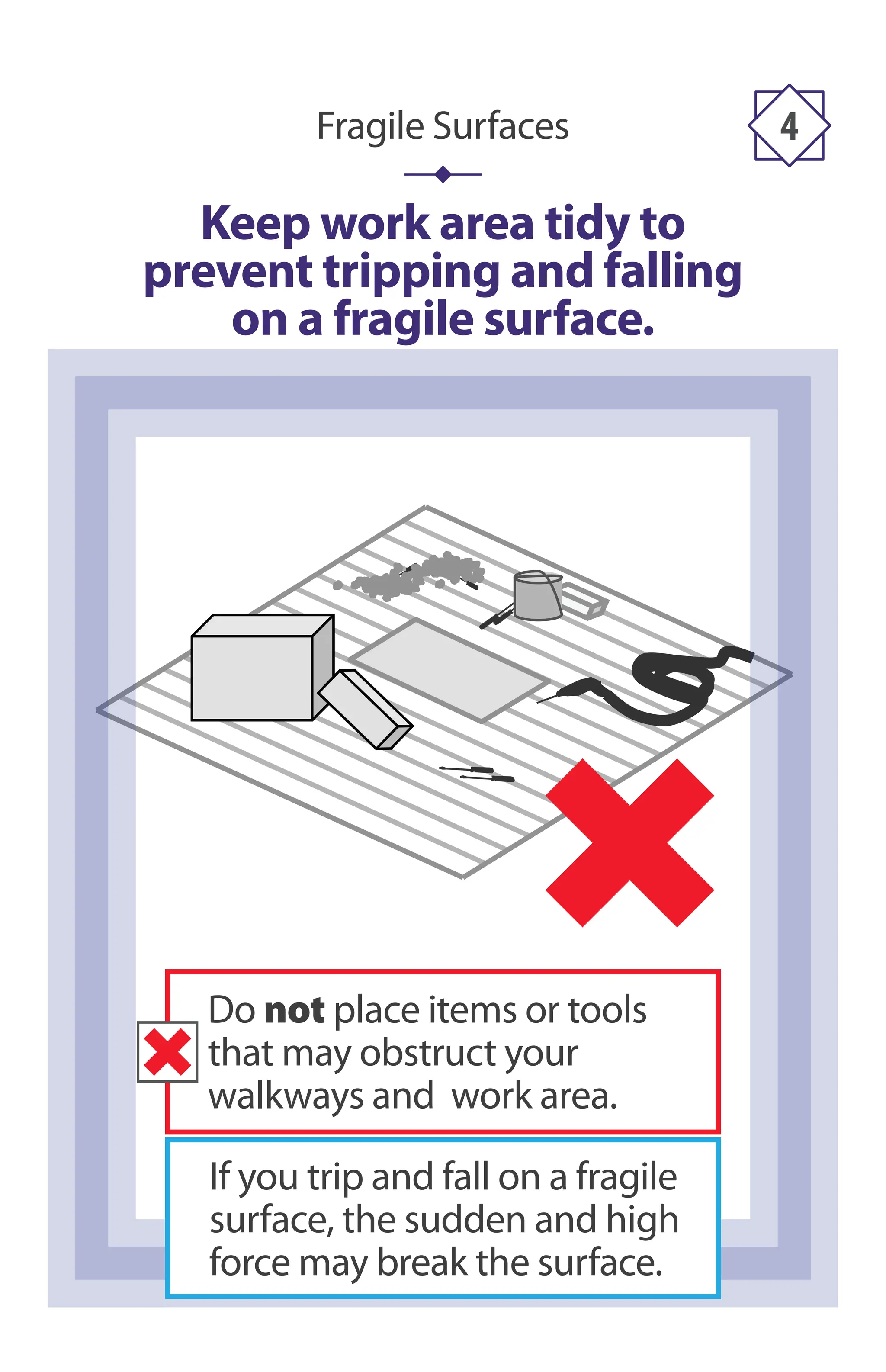
Keep work area tidy to
prevent tripping and falling
on a fragile surface.
Fragile Surfaces 4
If you trip and fall on a fragile
surface, the sudden and high
force may break the surface.
Do not place items or tools
that may obstruct your
walkways and work area.
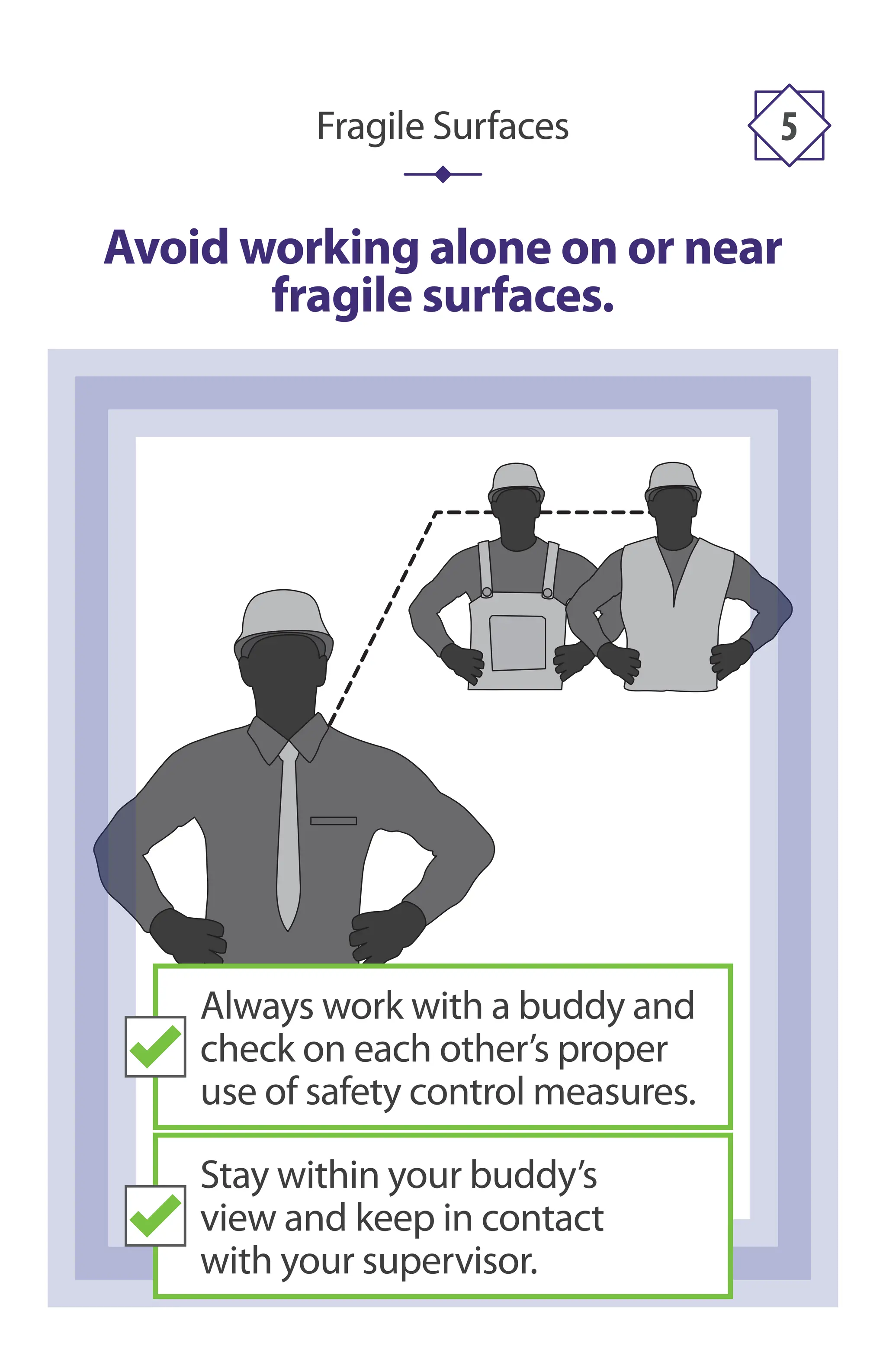
Avoid working alone on or near
fragile surfaces.
Fragile Surfaces 5
Always work with a buddy and
check on each other’s proper
use of safety control measures.
Stay within your buddy’s
view and keep in contact
with your supervisor.
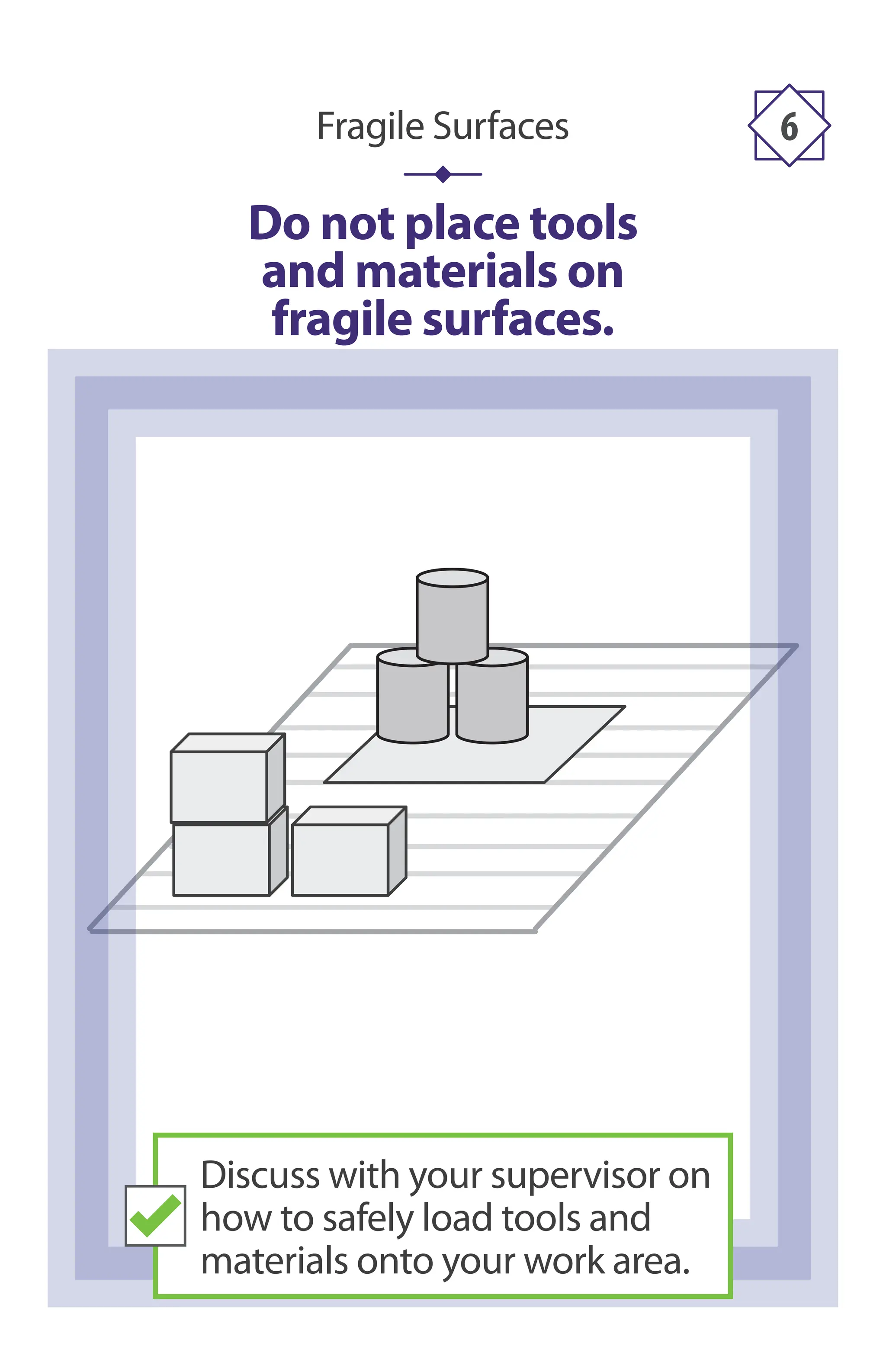
Do not place tools
and materials on
fragile surfaces.
Fragile Surfaces 6
Discuss with your supervisor on
how to safely load tools and
materials onto your work area.
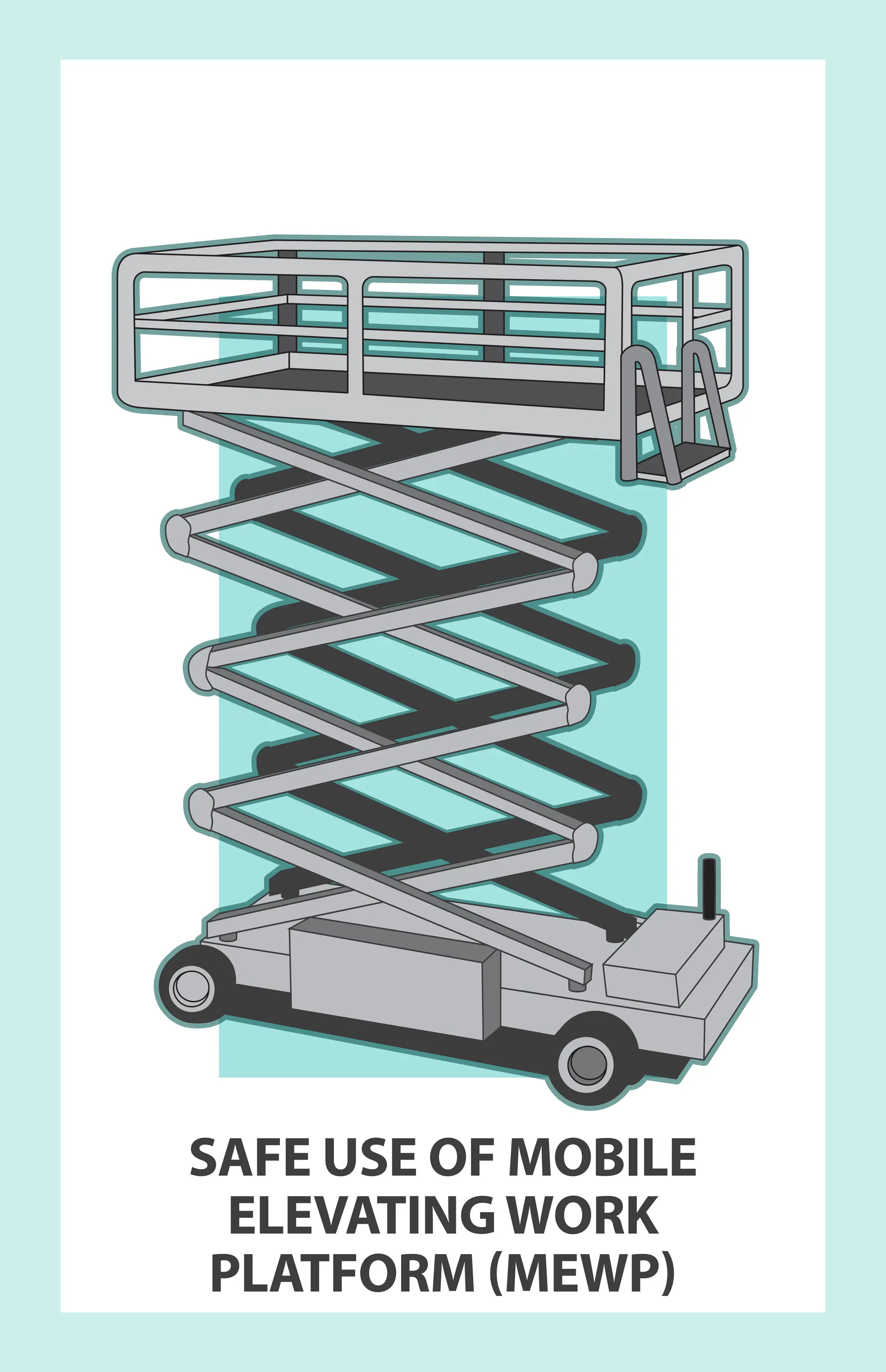
SAFE USE OF MOBILE
ELEVATINGWORK
PLATFORM (MEWP)
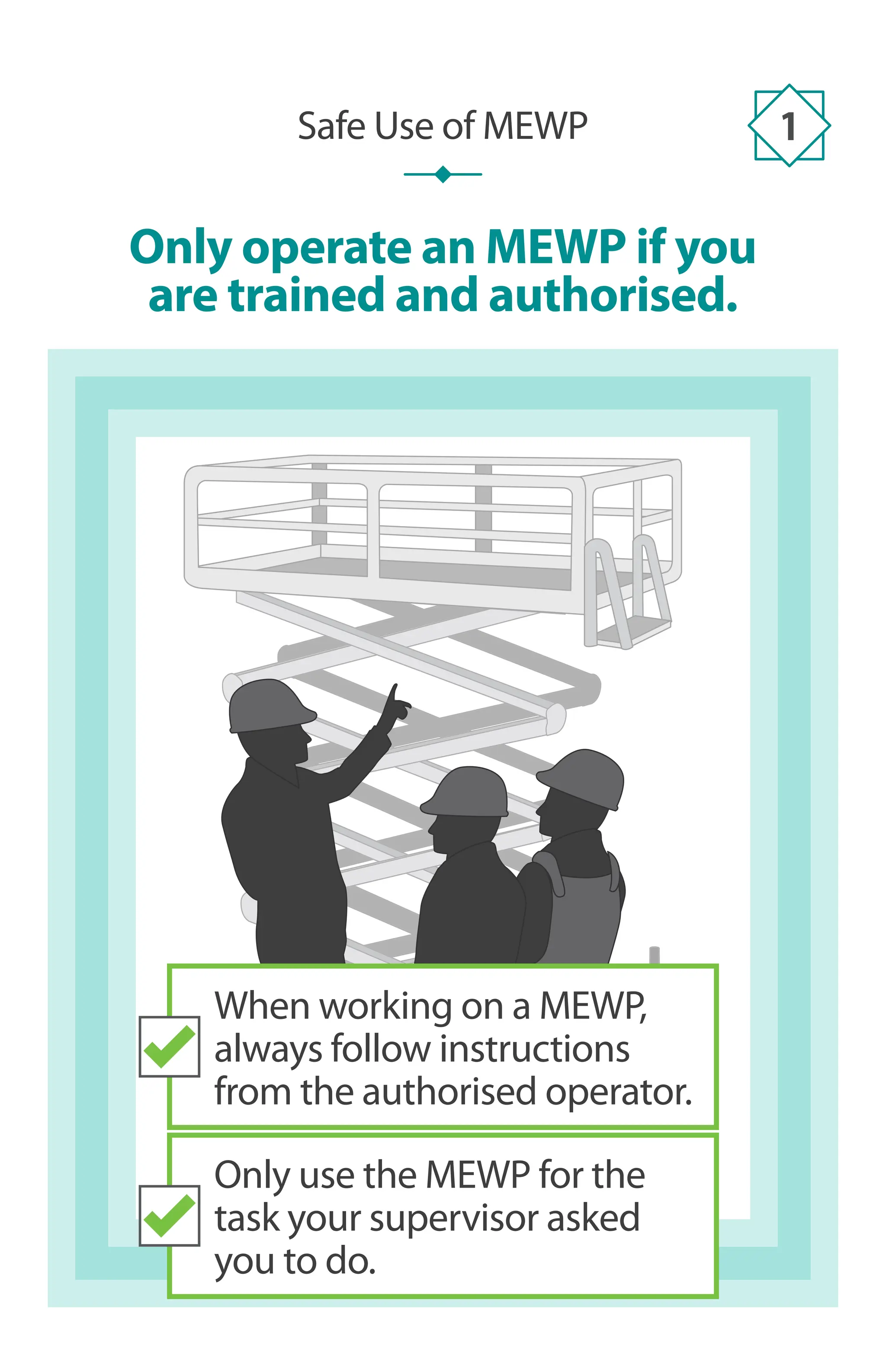
Only operate an MEWP if you
are trained and authorised.
Safe Use of MEWP 1
When working on a MEWP,
always follow instructions
from the authorised operator.
Only use the MEWP for the
task your supervisor asked
you to do.
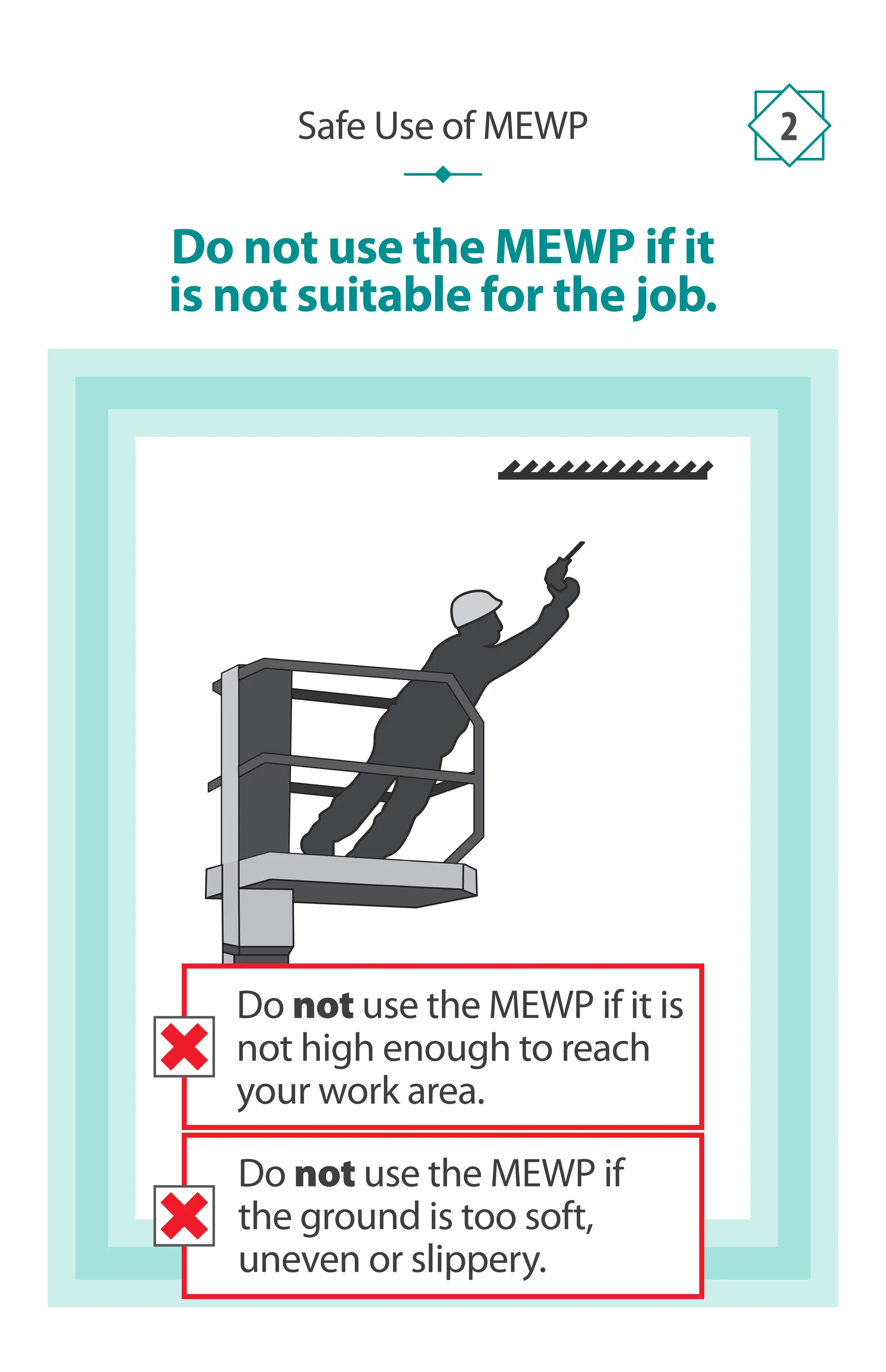
Do not use the MEWP if it
is not suitable for the job.
Safe Use of MEWP 2
Do not use the MEWP if
the ground is too soft,
uneven or slippery.
Do not use the MEWP if it is
not high enough to reach
your work area.
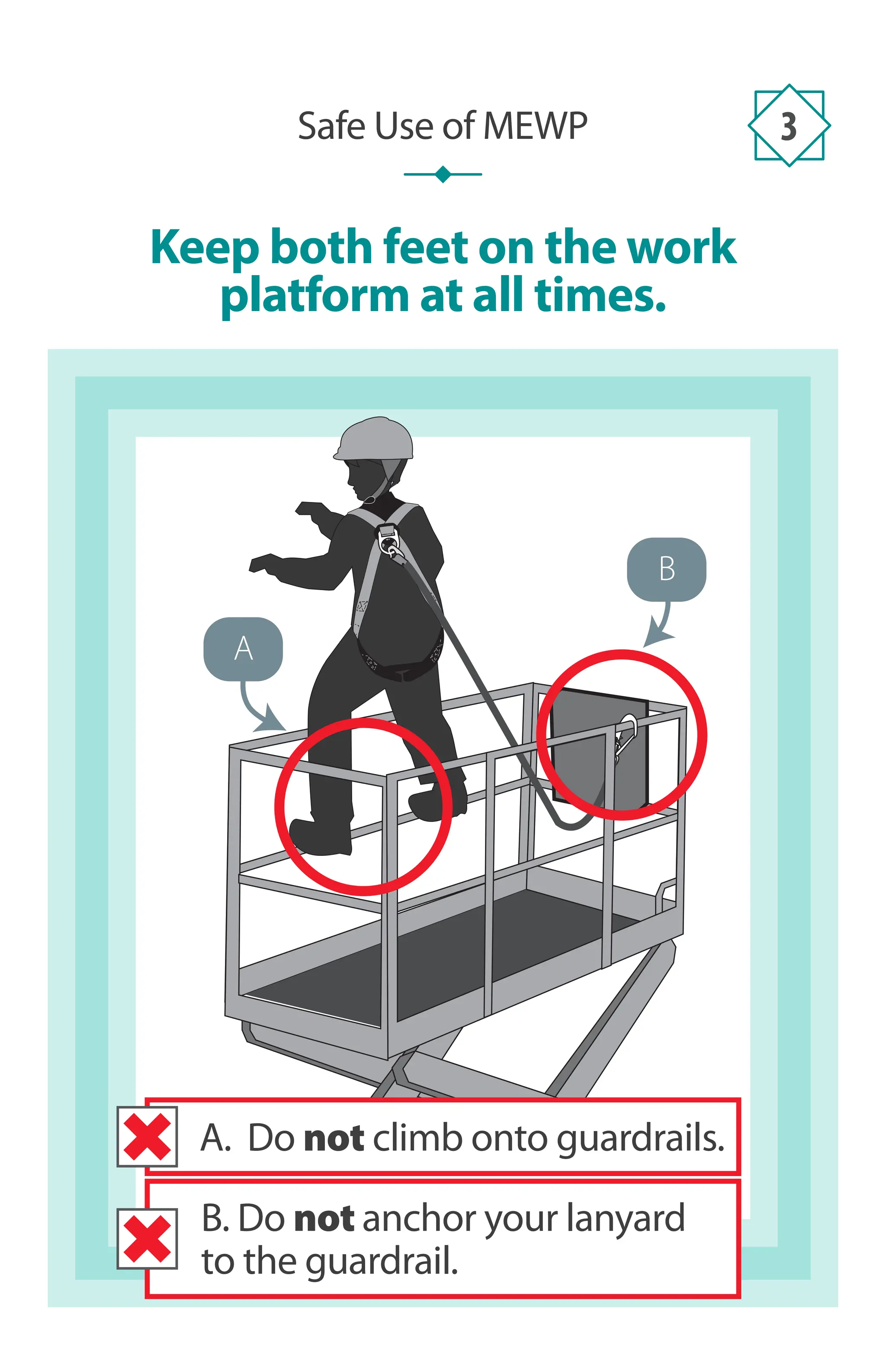
Keep both feet on the work
platform at all times.
Safe Use of MEWP 3
B. Do not anchor your lanyard
to the guardrail.
A. Do not climb onto guardrails.
A
B
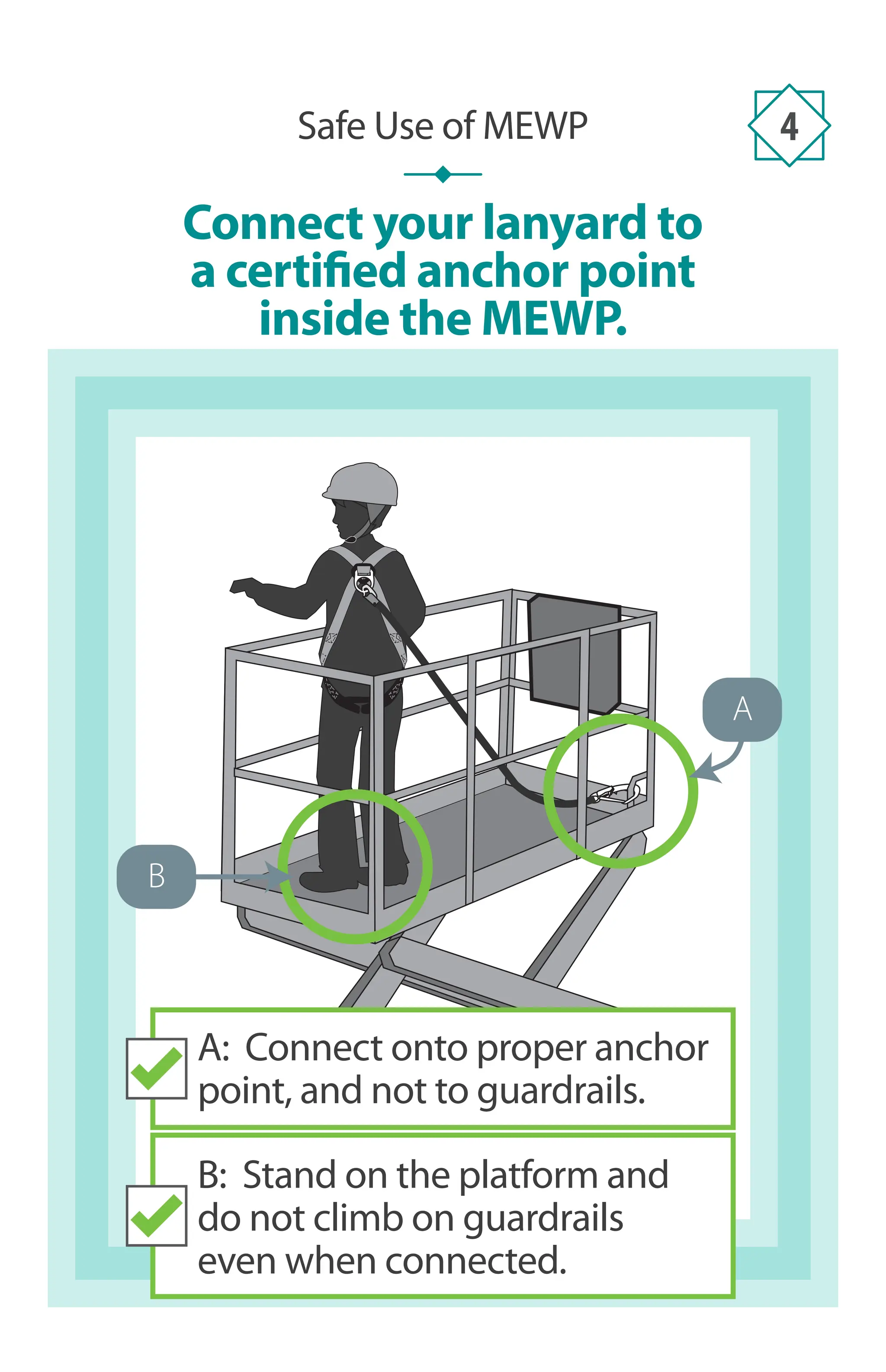
Connect your lanyard to
a certified anchor point
inside the MEWP.
Safe Use of MEWP 4
A: Connect onto proper anchor
point, and not to guardrails.
B: Stand on the platform and
do not climb on guardrails
even when connected.
B
A
Do not turn off any safety
devices of the MEWP.
Safe Use of MEWP 5
Do not use the MEWP if
any of the safety devices
doesn’t work.
Pay attention to any safety
alarm when operating and
working on your MEWP.
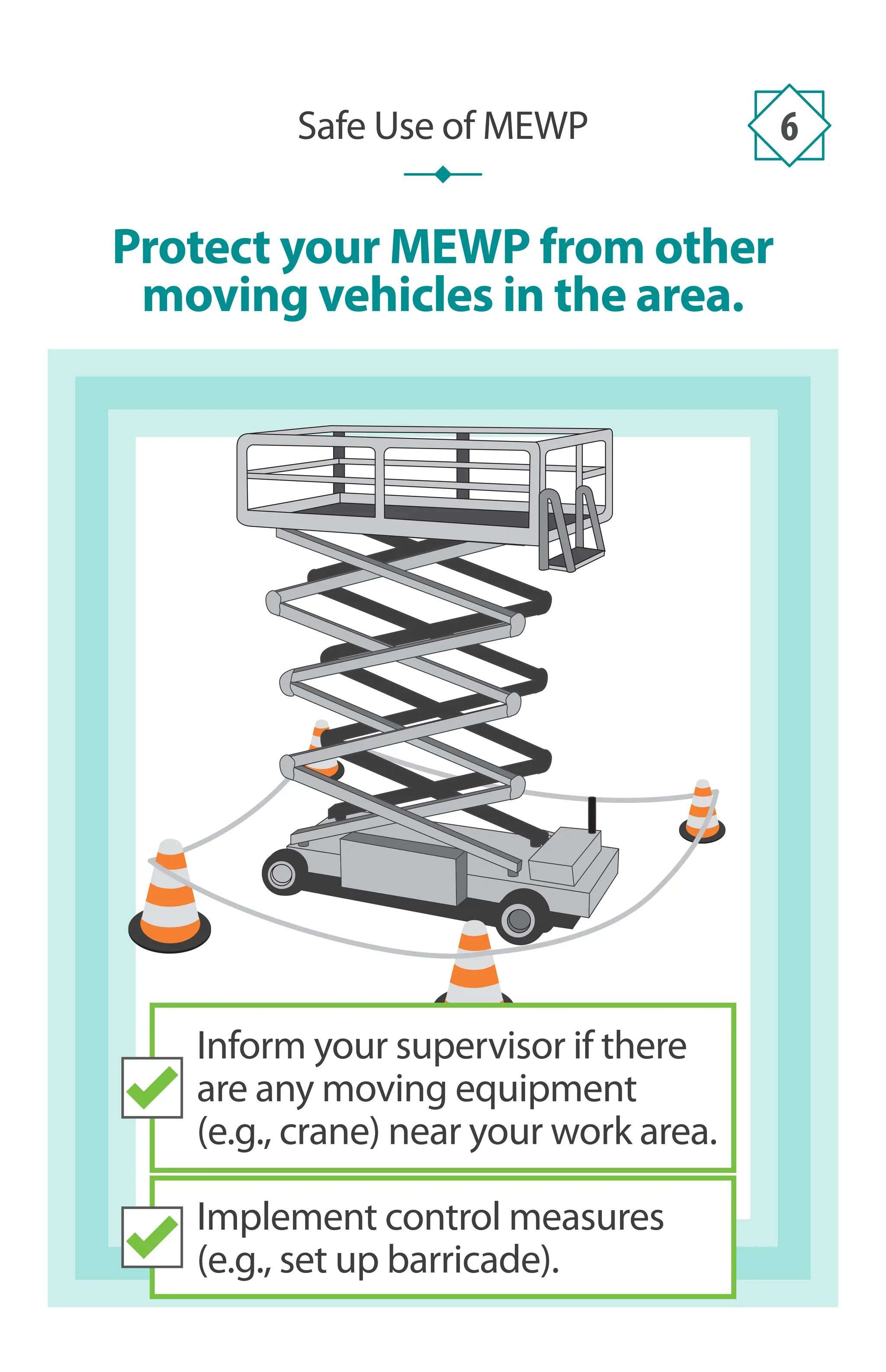
Protect your MEWP from other
moving vehicles in the area.
Safe Use of MEWP 6
Inform your supervisor if there
are any moving equipment
(e.g., crane) near your work area.
Implement control measures
(e.g., set up barricade).
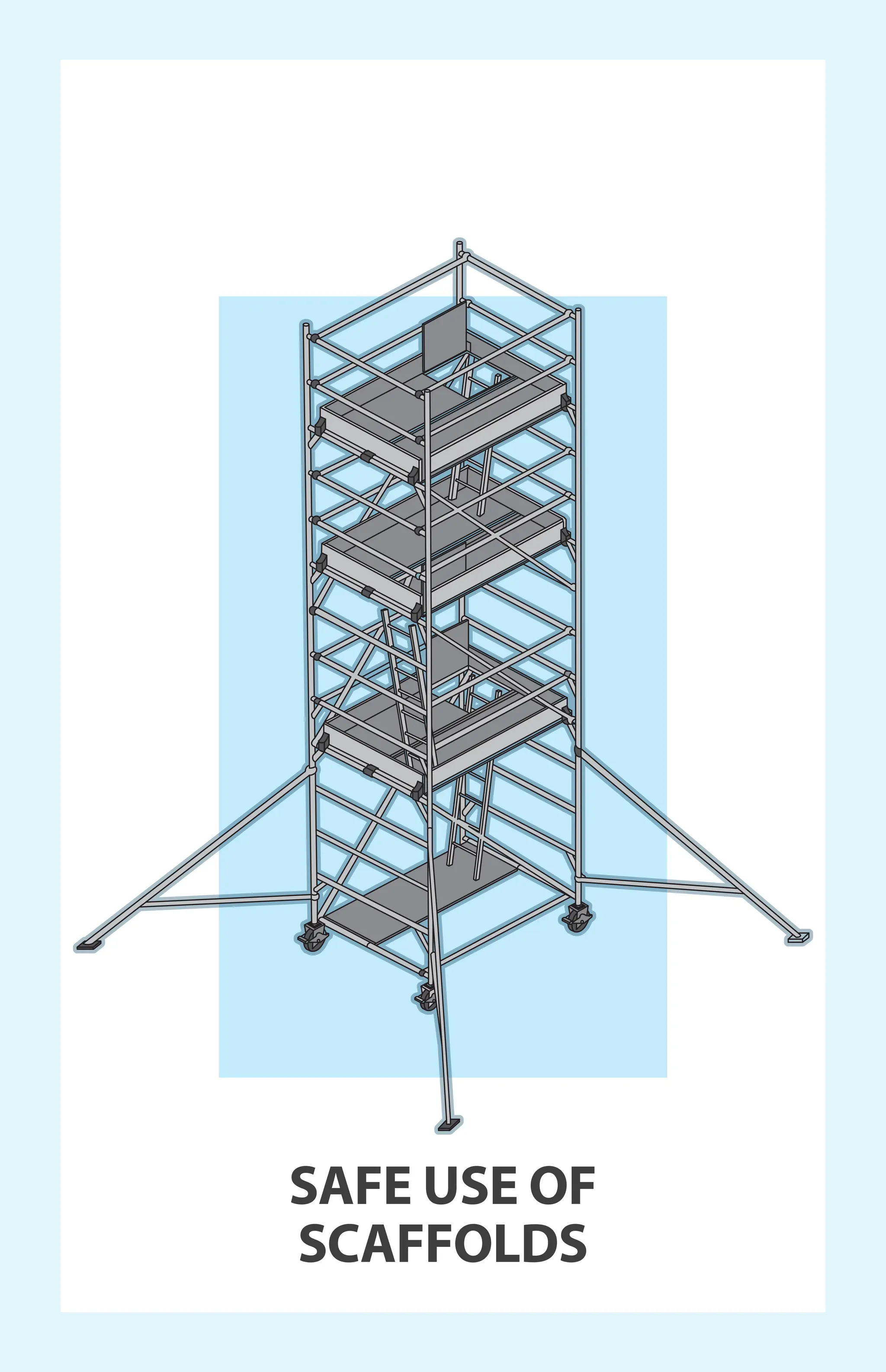
SAFE USE OF
SCAFFOLDS
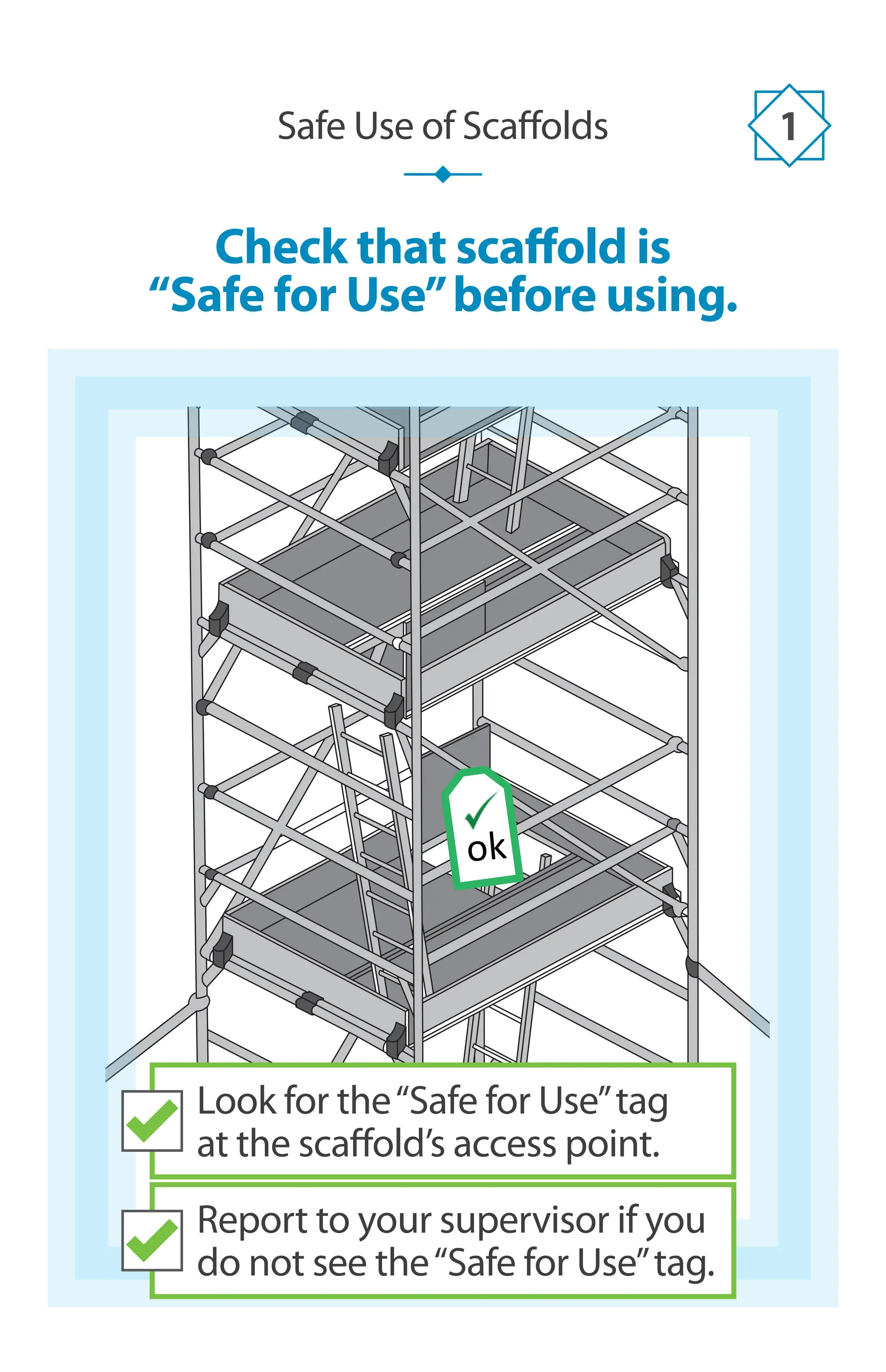
Check that scaffold is
“Safe for Use”before using.
Safe Use of Scaffolds 1
Look for the“Safe for Use”tag
at the scaffold’s access point.
Report to your supervisor if you
do not see the“Safe for Use”tag.
ok
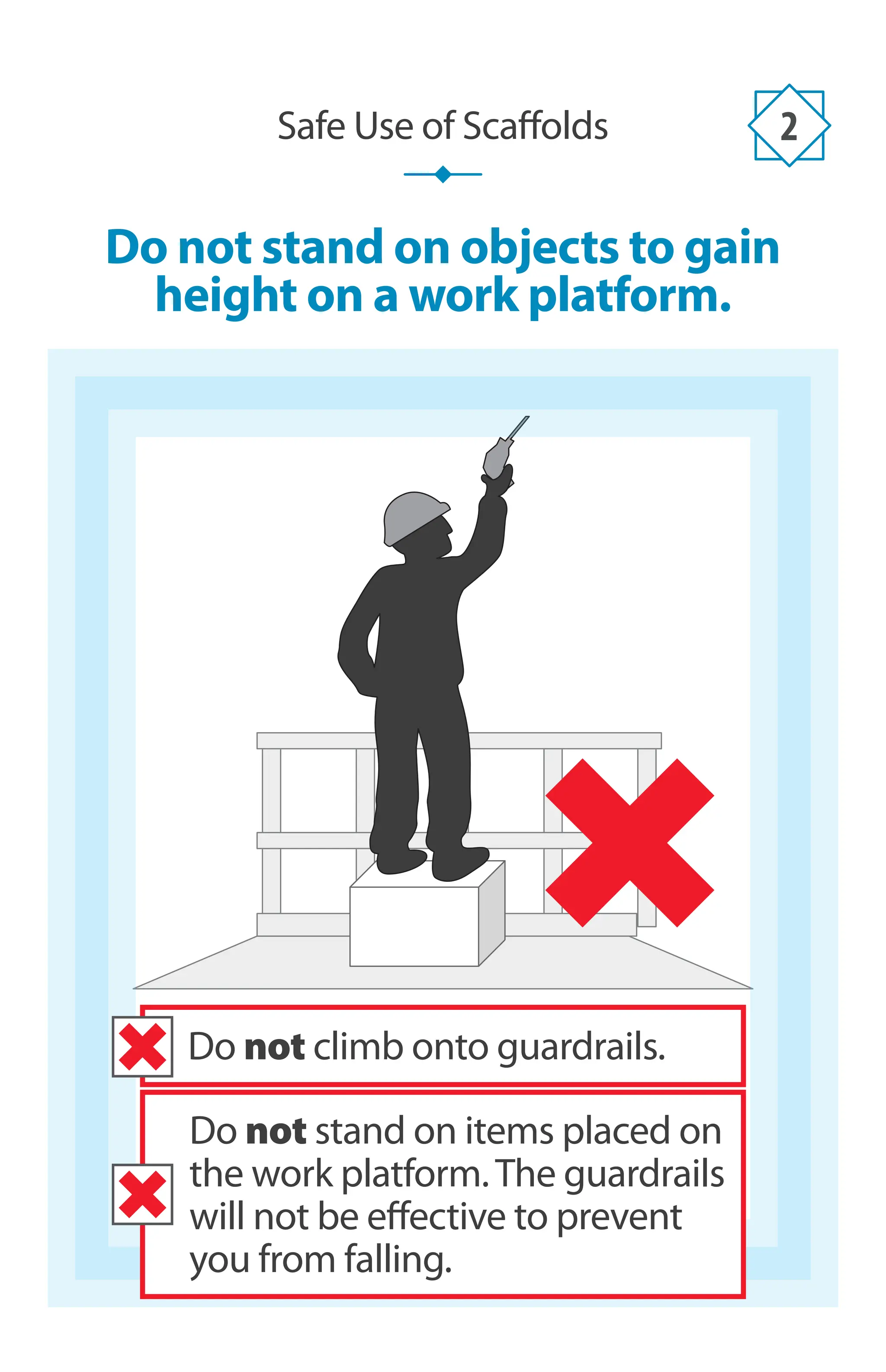
Do not stand on items placed on
the work platform.The guardrails
will not be effective to prevent
you from falling.
Do not climb onto guardrails.
Do not stand on objects to gain
height on a work platform.
Safe Use of Scaffolds 2
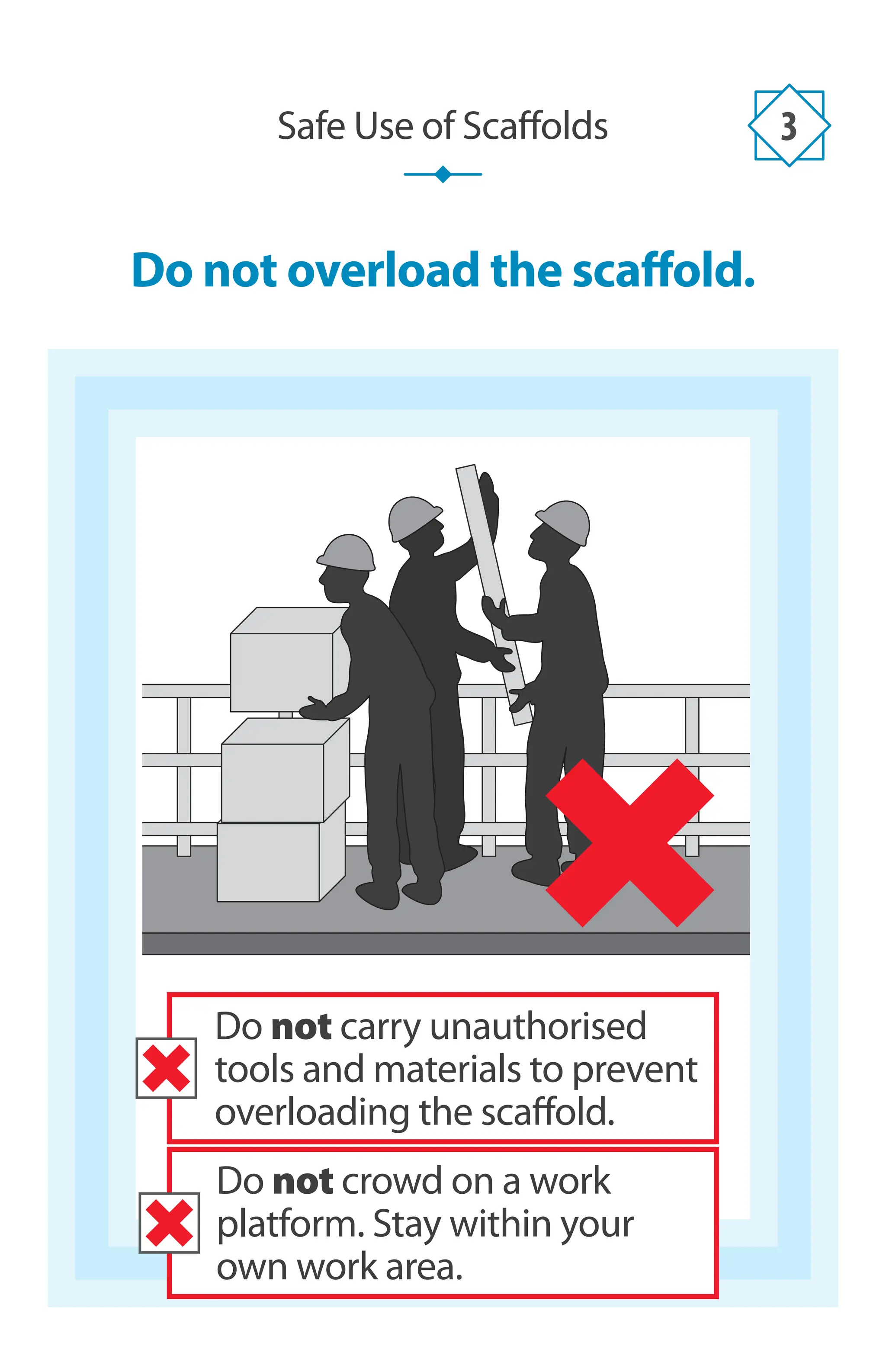
Do not overload the scaffold.
Safe Use of Scaffolds 3
Do not crowd on a work
platform. Stay within your
own work area.
Do not carry unauthorised
tools and materials to prevent
overloading the scaffold.
at least 50cm
Check that a work platform is
safe before stepping on it.
Safe Use of Scaffolds 4
There should be no openings
except for the access ladder.
Work platforms should be at
least 50 cm wide with no big
gaps between.
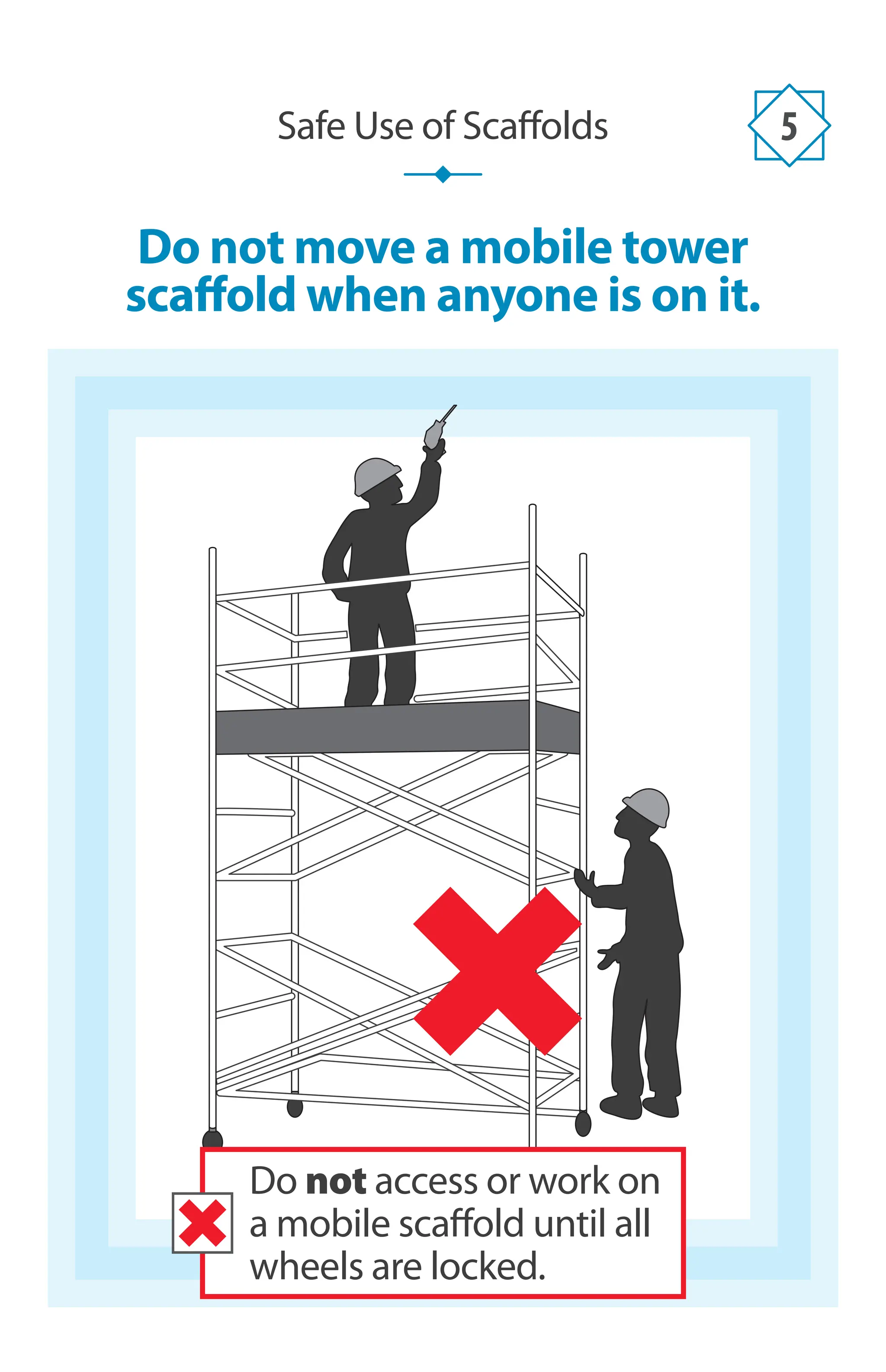
Do not move a mobile tower
scaffold when anyone is on it.
Safe Use of Scaffolds 5
Do not access or work on
a mobile scaffold until all
wheels are locked.
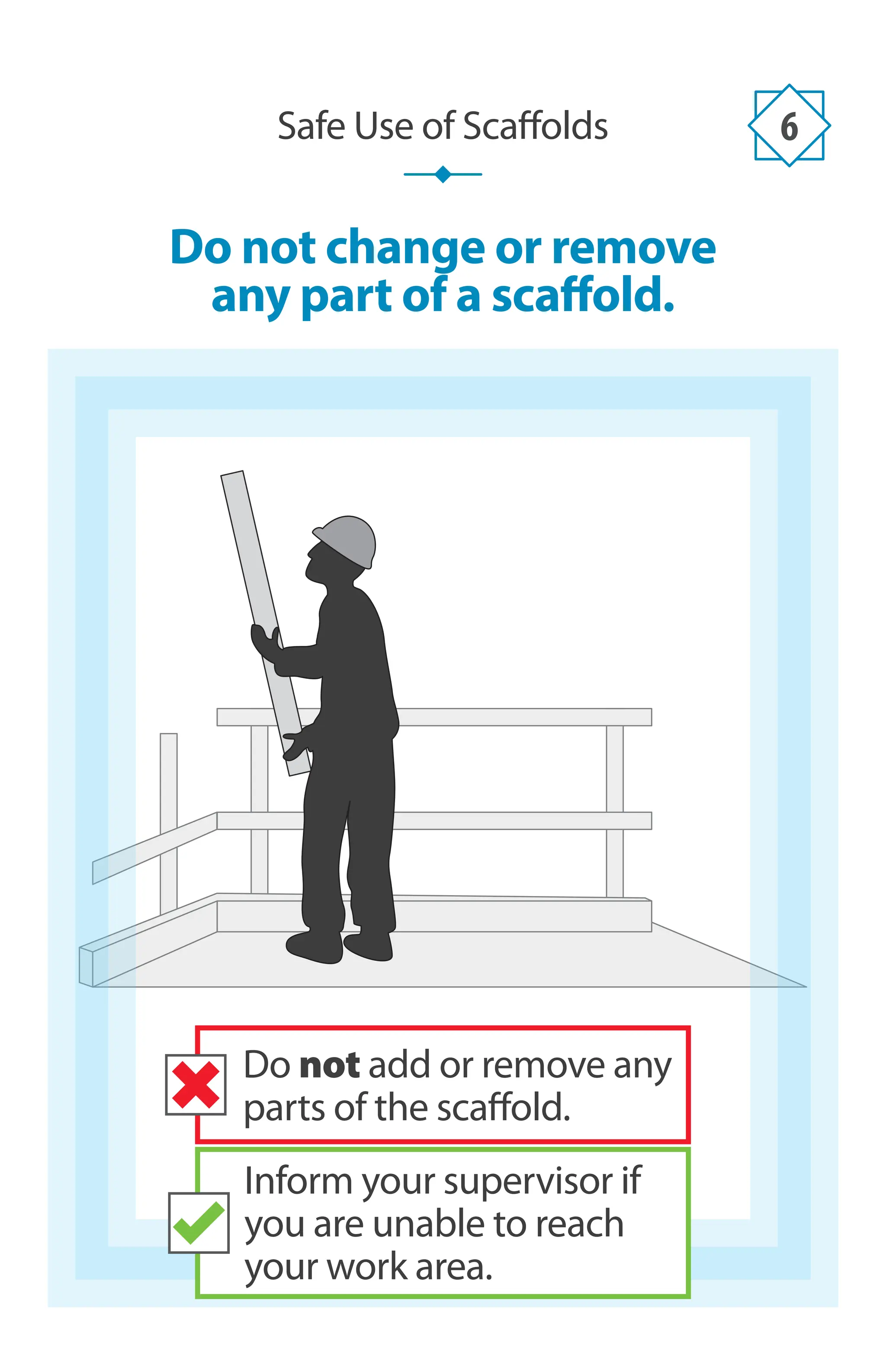
Do not change or remove
any part of a scaffold.
Safe Use of Scaffolds 6
Inform your supervisor if
you are unable to reach
your work area.
Do not add or remove any
parts of the scaffold.
HOUSEKEEPING
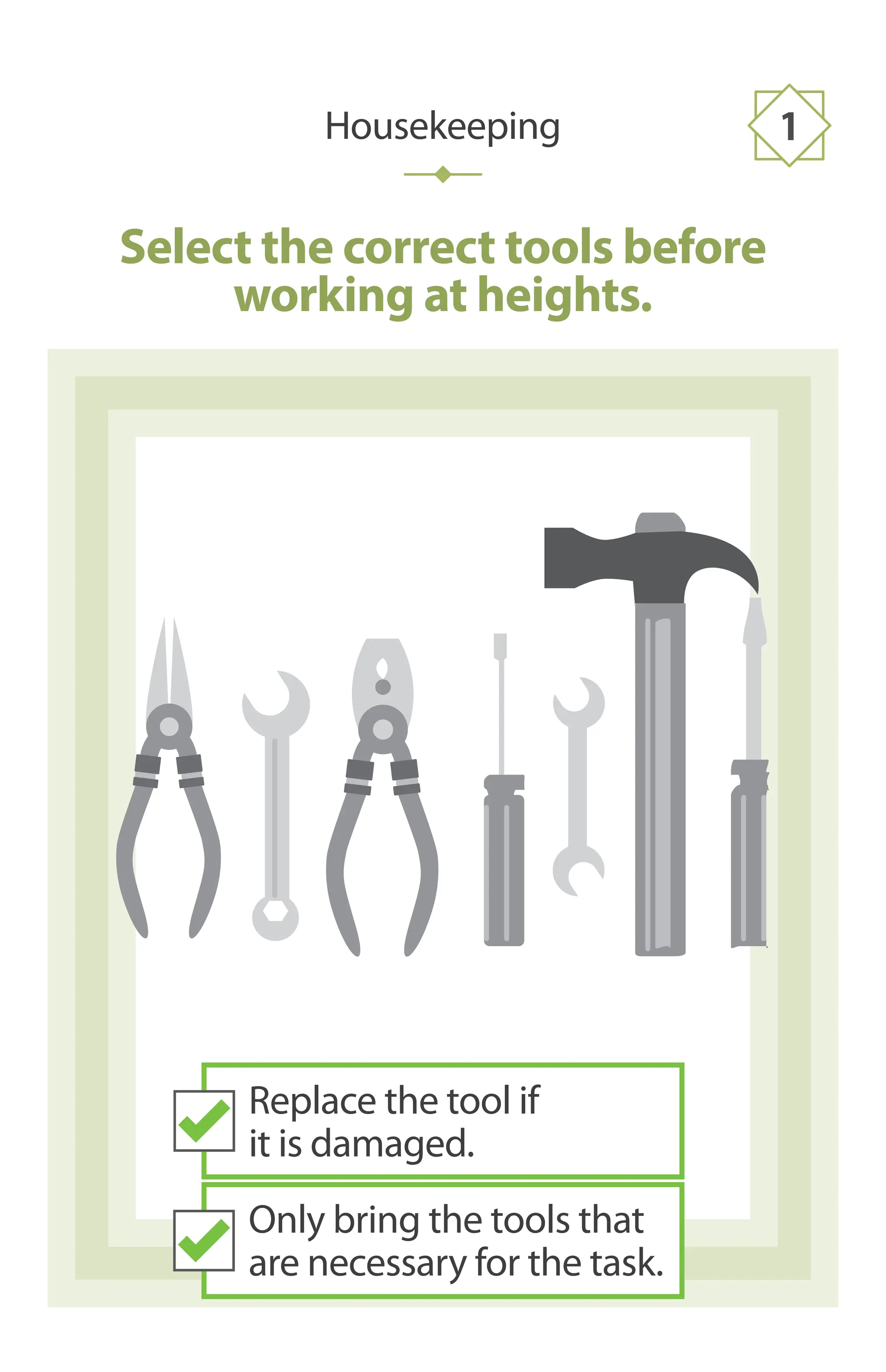
Select the correct tools before
working at heights.
Housekeeping 1
Replace the tool if
it is damaged.
Only bring the tools that
are necessary for the task.
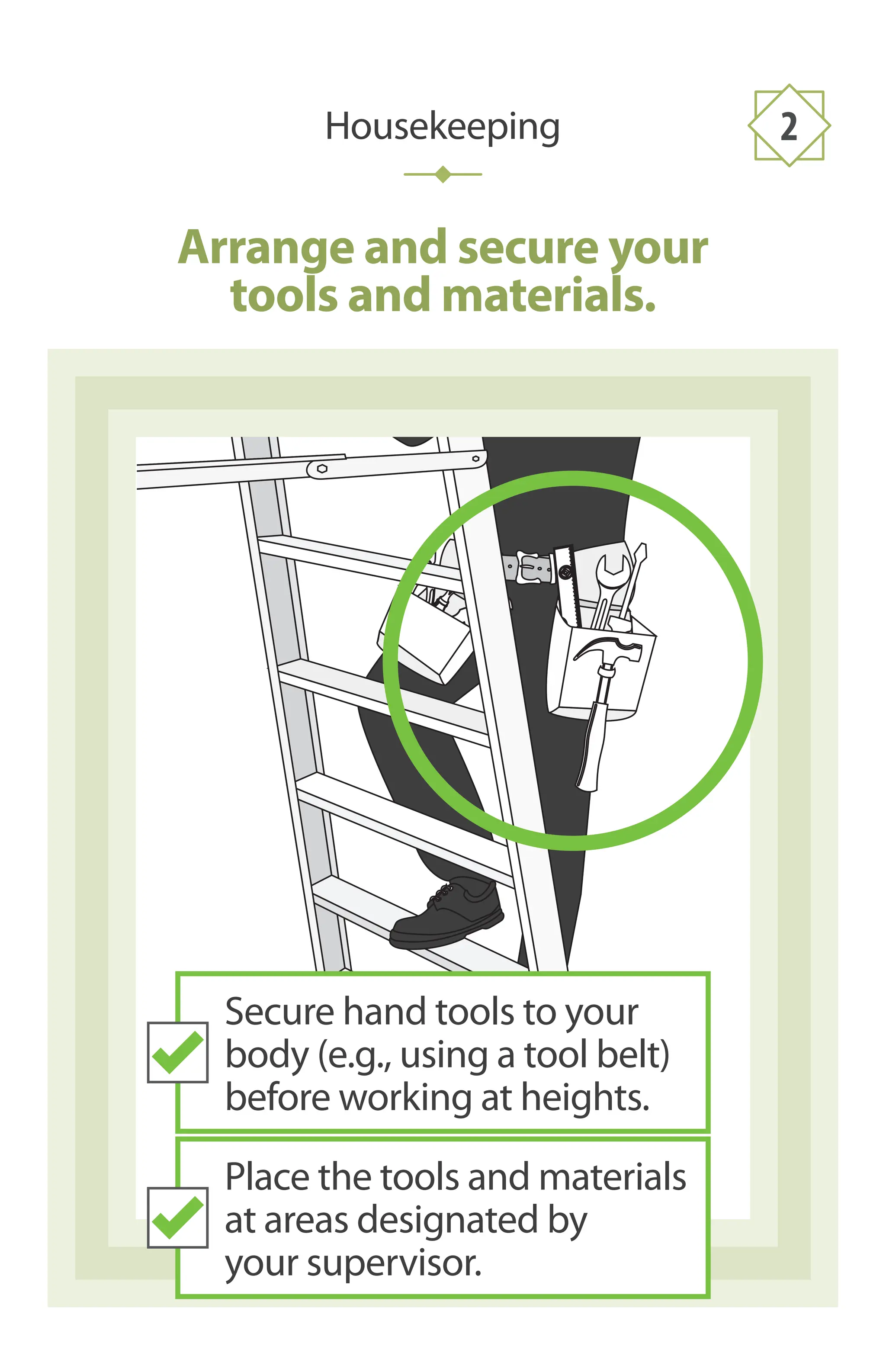
Secure hand tools to your
body (e.g., using a tool belt)
before working at heights.
Place the tools and materials
at areas designated by
your supervisor.
Arrange and secure your
tools and materials.
Housekeeping 2
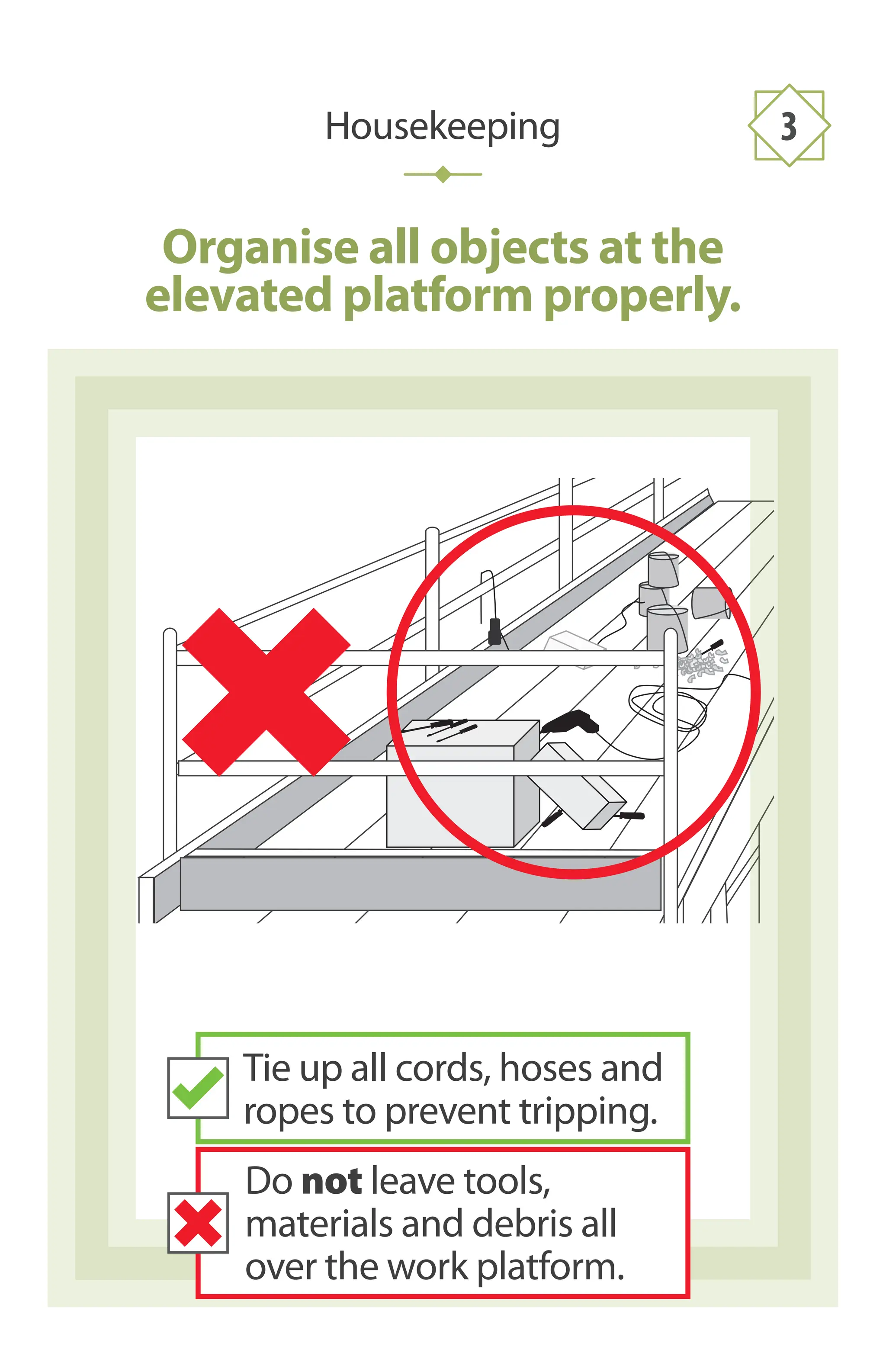
Do not leave tools,
materials and debris all
over the work platform.
Tie up all cords, hoses and
ropes to prevent tripping.
Organise all objects at the
elevated platform properly.
Housekeeping 3
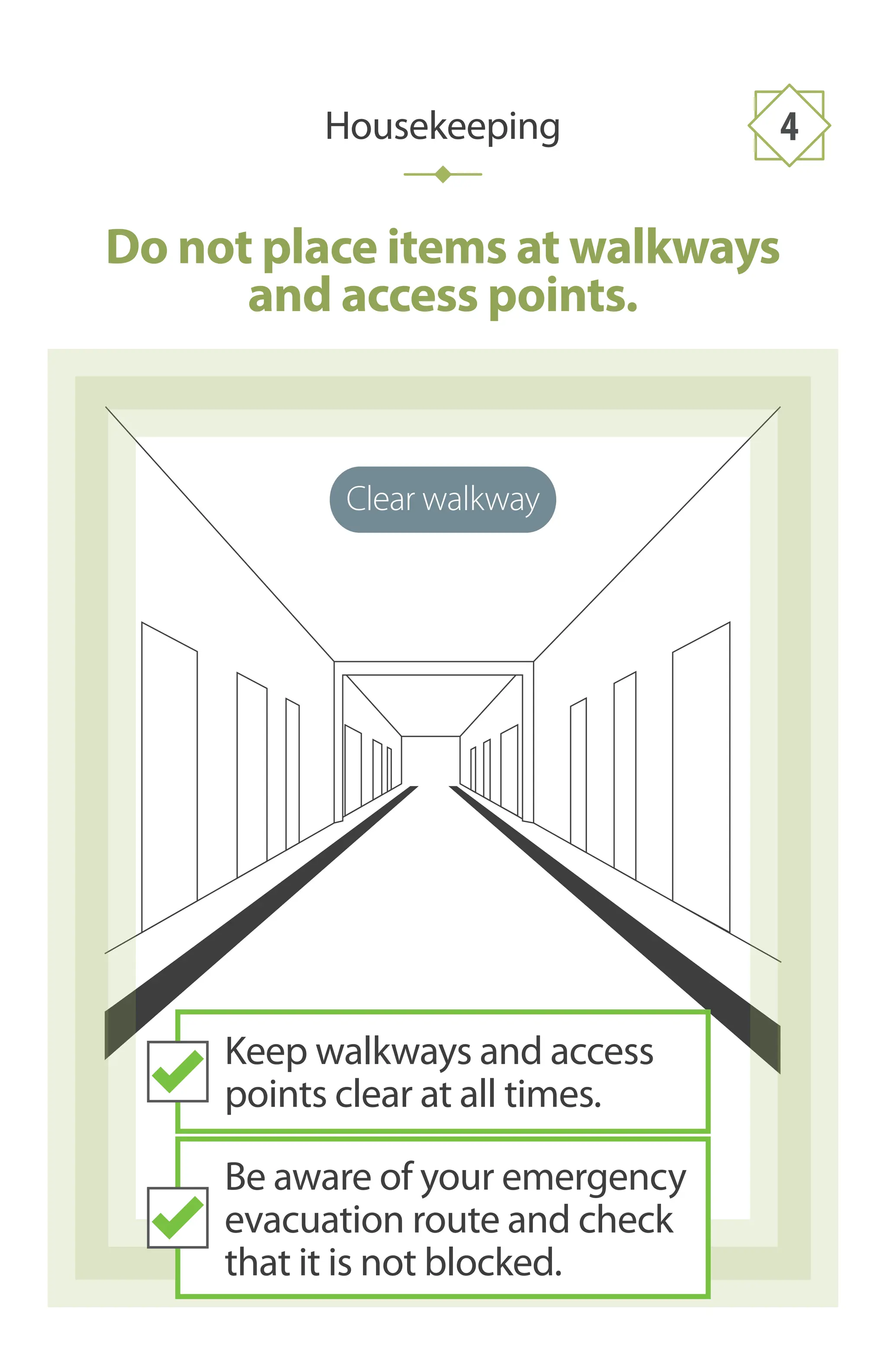
Clear walkway
Do not place items at walkways
and access points.
Housekeeping 4
Keep walkways and access
points clear at all times.
Be aware of your emergency
evacuation route and check
that it is not blocked.
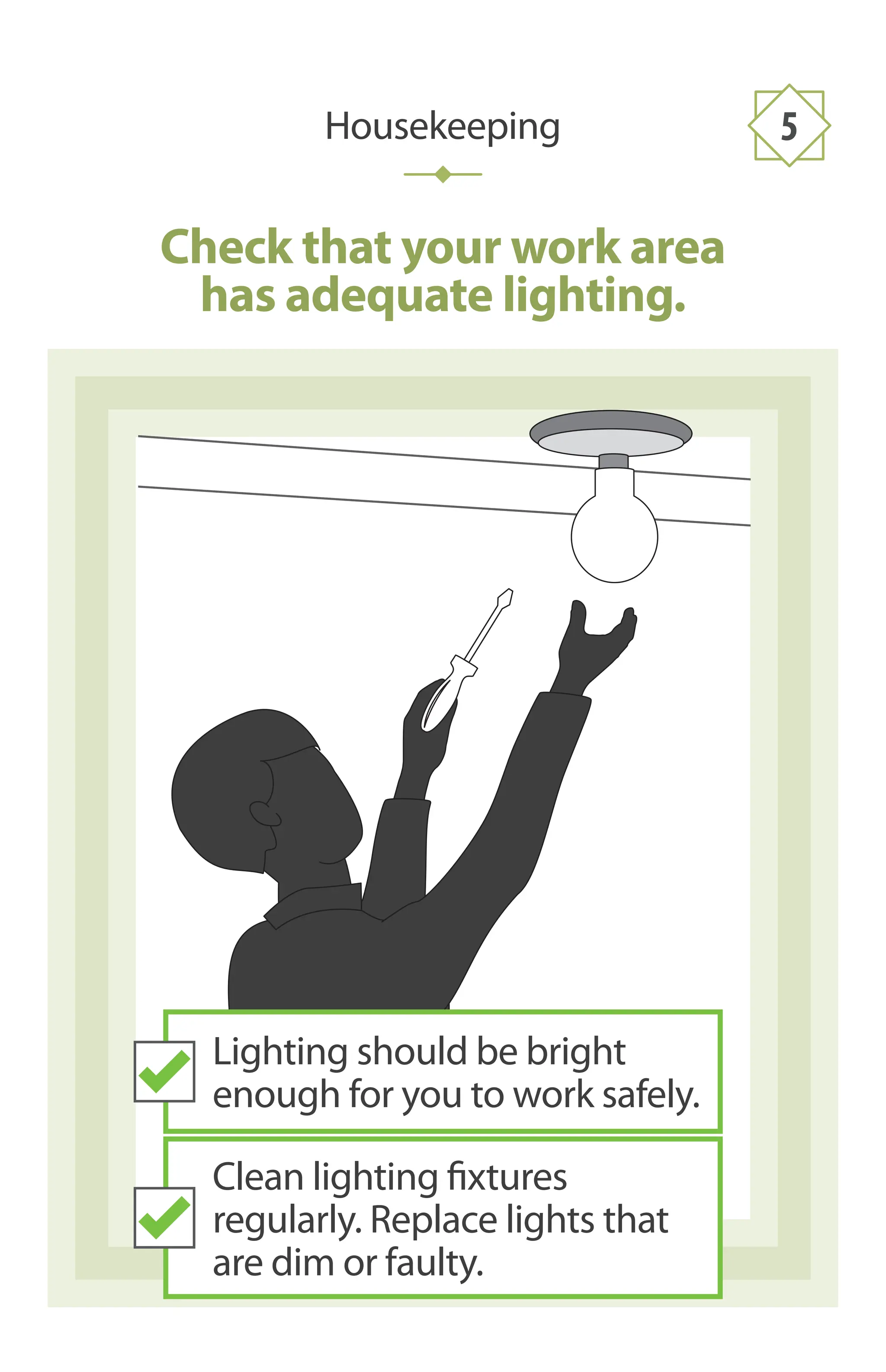
Check that your work area
has adequate lighting.
Housekeeping 5
Lighting should be bright
enough for you to work safely.
Clean lighting fixtures
regularly. Replace lights that
are dim or faulty.
Keep your work area clean
to prevent any hazards.
Housekeeping 6
Clean up your work
area after your shift.
Do not leave items that
may cause slips or trips
on the work platform.
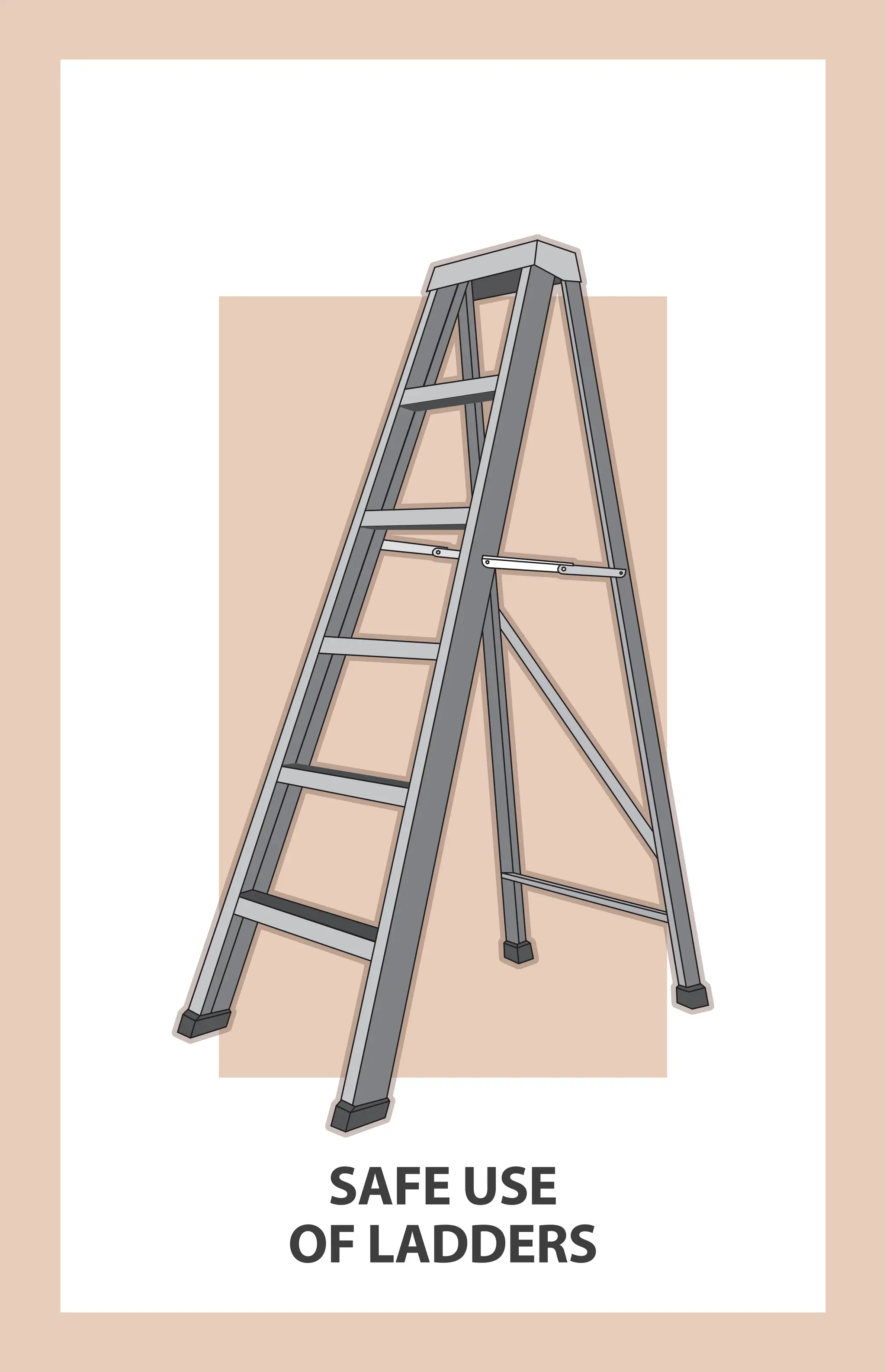
SAFE USE
OF LADDERS
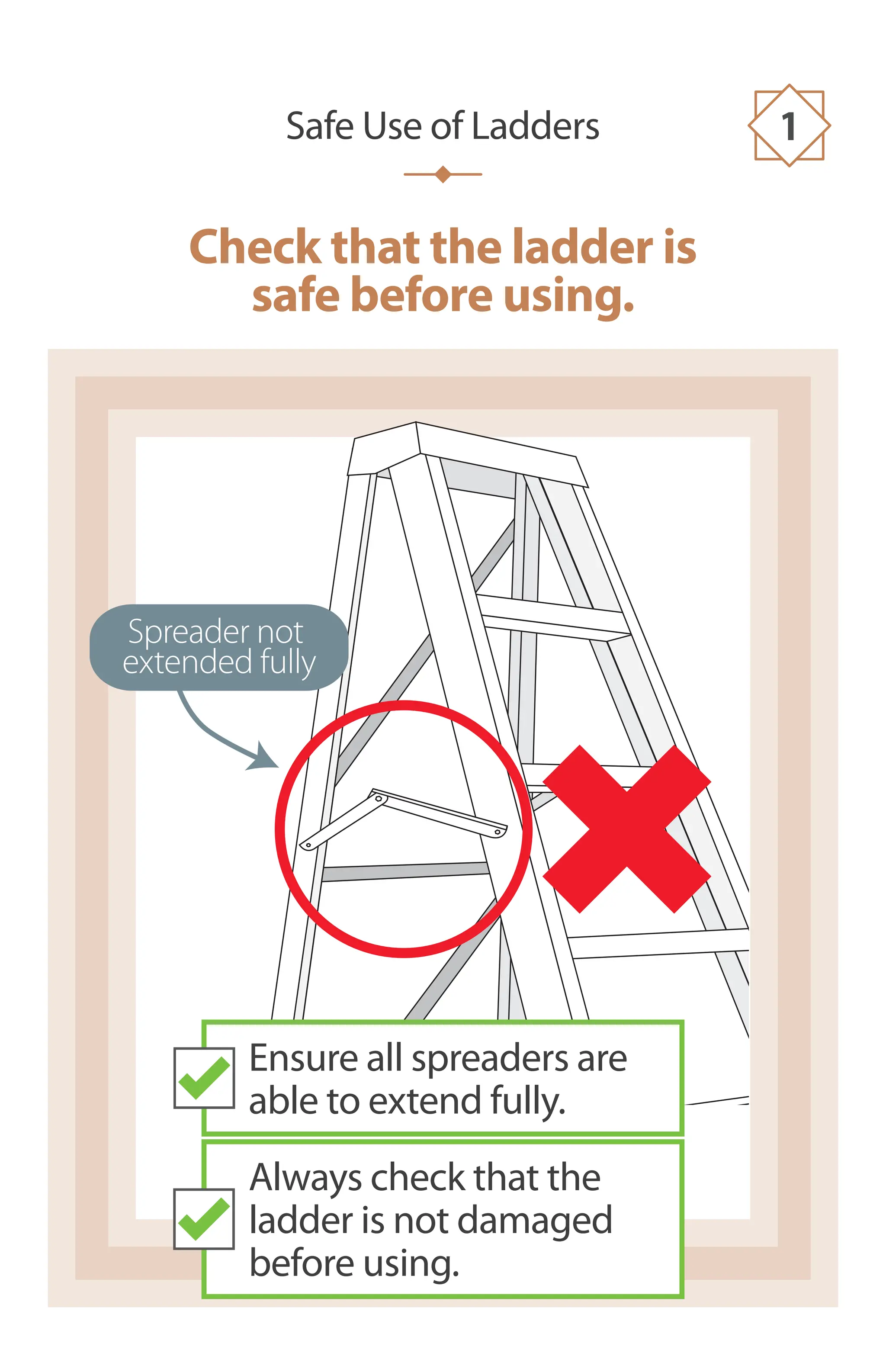
Check that the ladder is
safe before using.
Safe Use of Ladders 1
Ensure all spreaders are
able to extend fully.
Always check that the
ladder is not damaged
before using.
Spreader not
extended fully
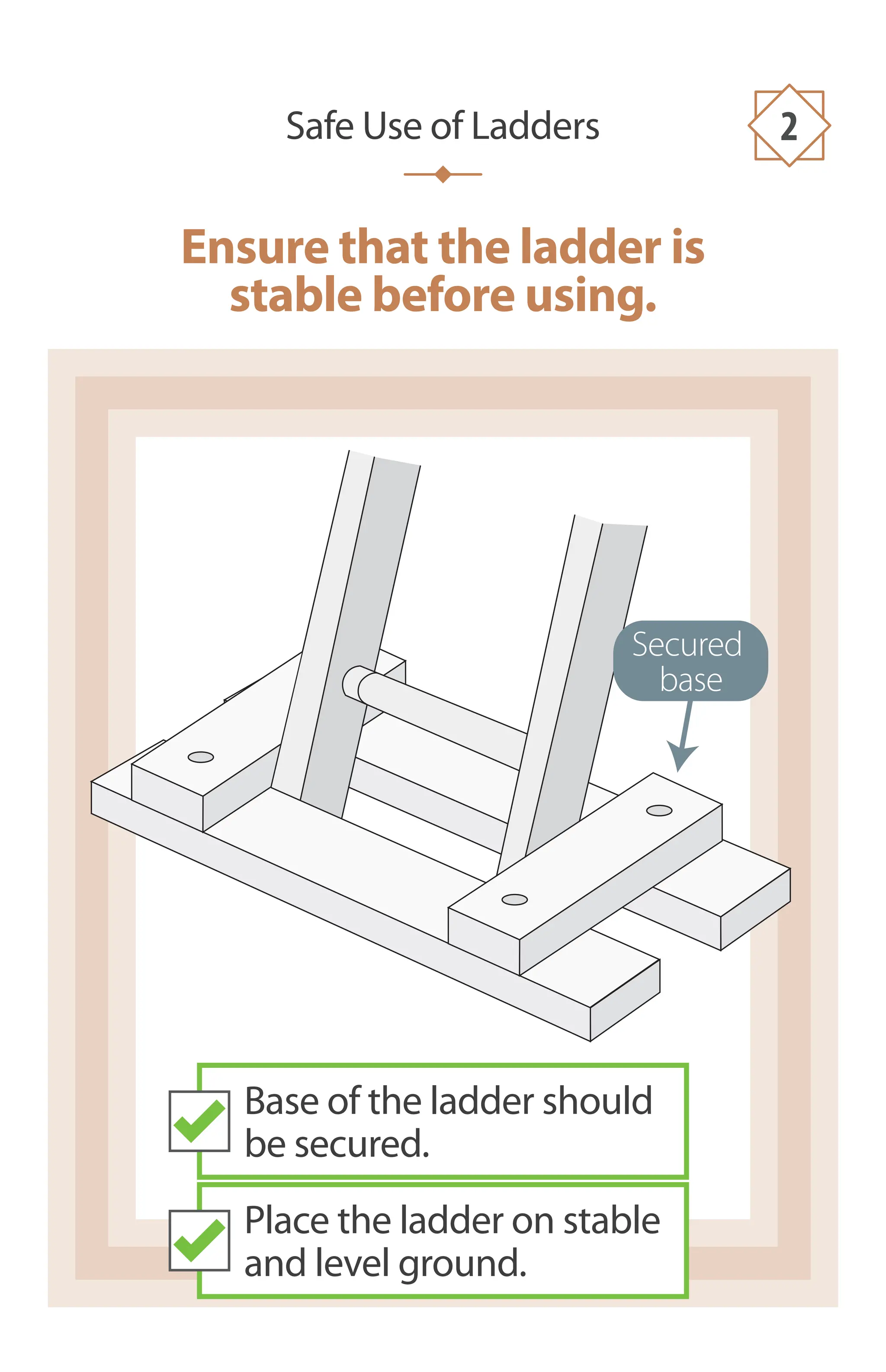
Ensure that the ladder is
stable before using.
Safe Use of Ladders 2
Secured
base
Base of the ladder should
be secured.
Place the ladder on stable
and level ground.
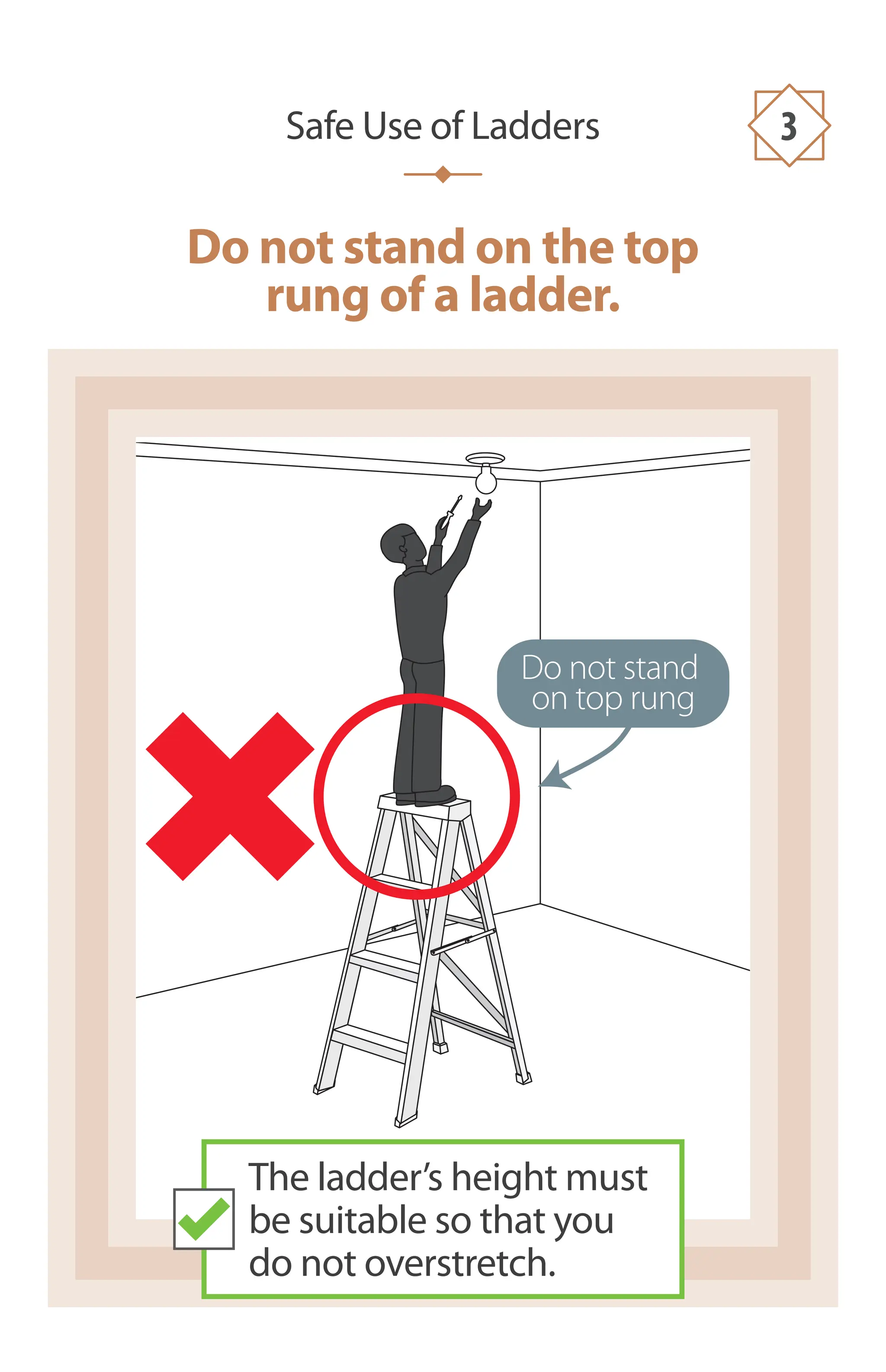
Do not stand on the top
rung of a ladder.
Safe Use of Ladders 3
The ladder’s height must
be suitable so that you
do not overstretch.
Do not stand
on top rung
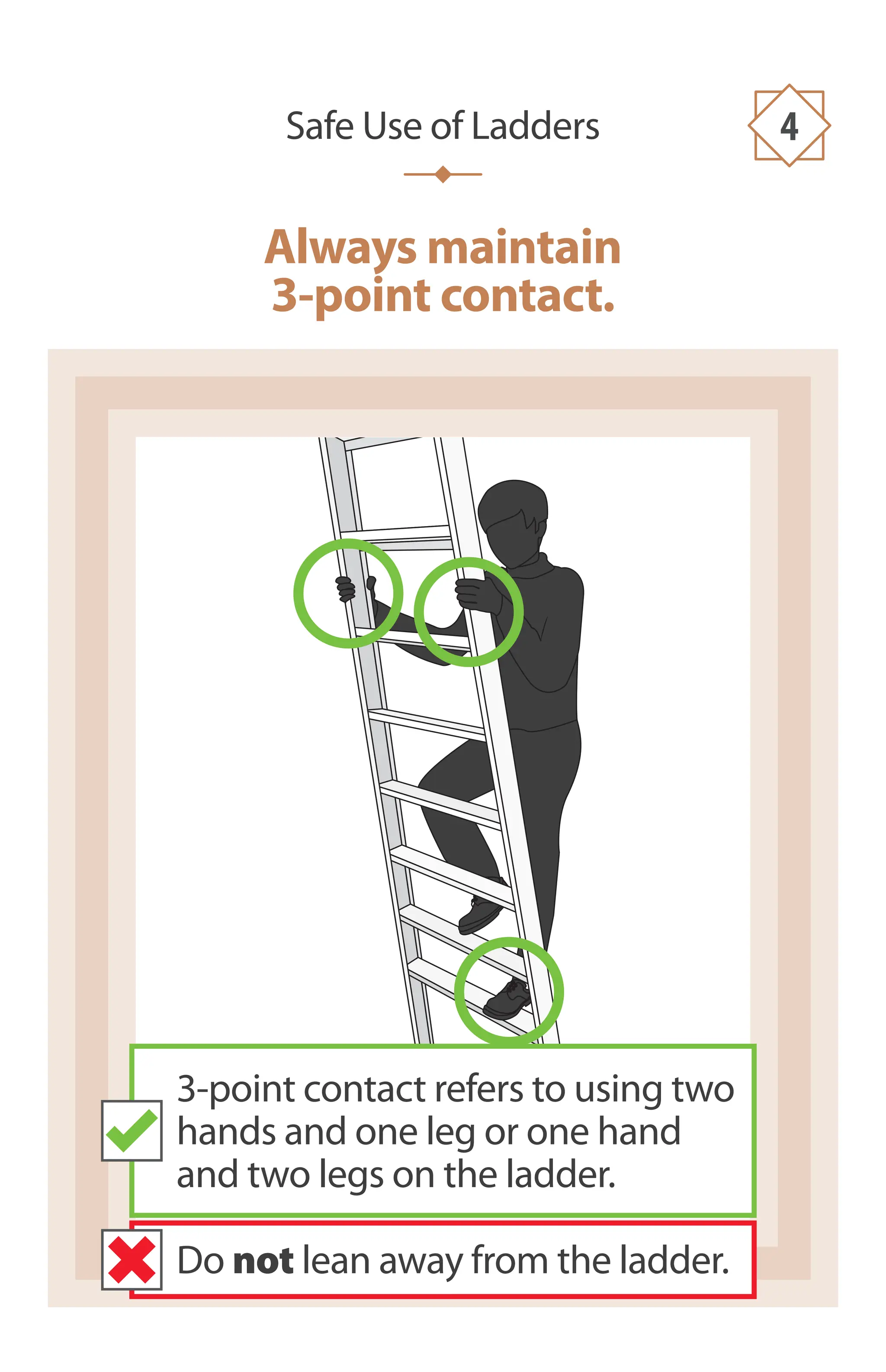
Always maintain
3-point contact.
Safe Use of Ladders 4
3-point contact refers to using two
hands and one leg or one hand
and two legs on the ladder.
Do not lean away from the ladder.
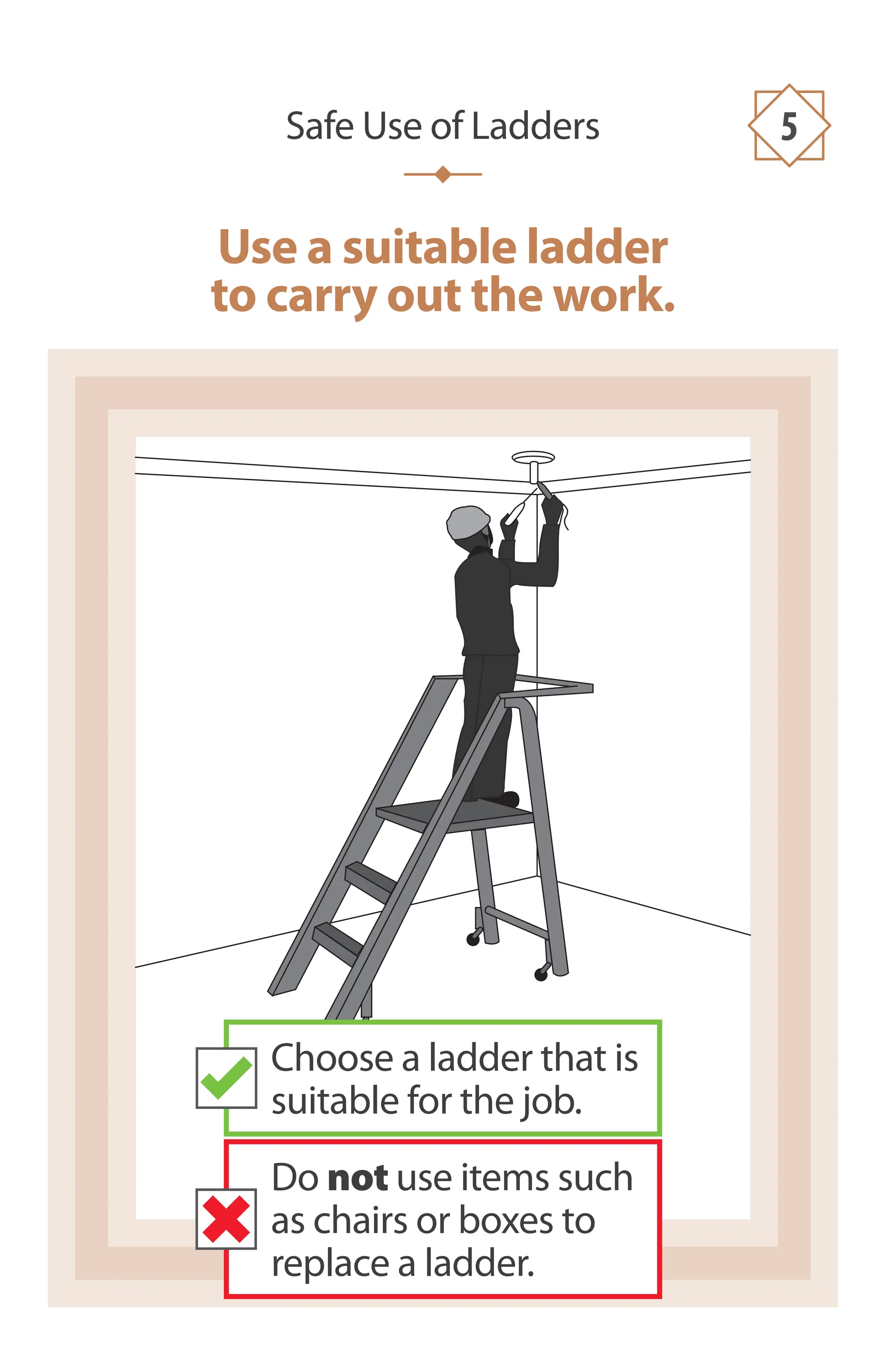
Use a suitable ladder
to carry out the work.
Safe Use of Ladders 5
Choose a ladder that is
suitable for the job.
Do not use items such
as chairs or boxes to
replace a ladder.
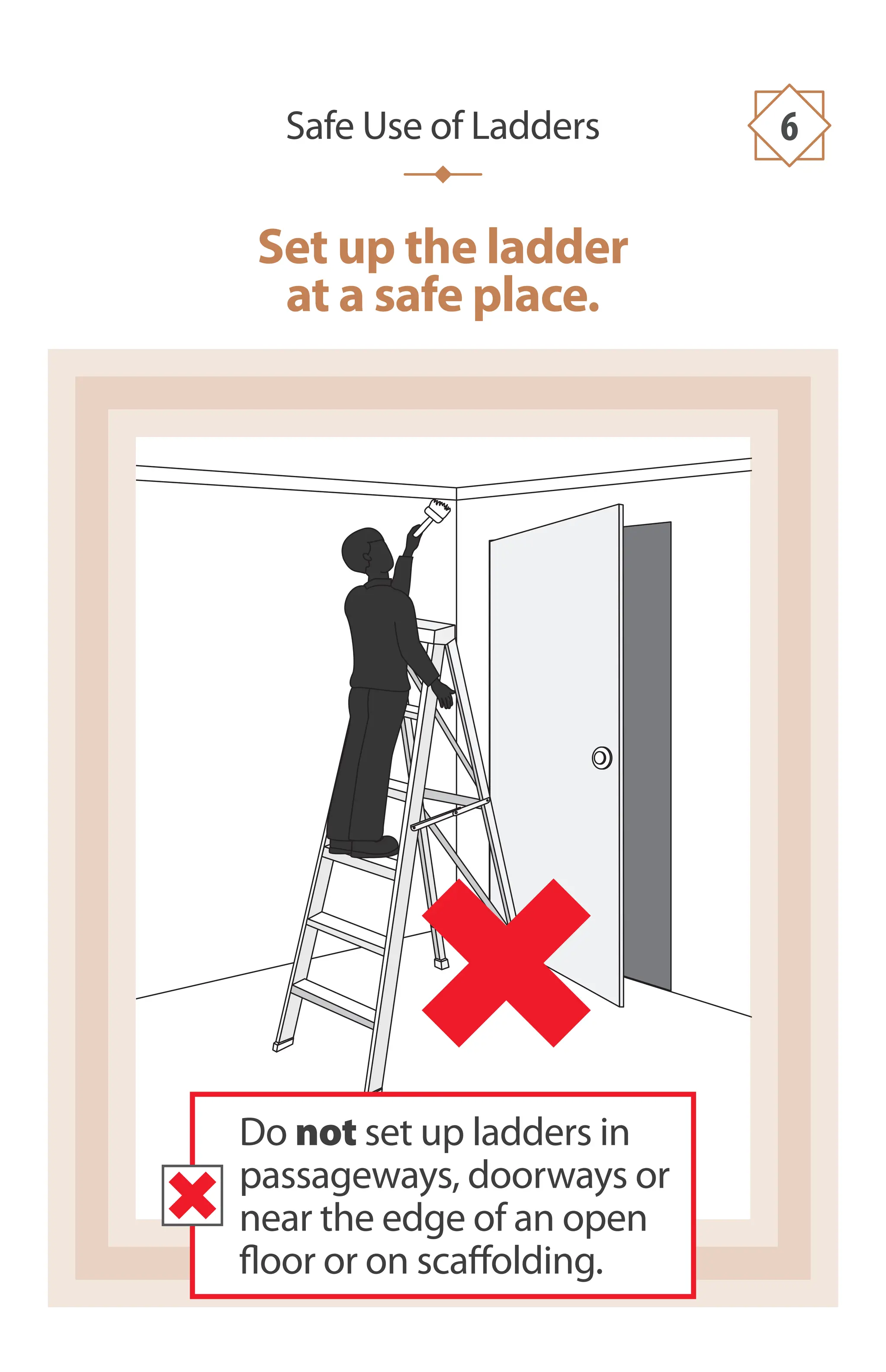
Set up the ladder
at a safe place.
Do not set up ladders in
passageways, doorways or
near the edge of an open
floor or on scaffolding.
Safe Use of Ladders 6
ACCESS AND EGRESS
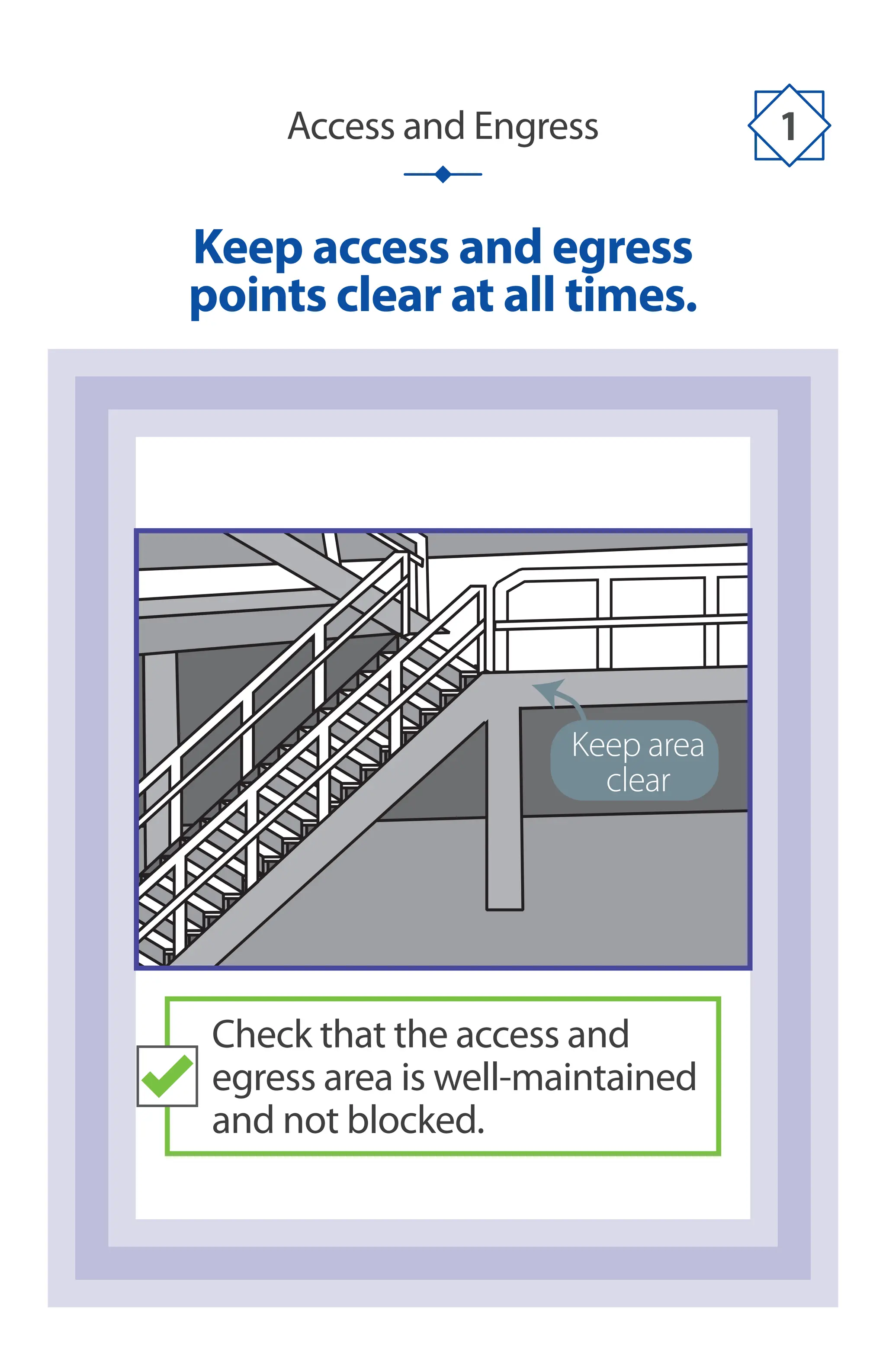
Keep area
clear
Keep access and egress
points clear at all times.
Access and Engress 1
Check that the access and
egress area is well-maintained
and not blocked.
Access and Engress 2
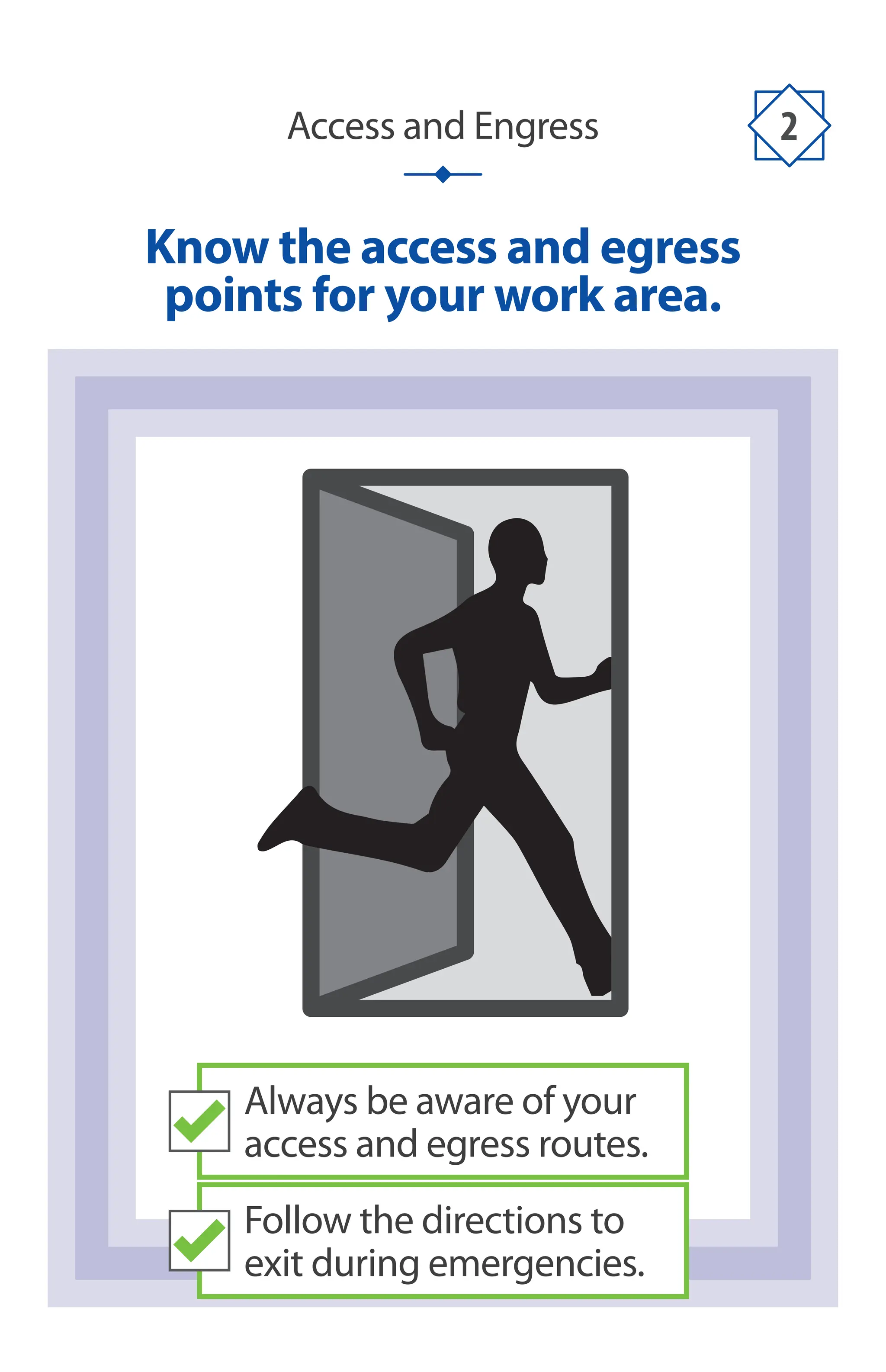
Know the access and egress
points for your work area.
Always be aware of your
access and egress routes.
Follow the directions to
exit during emergencies.
Access and Engress 3
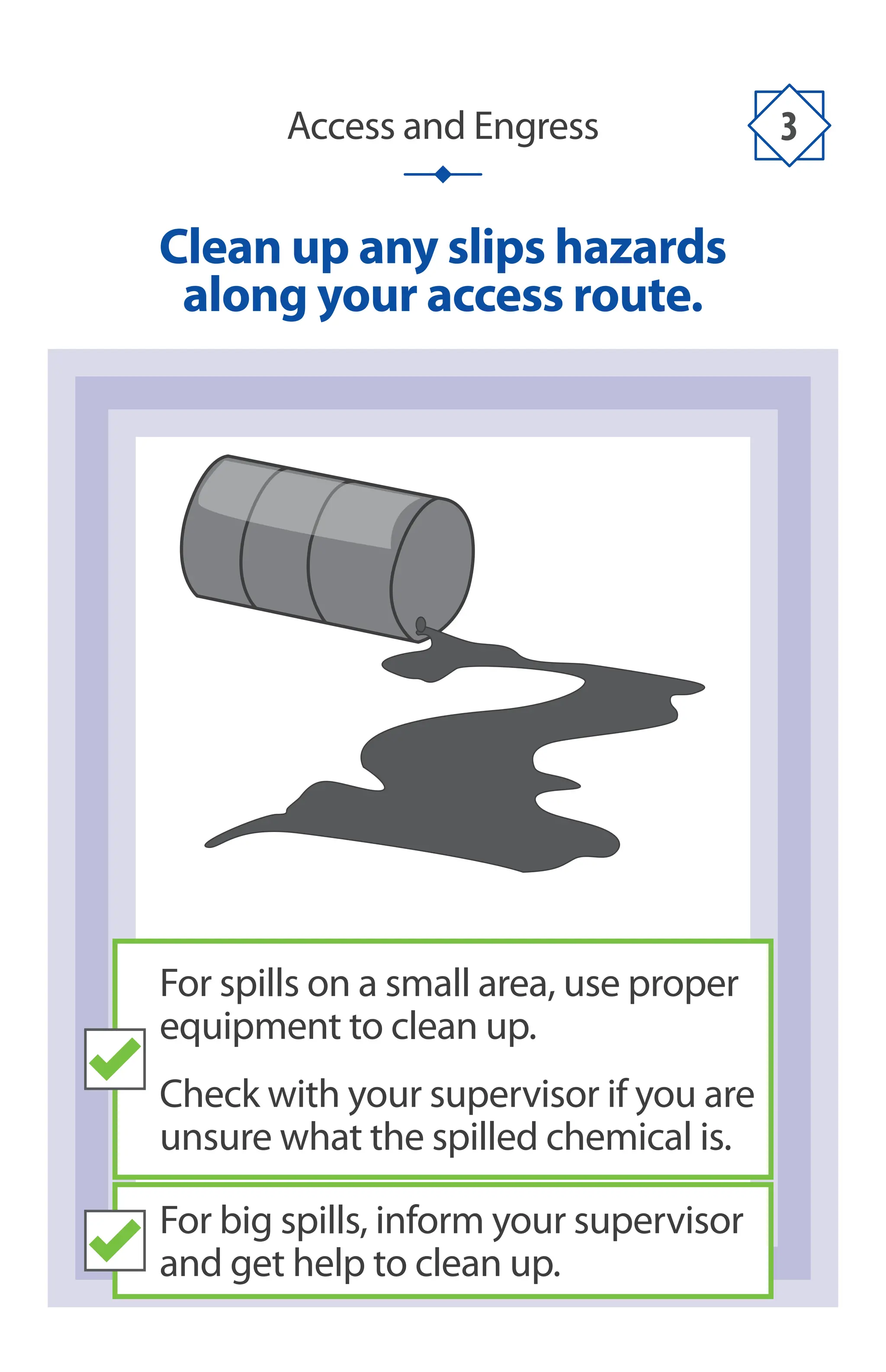
Clean up any slips hazards
along your access route.
For spills on a small area, use proper
equipment to clean up.
Check with your supervisor if you are
unsure what the spilled chemical is.
For big spills, inform your supervisor
and get help to clean up.
Access and Engress 4
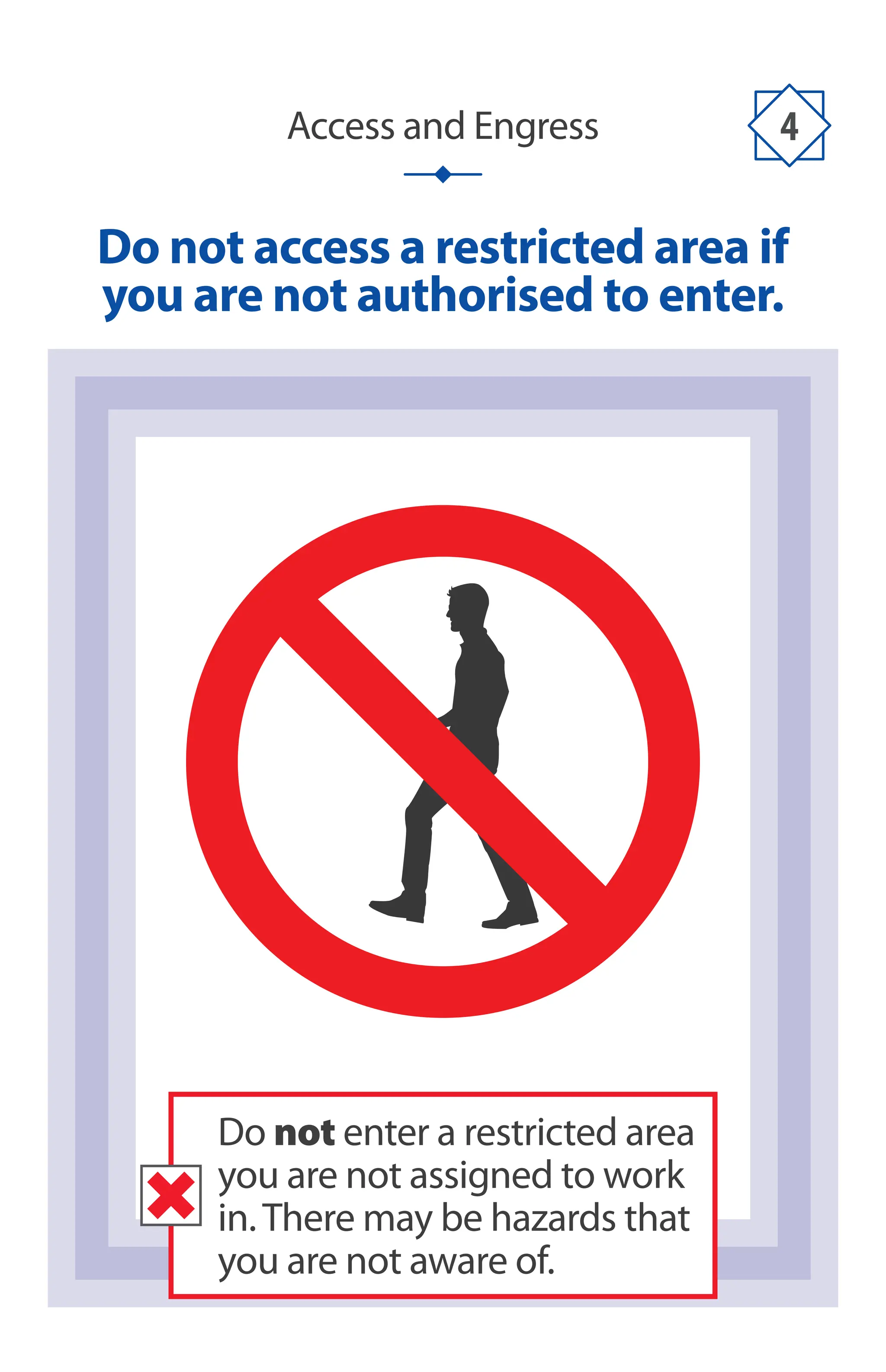
Do not access a restricted area if
you are not authorised to enter.
Do not enter a restricted area
you are not assigned to work
in.There may be hazards that
you are not aware of.
Access and Engress 5
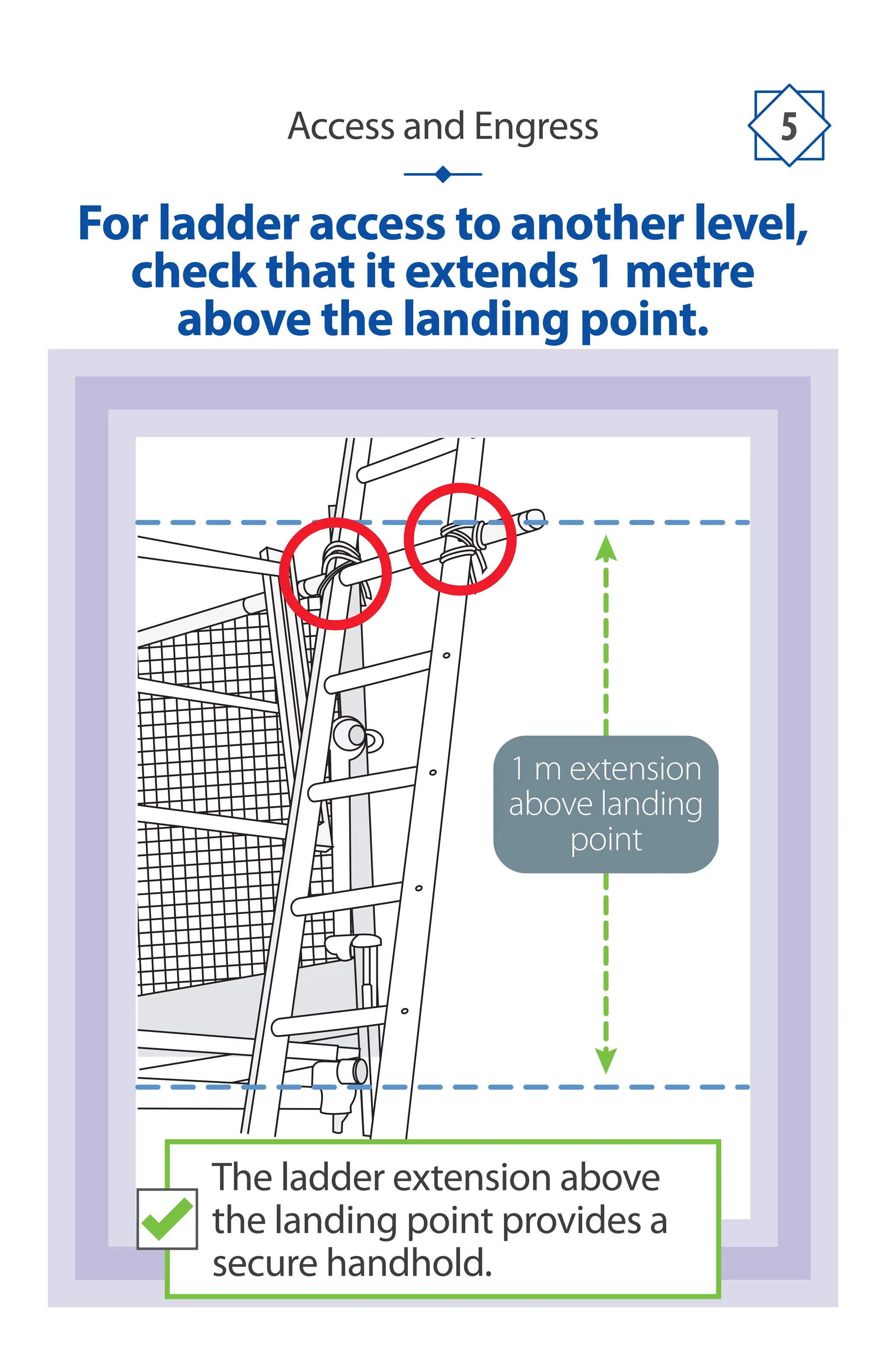
For ladder access to another level,
check that it extends 1 metre
above the landing point.
The ladder extension above
the landing point provides a
secure handhold.
1 m extension
above landing
point
Access and Engress 6
Keep your hands free
when climbing.
Always hold on onto the
handrails when climbing.
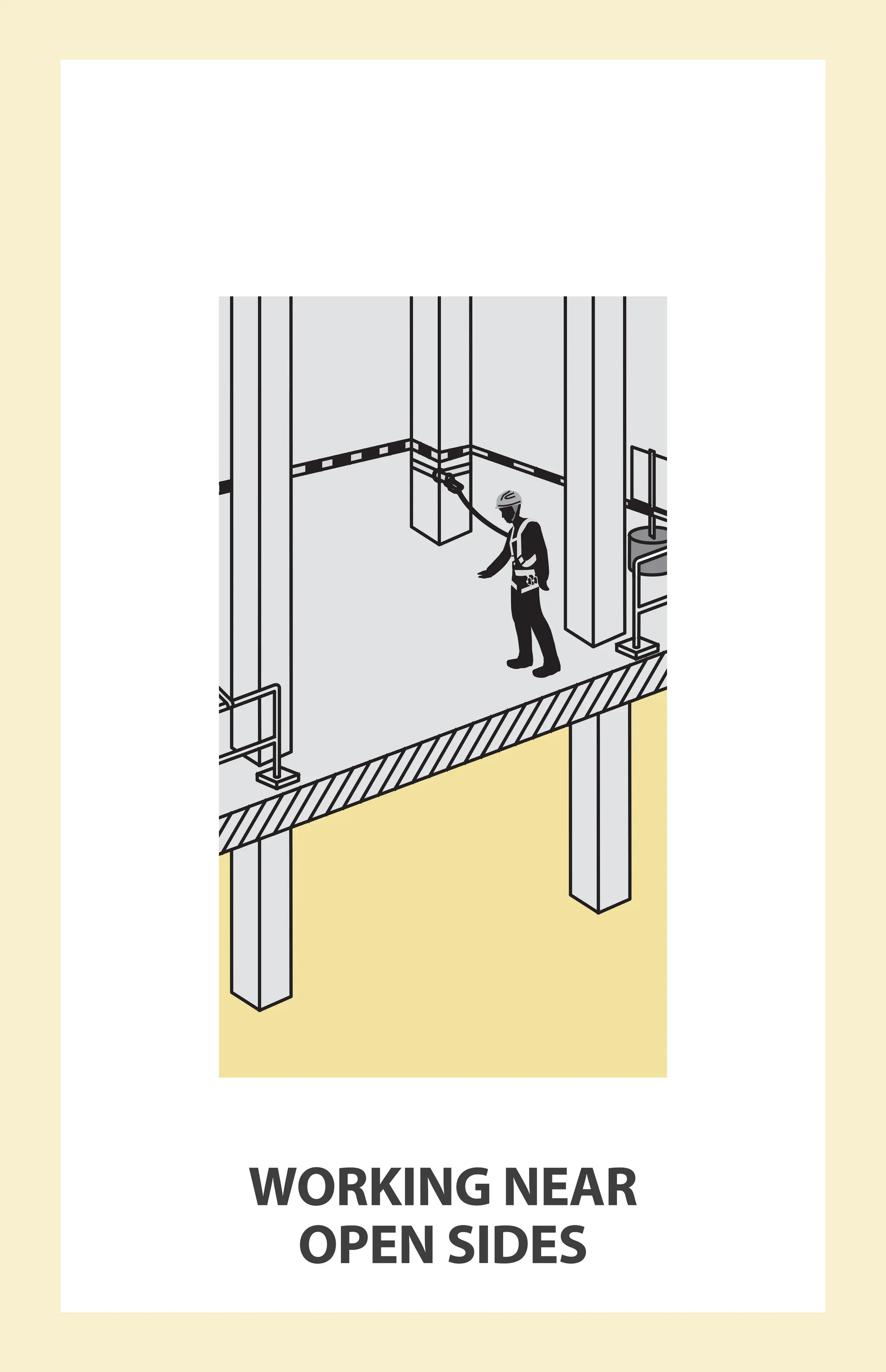
WORKING NEAR
OPEN SIDES
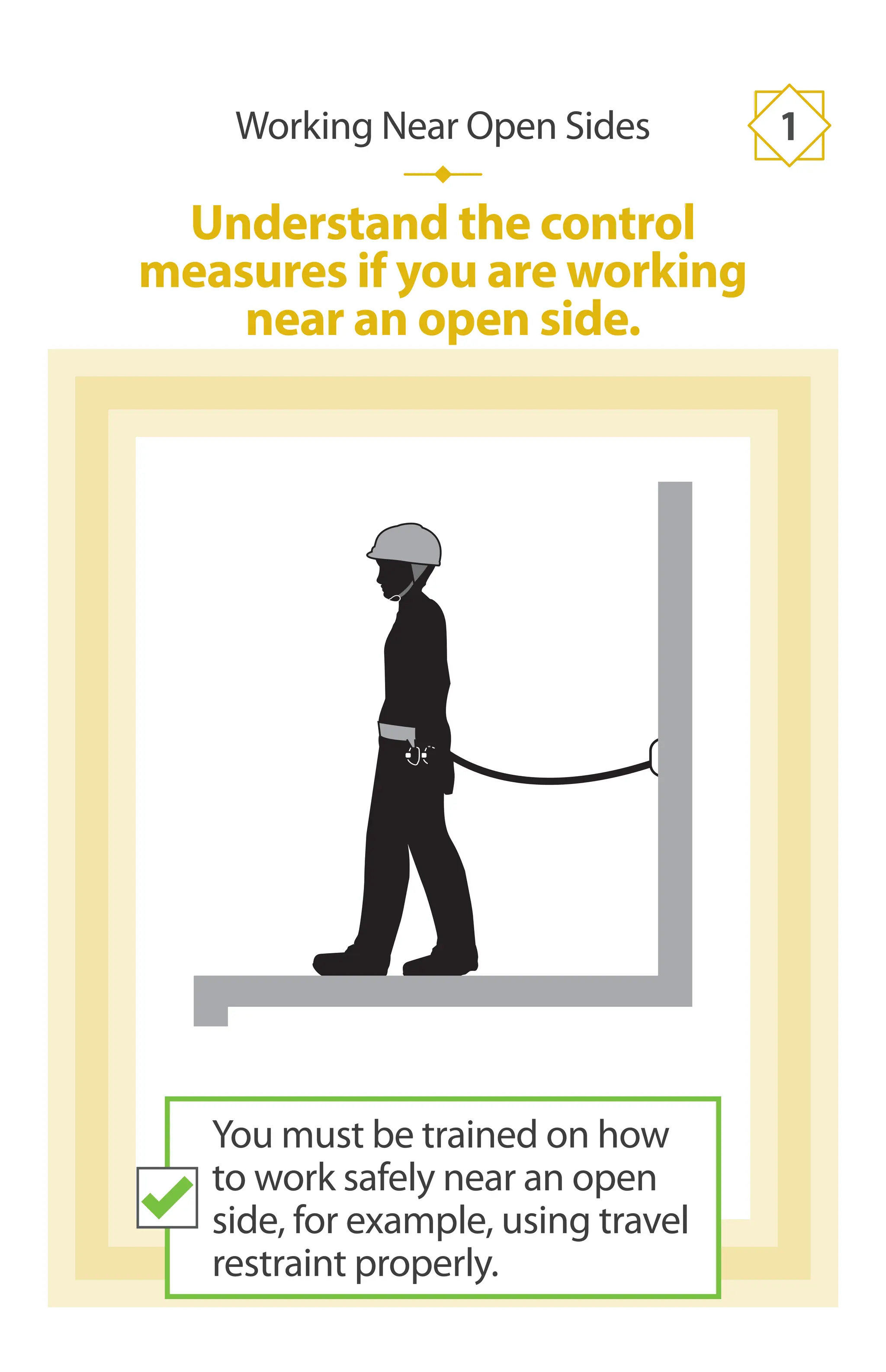
Understand the control
measures if you are working
near an open side.
Working Near Open Sides 1
You must be trained on how
to work safely near an open
side, for example, using travel
restraint properly.
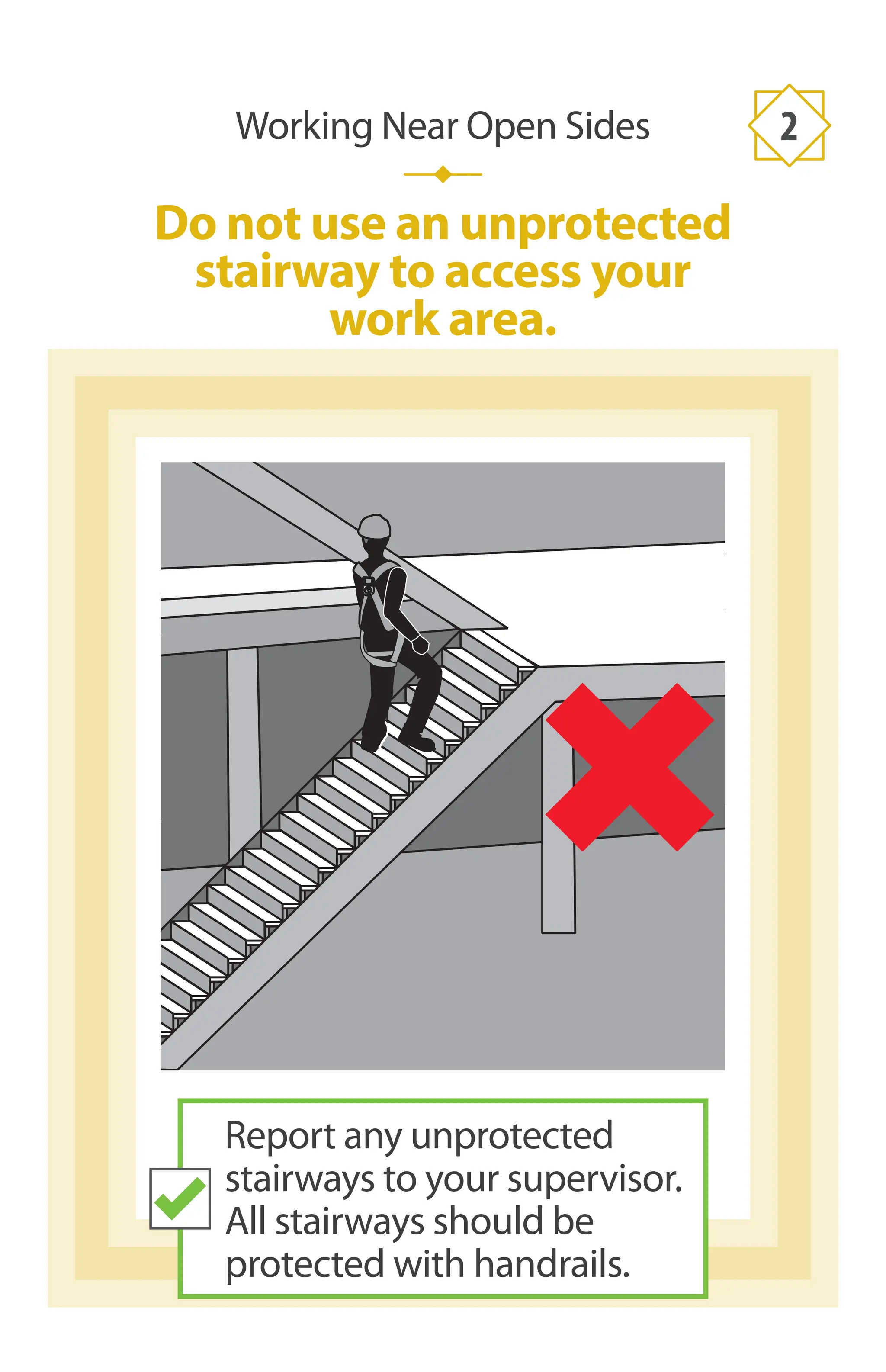
Report any unprotected
stairways to your supervisor.
All stairways should be
protected with handrails.
Do not use an unprotected
stairway to access your
work area.
Working Near Open Sides 2
Openings should be securely
fenced or covered to prevent
falling hazard.
Openings should be guarded at
all times, even during breaks.
Report any unguarded
openings to your supervisor.
Working Near Open Sides 3
Do not remove any
guardrails unless instructed
by your supervisor.
Working Near Open Sides 4
Always follow all safety
control measures when
removing any guardrails.
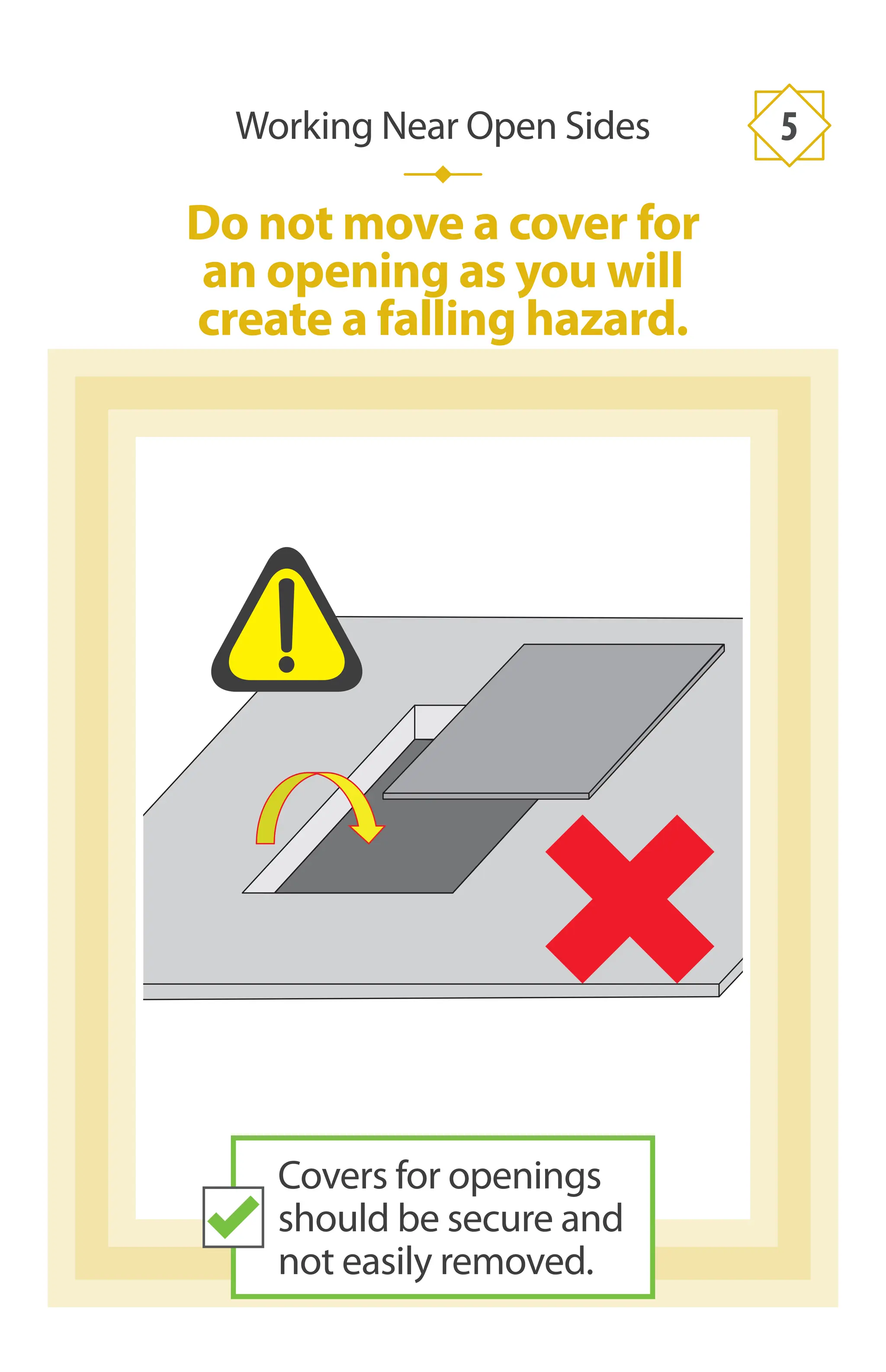
Do not move a cover for
an opening as you will
create a falling hazard.
Working Near Open Sides 5
Covers for openings
should be secure and
not easily removed.
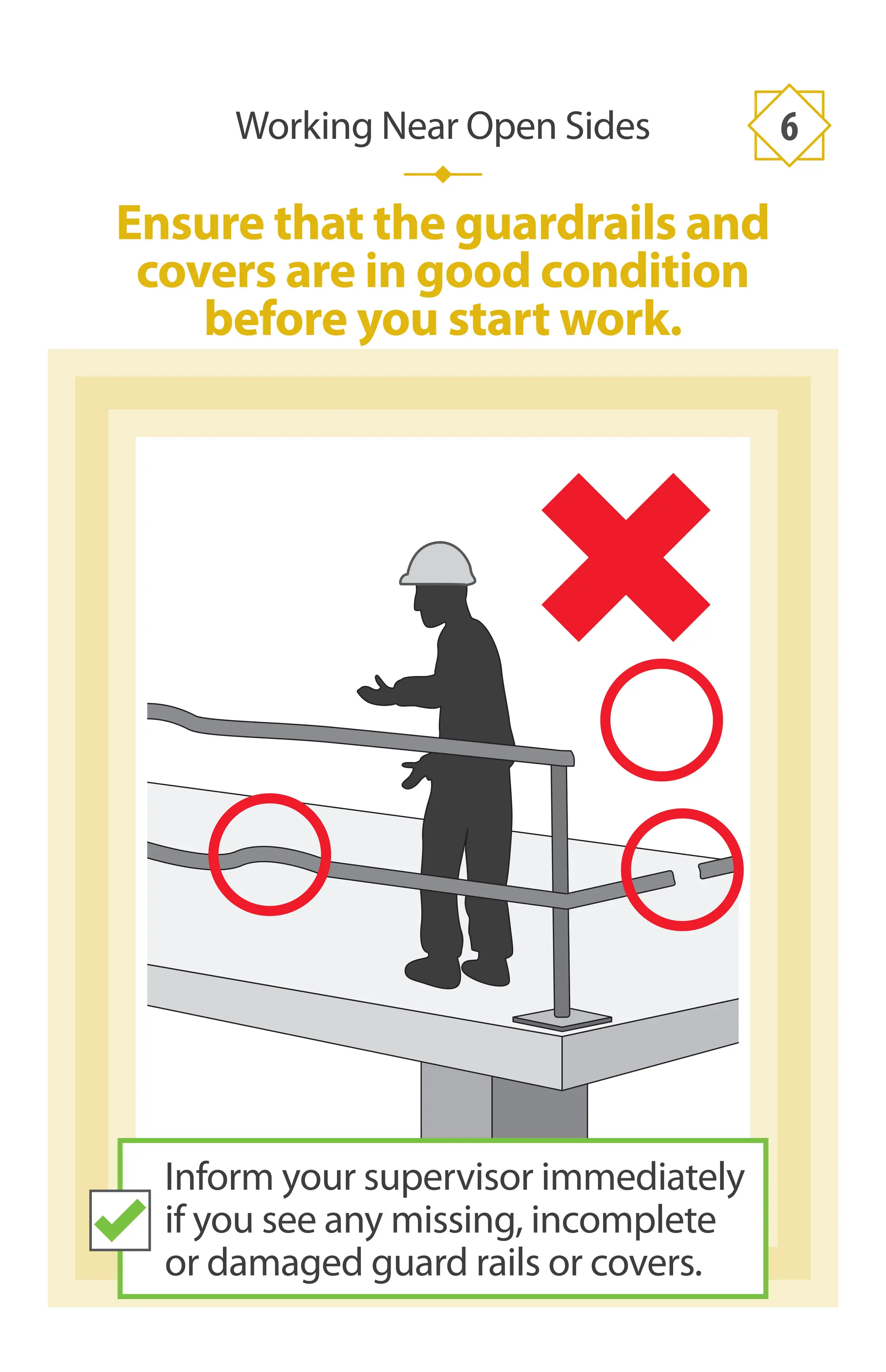
Ensure that the guardrails and
covers are in good condition
before you start work.
Working Near Open Sides 6
Inform your supervisor immediately
if you see any missing, incomplete
or damaged guard rails or covers.
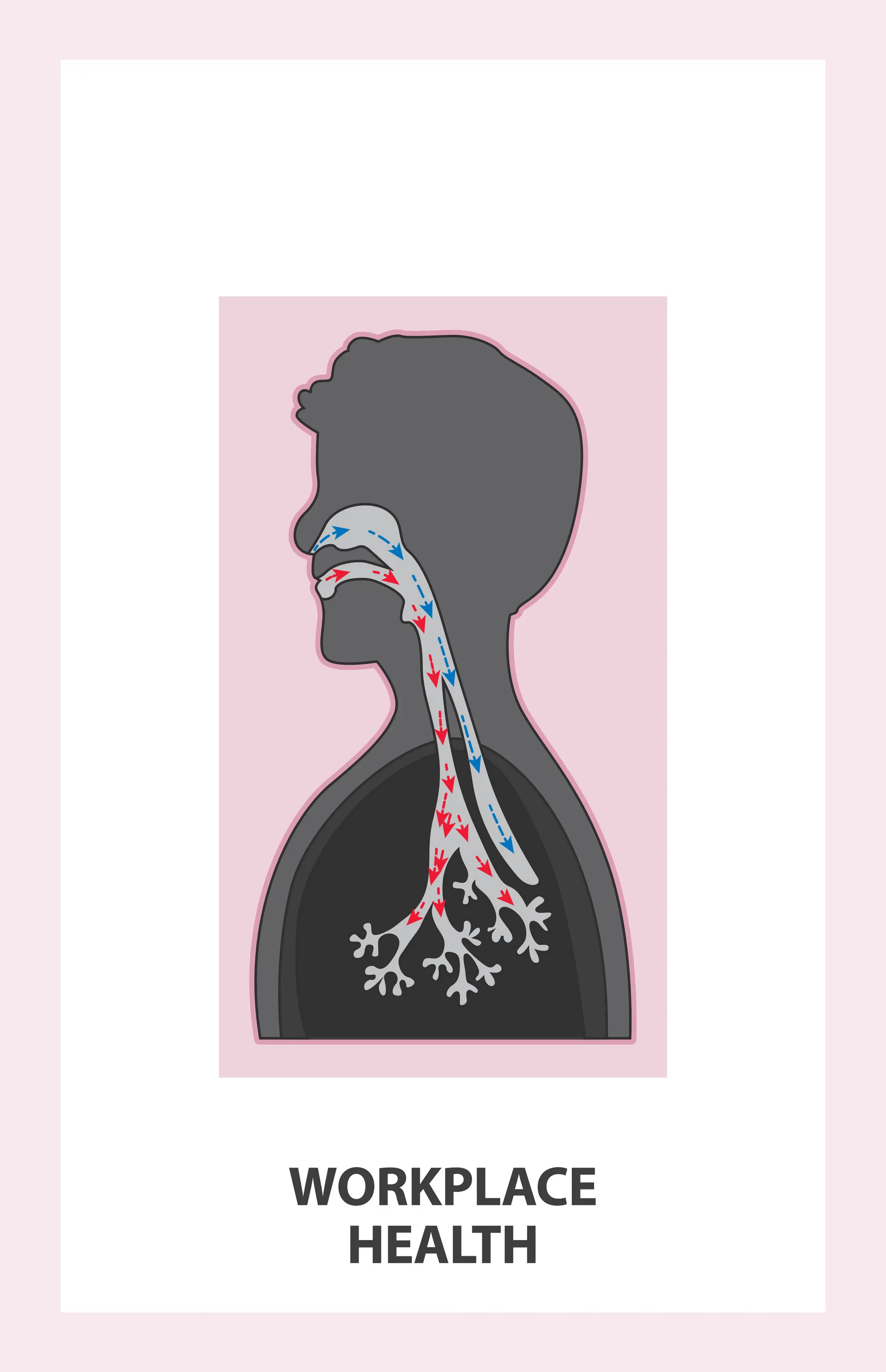
WORKPLACE
HEALTH
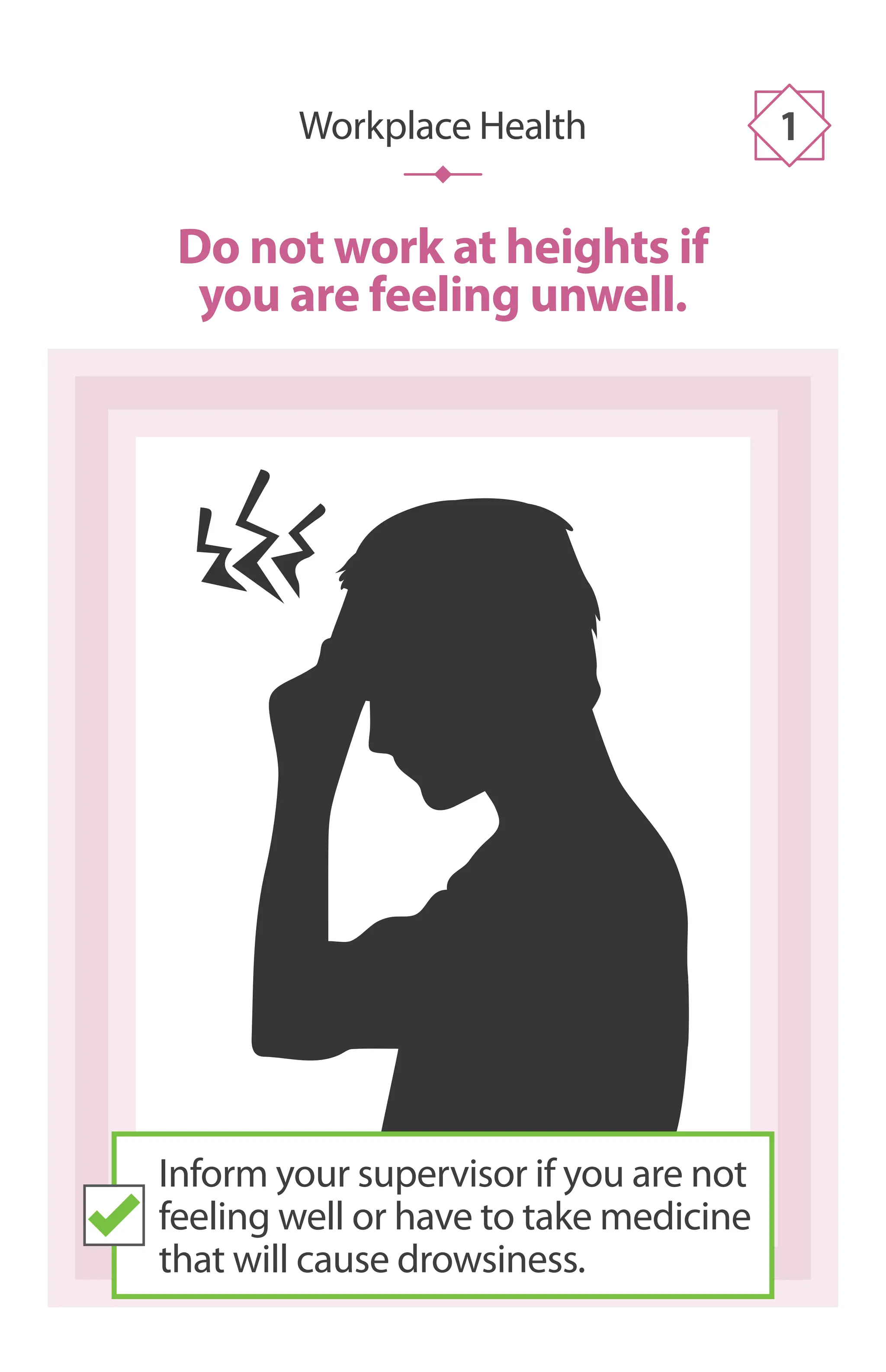
Do not work at heights if
you are feeling unwell.
Workplace Health 1
Inform your supervisor if you are not
feeling well or have to take medicine
that will cause drowsiness.
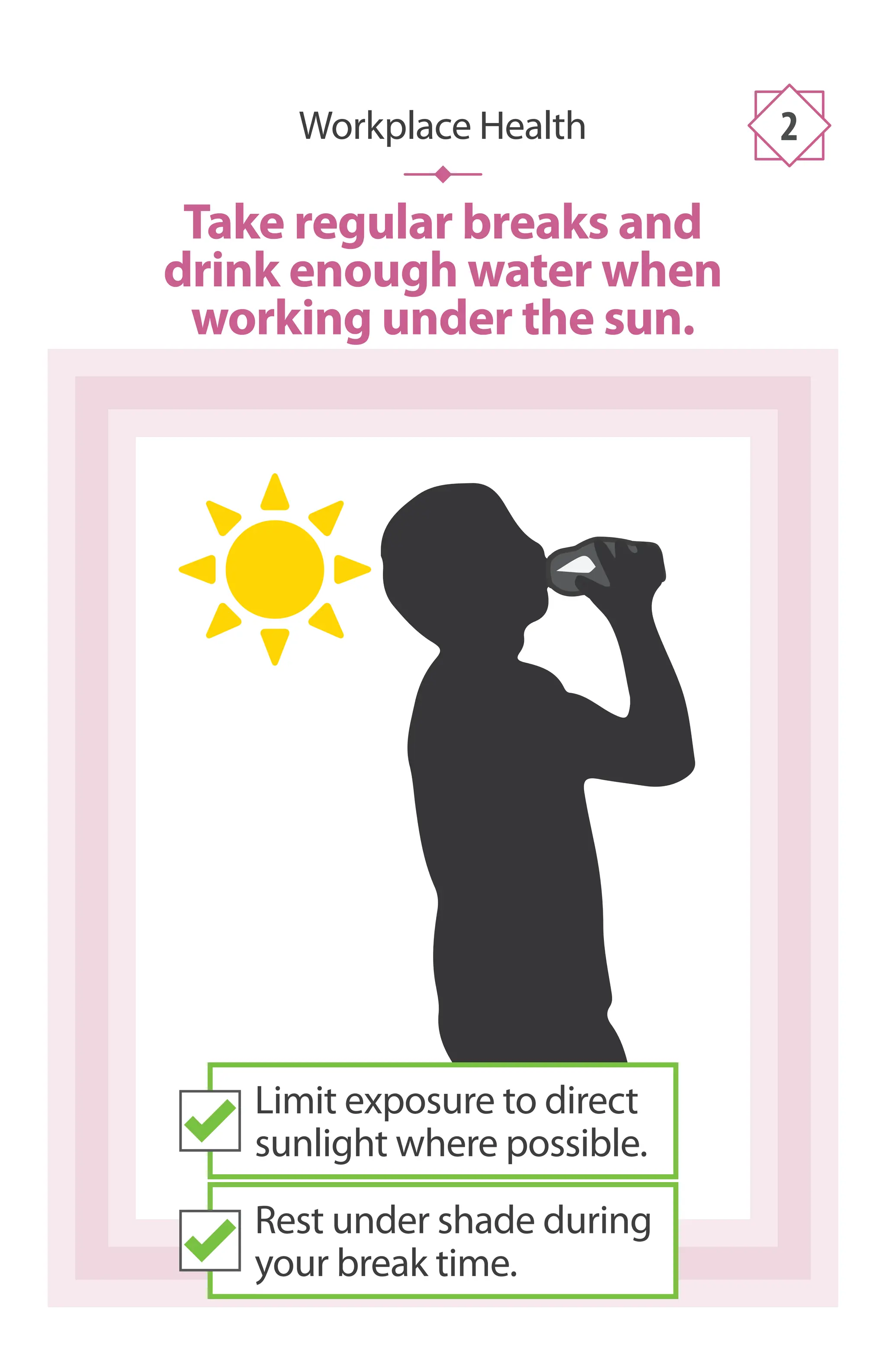
Take regular breaks and
drink enough water when
working under the sun.
Workplace Health 2
Limit exposure to direct
sunlight where possible.
Rest under shade during
your break time.
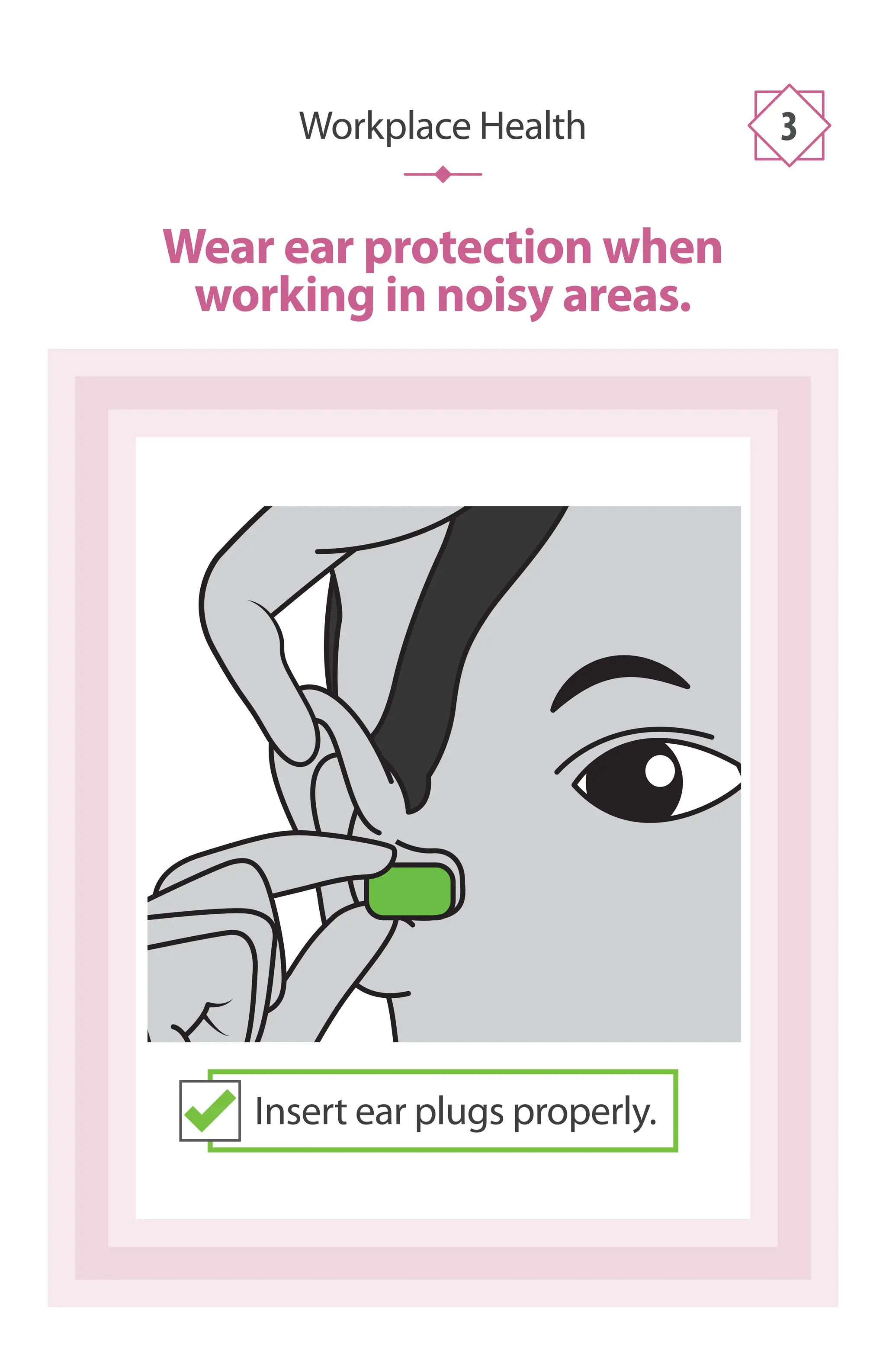
Wear ear protection when
working in noisy areas.
Workplace Health 3
Insert ear plugs properly.
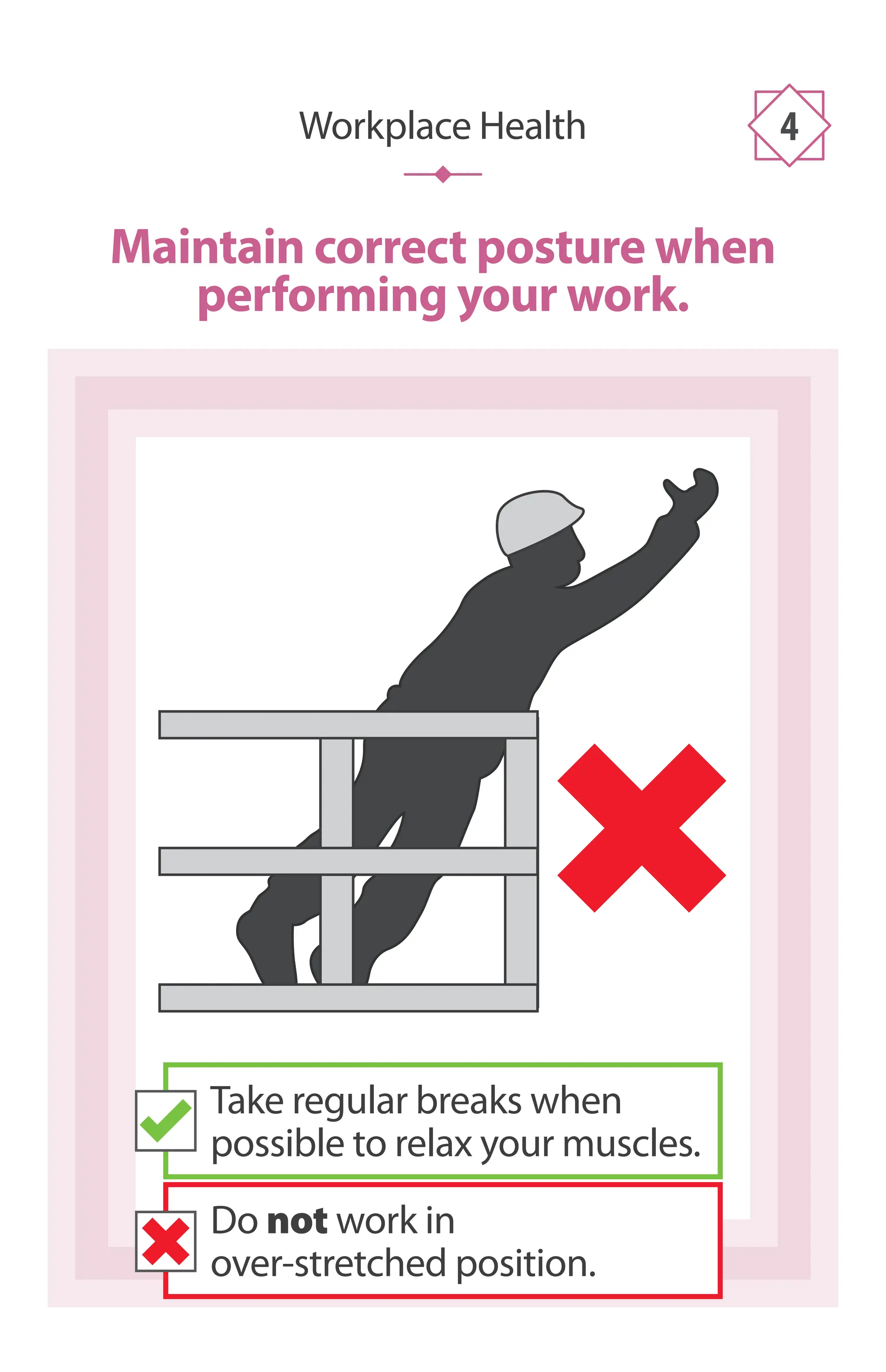
Maintain correct posture when
performing your work.
Workplace Health 4
Take regular breaks when
possible to relax your muscles.
Do not work in
over-stretched position.
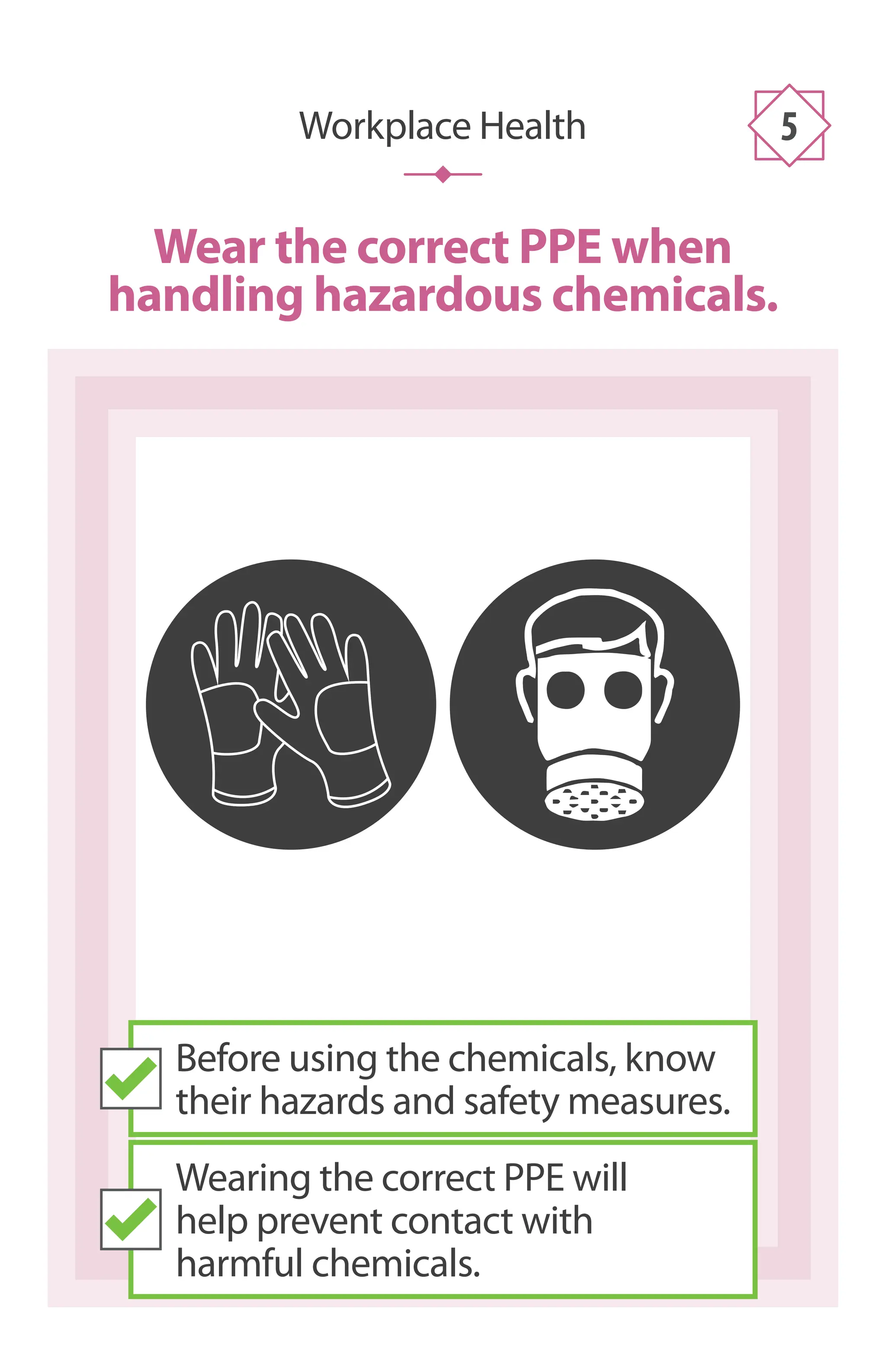
Workplace Health 5
Wear the correct PPE when
handling hazardous chemicals.
Before using the chemicals, know
their hazards and safety measures.
Wearing the correct PPE will
help prevent contact with
harmful chemicals.
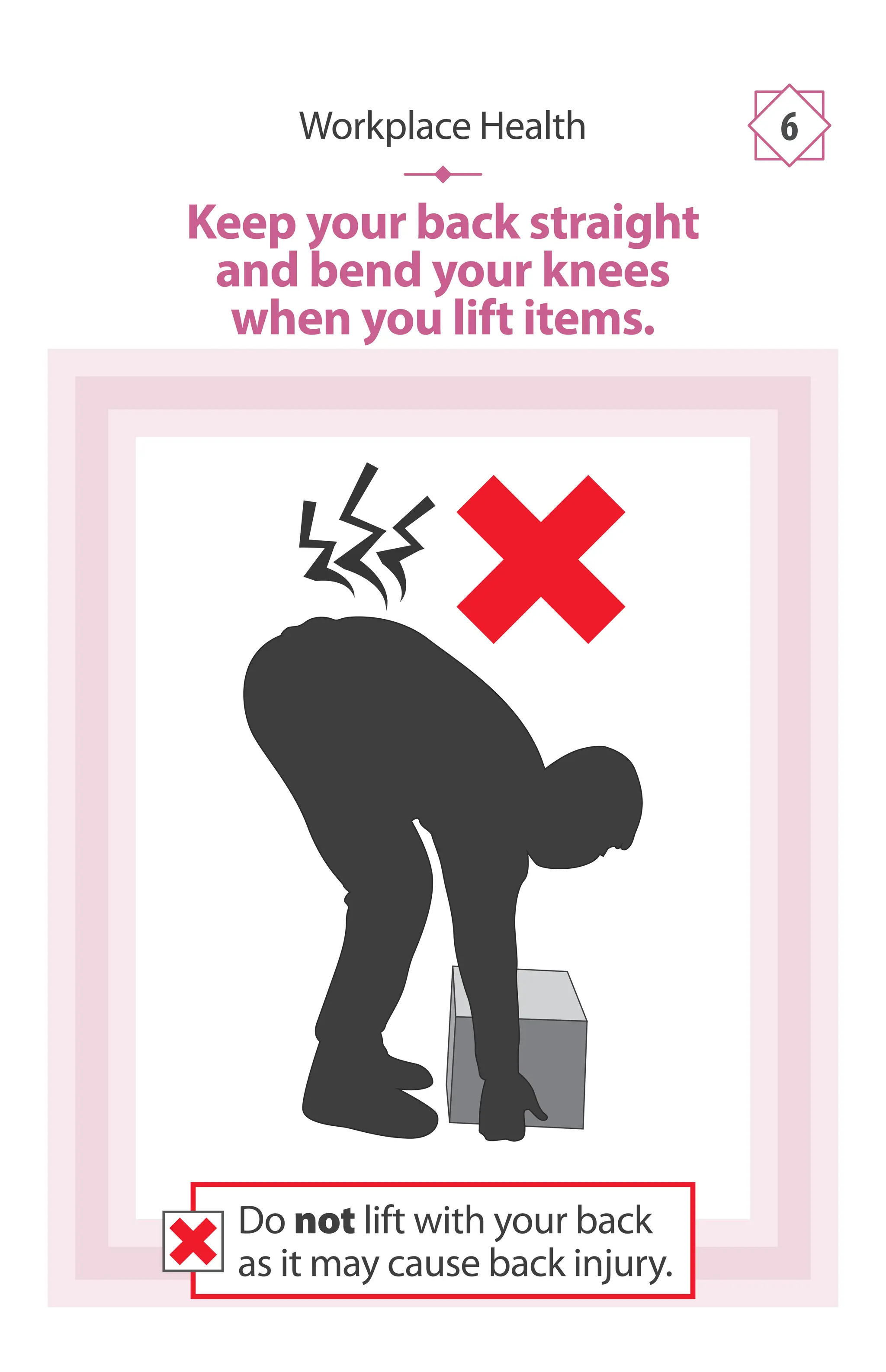
Workplace Health 6
Keep your back straight
and bend your knees
when you lift items.
Do not lift with your back
as it may cause back injury.
All rights reserved. This publication may
not be reproduced or transmitted in any
form or by any means, in whole or in part,
without prior written permission from the
Workplace Safety and Health (WSH)
Council. The information provided in this
publication is accurate as at time of
printing. The learning points and
recommendations are not exhaustive and
should neither be taken to encapsulate all
the responsibilities imposed by law nor as
replacement for independent legal
advice. The WSH Council does not accept
any liability or responsibility to any party
for any losses or damage arising from the
use of this publication.
Published in March 2016 by the
Workplace Safety and Health
Council in Collaboration with
the Ministry of Manpower
Website: www.wshc.sg
Email: contact@wshc.sg

Work at Height Kit for Supervisor and other workers

  • 1.
  • 2.
    The toolkit aimsto provide information for supervisor to communicate one topic a day to workers. Pictures are for illustration purposes only. How to use this toolkit? For Supervisors Red box or a red cross shows the wrong practice. Green box or a green tick shows the correct practice.
  • 3.
    SAFE USE OFPERSONAL FALL ARREST SYSTEM (PFAS)
  • 4.
    Get a buddyto check if you are wearing your harness correctly. Safe Use of PFAS 1 The D-ring should be located between shoulder blades.
  • 5.
    Ensure that theD-ring on your harness faces the same side as the anchor point. Front D-ring Safe Use of PFAS 2 If the anchor point is in front of you, ensure that your harness has a front D-ring for you to use. When using your rear D-ring, the anchor point should be behind you.
  • 6.
    Ensure that anchorpoint is secured before starting work. Anchor point on a structure Do not start work if the anchor point is not secure. The anchor point should be secured on structure that has been assessed as safe for use. Safe Use of PFAS 3
  • 7.
    Ensure that yourbody harness is the correct fit. Safe Use of PFAS 4 Tighten chest and leg straps so that no more than two fingers can fit between strap and body.
  • 8.
    Ensure that yourlanyard is anchored at all times. Anchored Second lanyard Safe Use of PFAS 5 Always maintain 100% tie-off. While being anchored, move to the next anchor point with your second lanyard.
  • 9.
    D-ring Anchor point Safe Use ofPFAS 6 Ensure that your lanyard is hooked onto an anchor point at all times. The lanyard should be hooked on the D-ring of your harness and the anchor point.
  • 10.
    INSPECTION OF PERSONAL FALLARREST SYSTEM (PFAS)
  • 11.
    Check for damaged surface Checkthat the surface of your harness webbing is not damaged. Inspection of PFAS 1 Do not use the harness if the webbing is damaged. Hold the webbing with both hands and bend it into an inverted“U”shape to check for damage.
  • 12.
    Frayed edges Cuts Inspect your harness beforeevery use. Inspection of PFAS 2 Loosened stitching Do not use the harness if the webbing, D-ring or any parts are damaged. Inform your supervisor if your harness is loose, worn out or cut.
  • 13.
    Ensure that theconnector is not damaged. Inspection of PFAS 3 Do not use the connector if any part is damaged. Check that the locking gear is not stuck.
  • 14.
    Inspection of PFAS4 Inspect the energy absorber of your lanyard and look out for damaged surface. Energy absorber Do not use the lanyard if the energy absorber has been activated before. Look out for holes, cuts or tears on the outer protective layer of the energy absorber.
  • 15.
    Check that yourequipment has the manufacturer’s label. Inspection of PFAS 5 Inform your supervisor if your equipment has expired. Check the expiry date of your equipment. Ask your supervisor if you are not sure. CONTENTOFHARNESSIDENTITYLABEL trademarkofthedevice number/yearoftheEuropeanstandards typeofthedevice theequipment referencenumber month/yearofthedevicemanufacture size numberofthemanufacturingseries CEmarkingandnumberof cautionreadthemanual markingofthemanufacturer ordistributor SAFETY HARNESS Ref AB 152 01 Size: M-XL CE 0082 EN 361-2002 EN 358 -2000 Date of manufacture : 03/2003 Serial number: 0000001
  • 16.
    Do not makeany markings on your harness as it may damage the harness. Inspection of PFAS 6 ABC Inform your supervisor if there are any markings on the harness. Harness must not have any markings, burn marks, cuts or cracks. Marking
  • 17.
    WORKING ON ORNEAR FRAGILE SURFACES
  • 18.
    Report any fragile surfacesin your work area to your supervisor. Fragile Surfaces 1 Examples include: roof skylight, rusted metal sheets, glass and plastic roof panels that cover an opening which you can fall through. A fragile surface is one that may not support your weight.
  • 19.
    Do not enteran area with fragile surfaces unless you are authorised. Fragile Surfaces 2 Do not enter if you were not briefed on the locations and hazards of fragile surfaces in your work area. Do not enter if you are not trained or do not understand how to work safely on or around fragile surfaces.
  • 20.
    Ensure that youare protected before stepping on a fragile surface. Fragile Surfaces 3 Always follow the safety control measures before you enter an area with fragile surfaces. Check with your supervisor if you are unsure if a surface is fragile.
  • 21.
    Keep work areatidy to prevent tripping and falling on a fragile surface. Fragile Surfaces 4 If you trip and fall on a fragile surface, the sudden and high force may break the surface. Do not place items or tools that may obstruct your walkways and work area.
  • 22.
    Avoid working aloneon or near fragile surfaces. Fragile Surfaces 5 Always work with a buddy and check on each other’s proper use of safety control measures. Stay within your buddy’s view and keep in contact with your supervisor.
  • 23.
    Do not placetools and materials on fragile surfaces. Fragile Surfaces 6 Discuss with your supervisor on how to safely load tools and materials onto your work area.
  • 24.
    SAFE USE OFMOBILE ELEVATINGWORK PLATFORM (MEWP)
  • 25.
    Only operate anMEWP if you are trained and authorised. Safe Use of MEWP 1 When working on a MEWP, always follow instructions from the authorised operator. Only use the MEWP for the task your supervisor asked you to do.
  • 26.
    Do not usethe MEWP if it is not suitable for the job. Safe Use of MEWP 2 Do not use the MEWP if the ground is too soft, uneven or slippery. Do not use the MEWP if it is not high enough to reach your work area.
  • 27.
    Keep both feeton the work platform at all times. Safe Use of MEWP 3 B. Do not anchor your lanyard to the guardrail. A. Do not climb onto guardrails. A B
  • 28.
    Connect your lanyardto a certified anchor point inside the MEWP. Safe Use of MEWP 4 A: Connect onto proper anchor point, and not to guardrails. B: Stand on the platform and do not climb on guardrails even when connected. B A
  • 29.
    Do not turnoff any safety devices of the MEWP. Safe Use of MEWP 5 Do not use the MEWP if any of the safety devices doesn’t work. Pay attention to any safety alarm when operating and working on your MEWP.
  • 30.
    Protect your MEWPfrom other moving vehicles in the area. Safe Use of MEWP 6 Inform your supervisor if there are any moving equipment (e.g., crane) near your work area. Implement control measures (e.g., set up barricade).
  • 31.
  • 32.
    Check that scaffoldis “Safe for Use”before using. Safe Use of Scaffolds 1 Look for the“Safe for Use”tag at the scaffold’s access point. Report to your supervisor if you do not see the“Safe for Use”tag. ok
  • 33.
    Do not standon items placed on the work platform.The guardrails will not be effective to prevent you from falling. Do not climb onto guardrails. Do not stand on objects to gain height on a work platform. Safe Use of Scaffolds 2
  • 34.
    Do not overloadthe scaffold. Safe Use of Scaffolds 3 Do not crowd on a work platform. Stay within your own work area. Do not carry unauthorised tools and materials to prevent overloading the scaffold.
  • 35.
    at least 50cm Checkthat a work platform is safe before stepping on it. Safe Use of Scaffolds 4 There should be no openings except for the access ladder. Work platforms should be at least 50 cm wide with no big gaps between.
  • 36.
    Do not movea mobile tower scaffold when anyone is on it. Safe Use of Scaffolds 5 Do not access or work on a mobile scaffold until all wheels are locked.
  • 37.
    Do not changeor remove any part of a scaffold. Safe Use of Scaffolds 6 Inform your supervisor if you are unable to reach your work area. Do not add or remove any parts of the scaffold.
  • 38.
  • 39.
    Select the correcttools before working at heights. Housekeeping 1 Replace the tool if it is damaged. Only bring the tools that are necessary for the task.
  • 40.
    Secure hand toolsto your body (e.g., using a tool belt) before working at heights. Place the tools and materials at areas designated by your supervisor. Arrange and secure your tools and materials. Housekeeping 2
  • 41.
    Do not leavetools, materials and debris all over the work platform. Tie up all cords, hoses and ropes to prevent tripping. Organise all objects at the elevated platform properly. Housekeeping 3
  • 42.
    Clear walkway Do notplace items at walkways and access points. Housekeeping 4 Keep walkways and access points clear at all times. Be aware of your emergency evacuation route and check that it is not blocked.
  • 43.
    Check that yourwork area has adequate lighting. Housekeeping 5 Lighting should be bright enough for you to work safely. Clean lighting fixtures regularly. Replace lights that are dim or faulty.
  • 44.
    Keep your workarea clean to prevent any hazards. Housekeeping 6 Clean up your work area after your shift. Do not leave items that may cause slips or trips on the work platform.
  • 45.
  • 46.
    Check that theladder is safe before using. Safe Use of Ladders 1 Ensure all spreaders are able to extend fully. Always check that the ladder is not damaged before using. Spreader not extended fully
  • 47.
    Ensure that theladder is stable before using. Safe Use of Ladders 2 Secured base Base of the ladder should be secured. Place the ladder on stable and level ground.
  • 48.
    Do not standon the top rung of a ladder. Safe Use of Ladders 3 The ladder’s height must be suitable so that you do not overstretch. Do not stand on top rung
  • 49.
    Always maintain 3-point contact. SafeUse of Ladders 4 3-point contact refers to using two hands and one leg or one hand and two legs on the ladder. Do not lean away from the ladder.
  • 50.
    Use a suitableladder to carry out the work. Safe Use of Ladders 5 Choose a ladder that is suitable for the job. Do not use items such as chairs or boxes to replace a ladder.
  • 51.
    Set up theladder at a safe place. Do not set up ladders in passageways, doorways or near the edge of an open floor or on scaffolding. Safe Use of Ladders 6
  • 52.
  • 53.
    Keep area clear Keep accessand egress points clear at all times. Access and Engress 1 Check that the access and egress area is well-maintained and not blocked.
  • 54.
    Access and Engress2 Know the access and egress points for your work area. Always be aware of your access and egress routes. Follow the directions to exit during emergencies.
  • 55.
    Access and Engress3 Clean up any slips hazards along your access route. For spills on a small area, use proper equipment to clean up. Check with your supervisor if you are unsure what the spilled chemical is. For big spills, inform your supervisor and get help to clean up.
  • 56.
    Access and Engress4 Do not access a restricted area if you are not authorised to enter. Do not enter a restricted area you are not assigned to work in.There may be hazards that you are not aware of.
  • 57.
    Access and Engress5 For ladder access to another level, check that it extends 1 metre above the landing point. The ladder extension above the landing point provides a secure handhold. 1 m extension above landing point
  • 58.
    Access and Engress6 Keep your hands free when climbing. Always hold on onto the handrails when climbing.
  • 59.
  • 60.
    Understand the control measuresif you are working near an open side. Working Near Open Sides 1 You must be trained on how to work safely near an open side, for example, using travel restraint properly.
  • 61.
    Report any unprotected stairwaysto your supervisor. All stairways should be protected with handrails. Do not use an unprotected stairway to access your work area. Working Near Open Sides 2
  • 62.
    Openings should besecurely fenced or covered to prevent falling hazard. Openings should be guarded at all times, even during breaks. Report any unguarded openings to your supervisor. Working Near Open Sides 3
  • 63.
    Do not removeany guardrails unless instructed by your supervisor. Working Near Open Sides 4 Always follow all safety control measures when removing any guardrails.
  • 64.
    Do not movea cover for an opening as you will create a falling hazard. Working Near Open Sides 5 Covers for openings should be secure and not easily removed.
  • 65.
    Ensure that theguardrails and covers are in good condition before you start work. Working Near Open Sides 6 Inform your supervisor immediately if you see any missing, incomplete or damaged guard rails or covers.
  • 66.
  • 67.
    Do not workat heights if you are feeling unwell. Workplace Health 1 Inform your supervisor if you are not feeling well or have to take medicine that will cause drowsiness.
  • 68.
    Take regular breaksand drink enough water when working under the sun. Workplace Health 2 Limit exposure to direct sunlight where possible. Rest under shade during your break time.
  • 69.
    Wear ear protectionwhen working in noisy areas. Workplace Health 3 Insert ear plugs properly.
  • 70.
    Maintain correct posturewhen performing your work. Workplace Health 4 Take regular breaks when possible to relax your muscles. Do not work in over-stretched position.
  • 71.
    Workplace Health 5 Wearthe correct PPE when handling hazardous chemicals. Before using the chemicals, know their hazards and safety measures. Wearing the correct PPE will help prevent contact with harmful chemicals.
  • 72.
    Workplace Health 6 Keepyour back straight and bend your knees when you lift items. Do not lift with your back as it may cause back injury.
  • 73.
    All rights reserved.This publication may not be reproduced or transmitted in any form or by any means, in whole or in part, without prior written permission from the Workplace Safety and Health (WSH) Council. The information provided in this publication is accurate as at time of printing. The learning points and recommendations are not exhaustive and should neither be taken to encapsulate all the responsibilities imposed by law nor as replacement for independent legal advice. The WSH Council does not accept any liability or responsibility to any party for any losses or damage arising from the use of this publication.
  • 74.
    Published in March2016 by the Workplace Safety and Health Council in Collaboration with the Ministry of Manpower Website: www.wshc.sg Email: contact@wshc.sg