Sept 4, 2023
Managing Retailing
Session 3
Understanding
where the
company stands
and how to
possible
overcome
challenges?
CASE ANALYSIS
Metro Cash
& Carry
GROUP 15
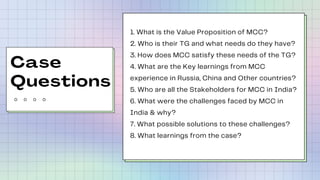
Case
Questions
1. What is the Value Proposition of MCC?
2. Who is their TG and what needs do they have?
3. How does MCC satisfy these needs of the TG?
4. What are the Key learnings from MCC
experience in Russia, China and Other countries?
5. Who are all the Stakeholders for MCC in India?
6. What were the challenges faced by MCC in
India & why?
7. What possible solutions to these challenges?
8. What learnings from the case?
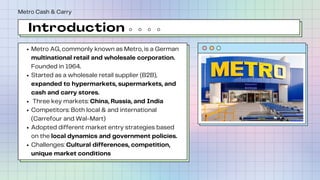
Introduction
Metro AG, commonly known as Metro, is a German
multinational retail and wholesale corporation.
Founded in 1964.
Started as a wholesale retail supplier (B2B),
expanded to hypermarkets, supermarkets, and
cash and carry stores.
Three key markets: China, Russia, and India
Competitors: Both local & and international
(Carrefour and Wal-Mart)
Adopted different market entry strategies based
on the local dynamics and government policies.
Challenges: Cultural differences, competition,
unique market conditions
Metro Cash & Carry
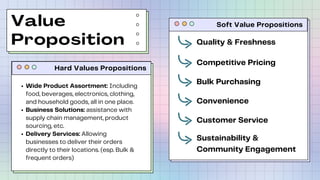
Value
Proposition
Soft Value Propositions
Hard Values Propositions
Wide Product Assortment: Including
food, beverages, electronics, clothing,
and household goods, all in one place.
Business Solutions: assistance with
supply chain management, product
sourcing, etc.
Delivery Services: Allowing
businesses to deliver their orders
directly to their locations. (esp. Bulk &
frequent orders)
Competitive Pricing
Bulk Purchasing
Convenience
Customer Service
Sustainability &
Community Engagement
Quality & Freshness
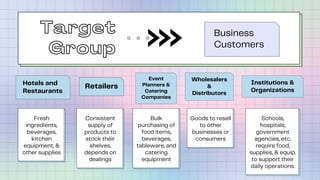
Target
Group
Business
Customers
Hotels and
Restaurants
Retailers
Event
Planners &
Catering
Companies
Wholesalers
&
Distributors
Institutions &
Organizations
Fresh
ingredients,
beverages,
kitchen
equipment, &
other supplies
Consistent
supply of
products to
stock their
shelves,
depends on
dealings
Bulk
purchasing of
food items,
beverages,
tableware, and
catering
equipment
Goods to resell
to other
businesses or
consumers
Schools,
hospitals,
government
agencies, etc.
require food,
supplies, & equip.
to support their
daily operations.
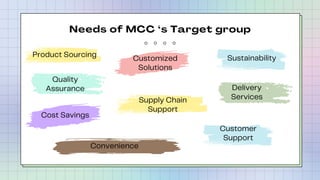
Needs of MCC ‘s Target group
Product Sourcing Customized
Solutions
Sustainability
Supply Chain
Support
Quality
Assurance
Cost Savings
Customer
Support
Convenience
Delivery
Services
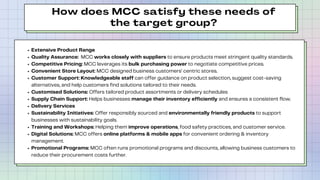
How does MCC satisfy these needs of
the target group?
Extensive Product Range
Quality Assurance: MCC works closely with suppliers to ensure products meet stringent quality standards.
Competitive Pricing: MCC leverages its bulk purchasing power to negotiate competitive prices.
Convenient Store Layout: MCC designed business customers’ centric stores.
Customer Support: Knowledgeable staff can offer guidance on product selection, suggest cost-saving
alternatives, and help customers find solutions tailored to their needs.
Customised Solutions: Offers tailored product assortments or delivery schedules
Supply Chain Support: Helps businesses manage their inventory efficiently and ensures a consistent flow.
Delivery Services
Sustainability Initiatives: Offer responsibly sourced and environmentally friendly products to support
businesses with sustainability goals.
Training and Workshops: Helping them improve operations, food safety practices, and customer service.
Digital Solutions: MCC offers online platforms & mobile apps for convenient ordering & inventory
management.
Promotional Programs: MCC often runs promotional programs and discounts, allowing business customers to
reduce their procurement costs further.
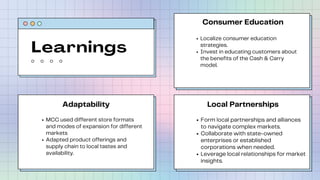
Learnings
Adaptability
MCC used different store formats
and modes of expansion for different
markets
Adapted product offerings and
supply chain to local tastes and
availability.
Consumer Education
Localize consumer education
strategies.
Invest in educating customers about
the benefits of the Cash & Carry
model.
Form local partnerships and alliances
to navigate complex markets.
Collaborate with state-owned
enterprises or established
corporations when needed.
Leverage local relationships for market
insights.
Local Partnerships
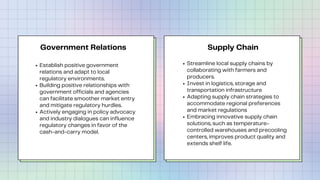
Establish positive government
relations and adapt to local
regulatory environments.
Building positive relationships with
government officials and agencies
can facilitate smoother market entry
and mitigate regulatory hurdles.
Actively engaging in policy advocacy
and industry dialogues can influence
regulatory changes in favor of the
cash-and-carry model.
Government Relations
Streamline local supply chains by
collaborating with farmers and
producers.
Invest in logistics, storage and
transportation infrastructure
Adapting supply chain strategies to
accommodate regional preferences
and market regulations
Embracing innovative supply chain
solutions, such as temperature-
controlled warehouses and precooling
centers, improves product quality and
extends shelf life.
Supply Chain
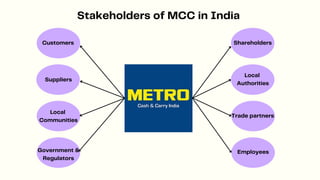
Stakeholders of MCC in India
Customers
Government &
Regulators
Trade partners
Shareholders
Suppliers
Local
Authorities
Local
Communities
Employees
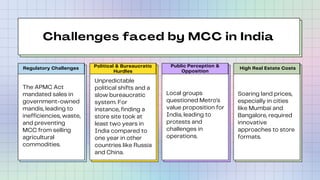
Challenges faced by MCC in India
Political & Bureaucratic
Hurdles
Regulatory Challenges Public Perception &
Opposition
High Real Estate Costs
The APMC Act
mandated sales in
government-owned
mandis, leading to
inefficiencies, waste,
and preventing
MCC from selling
agricultural
commodities.
Unpredictable
political shifts and a
slow bureaucratic
system. For
instance, finding a
store site took at
least two years in
India compared to
one year in other
countries like Russia
and China.
Local groups
questioned Metro's
value proposition for
India, leading to
protests and
challenges in
operations.
Soaring land prices,
especially in cities
like Mumbai and
Bangalore, required
innovative
approaches to store
formats.
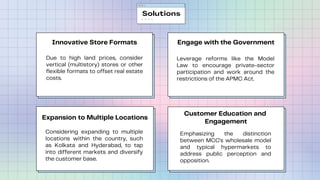
Innovative Store Formats
Due to high land prices, consider
vertical (multistory) stores or other
flexible formats to offset real estate
costs.
Customer Education and
Engagement
Emphasizing the distinction
between MCC's wholesale model
and typical hypermarkets to
address public perception and
opposition.
Engage with the Government
Leverage reforms like the Model
Law to encourage private-sector
participation and work around the
restrictions of the APMC Act.
Expansion to Multiple Locations
Considering expanding to multiple
locations within the country, such
as Kolkata and Hyderabad, to tap
into different markets and diversify
the customer base.
Solutions
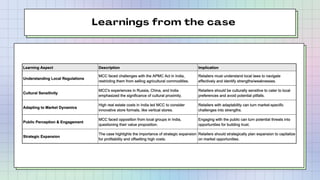
Learnings from the case
MCC Company
Thank
you!

Metro Cash & Carry Case Analysis.pdf

  • 1.
    Sept 4, 2023 ManagingRetailing Session 3 Understanding where the company stands and how to possible overcome challenges? CASE ANALYSIS Metro Cash & Carry GROUP 15
  • 2.
    Case Questions 1. What isthe Value Proposition of MCC? 2. Who is their TG and what needs do they have? 3. How does MCC satisfy these needs of the TG? 4. What are the Key learnings from MCC experience in Russia, China and Other countries? 5. Who are all the Stakeholders for MCC in India? 6. What were the challenges faced by MCC in India & why? 7. What possible solutions to these challenges? 8. What learnings from the case?
  • 3.
    Introduction Metro AG, commonlyknown as Metro, is a German multinational retail and wholesale corporation. Founded in 1964. Started as a wholesale retail supplier (B2B), expanded to hypermarkets, supermarkets, and cash and carry stores. Three key markets: China, Russia, and India Competitors: Both local & and international (Carrefour and Wal-Mart) Adopted different market entry strategies based on the local dynamics and government policies. Challenges: Cultural differences, competition, unique market conditions Metro Cash & Carry
  • 4.
    Value Proposition Soft Value Propositions HardValues Propositions Wide Product Assortment: Including food, beverages, electronics, clothing, and household goods, all in one place. Business Solutions: assistance with supply chain management, product sourcing, etc. Delivery Services: Allowing businesses to deliver their orders directly to their locations. (esp. Bulk & frequent orders) Competitive Pricing Bulk Purchasing Convenience Customer Service Sustainability & Community Engagement Quality & Freshness
  • 5.
    Target Group Business Customers Hotels and Restaurants Retailers Event Planners & Catering Companies Wholesalers & Distributors Institutions& Organizations Fresh ingredients, beverages, kitchen equipment, & other supplies Consistent supply of products to stock their shelves, depends on dealings Bulk purchasing of food items, beverages, tableware, and catering equipment Goods to resell to other businesses or consumers Schools, hospitals, government agencies, etc. require food, supplies, & equip. to support their daily operations.
  • 6.
    Needs of MCC‘s Target group Product Sourcing Customized Solutions Sustainability Supply Chain Support Quality Assurance Cost Savings Customer Support Convenience Delivery Services
  • 7.
    How does MCCsatisfy these needs of the target group? Extensive Product Range Quality Assurance: MCC works closely with suppliers to ensure products meet stringent quality standards. Competitive Pricing: MCC leverages its bulk purchasing power to negotiate competitive prices. Convenient Store Layout: MCC designed business customers’ centric stores. Customer Support: Knowledgeable staff can offer guidance on product selection, suggest cost-saving alternatives, and help customers find solutions tailored to their needs. Customised Solutions: Offers tailored product assortments or delivery schedules Supply Chain Support: Helps businesses manage their inventory efficiently and ensures a consistent flow. Delivery Services Sustainability Initiatives: Offer responsibly sourced and environmentally friendly products to support businesses with sustainability goals. Training and Workshops: Helping them improve operations, food safety practices, and customer service. Digital Solutions: MCC offers online platforms & mobile apps for convenient ordering & inventory management. Promotional Programs: MCC often runs promotional programs and discounts, allowing business customers to reduce their procurement costs further.
  • 8.
    Learnings Adaptability MCC used differentstore formats and modes of expansion for different markets Adapted product offerings and supply chain to local tastes and availability. Consumer Education Localize consumer education strategies. Invest in educating customers about the benefits of the Cash & Carry model. Form local partnerships and alliances to navigate complex markets. Collaborate with state-owned enterprises or established corporations when needed. Leverage local relationships for market insights. Local Partnerships
  • 9.
    Establish positive government relationsand adapt to local regulatory environments. Building positive relationships with government officials and agencies can facilitate smoother market entry and mitigate regulatory hurdles. Actively engaging in policy advocacy and industry dialogues can influence regulatory changes in favor of the cash-and-carry model. Government Relations Streamline local supply chains by collaborating with farmers and producers. Invest in logistics, storage and transportation infrastructure Adapting supply chain strategies to accommodate regional preferences and market regulations Embracing innovative supply chain solutions, such as temperature- controlled warehouses and precooling centers, improves product quality and extends shelf life. Supply Chain
  • 10.
    Stakeholders of MCCin India Customers Government & Regulators Trade partners Shareholders Suppliers Local Authorities Local Communities Employees
  • 11.
    Challenges faced byMCC in India Political & Bureaucratic Hurdles Regulatory Challenges Public Perception & Opposition High Real Estate Costs The APMC Act mandated sales in government-owned mandis, leading to inefficiencies, waste, and preventing MCC from selling agricultural commodities. Unpredictable political shifts and a slow bureaucratic system. For instance, finding a store site took at least two years in India compared to one year in other countries like Russia and China. Local groups questioned Metro's value proposition for India, leading to protests and challenges in operations. Soaring land prices, especially in cities like Mumbai and Bangalore, required innovative approaches to store formats.
  • 12.
    Innovative Store Formats Dueto high land prices, consider vertical (multistory) stores or other flexible formats to offset real estate costs. Customer Education and Engagement Emphasizing the distinction between MCC's wholesale model and typical hypermarkets to address public perception and opposition. Engage with the Government Leverage reforms like the Model Law to encourage private-sector participation and work around the restrictions of the APMC Act. Expansion to Multiple Locations Considering expanding to multiple locations within the country, such as Kolkata and Hyderabad, to tap into different markets and diversify the customer base. Solutions
  • 13.
  • 14.