Lesson 3:  Volume T. Trimpe 2008  http://sciencespot.net/
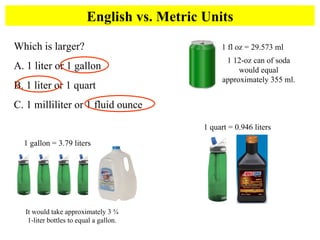
English vs. Metric Units Which is larger?  A. 1 liter or 1 gallon B. 1 liter or 1 quart C. 1 milliliter or 1 fluid ounce 1 gallon = 3.79 liters It would take approximately 3 ¾ 1-liter bottles to equal a gallon. 1 fl oz = 29.573 ml 1 12-oz can of soda would equal approximately 355 ml. 1 quart = 0.946 liters
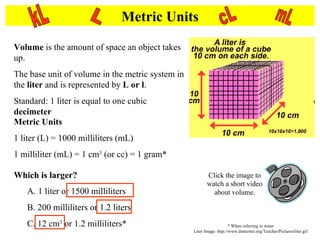
Metric Units Volume  is the amount of space an object takes up.  The base unit of volume in the metric system in the  liter  and is represented by  L or l . Standard: 1 liter is equal to one cubic  decimeter   Metric Units 1 liter (L) = 1000 milliliters (mL) 1 milliliter (mL) = 1 cm 3  (or cc) = 1 gram* L kL cL mL Which is larger? A. 1 liter or 1500 milliliters B. 200 milliliters or 1.2 liters C. 12 cm 3  or 1.2 milliliters* Click the image to watch a short video about volume. * When referring to water Liter Image: http://www.dmturner.org/Teacher/Pictures/liter.gif
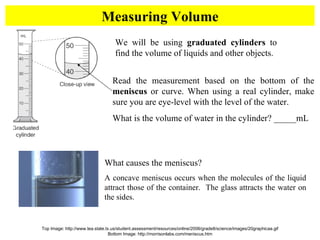
Measuring Volume Top Image: http://www.tea.state.tx.us/student.assessment/resources/online/2006/grade8/science/images/20graphicaa.gif Bottom Image: http://morrisonlabs.com/meniscus.htm We will be using  graduated cylinders  to find the volume of liquids and other objects. Read the measurement based on the bottom of the  meniscus  or curve. When using a real cylinder, make sure you are eye-level with the level of the water. What is the volume of water in the cylinder? _____mL What causes the meniscus? A concave meniscus occurs when the molecules of the liquid attract those of the container.  The glass attracts the water on the sides.
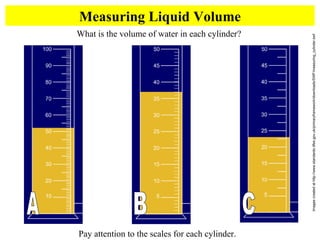
Measuring Liquid Volume Images created at http://www.standards.dfes.gov.uk/primaryframework/downloads/SWF/measuring_cylinder.swf What is the volume of water in each cylinder?  Pay attention to the scales for each cylinder. A B C
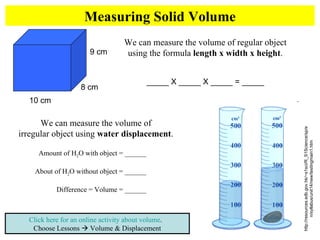
Measuring Solid Volume Click here for an online activity about volume .  Choose Lessons    Volume & Displacement We can measure the volume of regular object using the formula  length x width x height . _____ X _____ X _____ = _____ 10 cm 9 cm 8 cm http://resources.edb.gov.hk/~s1sci/R_S1Science/sp/en/syllabus/unit14/new/testingmain1.htm We can measure the volume of  irregular object using  water displacement .  Amount of H 2 O with object = ______ About of H 2 O without object = ______ Difference = Volume = ______

Metric Volume

  • 1.
    Lesson 3: Volume T. Trimpe 2008 http://sciencespot.net/
  • 2.
    English vs. MetricUnits Which is larger? A. 1 liter or 1 gallon B. 1 liter or 1 quart C. 1 milliliter or 1 fluid ounce 1 gallon = 3.79 liters It would take approximately 3 ¾ 1-liter bottles to equal a gallon. 1 fl oz = 29.573 ml 1 12-oz can of soda would equal approximately 355 ml. 1 quart = 0.946 liters
  • 3.
    Metric Units Volume is the amount of space an object takes up. The base unit of volume in the metric system in the liter and is represented by L or l . Standard: 1 liter is equal to one cubic decimeter Metric Units 1 liter (L) = 1000 milliliters (mL) 1 milliliter (mL) = 1 cm 3 (or cc) = 1 gram* L kL cL mL Which is larger? A. 1 liter or 1500 milliliters B. 200 milliliters or 1.2 liters C. 12 cm 3 or 1.2 milliliters* Click the image to watch a short video about volume. * When referring to water Liter Image: http://www.dmturner.org/Teacher/Pictures/liter.gif
  • 4.
    Measuring Volume TopImage: http://www.tea.state.tx.us/student.assessment/resources/online/2006/grade8/science/images/20graphicaa.gif Bottom Image: http://morrisonlabs.com/meniscus.htm We will be using graduated cylinders to find the volume of liquids and other objects. Read the measurement based on the bottom of the meniscus or curve. When using a real cylinder, make sure you are eye-level with the level of the water. What is the volume of water in the cylinder? _____mL What causes the meniscus? A concave meniscus occurs when the molecules of the liquid attract those of the container. The glass attracts the water on the sides.
  • 5.
    Measuring Liquid VolumeImages created at http://www.standards.dfes.gov.uk/primaryframework/downloads/SWF/measuring_cylinder.swf What is the volume of water in each cylinder? Pay attention to the scales for each cylinder. A B C
  • 6.
    Measuring Solid VolumeClick here for an online activity about volume . Choose Lessons  Volume & Displacement We can measure the volume of regular object using the formula length x width x height . _____ X _____ X _____ = _____ 10 cm 9 cm 8 cm http://resources.edb.gov.hk/~s1sci/R_S1Science/sp/en/syllabus/unit14/new/testingmain1.htm We can measure the volume of irregular object using water displacement . Amount of H 2 O with object = ______ About of H 2 O without object = ______ Difference = Volume = ______