METHODS OF
TEACHING
MATHEMATICS
INTRODUCTION
• How to teach is really difficult
problem for the teacher. To
make the teaching of
mathematics vital the teacher
should know the proper
methods of teaching.
DEFINITIONS
• METHOD IS NOTHING BUT WAY OF
PRESENTING SUBJECT MATTER
KEEPING IN MIND THE PSYCHOLOGICAL
AND PHYSICAL ENVIRONMENT OF THE
STUDENTS.
• TEACHING IS AN ART, METHODS ARE
WAYS TO UNDERSTAND AND PRACTICE
THE ART.
MAJOR METHODS OF TEACHING
The purpose of studying this method is to make teachers masters
of many methods and share of none, such that the teacher could
choose the best out of the many appropriate to the content of the
lesson, need of the class, chronological and mental age of the pupils.
• LECTURE METHOD
• HEURISTIC METHOD
• INDUCTIVE-DEDUCTIVE METHOD; and
• ANALYTIC-SYNTHETIC METHOD
LECTURED METHOD
Lecture method can be
considered as the oldest method. It is
based on the philosophy of idealism. It
is the method of depicting everything in
words. The speaker speaks and the
listener listen. This is a one man show
because the children remain the
passive through out the process.
PHASES IN THE LECTURE
METHOD
There are three phases in the process of
lecture method.
PREPARATORY PHASE
In this phase, teacher prepare the students to
receive the content of the lecture by asking
questions relating the new topic to the topic
already taught in the class at random.
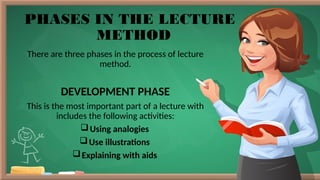
PHASES IN THE LECTURE
METHOD
There are three phases in the process of lecture
method.
DEVELOPMENT PHASE
This is the most important part of a lecture with
includes the following activities:
Using analogies
Use illustrations
Explaining with aids
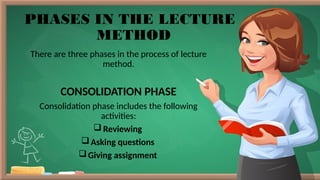
PHASES IN THE LECTURE
METHOD
There are three phases in the process of lecture
method.
CONSOLIDATION PHASE
Consolidation phase includes the following
activities:
 Reviewing
Asking questions
Giving assignment
ADVANTAGES OF LECTURE
METHOD
• It is easy for the teacher to prepare and execute.
• Large number of students can be handled at the same time.
• It gives students training and listening.
DISADVANTAGES OF
LECTURE METHOD
• Lengthy lectures can easily lead to boredom.
• It does not encourage pupil activity unless the lecture is extremely
competent.
• In this method more content may be covered by the teacher, but less
learning may take place.
HEURISTIC METHOD
The term heuristic is derived from a Greek word
“heurisco” which means I found or finding of oneself.
This method develop scientific and mathematical
hence, it has a special place in mathematics teaching.
DEFINITION
• The heuristic method is intended to
provide a training in method
knowledge is a secondary
consideration all together.
• This is the method of teaching which
places the pupil as far as possible in
the attitude of discover.
ADVANTAGES OF HEURISTIC
METHOD
• This is based on principle of philosophy.
• It develop research skills among children.
• It develop self-confidence and self-reliance.
• It develop scientific attitude.
• The knowledge gained by this method is long lasting.
DISADVANTAGES OF
HEURISTIC METHOD
• It is very slow method.
• It is very expensive method.
• This method is not suitable for lower classes.
• This method requires special preparation on the part of the teacher.
DEDUCTIVE AND INDUCTIVE
METHOD
• DEDUCTIVE METHOD – first of all the rules are given and then
student are ask to apply this rules to solve more problem.
Example: Using concept of deductive reasoning find the solution of the
syllogism having the following statement.
1. Every number divisible by 20 is also divisible by 10.
2. Every number divisible by 10 is an even number.
DEDUCTIVE AND INDUCTIVE
METHOD
• INDUCTIVE METHOD – Make use of students “perceiving” in this
method the teacher present with many examples showing how the
concept used.
Example:
1. Square of an odd number is odd and the square of even number is
even.
ANALYTIC AND
SYNTHETIC METHOD
•ANALITICAL METHOD – this meaning of the word analysis is to
– separate thing that together.
- analysis is also means – breaking up of a
given problem, so that is connects with what is already known. In
analysis we proceed from unknown to known.
ADVANTAGES OF ANALYTIC
METHOD
• It is psychological method.
• Facilitates understanding, as well as we discover facts.
• Students gains confidence and understanding.
• In this method students participation is encouraged.
DISADVANTAGES OF ANALYTIC
METHOD
• It is time consuming and lengthy method, so it is uneconomical.
• Not applicable to all topics.
• Not suitable for student with weak conceptual knowledge.
SYNTHETIC AND
SYNTHETIC METHOD
•SYNTHETIC METHOD – The word synthesis simple means – to
place things together or to join separate parts.
- To synthesis is to combine the elements to
produce something new.
ADVANTAGES OF SYNTHETIC
METHOD
• It is short and precise method.
• It saves time and energy.
• It suits the needs to a majority of the students.
• Accuracy is developed by the method.
DISADVANTAGES OF SYNTHETIC
METHOD
• There is no scope of discovery.
• Teacher-centered method, students are passive listener.
• No opportunity to develop the skills of thinking and reasoning.
• Student lack confidence to do other type of sums.
METHODS_OF_TEACHING in Mathematics subject.pptx

  • 1.
  • 2.
    INTRODUCTION • How toteach is really difficult problem for the teacher. To make the teaching of mathematics vital the teacher should know the proper methods of teaching.
  • 3.
    DEFINITIONS • METHOD ISNOTHING BUT WAY OF PRESENTING SUBJECT MATTER KEEPING IN MIND THE PSYCHOLOGICAL AND PHYSICAL ENVIRONMENT OF THE STUDENTS. • TEACHING IS AN ART, METHODS ARE WAYS TO UNDERSTAND AND PRACTICE THE ART.
  • 4.
    MAJOR METHODS OFTEACHING The purpose of studying this method is to make teachers masters of many methods and share of none, such that the teacher could choose the best out of the many appropriate to the content of the lesson, need of the class, chronological and mental age of the pupils. • LECTURE METHOD • HEURISTIC METHOD • INDUCTIVE-DEDUCTIVE METHOD; and • ANALYTIC-SYNTHETIC METHOD
  • 5.
    LECTURED METHOD Lecture methodcan be considered as the oldest method. It is based on the philosophy of idealism. It is the method of depicting everything in words. The speaker speaks and the listener listen. This is a one man show because the children remain the passive through out the process.
  • 6.
    PHASES IN THELECTURE METHOD There are three phases in the process of lecture method. PREPARATORY PHASE In this phase, teacher prepare the students to receive the content of the lecture by asking questions relating the new topic to the topic already taught in the class at random.
  • 7.
    PHASES IN THELECTURE METHOD There are three phases in the process of lecture method. DEVELOPMENT PHASE This is the most important part of a lecture with includes the following activities: Using analogies Use illustrations Explaining with aids
  • 8.
    PHASES IN THELECTURE METHOD There are three phases in the process of lecture method. CONSOLIDATION PHASE Consolidation phase includes the following activities:  Reviewing Asking questions Giving assignment
  • 9.
    ADVANTAGES OF LECTURE METHOD •It is easy for the teacher to prepare and execute. • Large number of students can be handled at the same time. • It gives students training and listening.
  • 10.
    DISADVANTAGES OF LECTURE METHOD •Lengthy lectures can easily lead to boredom. • It does not encourage pupil activity unless the lecture is extremely competent. • In this method more content may be covered by the teacher, but less learning may take place.
  • 11.
    HEURISTIC METHOD The termheuristic is derived from a Greek word “heurisco” which means I found or finding of oneself. This method develop scientific and mathematical hence, it has a special place in mathematics teaching.
  • 12.
    DEFINITION • The heuristicmethod is intended to provide a training in method knowledge is a secondary consideration all together. • This is the method of teaching which places the pupil as far as possible in the attitude of discover.
  • 13.
    ADVANTAGES OF HEURISTIC METHOD •This is based on principle of philosophy. • It develop research skills among children. • It develop self-confidence and self-reliance. • It develop scientific attitude. • The knowledge gained by this method is long lasting.
  • 14.
    DISADVANTAGES OF HEURISTIC METHOD •It is very slow method. • It is very expensive method. • This method is not suitable for lower classes. • This method requires special preparation on the part of the teacher.
  • 15.
    DEDUCTIVE AND INDUCTIVE METHOD •DEDUCTIVE METHOD – first of all the rules are given and then student are ask to apply this rules to solve more problem. Example: Using concept of deductive reasoning find the solution of the syllogism having the following statement. 1. Every number divisible by 20 is also divisible by 10. 2. Every number divisible by 10 is an even number.
  • 16.
    DEDUCTIVE AND INDUCTIVE METHOD •INDUCTIVE METHOD – Make use of students “perceiving” in this method the teacher present with many examples showing how the concept used. Example: 1. Square of an odd number is odd and the square of even number is even.
  • 17.
    ANALYTIC AND SYNTHETIC METHOD •ANALITICALMETHOD – this meaning of the word analysis is to – separate thing that together. - analysis is also means – breaking up of a given problem, so that is connects with what is already known. In analysis we proceed from unknown to known.
  • 18.
    ADVANTAGES OF ANALYTIC METHOD •It is psychological method. • Facilitates understanding, as well as we discover facts. • Students gains confidence and understanding. • In this method students participation is encouraged.
  • 19.
    DISADVANTAGES OF ANALYTIC METHOD •It is time consuming and lengthy method, so it is uneconomical. • Not applicable to all topics. • Not suitable for student with weak conceptual knowledge.
  • 20.
    SYNTHETIC AND SYNTHETIC METHOD •SYNTHETICMETHOD – The word synthesis simple means – to place things together or to join separate parts. - To synthesis is to combine the elements to produce something new.
  • 21.
    ADVANTAGES OF SYNTHETIC METHOD •It is short and precise method. • It saves time and energy. • It suits the needs to a majority of the students. • Accuracy is developed by the method.
  • 22.
    DISADVANTAGES OF SYNTHETIC METHOD •There is no scope of discovery. • Teacher-centered method, students are passive listener. • No opportunity to develop the skills of thinking and reasoning. • Student lack confidence to do other type of sums.