Lecture Notes
Compiled by Mr. Mwenda, A.
Course Instructor
2
 A teaching method comprises the principles and
methods used for instruction. It is identified by the
kinds of activities we do in classroom in order to
teach, and how we involve the senses – hear, see
and doing. It is the way/procedure/practice we
follow in the teaching process and usually a routine.
3
 The teaching method is usually assisted by a
teaching strategy. A teaching strategy is a plan of
actions designed to achieve the overall goal or aim.
For instance planning to use two different methods
during the teaching is a strategy.
 Teaching strategies complement teaching methods.
4
 For a particular teaching method chosen, teaching
techniques are skills for completing a specific task.
For instance if discussion of the content is to be
employed, then grouping students is a technique for
accomplishing discussion. Anything done to attract
students’ attention, for instance is a teaching
technique.
5
 As a result of individual differences, for any chosen
method, teaching approach is the personal
philosophy about teaching. For instance to be an
effective teacher one does not need to be
authoritarian. It is generally the way you treat the
teaching process. The way we support students’
learning during the teaching process.
6
 Therefore for effective instructions,
teaching methods, strategies,
techniques and approaches need to be
considered or rather combined.
 The choice of the teaching method(s)
largely depend on the nature of
content (difficulty or simplicity) to be
taught and the nature of students
(level and/or understanding capacity).
7
 There are many methods for teaching
mathematics. Effectiveness of the
methods are different for various
factors.
 However, there are methods that have
shown to be very effective in the
teaching and learning process.
 The teacher has to consider effective
methods for maximum learning.
8
 The methods adopted by the teacher must
emphasize:
1. Critical thinking
2. Concepts understanding (knowledge)
3. Analytical and logical skills
4. Problem-solving skills
5. Students’ ability to discover concepts and skills.
9
INDUCTIVE METHOD OF
TEACHING MATHEMATICS
10
 Inductive is a method in which a rule
or formula is established after
extensive study of particular cases,
experiences and examples. It is
based on induction reasoning.
 It is a process of using observations
to develop general principles about a
specific subject.
 Proceeds from particular to general.
11
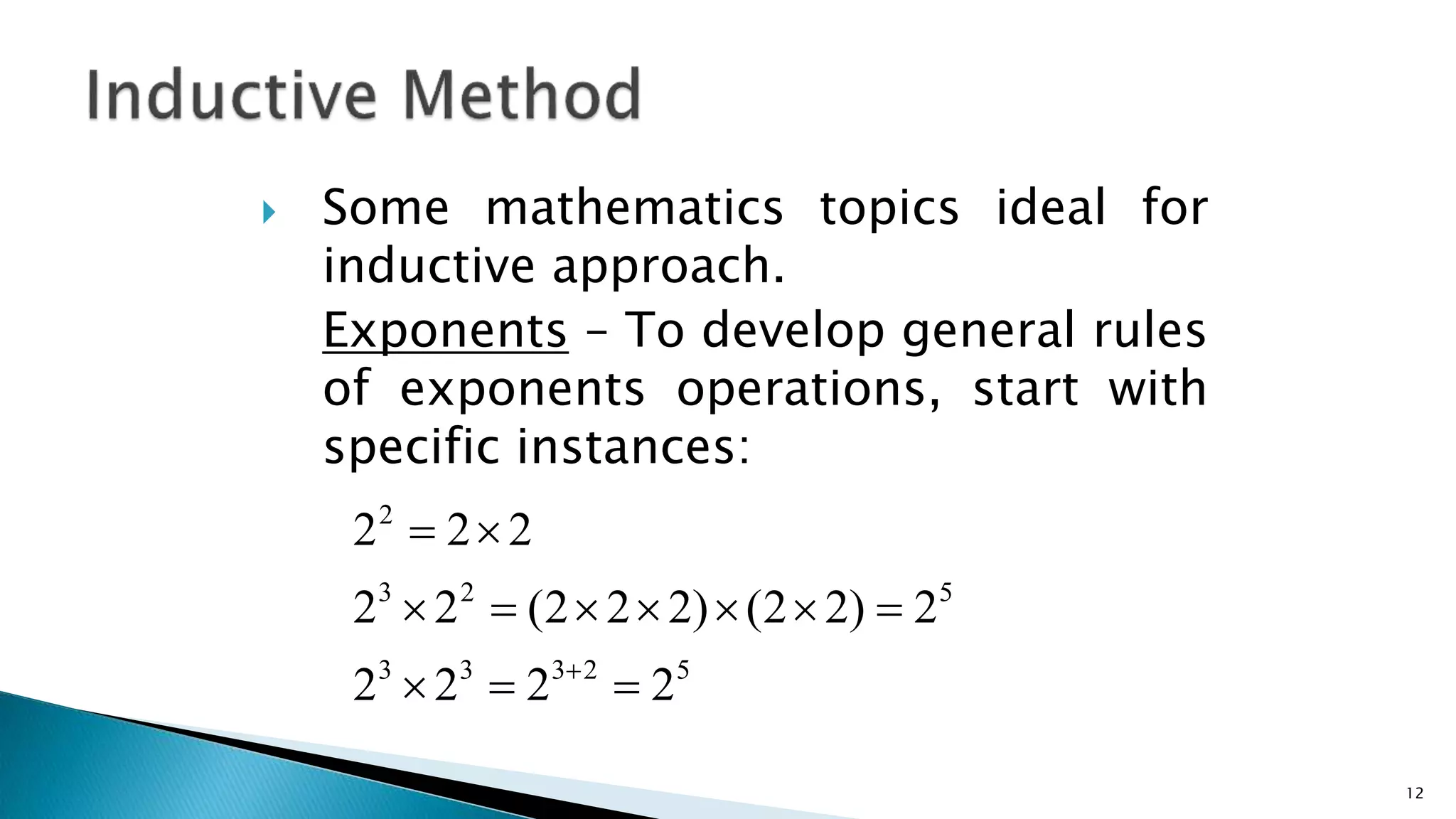
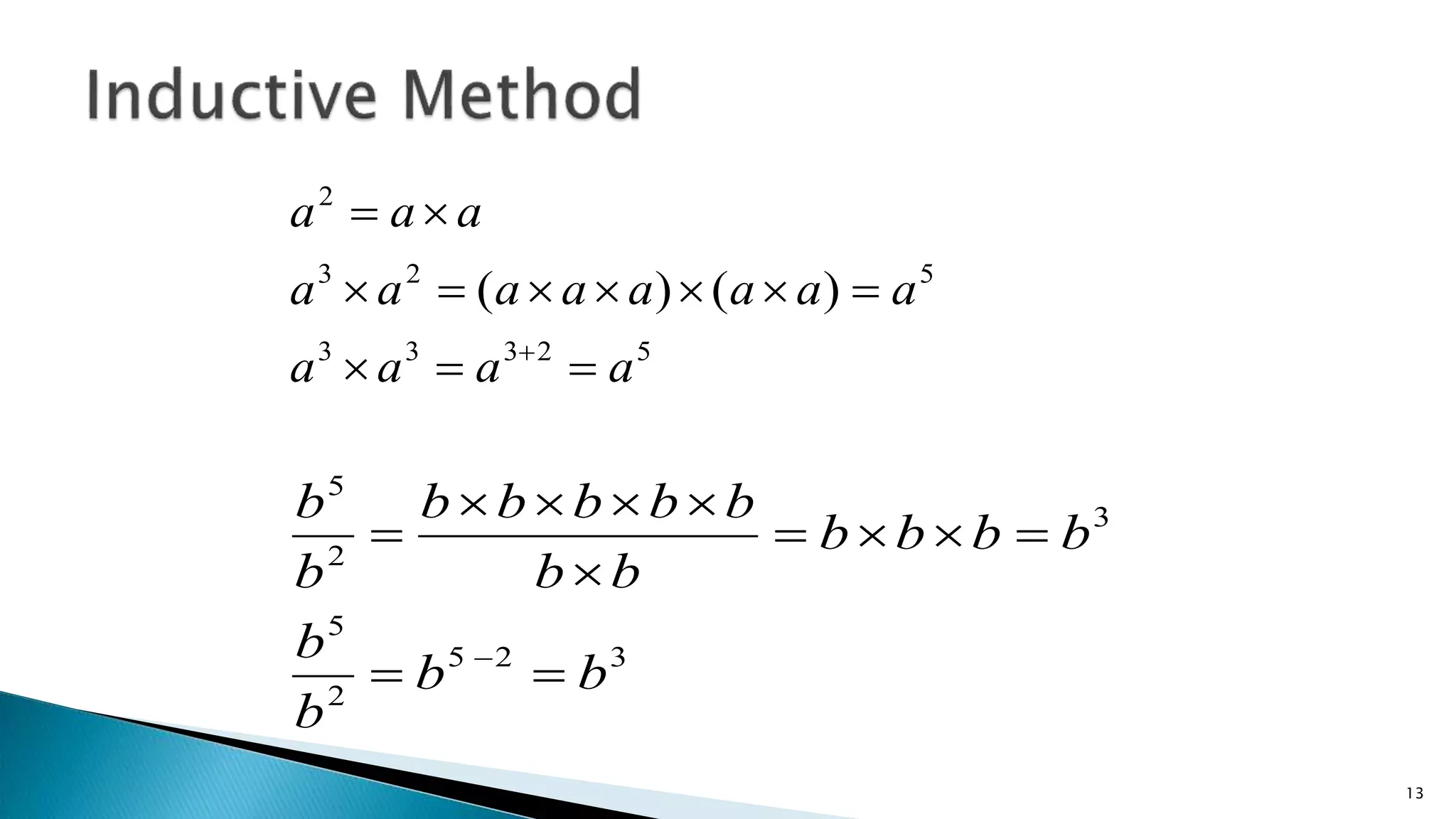
 Some mathematics topics ideal for
inductive approach.
Exponents – To develop general rules
of exponents operations, start with
specific instances:
12
5
2
3
3
3
5
2
3
2
2
2
2
2
2
)
2
2
(
)
2
2
2
(
2
2
2
2
2













13
5
2
3
3
3
5
2
3
2
)
(
)
(
a
a
a
a
a
a
a
a
a
a
a
a
a
a
a













3
2
5
2
5
3
2
5
b
b
b
b
b
b
b
b
b
b
b
b
b
b
b
b
b













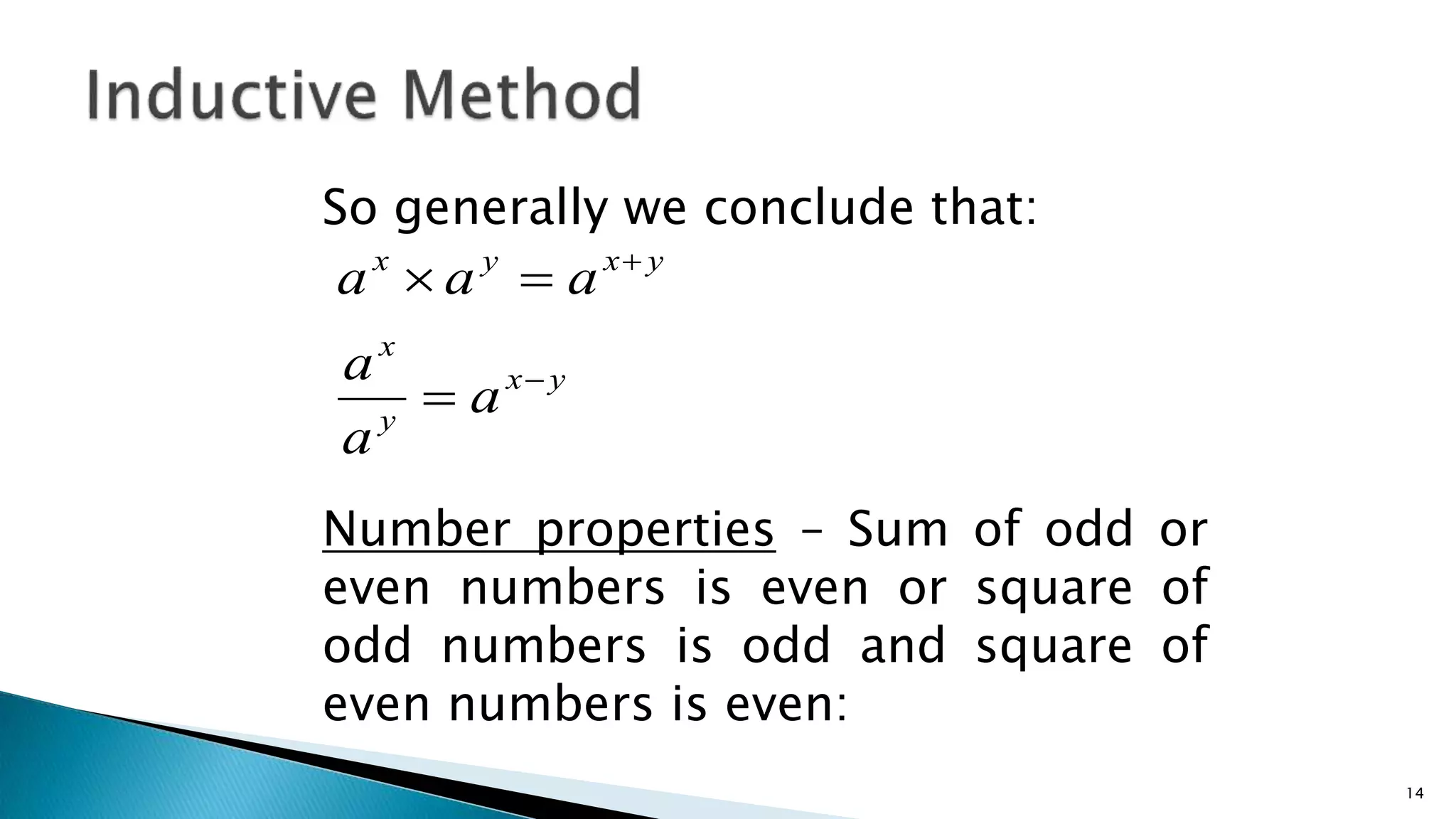
So generally we conclude that:
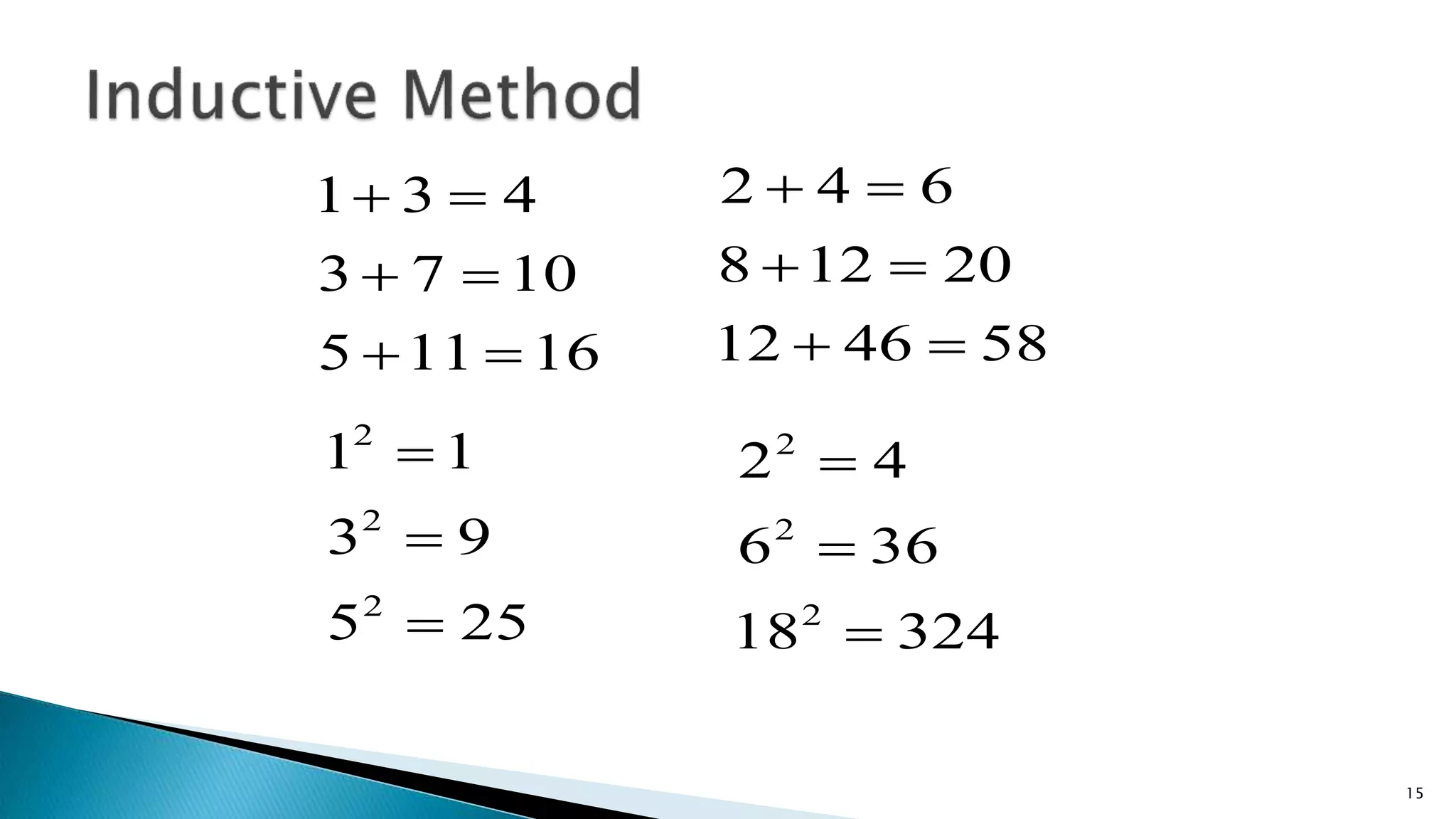
Number properties – Sum of odd or
even numbers is even or square of
odd numbers is odd and square of
even numbers is even:
14
y
x
y
x
y
x
y
x
a
a
a
a
a
a





15
16
11
5
10
7
3
4
3
1






58
46
12
20
12
8
6
4
2






25
5
9
3
1
1
2
2
2



324
18
36
6
4
2
2
2
2



Areas - Formulas for computing
areas of some basic shapes can also
be arrived at by this method.
You can add to this list.
 Strengths:
1. Good in basic mathematics.
2. It does not burden the mind.
3. Students understand easily.
16
4. Enhances recall.
5. Learning becomes more interesting
at the onset because they start with
what they know.
6. Suitable for lower classes.
7. It guide students through critical
thinking, awareness, evaluation of
what they observe and drawing
conclusion.
17
 Weaknesses:
1. Certain complex formula can not be
generated through this approach.
2. Time consuming as it requires many
examples to ensure understanding.
3. Applicable to limited number of
topics.
4. Its laborious.
18
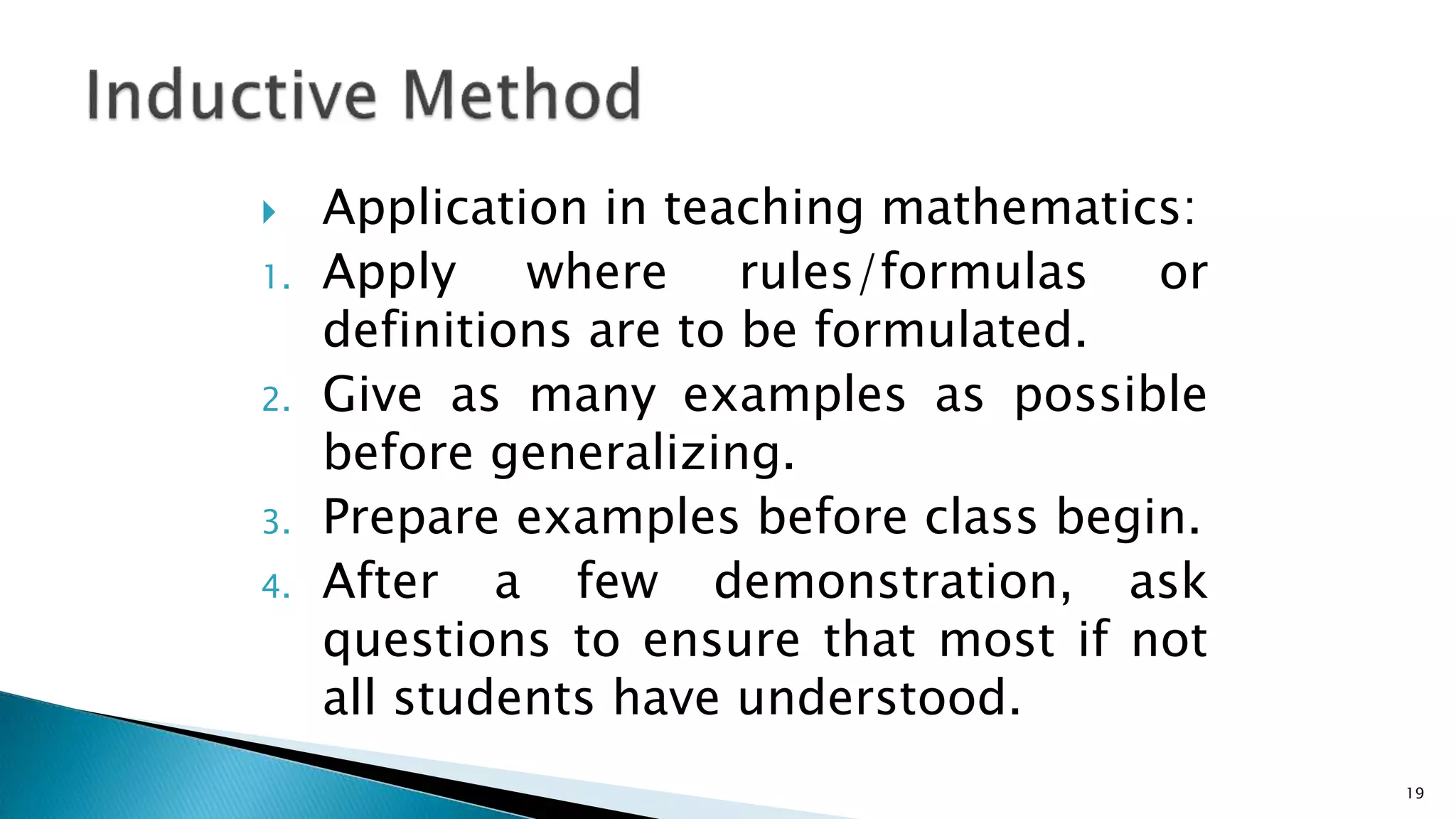
 Application in teaching mathematics:
1. Apply where rules/formulas or
definitions are to be formulated.
2. Give as many examples as possible
before generalizing.
3. Prepare examples before class begin.
4. After a few demonstration, ask
questions to ensure that most if not
all students have understood.
19
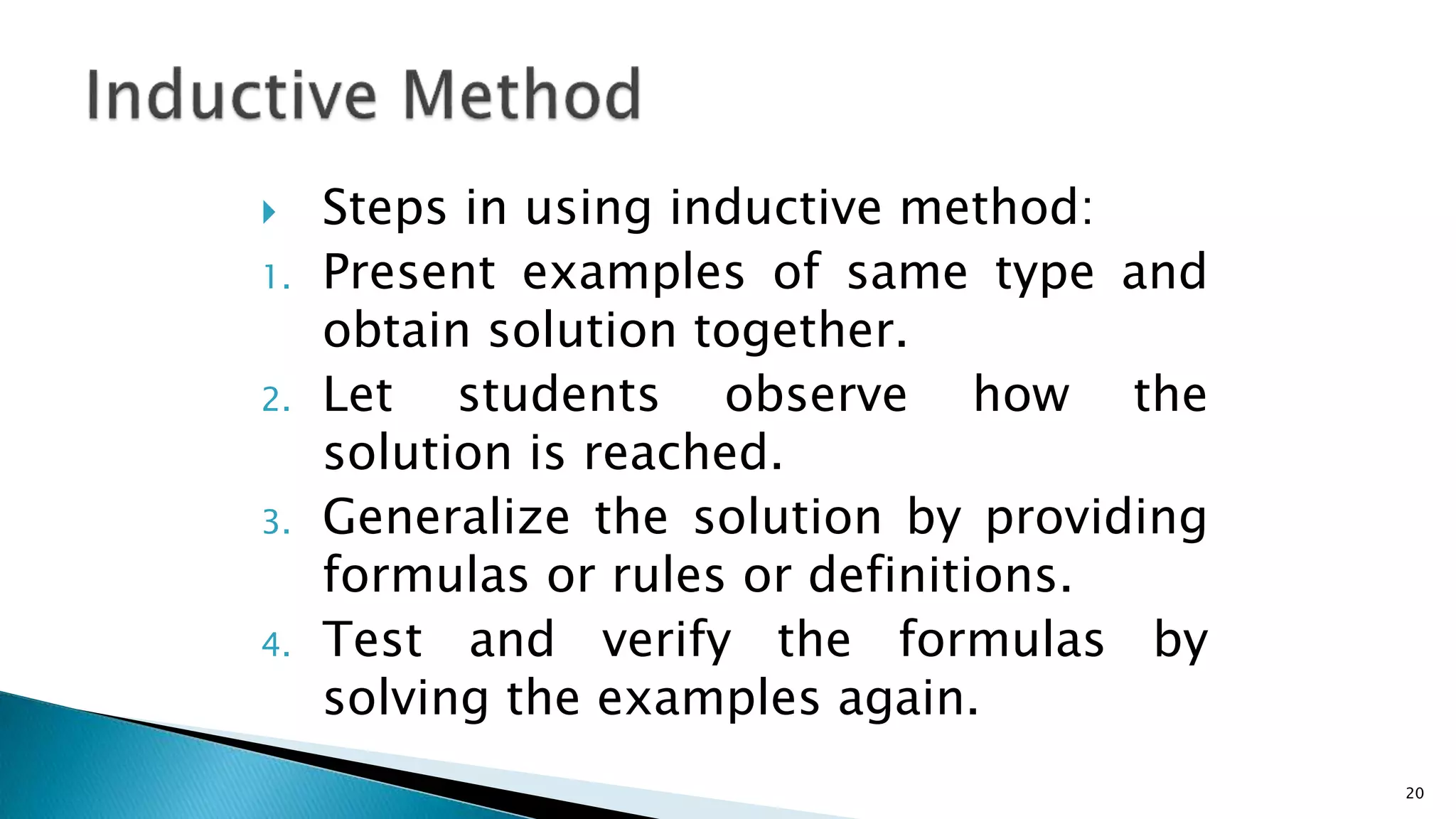
 Steps in using inductive method:
1. Present examples of same type and
obtain solution together.
2. Let students observe how the
solution is reached.
3. Generalize the solution by providing
formulas or rules or definitions.
4. Test and verify the formulas by
solving the examples again.
20
DEDUCTIVE METHOD OF
TEACHING MATHEMATICS
21
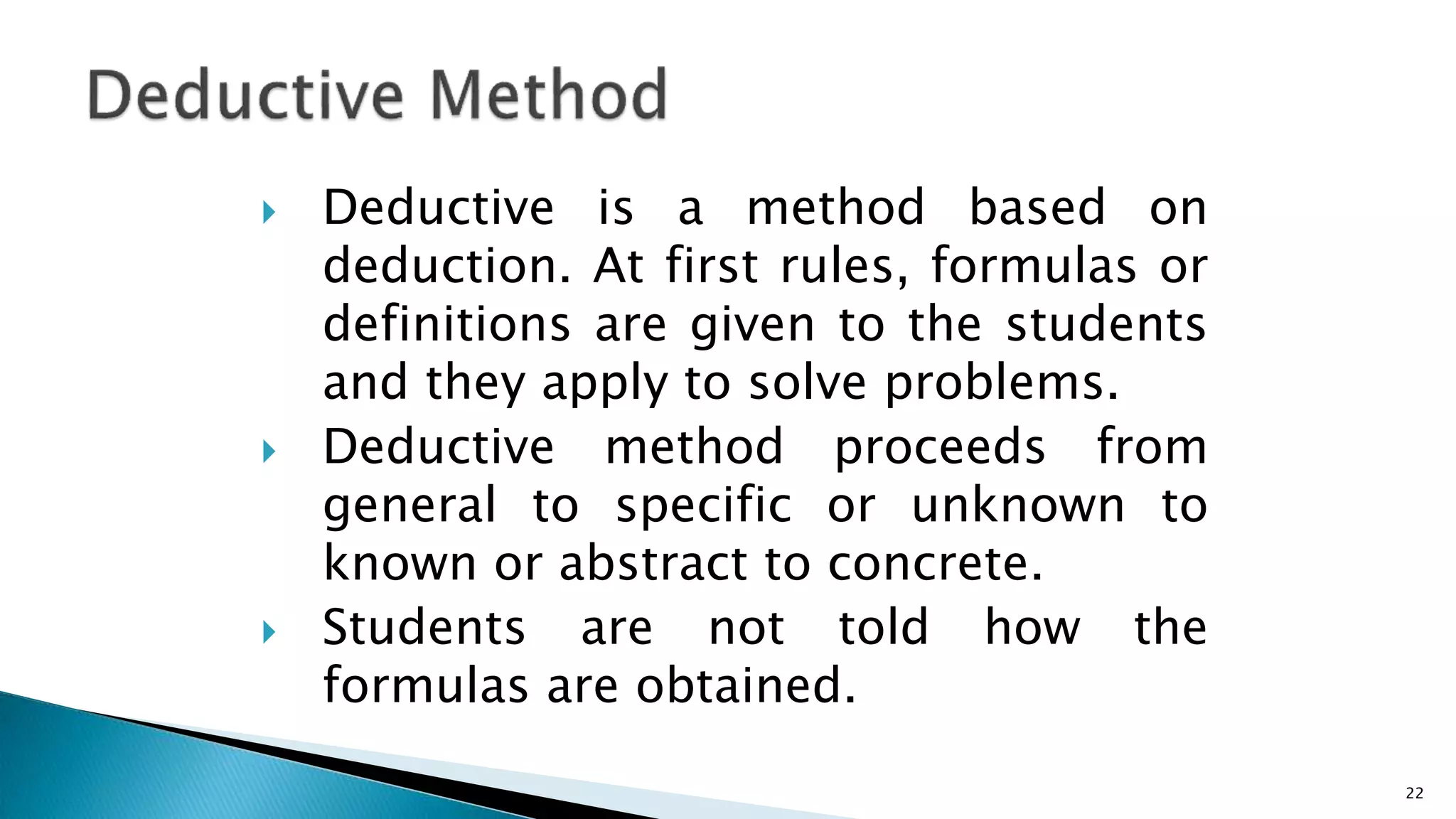
 Deductive is a method based on
deduction. At first rules, formulas or
definitions are given to the students
and they apply to solve problems.
 Deductive method proceeds from
general to specific or unknown to
known or abstract to concrete.
 Students are not told how the
formulas are obtained.
22
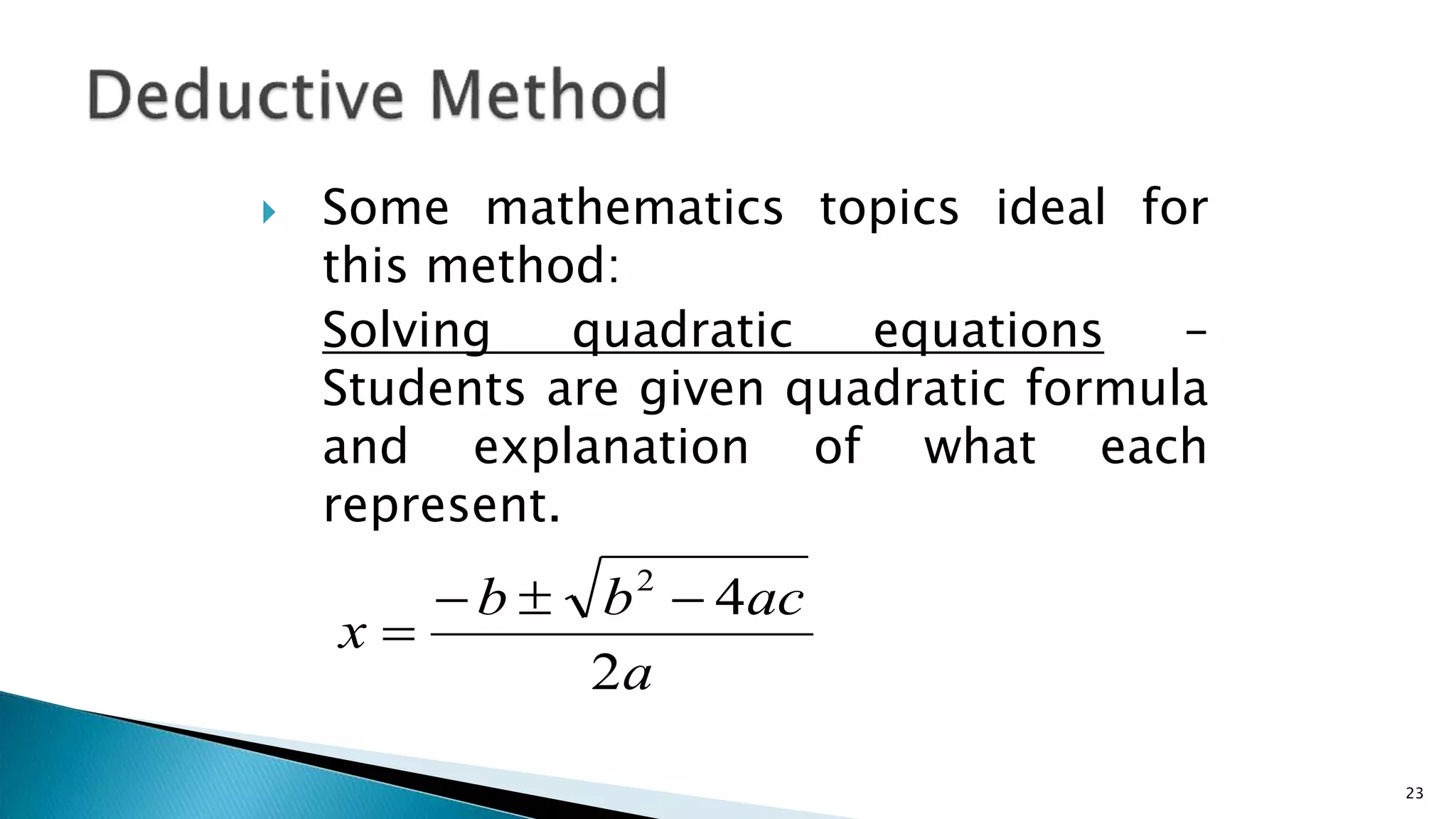
 Some mathematics topics ideal for
this method:
Solving quadratic equations –
Students are given quadratic formula
and explanation of what each
represent.
23
a
ac
b
b
x
2
4
2




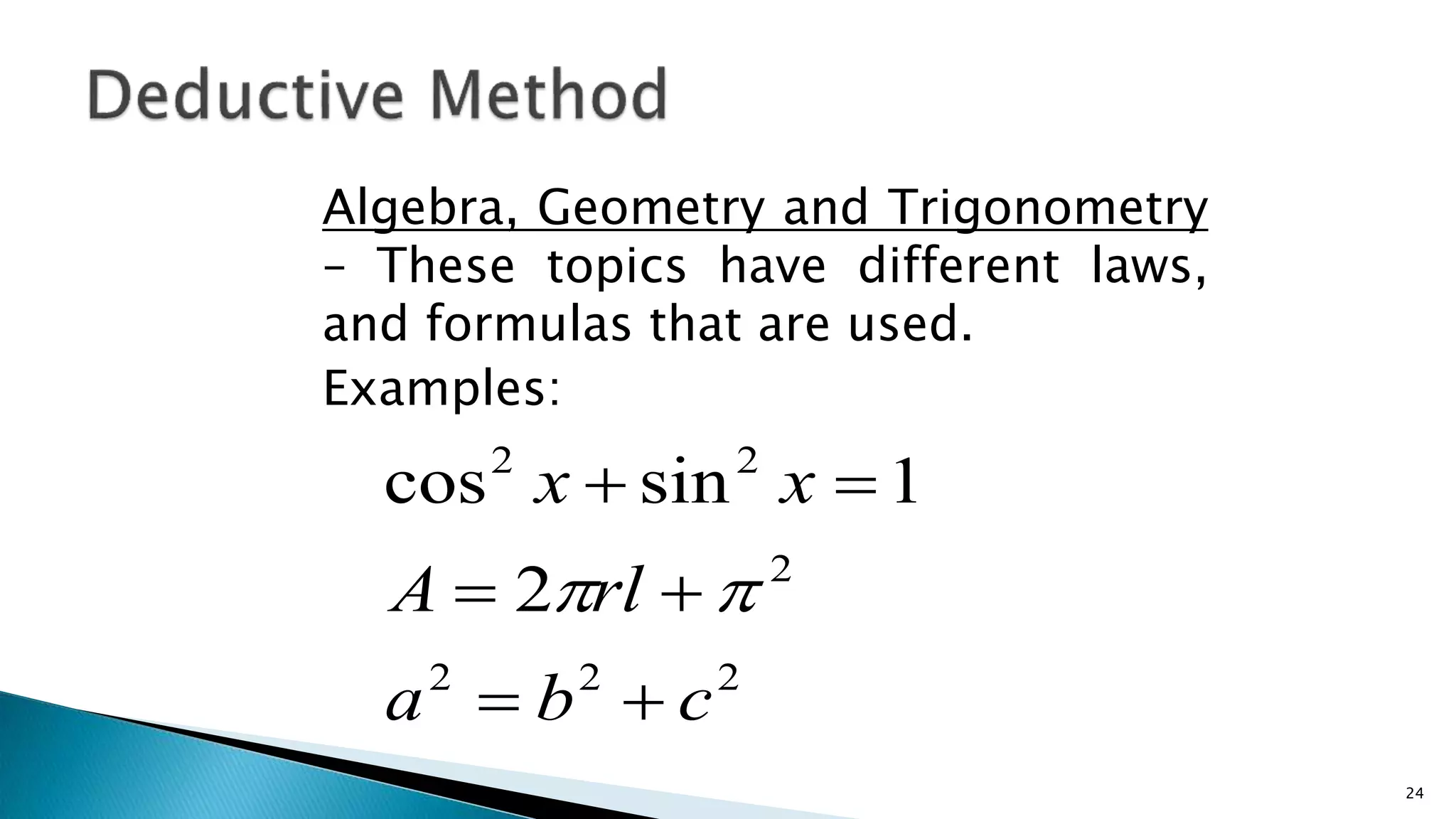
Algebra, Geometry and Trigonometry
– These topics have different laws,
and formulas that are used.
Examples:
24
2
2
2
2
2
2
2
1
sin
cos
c
b
a
rl
A
x
x








 Strengths:
1. Short, straight to the point and time
saving method
2. Suitable for all topics involving
formulas, rules or definitions.
3. Simple to implement and apply.
4. Fosters application.
5. Allow more time for drill work.
25
 Weaknesses:
1. Encourages memorization.
2. Students becomes passive learners.
3. Does not promote critical thinking
and reasoning skills.
4. Not suitable for lower classes.
5. Useful in revision stage.
6. Educationally unsound.
26
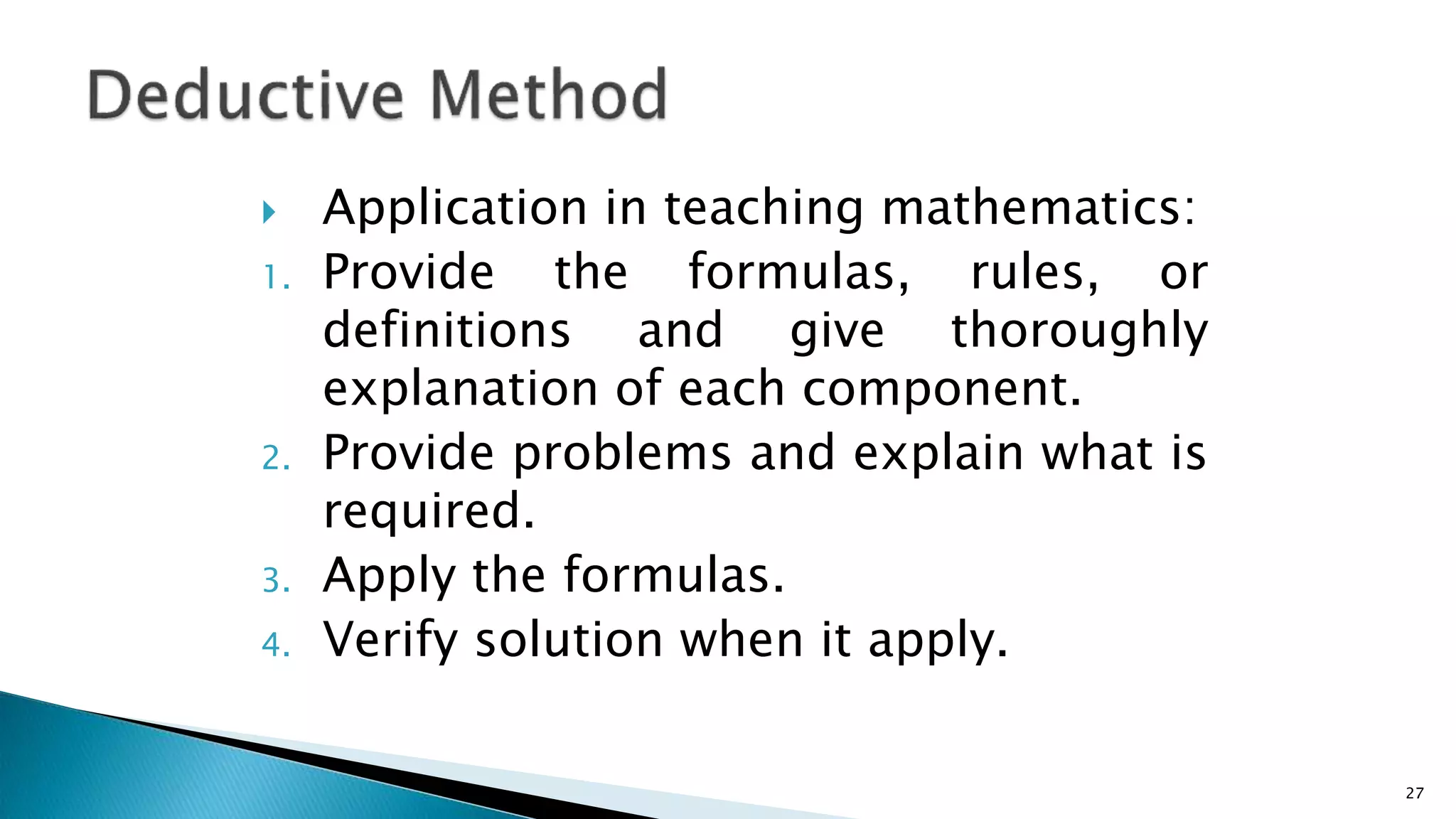
 Application in teaching mathematics:
1. Provide the formulas, rules, or
definitions and give thoroughly
explanation of each component.
2. Provide problems and explain what is
required.
3. Apply the formulas.
4. Verify solution when it apply.
27
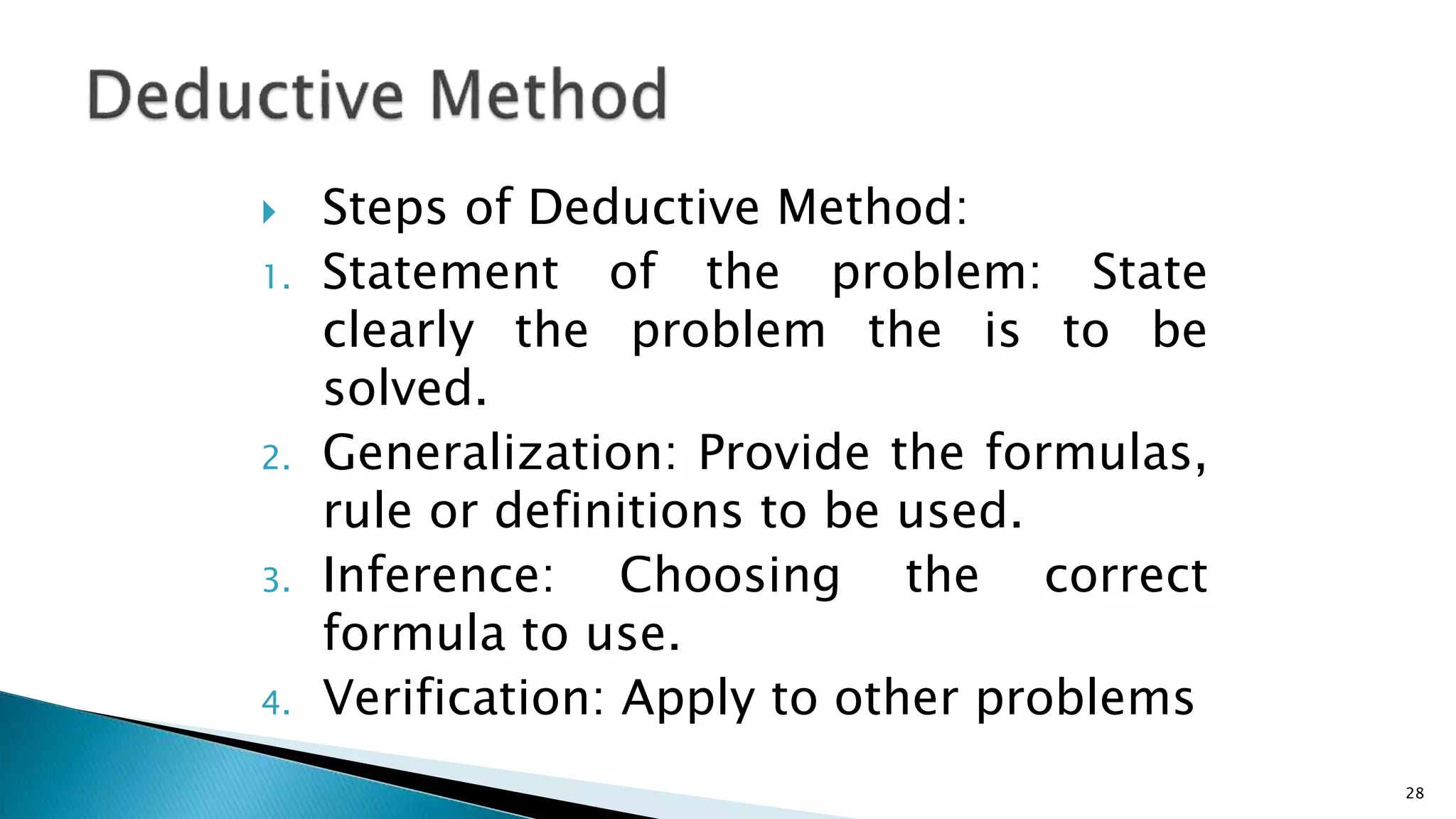
 Steps of Deductive Method:
1. Statement of the problem: State
clearly the problem the is to be
solved.
2. Generalization: Provide the formulas,
rule or definitions to be used.
3. Inference: Choosing the correct
formula to use.
4. Verification: Apply to other problems
28

MATHEMATICS INSTRUCTIONAL METHODS.pptx

  • 2.
    Lecture Notes Compiled byMr. Mwenda, A. Course Instructor 2
  • 3.
     A teachingmethod comprises the principles and methods used for instruction. It is identified by the kinds of activities we do in classroom in order to teach, and how we involve the senses – hear, see and doing. It is the way/procedure/practice we follow in the teaching process and usually a routine. 3
  • 4.
     The teachingmethod is usually assisted by a teaching strategy. A teaching strategy is a plan of actions designed to achieve the overall goal or aim. For instance planning to use two different methods during the teaching is a strategy.  Teaching strategies complement teaching methods. 4
  • 5.
     For aparticular teaching method chosen, teaching techniques are skills for completing a specific task. For instance if discussion of the content is to be employed, then grouping students is a technique for accomplishing discussion. Anything done to attract students’ attention, for instance is a teaching technique. 5
  • 6.
     As aresult of individual differences, for any chosen method, teaching approach is the personal philosophy about teaching. For instance to be an effective teacher one does not need to be authoritarian. It is generally the way you treat the teaching process. The way we support students’ learning during the teaching process. 6
  • 7.
     Therefore foreffective instructions, teaching methods, strategies, techniques and approaches need to be considered or rather combined.  The choice of the teaching method(s) largely depend on the nature of content (difficulty or simplicity) to be taught and the nature of students (level and/or understanding capacity). 7
  • 8.
     There aremany methods for teaching mathematics. Effectiveness of the methods are different for various factors.  However, there are methods that have shown to be very effective in the teaching and learning process.  The teacher has to consider effective methods for maximum learning. 8
  • 9.
     The methodsadopted by the teacher must emphasize: 1. Critical thinking 2. Concepts understanding (knowledge) 3. Analytical and logical skills 4. Problem-solving skills 5. Students’ ability to discover concepts and skills. 9
  • 10.
  • 11.
     Inductive isa method in which a rule or formula is established after extensive study of particular cases, experiences and examples. It is based on induction reasoning.  It is a process of using observations to develop general principles about a specific subject.  Proceeds from particular to general. 11
  • 12.
     Some mathematicstopics ideal for inductive approach. Exponents – To develop general rules of exponents operations, start with specific instances: 12 5 2 3 3 3 5 2 3 2 2 2 2 2 2 ) 2 2 ( ) 2 2 2 ( 2 2 2 2 2             
  • 13.
  • 14.
    So generally weconclude that: Number properties – Sum of odd or even numbers is even or square of odd numbers is odd and square of even numbers is even: 14 y x y x y x y x a a a a a a     
  • 15.
  • 16.
    Areas - Formulasfor computing areas of some basic shapes can also be arrived at by this method. You can add to this list.  Strengths: 1. Good in basic mathematics. 2. It does not burden the mind. 3. Students understand easily. 16
  • 17.
    4. Enhances recall. 5.Learning becomes more interesting at the onset because they start with what they know. 6. Suitable for lower classes. 7. It guide students through critical thinking, awareness, evaluation of what they observe and drawing conclusion. 17
  • 18.
     Weaknesses: 1. Certaincomplex formula can not be generated through this approach. 2. Time consuming as it requires many examples to ensure understanding. 3. Applicable to limited number of topics. 4. Its laborious. 18
  • 19.
     Application inteaching mathematics: 1. Apply where rules/formulas or definitions are to be formulated. 2. Give as many examples as possible before generalizing. 3. Prepare examples before class begin. 4. After a few demonstration, ask questions to ensure that most if not all students have understood. 19
  • 20.
     Steps inusing inductive method: 1. Present examples of same type and obtain solution together. 2. Let students observe how the solution is reached. 3. Generalize the solution by providing formulas or rules or definitions. 4. Test and verify the formulas by solving the examples again. 20
  • 21.
  • 22.
     Deductive isa method based on deduction. At first rules, formulas or definitions are given to the students and they apply to solve problems.  Deductive method proceeds from general to specific or unknown to known or abstract to concrete.  Students are not told how the formulas are obtained. 22
  • 23.
     Some mathematicstopics ideal for this method: Solving quadratic equations – Students are given quadratic formula and explanation of what each represent. 23 a ac b b x 2 4 2    
  • 24.
    Algebra, Geometry andTrigonometry – These topics have different laws, and formulas that are used. Examples: 24 2 2 2 2 2 2 2 1 sin cos c b a rl A x x        
  • 25.
     Strengths: 1. Short,straight to the point and time saving method 2. Suitable for all topics involving formulas, rules or definitions. 3. Simple to implement and apply. 4. Fosters application. 5. Allow more time for drill work. 25
  • 26.
     Weaknesses: 1. Encouragesmemorization. 2. Students becomes passive learners. 3. Does not promote critical thinking and reasoning skills. 4. Not suitable for lower classes. 5. Useful in revision stage. 6. Educationally unsound. 26
  • 27.
     Application inteaching mathematics: 1. Provide the formulas, rules, or definitions and give thoroughly explanation of each component. 2. Provide problems and explain what is required. 3. Apply the formulas. 4. Verify solution when it apply. 27
  • 28.
     Steps ofDeductive Method: 1. Statement of the problem: State clearly the problem the is to be solved. 2. Generalization: Provide the formulas, rule or definitions to be used. 3. Inference: Choosing the correct formula to use. 4. Verification: Apply to other problems 28