INTRODUCTION
• Radiation isthe emission and transmission of energy
in the form of waves or particle through any space or
medium
• TYPES
a) ionizing radiation e.g. X-ray, gamma ray etc.
b) non- ionizing radiation e.g. Microwave, radio wave
etc.
c) particulate e.g. Alpha, beta etc.
4.
RADIATION DOSE
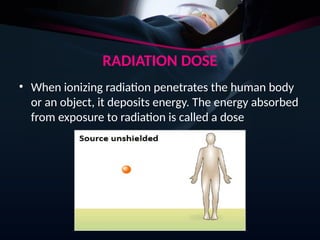
• Whenionizing radiation penetrates the human body
or an object, it deposits energy. The energy absorbed
from exposure to radiation is called a dose
5.
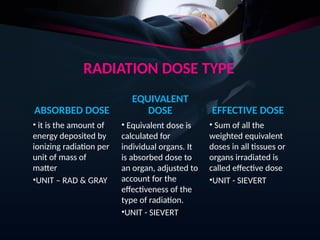
RADIATION DOSE TYPE
ABSORBEDDOSE
• it is the amount of
energy deposited by
ionizing radiation per
unit of mass of
matter
•UNIT – RAD & GRAY
EQUIVALENT
DOSE
• Equivalent dose is
calculated for
individual organs. It
is absorbed dose to
an organ, adjusted to
account for the
effectiveness of the
type of radiation.
•UNIT - SIEVERT
EFFECTIVE DOSE
• Sum of all the
weighted equivalent
doses in all tissues or
organs irradiated is
called effective dose
•UNIT - SIEVERT
6.
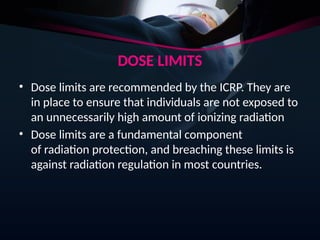
DOSE LIMITS
• Doselimits are recommended by the ICRP. They are
in place to ensure that individuals are not exposed to
an unnecessarily high amount of ionizing radiation
• Dose limits are a fundamental component
of radiation protection, and breaching these limits is
against radiation regulation in most countries.
7.
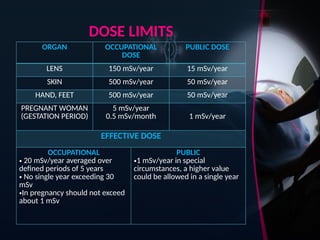
DOSE LIMITS
ORGAN OCCUPATIONAL
DOSE
PUBLICDOSE
LENS 150 mSv/year 15 mSv/year
SKIN 500 mSv/year 50 mSv/year
HAND, FEET 500 mSv/year 50 mSv/year
PREGNANT WOMAN
(GESTATION PERIOD)
5 mSv/year
0.5 mSv/month 1 mSv/year
EFFECTIVE DOSE
OCCUPATIONAL
• 20 mSv/year averaged over
defined periods of 5 years
• No single year exceeding 30
mSv
•In pregnancy should not exceed
about 1 mSv
PUBLIC
•1 mSv/year in special
circumstances, a higher value
could be allowed in a single year
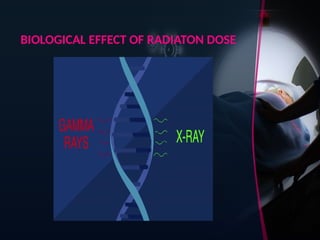
BIOLOGICAL EFFECT OFRADIATON DOSE
DETERMINISTIC EFFECT
• Are the result of high dose
• Occur above certain
threshold
• Have a severity depending
on the dose
STOCHASTIC EFFECT
• May arise from any dose
• Due to cell change and
genetic mutation
• Have no known threshold
• Increase probability when
dose is increased
10.
OBJECTIVE OF DOSEREDUCTION
• Reduce patient dose
• Reduce dose to health workers
• Reduce the biological effect on patient
as well as for health worker
11.
DOSE AFFECTING FACTORS
•X-RAY BEAM ENERGY (KVP): higher kVp results in
lower dose
• ADDED FILTRATION: Higher added filtration results in
lower dose
• COLLIMATION: Aggressive collimation reduces the
irradiated area as well as scatter radiation
• GRIDS: Grids reduce scatter radiation but increase
patient dose
12.
DOSE AFFECTING FACTORS
•IMAGE RECEPTOR: Faster speed image receptor
reduces patient dose
• TUBE CURRENT AND EXPOSURE TIME (mAs): The
patient dose is proportional to mAs
• PATIENT SIZE: It is beneficial to optimize the
technique chart for various patient size and anatomic
areas.
13.
STRATEGIES TO MINIMIZEDOSE
1. ELIMINATE UNNECESSARY RADIATIONS
• Basic principle of ‘As low as reasonably
achievable’
• By eliminating unnecessary exams or
using alternative modalities that don’t
use radiation
• No excuse for x ray examination to be
carried out again and again with high
dose
14.
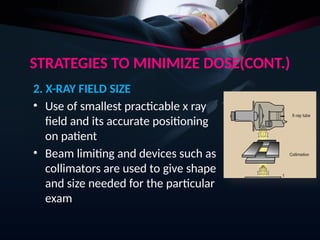
STRATEGIES TO MINIMIZEDOSE(CONT.)
2. X-RAY FIELD SIZE
• Use of smallest practicable x ray
field and its accurate positioning
on patient
• Beam limiting and devices such as
collimators are used to give shape
and size needed for the particular
exam
15.
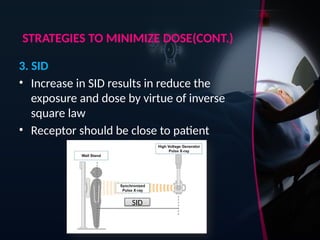
STRATEGIES TO MINIMIZEDOSE(CONT.)
3. SID
• Increase in SID results in reduce the
exposure and dose by virtue of inverse
square law
• Receptor should be close to patient
SID
16.
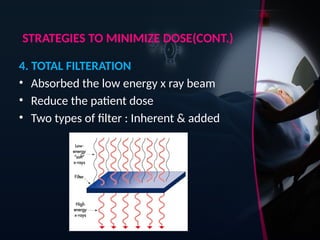
STRATEGIES TO MINIMIZEDOSE(CONT.)
4. TOTAL FILTERATION
• Absorbed the low energy x ray beam
• Reduce the patient dose
• Two types of filter : Inherent & added
17.
STRATEGIES TO MINIMIZEDOSE(CONT.)
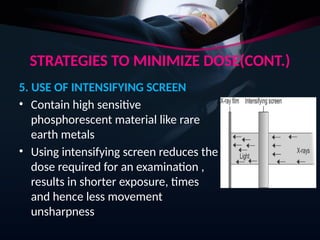
5. USE OF INTENSIFYING SCREEN
• Contain high sensitive
phosphorescent material like rare
earth metals
• Using intensifying screen reduces the
dose required for an examination ,
results in shorter exposure, times
and hence less movement
unsharpness
18.
STRATEGIES TO MINIMIZEDOSE(CONT.)
6. REDUCE REPEAT IRRADIATIONS
• X-ray should be repeated until the
new radiograph will give added
information which was not available
on the previous one
• Use of a reference list of technical
factors according to the patient
shape and size
19.
STRATEGIES TO MINIMIZEDOSE(CONT.)
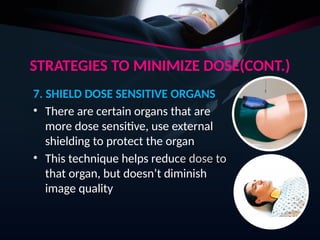
7. SHIELD DOSE SENSITIVE ORGANS
• There are certain organs that are
more dose sensitive, use external
shielding to protect the organ
• This technique helps reduce dose to
that organ, but doesn’t diminish
image quality
SUMMARY
• The useof medical X ray examinations needs to be
‑
minimized, and alternative tests should be used
whenever possible.
• If medical X ray screening and treatment are
‑
necessary, the risk benefit ratio should be weighed to
‑
determine the most effective dose, while protecting
other areas from avoidable exposure. Particular
attention should be paid to the increased radiation risk
in children and the protection of sensitive glands
QUESTIONS
1. What doesthe following acronym represent? A L A R A
a. As Low As Reasonably Achievable
b. As Long As Radiation Achievable
c. As Long As Radiation Absorbed
d. As Long As Radiation Allowable
2. Which of the Following is Not One of the Three Major
Principles Assisting the ALARA Concept?
e. Distance c. Shielding
f. Maintenance d. Time
24.
QUESTIONS
3. Following whichfactor not affect radiation dose
a. kVp c. Filteration
b. mAs d. Tube angle
4. Which statement is correct
a. Using intensifying screen increase the dose
b. Filters absorbed the high energy x ray beam
c. Increase in SID results in reduce the exposure
d. Grids decrease patient dose
25.
QUESTIONS
5. Increasing themAs will produce
a. More x ray photons with less penetrating power
b. More x ray photon with more penetrating power
c. Less x ray photon with less penetrating power
d. More x ray photon with same penetrating power