Sampling Daiane Umetsu Diego Pereira Jeferson L. Feuser
Population: Group of elements/cases that share common characteristics and which are relevant to the problem/research goal. Census: Complete set of elements/cases that compose the population. Sample: Group of elements/cases from population. The elements are selected according the selection criteria. 
Malhotra (2012) 
Hair Jr. (2010) 
1
Definition of the target population: Identify a target population that can provide the data. Determination of the sampling framework: Formal criteria of sample selection and organization of the qualified elements. Sample size: Determination of the number of necessary cases to obtain the data. 
Malhotra (2012) 
Hair Jr. (2010) 
2
Sampling error: Involves biases related with errors that occured in the elements selection process. Non-sampling error: Can occur at any research stage and involves the data accuracy. There is no procedure to evalute the impact of the error on the quality of collected data. 
Malhotra (2012) 
Hair Jr. (2010) 
3
Population: Marvel Super Heroes 
4
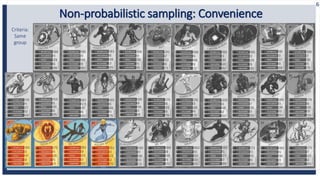
Non-probabilistic sampling: Convenience The elements are selected based in the convenience for the study. This technique is more used in the initial stages and also known as accidental sampling. The elements selection is performed by the researcher. 
Malhotra (2012) 
Hair Jr. (2010) 
5
Non-probabilistic sampling: Convenience 
Criteria: 
Same group 
6
Non-probabilistic sampling: Judgement The sample is choosen according with the researcher knowledge, that specific elements have conditions to contribute in a study. 
Hair Jr. (2010) 
7
Non-probabilistic: Judgement 
Criteria: 
Intelligence 
8
Non-probabilistic sampling: Quotas Comprises a judgement technique performed in two stages. Categories are determined, the relevant characteristics and the proportion of the distribution in the population are fixed (e. g.: gender and age). After this, the elements are selected according with the researcher judgement. 
Hair Jr. (2010) 
9
Non-probabilistic sampling: Quotas 
Criteria: 
Ability 
10
Non-probabilistic sampling: Snowball A specific group of elements is chosen to comprise the sample and these elements indicate other people from the same population. This technique is useful when a researcher needs to find reduced groups or when is difficult to reach specific populations. 
Hair Jr. (2010) 
11
Non-probabilistic sampling: Snowball 
Criteria: 
Strike force 
12
Probabilistic sampling: Simple random The elements have the same possibility to be selected and the selection process is aleatory. The results are representative for the population and there is a sampling error. 
Malhotra (2012) 
Hair Jr. (2010) 
13
Probabilistic sampling: Simple random 
Criteria: 
Draw sample 
14
Probabilistic sampling: Systematic The population must be organized by natural criterion. The sample is determined using a sampling error. A selection range is calculated. An initial number is determined randomly and these elements are selected using the value obtained in the selection range stage. 
Hair Jr. (2010) 
15
Probabilistic: Systematic 
Criteria: 
Selection range 
16
Probabilistic sampling: Stratified The population is separated in groups (e. g.: gender, age, stratum) and the sample elements are chosen considering these groups. The population must be divided in homogeneous clusters. Random samples are selected in each cluster. The cluster samples are combined in a big sample of whole population. 
Hair Jr. (2010) 
17
Probabilistic sampling: Stratified 
Stages: 
-Separation by gender 
-Draw sample 
18
Probabilistic sampling: Cluster Involves a division of the area to be surveyed in neighborhoods or households. The elements of these clusters (groups) are selected randomly or everybody are included in the sample. 
Hair Jr. (2010) 
19
Probabilistic sampling: Cluster 
Criteria: 
-Elements of the same group 
-Aleatory Selection 
20
Criteria for sample size determination When the variability of the characteristics of the population is high, the confidence level is high and the error sampling is low, the number of elements needs to be greater. In a non-probabilistic sampling, the determination is based in the researcher knowledge on the study object (theme). 
Hair Jr. (2010) 
21
Project X: Probabilistic and aleatory sample – 6 countries Gender, Age, Stratum and Local Quotas 
Gender 
Proportion 
Quota 
Female 
52,42% 
1069 
Male 
47,58% 
970 
Age 
Proportion 
Quota 
Less than 18 
4,15% 
85 
18-24 
19,25% 
393 
25-34 
33,90% 
691 
35-44 
22,97% 
468 
45-54 
13,68% 
279 
55 or more 
6,05% 
123 
Stratum 
Proportion 
Quota 
A1 
1,46% 
30 
A2 
7,75% 
158 
B1 
18,11% 
369 
B2 
30,0% 
611 
C1 
26,13% 
533 
C2 
13,42% 
274 
D 
2,85% 
58 
E 
0,28% 
6 
State 
Proportion 
Quota 
São Paulo 
32,64% 
666 
Rio de Janeiro 
11,56% 
236 
Minas Gerais 
8,32% 
170 
Bahia 
5,00% 
102 
Paraná 
4,74% 
97 
Rio Grande do Sul 
4,73% 
96 
Pernambuco 
2,95% 
60 
Santa Catarina 
2,82% 
58 
Ceará 
2,00% 
41 
Goiás 
1,90% 
39 
Others 
23,22% 
474 
22
Project Y Non-probabilistic sample - 5 countries 3 brands evaluated in each country Sample quotas for each brand and region 
Brand 
Quotas 
Region 
Quotas 
1 
200 
A 
300 
2 
200 
B 
160 
3 
200 
C 
140 
23
References 
HAIR JR., Joseph F. Fundamentos de pesquisa de marketing. Porto Alegre: Bookman, 2010. 
MALHOTRA, Naresh K. Pesquisa de marketing: uma orientação aplicada. Porto Alegre: Bookman, 2012. 
24

Methods of sample selection

  • 1.
    Sampling Daiane UmetsuDiego Pereira Jeferson L. Feuser
  • 2.
    Population: Group ofelements/cases that share common characteristics and which are relevant to the problem/research goal. Census: Complete set of elements/cases that compose the population. Sample: Group of elements/cases from population. The elements are selected according the selection criteria. Malhotra (2012) Hair Jr. (2010) 1
  • 3.
    Definition of thetarget population: Identify a target population that can provide the data. Determination of the sampling framework: Formal criteria of sample selection and organization of the qualified elements. Sample size: Determination of the number of necessary cases to obtain the data. Malhotra (2012) Hair Jr. (2010) 2
  • 4.
    Sampling error: Involvesbiases related with errors that occured in the elements selection process. Non-sampling error: Can occur at any research stage and involves the data accuracy. There is no procedure to evalute the impact of the error on the quality of collected data. Malhotra (2012) Hair Jr. (2010) 3
  • 5.
  • 6.
    Non-probabilistic sampling: ConvenienceThe elements are selected based in the convenience for the study. This technique is more used in the initial stages and also known as accidental sampling. The elements selection is performed by the researcher. Malhotra (2012) Hair Jr. (2010) 5
  • 7.
  • 8.
    Non-probabilistic sampling: JudgementThe sample is choosen according with the researcher knowledge, that specific elements have conditions to contribute in a study. Hair Jr. (2010) 7
  • 9.
  • 10.
    Non-probabilistic sampling: QuotasComprises a judgement technique performed in two stages. Categories are determined, the relevant characteristics and the proportion of the distribution in the population are fixed (e. g.: gender and age). After this, the elements are selected according with the researcher judgement. Hair Jr. (2010) 9
  • 11.
  • 12.
    Non-probabilistic sampling: SnowballA specific group of elements is chosen to comprise the sample and these elements indicate other people from the same population. This technique is useful when a researcher needs to find reduced groups or when is difficult to reach specific populations. Hair Jr. (2010) 11
  • 13.
    Non-probabilistic sampling: Snowball Criteria: Strike force 12
  • 14.
    Probabilistic sampling: Simplerandom The elements have the same possibility to be selected and the selection process is aleatory. The results are representative for the population and there is a sampling error. Malhotra (2012) Hair Jr. (2010) 13
  • 15.
    Probabilistic sampling: Simplerandom Criteria: Draw sample 14
  • 16.
    Probabilistic sampling: SystematicThe population must be organized by natural criterion. The sample is determined using a sampling error. A selection range is calculated. An initial number is determined randomly and these elements are selected using the value obtained in the selection range stage. Hair Jr. (2010) 15
  • 17.
  • 18.
    Probabilistic sampling: StratifiedThe population is separated in groups (e. g.: gender, age, stratum) and the sample elements are chosen considering these groups. The population must be divided in homogeneous clusters. Random samples are selected in each cluster. The cluster samples are combined in a big sample of whole population. Hair Jr. (2010) 17
  • 19.
    Probabilistic sampling: Stratified Stages: -Separation by gender -Draw sample 18
  • 20.
    Probabilistic sampling: ClusterInvolves a division of the area to be surveyed in neighborhoods or households. The elements of these clusters (groups) are selected randomly or everybody are included in the sample. Hair Jr. (2010) 19
  • 21.
    Probabilistic sampling: Cluster Criteria: -Elements of the same group -Aleatory Selection 20
  • 22.
    Criteria for samplesize determination When the variability of the characteristics of the population is high, the confidence level is high and the error sampling is low, the number of elements needs to be greater. In a non-probabilistic sampling, the determination is based in the researcher knowledge on the study object (theme). Hair Jr. (2010) 21
  • 23.
    Project X: Probabilisticand aleatory sample – 6 countries Gender, Age, Stratum and Local Quotas Gender Proportion Quota Female 52,42% 1069 Male 47,58% 970 Age Proportion Quota Less than 18 4,15% 85 18-24 19,25% 393 25-34 33,90% 691 35-44 22,97% 468 45-54 13,68% 279 55 or more 6,05% 123 Stratum Proportion Quota A1 1,46% 30 A2 7,75% 158 B1 18,11% 369 B2 30,0% 611 C1 26,13% 533 C2 13,42% 274 D 2,85% 58 E 0,28% 6 State Proportion Quota São Paulo 32,64% 666 Rio de Janeiro 11,56% 236 Minas Gerais 8,32% 170 Bahia 5,00% 102 Paraná 4,74% 97 Rio Grande do Sul 4,73% 96 Pernambuco 2,95% 60 Santa Catarina 2,82% 58 Ceará 2,00% 41 Goiás 1,90% 39 Others 23,22% 474 22
  • 24.
    Project Y Non-probabilisticsample - 5 countries 3 brands evaluated in each country Sample quotas for each brand and region Brand Quotas Region Quotas 1 200 A 300 2 200 B 160 3 200 C 140 23
  • 25.
    References HAIR JR.,Joseph F. Fundamentos de pesquisa de marketing. Porto Alegre: Bookman, 2010. MALHOTRA, Naresh K. Pesquisa de marketing: uma orientação aplicada. Porto Alegre: Bookman, 2012. 24