EFFORTS TO IMPROVE IPA LEARNING OUTCOMES THROUGH
DEMONSTRATION LEARNING MODELS IN CLASS VIII.3 STUDENTS,
SMPN 1 SINTUK TOBOH GADANG
Mellya Eka Putri1
Science Teacher SMPN 1 Sintuk Toboh Gadang
2017
Abstract
This study aims to obtain information and find out about efforts to
improve learning outcomes of science through the
DEMONTRATION learning model. This type of research is
classroom action research. The subjects of this study were in class
VIII.3 at SMPN 1 Sintuk Toboh Gadang with 29 students. This
research uses a qualitative approach. Research procedures include
planning, implementing, observing, and reflecting. This research was
conducted in two cycles and was conducted in collaboration between
the researcher and the observer. The techniques used in data
collection are observation, tests, field notes and documentation. Data
analysis uses percentages. The results of this study indicate that
student learning outcomes in the science learning process by using
DEMONTRATION can improve student learning outcomes.
Keywords: Science Learning Outcomes, DEMONSTRATION
Learning Model
INTRODUCTION
The learning of Natural Sciences (IPA) is expected to be a vehicle for students
to learn about themselves and their surroundings, as well as further
development in their application in daily life. The National Education
Standards Agency (BSNP) (in the Learning Unit Level Curriculum, 2006: 484)
states "the science learning process in junior high schools emphasizes
providing direct experience to develop competencies in order to explore and
understand the natural surroundings scientifically"
Students as educational subjects, are required to be active in learning, seeking
information and exploring alone or in groups. The teacher acts as a facilitator
and guides students towards optimizing the achievement of the knowledge
being learned. In accordance with Piaget's theory (in Yusuf, 2007: 1) that "In
learning the teacher acts as a facilitator, not a provider of information".
In the syllabus development guide and Learning Implementation Plan (RPP),
the Ministry of National Education (in Irma, 2007: 2) states "Learning
activities are designed to provide learning experiences that involve mental
and physical processes through interactions between students, students and
teachers, the environment, and resources other learning in the context of
achieving basic competencies ". Learning activities contain life skills that
students need to master.
The learning method used by the teacher in bridging student needs only uses
the lecture method. Because every student is required to have a textbook. So
the teacher only explains the material in the book and asks students to
answer the questions in the textbook. Therefore the value obtained by
students is not as expected. The result is still below the standard of teaching
and learning completeness with an average value of 6.0. the completeness
value set by the school is 7.
In addition to the low value of Completion in Teaching and Learning
(SKBM), the activities shown by students are also low such as: doing
homework (homework), low interest in student learning in groups. In general
students tend to be passive, only accept what the teacher says. If the teacher
asks questions students do not dare to answer, if there are only 4-5 students.
Based on the above problems, the effort to improve student learning
outcomes in science learning in SMPN 1 Sintuk Toboh Gadang is a problem
that needs to be addressed. One method of learning that is thought to
overcome these problems is the method of cooperative learning.
Through cooperative learning methods students can learn more actively and
an atmosphere that is conducive to developing knowledge, values attitudes,
activeness, and social skills such as cooperative skills that benefit their lives in
society. By using cooperative learning methods are expected to foster
excitement in learning. Because with the cooperative learning method, the
competencies possessed by students will trigger to make the learning
atmosphere complement each other in terms of knowledge and expertise.
According to Muhamad (2004: 1) "Cooperative learning methods are practical
classroom techniques that teachers can use every day to help their students
learn each subject, from basic skills to complex problem solving". So, the
cooperative learning method is to utilize small groups in teaching that allows
students to work together to maximize their learning outcomes.
By studying groups will make it easier for students to understand the subject
matter. Slavin (in Karuru, 2007: 1) that "Students will more easily find and
understand difficult concepts if they can discuss these concepts with each
other". And also with group learning will bring a positive influence on
students. In accordance with the results of Slavin's research (in Harnawati,
2006: 9) that "The elements of group goals and individual responsibility show
a real positive effect on learning outcomes of students in grades two through
twelfth grade with all subjects".
One of the cooperative learning methods that can be used by the teacher is
the Demonstration type cooperative learning method. Demonstration type
cooperative learning method is a very interesting learning method and
students are very happy to be asked to answer questions, without realizing
students directly sharpen their brains by filling in the boxes provided by the
teacher including filling in the worksheet.
LITERATURE REVIEW
According to Slameto (Syaiful Bahri Djamarah, 2011: 13) learning is a
business process undertaken to obtain behavioral changes from interactions
with the environment obtained from experience
Oemar (2008: 2) also argues that, learning outcomes are behaviors that arise,
for example from not knowing to knowing, new questions arise, changes in
the stage of habitual skills, ability to appreciate, the development of social,
emotional, and physical growth.
Carin (in Yusuf, 2007: 1) states that: IPA as a product or content includes
facts, concepts, principles, laws, and theories of science. So basically IPA
consists of three components, namely scientific attitude, scientific process,
and scientific products. This means that science does not only consist of a
collection of knowledge or various memorized facts, it is also an active
activity or process of using the mind to study natural phenomena that cannot
be contemplated.
According to Sanjaya (2006: 147) "Method is a method used to implement a
plan that has been prepared in real activities so that the objectives that have
been prepared are achieved optimally".
According to Uno and Mohamad (2012: 98) The demonstration method is also
used in active learning, because it is in contact with how students
demonstrate something. This learning strategy shows how it does something
which is then observed and discussed.
RESEARCH METHODOLOGY
This research is a classroom action research. According Suharsimi Arikunto,
et al (2007: 3) classroom action research is an examination of learning
activities in the form of actions that are deliberately raised and occur in a
class together. This research was conducted at SMPN 1 Sintuk Toboh
Gadang. This class action research was planned in class VIII.3 SMPN 1 Sintuk
Toboh Gadang with 29 students, consisting of 15 men and 14 women. This
research was conducted in the second semester and in class VIII.3 SMPN 1
Sintuk Toboh Gadang 2016/2017 school year. The research process consists of
four sets of activities carried out in an iterative cycle, namely:
1. Planning
The plan is the initial stage that must be done.
2. Action
Action is the application of a plan that has been made in the form of an
application of a particular learning strategy that aims to improve and
perfect the strategy being carried out.
3. Observation
Observations are made to observe changes that occur during the action
carried out.
4. Reflection
Contemplation is the activity of reflecting the results of observations to
become the next planning material.
Data collection tools include observation sheets, field notes, tests, and
documentation. Data analysis technique Data filling in the observation sheet
of student learning activities in a qualitative analysis in the form of a
percentage, To calculate the percentage of student learning outcomes
researchers use the benchmark "Total achievement score divided by
maximum score multiplied by 100".
NA = Total Score Achieved x 100 %
Maximum Score
RESEARCH RESULTS AND DISCUSSION
RESEARCH RESULT
Pre Cycle
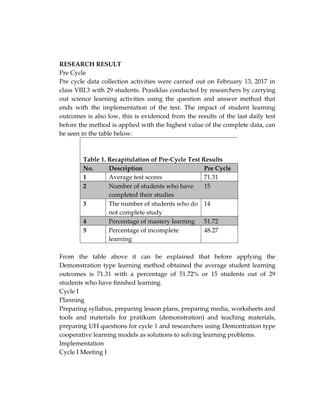
Pre cycle data collection activities were carried out on February 13, 2017 in
class VIII.3 with 29 students. Prasiklus conducted by researchers by carrying
out science learning activities using the question and answer method that
ends with the implementation of the test. The impact of student learning
outcomes is also low, this is evidenced from the results of the last daily test
before the method is applied with the highest value of the complete data, can
be seen in the table below:
Table 1. Recapitulation of Pre-Cycle Test Results
No. Description Pre Cycle
1 Average test scores 71.31
2 Number of students who have
completed their studies
15
3 The number of students who do
not complete study
14
4 Percentage of mastery learning 51.72
5 Percentage of incomplete
learning
48.27
From the table above it can be explained that before applying the
Demonstration type learning method obtained the average student learning
outcomes is 71.31 with a percentage of 51.72% or 15 students out of 29
students who have finished learning.
Cycle I
Planning
Preparing syllabus, preparing lesson plans, preparing media, worksheets and
tools and materials for pratikum (demonstration) and teaching materials,
preparing UH questions for cycle 1 and researchers using Demontration type
cooperative learning models as solutions to solving learning problems.
Implementation
Cycle I Meeting I
Held on Monday 20 February 2017 with the material Pressure on solids,
factors. - factors affecting the pressure on solids and the use of the pressure
formula P = F / A in the sample questions consisting of preliminary activities,
core activities and closing activities .
Cycle 2 Meeting I
Held on Monday, February 27, 2017 in Class VIII.3 with the material Pascal
Law, Application of the Formula Formula Pascal F1 / A1 = F2 / A2 and
Examples of tools that work according to the Pascal law consisting of
preliminary activities, core activities, and closing activities .
Observation
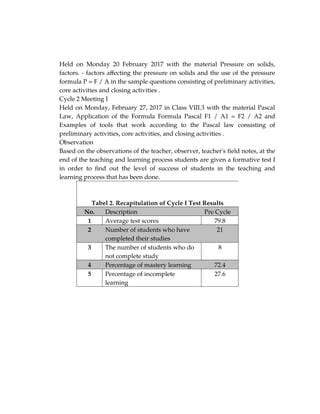
Based on the observations of the teacher, observer, teacher's field notes, at the
end of the teaching and learning process students are given a formative test I
in order to find out the level of success of students in the teaching and
learning process that has been done.
Tabel 2. Recapitulation of Cycle I Test Results
No. Description Pre Cycle
1 Average test scores 79.8
2 Number of students who have
completed their studies
21
3 The number of students who do
not complete study
8
4 Percentage of mastery learning 72.4
5 Percentage of incomplete
learning
27.6
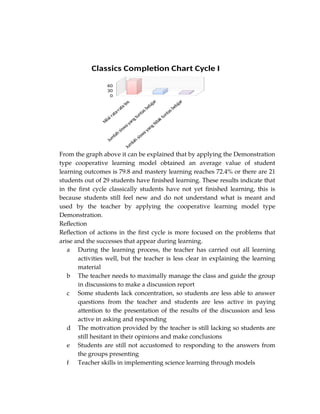
0
30
60
Classics Completion Chart Cycle I
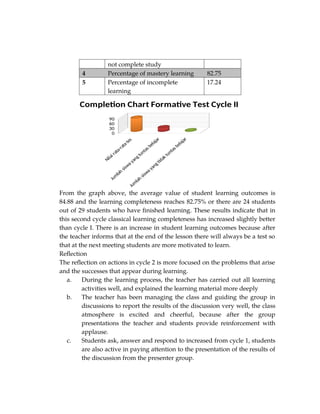
From the graph above it can be explained that by applying the Demonstration
type cooperative learning model obtained an average value of student
learning outcomes is 79.8 and mastery learning reaches 72.4% or there are 21
students out of 29 students have finished learning. These results indicate that
in the first cycle classically students have not yet finished learning, this is
because students still feel new and do not understand what is meant and
used by the teacher by applying the cooperative learning model type
Demonstration.
Reflection
Reflection of actions in the first cycle is more focused on the problems that
arise and the successes that appear during learning.
a During the learning process, the teacher has carried out all learning
activities well, but the teacher is less clear in explaining the learning
material
b The teacher needs to maximally manage the class and guide the group
in discussions to make a discussion report
c Some students lack concentration, so students are less able to answer
questions from the teacher and students are less active in paying
attention to the presentation of the results of the discussion and less
active in asking and responding
d The motivation provided by the teacher is still lacking so students are
still hesitant in their opinions and make conclusions
e Students are still not accustomed to responding to the answers from
the groups presenting
f Teacher skills in implementing science learning through models
g Cooperative learning type of Demonstration is well categorized.
h Student activities in learning science through the Demonstrated
Cooperative Learning model are categorized as good.
Cycle II
Planning
Preparing syllabus, preparing lesson plans, preparing media, worksheets and
tools and materials for pratikum (teaching demonstration) and teaching
materials, preparing UH questions for cycle 2, and researchers using the
Demonstration type cooperative learning model as a solution to solving
learning problems.
Cycle I Meeting II
The implementation of teaching and learning activities for the second cycle
was held Monday on March 26, 2017 in Class VIII.3 with the material
Explaining the Archimedes Law, Using the formula Fa = ρc.g.vb andc.g.vb and
Examples of tools for which the working principle of Archimedes's law
consists of preliminary activities , core activities and closing activities.
Cycle 2 Meeting II
The second meeting on the second cycle was held on Monday March 13, 2017
in class VIII.3 with material Floating objects, floating objects and sinking
objects consisting of preliminary activities, core activities and closing
activities.
Observation
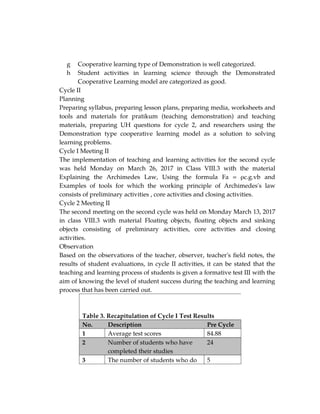
Based on the observations of the teacher, observer, teacher's field notes, the
results of student evaluations, in cycle II activities, it can be stated that the
teaching and learning process of students is given a formative test III with the
aim of knowing the level of student success during the teaching and learning
process that has been carried out.
Table 3. Recapitulation of Cycle I Test Results
No. Description Pre Cycle
1 Average test scores 84.88
2 Number of students who have
completed their studies
24
3 The number of students who do 5
not complete study
4 Percentage of mastery learning 82.75
5 Percentage of incomplete
learning
17.24
0
30
60
90
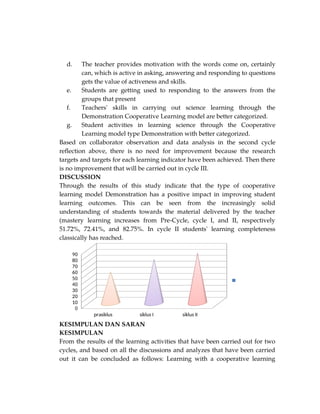
Completion Chart Formative Test Cycle II
From the graph above, the average value of student learning outcomes is
84.88 and the learning completeness reaches 82.75% or there are 24 students
out of 29 students who have finished learning. These results indicate that in
this second cycle classical learning completeness has increased slightly better
than cycle I. There is an increase in student learning outcomes because after
the teacher informs that at the end of the lesson there will always be a test so
that at the next meeting students are more motivated to learn.
Reflection
The reflection on actions in cycle 2 is more focused on the problems that arise
and the successes that appear during learning.
a. During the learning process, the teacher has carried out all learning
activities well, and explained the learning material more deeply
b. The teacher has been managing the class and guiding the group in
discussions to report the results of the discussion very well, the class
atmosphere is excited and cheerful, because after the group
presentations the teacher and students provide reinforcement with
applause.
c. Students ask, answer and respond to increased from cycle 1, students
are also active in paying attention to the presentation of the results of
the discussion from the presenter group.
d. The teacher provides motivation with the words come on, certainly
can, which is active in asking, answering and responding to questions
gets the value of activeness and skills.
e. Students are getting used to responding to the answers from the
groups that present
f. Teachers' skills in carrying out science learning through the
Demonstration Cooperative Learning model are better categorized.
g. Student activities in learning science through the Cooperative
Learning model type Demonstration with better categorized.
Based on collaborator observation and data analysis in the second cycle
reflection above, there is no need for improvement because the research
targets and targets for each learning indicator have been achieved. Then there
is no improvement that will be carried out in cycle III.
DISCUSSION
Through the results of this study indicate that the type of cooperative
learning model Demonstration has a positive impact in improving student
learning outcomes. This can be seen from the increasingly solid
understanding of students towards the material delivered by the teacher
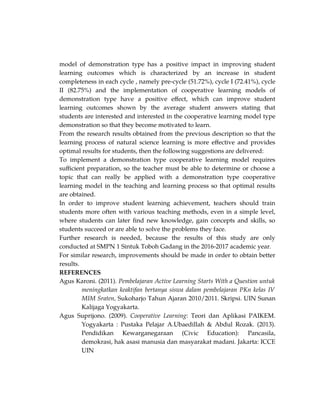
(mastery learning increases from Pre-Cycle, cycle I, and II, respectively
51.72%, 72.41%, and 82.75%. In cycle II students' learning completeness
classically has reached.
prasiklus siklus I siklus II
0
10
20
30
40
50
60
70
80
90
KESIMPULAN DAN SARAN
KESIMPULAN
From the results of the learning activities that have been carried out for two
cycles, and based on all the discussions and analyzes that have been carried
out it can be concluded as follows: Learning with a cooperative learning
model of demonstration type has a positive impact in improving student
learning outcomes which is characterized by an increase in student
completeness in each cycle , namely pre-cycle (51.72%), cycle I (72.41%), cycle
II (82.75%) and the implementation of cooperative learning models of
demonstration type have a positive effect, which can improve student
learning outcomes shown by the average student answers stating that
students are interested and interested in the cooperative learning model type
demonstration so that they become motivated to learn.
From the research results obtained from the previous description so that the
learning process of natural science learning is more effective and provides
optimal results for students, then the following suggestions are delivered:
To implement a demonstration type cooperative learning model requires
sufficient preparation, so the teacher must be able to determine or choose a
topic that can really be applied with a demonstration type cooperative
learning model in the teaching and learning process so that optimal results
are obtained.
In order to improve student learning achievement, teachers should train
students more often with various teaching methods, even in a simple level,
where students can later find new knowledge, gain concepts and skills, so
students succeed or are able to solve the problems they face.
Further research is needed, because the results of this study are only
conducted at SMPN 1 Sintuk Toboh Gadang in the 2016-2017 academic year.
For similar research, improvements should be made in order to obtain better
results.
REFERENCES
Agus Karoni. (2011). Pembelajaran Active Learning Starts With a Question untuk
meningkatkan keaktifan bertanya siswa dalam pembelajaran PKn kelas IV
MIM Sraten, Sukoharjo Tahun Ajaran 2010/2011. Skripsi. UIN Sunan
Kalijaga Yogyakarta.
Agus Suprijono. (2009). Cooperative Learning: Teori dan Aplikasi PAIKEM.
Yogyakarta : Pustaka Pelajar A.Ubaedillah & Abdul Rozak. (2013).
Pendidikan Kewarganegaraan (Civic Education): Pancasila,
demokrasi, hak asasi manusia dan masyarakat madani. Jakarta: ICCE
UIN
Syarif Hidayatullah Ari Samandhi. (2009). Pembelajaran Aktif (Active Learning).
Jakarta: Teaching Improvement Worshop Enginering Education
Develompment Project.
Baharudin & Esa Nur Wahyuni. (2009). Teori Belajar dan Pembelajaran.
Yogyakarta: Ar-Ruzz Media.
Desmita. (2009). Psikologi Perekembangan Siswa: Panduan Bagi Orang Tua Dan
Guru Dalam Memahami Psikologi Anak Usia SD, SMP, SMA.
Bandung: PT. Remaja Rosdakarya.
Diana Mutiah. (2010). Psikologi Bermain Anak Usia Dini. Jakarta: Kencana
Prenada Endang Poerwanti dkk. (2008). Asesmen Pembelajaran SD.
Jakarta: Dirjen Dikti.
Hamruni. (2011). Strategi Pembelajaran. Yogyakarta: Insan Madani.
Hamzah B. Uno dan Nurdin Mohamad. (2012). Belajar dengan Pendekatan
PAILKEM:Pembelajaran Aktif, Inovatif, Lingkungan, Kreatif, Efektif,
Menarik. Jakarta: PT.Bumi Aksara.
Hiszyam Zaini. (2008). Strategi Pembelajaran Aktif. Yogyakarta: Insan Madani.
Hollingsworth, Pat & Gina Lewis. (2008). Pembelajaran Aktif: Meningkatkan
Keasyikan Kegiatan Di Kelas. Penerjemah: Dwi Wulandari. Jakarta:
Indeks.
Moh. Sholeh Hamid. (2011). Metode Edutaiment. Yogyakarta: Diva Press. Redja
Mudyahardjo. (2012). Pengantar Pendidikan. Jakarta: Rajawali Pers.
Muhammad Thobroni & Arik Mustofa. (2013). Belajar & Pembelajaran:
Pengembangan Wacana Dan Praktik Pembelajaran Dalam
Pembangunan Nasional . Yogyakarta:Ar-Ruzz Media.
Saiful Bahri Djamarah. (2011).Psikologi Belajar. Jakarta: Rineka Cipta.
Samsuri. (2011). Sugiyono. (2009). Metode Penelitian Pendidikan Pendekatan
Kuantitatif, Kualitatif, dan R & D. Bandung: Alfabeta. 99 .(2010).
Metode Penelitian Pendidikan. Bandung: Alfabeta. Sugihartono, dkk.
(2007). Psikologi Pendidikan. Yogyakarta: UNY Press.
Suharsimi Arikunto. (2007). Penelitian Tindakan Kelas. Jakarta: Bumi Aksara.
Suyono & Hariyanto. (2011). Belajar dan Pembelajaran. Bandung: PT.Remaja

EFFORTS TO IMPROVE IPA LEARNING OUTCOMES THROUGH DEMONSTRATION LEARNING MODELS

  • 1.
    EFFORTS TO IMPROVEIPA LEARNING OUTCOMES THROUGH DEMONSTRATION LEARNING MODELS IN CLASS VIII.3 STUDENTS, SMPN 1 SINTUK TOBOH GADANG Mellya Eka Putri1 Science Teacher SMPN 1 Sintuk Toboh Gadang 2017 Abstract This study aims to obtain information and find out about efforts to improve learning outcomes of science through the DEMONTRATION learning model. This type of research is classroom action research. The subjects of this study were in class VIII.3 at SMPN 1 Sintuk Toboh Gadang with 29 students. This research uses a qualitative approach. Research procedures include planning, implementing, observing, and reflecting. This research was conducted in two cycles and was conducted in collaboration between the researcher and the observer. The techniques used in data collection are observation, tests, field notes and documentation. Data analysis uses percentages. The results of this study indicate that student learning outcomes in the science learning process by using DEMONTRATION can improve student learning outcomes. Keywords: Science Learning Outcomes, DEMONSTRATION Learning Model INTRODUCTION The learning of Natural Sciences (IPA) is expected to be a vehicle for students to learn about themselves and their surroundings, as well as further development in their application in daily life. The National Education Standards Agency (BSNP) (in the Learning Unit Level Curriculum, 2006: 484) states "the science learning process in junior high schools emphasizes providing direct experience to develop competencies in order to explore and understand the natural surroundings scientifically" Students as educational subjects, are required to be active in learning, seeking information and exploring alone or in groups. The teacher acts as a facilitator
  • 2.
    and guides studentstowards optimizing the achievement of the knowledge being learned. In accordance with Piaget's theory (in Yusuf, 2007: 1) that "In learning the teacher acts as a facilitator, not a provider of information". In the syllabus development guide and Learning Implementation Plan (RPP), the Ministry of National Education (in Irma, 2007: 2) states "Learning activities are designed to provide learning experiences that involve mental and physical processes through interactions between students, students and teachers, the environment, and resources other learning in the context of achieving basic competencies ". Learning activities contain life skills that students need to master. The learning method used by the teacher in bridging student needs only uses the lecture method. Because every student is required to have a textbook. So the teacher only explains the material in the book and asks students to answer the questions in the textbook. Therefore the value obtained by students is not as expected. The result is still below the standard of teaching and learning completeness with an average value of 6.0. the completeness value set by the school is 7. In addition to the low value of Completion in Teaching and Learning (SKBM), the activities shown by students are also low such as: doing homework (homework), low interest in student learning in groups. In general students tend to be passive, only accept what the teacher says. If the teacher asks questions students do not dare to answer, if there are only 4-5 students. Based on the above problems, the effort to improve student learning outcomes in science learning in SMPN 1 Sintuk Toboh Gadang is a problem that needs to be addressed. One method of learning that is thought to overcome these problems is the method of cooperative learning. Through cooperative learning methods students can learn more actively and an atmosphere that is conducive to developing knowledge, values attitudes, activeness, and social skills such as cooperative skills that benefit their lives in society. By using cooperative learning methods are expected to foster excitement in learning. Because with the cooperative learning method, the competencies possessed by students will trigger to make the learning atmosphere complement each other in terms of knowledge and expertise. According to Muhamad (2004: 1) "Cooperative learning methods are practical classroom techniques that teachers can use every day to help their students
  • 3.
    learn each subject,from basic skills to complex problem solving". So, the cooperative learning method is to utilize small groups in teaching that allows students to work together to maximize their learning outcomes. By studying groups will make it easier for students to understand the subject matter. Slavin (in Karuru, 2007: 1) that "Students will more easily find and understand difficult concepts if they can discuss these concepts with each other". And also with group learning will bring a positive influence on students. In accordance with the results of Slavin's research (in Harnawati, 2006: 9) that "The elements of group goals and individual responsibility show a real positive effect on learning outcomes of students in grades two through twelfth grade with all subjects". One of the cooperative learning methods that can be used by the teacher is the Demonstration type cooperative learning method. Demonstration type cooperative learning method is a very interesting learning method and students are very happy to be asked to answer questions, without realizing students directly sharpen their brains by filling in the boxes provided by the teacher including filling in the worksheet. LITERATURE REVIEW According to Slameto (Syaiful Bahri Djamarah, 2011: 13) learning is a business process undertaken to obtain behavioral changes from interactions with the environment obtained from experience Oemar (2008: 2) also argues that, learning outcomes are behaviors that arise, for example from not knowing to knowing, new questions arise, changes in the stage of habitual skills, ability to appreciate, the development of social, emotional, and physical growth. Carin (in Yusuf, 2007: 1) states that: IPA as a product or content includes facts, concepts, principles, laws, and theories of science. So basically IPA consists of three components, namely scientific attitude, scientific process, and scientific products. This means that science does not only consist of a collection of knowledge or various memorized facts, it is also an active activity or process of using the mind to study natural phenomena that cannot be contemplated. According to Sanjaya (2006: 147) "Method is a method used to implement a plan that has been prepared in real activities so that the objectives that have been prepared are achieved optimally".
  • 4.
    According to Unoand Mohamad (2012: 98) The demonstration method is also used in active learning, because it is in contact with how students demonstrate something. This learning strategy shows how it does something which is then observed and discussed. RESEARCH METHODOLOGY This research is a classroom action research. According Suharsimi Arikunto, et al (2007: 3) classroom action research is an examination of learning activities in the form of actions that are deliberately raised and occur in a class together. This research was conducted at SMPN 1 Sintuk Toboh Gadang. This class action research was planned in class VIII.3 SMPN 1 Sintuk Toboh Gadang with 29 students, consisting of 15 men and 14 women. This research was conducted in the second semester and in class VIII.3 SMPN 1 Sintuk Toboh Gadang 2016/2017 school year. The research process consists of four sets of activities carried out in an iterative cycle, namely: 1. Planning The plan is the initial stage that must be done. 2. Action Action is the application of a plan that has been made in the form of an application of a particular learning strategy that aims to improve and perfect the strategy being carried out. 3. Observation Observations are made to observe changes that occur during the action carried out. 4. Reflection Contemplation is the activity of reflecting the results of observations to become the next planning material. Data collection tools include observation sheets, field notes, tests, and documentation. Data analysis technique Data filling in the observation sheet of student learning activities in a qualitative analysis in the form of a percentage, To calculate the percentage of student learning outcomes researchers use the benchmark "Total achievement score divided by maximum score multiplied by 100". NA = Total Score Achieved x 100 % Maximum Score RESEARCH RESULTS AND DISCUSSION
  • 5.
    RESEARCH RESULT Pre Cycle Precycle data collection activities were carried out on February 13, 2017 in class VIII.3 with 29 students. Prasiklus conducted by researchers by carrying out science learning activities using the question and answer method that ends with the implementation of the test. The impact of student learning outcomes is also low, this is evidenced from the results of the last daily test before the method is applied with the highest value of the complete data, can be seen in the table below: Table 1. Recapitulation of Pre-Cycle Test Results No. Description Pre Cycle 1 Average test scores 71.31 2 Number of students who have completed their studies 15 3 The number of students who do not complete study 14 4 Percentage of mastery learning 51.72 5 Percentage of incomplete learning 48.27 From the table above it can be explained that before applying the Demonstration type learning method obtained the average student learning outcomes is 71.31 with a percentage of 51.72% or 15 students out of 29 students who have finished learning. Cycle I Planning Preparing syllabus, preparing lesson plans, preparing media, worksheets and tools and materials for pratikum (demonstration) and teaching materials, preparing UH questions for cycle 1 and researchers using Demontration type cooperative learning models as solutions to solving learning problems. Implementation Cycle I Meeting I
  • 6.
    Held on Monday20 February 2017 with the material Pressure on solids, factors. - factors affecting the pressure on solids and the use of the pressure formula P = F / A in the sample questions consisting of preliminary activities, core activities and closing activities . Cycle 2 Meeting I Held on Monday, February 27, 2017 in Class VIII.3 with the material Pascal Law, Application of the Formula Formula Pascal F1 / A1 = F2 / A2 and Examples of tools that work according to the Pascal law consisting of preliminary activities, core activities, and closing activities . Observation Based on the observations of the teacher, observer, teacher's field notes, at the end of the teaching and learning process students are given a formative test I in order to find out the level of success of students in the teaching and learning process that has been done. Tabel 2. Recapitulation of Cycle I Test Results No. Description Pre Cycle 1 Average test scores 79.8 2 Number of students who have completed their studies 21 3 The number of students who do not complete study 8 4 Percentage of mastery learning 72.4 5 Percentage of incomplete learning 27.6
  • 7.
    0 30 60 Classics Completion ChartCycle I From the graph above it can be explained that by applying the Demonstration type cooperative learning model obtained an average value of student learning outcomes is 79.8 and mastery learning reaches 72.4% or there are 21 students out of 29 students have finished learning. These results indicate that in the first cycle classically students have not yet finished learning, this is because students still feel new and do not understand what is meant and used by the teacher by applying the cooperative learning model type Demonstration. Reflection Reflection of actions in the first cycle is more focused on the problems that arise and the successes that appear during learning. a During the learning process, the teacher has carried out all learning activities well, but the teacher is less clear in explaining the learning material b The teacher needs to maximally manage the class and guide the group in discussions to make a discussion report c Some students lack concentration, so students are less able to answer questions from the teacher and students are less active in paying attention to the presentation of the results of the discussion and less active in asking and responding d The motivation provided by the teacher is still lacking so students are still hesitant in their opinions and make conclusions e Students are still not accustomed to responding to the answers from the groups presenting f Teacher skills in implementing science learning through models
  • 8.
    g Cooperative learningtype of Demonstration is well categorized. h Student activities in learning science through the Demonstrated Cooperative Learning model are categorized as good. Cycle II Planning Preparing syllabus, preparing lesson plans, preparing media, worksheets and tools and materials for pratikum (teaching demonstration) and teaching materials, preparing UH questions for cycle 2, and researchers using the Demonstration type cooperative learning model as a solution to solving learning problems. Cycle I Meeting II The implementation of teaching and learning activities for the second cycle was held Monday on March 26, 2017 in Class VIII.3 with the material Explaining the Archimedes Law, Using the formula Fa = ρc.g.vb andc.g.vb and Examples of tools for which the working principle of Archimedes's law consists of preliminary activities , core activities and closing activities. Cycle 2 Meeting II The second meeting on the second cycle was held on Monday March 13, 2017 in class VIII.3 with material Floating objects, floating objects and sinking objects consisting of preliminary activities, core activities and closing activities. Observation Based on the observations of the teacher, observer, teacher's field notes, the results of student evaluations, in cycle II activities, it can be stated that the teaching and learning process of students is given a formative test III with the aim of knowing the level of student success during the teaching and learning process that has been carried out. Table 3. Recapitulation of Cycle I Test Results No. Description Pre Cycle 1 Average test scores 84.88 2 Number of students who have completed their studies 24 3 The number of students who do 5
  • 9.
    not complete study 4Percentage of mastery learning 82.75 5 Percentage of incomplete learning 17.24 0 30 60 90 Completion Chart Formative Test Cycle II From the graph above, the average value of student learning outcomes is 84.88 and the learning completeness reaches 82.75% or there are 24 students out of 29 students who have finished learning. These results indicate that in this second cycle classical learning completeness has increased slightly better than cycle I. There is an increase in student learning outcomes because after the teacher informs that at the end of the lesson there will always be a test so that at the next meeting students are more motivated to learn. Reflection The reflection on actions in cycle 2 is more focused on the problems that arise and the successes that appear during learning. a. During the learning process, the teacher has carried out all learning activities well, and explained the learning material more deeply b. The teacher has been managing the class and guiding the group in discussions to report the results of the discussion very well, the class atmosphere is excited and cheerful, because after the group presentations the teacher and students provide reinforcement with applause. c. Students ask, answer and respond to increased from cycle 1, students are also active in paying attention to the presentation of the results of the discussion from the presenter group.
  • 10.
    d. The teacherprovides motivation with the words come on, certainly can, which is active in asking, answering and responding to questions gets the value of activeness and skills. e. Students are getting used to responding to the answers from the groups that present f. Teachers' skills in carrying out science learning through the Demonstration Cooperative Learning model are better categorized. g. Student activities in learning science through the Cooperative Learning model type Demonstration with better categorized. Based on collaborator observation and data analysis in the second cycle reflection above, there is no need for improvement because the research targets and targets for each learning indicator have been achieved. Then there is no improvement that will be carried out in cycle III. DISCUSSION Through the results of this study indicate that the type of cooperative learning model Demonstration has a positive impact in improving student learning outcomes. This can be seen from the increasingly solid understanding of students towards the material delivered by the teacher (mastery learning increases from Pre-Cycle, cycle I, and II, respectively 51.72%, 72.41%, and 82.75%. In cycle II students' learning completeness classically has reached. prasiklus siklus I siklus II 0 10 20 30 40 50 60 70 80 90 KESIMPULAN DAN SARAN KESIMPULAN From the results of the learning activities that have been carried out for two cycles, and based on all the discussions and analyzes that have been carried out it can be concluded as follows: Learning with a cooperative learning
  • 11.
    model of demonstrationtype has a positive impact in improving student learning outcomes which is characterized by an increase in student completeness in each cycle , namely pre-cycle (51.72%), cycle I (72.41%), cycle II (82.75%) and the implementation of cooperative learning models of demonstration type have a positive effect, which can improve student learning outcomes shown by the average student answers stating that students are interested and interested in the cooperative learning model type demonstration so that they become motivated to learn. From the research results obtained from the previous description so that the learning process of natural science learning is more effective and provides optimal results for students, then the following suggestions are delivered: To implement a demonstration type cooperative learning model requires sufficient preparation, so the teacher must be able to determine or choose a topic that can really be applied with a demonstration type cooperative learning model in the teaching and learning process so that optimal results are obtained. In order to improve student learning achievement, teachers should train students more often with various teaching methods, even in a simple level, where students can later find new knowledge, gain concepts and skills, so students succeed or are able to solve the problems they face. Further research is needed, because the results of this study are only conducted at SMPN 1 Sintuk Toboh Gadang in the 2016-2017 academic year. For similar research, improvements should be made in order to obtain better results. REFERENCES Agus Karoni. (2011). Pembelajaran Active Learning Starts With a Question untuk meningkatkan keaktifan bertanya siswa dalam pembelajaran PKn kelas IV MIM Sraten, Sukoharjo Tahun Ajaran 2010/2011. Skripsi. UIN Sunan Kalijaga Yogyakarta. Agus Suprijono. (2009). Cooperative Learning: Teori dan Aplikasi PAIKEM. Yogyakarta : Pustaka Pelajar A.Ubaedillah & Abdul Rozak. (2013). Pendidikan Kewarganegaraan (Civic Education): Pancasila, demokrasi, hak asasi manusia dan masyarakat madani. Jakarta: ICCE UIN
  • 12.
    Syarif Hidayatullah AriSamandhi. (2009). Pembelajaran Aktif (Active Learning). Jakarta: Teaching Improvement Worshop Enginering Education Develompment Project. Baharudin & Esa Nur Wahyuni. (2009). Teori Belajar dan Pembelajaran. Yogyakarta: Ar-Ruzz Media. Desmita. (2009). Psikologi Perekembangan Siswa: Panduan Bagi Orang Tua Dan Guru Dalam Memahami Psikologi Anak Usia SD, SMP, SMA. Bandung: PT. Remaja Rosdakarya. Diana Mutiah. (2010). Psikologi Bermain Anak Usia Dini. Jakarta: Kencana Prenada Endang Poerwanti dkk. (2008). Asesmen Pembelajaran SD. Jakarta: Dirjen Dikti. Hamruni. (2011). Strategi Pembelajaran. Yogyakarta: Insan Madani. Hamzah B. Uno dan Nurdin Mohamad. (2012). Belajar dengan Pendekatan PAILKEM:Pembelajaran Aktif, Inovatif, Lingkungan, Kreatif, Efektif, Menarik. Jakarta: PT.Bumi Aksara. Hiszyam Zaini. (2008). Strategi Pembelajaran Aktif. Yogyakarta: Insan Madani. Hollingsworth, Pat & Gina Lewis. (2008). Pembelajaran Aktif: Meningkatkan Keasyikan Kegiatan Di Kelas. Penerjemah: Dwi Wulandari. Jakarta: Indeks. Moh. Sholeh Hamid. (2011). Metode Edutaiment. Yogyakarta: Diva Press. Redja Mudyahardjo. (2012). Pengantar Pendidikan. Jakarta: Rajawali Pers. Muhammad Thobroni & Arik Mustofa. (2013). Belajar & Pembelajaran: Pengembangan Wacana Dan Praktik Pembelajaran Dalam Pembangunan Nasional . Yogyakarta:Ar-Ruzz Media. Saiful Bahri Djamarah. (2011).Psikologi Belajar. Jakarta: Rineka Cipta. Samsuri. (2011). Sugiyono. (2009). Metode Penelitian Pendidikan Pendekatan Kuantitatif, Kualitatif, dan R & D. Bandung: Alfabeta. 99 .(2010). Metode Penelitian Pendidikan. Bandung: Alfabeta. Sugihartono, dkk. (2007). Psikologi Pendidikan. Yogyakarta: UNY Press. Suharsimi Arikunto. (2007). Penelitian Tindakan Kelas. Jakarta: Bumi Aksara. Suyono & Hariyanto. (2011). Belajar dan Pembelajaran. Bandung: PT.Remaja