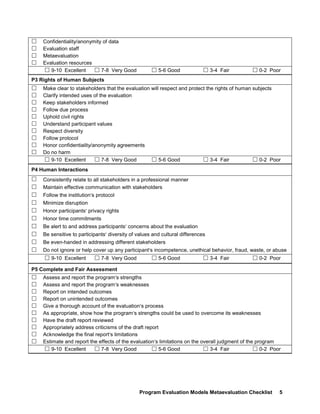
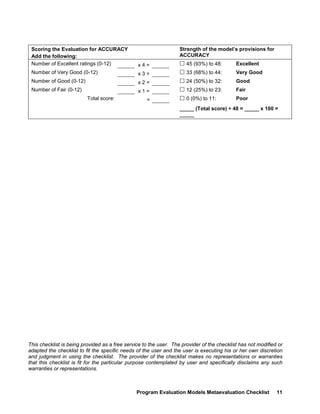
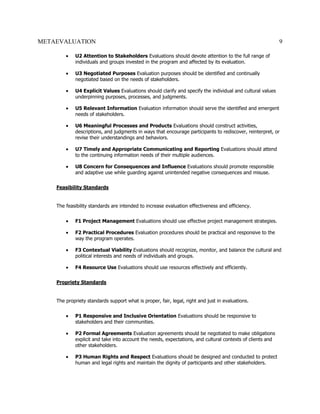
This document provides a summary of metaevaluation, including its definition, history, types, models, purpose, process, standards, and checklists. Metaevaluation is defined as the evaluation of an evaluation to assess its quality and adherence to standards. It gained prominence in the late 20th century with the increased focus on educational program effectiveness. There are two types - proactive and retroactive. Key standards for metaevaluation include utility, feasibility, propriety, accuracy, and accountability. The metaevaluation process involves 10 steps including defining questions, collecting information, analyzing adherence to standards, and reporting findings. Checklists are provided to aid in conducting metaevaluations.




![11
A.9
In communicating evaluation
methods and approaches,
discuss in a contextually
appropriate way those
values, assumptions,
theories, methods, analyses,
results, and analyses
significantly affecting the
interpretation of the
evaluative findings
Form 5: Quantitative Analysis for Guiding Principle A–SYSTEMATIC INQUIRY
Caveat: It is problematic to do any kind of precise quantitative analysis of ratings drawn from the Guiding Principles and this checklist,
because the relative importance of different checkpoints can vary across evaluations, some checkpoints will not be applicable in given
evaluations, and the authors of the Guiding Principles provided considerably less detail for some principles than others. There is thus no
basis for defining one set of cut scores to divide such criterial concepts as Poor, Marginal, Moderate, Good, and Excellent. The following
quantitative analysis procedure is provided only as a rough guide and illustration for exploring the quantitative rating matter. This
procedure may be useful in some cases, but not others. Users are advised to apply the procedure with caution and where it clearly would
be misleading not to apply it at all.
To apply this procedure to quantify the target evaluation’s merit in fulfilling Principle A, carry out the following steps and record your
answer in the space at the right of each step.
Procedure Answer
1. Proceed with this analysis only if all checkpoints for this principle marked * as a minimum
requirement have been met (marked +).
2. Determine the number of applicable indicators associated with Principle A by subtracting the number
of Principle A indicators marked NA from the total number of Principle A indicators (9).
3. If the number of indicators marked + or - is less than 8, abort the quantitative analysis and proceed to
the qualitative analysis.
4. Assess whether the following cut scores are acceptable: and defensible for interpreting the value
meaning of the score for Principle A. Indicate your decision by placing a checkmark in the
appropriate space to the right. Write the rationale for your decision on this matter in the space to the
right.
• for all 9 checkpoints: [0-4: Poor, 5: Marginal, 6: Moderate, 7: Good, 8 or 9: Excellent]4
• for 8 applicable checkpoints: [0-4: Poor, 5: Marginal, 6: Moderate, 7: Good, 8: Excellent
Acceptable
Not Acceptable
Rationale:
5. Determine the rating for the evaluation on Principle A by summing the number of principles met and
adding a 0. For example, a score of 8 would receive a rating of 80.](https://image.slidesharecdn.com/f4e2a856-d114-4e97-950c-07f1bceeb202-151020152650-lva1-app6891/85/Metaevaluation-Summary-25-320.jpg)


![17
Form 8: Quantitative Analysis for Guiding Principle B–COMPETENCE
Caveat: It is problematic to do any kind of precise quantitative analysis of ratings drawn from the Guiding Principles and this checklist,
because the relative importance of different checkpoints can vary across evaluations, some checkpoints will not be applicable in given
evaluations, and the authors of the Guiding Principles provided considerably less detail for some principles than others. There is thus no
clear basis for defining one set of cut scores to divide such criterial concepts as Poor, Marginal, Moderate, Good, and Excellent. The
following quantitative analysis procedures is provided only as a rough guide for exploring the quantitative rating matter. This procedure
may be quite useful in some cases, but not in others. Users are advised to use the procedure with caution and where it clearly would be
misleading not to use it at all.
To employ this procedure to quantify the target evaluation’s merit in fulfilling Principle B, carry out the following steps and record your
answer in the space at the right of each step.
1. Proceed with this analysis only if all checkpoints for this principle marked * as a minimum
requirement have been met (marked +).
2. Determine the number of applicable indicators associated with Principle B by subtracting the number
of Principle B indicators marked NA from the total number of Principle B indicators (7).
3. If the number of indicators marked + or - is less than 6, abort the quantitative analysis and proceed to
the qualitative analysis.
4. Assess whether the following cut scores are acceptable: and defensible for interpreting the value
meaning of the score for Principle B. Indicate your decision by placing a checkmark in the
appropriate space to the right. Write the rationale for your decision on this matter in the space to the
right.
• for all 7 checkpoints: [0-2: Poor, 3: Marginal, 4: Moderate, 5: Good, 6 or 7: Excellent
• for 6 applicable checkpoints: [0-3: Poor, 4: Marginal to: Moderate, 5: Good, 6: Excellent ]
Acceptable
Not Acceptable
Rationale:
5. Determine the rating for the evaluation on Principle A by summing the number of principles met and
adding a 0. For example, a score of 7 would receive a rating of 70.
6. If you disagree with the cut scores in 4 above, provide the ones you will use here. In either case,
record your rating and quality designation (poor, marginal, moderate, good, or excellent) of the
evaluation in the space at the right. Also, provide your rationale for the new cut scores below..
Rating: _
Quality Designation:
Rationale:](https://image.slidesharecdn.com/f4e2a856-d114-4e97-950c-07f1bceeb202-151020152650-lva1-app6891/85/Metaevaluation-Summary-31-320.jpg)


![24
Form 11: Quantitative Analysis for Guiding Principle C–INTEGRITY AND HONESTY
Caveat: It is problematic to do any kind of precise quantitative analysis of ratings drawn from the Guiding Principles and this checklist,
because the importance and applicability of checkpoints varies for different evaluations, some checkpoints will not be applicable in given
evaluations, and there is no one consistent basis for setting cut scores to divide the criterial concepts of Poor, Marginal, Moderate, Good,
and Excellent. The following quantitative analysis procedures is provided only as a rough guide for exploring the quantitative rating
matter. This procedure may be useful in some cases, but not in others. Users are advised to apply the procedure with caution and where it
clearly would be misleading not to apply it at all.
To employ this procedure to quantify the target evaluation’s merit in fulfilling Principle C, carry out the following steps and record your
answer in the space at the right of each step.
2. Proceed with this analysis only if all checkpoints for this principle marked * as a minimum
requirement have been met (marked +).
2. Determine the number of applicable indicators associated with Principle C by subtracting the
number of Principle C indicators marked NA from the total number of Principle C indicators (16).
3. If the number of indicators marked + or - is less than 12, abort the quantitative analysis and
proceed to the qualitative analysis.
4. Determine the percent of Principle C applicable indicators that the target evaluation passed by
dividing the number of indicators marked with a plus (+) by the number of indicators not marked
NA.
5. Determine the score for Principle C by multiplying the percent of Principle C applicable indicators
marked with a + by 100.
6. Assess whether the following cut scores [0-39: Poor, 40-59: Marginal, 60-79: Moderate, 80-92:
Good, 93-100: Excellent] are acceptable and defensible for interpreting the value meaning of the
score for Principle C. Indicate your decision by placing a checkmark in the appropriate space to
the right. Write your rationale for your decision on this matter below.
___Acceptable
___Not Acceptable
7. If you disagree with the cut scores in 6 above, provide the ones you will use here. In either case
record the rating and quality designation (poor, marginal, moderate, good, or excellent) of the
evaluation in the space at the right. Also, provide your rationale for the new cut scores below.
Rating:
Quality Designation:
Rationale:](https://image.slidesharecdn.com/f4e2a856-d114-4e97-950c-07f1bceeb202-151020152650-lva1-app6891/85/Metaevaluation-Summary-38-320.jpg)


![30
Form 14: Quantitative Analysis for Guiding Principle D–RESPECT FOR PEOPLE
Caveat: It is problematic to do any kind of precise quantitative analysis of ratings drawn from the Guiding Principles and this checklist,
because some criteria are more important than others, many criteria will not be applicable in given evaluations, the importance and
applicability of checkpoints vary for different evaluations, and there is no clear basis for setting cut scores to divide the criterial concepts of
Poor, Marginal, Moderate, Good, and Excellent. The following quantitative analysis procedure is provided only as a rough guide for
exploring the quantitative rating matter. This procedure may be useful in some cases, but not in others. Users are advised to apply the
procedure with caution and where it clearly would be misleading not to apply it at all.
To employ this procedure to quantify the target evaluation’s merit in fulfilling Principle D, carry out the following steps and record your
answer in the space at the right of each step.
7. Proceed with this analysis only if all checkpoints for this principle marked * as a minimum requirement
have been met (marked +).
2. Determine the number of applicable indicators associated with Principle D by subtracting the number of
Principle D indicators marked NA from the total number of Principle D indicators (16).
3. If the number of indicators marked + or - is less than 10, abort the quantitative analysis and proceed to
the qualitative analysis.
4. Determine the percent of Principle D applicable indicators that the target evaluation passed by dividing
the number of indicators marked with a plus (+) by the number of indicators not marked NA.
5. Determine the score for Principle D by multiplying the percent of Principle D applicable indicators
marked with a + by 100.
6. Assess whether the following cut scores [0-39: Poor, 40-59: Marginal, 60-79: Moderate, 80-92: Good,
93-100: Excellent] are acceptable and defensible for interpreting the value meaning of the score for
Principle D. Indicate your decision by placing a checkmark in the appropriate space to the right. Write
your rationale for your decision on this matter here:
Acceptable
Not Acceptable
7. If you disagree with the cut scores in 6. above, provide the ones you will use here. In either case,
record your rating and quality designation (poor, marginal, moderate, good, or excellent) of the
evaluation in the space at the right:. Also, provide your rationale for the new cut scores below:
Rating:
Quality Designation:
Rationale:](https://image.slidesharecdn.com/f4e2a856-d114-4e97-950c-07f1bceeb202-151020152650-lva1-app6891/85/Metaevaluation-Summary-44-320.jpg)


![36
Form 17: Quantitative Analysis for Guiding Principle E–GENERAL AND PUBLIC WELFARE
Caveat: It is problematic to do any kind of precise quantitative analysis of ratings drawn from the Guiding Principles and this checklist,
because some checkpoints are more important than others, many checklists will not be applicable in given evaluations, the checkpoints
vary in importance and applicability across evaluations, and there is no one basis for setting cut scores to divide the criterial concepts of
Poor, Marginal, Moderate, Good, and Excellent. The following quantitative analysis procedure is provided only as a rough guide for
exploring the quantitative rating matter. This procedure may be useful in some cases, but not others. Users are advised to apply the
procedure with caution and where it clearly would be misleading not to apply it at all.
To employ this procedure to quantify the target evaluation’s merit in fulfilling Principle A, carry out the following steps and record your
answer in the space at the right of each step.
1. Proceed with this analysis only if all checkpoints for this principle marked * as a minimum
requirement have been met (marked +).
2. Determine the number of applicable indicators associated with Principle E by subtracting the number
of Principle E indicators marked NA from the total number of Principle E indicators (13).
3. If the number of indicators marked + or - is less than 10, abort the quantitative analysis and proceed
to the qualitative analysis.
4. Determine the percent of Principle E applicable indicators that the target evaluation passed by
dividing the number of indicators marked with a plus (+) by the number of indicators not marked
NA.
5. Determine the score for Principle E by multiplying the percent of Principle E applicable indicators
marked with a + by 100.
6. Assess whether the following cut scores [0-39: Poor, 40-59: Marginal, 60-79: Moderate, 80-92: Good,
93-100: Excellent] are acceptable and defensible for interpreting the value meaning of the score for
Principle E. Indicate your decision by placing a checkmark in the appropriate space to the right.
Write your rationale for your decision on this matter here:
Acceptable
Not Acceptable
7. If you disagree with the cut scores in 6 above, provide the ones you will use here. In either case,
record the rating of the evaluation and quality designation (poor, marginal, moderate, good, or
excellent) in the space at the right. Also, provide your rationale for the new cut scores below:
Rating:
Quality Designation:
Rationale:](https://image.slidesharecdn.com/f4e2a856-d114-4e97-950c-07f1bceeb202-151020152650-lva1-app6891/85/Metaevaluation-Summary-50-320.jpg)


![39
Form 20: Summary Quantitative Evaluation of the Target Evaluation
Caveat: It is problematic to do any kind of precise quantitative analysis of ratings drawn from the Guiding Principles and this checklist,
because the relative importance of different checklists varies across different evaluations, many checkpoints will not be applicable in given
evaluations, and there is no single basis for setting cut scores that divide the criterial concepts of Poor, Marginal, Moderate, Good, and
Excellent. The following quantitative analysis procedure is provided only as a rough guide for exploring the quantitative rating matter.
This procedure may be useful in some cases, but not others. Users are advised to apply the procedure with caution and where it clearly
would be misleading not to apply it at all.
To apply this procedure to quantify the target evaluation’s merit in fulfilling all 5 AEA Guiding Principles, carry out the following steps
and, as appropriate, record your answers in the space at the right of each step.
1.___Proceed with this analysis only if you obtained ratings (in Forms 5, 8, 11, 14, and 17) for all 5
principles in accordance with the instructions given for those forms.
2___If the target evaluation rated Poor on any principle, judge the evaluation a failure regardless of its
ratings on the other principles.
3___If the target evaluation rated Marginal or higher on all 5 principles, determine the evaluation’s
overall score by summing the 5 scores and dividing by 5.
4___Assess whether the following cut scores [0-39: Poor, 40-59: Marginal, 60-79: Moderate, 80-92:
Good, 93-100: Excellent]
8
are acceptable and defensible for interpreting the value meaning of the
score for the overall evaluation. Indicate your decision by placing a checkmark in the appropriate
space to the right. Write your rationale for your decision on this matter here:
Acceptable
Not Acceptable
8
The rationale for this set of cut scores is focused mainly on the top and bottom judgment categories.
Any evaluation that met less than 25 percent of checkpoints overall would provide a poor basis for decision making.
An evaluation that met 93 percent or more of the checkpoints would be excellent, so long as no checkpoint judged
to be a minimum requirement was failed. Meeting 80 - 92 percent of the checkpoints would seem to provide a
probably good basis for decision making, again assuming that no minimum requirement checkpoint was missed. An
evaluation that scored in the moderate range (meeting 60 - 79 percent of the checkpoints) would not be considered
good, but also not disastrous if no minimum requirement checkpoints were missed. Summative metaevaluations
should seek to credit evaluations that fall in the excellent range and discourage use of those that fall in the poor and
marginal ranges (0 - 59 percent of the checkpoints met). Formative metaevaluations should seek to help strengthen
especially those evaluations that fall in the moderate and good ranges.](https://image.slidesharecdn.com/f4e2a856-d114-4e97-950c-07f1bceeb202-151020152650-lva1-app6891/85/Metaevaluation-Summary-53-320.jpg)