Practice Question
Let's take a moment to place the practice question in context. A
practice question is not a research question. A gap in knowledge
guides the PhD researcher in writing a research question that
includes making a prediction.
A practice question emerges from the research you read, review,
and critically appraise to articulate and support your practice
problem. A clear and concise practice question is always
supported by research evidence. Alongside the research
evidence that lends support to a practice question, the unique
practice needs of the local practice setting is reflected in the
practice question.
Developing an Answerable Practice Question Exploration
Return to Your Practice Problem
Take this opportunity to review your research evidence.
Embedded in the research used to articulate a compelling
practice problem is the beginning of your practice question.
Practice Setting
Take this opportunity to reflect on your practice problem
through the lens of your local practice setting. What does your
practice problem look like in daily practice? Reflect on
conversations shared with key stakeholders in practice. What is
going on in practice related to the identified practice problem?
PICOT is a mnemonic for a formatting tool that serves two
purposes. Each purpose is of equal importance to the practice
scholar as the practice change project is designed.
Assists with writing a clear, concise, one-sentence practice
question.
Assists with searching and retrieving relevant evidence in the
robust scientific search engines. The formatting tool PICOT
lends itself to the identification of keywords from each segment
of the practice question. The ability to break a practice question
into keywords is what makes searching for evidence.
Element Description
P Patient/Population The practice scholar states the
relevant patients/individuals. What does the research literature
say about the age, gender, specific characteristics, social that
would be important in this practice problem? The concise
articulation of the population is supported by a synthesis of
research evidence.
I Intervention The practice scholar states the research-
evidence based intervention to be translated to practice. The
research-evidence based intervention is supported by research
evidence. The practice scholar translates/transfers the research-
evidence based intervention as it was tested and empirically
proven across research studies. Note: The practice scholar does
not alter the research-evidence based intervention.
Implementation fidelity requires no changes be made to the
empirically proven research intervention.
C Comparison The practice scholar describes current
practice. In a practice change project, the comparison is practice
as usual.
O Outcome
The practice scholar's intention is to learn if the translation of a
research-evidence based intervention influences local practice
outcomes. Practice change projects are not intended to design or
test an intervention, therefore, a prediction is not made as
outcomes are identified.
The practice outcome may be singular or several stated
outcomes. The practice scholar returns to research studies where
the research-evidence based intervention was tested. These
studies describe how study outcomes were measured. The
practice scholar confirms that identified outcomes in the
practice change project are numerical and are captured using
reliable and valid measures.
Reliability in statistics and psychometrics is the overall
consistency of a measure. A measure is said to have a high
reliability if it produces similar results under consistent
conditions. For example, measurements of people's height and
weight are often extremely reliable.
Validity in statistics and psychometrics refers to the extent to
which an assessment accurately measures what it is intended to
measure.
T Timeframe The timeframe for the DNP Practice
Change Project is 8–10 weeks.
Fineout-Overholt (2006) developed PICOT templates to assist in
the formulation of a focused, answerable question. These
templates align with the primary clinical domains, which
include intervention/therapy, etiology, diagnosis,
prognosis/prediction, and meaning.
Let’s use these PICOT templates to formulate a focused,
answerable question to address each clinical domain.
Clinical Domain: Intervention/Therapy
Questions in this domain address the treatment of an illness or
disability.
Use the Intervention template to formulate a focused,
answerable question addressing an intervention.
Intervention
In ____________________(P), how does
____________________ (I) compared to
____________________(C) affect _____________________(O)
within ___________(T)?
Now compare your answer to a sample question addressing an
intervention.
In African-American female adolescents newly diagnosed with
Type 2 Diabetes (P), does medical nutrition therapy (I) as
compared to a low-carbohydrate diet (C) help achieve and
maintain blood glucose levels in the normal range (O) over 8-12
weeks (T)?
Use the therapy template to formulate a focused, answerable
question addressing a therapy.
THERAPY
In __________________(P), what is the effect of
__________________(I) compared to _____________ (C) on
________________(O within _____________(T)?
Now compare your answer to a sample question addressing
therapy.In obese adolescents (P), does a personal movement
tracker device (I) as compared to not using a movement tracker
device (C) influence BMI and quality of life (O) over 8-12
weeks?
Reflect on how these templates addressing intervention and
therapy are similar? How are they different?
Clinical Domain: Etiology
Questions in this domain address the causes or origins of
disease (i.e., factors that produce or predispose toward a certain
disease or disorder).
Use the Etiology template to formulate a focused, answerable
question addressing etiology.
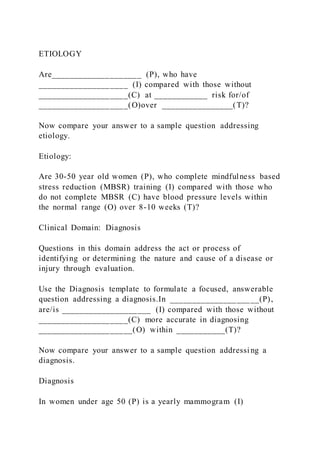
ETIOLOGY
Are____________________ (P), who have
____________________ (I) compared with those without
____________________(C) at ____________ risk for/of
____________________(O)over ________________(T)?
Now compare your answer to a sample question addressing
etiology.
Etiology:
Are 30-50 year old women (P), who complete mindfulness based
stress reduction (MBSR) training (I) compared with those who
do not complete MBSR (C) have blood pressure levels within
the normal range (O) over 8-10 weeks (T)?
Clinical Domain: Diagnosis
Questions in this domain address the act or process of
identifying or determining the nature and cause of a disease or
injury through evaluation.
Use the Diagnosis template to formulate a focused, answerable
question addressing a diagnosis.In ____________________(P),
are/is ____________________ (I) compared with those without
____________________(C) more accurate in diagnosing
_____________________(O) within ___________(T)?
Now compare your answer to a sample question addressing a
diagnosis.
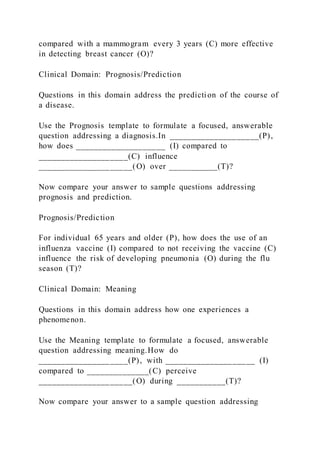
Diagnosis
In women under age 50 (P) is a yearly mammogram (I)
compared with a mammogram every 3 years (C) more effective
in detecting breast cancer (O)?
Clinical Domain: Prognosis/Prediction
Questions in this domain address the prediction of the course of
a disease.
Use the Prognosis template to formulate a focused, answerable
question addressing a diagnosis.In ____________________(P),
how does ____________________ (I) compared to
____________________(C) influence
_____________________(O) over ___________(T)?
Now compare your answer to sample questions addressing
prognosis and prediction.
Prognosis/Prediction
For individual 65 years and older (P), how does the use of an
influenza vaccine (I) compared to not receiving the vaccine (C)
influence the risk of developing pneumonia (O) during the flu
season (T)?
Clinical Domain: Meaning
Questions in this domain address how one experiences a
phenomenon.
Use the Meaning template to formulate a focused, answerable
question addressing meaning.How do
____________________(P), with ____________________ (I)
compared to ______________(C) perceive
_____________________(O) during ___________(T)?
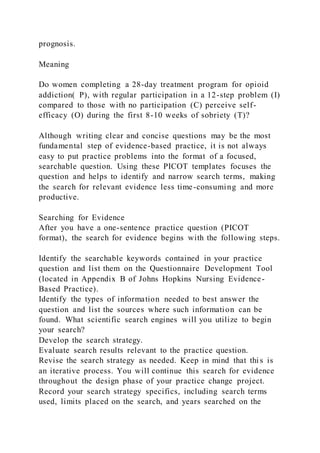
Now compare your answer to a sample question addressing
prognosis.
Meaning
Do women completing a 28-day treatment program for opioid
addiction( P), with regular participation in a 12-step problem (I)
compared to those with no participation (C) perceive self-
efficacy (O) during the first 8-10 weeks of sobriety (T)?
Although writing clear and concise questions may be the most
fundamental step of evidence-based practice, it is not always
easy to put practice problems into the format of a focused,
searchable question. Using these PICOT templates focuses the
question and helps to identify and narrow search terms, making
the search for relevant evidence less time-consuming and more
productive.
Searching for Evidence
After you have a one-sentence practice question (PICOT
format), the search for evidence begins with the following steps.
Identify the searchable keywords contained in your practice
question and list them on the Questionnaire Development Tool
(located in Appendix B of Johns Hopkins Nursing Evidence-
Based Practice).
Identify the types of information needed to best answer the
question and list the sources where such information can be
found. What scientific search engines will you utilize to begin
your search?
Develop the search strategy.
Evaluate search results relevant to the practice question.
Revise the search strategy as needed. Keep in mind that thi s is
an iterative process. You will continue this search for evidence
throughout the design phase of your practice change project.
Record your search strategy specifics, including search terms
used, limits placed on the search, and years searched on the
Question Development Tool and save the results.
P O L I T I C A L C S R : D O E S D E M O C R A T I C T H
E O R Y O F F E R N E W I N S I G H T S ? ?
Critics of integrated social contract theory argue that there are
no universally recognized
hypernorms, only standards which differ between cultures and
countries. Similarly, echo-
ing the positivist position, they argue that law-making and
enforcement are essentially
national, as there is no global legislature. Hence, both moral
and legal authority seem to be
lacking at global level. Is it still possible to derive a normative
basis for CSR which takes a
transnational approach and avoids a presumption of universal
norms? Some theorists feel
that the answer lies in the views of deliberative democracy held
by Jürgen Habermas.
Scherer and Palazzo put forward a theory of CSR that envisages
the company as a political
actor in a globalized society (Scherer and Palazzo, 2007). They
point out that globalization
is eroding the roles of traditional national governments, while
companies are taking on
wider roles in society formerly carried out by governments.
These roles were highlighted in
the section above on corporate citizenship. In this context,
companies are becoming part of
a wider participative process, also involving civil society and
governments.
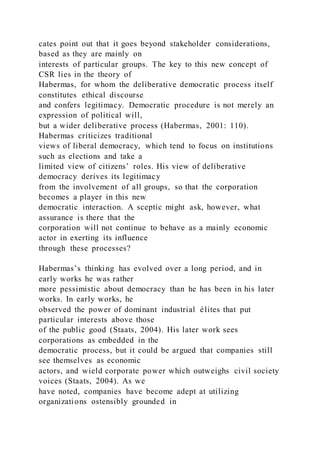
This deliberative concept of CSR sounds similar to stakeholder
dialogue, but its advo-
cates point out that it goes beyond stakeholder considerations,
based as they are mainly on
interests of particular groups. The key to this new concept of
CSR lies in the theory of
Habermas, for whom the deliberative democratic process itself
constitutes ethical discourse
and confers legitimacy. Democratic procedure is not merely an
expression of political will,
but a wider deliberative process (Habermas, 2001: 110).
Habermas criticizes traditional
views of liberal democracy, which tend to focus on institutions
such as elections and take a
limited view of citizens’ roles. His view of deliberative
democracy derives its legitimacy
from the involvement of all groups, so that the corporation
becomes a player in this new
democratic interaction. A sceptic might ask, however, what
assurance is there that the
corporation will not continue to behave as a mainly economic
actor in exerting its influence
through these processes?
Habermas’s thinking has evolved over a long period, and in
early works he was rather
more pessimistic about democracy than he has been in his later
works. In early works, he
observed the power of dominant industrial élites that put
particular interests above those
of the public good (Staats, 2004). His later work sees
corporations as embedded in the
democratic process, but it could be argued that companies still
see themselves as economic
actors, and wield corporate power which outweighs civil society
voices (Staats, 2004). As we
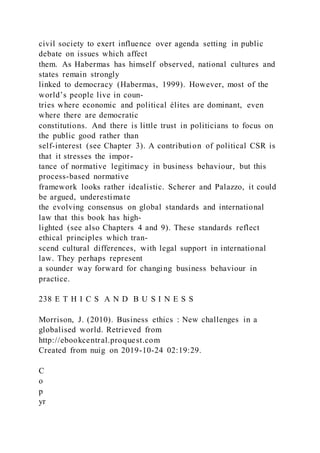
have noted, companies have become adept at utilizing
organizations ostensibly grounded in
civil society to exert influence over agenda setting in public
debate on issues which affect
them. As Habermas has himself observed, national cultures and
states remain strongly
linked to democracy (Habermas, 1999). However, most of the
world’s people live in coun-
tries where economic and political élites are dominant, even
where there are democratic
constitutions. And there is little trust in politicians to focus on
the public good rather than
self-interest (see Chapter 3). A contribution of political CSR is
that it stresses the impor-
tance of normative legitimacy in business behaviour, but this
process-based normative
framework looks rather idealistic. Scherer and Palazzo, it could
be argued, underestimate
the evolving consensus on global standards and international
law that this book has high-
lighted (see also Chapters 4 and 9). These standards reflect
ethical principles which tran-
scend cultural differences, with legal support in international
law. They perhaps represent
a sounder way forward for changing business behaviour in
practice.
238 E T H I C S A N D B U S I N E S S
Morrison, J. (2010). Business ethics : New challenges in a
globalised world. Retrieved from
http://ebookcentral.proquest.com
Created from nuig on 2019-10-24 02:19:29.
C
o
p
yr
ig
h
t
©
2
0
1
0
.
P
a
lg
ra
ve
M
a
cm
ill
a
n
.
A
ll
ri
g
h
ts
r
e
se
rv
e
d
.

Practice question lets take a moment to place the practice que

  • 1.
    Practice Question Let's takea moment to place the practice question in context. A practice question is not a research question. A gap in knowledge guides the PhD researcher in writing a research question that includes making a prediction. A practice question emerges from the research you read, review, and critically appraise to articulate and support your practice problem. A clear and concise practice question is always supported by research evidence. Alongside the research evidence that lends support to a practice question, the unique practice needs of the local practice setting is reflected in the practice question. Developing an Answerable Practice Question Exploration Return to Your Practice Problem Take this opportunity to review your research evidence. Embedded in the research used to articulate a compelling practice problem is the beginning of your practice question. Practice Setting Take this opportunity to reflect on your practice problem through the lens of your local practice setting. What does your practice problem look like in daily practice? Reflect on conversations shared with key stakeholders in practice. What is going on in practice related to the identified practice problem? PICOT is a mnemonic for a formatting tool that serves two purposes. Each purpose is of equal importance to the practice scholar as the practice change project is designed. Assists with writing a clear, concise, one-sentence practice question. Assists with searching and retrieving relevant evidence in the robust scientific search engines. The formatting tool PICOT lends itself to the identification of keywords from each segment
  • 2.
    of the practicequestion. The ability to break a practice question into keywords is what makes searching for evidence. Element Description P Patient/Population The practice scholar states the relevant patients/individuals. What does the research literature say about the age, gender, specific characteristics, social that would be important in this practice problem? The concise articulation of the population is supported by a synthesis of research evidence. I Intervention The practice scholar states the research- evidence based intervention to be translated to practice. The research-evidence based intervention is supported by research evidence. The practice scholar translates/transfers the research- evidence based intervention as it was tested and empirically proven across research studies. Note: The practice scholar does not alter the research-evidence based intervention. Implementation fidelity requires no changes be made to the empirically proven research intervention. C Comparison The practice scholar describes current practice. In a practice change project, the comparison is practice as usual. O Outcome The practice scholar's intention is to learn if the translation of a research-evidence based intervention influences local practice outcomes. Practice change projects are not intended to design or test an intervention, therefore, a prediction is not made as outcomes are identified. The practice outcome may be singular or several stated outcomes. The practice scholar returns to research studies where the research-evidence based intervention was tested. These studies describe how study outcomes were measured. The practice scholar confirms that identified outcomes in the practice change project are numerical and are captured using reliable and valid measures.
  • 3.
    Reliability in statisticsand psychometrics is the overall consistency of a measure. A measure is said to have a high reliability if it produces similar results under consistent conditions. For example, measurements of people's height and weight are often extremely reliable. Validity in statistics and psychometrics refers to the extent to which an assessment accurately measures what it is intended to measure. T Timeframe The timeframe for the DNP Practice Change Project is 8–10 weeks. Fineout-Overholt (2006) developed PICOT templates to assist in the formulation of a focused, answerable question. These templates align with the primary clinical domains, which include intervention/therapy, etiology, diagnosis, prognosis/prediction, and meaning. Let’s use these PICOT templates to formulate a focused, answerable question to address each clinical domain. Clinical Domain: Intervention/Therapy Questions in this domain address the treatment of an illness or disability. Use the Intervention template to formulate a focused, answerable question addressing an intervention. Intervention In ____________________(P), how does ____________________ (I) compared to ____________________(C) affect _____________________(O) within ___________(T)?
  • 4.
    Now compare youranswer to a sample question addressing an intervention. In African-American female adolescents newly diagnosed with Type 2 Diabetes (P), does medical nutrition therapy (I) as compared to a low-carbohydrate diet (C) help achieve and maintain blood glucose levels in the normal range (O) over 8-12 weeks (T)? Use the therapy template to formulate a focused, answerable question addressing a therapy. THERAPY In __________________(P), what is the effect of __________________(I) compared to _____________ (C) on ________________(O within _____________(T)? Now compare your answer to a sample question addressing therapy.In obese adolescents (P), does a personal movement tracker device (I) as compared to not using a movement tracker device (C) influence BMI and quality of life (O) over 8-12 weeks? Reflect on how these templates addressing intervention and therapy are similar? How are they different? Clinical Domain: Etiology Questions in this domain address the causes or origins of disease (i.e., factors that produce or predispose toward a certain disease or disorder). Use the Etiology template to formulate a focused, answerable question addressing etiology.
  • 5.
    ETIOLOGY Are____________________ (P), whohave ____________________ (I) compared with those without ____________________(C) at ____________ risk for/of ____________________(O)over ________________(T)? Now compare your answer to a sample question addressing etiology. Etiology: Are 30-50 year old women (P), who complete mindfulness based stress reduction (MBSR) training (I) compared with those who do not complete MBSR (C) have blood pressure levels within the normal range (O) over 8-10 weeks (T)? Clinical Domain: Diagnosis Questions in this domain address the act or process of identifying or determining the nature and cause of a disease or injury through evaluation. Use the Diagnosis template to formulate a focused, answerable question addressing a diagnosis.In ____________________(P), are/is ____________________ (I) compared with those without ____________________(C) more accurate in diagnosing _____________________(O) within ___________(T)? Now compare your answer to a sample question addressing a diagnosis. Diagnosis In women under age 50 (P) is a yearly mammogram (I)
  • 6.
    compared with amammogram every 3 years (C) more effective in detecting breast cancer (O)? Clinical Domain: Prognosis/Prediction Questions in this domain address the prediction of the course of a disease. Use the Prognosis template to formulate a focused, answerable question addressing a diagnosis.In ____________________(P), how does ____________________ (I) compared to ____________________(C) influence _____________________(O) over ___________(T)? Now compare your answer to sample questions addressing prognosis and prediction. Prognosis/Prediction For individual 65 years and older (P), how does the use of an influenza vaccine (I) compared to not receiving the vaccine (C) influence the risk of developing pneumonia (O) during the flu season (T)? Clinical Domain: Meaning Questions in this domain address how one experiences a phenomenon. Use the Meaning template to formulate a focused, answerable question addressing meaning.How do ____________________(P), with ____________________ (I) compared to ______________(C) perceive _____________________(O) during ___________(T)? Now compare your answer to a sample question addressing
  • 7.
    prognosis. Meaning Do women completinga 28-day treatment program for opioid addiction( P), with regular participation in a 12-step problem (I) compared to those with no participation (C) perceive self- efficacy (O) during the first 8-10 weeks of sobriety (T)? Although writing clear and concise questions may be the most fundamental step of evidence-based practice, it is not always easy to put practice problems into the format of a focused, searchable question. Using these PICOT templates focuses the question and helps to identify and narrow search terms, making the search for relevant evidence less time-consuming and more productive. Searching for Evidence After you have a one-sentence practice question (PICOT format), the search for evidence begins with the following steps. Identify the searchable keywords contained in your practice question and list them on the Questionnaire Development Tool (located in Appendix B of Johns Hopkins Nursing Evidence- Based Practice). Identify the types of information needed to best answer the question and list the sources where such information can be found. What scientific search engines will you utilize to begin your search? Develop the search strategy. Evaluate search results relevant to the practice question. Revise the search strategy as needed. Keep in mind that thi s is an iterative process. You will continue this search for evidence throughout the design phase of your practice change project. Record your search strategy specifics, including search terms used, limits placed on the search, and years searched on the
  • 8.
    Question Development Tooland save the results. P O L I T I C A L C S R : D O E S D E M O C R A T I C T H E O R Y O F F E R N E W I N S I G H T S ? ? Critics of integrated social contract theory argue that there are no universally recognized hypernorms, only standards which differ between cultures and countries. Similarly, echo- ing the positivist position, they argue that law-making and enforcement are essentially national, as there is no global legislature. Hence, both moral and legal authority seem to be lacking at global level. Is it still possible to derive a normative basis for CSR which takes a transnational approach and avoids a presumption of universal norms? Some theorists feel that the answer lies in the views of deliberative democracy held by Jürgen Habermas. Scherer and Palazzo put forward a theory of CSR that envisages the company as a political actor in a globalized society (Scherer and Palazzo, 2007). They point out that globalization is eroding the roles of traditional national governments, while companies are taking on wider roles in society formerly carried out by governments. These roles were highlighted in the section above on corporate citizenship. In this context, companies are becoming part of a wider participative process, also involving civil society and governments. This deliberative concept of CSR sounds similar to stakeholder dialogue, but its advo-
  • 9.
    cates point outthat it goes beyond stakeholder considerations, based as they are mainly on interests of particular groups. The key to this new concept of CSR lies in the theory of Habermas, for whom the deliberative democratic process itself constitutes ethical discourse and confers legitimacy. Democratic procedure is not merely an expression of political will, but a wider deliberative process (Habermas, 2001: 110). Habermas criticizes traditional views of liberal democracy, which tend to focus on institutions such as elections and take a limited view of citizens’ roles. His view of deliberative democracy derives its legitimacy from the involvement of all groups, so that the corporation becomes a player in this new democratic interaction. A sceptic might ask, however, what assurance is there that the corporation will not continue to behave as a mainly economic actor in exerting its influence through these processes? Habermas’s thinking has evolved over a long period, and in early works he was rather more pessimistic about democracy than he has been in his later works. In early works, he observed the power of dominant industrial élites that put particular interests above those of the public good (Staats, 2004). His later work sees corporations as embedded in the democratic process, but it could be argued that companies still see themselves as economic actors, and wield corporate power which outweighs civil society voices (Staats, 2004). As we have noted, companies have become adept at utilizing organizations ostensibly grounded in
  • 10.
    civil society toexert influence over agenda setting in public debate on issues which affect them. As Habermas has himself observed, national cultures and states remain strongly linked to democracy (Habermas, 1999). However, most of the world’s people live in coun- tries where economic and political élites are dominant, even where there are democratic constitutions. And there is little trust in politicians to focus on the public good rather than self-interest (see Chapter 3). A contribution of political CSR is that it stresses the impor- tance of normative legitimacy in business behaviour, but this process-based normative framework looks rather idealistic. Scherer and Palazzo, it could be argued, underestimate the evolving consensus on global standards and international law that this book has high- lighted (see also Chapters 4 and 9). These standards reflect ethical principles which tran- scend cultural differences, with legal support in international law. They perhaps represent a sounder way forward for changing business behaviour in practice. 238 E T H I C S A N D B U S I N E S S Morrison, J. (2010). Business ethics : New challenges in a globalised world. Retrieved from http://ebookcentral.proquest.com Created from nuig on 2019-10-24 02:19:29. C o p yr
  • 11.
  • 12.