

SEMANTIC CIS: COMMUNITY
INFORMATION SERVICES ON
SEMANTIC WEB PLATFORM

Barnali Roy Choudhury
JRF, The Dept. Of Library & Information science
The University of Burdwan
Semantic Web?
“The Semantic Web is the extension of the
World Wide Web that enables people to
share content beyond the boundaries of
applications and websites.”
http://semanticweb.org/wiki/Main_Page
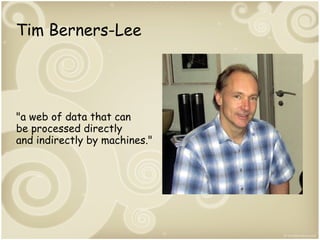
Tim Berners-Lee

"a web of data that can
be processed directly
and indirectly by machines."
Semantic Web

The vision of the Semantic Web is to extend
principles of the Web from documents to data.
Purpose
To enhance the evolution of the current Web by
enabling users to find, share, and combine
information more easily.The semantic web is a
innovative way to disseminate information by
which information can be readily interpreted
by machines, so machines can perform more of
the tedious work involved in finding,
combining, and acting upon information on the
web.
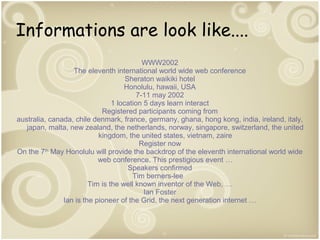
Informations are look like....
WWW2002
The eleventh international world wide web conference
Sheraton waikiki hotel
Honolulu, hawaii, USA
7-11 may 2002
1 location 5 days learn interact
Registered participants coming from
australia, canada, chile denmark, france, germany, ghana, hong kong, india, ireland, italy,
japan, malta, new zealand, the netherlands, norway, singapore, switzerland, the united
kingdom, the united states, vietnam, zaire
Register now
On the 7th May Honolulu will provide the backdrop of the eleventh international world wide
web conference. This prestigious event …
Speakers confirmed
Tim berners-lee
Tim is the well known inventor of the Web, …
Ian Foster
Ian is the pioneer of the Grid, the next generation internet …
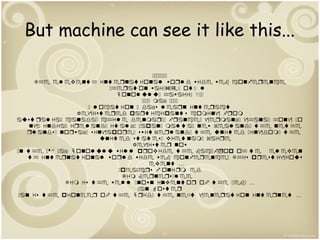
But machine can see it like this...


   











 
 

…
   


…

…
Problems with HTML
The World Wide Web is based mainly on
documents written in Hypertext Markup
Language (HTML),
Is used for coding a body of text interspersed
with multimedia objects such as images and
interactive forms.
Metadata tags provide a method by which
computers can categorise the content of web
pages.
Solution with Semantic Web
The term "Semantic Web" is depends on some
formats and technologies that promote it. The
collection, structuring and recovery of linked
data are promoted by technologies (are
specified as W3C standards) that facilitate a
formal description of concepts, terms, and
relationships within a particular knowledge
domain.
Solution with Semantic Web
These technologies include:
* Resource Description Framework (RDF),
* RDF Schema (RDFS) is a framework for vocabulary
* Simple Knowledge Organization System (SKOS)
* SPARQL, an RDF query language
* Notation3 (N3), designed with human-readability in mind
* N-Triples, a format for storing and transmitting data
* Turtle (Terse RDF Triple Language)
* Web Ontology Language (OWL), a family of knowledge
representation languages
COMMUNITY INFORMATION
SERVICES
“Services

which assist individuals and groups
with daily problem-solving and with
participation in the domestics' process. The
services concentrate on the needs of those who
do not have ready access to other sources of
assistance and on the most important problems
that people have to face problems to do with
their homes, their jobs and their rights.”
COMMUNITY INFORMATION
SERVICES
Survival Information such as that related to health, housing,
income, legal protection, economic opportunities, political
rights etc.
Citizen action information, needed for effective participation as
individual or as members of a group in the social, political,
legal and economic process.
Local information i.e., basic information concerning courses,
educational facilities, government agencies, local
organizations,fractional groups, health professionals etc.
Including a calendar of local events.
BASIC CRITERIAS FOR SEMANTIC CIS
Database(s);
•

Framwork;

Cataloguing Rules;
Vocabulary with Domain Specific IPSV(Integrated
Public Sector Vocabulary); and
•

Ontology
ONTOLOGY?
The term borrowed form Philosophy. A branch of philosophy
that deals with the nature and the organisation of reality
Science of Being (Aristotle, Metaphysics, IV, 1)
Tries to answer the questions:
What characterizes being?
Eventually, what is being?
What is ONTOLOGY?

“An ontology is a formal representation of a set

of concepts within a domain and the
relationships between those concepts. It is
used to reason about the properties of that
domain.”
Why?
To share common understanding of the structure
of descriptive information
• among people
• among software agent
• between people and software

To enable reuse of domain knowledge
• to introduce standards to allow
interoperability
• to avoid repeated work
COVERAGE
•
•
•
•

“Ontology”

covers a range of things
Controlled vocabularies – e.g. MeSH
Linguistic structures – e.g. WordNet
Hierarchies (with bells and whistles) – e.g. Gene
Ontology
• Frame representations – e.g. FMA
• Description logic formalisms – Snomed-CT,
GALEN, OWL-DL based ontologies
• Philosophically inspired e.g. Ontoclean and SUMO
ONTOLOGY

Three ‘flavours’
OWL-Lite –simple but limited
OWL-DL – complex but deliverable (real soon
now)
OWL-Full – fully expressive but serious
logical/computational problems
Ontology Editors
•
•
•
•
•
•
•
•
•
•
•

Protégé 2000,
Oiled,
Apollo,
RDFedt,
OntoLingua,
OntoEdit,
WebODE,
KAON,
ICOM,
DOE and
WebOnto
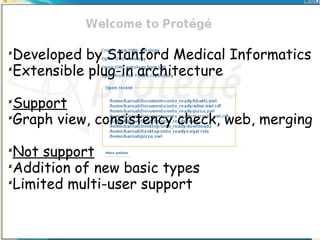
Developed by Stanford Medical Informatics

Extensible plug-in architecture


Support

Graph view, consistency check, web, merging


Not support

Addition of new basic types

Limited multi-user support

SEMANTIC CIS: COMMUNITY INFORMATION SERVICES ON SEMANTIC WEB PLATFORM

SEMANTIC CIS: COMMUNITY INFORMATION SERVICES ON SEMANTIC WEB PLATFORM

  • 1.
    SEMANTIC CIS: COMMUNITY INFORMATIONSERVICES ON SEMANTIC WEB PLATFORM Barnali Roy Choudhury JRF, The Dept. Of Library & Information science The University of Burdwan
  • 2.
    Semantic Web? “The SemanticWeb is the extension of the World Wide Web that enables people to share content beyond the boundaries of applications and websites.” http://semanticweb.org/wiki/Main_Page
  • 3.
    Tim Berners-Lee "a webof data that can be processed directly and indirectly by machines."
  • 4.
    Semantic Web The visionof the Semantic Web is to extend principles of the Web from documents to data.
  • 5.
    Purpose To enhance theevolution of the current Web by enabling users to find, share, and combine information more easily.The semantic web is a innovative way to disseminate information by which information can be readily interpreted by machines, so machines can perform more of the tedious work involved in finding, combining, and acting upon information on the web.
  • 6.
    Informations are looklike.... WWW2002 The eleventh international world wide web conference Sheraton waikiki hotel Honolulu, hawaii, USA 7-11 may 2002 1 location 5 days learn interact Registered participants coming from australia, canada, chile denmark, france, germany, ghana, hong kong, india, ireland, italy, japan, malta, new zealand, the netherlands, norway, singapore, switzerland, the united kingdom, the united states, vietnam, zaire Register now On the 7th May Honolulu will provide the backdrop of the eleventh international world wide web conference. This prestigious event … Speakers confirmed Tim berners-lee Tim is the well known inventor of the Web, … Ian Foster Ian is the pioneer of the Grid, the next generation internet …
  • 7.
    But machine cansee it like this...                       …       …  …
  • 8.
    Problems with HTML TheWorld Wide Web is based mainly on documents written in Hypertext Markup Language (HTML), Is used for coding a body of text interspersed with multimedia objects such as images and interactive forms. Metadata tags provide a method by which computers can categorise the content of web pages.
  • 9.
    Solution with SemanticWeb The term "Semantic Web" is depends on some formats and technologies that promote it. The collection, structuring and recovery of linked data are promoted by technologies (are specified as W3C standards) that facilitate a formal description of concepts, terms, and relationships within a particular knowledge domain.
  • 10.
    Solution with SemanticWeb These technologies include: * Resource Description Framework (RDF), * RDF Schema (RDFS) is a framework for vocabulary * Simple Knowledge Organization System (SKOS) * SPARQL, an RDF query language * Notation3 (N3), designed with human-readability in mind * N-Triples, a format for storing and transmitting data * Turtle (Terse RDF Triple Language) * Web Ontology Language (OWL), a family of knowledge representation languages
  • 11.
    COMMUNITY INFORMATION SERVICES “Services which assistindividuals and groups with daily problem-solving and with participation in the domestics' process. The services concentrate on the needs of those who do not have ready access to other sources of assistance and on the most important problems that people have to face problems to do with their homes, their jobs and their rights.”
  • 12.
    COMMUNITY INFORMATION SERVICES Survival Informationsuch as that related to health, housing, income, legal protection, economic opportunities, political rights etc. Citizen action information, needed for effective participation as individual or as members of a group in the social, political, legal and economic process. Local information i.e., basic information concerning courses, educational facilities, government agencies, local organizations,fractional groups, health professionals etc. Including a calendar of local events.
  • 13.
    BASIC CRITERIAS FORSEMANTIC CIS Database(s); • Framwork; Cataloguing Rules; Vocabulary with Domain Specific IPSV(Integrated Public Sector Vocabulary); and • Ontology
  • 14.
    ONTOLOGY? The term borrowedform Philosophy. A branch of philosophy that deals with the nature and the organisation of reality Science of Being (Aristotle, Metaphysics, IV, 1) Tries to answer the questions: What characterizes being? Eventually, what is being?
  • 15.
    What is ONTOLOGY? “Anontology is a formal representation of a set of concepts within a domain and the relationships between those concepts. It is used to reason about the properties of that domain.”
  • 16.
    Why? To share commonunderstanding of the structure of descriptive information • among people • among software agent • between people and software To enable reuse of domain knowledge • to introduce standards to allow interoperability • to avoid repeated work
  • 17.
    COVERAGE • • • • “Ontology” covers a rangeof things Controlled vocabularies – e.g. MeSH Linguistic structures – e.g. WordNet Hierarchies (with bells and whistles) – e.g. Gene Ontology • Frame representations – e.g. FMA • Description logic formalisms – Snomed-CT, GALEN, OWL-DL based ontologies • Philosophically inspired e.g. Ontoclean and SUMO
  • 18.
    ONTOLOGY Three ‘flavours’ OWL-Lite –simplebut limited OWL-DL – complex but deliverable (real soon now) OWL-Full – fully expressive but serious logical/computational problems
  • 19.
  • 20.
    Developed by StanfordMedical Informatics  Extensible plug-in architecture  Support  Graph view, consistency check, web, merging  Not support  Addition of new basic types  Limited multi-user support 