Chemistry of
Nutrition
Course Outcome: Contrast the synthesis, composition, structure and functions of
major biological macromolecules and Illustrate the process of flow of genetic
information.
chemis
try
and
nutriti
on
come
● Nutrition is referring to all of the nutrients, vitamins, and
minerals our bodies need to live and function properly.
● Our bodies are very complex and go through many process’“by
which substances in food are transformed into body tissues and
provide energy for the full range of physical and mental
activities that make up human life.” (Kent-Jones, 2020)
● These processes are going to involve biochemistry and
molecular biology
● There are 3 essential nutrients to be consumed through food for
the human body, Carbohydrates, Proteins, and Lipids these give
the body its energy.
● Meanwhile minerals, vitamins, and water support the body's
metabolism.
● Chemical reactions, where one or more chemical substance is
changed into a different substance, are occuring in the body
constantly to give us energy and keep our bodies functioning
● The next few slides will talk about the digestion of these
nutrients and how chemistry correlates.
Chemical digestion
● Chemical digestion “involves the catalytic processing of food in the
gastrointestinal (GI) tract by digestive enzymes, aided by co-
secreted substances, required to break down the food substances
into simpler molecules for absorption”(Welcome, 2018).
● Large food molecules i.e. nucleic acids, carbohydrates and proteins
must be broken down to small molecules that can be of great help
in providing the body with energy and improving the body system.
● Enzymes make this possible through hydrolysis.
● After polymers are broken down into monomers they go through
absorption in the stomach and small intestines, entering the
circulatory system and then being carried to cells that need the
nutrients that were absorbed.
synthesis, composition, structure and
functions of major biological
macromolecules
Nucleic acids
● DNA and RNA are synthesized and degraded. Nucleic acids are nucleotides polymers.
Nucleotide synthesis is an anabolic mechanism having the chemical reaction of
phosphate, a pentose sugar, and a nitrogenous base.
● COMPOSITION: has a series of building blocks called nucleotides. Each nucleotide
having a nitrogen-containing aromatic base attached to a pentose (five-carbon)
sugar connected to a phosphate group.
● Relating with nutrition, dietary acids occur in the form of RNA/DNA mixtures.
● The break-down of these compounds involve complex chains of reactions in
the body.
● Nucleic acids undergo partial hydrolysis in the stomach and then subjected
to pancreatic nucleases and phosphoestereases to yield nucleotides and
nucleosides.
● Under these circumstances, the supply of nucleic acids from dietary sources
is deemed necessary and could be beneficial in maintaining bodily and
immune functions.
synthesis, composition, structure and
functions of major biological
macromolecules Continued
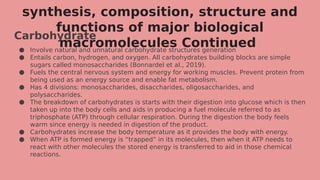
Carbohydrate
● Involve natural and unnatural carbohydrate structures generation
● Entails carbon, hydrogen, and oxygen. All carbohydrates building blocks are simple
sugars called monosaccharides (Bonnardel et al., 2019).
● Fuels the central nervous system and energy for working muscles. Prevent protein from
being used as an energy source and enable fat metabolism.
● Has 4 divisions: monosaccharides, disaccharides, oligosaccharides, and
polysaccharides.
● The breakdown of carbohydrates is starts with their digestion into glucose which is then
taken up into the body cells and aids in producing a fuel molecule referred to as
triphosphate (ATP) through cellular respiration. During the digestion the body feels
warm since energy is needed in digestion of the product.
● Carbohydrates increase the body temperature as it provides the body with energy.
● When ATP is formed energy is “trapped” in its molecules, then when it ATP needs to
react with other molecules the stored energy is transferred to aid in those chemical
reactions.
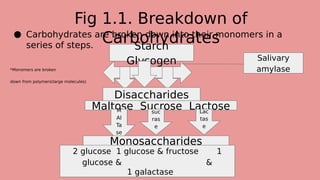
Fig 1.1. Breakdown of
Carbohydrates
● Carbohydrates are broken down into their monomers in a
series of steps.
*Monomers are broken
down from polymers(large molecules)
Starch
Glycogen
Disaccharides
Maltose Sucrose Lactose
M
Al
Ta
se
suc
ras
e
Lac
tas
e
Monosaccharides
2 glucose 1 glucose & fructose 1
glucose & &
1 galactase
Salivary
amylase
synthesis, composition, structure and
functions of major biological
macromolecules Continued
Protein
● Proteins are important nutrients essential for the body in
building crucial cellular structures.
● It occurs in two stages: transcription and translation.
Transcription involves transfer of genetic instructions in DNA to
mRNA in the nucleus. It includes three steps: initiation,
elongation, and termination.
● Repair and build your body's tissues, allows metabolic reactions
to take place and coordinates bodily functions.
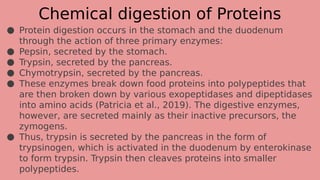
Chemical digestion of Proteins
● Protein digestion occurs in the stomach and the duodenum
through the action of three primary enzymes:
● Pepsin, secreted by the stomach.
● Trypsin, secreted by the pancreas.
● Chymotrypsin, secreted by the pancreas.
● These enzymes break down food proteins into polypeptides that
are then broken down by various exopeptidases and dipeptidases
into amino acids (Patricia et al., 2019). The digestive enzymes,
however, are secreted mainly as their inactive precursors, the
zymogens.
● Thus, trypsin is secreted by the pancreas in the form of
trypsinogen, which is activated in the duodenum by enterokinase
to form trypsin. Trypsin then cleaves proteins into smaller
polypeptides.
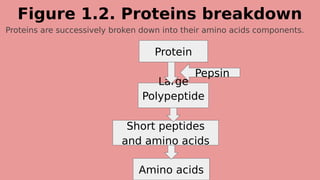
Figure 1.2. Proteins breakdown
Proteins are successively broken down into their amino acids components.
Protein
Large
Polypeptide
s
Amino acids
Short peptides
and amino acids
Pepsin
Breakdown of Proteins continued
● Protein to be used for energy: Before amino acids can be catabolized,
they must be converted to substances that can enter the Krebs cycle.
These conversions involve deamination, decarboxylation, and
hydrogenation.
● Amino acids can be converted into glucose, fatty acids, and ketone
bodies.
● Proteins are conserved by body cells; they are used for most cellular
structures. Ingested proteins are broken down to amino acids Cells
remove amino acid to build proteins synthesized proteins are actively
transported across cell membranes Amino acids are used to make ATP
only when proteins are overabundant or there is a shortage of other
sources
● Proteins make the body to burn more calories which leads to an
increase in the thermic effect thus boosting metabolism.
Fats(lipids)
● Contain carbon hydrogen, and oxygen.
● “Lipids are soluble in organic solvents (such as acetone or ether) and insoluble in water
” (Kent-Jones, 2020)
● The lipids of nutritional importance are triglycerides(3 fatty acids
attached to a backbone of glycerol), phospholipids (same as triglyceride
but has a phosphate group), and sterols (multi-ring structure).
● Lipids carry the 4 fat soluble vitamins A,D, E, and K and assist in their
absorption.
● Fats are a more concentrated form of energy than carbohydrates.
synthesis, composition, structure and
functions of major biological
macromolecules Continued
● Chemistry of nutrition relates perfectly with nursing.
● Proper nutrition plays big role in disease prevention and ensures
ongoing good health.
● Nucleic acids, carbohydrates and proteins are essential for
healthy living.
● Nursing is a field that dwells on care of individuals through
promotion of health. Doing this cannot be possible without
chemistry of nutrition.
● Nutrition is the process of providing the body with essential raw
materials for proper functioning. These brings out the ties
between nursing and nutrition.
● Both depend on the other for the well being of the body.
References
● Bonnardel, F., Mariethoz, J., Salentin, S., Robin, X., Schroeder, M., Perez,
S., ... & Impart, A. (2019). UniLectin3D, a database of carbohydrate
binding proteins with curated information on 3D structures and
interacting ligands. Nucleic acids research, 47(D1), D1236-D1244.
● Welcome, M. O. (2018). Chemical Digestion, Absorption, and Transport.
In Gastrointestinal Physiology (pp. 871-972). Springer, Cham.
● Patricia, J. J., & Dhamoon, A. S. (2019). Physiology, Digestion.
● Kent-Jones, D. (2020). Human Nutrition.
https://www.britannica.com/science/human-nutrition
● Bauer, R. (20180109). Introduction to Chemistry, 5th Edition.

Chemistry_of_Nutrition__1_.pptx.pdf

  • 1.
    Chemistry of Nutrition Course Outcome:Contrast the synthesis, composition, structure and functions of major biological macromolecules and Illustrate the process of flow of genetic information.
  • 2.
    chemis try and nutriti on come ● Nutrition isreferring to all of the nutrients, vitamins, and minerals our bodies need to live and function properly. ● Our bodies are very complex and go through many process’“by which substances in food are transformed into body tissues and provide energy for the full range of physical and mental activities that make up human life.” (Kent-Jones, 2020) ● These processes are going to involve biochemistry and molecular biology ● There are 3 essential nutrients to be consumed through food for the human body, Carbohydrates, Proteins, and Lipids these give the body its energy. ● Meanwhile minerals, vitamins, and water support the body's metabolism. ● Chemical reactions, where one or more chemical substance is changed into a different substance, are occuring in the body constantly to give us energy and keep our bodies functioning ● The next few slides will talk about the digestion of these nutrients and how chemistry correlates.
  • 3.
    Chemical digestion ● Chemicaldigestion “involves the catalytic processing of food in the gastrointestinal (GI) tract by digestive enzymes, aided by co- secreted substances, required to break down the food substances into simpler molecules for absorption”(Welcome, 2018). ● Large food molecules i.e. nucleic acids, carbohydrates and proteins must be broken down to small molecules that can be of great help in providing the body with energy and improving the body system. ● Enzymes make this possible through hydrolysis. ● After polymers are broken down into monomers they go through absorption in the stomach and small intestines, entering the circulatory system and then being carried to cells that need the nutrients that were absorbed.
  • 4.
    synthesis, composition, structureand functions of major biological macromolecules Nucleic acids ● DNA and RNA are synthesized and degraded. Nucleic acids are nucleotides polymers. Nucleotide synthesis is an anabolic mechanism having the chemical reaction of phosphate, a pentose sugar, and a nitrogenous base. ● COMPOSITION: has a series of building blocks called nucleotides. Each nucleotide having a nitrogen-containing aromatic base attached to a pentose (five-carbon) sugar connected to a phosphate group. ● Relating with nutrition, dietary acids occur in the form of RNA/DNA mixtures. ● The break-down of these compounds involve complex chains of reactions in the body. ● Nucleic acids undergo partial hydrolysis in the stomach and then subjected to pancreatic nucleases and phosphoestereases to yield nucleotides and nucleosides. ● Under these circumstances, the supply of nucleic acids from dietary sources is deemed necessary and could be beneficial in maintaining bodily and immune functions.
  • 5.
    synthesis, composition, structureand functions of major biological macromolecules Continued Carbohydrate ● Involve natural and unnatural carbohydrate structures generation ● Entails carbon, hydrogen, and oxygen. All carbohydrates building blocks are simple sugars called monosaccharides (Bonnardel et al., 2019). ● Fuels the central nervous system and energy for working muscles. Prevent protein from being used as an energy source and enable fat metabolism. ● Has 4 divisions: monosaccharides, disaccharides, oligosaccharides, and polysaccharides. ● The breakdown of carbohydrates is starts with their digestion into glucose which is then taken up into the body cells and aids in producing a fuel molecule referred to as triphosphate (ATP) through cellular respiration. During the digestion the body feels warm since energy is needed in digestion of the product. ● Carbohydrates increase the body temperature as it provides the body with energy. ● When ATP is formed energy is “trapped” in its molecules, then when it ATP needs to react with other molecules the stored energy is transferred to aid in those chemical reactions.
  • 6.
    Fig 1.1. Breakdownof Carbohydrates ● Carbohydrates are broken down into their monomers in a series of steps. *Monomers are broken down from polymers(large molecules) Starch Glycogen Disaccharides Maltose Sucrose Lactose M Al Ta se suc ras e Lac tas e Monosaccharides 2 glucose 1 glucose & fructose 1 glucose & & 1 galactase Salivary amylase
  • 7.
    synthesis, composition, structureand functions of major biological macromolecules Continued Protein ● Proteins are important nutrients essential for the body in building crucial cellular structures. ● It occurs in two stages: transcription and translation. Transcription involves transfer of genetic instructions in DNA to mRNA in the nucleus. It includes three steps: initiation, elongation, and termination. ● Repair and build your body's tissues, allows metabolic reactions to take place and coordinates bodily functions.
  • 8.
    Chemical digestion ofProteins ● Protein digestion occurs in the stomach and the duodenum through the action of three primary enzymes: ● Pepsin, secreted by the stomach. ● Trypsin, secreted by the pancreas. ● Chymotrypsin, secreted by the pancreas. ● These enzymes break down food proteins into polypeptides that are then broken down by various exopeptidases and dipeptidases into amino acids (Patricia et al., 2019). The digestive enzymes, however, are secreted mainly as their inactive precursors, the zymogens. ● Thus, trypsin is secreted by the pancreas in the form of trypsinogen, which is activated in the duodenum by enterokinase to form trypsin. Trypsin then cleaves proteins into smaller polypeptides.
  • 9.
    Figure 1.2. Proteinsbreakdown Proteins are successively broken down into their amino acids components. Protein Large Polypeptide s Amino acids Short peptides and amino acids Pepsin
  • 10.
    Breakdown of Proteinscontinued ● Protein to be used for energy: Before amino acids can be catabolized, they must be converted to substances that can enter the Krebs cycle. These conversions involve deamination, decarboxylation, and hydrogenation. ● Amino acids can be converted into glucose, fatty acids, and ketone bodies. ● Proteins are conserved by body cells; they are used for most cellular structures. Ingested proteins are broken down to amino acids Cells remove amino acid to build proteins synthesized proteins are actively transported across cell membranes Amino acids are used to make ATP only when proteins are overabundant or there is a shortage of other sources ● Proteins make the body to burn more calories which leads to an increase in the thermic effect thus boosting metabolism.
  • 11.
    Fats(lipids) ● Contain carbonhydrogen, and oxygen. ● “Lipids are soluble in organic solvents (such as acetone or ether) and insoluble in water ” (Kent-Jones, 2020) ● The lipids of nutritional importance are triglycerides(3 fatty acids attached to a backbone of glycerol), phospholipids (same as triglyceride but has a phosphate group), and sterols (multi-ring structure). ● Lipids carry the 4 fat soluble vitamins A,D, E, and K and assist in their absorption. ● Fats are a more concentrated form of energy than carbohydrates.
  • 12.
    synthesis, composition, structureand functions of major biological macromolecules Continued ● Chemistry of nutrition relates perfectly with nursing. ● Proper nutrition plays big role in disease prevention and ensures ongoing good health. ● Nucleic acids, carbohydrates and proteins are essential for healthy living. ● Nursing is a field that dwells on care of individuals through promotion of health. Doing this cannot be possible without chemistry of nutrition. ● Nutrition is the process of providing the body with essential raw materials for proper functioning. These brings out the ties between nursing and nutrition. ● Both depend on the other for the well being of the body.
  • 13.
    References ● Bonnardel, F.,Mariethoz, J., Salentin, S., Robin, X., Schroeder, M., Perez, S., ... & Impart, A. (2019). UniLectin3D, a database of carbohydrate binding proteins with curated information on 3D structures and interacting ligands. Nucleic acids research, 47(D1), D1236-D1244. ● Welcome, M. O. (2018). Chemical Digestion, Absorption, and Transport. In Gastrointestinal Physiology (pp. 871-972). Springer, Cham. ● Patricia, J. J., & Dhamoon, A. S. (2019). Physiology, Digestion. ● Kent-Jones, D. (2020). Human Nutrition. https://www.britannica.com/science/human-nutrition ● Bauer, R. (20180109). Introduction to Chemistry, 5th Edition.