Message Digest: MD4
Algorithm​
Introduction
 The initialize "MD" stands for "Message Digest."​
 It is a cryptographic hash function develop by Ronal Rivest in 1990.
 It produces 128 bit messages digest by taking a message of any arbitrary
length.
Steps performed in MD4
 Append Padding bits.
 Append Length.
 Initialize MD buffer
 Process message in 16-word blocks.
 Output.
Continue…
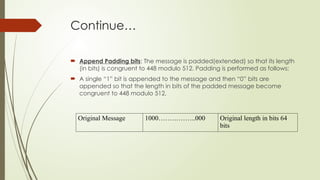
 Append Padding bits: The message is padded(extended) so that its length
(in bits) is congruent to 448 modulo 512. Padding is performed as follows:
 A single “1” bit is appended to the message and then “0” bits are
appended so that the length in bits of the padded message become
congruent to 448 modulo 512.
Original Message​ 1000……………..000​ Original length in bits 64
bits​
Continue…
 Append Length: A 64 bit representation of ‘b’ is appended to the result of
the previous step. The resulting message has a length that is an exact
multiple of 512 bits. Equivalently this message has a length that is an exact
multiple 16 (32 – bits) words.
 Note: b = length of message before padding bits are added.
 Let M[0 ... N-1] denote the words of the resulting message, where N is a
multiple of 16. ​
Continue…
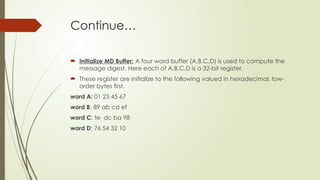
 Initialize MD Buffer: A four word buffer (A,B,C,D) is used to compute the
message digest. Here each of A,B,C,D is a 32-bit register.
 These register are initialize to the following valued in hexadecimal, low-
order bytes first.
word A: 01 23 45 67 ​
word B: 89 ab cd ef ​
word C: fe dc ba 98 ​
word D: 76 54 32 10​
Continue…
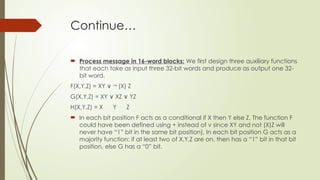
 Process message in 16-word blocks: We first design three auxiliary functions
that each take as input three 32-bit words and produce as output one 32-
bit word.
F(X,Y,Z) = XY ¬ (X) Z ​
∨
G(X,Y,Z) = XY XZ YZ ​
∨ ∨
H(X,Y,Z) = X Y Z
 In each bit position F acts as a conditional if X then Y else Z. The function F
could have been defined using + instead of v since XY and not (X)Z will
never have “1” bit in the same bit position), In each bit position G acts as a
majority function: if at least two of X,Y,Z are on, then has a “1” bit in that bit
position, else G has a “0” bit. ​
Continue…
 Process message in 16-word blocks: We first design three auxiliary functions
that each take as input three 32-bit words and produce as output one 32-
bit word.
F(X,Y,Z) = XY ¬ (X) Z ​
∨
G(X,Y,Z) = XY XZ YZ ​
∨ ∨
H(X,Y,Z) = X Y Z
 In each bit position F acts as a conditional if X then Y else Z. The function F
could have been defined using + instead of v since XY and not (X)Z will
never have “1” bit in the same bit position), In each bit position G acts as a
majority function: if at least two of X,Y,Z are on, then has a “1” bit in that bit
position, else G has a “0” bit. ​
Continue…
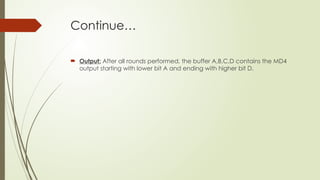
 Output: After all rounds performed, the buffer A,B,C,D contains the MD4
output starting with lower bit A and ending with higher bit D.

Message Digest Algorithm 4 cryptography.pptx

  • 1.
  • 2.
    Introduction  The initialize"MD" stands for "Message Digest."​  It is a cryptographic hash function develop by Ronal Rivest in 1990.  It produces 128 bit messages digest by taking a message of any arbitrary length.
  • 3.
    Steps performed inMD4  Append Padding bits.  Append Length.  Initialize MD buffer  Process message in 16-word blocks.  Output.
  • 4.
    Continue…  Append Paddingbits: The message is padded(extended) so that its length (in bits) is congruent to 448 modulo 512. Padding is performed as follows:  A single “1” bit is appended to the message and then “0” bits are appended so that the length in bits of the padded message become congruent to 448 modulo 512. Original Message​ 1000……………..000​ Original length in bits 64 bits​
  • 5.
    Continue…  Append Length:A 64 bit representation of ‘b’ is appended to the result of the previous step. The resulting message has a length that is an exact multiple of 512 bits. Equivalently this message has a length that is an exact multiple 16 (32 – bits) words.  Note: b = length of message before padding bits are added.  Let M[0 ... N-1] denote the words of the resulting message, where N is a multiple of 16. ​
  • 6.
    Continue…  Initialize MDBuffer: A four word buffer (A,B,C,D) is used to compute the message digest. Here each of A,B,C,D is a 32-bit register.  These register are initialize to the following valued in hexadecimal, low- order bytes first. word A: 01 23 45 67 ​ word B: 89 ab cd ef ​ word C: fe dc ba 98 ​ word D: 76 54 32 10​
  • 7.
    Continue…  Process messagein 16-word blocks: We first design three auxiliary functions that each take as input three 32-bit words and produce as output one 32- bit word. F(X,Y,Z) = XY ¬ (X) Z ​ ∨ G(X,Y,Z) = XY XZ YZ ​ ∨ ∨ H(X,Y,Z) = X Y Z  In each bit position F acts as a conditional if X then Y else Z. The function F could have been defined using + instead of v since XY and not (X)Z will never have “1” bit in the same bit position), In each bit position G acts as a majority function: if at least two of X,Y,Z are on, then has a “1” bit in that bit position, else G has a “0” bit. ​
  • 8.
    Continue…  Process messagein 16-word blocks: We first design three auxiliary functions that each take as input three 32-bit words and produce as output one 32- bit word. F(X,Y,Z) = XY ¬ (X) Z ​ ∨ G(X,Y,Z) = XY XZ YZ ​ ∨ ∨ H(X,Y,Z) = X Y Z  In each bit position F acts as a conditional if X then Y else Z. The function F could have been defined using + instead of v since XY and not (X)Z will never have “1” bit in the same bit position), In each bit position G acts as a majority function: if at least two of X,Y,Z are on, then has a “1” bit in that bit position, else G has a “0” bit. ​
  • 9.
    Continue…  Output: Afterall rounds performed, the buffer A,B,C,D contains the MD4 output starting with lower bit A and ending with higher bit D.