MESSAGE AUTHENTICATION
CODE
PRESENTED BY
NITIN D R
MESSAGE AUTHENTICATION
• Protecting the Integrity of the message.
• Validating identity of originator.
• Non-Repudiation of origin
METHOD TO PRODUCE AUTHENTICATION
• Message Encryption
• Message Authentication Code (MAC)
• Hash Function
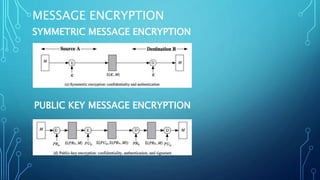
MESSAGE ENCRYPTION
SYMMETRIC MESSAGE ENCRYPTION
PUBLIC KEY MESSAGE ENCRYPTION
MESSAGE AUTHENTICATION CODE
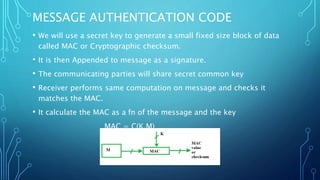
• We will use a secret key to generate a small fixed size block of data
called MAC or Cryptographic checksum.
• It is then Appended to message as a signature.
• The communicating parties will share secret common key
• Receiver performs same computation on message and checks it
matches the MAC.
• It calculate the MAC as a fn of the message and the key
MAC = C(K,M)
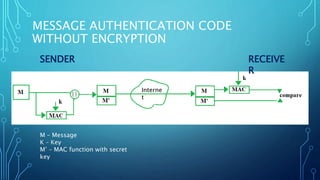
M – Message
K – Key
M’ – MAC function with secret
key
SENDER RECEIVE
R
MESSAGE AUTHENTICATION CODE
WITHOUT ENCRYPTION
Interne
t
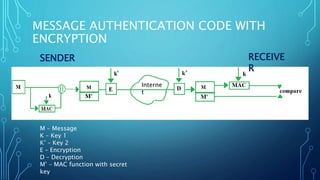
MESSAGE AUTHENTICATION CODE WITH
ENCRYPTION
SENDER RECEIVE
R
M – Message
K – Key 1
K’ – Key 2
E – Encryption
D – Decryption
M’ – MAC function with secret
key
Interne
t
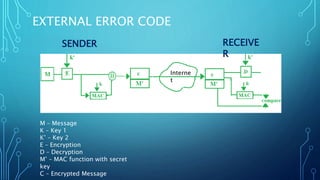
EXTERNAL ERROR CODE
SENDER RECEIVE
R
M – Message
K – Key 1
K’ – Key 2
E – Encryption
D – Decryption
M’ – MAC function with secret
key
C – Encrypted Message
Interne
t
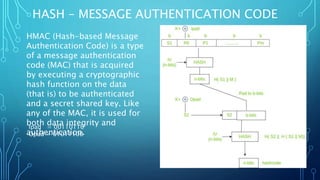
HASH – MESSAGE AUTHENTICATION CODE
HMAC (Hash-based Message
Authentication Code) is a type
of a message authentication
code (MAC) that is acquired
by executing a cryptographic
hash function on the data
(that is) to be authenticated
and a secret shared key. Like
any of the MAC, it is used for
both data integrity and
authentication.
Ipad = 00110110
Opad = 01011100
THANK YOU

Message authentication code presentation.pptx

  • 1.
  • 2.
    MESSAGE AUTHENTICATION • Protectingthe Integrity of the message. • Validating identity of originator. • Non-Repudiation of origin METHOD TO PRODUCE AUTHENTICATION • Message Encryption • Message Authentication Code (MAC) • Hash Function
  • 3.
    MESSAGE ENCRYPTION SYMMETRIC MESSAGEENCRYPTION PUBLIC KEY MESSAGE ENCRYPTION
  • 4.
    MESSAGE AUTHENTICATION CODE •We will use a secret key to generate a small fixed size block of data called MAC or Cryptographic checksum. • It is then Appended to message as a signature. • The communicating parties will share secret common key • Receiver performs same computation on message and checks it matches the MAC. • It calculate the MAC as a fn of the message and the key MAC = C(K,M)
  • 5.
    M – Message K– Key M’ – MAC function with secret key SENDER RECEIVE R MESSAGE AUTHENTICATION CODE WITHOUT ENCRYPTION Interne t
  • 6.
    MESSAGE AUTHENTICATION CODEWITH ENCRYPTION SENDER RECEIVE R M – Message K – Key 1 K’ – Key 2 E – Encryption D – Decryption M’ – MAC function with secret key Interne t
  • 7.
    EXTERNAL ERROR CODE SENDERRECEIVE R M – Message K – Key 1 K’ – Key 2 E – Encryption D – Decryption M’ – MAC function with secret key C – Encrypted Message Interne t
  • 8.
    HASH – MESSAGEAUTHENTICATION CODE HMAC (Hash-based Message Authentication Code) is a type of a message authentication code (MAC) that is acquired by executing a cryptographic hash function on the data (that is) to be authenticated and a secret shared key. Like any of the MAC, it is used for both data integrity and authentication. Ipad = 00110110 Opad = 01011100
  • 9.