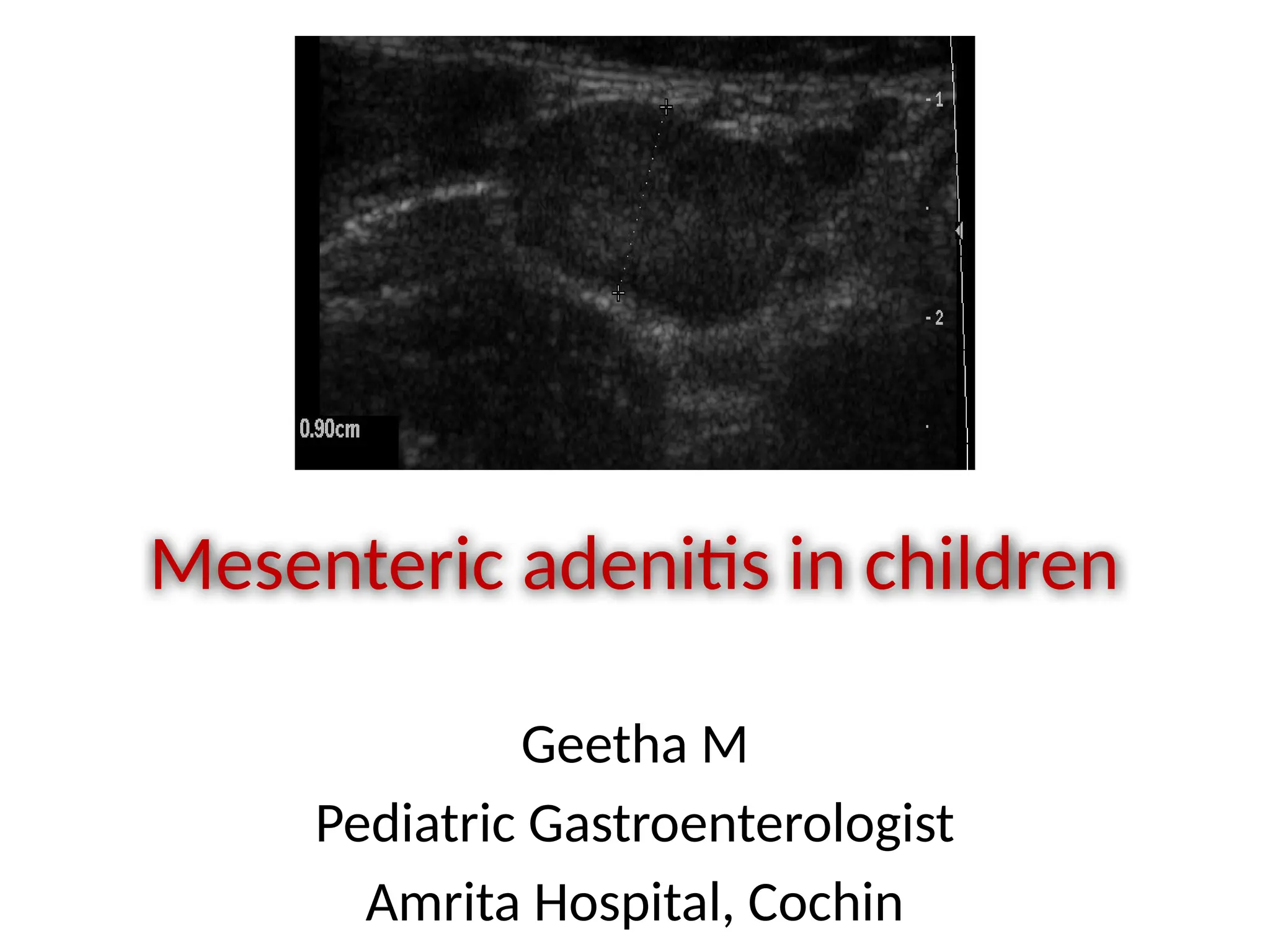
Mesenteric adenitis in children
Geetha M
Pediatric Gastroenterologist
Amrita Hospital, Cochin
Scenario
• Mesenteric Lymphadenopathy not a diagnosis
• Incidental finding in Recurrent Abdominal Pain
• USG abdomen is one primary investigation
• Organic causes 4-11%
• USG findings- Mesenteric nodes, GB Stones
• ? Significance
MLN
• Medical literature
• Pediatric Literature – specific inflammation by
Yersinia, Staph, Salmonella
• Radiological literature - LN > 5mm size
• What is the significance?
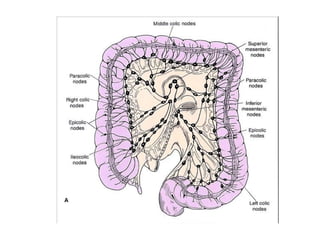
What is mesenteric adenitis?
• 3 or > LN
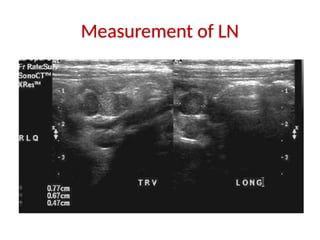
• 4 mm or > in short axis: 8mm > in long axis
• Primary- when LN are the only finding
• Secondary – when another pathology is
identified
• Incidence varies
Rao PM, Rhea JT, Novelline RA. CT diagnosis of mesenteric adenitis.
Radiology 1997; 202:145–149.
Measurement of LN
Causes - Local Infections
• Gastroenteritis
• Appendicitis
• Parasitic infections
• IBD
Parasitic Infection
• Parasitic infec is a cause of RAP
• ?? Cause for MLN??
• 2002-2008 , 224 children with RAP
• 89 boys: 135 girls ; Mean age 9 yrs
• Ped sonologist
• Short axis >8mm = enlarged MLN
Enlarged mesenteric lymph nodes in children with recurrent abdominal pain: Is
there an association with intestinal parasitic infections?
Fraukje Wiersma et al
Contd……..
• All children had MLN at least 5mm
• 86% (193/224) - had all nodes < 5mm
• 6/224 (2.5%) > 8mm: 25/224 (11.2%) 5-7mm
• None of the 6 had parasites
• 25% (56) had parasitic infection
– 47 - < 5mm
– 9 – 5-7 mm
• Concluded – not related to parasitic infection
Simanovsky N et al. Importance of sonographic detection of enlarged abdominal lymph nodes in
children. J Ultrasound Med 2007; 26:581-584
Infections associated with MLN
• Yersinia enterocolitica - RIF syndrome
• Atypical Mycobacteria
• Campylobacter spp
• Coxackie virus, EBV
• HIV
Jelloul I, Fremond B, Dyon JF, Orme RI, Babut JM. Mesenteric adenitis caused by Yersinia
pseudotuberculosis presenting as abdominal mass. Eur J Pediatr Surg 1997; 7:180–183.
Nilehn B, Sjostrom B. Studies on Yersinia enterocolitica. Occurrence in various groups of
acute abdominal disease. Acta Pathol Microbiol Scand 1967; 71:612-628.
Symptomatology
• Mostly asymptomatic
• Diffuse abd pain – sometimes localised in RLQ
• Concomittant/ antecedent URI
• Anorexia
• Diarrhoea
• Nausea/ vomiting
Symptoms………….Contd
• Fever
• Rhinorrhoea
• RLQ tenderness
• 20% peripheral lymphadenopathy
• LN Biopsy – mostly reactive/ non – specific
inflammation
Early Studies
• LN > 4mm in AP diameter – 4% asymp children
• 10-20 mm long axis 89% asymp children
• MLN (long axis) in almost all children
Sivit CJ, et al. Visualization of enlarged mesenteric lymph nodes at US examination.
Pediatr Radiol 1993; 23:471-475
Healy MV, Graham PM. Assessment of abdominal lymph nodes in a normal pediatric
population: an ultrasound study. Australas Radiol 1993; 37:171–172.
Watanabe M, Ishii E, Hirowatari Y, et al. Evaluation of abdominal lymphadenopathy in
children by ultrasonography. Pediatr Radiol 1997; 27:860–864
CT and MLN
• All non contrast CT images done for renal
stones were evaluated for MLN
• 33/61 had MLN mostly in RLQ
• Max size 10 mm – also in RLQ
• Cluster of 3 nodes – RLQ
• 5mm size nodes – in almost all
• Hence a measurement of 8mm or > chosen
Karmazyn B, Werner EA, Rejaie B, Applegate KE. Mesenteric lymph nodes in children:
what is normal? Pediatr Radiol 2005; 35:774-777
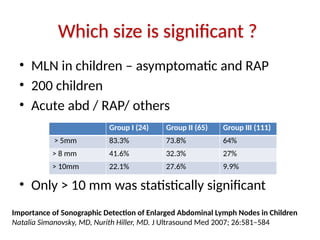
Which size is significant ?
• MLN in children – asymptomatic and RAP
• 200 children
• Acute abd / RAP/ others
• Only > 10 mm was statistically significant
Group I (24) Group II (65) Group III (111)
> 5mm 83.3% 73.8% 64%
> 8 mm 41.6% 32.3% 27%
> 10mm 22.1% 27.6% 9.9%
Importance of Sonographic Detection of Enlarged Abdominal Lymph Nodes in Children
Natalia Simanovsky, MD, Nurith Hiller, MD. J Ultrasound Med 2007; 26:581–584
Does Size Matter ?
• LN > 4mm seen in 4-64% asymp children
• 14-83% of symp children
• MLN are seen in all children – asymp, symp-
acute abd, CAP, gastroenteritis
• Tendency to have larger nodes in acute infect
• As an isolated finding – not much importance
Nan Fang Yi Ke Da Xue Xue Bao. 2011 Mar;31(3):522-4.
[Enlarged mesenteric lymph nodes in children: a clinical analysis with ultrasonography and the
implications].
[WANG WG, TIAN H, YAN JY, LI T, ZHANG TD, ZHAO YP, ZHANG LY, XING HG.
Sivit CJ, et al. Visualization of enlarged mesenteric lymph nodes at US examination. Pediatr Radiol
1993; 23:471-475
Rathaus Vet al Enlarged mesenteric lymph nodes in asymptomatic children: the value of the finding
in various imaging modalities. Br J Radiol 2005; 78:30-33
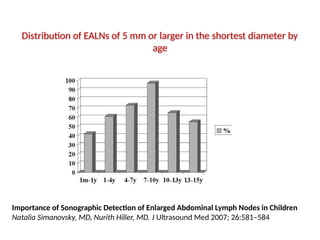
Distribution of EALNs of 5 mm or larger in the shortest diameter by
age
Importance of Sonographic Detection of Enlarged Abdominal Lymph Nodes in Children
Natalia Simanovsky, MD, Nurith Hiller, MD. J Ultrasound Med 2007; 26:581–584
Indian Experience
• MLN almost universally seen
• Enlarged nodes > 8mm upto 20mm
• If isolated and clinically well – only follow up
• If symptomatic - course of antibiotics
• Usually pain tends to settle but nodes persist
• If persistent and symptomatic - evaluate
Conclusions
• Frequent in asymptomatic children
• Nodes 10 mm or > in setting of abdominal
pain – considered as ML
• Usually increase in size till 10 yrs and then
regress
• Mostly non specific – but follow up if
necessary

Mesenteric Lymphadenopathy in Children.ppt

  • 1.
    Mesenteric adenitis inchildren Geetha M Pediatric Gastroenterologist Amrita Hospital, Cochin
  • 2.
    Scenario • Mesenteric Lymphadenopathynot a diagnosis • Incidental finding in Recurrent Abdominal Pain • USG abdomen is one primary investigation • Organic causes 4-11% • USG findings- Mesenteric nodes, GB Stones • ? Significance
  • 3.
    MLN • Medical literature •Pediatric Literature – specific inflammation by Yersinia, Staph, Salmonella • Radiological literature - LN > 5mm size • What is the significance?
  • 4.
    What is mesentericadenitis? • 3 or > LN • 4 mm or > in short axis: 8mm > in long axis • Primary- when LN are the only finding • Secondary – when another pathology is identified • Incidence varies Rao PM, Rhea JT, Novelline RA. CT diagnosis of mesenteric adenitis. Radiology 1997; 202:145–149.
  • 6.
  • 7.
    Causes - LocalInfections • Gastroenteritis • Appendicitis • Parasitic infections • IBD
  • 8.
    Parasitic Infection • Parasiticinfec is a cause of RAP • ?? Cause for MLN?? • 2002-2008 , 224 children with RAP • 89 boys: 135 girls ; Mean age 9 yrs • Ped sonologist • Short axis >8mm = enlarged MLN Enlarged mesenteric lymph nodes in children with recurrent abdominal pain: Is there an association with intestinal parasitic infections? Fraukje Wiersma et al
  • 9.
    Contd…….. • All childrenhad MLN at least 5mm • 86% (193/224) - had all nodes < 5mm • 6/224 (2.5%) > 8mm: 25/224 (11.2%) 5-7mm • None of the 6 had parasites • 25% (56) had parasitic infection – 47 - < 5mm – 9 – 5-7 mm • Concluded – not related to parasitic infection Simanovsky N et al. Importance of sonographic detection of enlarged abdominal lymph nodes in children. J Ultrasound Med 2007; 26:581-584
  • 10.
    Infections associated withMLN • Yersinia enterocolitica - RIF syndrome • Atypical Mycobacteria • Campylobacter spp • Coxackie virus, EBV • HIV Jelloul I, Fremond B, Dyon JF, Orme RI, Babut JM. Mesenteric adenitis caused by Yersinia pseudotuberculosis presenting as abdominal mass. Eur J Pediatr Surg 1997; 7:180–183. Nilehn B, Sjostrom B. Studies on Yersinia enterocolitica. Occurrence in various groups of acute abdominal disease. Acta Pathol Microbiol Scand 1967; 71:612-628.
  • 11.
    Symptomatology • Mostly asymptomatic •Diffuse abd pain – sometimes localised in RLQ • Concomittant/ antecedent URI • Anorexia • Diarrhoea • Nausea/ vomiting
  • 12.
    Symptoms………….Contd • Fever • Rhinorrhoea •RLQ tenderness • 20% peripheral lymphadenopathy • LN Biopsy – mostly reactive/ non – specific inflammation
  • 13.
    Early Studies • LN> 4mm in AP diameter – 4% asymp children • 10-20 mm long axis 89% asymp children • MLN (long axis) in almost all children Sivit CJ, et al. Visualization of enlarged mesenteric lymph nodes at US examination. Pediatr Radiol 1993; 23:471-475 Healy MV, Graham PM. Assessment of abdominal lymph nodes in a normal pediatric population: an ultrasound study. Australas Radiol 1993; 37:171–172. Watanabe M, Ishii E, Hirowatari Y, et al. Evaluation of abdominal lymphadenopathy in children by ultrasonography. Pediatr Radiol 1997; 27:860–864
  • 14.
    CT and MLN •All non contrast CT images done for renal stones were evaluated for MLN • 33/61 had MLN mostly in RLQ • Max size 10 mm – also in RLQ • Cluster of 3 nodes – RLQ • 5mm size nodes – in almost all • Hence a measurement of 8mm or > chosen Karmazyn B, Werner EA, Rejaie B, Applegate KE. Mesenteric lymph nodes in children: what is normal? Pediatr Radiol 2005; 35:774-777
  • 15.
    Which size issignificant ? • MLN in children – asymptomatic and RAP • 200 children • Acute abd / RAP/ others • Only > 10 mm was statistically significant Group I (24) Group II (65) Group III (111) > 5mm 83.3% 73.8% 64% > 8 mm 41.6% 32.3% 27% > 10mm 22.1% 27.6% 9.9% Importance of Sonographic Detection of Enlarged Abdominal Lymph Nodes in Children Natalia Simanovsky, MD, Nurith Hiller, MD. J Ultrasound Med 2007; 26:581–584
  • 16.
    Does Size Matter? • LN > 4mm seen in 4-64% asymp children • 14-83% of symp children • MLN are seen in all children – asymp, symp- acute abd, CAP, gastroenteritis • Tendency to have larger nodes in acute infect • As an isolated finding – not much importance Nan Fang Yi Ke Da Xue Xue Bao. 2011 Mar;31(3):522-4. [Enlarged mesenteric lymph nodes in children: a clinical analysis with ultrasonography and the implications]. [WANG WG, TIAN H, YAN JY, LI T, ZHANG TD, ZHAO YP, ZHANG LY, XING HG. Sivit CJ, et al. Visualization of enlarged mesenteric lymph nodes at US examination. Pediatr Radiol 1993; 23:471-475 Rathaus Vet al Enlarged mesenteric lymph nodes in asymptomatic children: the value of the finding in various imaging modalities. Br J Radiol 2005; 78:30-33
  • 17.
    Distribution of EALNsof 5 mm or larger in the shortest diameter by age Importance of Sonographic Detection of Enlarged Abdominal Lymph Nodes in Children Natalia Simanovsky, MD, Nurith Hiller, MD. J Ultrasound Med 2007; 26:581–584
  • 18.
    Indian Experience • MLNalmost universally seen • Enlarged nodes > 8mm upto 20mm • If isolated and clinically well – only follow up • If symptomatic - course of antibiotics • Usually pain tends to settle but nodes persist • If persistent and symptomatic - evaluate
  • 19.
    Conclusions • Frequent inasymptomatic children • Nodes 10 mm or > in setting of abdominal pain – considered as ML • Usually increase in size till 10 yrs and then regress • Mostly non specific – but follow up if necessary