Muhammad (peace be upon him)
Mercy to Mankind
Outline
 Introduction
 Messenger of Mercy
– Equality
– Kindness
– For animals
– For environment
 His Message
Introduction
Almost 1.2 Billion bear witness he is the
Messenger of God
*1,126,325,000
Who is he ?
ENCYCLOPAEDIA BRITANNICA
MUHAMMAD is the most
successful of all Prophets and
religious personalities.“ (11th
Edition under Koran)
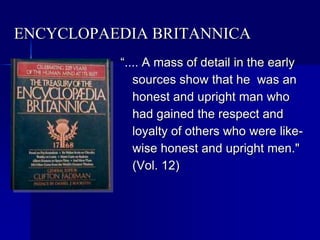
ENCYCLOPAEDIA BRITANNICA
“.... A mass of detail in the early
sources show that he was an
honest and upright man who
had gained the respect and
loyalty of others who were like-
wise honest and upright men."
(Vol. 12)
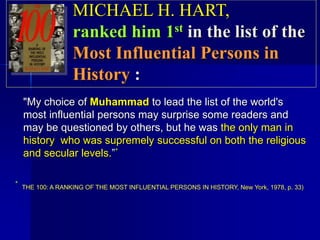
"My choice of Muhammad to lead the list of the world's
most influential persons may surprise some readers and
may be questioned by others, but he was the only man in
history who was supremely successful on both the religious
and secular levels.”*
* THE 100: A RANKING OF THE MOST INFLUENTIAL PERSONS IN HISTORY, New York, 1978, p. 33)
MICHAEL H. HART,
ranked him 1st in the list of the
Most Influential Persons in
History :
If
• greatness of purpose,
• smallness of means and
• astounding results
are the three criteria of human genius, who
could dare to compare any great man in
modern history than MUHAMMAD?
LAMAR TINE,
The renowned historian, speaking on the essentials of
human greatness wonders:
He did it…
 He was by far the most remarkable man that ever set
foot on this earth
 He preached a religion, founded a state, built a nation,
laid down a moral code, initiated numerous social and
political reforms
 He established a powerful and dynamic society to
practice and represent his teachings and
completely revolutionized the worlds of human
thought and behavior for all times to come
He was born in Arabia in the year 570, started his
mission of preaching the religion of Truth, Islam
(submission to One God) at the age of forty and
departed from this world at the age of sixty-three.
During this short period of 23 years as a Prophet,
he changed the complete Arabian peninsula
His Mission Impossible
 From paganism and idolatry to SUBMISSION to the One
True God,
 From tribal quarrels and wars to national solidarity and
cohesion,
 From drunkenness and debauchery to sobriety and piety,
 From lawlessness and anarchy to disciplined living,
 From utter bankruptcy to the highest standards of moral
excellence.
His Mission Impossible
Human history has never known such a
complete transformation of a society or a place
before or since
IMAGINE all these unbelievable wonders in JUST
OVER TWO DECADES.
His Mission Impossible
Yes, this was done by Prophet MUHAMMAD
(pbuh)
WHY PROPHETS ??
– Sources of human knowledge - limited
– Normal realities can be understood by
observation
– Higher level realities - deductive reasoning +
scientific investigation.
– Ultimate realities (esp. why?)
– Science + Philosophy can only speculate
WHY PROPHETS ??
– No other source except divine guidance
conveyed thru prophets.
– God did not leave us without guidance. From
first man till the last.
Mission of a Prophet
To lay down:
– Framework of belief
– Mode of worship
– Moral code
– Rules of culture and civilization
In fact to prescribe whole system of thought and
action (Al-Deen), which includes all aspects of
life.
Mission of a Prophet
– Read the book to people
– Purify them (belief and actions)
– Teach the book and Wisdom
– Be a practical model
– Train the individuals and society to establish
Islamic system of life (Kingdom of God on
earth)
Mission of a Prophet
– Not all the prophets succeeded because of the
prejudice and intolerance of people.
Muhammad (pbuh) did succeed in establishing
the kingdom of God.
Prophethood
– God conveyed his message to man thru
Muhammad (pbuh) in two forms
 Quran - The Book
 Sunnah - Sayings, practices, and approvals of the
prophet. (PRACTICAL DEMO)
– Belief in Prophethood brings the life into real
worship and obedience, otherwise, the belief
remains just the theory.
Requirements (of Belief in
Prophethood)
– Believe in him (as required)
– Obey him in all spheres of life
– His Sunnah is the explanation of Quran, nobody
can contradict his explanation.
– No independent decision in a matter prescribed
by the prophet
Position of a Prophet
– Servant of God
– Makes people to obey God and worship Him
and not himself, by conveying, No Force !!
– Just a human being. No share in divinity (4
areas mentioned above, entity, attributes,
rights, and powers)
– Not a superhuman. So, Islam has saved its
followers from any exaggeration in this belief.
What Distinguishes Muhammad
(pbuh) from Others ??
– Last Prophet
– Revived the faith conveyed by all prophets
– Pure message retransmitted thru him
– No messenger after him
– Book is preserved
– Sunnah (practice, sayings, approvals) is recorded in
details (No better compilation of any person in history is
present)
Why follow Muhammad
(pbuh)
– For instruction, we turn to Muhammad (pbuh),
not because of prejudice, but because
– Last Prophet  latest guidance
– Word of God  in pure divine, living language
– Historical record of his Sunnah is preserved
Muhammad's (pbuh)
Mission - Universal
– Quran confirms it
– Logical consequence of finality
– Complete code  supports finality
– No man in the last 1400 yrs like him
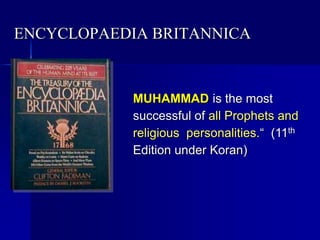
ENCYCLOPAEDIA BRITANNICA
MUHAMMAD is the most
successful of all Prophets and
religious personalities.“ (11th
Edition under Koran)
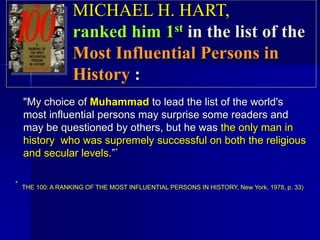
"My choice of Muhammad to lead the list of the world's
most influential persons may surprise some readers and
may be questioned by others, but he was the only man in
history who was supremely successful on both the religious
and secular levels.”*
* THE 100: A RANKING OF THE MOST INFLUENTIAL PERSONS IN HISTORY, New York, 1978, p. 33)
MICHAEL H. HART,
ranked him 1st in the list of the
Most Influential Persons in
History :
Appearance
 Muhammad (pbuh) was of a height a little above
the average.
 He was fair of complexion and altogether very
handsome.
Appearance
 He did not speak unnecessarily and what he said
was always to the point and without any padding.
 At times he would make his meaning clear by
slowly repeating what he had said.
 His laugh was mostly a smile.
 He kept his feelings under firm control.
Dress
 His dress generally consisted of a shirt, tamad
(trousers), a sheet thrown round the shoulders
and a turban.
 His blanket had several patches (Tirmidhi).
 He had very few spare clothes, but he kept them
spotlessly clean (Bukhari).
Dress
Once he enquired of a person in dirty clothes
whether he had any income. Upon getting a
reply in the affirmative, he observed, "When
Allah has blessed you with His bounty, your
appearance should reflect it." [Abu Dawood]
House & Belongings!!!
His house was but a hut with walls of unbaked clay
and a thatched roof of palm leaves covered by
camel skin. It contained
– a rope cot,
– a pillow stuffed with palm leaves ,
– the skin of some animal spread on the floor and
a water
– bag of leather
– and some weapons.
House & Belongings!!!
These were all his earthly belongings, besides
a camel,
a horse, and
an ass and
some land which he had acquired in the later
part of his life (Bukhari, Muslim, Abu
Dawood).
"I wanted to know the best of one who holds today's
undisputed sway over the hearts of millions of
mankind.. I became more than convinced that it was
not the sword that won a place for Islam in those
days in the scheme of life.”
MAHATMA GANDHI, says
in ‘Young India’..
"It was the rigid simplicity, the utter self-effacement of
the Prophet the scrupulous regard for pledges, his
intrepidity, his fearlessness, his absolute trust in God
and in his own mission….”
MAHATMA GANDHI, says
in ‘Young India’..
House & Belongings!!!
Sometimes he slept on his cot, sometimes on a skin
or ordinary mattress, and sometimes on the
ground.
To his disciples (who wanted to offer him a soft bed)
"What have I to do with worldly things. My
connection with the world is like that of a traveller
resting for a while underneath the shade of a tree
and then moving on."
House & Belongings!!!
His wife A'isha (ra) says that there was hardly a day
in his life when he had two square meals. [Sahih
Muslim]
This was so inspite of him being the most beloved
ruler of the Islamic State of all times.
For his family!
He had declared unlawful for himself and his family
anything given by the people by way of Zakat
(obligatory donation of 2.5% of savings) or
sadaqa (charity).
"He was Caesar and Pope in one; but he
was Pope without Pope's pretensions,
Caesar without the legions of Caesar:
without a standing army, without a
bodyguard, without a palace, without a fixed
revenue;
REV. REGINALD
BOSWORTH SMITH,
If ever any man had the right to say that he
ruled by the right divine, it was Mohammed,
for he had all the power without its
instruments and without its supports."
REV. REGINALD
BOSWORTH SMITH,
Extremely humble!
Though virtual king of Arabia and an apostle of
Allah, he never assumed an air of superiority.
He used to invite people be they slaves, servants or
the poorest believers, to partake with him of his
scanty meals. [Tirmidhi]
He did not like people to get up for him and used to
say, "Let him who likes people to stand up in his
honour, he should seek a place in hell." [Abu
Dawud]
At home!
His wife A'isha (ra) said, "He always joined in
household work and would at times mend his
clothes, repair his shoes and sweep the floor. He
would milk, tether, and feed his animals and do
the household shopping." [Qazi Iyaz: Shifa; Sahih
Bukhari]
Spend his time…
According to the demands on him for:
 offering worship to Allah
 public affairs, and
 personal matters.
Spend his time…
All his activities were full of supplications and
prayers.
His Love, Devotion, Dedication is transparent
through all these supplcns. (not just 5 prayers).
A full 300 page-books is there just on the prayers
he used to recite.
Supplications…
MIRACULOUS ASPECT
 Establish / Correct the relationship with God
 Maintain it
Millions of Muslims throughout centuries have been
reciting these everyday.
Of course, they want to follow him in all aspects
(name, dress, beard, living style…).
Supplications…
 And don’t forget that he was not
just a spiritual guide… He was a
leader in all aspects of life.
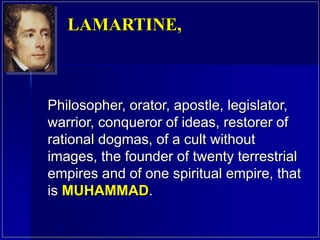
Philosopher, orator, apostle, legislator,
warrior, conqueror of ideas, restorer of
rational dogmas, of a cult without
images, the founder of twenty terrestrial
empires and of one spiritual empire, that
is MUHAMMAD.
LAMARTINE,
The most famous men created arms,
laws and empires only. They founded, if
anything at all, no more than material
powers which often crumbled away
before their eyes.
LAMARTINE,
This man moved not only armies,
legislation, empires, peoples and
dynasties, but millions of men in one-
third of the then inhabited world; and
more than that, he moved the altars, the
gods, the religions, the ideas, the beliefs
and souls....
LAMARTINE,
As regards all the standards by which
Human Greatness may be measured, we
may well ask,
IS THERE ANY MAN GREATER THAN
HE ?"
(ALPHONSE DE LAMAR TINE, HISTOIRE DE LA TURQUIE, PARIS,
1854, VOL. II, PP 276-277)
LAMARTINE,
His Behavior
By nature he was gentle and kind-hearted, always
inclined to be gracious and to overlook the faults
of others.
Politeness and courtesy,
compassion and tenderness,
simplicity and humility,
sympathy and sincerity
were some of the keynotes of his character.
His Character
 About himself the Prophet (pbuh) said “Allah has
sent me as an apostle so that I may demonstrate
perfection of character, refinement of manners
and loftiness of deportment." [Malik]
His Behavior
He was not annoyed if anyone interrupted
him even during the SERMONS for
anything.
 Bedouin (desert-man)
 His grandson
His Behavior
The Prophet (pbuh) said: “He is a bad person
in the sight of Allah
* who does not behave courteously, and
* people shun his company because of his
bad manners.
[Sahih Bukhari]
Messenger of Mercy
 We have sent you except as a mercy for the
worlds (al-Qur’an)
 Extremely kind and merciful for believers
 Even for his enemies - After Makkah’s victory
Kindness to Animals
 "Indeed, there is heavenly reward for every
act of kindness done to a living animal.“
 If he saw any animal over-loaded he would
pull up the owner and say, "Fear Allah in
your treatment of animals."
Love for the poor
 He said: "He is not a perfect Muslim who
eats his fill and lets his neighbour go
hungry."
 To his wife he said, "O A'isha, love the poor
and let them come to you and Allah will draw
you near to Himself." [Sahih Bukhari]
Messenger of Mercy
 He achieved a huge revolution without almost
any bloodshed!
 Only few hundreds were killed (initiated by
wars from others).
 Just compare it with any other revolution of
the world!!!
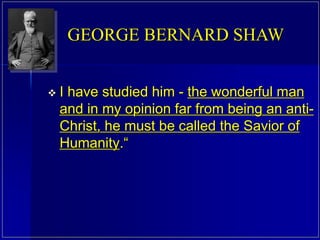
 I have studied him - the wonderful man
and in my opinion far from being an anti-
Christ, he must be called the Savior of
Humanity.“
GEORGE BERNARD SHAW
His Life in Brief!!!
 Born in Makkah
 Married Khadijah (R) a widow of 40 years at the
age of 25. Stayed with her till her death
 Made Prophet at 40 years; Spread the message
 Opposition by Makkans (egos; positions; vested
interests; establishments)
 Migrated to Madinah at 53 (after 13 years); His
followers migrated too.
His Life in Brief!!!
 Established Islamic State in Madinah; Taught
Muslims how to live (in all aspects of life: Spiritual,
moral, social, political, … all aspects of life… in all
types of situations).
 Attacked continuously by surrounding enemies
including those from Makkah
 Became victorious within 10 years!
 Whole Arabia became Muslim
 Died at the age of 63.
The Message of
Muhammad pbuh
Basic Definitions
– Islam: Peaceful, willing submission to God.
– Islam is not a religion alone. It is a code/way of
life (Deen). It encompasses all spheres of life.
– Religion guides in the area of 'ibadaat
(worship) only. Whereas Deen guides all
spheres of life of a man i.e. in mosque/church
and state affairs.
Basic Definitions
– A Muslim is the one who submits himself
to God willfully and peacefully.
A Muslim's belief is:
– There is no God except the one true God
– and Muhammad is the messenger and
slave of God. (Peace be upon him)
Who was the first Muslim
on earth?
– Adam not Muhammad (peace be on them
both)
– Islam is not a new religion. It is the religion
given by God
to the first man and is
the same for the last one too and
for every one in between.
Misconceptions
– Muhammad pbuh is not the founder of
Islam. He came with the last edition of
Islam.
– Muslims are not Muhammadans.
– Muslims do not worship Muhammad pbuh.
The Miracle given to
Muhammad pbuh – Al-Qur’an
– A UNIQUE BOOK
– Memorized in Full by hundreds of thousands
– TOP in being read daily by millions all over the world
(Encyclopedia Britannic, 11th edition)
– Preserved in its ORIGINAL form for the last 14 centuries
Center, The KAABA in
Makkah
– Built by Prophets ABRAHAM and ISHMAEL 3000 years
ago
– Muslims throughout the world face towards it while
praying
– 1.5 MILLION Muslims in Hajj; 1.5 in Umrah
– Where everybody (males) dress the same and race,
wealth, status, etc., all are removed.
The FASTEST Growing
Religion in the world:
– Not by Sword or Money ! “Today it is 'perhaps' the
fastest growing religion in US” (Maston Speight,
Director of the office of Christian Muslim relations of the
national council of churches of Christ of the USA)
– 'World's fastest growing religion' (Robert Morey,
Director of research and education foundation, Austin,
TX) in spite of the Muslims powerlessness and
decadence in the past 2 centuries.
– 'In modern times it has made great gains in
Africa' (The 1990 Almanac, Houghton Mifflin Company,
Boston) .
The FASTEST Growing
Religion in the world:
– Never witnessed large scale desertions: As against all
other religions.
– Devoid of Major Splits: Divisions (Shiites, Zaidi, etc.,)
are around 10% only.
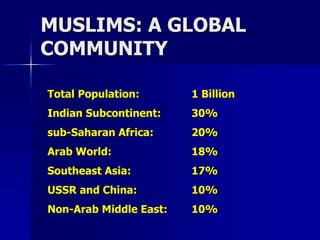
MUSLIMS: A GLOBAL
COMMUNITY
Total Population: 1 Billion
Indian Subcontinent: 30%
sub-Saharan Africa: 20%
Arab World: 18%
Southeast Asia: 17%
USSR and China: 10%
Non-Arab Middle East: 10%
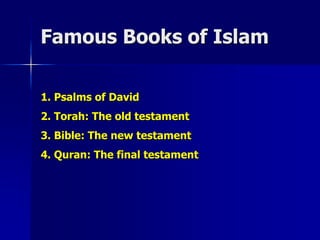
Famous Books of Islam
1. Psalms of David
2. Torah: The old testament
3. Bible: The new testament
4. Quran: The final testament
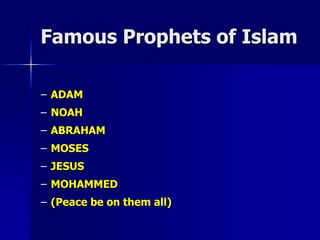
Famous Prophets of Islam
– ADAM
– NOAH
– ABRAHAM
– MOSES
– JESUS
– MOHAMMED
– (Peace be on them all)
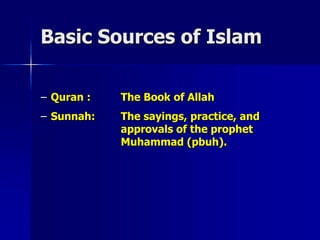
Basic Sources of Islam
– Quran : The Book of Allah
– Sunnah: The sayings, practice, and
approvals of the prophet
Muhammad (pbuh).
Three Main Elements of
Islam
– Sovereignty of God on all matters of life; spiritual and
material.
– Prophethood: Guidance (spiritual and material) is sent
thru prophets from Adam thru Mohammed (peace be
upon them.)
– The Hereafter (Life after death)
Obedience...…..Paradise for ever
Disobedience….Hell for ever
BASIC PILLARS OF ISLAM
Every act done with the consciousness that it fulfills the
divine will is considered an act of worship in Islam.
Nevertheless, the specific acts of worship termed as the
Pillars of Islam are on the higher plane of spirituality.
BASIC PILLARS OF ISLAM
They are:
1. The Declaration of Faith (Shahadah): 'I bear witness
that there is none worthy of worship except God and
that Muhammad is His servant and messenger.
2. The Prayer (Salah): 5 times a day as a duty towards
God. To strengthen the belief in God. To inspires man
to higher morality.
3. Fasting (Siyam): Cultivates piety, patience and love for
the poor.
BASIC PILLARS OF ISLAM
4. The poor-Tax (Zakat): To give 2.5% annually of one's
net savings as alms to the poor. (Life insurance in a
Muslim community)
5. Pilgrimage (Hajj): To Makkah, provided one has the
means (financial and physical).
Articles of Faith
– Existence, oneness and Attributes of Allah
– Belief in Angels
– Belief in Holy Books
– Belief in Prophets
– Belief in the Hereafter
– Belief in the Destiny (All past, present, and future
events are from Allah and in His Knowledge.)
Universality of Message
– Quran always address "O Mankind", "O Son of
Adam". And Not to people of any particular race,
tribe, are, color, language..
– "The believers are like brothers" (Quran).
– "All men are equal in Islam. The Arab has no
superiority over non-Arab, nor does the non-Arab
have superiority over Arabs except in the fear of
God." - Prophet Muhammad (pbuh)
FAITH IN GOD
Not just that HE exists but
– Creator, Master, Ruler, Administrator of the
universe;
– No one has share in His
 Entity (Asma)
 Attributes (Sifaat)
 Rights (Huqooq)
 Authority/powers (Ekhtiaraat)
Purity of Faith
In the name of God, Most Gracious, Most Merciful
– Say: He is God, The One and Only
– God, the Eternal, the Absolute
– He begets not, nor is he begotten
– And there is none like unto Him. [Quran 131:1-
5]
Requirements (of Faith in
God)
– Worship Him alone
– Pray Him alone
– Have hope and fear from Him alone
– Take the law from Him alone. Law making
should be within the limits prescribed by Him
and under His permission.
BELIEF IN THE
HEREAFTER
– This life is a test.
– At the end Accountability
– Time for accountability - fixed by God
– present order of things will be replaced by
another
– All human beings will rise once again in the new
world
– Everyone will face God individually
BELIEF IN THE
HEREAFTER
– Judgment based on not just God's knowledge
but Proofs from angles, his environment, his
book of deeds etc.,
– No undue intercession. No bribery, No advocacy
without His permission.
– Criteria: Did the man conduct himself a/c to
Islam?
BELIEF IN THE
HEREAFTER
– In one of his sermons calculated to instil the
fear of Allah and the day of reckoning in the
hearts of men, Prophet Muhammad pbuh said:
– O people of Quraish be prepared for the
hereafter, I cannot save you from the
punishment of Allah;
– O Bani Abd Manaf, ….; O Abbas… O Fatima,
daughter of Muhammad, even you I cannot
save you from the punishment of Allah."
Three Categories of
people
– Who Reject - Hellfire forever
– Who Believe, but distorted way - (a/c to
scholars, such people will be sent to Hell for
sometime and then sent to Heaven)
– Who accept and practice - Paradise forever
Three Categories of
people
– Every thing in this life is pure blessing of God
and it is impossible for human to deserve any
reward. The prophet Muhammad (pbuh)
clarified that even he also will enter paradise
because of the mercy of Allah and not based
upon his actions. The actions we do just enable
us to receive that mercy which will send us to
paradise.
SOME ISLAMIC
PRINCIPLES
– Oneness of God
– Oneness of mankind: No one can claim that he
is better than others. It is only God Who knows
who is better. It depends on piety and
righteousness.
SOME ISLAMIC
PRINCIPLES
– Oneness of Messengers and the Message:
– Muslims believe that God sent different
messengers throughout the history of mankind.
– All came with the same message and the same
teachings.
– Muslims believe in Noah, Abraham, Isaac,
Ismail, Jacob, Moses, David, Jesus, and
Muhammad. They are all the Prophets of
Islam.
Equality in Islam
(POLICY)
– O' Mankind! We created you from a single (pair) of a
male and a female, and made you into nations and
tribes, that ye may know each other (not that ye may
despise each other). Verily the most honored of you in
the sight of God is (he who is) the most righteous of
you. Quran 49:13
– God looks not to your FIGURES nor to your WEALTH but
to your HEARTS and to your DEEDS - Prophet
Muhammad (Peace be upon him)
Equality in Islam
(PROGRAM)
– Group prayers - a part of the program
– 5 times a day for every locality
– Once a week for the whole city
– Once a year for the whole Muslim world i.e.
pilgrimage to Makkah.
– Where everybody prays shoulder to shoulder.
"It was the first religion that preached and practiced
democracy; for, in the mosque, when the call for prayer is
sounded and worshippers are gathered together, the
democracy of Islam is embodied five times a day when the
peasant and king kneel side by side and proclaim: 'God
Alone is Great'...
(S.NAIDU, IDEALS OF ISLAM, VIDE SPEECHES & WRITINGS, MADRAS, 1918)
SAROJINI NAIDU, the
famous Indian poetess
says …
Leaders must fulfill three functions
– provide for the well being of the led,
– provide a social organization in which people feel
relatively secure
– provide them with one set of beliefs
PROF. JULES MASSERMAN
of USA Psychiatric Association :
People like Pasteur and Salk are leaders in the first
sense.
People like Gandhi and Confucius, on one hand, and
Alexander, Caesar and Hitler on the other, are
leaders in the second and perhaps the third sense.
Jesus and Buddha belong in the third category alone.
PROF. JULES MASSERMAN
of USA Psychiatric Association :
Perhaps the greatest leader of all times
was MUHAMMAD, who combined all
three functions.
To a lesser degree, Moses did the same."
PROF. JULES MASSERMAN
of USA Psychiatric Association :
"It is impossible for anyone who studies the life &
character of the great Prophet of Arabia, …., to feel
anything but reverence for that mighty Prophet, one
of the great messengers of the Supreme. …
I myself feel whenever I re-read them, a new way of
admiration, a new sense of reverence for that
mighty Arabian teacher."
ANNIE BESANT
in The Life & Teaching of
MUHAMMAD says
Thank you!!!

Mercy to mankind

  • 1.
    Muhammad (peace beupon him) Mercy to Mankind
  • 2.
    Outline  Introduction  Messengerof Mercy – Equality – Kindness – For animals – For environment  His Message
  • 3.
  • 4.
    Almost 1.2 Billionbear witness he is the Messenger of God *1,126,325,000 Who is he ?
  • 5.
    ENCYCLOPAEDIA BRITANNICA MUHAMMAD isthe most successful of all Prophets and religious personalities.“ (11th Edition under Koran)
  • 6.
    ENCYCLOPAEDIA BRITANNICA “.... Amass of detail in the early sources show that he was an honest and upright man who had gained the respect and loyalty of others who were like- wise honest and upright men." (Vol. 12)
  • 7.
    "My choice ofMuhammad to lead the list of the world's most influential persons may surprise some readers and may be questioned by others, but he was the only man in history who was supremely successful on both the religious and secular levels.”* * THE 100: A RANKING OF THE MOST INFLUENTIAL PERSONS IN HISTORY, New York, 1978, p. 33) MICHAEL H. HART, ranked him 1st in the list of the Most Influential Persons in History :
  • 8.
    If • greatness ofpurpose, • smallness of means and • astounding results are the three criteria of human genius, who could dare to compare any great man in modern history than MUHAMMAD? LAMAR TINE, The renowned historian, speaking on the essentials of human greatness wonders:
  • 9.
    He did it… He was by far the most remarkable man that ever set foot on this earth  He preached a religion, founded a state, built a nation, laid down a moral code, initiated numerous social and political reforms  He established a powerful and dynamic society to practice and represent his teachings and completely revolutionized the worlds of human thought and behavior for all times to come
  • 10.
    He was bornin Arabia in the year 570, started his mission of preaching the religion of Truth, Islam (submission to One God) at the age of forty and departed from this world at the age of sixty-three. During this short period of 23 years as a Prophet, he changed the complete Arabian peninsula His Mission Impossible
  • 11.
     From paganismand idolatry to SUBMISSION to the One True God,  From tribal quarrels and wars to national solidarity and cohesion,  From drunkenness and debauchery to sobriety and piety,  From lawlessness and anarchy to disciplined living,  From utter bankruptcy to the highest standards of moral excellence. His Mission Impossible
  • 12.
    Human history hasnever known such a complete transformation of a society or a place before or since IMAGINE all these unbelievable wonders in JUST OVER TWO DECADES. His Mission Impossible Yes, this was done by Prophet MUHAMMAD (pbuh)
  • 13.
    WHY PROPHETS ?? –Sources of human knowledge - limited – Normal realities can be understood by observation – Higher level realities - deductive reasoning + scientific investigation. – Ultimate realities (esp. why?) – Science + Philosophy can only speculate
  • 14.
    WHY PROPHETS ?? –No other source except divine guidance conveyed thru prophets. – God did not leave us without guidance. From first man till the last.
  • 15.
    Mission of aProphet To lay down: – Framework of belief – Mode of worship – Moral code – Rules of culture and civilization In fact to prescribe whole system of thought and action (Al-Deen), which includes all aspects of life.
  • 16.
    Mission of aProphet – Read the book to people – Purify them (belief and actions) – Teach the book and Wisdom – Be a practical model – Train the individuals and society to establish Islamic system of life (Kingdom of God on earth)
  • 17.
    Mission of aProphet – Not all the prophets succeeded because of the prejudice and intolerance of people. Muhammad (pbuh) did succeed in establishing the kingdom of God.
  • 18.
    Prophethood – God conveyedhis message to man thru Muhammad (pbuh) in two forms  Quran - The Book  Sunnah - Sayings, practices, and approvals of the prophet. (PRACTICAL DEMO) – Belief in Prophethood brings the life into real worship and obedience, otherwise, the belief remains just the theory.
  • 19.
    Requirements (of Beliefin Prophethood) – Believe in him (as required) – Obey him in all spheres of life – His Sunnah is the explanation of Quran, nobody can contradict his explanation. – No independent decision in a matter prescribed by the prophet
  • 20.
    Position of aProphet – Servant of God – Makes people to obey God and worship Him and not himself, by conveying, No Force !! – Just a human being. No share in divinity (4 areas mentioned above, entity, attributes, rights, and powers) – Not a superhuman. So, Islam has saved its followers from any exaggeration in this belief.
  • 21.
    What Distinguishes Muhammad (pbuh)from Others ?? – Last Prophet – Revived the faith conveyed by all prophets – Pure message retransmitted thru him – No messenger after him – Book is preserved – Sunnah (practice, sayings, approvals) is recorded in details (No better compilation of any person in history is present)
  • 22.
    Why follow Muhammad (pbuh) –For instruction, we turn to Muhammad (pbuh), not because of prejudice, but because – Last Prophet  latest guidance – Word of God  in pure divine, living language – Historical record of his Sunnah is preserved
  • 23.
    Muhammad's (pbuh) Mission -Universal – Quran confirms it – Logical consequence of finality – Complete code  supports finality – No man in the last 1400 yrs like him
  • 24.
    ENCYCLOPAEDIA BRITANNICA MUHAMMAD isthe most successful of all Prophets and religious personalities.“ (11th Edition under Koran)
  • 25.
    "My choice ofMuhammad to lead the list of the world's most influential persons may surprise some readers and may be questioned by others, but he was the only man in history who was supremely successful on both the religious and secular levels.”* * THE 100: A RANKING OF THE MOST INFLUENTIAL PERSONS IN HISTORY, New York, 1978, p. 33) MICHAEL H. HART, ranked him 1st in the list of the Most Influential Persons in History :
  • 26.
    Appearance  Muhammad (pbuh)was of a height a little above the average.  He was fair of complexion and altogether very handsome.
  • 27.
    Appearance  He didnot speak unnecessarily and what he said was always to the point and without any padding.  At times he would make his meaning clear by slowly repeating what he had said.  His laugh was mostly a smile.  He kept his feelings under firm control.
  • 28.
    Dress  His dressgenerally consisted of a shirt, tamad (trousers), a sheet thrown round the shoulders and a turban.  His blanket had several patches (Tirmidhi).  He had very few spare clothes, but he kept them spotlessly clean (Bukhari).
  • 29.
    Dress Once he enquiredof a person in dirty clothes whether he had any income. Upon getting a reply in the affirmative, he observed, "When Allah has blessed you with His bounty, your appearance should reflect it." [Abu Dawood]
  • 30.
    House & Belongings!!! Hishouse was but a hut with walls of unbaked clay and a thatched roof of palm leaves covered by camel skin. It contained – a rope cot, – a pillow stuffed with palm leaves , – the skin of some animal spread on the floor and a water – bag of leather – and some weapons.
  • 31.
    House & Belongings!!! Thesewere all his earthly belongings, besides a camel, a horse, and an ass and some land which he had acquired in the later part of his life (Bukhari, Muslim, Abu Dawood).
  • 32.
    "I wanted toknow the best of one who holds today's undisputed sway over the hearts of millions of mankind.. I became more than convinced that it was not the sword that won a place for Islam in those days in the scheme of life.” MAHATMA GANDHI, says in ‘Young India’..
  • 33.
    "It was therigid simplicity, the utter self-effacement of the Prophet the scrupulous regard for pledges, his intrepidity, his fearlessness, his absolute trust in God and in his own mission….” MAHATMA GANDHI, says in ‘Young India’..
  • 34.
    House & Belongings!!! Sometimeshe slept on his cot, sometimes on a skin or ordinary mattress, and sometimes on the ground. To his disciples (who wanted to offer him a soft bed) "What have I to do with worldly things. My connection with the world is like that of a traveller resting for a while underneath the shade of a tree and then moving on."
  • 35.
    House & Belongings!!! Hiswife A'isha (ra) says that there was hardly a day in his life when he had two square meals. [Sahih Muslim] This was so inspite of him being the most beloved ruler of the Islamic State of all times.
  • 36.
    For his family! Hehad declared unlawful for himself and his family anything given by the people by way of Zakat (obligatory donation of 2.5% of savings) or sadaqa (charity).
  • 37.
    "He was Caesarand Pope in one; but he was Pope without Pope's pretensions, Caesar without the legions of Caesar: without a standing army, without a bodyguard, without a palace, without a fixed revenue; REV. REGINALD BOSWORTH SMITH,
  • 38.
    If ever anyman had the right to say that he ruled by the right divine, it was Mohammed, for he had all the power without its instruments and without its supports." REV. REGINALD BOSWORTH SMITH,
  • 39.
    Extremely humble! Though virtualking of Arabia and an apostle of Allah, he never assumed an air of superiority. He used to invite people be they slaves, servants or the poorest believers, to partake with him of his scanty meals. [Tirmidhi] He did not like people to get up for him and used to say, "Let him who likes people to stand up in his honour, he should seek a place in hell." [Abu Dawud]
  • 40.
    At home! His wifeA'isha (ra) said, "He always joined in household work and would at times mend his clothes, repair his shoes and sweep the floor. He would milk, tether, and feed his animals and do the household shopping." [Qazi Iyaz: Shifa; Sahih Bukhari]
  • 41.
    Spend his time… Accordingto the demands on him for:  offering worship to Allah  public affairs, and  personal matters.
  • 42.
    Spend his time… Allhis activities were full of supplications and prayers. His Love, Devotion, Dedication is transparent through all these supplcns. (not just 5 prayers). A full 300 page-books is there just on the prayers he used to recite.
  • 43.
    Supplications… MIRACULOUS ASPECT  Establish/ Correct the relationship with God  Maintain it Millions of Muslims throughout centuries have been reciting these everyday. Of course, they want to follow him in all aspects (name, dress, beard, living style…).
  • 44.
    Supplications…  And don’tforget that he was not just a spiritual guide… He was a leader in all aspects of life.
  • 45.
    Philosopher, orator, apostle,legislator, warrior, conqueror of ideas, restorer of rational dogmas, of a cult without images, the founder of twenty terrestrial empires and of one spiritual empire, that is MUHAMMAD. LAMARTINE,
  • 46.
    The most famousmen created arms, laws and empires only. They founded, if anything at all, no more than material powers which often crumbled away before their eyes. LAMARTINE,
  • 47.
    This man movednot only armies, legislation, empires, peoples and dynasties, but millions of men in one- third of the then inhabited world; and more than that, he moved the altars, the gods, the religions, the ideas, the beliefs and souls.... LAMARTINE,
  • 48.
    As regards allthe standards by which Human Greatness may be measured, we may well ask, IS THERE ANY MAN GREATER THAN HE ?" (ALPHONSE DE LAMAR TINE, HISTOIRE DE LA TURQUIE, PARIS, 1854, VOL. II, PP 276-277) LAMARTINE,
  • 49.
    His Behavior By naturehe was gentle and kind-hearted, always inclined to be gracious and to overlook the faults of others. Politeness and courtesy, compassion and tenderness, simplicity and humility, sympathy and sincerity were some of the keynotes of his character.
  • 50.
    His Character  Abouthimself the Prophet (pbuh) said “Allah has sent me as an apostle so that I may demonstrate perfection of character, refinement of manners and loftiness of deportment." [Malik]
  • 51.
    His Behavior He wasnot annoyed if anyone interrupted him even during the SERMONS for anything.  Bedouin (desert-man)  His grandson
  • 52.
    His Behavior The Prophet(pbuh) said: “He is a bad person in the sight of Allah * who does not behave courteously, and * people shun his company because of his bad manners. [Sahih Bukhari]
  • 53.
    Messenger of Mercy We have sent you except as a mercy for the worlds (al-Qur’an)  Extremely kind and merciful for believers  Even for his enemies - After Makkah’s victory
  • 54.
    Kindness to Animals "Indeed, there is heavenly reward for every act of kindness done to a living animal.“  If he saw any animal over-loaded he would pull up the owner and say, "Fear Allah in your treatment of animals."
  • 55.
    Love for thepoor  He said: "He is not a perfect Muslim who eats his fill and lets his neighbour go hungry."  To his wife he said, "O A'isha, love the poor and let them come to you and Allah will draw you near to Himself." [Sahih Bukhari]
  • 56.
    Messenger of Mercy He achieved a huge revolution without almost any bloodshed!  Only few hundreds were killed (initiated by wars from others).  Just compare it with any other revolution of the world!!!
  • 57.
     I havestudied him - the wonderful man and in my opinion far from being an anti- Christ, he must be called the Savior of Humanity.“ GEORGE BERNARD SHAW
  • 58.
    His Life inBrief!!!  Born in Makkah  Married Khadijah (R) a widow of 40 years at the age of 25. Stayed with her till her death  Made Prophet at 40 years; Spread the message  Opposition by Makkans (egos; positions; vested interests; establishments)  Migrated to Madinah at 53 (after 13 years); His followers migrated too.
  • 59.
    His Life inBrief!!!  Established Islamic State in Madinah; Taught Muslims how to live (in all aspects of life: Spiritual, moral, social, political, … all aspects of life… in all types of situations).  Attacked continuously by surrounding enemies including those from Makkah  Became victorious within 10 years!  Whole Arabia became Muslim  Died at the age of 63.
  • 60.
  • 61.
    Basic Definitions – Islam:Peaceful, willing submission to God. – Islam is not a religion alone. It is a code/way of life (Deen). It encompasses all spheres of life. – Religion guides in the area of 'ibadaat (worship) only. Whereas Deen guides all spheres of life of a man i.e. in mosque/church and state affairs.
  • 62.
    Basic Definitions – AMuslim is the one who submits himself to God willfully and peacefully. A Muslim's belief is: – There is no God except the one true God – and Muhammad is the messenger and slave of God. (Peace be upon him)
  • 63.
    Who was thefirst Muslim on earth? – Adam not Muhammad (peace be on them both) – Islam is not a new religion. It is the religion given by God to the first man and is the same for the last one too and for every one in between.
  • 64.
    Misconceptions – Muhammad pbuhis not the founder of Islam. He came with the last edition of Islam. – Muslims are not Muhammadans. – Muslims do not worship Muhammad pbuh.
  • 65.
    The Miracle givento Muhammad pbuh – Al-Qur’an – A UNIQUE BOOK – Memorized in Full by hundreds of thousands – TOP in being read daily by millions all over the world (Encyclopedia Britannic, 11th edition) – Preserved in its ORIGINAL form for the last 14 centuries
  • 66.
    Center, The KAABAin Makkah – Built by Prophets ABRAHAM and ISHMAEL 3000 years ago – Muslims throughout the world face towards it while praying – 1.5 MILLION Muslims in Hajj; 1.5 in Umrah – Where everybody (males) dress the same and race, wealth, status, etc., all are removed.
  • 67.
    The FASTEST Growing Religionin the world: – Not by Sword or Money ! “Today it is 'perhaps' the fastest growing religion in US” (Maston Speight, Director of the office of Christian Muslim relations of the national council of churches of Christ of the USA) – 'World's fastest growing religion' (Robert Morey, Director of research and education foundation, Austin, TX) in spite of the Muslims powerlessness and decadence in the past 2 centuries. – 'In modern times it has made great gains in Africa' (The 1990 Almanac, Houghton Mifflin Company, Boston) .
  • 68.
    The FASTEST Growing Religionin the world: – Never witnessed large scale desertions: As against all other religions. – Devoid of Major Splits: Divisions (Shiites, Zaidi, etc.,) are around 10% only.
  • 69.
    MUSLIMS: A GLOBAL COMMUNITY TotalPopulation: 1 Billion Indian Subcontinent: 30% sub-Saharan Africa: 20% Arab World: 18% Southeast Asia: 17% USSR and China: 10% Non-Arab Middle East: 10%
  • 70.
    Famous Books ofIslam 1. Psalms of David 2. Torah: The old testament 3. Bible: The new testament 4. Quran: The final testament
  • 71.
    Famous Prophets ofIslam – ADAM – NOAH – ABRAHAM – MOSES – JESUS – MOHAMMED – (Peace be on them all)
  • 72.
    Basic Sources ofIslam – Quran : The Book of Allah – Sunnah: The sayings, practice, and approvals of the prophet Muhammad (pbuh).
  • 73.
    Three Main Elementsof Islam – Sovereignty of God on all matters of life; spiritual and material. – Prophethood: Guidance (spiritual and material) is sent thru prophets from Adam thru Mohammed (peace be upon them.) – The Hereafter (Life after death) Obedience...…..Paradise for ever Disobedience….Hell for ever
  • 74.
    BASIC PILLARS OFISLAM Every act done with the consciousness that it fulfills the divine will is considered an act of worship in Islam. Nevertheless, the specific acts of worship termed as the Pillars of Islam are on the higher plane of spirituality.
  • 75.
    BASIC PILLARS OFISLAM They are: 1. The Declaration of Faith (Shahadah): 'I bear witness that there is none worthy of worship except God and that Muhammad is His servant and messenger. 2. The Prayer (Salah): 5 times a day as a duty towards God. To strengthen the belief in God. To inspires man to higher morality. 3. Fasting (Siyam): Cultivates piety, patience and love for the poor.
  • 76.
    BASIC PILLARS OFISLAM 4. The poor-Tax (Zakat): To give 2.5% annually of one's net savings as alms to the poor. (Life insurance in a Muslim community) 5. Pilgrimage (Hajj): To Makkah, provided one has the means (financial and physical).
  • 77.
    Articles of Faith –Existence, oneness and Attributes of Allah – Belief in Angels – Belief in Holy Books – Belief in Prophets – Belief in the Hereafter – Belief in the Destiny (All past, present, and future events are from Allah and in His Knowledge.)
  • 78.
    Universality of Message –Quran always address "O Mankind", "O Son of Adam". And Not to people of any particular race, tribe, are, color, language.. – "The believers are like brothers" (Quran). – "All men are equal in Islam. The Arab has no superiority over non-Arab, nor does the non-Arab have superiority over Arabs except in the fear of God." - Prophet Muhammad (pbuh)
  • 79.
    FAITH IN GOD Notjust that HE exists but – Creator, Master, Ruler, Administrator of the universe; – No one has share in His  Entity (Asma)  Attributes (Sifaat)  Rights (Huqooq)  Authority/powers (Ekhtiaraat)
  • 80.
    Purity of Faith Inthe name of God, Most Gracious, Most Merciful – Say: He is God, The One and Only – God, the Eternal, the Absolute – He begets not, nor is he begotten – And there is none like unto Him. [Quran 131:1- 5]
  • 81.
    Requirements (of Faithin God) – Worship Him alone – Pray Him alone – Have hope and fear from Him alone – Take the law from Him alone. Law making should be within the limits prescribed by Him and under His permission.
  • 82.
    BELIEF IN THE HEREAFTER –This life is a test. – At the end Accountability – Time for accountability - fixed by God – present order of things will be replaced by another – All human beings will rise once again in the new world – Everyone will face God individually
  • 83.
    BELIEF IN THE HEREAFTER –Judgment based on not just God's knowledge but Proofs from angles, his environment, his book of deeds etc., – No undue intercession. No bribery, No advocacy without His permission. – Criteria: Did the man conduct himself a/c to Islam?
  • 84.
    BELIEF IN THE HEREAFTER –In one of his sermons calculated to instil the fear of Allah and the day of reckoning in the hearts of men, Prophet Muhammad pbuh said: – O people of Quraish be prepared for the hereafter, I cannot save you from the punishment of Allah; – O Bani Abd Manaf, ….; O Abbas… O Fatima, daughter of Muhammad, even you I cannot save you from the punishment of Allah."
  • 85.
    Three Categories of people –Who Reject - Hellfire forever – Who Believe, but distorted way - (a/c to scholars, such people will be sent to Hell for sometime and then sent to Heaven) – Who accept and practice - Paradise forever
  • 86.
    Three Categories of people –Every thing in this life is pure blessing of God and it is impossible for human to deserve any reward. The prophet Muhammad (pbuh) clarified that even he also will enter paradise because of the mercy of Allah and not based upon his actions. The actions we do just enable us to receive that mercy which will send us to paradise.
  • 87.
    SOME ISLAMIC PRINCIPLES – Onenessof God – Oneness of mankind: No one can claim that he is better than others. It is only God Who knows who is better. It depends on piety and righteousness.
  • 88.
    SOME ISLAMIC PRINCIPLES – Onenessof Messengers and the Message: – Muslims believe that God sent different messengers throughout the history of mankind. – All came with the same message and the same teachings. – Muslims believe in Noah, Abraham, Isaac, Ismail, Jacob, Moses, David, Jesus, and Muhammad. They are all the Prophets of Islam.
  • 89.
    Equality in Islam (POLICY) –O' Mankind! We created you from a single (pair) of a male and a female, and made you into nations and tribes, that ye may know each other (not that ye may despise each other). Verily the most honored of you in the sight of God is (he who is) the most righteous of you. Quran 49:13 – God looks not to your FIGURES nor to your WEALTH but to your HEARTS and to your DEEDS - Prophet Muhammad (Peace be upon him)
  • 90.
    Equality in Islam (PROGRAM) –Group prayers - a part of the program – 5 times a day for every locality – Once a week for the whole city – Once a year for the whole Muslim world i.e. pilgrimage to Makkah. – Where everybody prays shoulder to shoulder.
  • 91.
    "It was thefirst religion that preached and practiced democracy; for, in the mosque, when the call for prayer is sounded and worshippers are gathered together, the democracy of Islam is embodied five times a day when the peasant and king kneel side by side and proclaim: 'God Alone is Great'... (S.NAIDU, IDEALS OF ISLAM, VIDE SPEECHES & WRITINGS, MADRAS, 1918) SAROJINI NAIDU, the famous Indian poetess says …
  • 92.
    Leaders must fulfillthree functions – provide for the well being of the led, – provide a social organization in which people feel relatively secure – provide them with one set of beliefs PROF. JULES MASSERMAN of USA Psychiatric Association :
  • 93.
    People like Pasteurand Salk are leaders in the first sense. People like Gandhi and Confucius, on one hand, and Alexander, Caesar and Hitler on the other, are leaders in the second and perhaps the third sense. Jesus and Buddha belong in the third category alone. PROF. JULES MASSERMAN of USA Psychiatric Association :
  • 94.
    Perhaps the greatestleader of all times was MUHAMMAD, who combined all three functions. To a lesser degree, Moses did the same." PROF. JULES MASSERMAN of USA Psychiatric Association :
  • 95.
    "It is impossiblefor anyone who studies the life & character of the great Prophet of Arabia, …., to feel anything but reverence for that mighty Prophet, one of the great messengers of the Supreme. … I myself feel whenever I re-read them, a new way of admiration, a new sense of reverence for that mighty Arabian teacher." ANNIE BESANT in The Life & Teaching of MUHAMMAD says
  • 96.