IMPORTANCE OF
COLLECTIVE WORK

IN OUR SOCIETY
Summary Slide
   Importance of collective work
   Definition
   Jama’ah and Al Jama’ah
   Reasons for emphasis upon Jama’ah
   Jama’ah and other organizations
   Jama’ah and sects
   Goal
   Few characteristics of Islamic message
    5 Basic organizational features
    3 Stages of work
   General guidelines for Jama’ah methodology
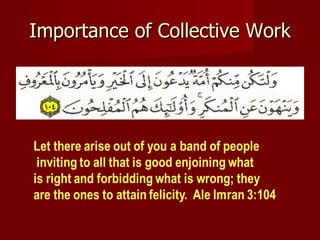
Importance of Collective Work
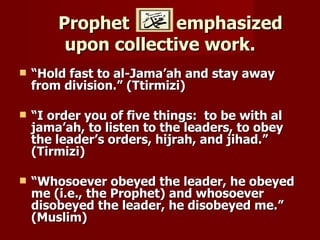
Prophet       emphasized
         upon collective work.
   “Hold fast to al-Jama’ah and stay away
    from division.” (Ttirmizi)

   “I order you of five things: to be with al
    jama’ah, to listen to the leaders, to obey
    the leader’s orders, hijrah, and jihad.”
    (Tirmizi)

   “Whosoever obeyed the leader, he obeyed
    me (i.e., the Prophet) and whosoever
    disobeyed the leader, he disobeyed me.”
    (Muslim)
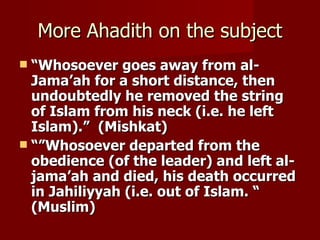
More Ahadith on the subject
 “Whosoever goes away from al-
  Jama’ah for a short distance, then
  undoubtedly he removed the string
  of Islam from his neck (i.e. he left
  Islam).” (Mishkat)
 “”Whosoever departed from the
  obedience (of the leader) and left al-
  jama’ah and died, his death occurred
  in Jahiliyyah (i.e. out of Islam. “
  (Muslim)
Jama’ah work necessary for
               success
   “If one dies and there is no ring of
    bay’ah in his neck (i.e., pledge of
    obedience to the leader), he died in
    Jahiliyyah (i.e. out of Islam).”
    (Muslim)
Definition:
   It is an organization of Muslims who
    have voluntarily and consciously
    submitted themselves to the discipline of
    the jamaah for continuous effort to
    maintain and enhance their:
    Islamic Awareness
   Commitment,
   Dedication, and
   Sacrifice to achieve the goal of Aqamah
    of Deen
Jama’ah and Al-Jama’ah
 Al-Jama’ah is the term used in Hadith
  and is synonymous with the words
  Ummah and Hizb used in Quran.
 It implies the united Muslim Ummah
  in a united Islamic state, governed
  by an elected khalifah in accordance
  with the laws of shari’ah.
 As defined above, there can be only
  one al-jama’ah in a given time.
Differences between Al Jama’ah
       and Jama’ah or Movement
   there could be more than one Islamic
    Jama’ah or movement at one time in order
    to reestablish the concept of Al Jama’ah.
   Jama’ah is not an alternative to al-
    jama’ah. It is only a way to al jama’ah.
   Leadership of al-jama’ah (or an Islamic
    state) has the authority to enforce hudood
    or a penal system that is beyond the
    jurisdiction of a jama’ah.
Al Jama’ah versus Jama’ah
   Being part of al-jama’ah (if one exists) is a
    basic condition of faith (or Iman). On the
    contrary, working with a jama’ah (or
    Islamic movement) is important but if one
    stays aloof, though he may be neglecting
    an important duty, it cannot be called
    apostasy.
   Jama’ah (or Islamic movement) will be
    recognized by its characteristics and the
    struggle to establish Al Islam and not just
    by its claim only.
Reasons for Great Emphasis on
      Islamic Jama’ah
   “Stay with al-Jama’ah, because the wolf
    devours the goat that runs away (from the
    herd).” (Abu Dawood)
   “Satan is man’s wolf, just like there is
    goat’s wolf who hunts the goats that stay
    aloof, or run away or are separated (from
    the herd).” (Mishkat)
   “Stay with al-Jama’ah and stay away from
    divisions. This is because Satan is with one
    individual, but stays away from two.”
    (Tirmizi)
Why so much emphasis on being a
        part of Jama’ah?
   Inability to practice appropriately certain
    Islamic injunctions without Islamic
    Jama’ah ,e.g., Aqamah of Deen.
   Difficult to protect against negative
    effects of the Un-Islamic environment
n    Feeling of great uneasiness and
    discomfort at the initial stage
n   Getting used to the environment
n   Compromise with the environment
n   Changes of values
Jamah and other organizations
 Organizations that provide essential
  services like establishing places for
  prayer, schools, cemeteries etc
 Organizations based on national
  origin to cater to the particular needs
  of their members and to support
  their national causes.
 Organizations of Muslim
  professionals
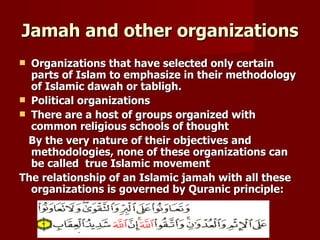
Jamah and other organizations
 Organizations that have selected only certain
  parts of Islam to emphasize in their methodology
  of Islamic dawah or tabligh.
 Political organizations
 There are a host of groups organized with
  common religious schools of thought
  By the very nature of their objectives and
  methodologies, none of these organizations can
  be called true Islamic movement
The relationship of an Islamic jamah with all these
  organizations is governed by Quranic principle:
Jama’ah versus sects
Definition of a Sect or Furqah
A sect is a group of individuals who present
  themselves as a distinct entity due to one of the
  following reasons:
 Extraordinary emphasis on minor issues and in
  the details of Shari’ah when alternate opinions
  are also derived from Shari’ah.
 Declaring others as polytheists and out of Islam
  when it may only be a matter of
  misunderstanding
 Grouping around some personalities and forming
  personality cults
 Grouping based on ethnic, nationalistic, or other
  prejudicial grounds with a false sense of
  superiority
Goal of Jama’ah

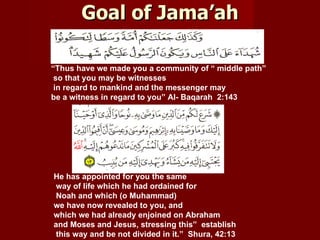
“Thus have we made you a community of “ middle path”
 so that you may be witnesses
 in regard to mankind and the messenger may
be a witness in regard to you” Al- Baqarah 2:143


He has appointed for you the same
 way of life which he had ordained for
 Noah and which (o Muhammad)
we have now revealed to you, and
which we had already enjoined on Abraham
and Moses and Jesus, stressing this” establish
 this way and be not divided in it.” Shura, 42:13
Goal of Jama’ah


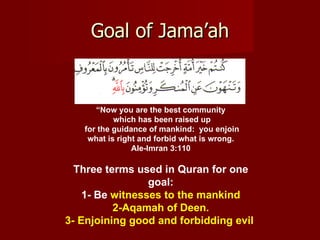
      “Now you are the best community
           which has been raised up
   for the guidance of mankind: you enjoin
    what is right and forbid what is wrong.
                Ale-Imran 3:110

  Three terms used in Quran for one
                 goal:
    1- Be witnesses to the mankind
          2-Aqamah of Deen.
3- Enjoining good and forbidding evil
A Few Characteristics of
          IslamicMessage
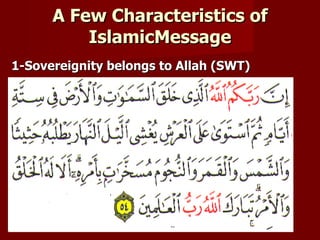
1-Sovereignity belongs to Allah (SWT)
Sovereignty
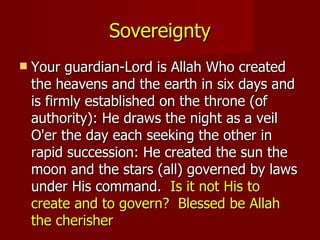
   Your guardian-Lord is Allah Who created
    the heavens and the earth in six days and
    is firmly established on the throne (of
    authority): He draws the night as a veil
    O'er the day each seeking the other in
    rapid succession: He created the sun the
    moon and the stars (all) governed by laws
    under His command. Is it not His to
    create and to govern? Blessed be Allah
    the cherisher
2-Status of the Prophets


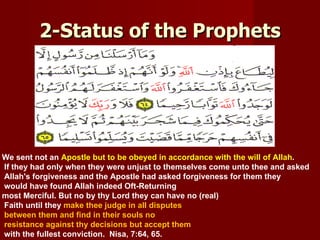
We sent not an Apostle but to be obeyed in accordance with the will of Allah.
If they had only when they were unjust to themselves come unto thee and asked
Allah's forgiveness and the Apostle had asked forgiveness for them they
would have found Allah indeed Oft-Returning
most Merciful. But no by thy Lord they can have no (real)
Faith until they make thee judge in all disputes
between them and find in their souls no
resistance against thy decisions but accept them
with the fullest conviction. Nisa, 7:64, 65.
3-Man’s Vicegerence on
               Earth

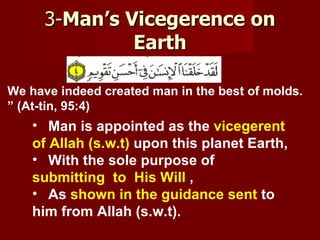
We have indeed created man in the best of molds.
” (At-tin, 95:4)
    • Man is appointed as the vicegerent
    of Allah (s.w.t) upon this planet Earth,
    • With the sole purpose of
    submitting to His Will ,
    • As shown in the guidance sent to
    him from Allah (s.w.t).
4-Ideological Unity


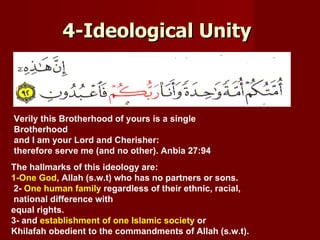
Verily this Brotherhood of yours is a single
Brotherhood
and I am your Lord and Cherisher:
therefore serve me (and no other). Anbia 27:94
The hallmarks of this ideology are:
1-One God, Allah (s.w.t) who has no partners or sons.
2- One human family regardless of their ethnic, racial,
national difference with
equal rights.
3- and establishment of one Islamic society or
Khilafah obedient to the commandments of Allah (s.w.t).
5-Universality of the Message
         and the Program


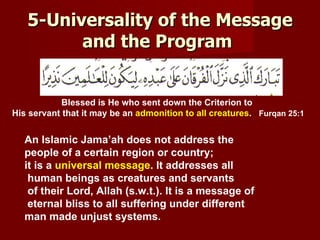
            Blessed is He who sent down the Criterion to
His servant that it may be an admonition to all creatures. Furqan 25:1


  An Islamic Jama’ah does not address the
  people of a certain region or country;
  it is a universal message. It addresses all
   human beings as creatures and servants
   of their Lord, Allah (s.w.t.). It is a message of
   eternal bliss to all suffering under different
  man made unjust systems.
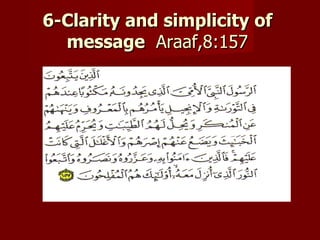
6-Clarity and simplicity of
  message Araaf,8:157
6-Clarity and simplicity of
               message
   "Those who follow the apostle the unlettered
    prophet whom they find mentioned in their own
    (Scriptures); in the law and the Gospel; for he
    commands them what is just and forbids them
    what is evil: he allows them as lawful what is
    good (and pure) and prohibits them from what is
    bad (and impure); He releases them from their
    heavy burdens and from the yokes that are upon
    them. So it is those who believe in him honor him
    help him and follow the light which is sent down
    with him it is they who will prosper." Al Araaf
    8:157
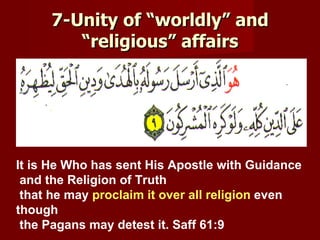
7-Unity of “worldly” and
        “religious” affairs


It is He Who has sent His Apostle with Guidance
 and the Religion of Truth
 that he may proclaim it over all religion even
though
 the Pagans may detest it. Saff 61:9
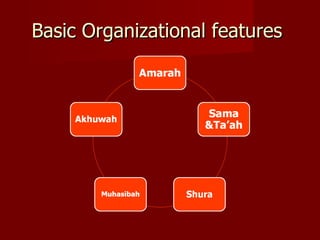
Basic Organizational features
Basic Organizational
                features
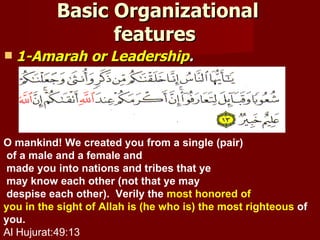
   1-Amarah or Leadership.


O mankind! We created you from a single (pair)
 of a male and a female and
 made you into nations and tribes that ye
 may know each other (not that ye may
 despise each other). Verily the most honored of
you in the sight of Allah is (he who is) the most righteous of
you.
Al Hujurat:49:13
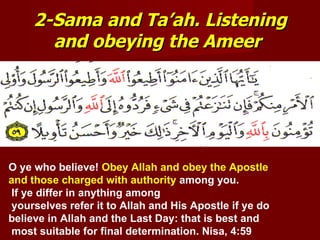
2-Sama and Ta’ah. Listening
       and obeying the Ameer


O ye who believe! Obey Allah and obey the Apostle
and those charged with authority among you.
 If ye differ in anything among
 yourselves refer it to Allah and His Apostle if ye do
believe in Allah and the Last Day: that is best and
 most suitable for final determination. Nisa, 4:59
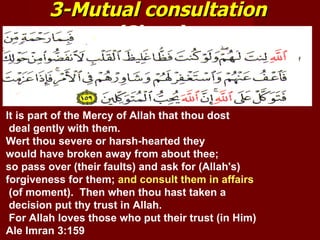
3-Mutual consultation
             (Shura).


It is part of the Mercy of Allah that thou dost
 deal gently with them.
Wert thou severe or harsh-hearted they
would have broken away from about thee;
so pass over (their faults) and ask for (Allah's)
forgiveness for them; and consult them in affairs
 (of moment). Then when thou hast taken a
 decision put thy trust in Allah.
 For Allah loves those who put their trust (in Him)
Ale Imran 3:159
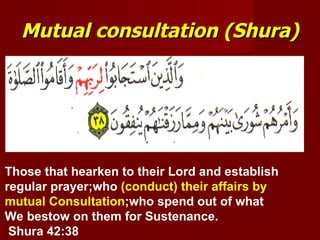
Mutual consultation (Shura)


Those that hearken to their Lord and establish
regular prayer;who (conduct) their affairs by
mutual Consultation;who spend out of what
We bestow on them for Sustenance.
 Shura 42:38
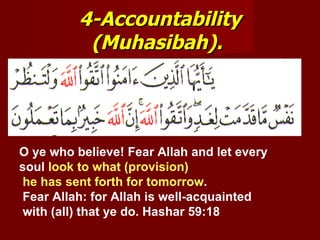
4-Accountability
           (Muhasibah).


O ye who believe! Fear Allah and let every
soul look to what (provision)
 he has sent forth for tomorrow.
 Fear Allah: for Allah is well-acquainted
 with (all) that ye do. Hashar 59:18
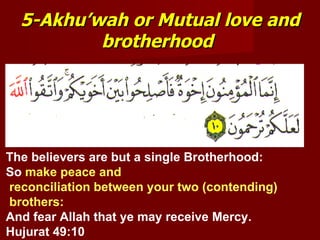
5-Akhu’wah or Mutual love and
          brotherhood


The believers are but a single Brotherhood:
So make peace and
reconciliation between your two (contending)
brothers:
And fear Allah that ye may receive Mercy.
Hujurat 49:10
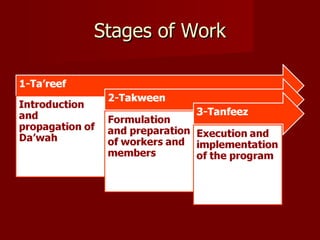
Stages of Work
I-    Tareef: The stage of
                 Da’wah
   In this stage, the following issues are
    brought in focus:
   Islam is the only solution for man’s
    problems. Let us all submit to the
    Guidance provided by our Creator.
   Islam is comprehensive way of life to bring
    true peace and justice at. individual,
    family, social and global level
   Let us rise above the differences and bring
    about true unity amongst the human
    beings based upon equality, justice and
    mutual respect.
Response to Islamic Dawah
   A true believer and supporter
   Believer, but hesitant
   Believer, hostile due to some prejudice,
    misconception, or impressed by secular
    philosophies
   Non- Muslims.
    An Islamic Movement has to develop an
    effective methodology for Da’wah to this
    large audience, especially in the West.
    This task has to be carried out as Prophet
    of Allah-with understanding, compassion,
    and concern.
Relations with other Islamic
           Organizations
   Maintain close contacts with other Muslim
    groups
   Cooperate with them for the cause of
    Islam, despite some differences on issues
    or methods.
   Be generous dealings with them and
    Refrain from rebuking them publicly.
   The positive achievements of other groups
    should be applauded and recognized.
II- Takween: Stage of
Formulation and Preparation of
          Workers
 Moral and Spiritual preparation
 Intellectual Preparation
 Brotherly Relations which include but is
  not limited to :
 1) Taa’ruf. In depth mutual introduction
  must be done like members of family.
 2) Nus’h, exchanging mutual advice, and
 3) Takaful, mutual support, including
  financial support.
III- Tanfeez: The Stage of
 Implementation and Execution
    Efforts for positive Social Change:

Part and full time schools for children and youth.
Health clinics, hospitals, and birth centers for the poor and needy.
Shelters for homeless orphans and battered wives.
Temporary hotels for new immigrants and travelers.
Ambulance and funeral services.
Day-care centers for the children.
Zakat fund and its distribution to the poor and needy.
Disaster relief, e.g. in a tornado, earthquake, or famine.
Anti-drug abuse campaign.
Support of other groups in the society who are
struggling against particular evils.
(e.g., MADD: Mothers against Drunk Drivers, etc.)
Tanfeez
 Hope and Vision
 Patience, Perseverance, and
  Constant Work
 True Jihad (Struggle)
Clarifying vision, positive thinking and prudent planning.
Propagation of its message by word of mouth and writings
Action. Practicing Islamic teachings in personal,
family and community life.
True Jihad (whole hearted struggle with
sense of sacrifice) by being part of Jama’ah
activities in promoting good in the society and removing evil
and achieving ultimate goal of implementing Islam.
General Guidelines for Jama’ah
        Methodology
 Continuity and constancy in work
 Cohesiveness and unity of thought
  and purpose
 Struggle Strictly in Accordance with
  Shari’ah’.
 Work sincerely for Allah (SWT) &
  Free of Riya (Show)
 No desire for material benefits,power
  or thanks
General Guidelines for Jama’ah
        Methodology
   With the Tacit Approval and Planning of
    the Group
   Peaceful struggle respecting the laws of
    the land
   Discipline and Obedience of the Jamaah
   To be open and not secret
All thanks to Allah, The Most High
    Who is our Wali and Guide.

Importance of-collective-work-or-jamaah-

  • 1.
  • 2.
    Summary Slide  Importance of collective work  Definition  Jama’ah and Al Jama’ah  Reasons for emphasis upon Jama’ah  Jama’ah and other organizations  Jama’ah and sects  Goal  Few characteristics of Islamic message  5 Basic organizational features  3 Stages of work  General guidelines for Jama’ah methodology
  • 3.
  • 4.
    Prophet emphasized upon collective work.  “Hold fast to al-Jama’ah and stay away from division.” (Ttirmizi)  “I order you of five things: to be with al jama’ah, to listen to the leaders, to obey the leader’s orders, hijrah, and jihad.” (Tirmizi)  “Whosoever obeyed the leader, he obeyed me (i.e., the Prophet) and whosoever disobeyed the leader, he disobeyed me.” (Muslim)
  • 5.
    More Ahadith onthe subject  “Whosoever goes away from al- Jama’ah for a short distance, then undoubtedly he removed the string of Islam from his neck (i.e. he left Islam).” (Mishkat)  “”Whosoever departed from the obedience (of the leader) and left al- jama’ah and died, his death occurred in Jahiliyyah (i.e. out of Islam. “ (Muslim)
  • 6.
    Jama’ah work necessaryfor success  “If one dies and there is no ring of bay’ah in his neck (i.e., pledge of obedience to the leader), he died in Jahiliyyah (i.e. out of Islam).” (Muslim)
  • 7.
    Definition:  It is an organization of Muslims who have voluntarily and consciously submitted themselves to the discipline of the jamaah for continuous effort to maintain and enhance their:  Islamic Awareness  Commitment,  Dedication, and  Sacrifice to achieve the goal of Aqamah of Deen
  • 8.
    Jama’ah and Al-Jama’ah Al-Jama’ah is the term used in Hadith and is synonymous with the words Ummah and Hizb used in Quran.  It implies the united Muslim Ummah in a united Islamic state, governed by an elected khalifah in accordance with the laws of shari’ah.  As defined above, there can be only one al-jama’ah in a given time.
  • 9.
    Differences between AlJama’ah and Jama’ah or Movement  there could be more than one Islamic Jama’ah or movement at one time in order to reestablish the concept of Al Jama’ah.  Jama’ah is not an alternative to al- jama’ah. It is only a way to al jama’ah.  Leadership of al-jama’ah (or an Islamic state) has the authority to enforce hudood or a penal system that is beyond the jurisdiction of a jama’ah.
  • 10.
    Al Jama’ah versusJama’ah  Being part of al-jama’ah (if one exists) is a basic condition of faith (or Iman). On the contrary, working with a jama’ah (or Islamic movement) is important but if one stays aloof, though he may be neglecting an important duty, it cannot be called apostasy.  Jama’ah (or Islamic movement) will be recognized by its characteristics and the struggle to establish Al Islam and not just by its claim only.
  • 11.
    Reasons for GreatEmphasis on Islamic Jama’ah  “Stay with al-Jama’ah, because the wolf devours the goat that runs away (from the herd).” (Abu Dawood)  “Satan is man’s wolf, just like there is goat’s wolf who hunts the goats that stay aloof, or run away or are separated (from the herd).” (Mishkat)  “Stay with al-Jama’ah and stay away from divisions. This is because Satan is with one individual, but stays away from two.” (Tirmizi)
  • 12.
    Why so muchemphasis on being a part of Jama’ah?  Inability to practice appropriately certain Islamic injunctions without Islamic Jama’ah ,e.g., Aqamah of Deen.  Difficult to protect against negative effects of the Un-Islamic environment n Feeling of great uneasiness and discomfort at the initial stage n Getting used to the environment n Compromise with the environment n Changes of values
  • 13.
    Jamah and otherorganizations  Organizations that provide essential services like establishing places for prayer, schools, cemeteries etc  Organizations based on national origin to cater to the particular needs of their members and to support their national causes.  Organizations of Muslim professionals
  • 14.
    Jamah and otherorganizations  Organizations that have selected only certain parts of Islam to emphasize in their methodology of Islamic dawah or tabligh.  Political organizations  There are a host of groups organized with common religious schools of thought By the very nature of their objectives and methodologies, none of these organizations can be called true Islamic movement The relationship of an Islamic jamah with all these organizations is governed by Quranic principle:
  • 15.
    Jama’ah versus sects Definitionof a Sect or Furqah A sect is a group of individuals who present themselves as a distinct entity due to one of the following reasons:  Extraordinary emphasis on minor issues and in the details of Shari’ah when alternate opinions are also derived from Shari’ah.  Declaring others as polytheists and out of Islam when it may only be a matter of misunderstanding  Grouping around some personalities and forming personality cults  Grouping based on ethnic, nationalistic, or other prejudicial grounds with a false sense of superiority
  • 16.
    Goal of Jama’ah “Thushave we made you a community of “ middle path” so that you may be witnesses in regard to mankind and the messenger may be a witness in regard to you” Al- Baqarah 2:143 He has appointed for you the same way of life which he had ordained for Noah and which (o Muhammad) we have now revealed to you, and which we had already enjoined on Abraham and Moses and Jesus, stressing this” establish this way and be not divided in it.” Shura, 42:13
  • 17.
    Goal of Jama’ah “Now you are the best community which has been raised up for the guidance of mankind: you enjoin what is right and forbid what is wrong. Ale-Imran 3:110 Three terms used in Quran for one goal: 1- Be witnesses to the mankind 2-Aqamah of Deen. 3- Enjoining good and forbidding evil
  • 18.
    A Few Characteristicsof IslamicMessage 1-Sovereignity belongs to Allah (SWT)
  • 19.
    Sovereignty  Your guardian-Lord is Allah Who created the heavens and the earth in six days and is firmly established on the throne (of authority): He draws the night as a veil O'er the day each seeking the other in rapid succession: He created the sun the moon and the stars (all) governed by laws under His command. Is it not His to create and to govern? Blessed be Allah the cherisher
  • 20.
    2-Status of theProphets We sent not an Apostle but to be obeyed in accordance with the will of Allah. If they had only when they were unjust to themselves come unto thee and asked Allah's forgiveness and the Apostle had asked forgiveness for them they would have found Allah indeed Oft-Returning most Merciful. But no by thy Lord they can have no (real) Faith until they make thee judge in all disputes between them and find in their souls no resistance against thy decisions but accept them with the fullest conviction. Nisa, 7:64, 65.
  • 21.
    3-Man’s Vicegerence on Earth We have indeed created man in the best of molds. ” (At-tin, 95:4) • Man is appointed as the vicegerent of Allah (s.w.t) upon this planet Earth, • With the sole purpose of submitting to His Will , • As shown in the guidance sent to him from Allah (s.w.t).
  • 22.
    4-Ideological Unity Verily thisBrotherhood of yours is a single Brotherhood and I am your Lord and Cherisher: therefore serve me (and no other). Anbia 27:94 The hallmarks of this ideology are: 1-One God, Allah (s.w.t) who has no partners or sons. 2- One human family regardless of their ethnic, racial, national difference with equal rights. 3- and establishment of one Islamic society or Khilafah obedient to the commandments of Allah (s.w.t).
  • 23.
    5-Universality of theMessage and the Program Blessed is He who sent down the Criterion to His servant that it may be an admonition to all creatures. Furqan 25:1 An Islamic Jama’ah does not address the people of a certain region or country; it is a universal message. It addresses all human beings as creatures and servants of their Lord, Allah (s.w.t.). It is a message of eternal bliss to all suffering under different man made unjust systems.
  • 24.
    6-Clarity and simplicityof message Araaf,8:157
  • 25.
    6-Clarity and simplicityof message  "Those who follow the apostle the unlettered prophet whom they find mentioned in their own (Scriptures); in the law and the Gospel; for he commands them what is just and forbids them what is evil: he allows them as lawful what is good (and pure) and prohibits them from what is bad (and impure); He releases them from their heavy burdens and from the yokes that are upon them. So it is those who believe in him honor him help him and follow the light which is sent down with him it is they who will prosper." Al Araaf 8:157
  • 26.
    7-Unity of “worldly”and “religious” affairs It is He Who has sent His Apostle with Guidance and the Religion of Truth that he may proclaim it over all religion even though the Pagans may detest it. Saff 61:9
  • 27.
  • 28.
    Basic Organizational features  1-Amarah or Leadership. O mankind! We created you from a single (pair) of a male and a female and made you into nations and tribes that ye may know each other (not that ye may despise each other). Verily the most honored of you in the sight of Allah is (he who is) the most righteous of you. Al Hujurat:49:13
  • 29.
    2-Sama and Ta’ah.Listening and obeying the Ameer O ye who believe! Obey Allah and obey the Apostle and those charged with authority among you. If ye differ in anything among yourselves refer it to Allah and His Apostle if ye do believe in Allah and the Last Day: that is best and most suitable for final determination. Nisa, 4:59
  • 30.
    3-Mutual consultation (Shura). It is part of the Mercy of Allah that thou dost deal gently with them. Wert thou severe or harsh-hearted they would have broken away from about thee; so pass over (their faults) and ask for (Allah's) forgiveness for them; and consult them in affairs (of moment). Then when thou hast taken a decision put thy trust in Allah. For Allah loves those who put their trust (in Him) Ale Imran 3:159
  • 31.
    Mutual consultation (Shura) Thosethat hearken to their Lord and establish regular prayer;who (conduct) their affairs by mutual Consultation;who spend out of what We bestow on them for Sustenance. Shura 42:38
  • 32.
    4-Accountability (Muhasibah). O ye who believe! Fear Allah and let every soul look to what (provision) he has sent forth for tomorrow. Fear Allah: for Allah is well-acquainted with (all) that ye do. Hashar 59:18
  • 33.
    5-Akhu’wah or Mutuallove and brotherhood The believers are but a single Brotherhood: So make peace and reconciliation between your two (contending) brothers: And fear Allah that ye may receive Mercy. Hujurat 49:10
  • 34.
  • 35.
    I- Tareef: The stage of Da’wah  In this stage, the following issues are brought in focus:  Islam is the only solution for man’s problems. Let us all submit to the Guidance provided by our Creator.  Islam is comprehensive way of life to bring true peace and justice at. individual, family, social and global level  Let us rise above the differences and bring about true unity amongst the human beings based upon equality, justice and mutual respect.
  • 36.
    Response to IslamicDawah  A true believer and supporter  Believer, but hesitant  Believer, hostile due to some prejudice, misconception, or impressed by secular philosophies  Non- Muslims. An Islamic Movement has to develop an effective methodology for Da’wah to this large audience, especially in the West. This task has to be carried out as Prophet of Allah-with understanding, compassion, and concern.
  • 37.
    Relations with otherIslamic Organizations  Maintain close contacts with other Muslim groups  Cooperate with them for the cause of Islam, despite some differences on issues or methods.  Be generous dealings with them and  Refrain from rebuking them publicly.  The positive achievements of other groups should be applauded and recognized.
  • 38.
    II- Takween: Stageof Formulation and Preparation of Workers  Moral and Spiritual preparation  Intellectual Preparation  Brotherly Relations which include but is not limited to : 1) Taa’ruf. In depth mutual introduction must be done like members of family. 2) Nus’h, exchanging mutual advice, and 3) Takaful, mutual support, including financial support.
  • 39.
    III- Tanfeez: TheStage of Implementation and Execution  Efforts for positive Social Change: Part and full time schools for children and youth. Health clinics, hospitals, and birth centers for the poor and needy. Shelters for homeless orphans and battered wives. Temporary hotels for new immigrants and travelers. Ambulance and funeral services. Day-care centers for the children. Zakat fund and its distribution to the poor and needy. Disaster relief, e.g. in a tornado, earthquake, or famine. Anti-drug abuse campaign. Support of other groups in the society who are struggling against particular evils. (e.g., MADD: Mothers against Drunk Drivers, etc.)
  • 40.
    Tanfeez  Hope andVision  Patience, Perseverance, and Constant Work  True Jihad (Struggle) Clarifying vision, positive thinking and prudent planning. Propagation of its message by word of mouth and writings Action. Practicing Islamic teachings in personal, family and community life. True Jihad (whole hearted struggle with sense of sacrifice) by being part of Jama’ah activities in promoting good in the society and removing evil and achieving ultimate goal of implementing Islam.
  • 41.
    General Guidelines forJama’ah Methodology  Continuity and constancy in work  Cohesiveness and unity of thought and purpose  Struggle Strictly in Accordance with Shari’ah’.  Work sincerely for Allah (SWT) & Free of Riya (Show)  No desire for material benefits,power or thanks
  • 42.
    General Guidelines forJama’ah Methodology  With the Tacit Approval and Planning of the Group  Peaceful struggle respecting the laws of the land  Discipline and Obedience of the Jamaah  To be open and not secret
  • 43.
    All thanks toAllah, The Most High Who is our Wali and Guide.