Mentoring

“ the art of helping another learn”


        Alan Adair

    Extra Dimension
Workshop Overview


 Why mentoring?
   – Enables learning transfer (Recent study assessed that all
     investment in mgmt development only gave 1% ROI benefit)

   – Significant impact as a success factor for leader development

   – Reinforces and supports ‘future focussed’ behaviour
     (challenging the status quo)

   – Aids retention and motivation of our best people


                                                                     2
Workshop Overview
   Agree the role of the Mentor

   The aim of mentoring

   Mentoring Skills – principles and practice

   Running a mentoring meeting – a template


                                                 3
The role of the Mentor (think Yoda!)
  – Trusted advisor

  – Organisational advocate

  – Coach

  – Counsellor

  – Networker

  – Offering a ‘seat on the stool’

  Friend, partner, magician, sage, superhero….

  What is mentoring NOT…?


                                                 4
The aim of mentoring


   Betterment:

   Better performance, greater productivity and higher effectiveness

   By:

   – Helping another to learn and grow

   – Creating a partnership

   – Mutual development – both go on a learning journey


                                                                       5
Brainstorm-

     The pitfalls / traps of being a mentor (attitude)

     The qualities of good mentors


                                                          6
The pitfalls / traps of being a mentor
      I can help – tendency to want / need to feel
       good about yourself as a rescuer

      I know best – your esteem being built by their
       gratitude (how might you feel if they find a better
       mentor?)

      I can help you get ahead - can end up as a
       sinister ‘I’ll scratch your back, etc. etc

      You need me – inviting dependence (leading to
       disempowerment and resentment)
                                                             7
The qualities of good mentors

        Balance

        Truth

        Trust

        Abundance

        Passion

        Courage


                                8
Mentoring Skills

Work in pairs:

 One uses the opportunity to talk through a real issue or
  concern.

 Other:

     – Listens carefully (summarise or ask questions of clarification)

     – Checks level of feeling

     – Use questions that seek to understand, create insight

     – Don’t: offer solutions / Judge / Take the airspace


                                                                         9
Great mentor questions

   What have you learned that surprised you?

   How is this different / the same?

   What are the key implications for you?

   If you could do that again, what would you do differently?


    The questions that work best are the one’s that provoke higher level thinking and synthesis,
    that require the mentee to dig deeper and search for answers.

    The clue to when you are getting it right – when there are ah-ha’s.


One important tip: avoid the question Why?

                                                                                                   10
Running a mentoring meeting – a template

Creating a respectful learning space:

Before the meeting:

    Get yourself in a good state for mentoring – relaxed, learner focussed, space, privacy, re-focus (check
    your notes)

Opening:

    Help the mentee to get to the same state – and make a positioning statement ‘last time we met you
    were aiming to…’

The body of the meeting

    Focus on enabling and facilitating thinking, discovery and learning. Self monitor – if you get it wrong,
    point it out and fix it!

Closing the meeting

    Ask learner to summarise and set goals for interim period. Schedule next meeting – agree what to11
                                                                                                     note
    and where to start next time.
First and Last meetings


a) the first meeting:

      Check what they want (goals and aims) and how they want to work with you, check how you
      will manage process and feedback and make an explicit statement of your commitment to
      becoming a good mentor with their support.

a) the last meeting:

      Know when it’s happening!

      Make a ritual of it and celebrate.

      A solid send-off with gifts of confidence, esteem, respect and renewal


                                                                                                12
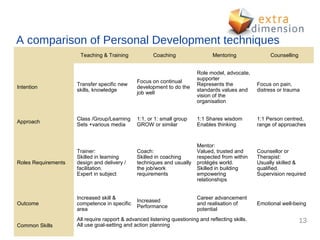
A comparison of Personal Development techniques
                      Teaching & Training             Coaching                  Mentoring               Counselling


                                                                         Role model, advocate,
                                                                         supporter
                                               Focus on continual
                     Transfer specific new                               Represents the            Focus on pain,
Intention                                      development to do the
                     skills, knowledge                                   standards values and      distress or trauma
                                               job well
                                                                         vision of the
                                                                         organisation


                     Class /Group/Learning     1:1, or 1: small group    1:1 Shares wisdom         1:1 Person centred,
Approach
                     Sets +various media       GROW or similar           Enables thinking          range of approaches


                                                                         Mentor:
                     Trainer:                  Coach:                    Valued, trusted and       Counsellor or
                     Skilled in learning       Skilled in coaching       respected from within     Therapist:
Roles Requirements   design and delivery /     techniques and usually    protégés world.           Usually skilled &
                     facilitation.             the job/work              Skilled in building       qualified.
                     Expert in subject         requirements              empowering                Supervision required
                                                                         relationships


                     Increased skill &                                   Career advancement
                                               Increased
Outcome              competence in specific                              and realisation of        Emotional well-being
                                               Performance
                     area                                                potential
                     All require rapport & advanced listening questioning and reflecting skills.                      13
Common Skills        All use goal-setting and action planning

Mentoring Workshop

  • 1.
    Mentoring “ the artof helping another learn” Alan Adair Extra Dimension
  • 2.
    Workshop Overview  Whymentoring? – Enables learning transfer (Recent study assessed that all investment in mgmt development only gave 1% ROI benefit) – Significant impact as a success factor for leader development – Reinforces and supports ‘future focussed’ behaviour (challenging the status quo) – Aids retention and motivation of our best people 2
  • 3.
    Workshop Overview  Agree the role of the Mentor  The aim of mentoring  Mentoring Skills – principles and practice  Running a mentoring meeting – a template 3
  • 4.
    The role ofthe Mentor (think Yoda!) – Trusted advisor – Organisational advocate – Coach – Counsellor – Networker – Offering a ‘seat on the stool’ Friend, partner, magician, sage, superhero…. What is mentoring NOT…? 4
  • 5.
    The aim ofmentoring Betterment: Better performance, greater productivity and higher effectiveness By: – Helping another to learn and grow – Creating a partnership – Mutual development – both go on a learning journey 5
  • 6.
    Brainstorm-  The pitfalls / traps of being a mentor (attitude)  The qualities of good mentors 6
  • 7.
    The pitfalls /traps of being a mentor  I can help – tendency to want / need to feel good about yourself as a rescuer  I know best – your esteem being built by their gratitude (how might you feel if they find a better mentor?)  I can help you get ahead - can end up as a sinister ‘I’ll scratch your back, etc. etc  You need me – inviting dependence (leading to disempowerment and resentment) 7
  • 8.
    The qualities ofgood mentors  Balance  Truth  Trust  Abundance  Passion  Courage 8
  • 9.
    Mentoring Skills Work inpairs:  One uses the opportunity to talk through a real issue or concern.  Other: – Listens carefully (summarise or ask questions of clarification) – Checks level of feeling – Use questions that seek to understand, create insight – Don’t: offer solutions / Judge / Take the airspace 9
  • 10.
    Great mentor questions  What have you learned that surprised you?  How is this different / the same?  What are the key implications for you?  If you could do that again, what would you do differently? The questions that work best are the one’s that provoke higher level thinking and synthesis, that require the mentee to dig deeper and search for answers. The clue to when you are getting it right – when there are ah-ha’s. One important tip: avoid the question Why? 10
  • 11.
    Running a mentoringmeeting – a template Creating a respectful learning space: Before the meeting: Get yourself in a good state for mentoring – relaxed, learner focussed, space, privacy, re-focus (check your notes) Opening: Help the mentee to get to the same state – and make a positioning statement ‘last time we met you were aiming to…’ The body of the meeting Focus on enabling and facilitating thinking, discovery and learning. Self monitor – if you get it wrong, point it out and fix it! Closing the meeting Ask learner to summarise and set goals for interim period. Schedule next meeting – agree what to11 note and where to start next time.
  • 12.
    First and Lastmeetings a) the first meeting: Check what they want (goals and aims) and how they want to work with you, check how you will manage process and feedback and make an explicit statement of your commitment to becoming a good mentor with their support. a) the last meeting: Know when it’s happening! Make a ritual of it and celebrate. A solid send-off with gifts of confidence, esteem, respect and renewal 12
  • 13.
    A comparison ofPersonal Development techniques Teaching & Training Coaching Mentoring Counselling Role model, advocate, supporter Focus on continual Transfer specific new Represents the Focus on pain, Intention development to do the skills, knowledge standards values and distress or trauma job well vision of the organisation Class /Group/Learning 1:1, or 1: small group 1:1 Shares wisdom 1:1 Person centred, Approach Sets +various media GROW or similar Enables thinking range of approaches Mentor: Trainer: Coach: Valued, trusted and Counsellor or Skilled in learning Skilled in coaching respected from within Therapist: Roles Requirements design and delivery / techniques and usually protégés world. Usually skilled & facilitation. the job/work Skilled in building qualified. Expert in subject requirements empowering Supervision required relationships Increased skill & Career advancement Increased Outcome competence in specific and realisation of Emotional well-being Performance area potential All require rapport & advanced listening questioning and reflecting skills. 13 Common Skills All use goal-setting and action planning