Mental Health
โ€ข Q. Characteristics of a mentally healthy person
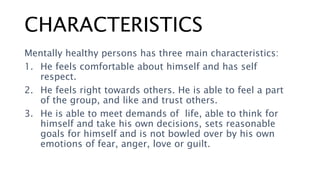
CHARACTERISTICS
Mentally healthy persons has three main characteristics:
1. He feels comfortable about himself and has self
respect.
2. He feels right towards others. He is able to feel a part
of the group, and like and trust others.
3. He is able to meet demands of life, able to think for
himself and take his own decisions, sets reasonable
goals for himself and is not bowled over by his own
emotions of fear, anger, love or guilt.
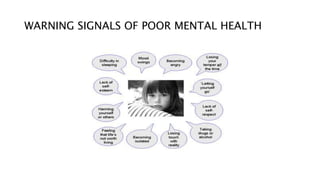
WARNING SIGNALS OF POOR MENTAL HEALTH
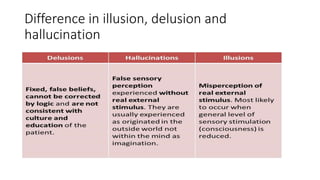
Difference in illusion, delusion and
hallucination
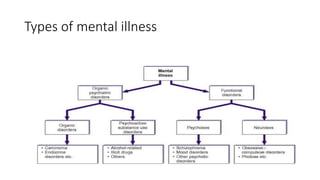
Types of mental illness
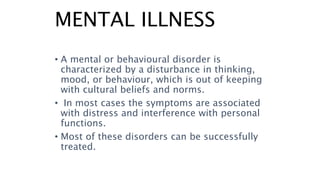
MENTAL ILLNESS
โ€ข A mental or behavioural disorder is
characterized by a disturbance in thinking,
mood, or behaviour, which is out of keeping
with cultural beliefs and norms.
โ€ข In most cases the symptoms are associated
with distress and interference with personal
functions.
โ€ข Most of these disorders can be successfully
treated.
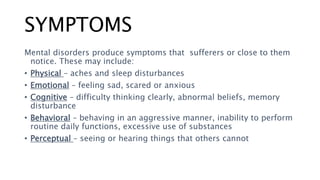
SYMPTOMS
Mental disorders produce symptoms that sufferers or close to them
notice. These may include:
โ€ข Physical โ€“ aches and sleep disturbances
โ€ข Emotional โ€“ feeling sad, scared or anxious
โ€ข Cognitive โ€“ difficulty thinking clearly, abnormal beliefs, memory
disturbance
โ€ข Behavioral โ€“ behaving in an aggressive manner, inability to perform
routine daily functions, excessive use of substances
โ€ข Perceptual โ€“ seeing or hearing things that others cannot
โ€ข Specific early signs vary from disorder to disorder. People
who experience one or more of the symptoms listed
above are encouraged to seek professional help if the
symptoms persist, cause significant distress, or interfere
with tasks of day-to-day living.
TYPES OF MENTAL ILLNESS
Mental illness can be separated into two
categories:
โ€ข Psychotic illness
โ€ข Non โ€“ psychotic illness
PSYCHOTIC ILLNESS
โ€ข Psychosis is a condition which affects the
mind and results in some loss of contact
with reality.
โ€ข When someone experiences psychosis their
thoughts become disordered and they have
difficulty knowing what is real and what is
not.
โ€ข They develop delusions, hallucinations,
illusions, etc.
TYPES OF PSYCHOSIS
โ€ข Brief reactive psychosis occurs suddenly in
response to severe stress such as
bereavement or severe trauma. This lasts
for less than a month.
โ€ข Drug induced psychosis is brought on by
the use of drugs such as cannabis, LSD,
speed or magic mushrooms. This usually
lasts for only a few months.
โ€ข Organic psychosis can appear when
someone suffers from a head injury or a
physical illness which disrupts brain
functioning. eg. Alzheimerโ€™s disease
Contdโ€ฆ
โ€ข Schizophrenia is a psychotic illness which changes
behavior for at least six months.
โ€ข Schizophreniform is a psychotic illness that lasts for
less than six months.
โ€ข Schizoaffective disorder is a psychotic illness which is
not typical of a mood disorder or schizophrenia.
Contdโ€ฆ
โ€ข Bipolar disorder (Manic depression) is characterized by
extreme mood swings between depressions and highs
(mania).
โ€ข Psychotic depression is a depression with psychotic
symptoms, without highs (mania).
Most people who experience a psychotic illness
are able to live full and independent lives with effective
medication and support.
NON - PSYCHOTIC ILLNESS
โ€ข Non psychotic illness occurs when the
everyday feelings of depression, sadness,
tension, anxiety or fear become so
overwhelming that people have difficulty
coping with day to day activities such as
work, recreation and relationships.
NON PSYCHOTIC ILLNESS INCLUDES:
โ€ข Agoraphobia
โ€ข Panic disorder
โ€ข Social disorder
โ€ข Obsessive compulsive disorder
โ€ข Post traumatic stress disorder
โ€ข Eating disorders
โ€ข Some forms of depression
โ€ข Most non โ€“ psychotic illness can be assisted by
treatments such as education, counseling, cognitive
behavior therapy or in some cases meditation.
โ€ข These treatments may help to develop new ways of
thinking about and dealing with their illness.
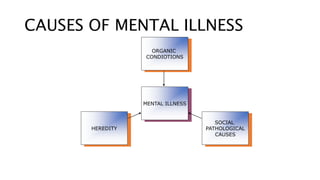
CAUSES OF MENTAL ILLNESS
HEREDITY
SOCIAL
PATHOLOGICAL
CAUSES
ORGANIC
CONDIOTIONS
MENTAL ILLNESS
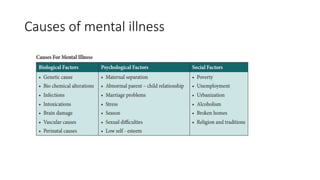
Causes of mental illness
CAUSES
โ€ข Organic conditions: cerebral arteriosclerosis, neoplasm,
neurological disorders, chronic diseases.
โ€ข Heredity
โ€ข Psychosocial factors: worries, anxieties, emotional stress,
tension, frustration, unhappy marriages, broken homes,
poverty, urbanization, economic insecurity.
Contdโ€ฆ
โ€ข Environmental factors:
๏‚ง Toxic substances- mercury, carbon disulfide,
lead compounds etc.
๏‚ง Psychotropic drugs- barbiturates, alcohol,
griseofulvin.
๏‚ง Nutritional factors- deficiency of thiamine,
pyridoxine.
๏‚ง Minerals- deficiency of iodine.
๏‚ง Infectious agents- measles, rubella
๏‚ง Traumatic factors- road and occupational
accidents
๏‚ง Radiation
CRUCIAL POINTS IN
THE LIFE CYCLE OF
HUMAN BEINGS
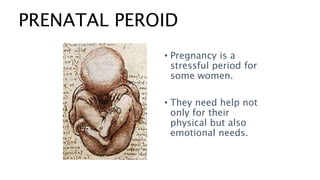
PRENATAL PEROID
โ€ข Pregnancy is a
stressful period for
some women.
โ€ข They need help not
only for their
physical but also
emotional needs.
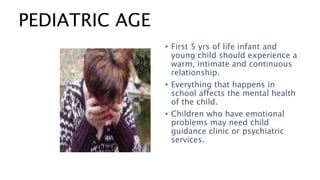
PEDIATRIC AGE
โ€ข First 5 yrs of life infant and
young child should experience a
warm, intimate and continuous
relationship.
โ€ข Everything that happens in
school affects the mental health
of the child.
โ€ข Children who have emotional
problems may need child
guidance clinic or psychiatric
services.
ADOLESCENCE
The basic needs of
adolescents are:
๏‚ง Need to be needed by
others
๏‚ง Need for increasing
independence
๏‚ง Need to achive
adequate adjustment to
opposite sex
๏‚ง Need to rethink the
cherished beliefs of
oneโ€™s elders.
OLD AGE
Causes:
๏‚ง Organic conditions of the
brain
๏‚ง Economic insecurity
๏‚ง Lack of a home
๏‚ง Poor status and insecurity
Thus throughout his life, the needs of man
remain same:
๏‚ง Need for affection
๏‚ง Need for belonging
๏‚ง Need for independence
๏‚ง Need for achievement
๏‚ง Need for recognition or approval
๏‚ง Need for sense of personal worth
๏‚ง Need for self actualization
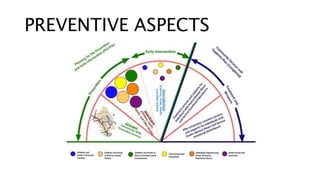
PREVENTIVE ASPECTS
WORLD MENTAL HEALTH DAY
โ€ข The world mental health day was first
proclaimed by the World Federation for
Mental Health (WFMH) in 1992.
โ€ข It is co- sponsored by WHO
โ€ข It requests Members States "to promote
mental health and healthy behaviour using
the commemoration of the World Mental
Health Day 10th October".
THEME for this year?
MENTAL HEALTH PROGRAMME
โ€ข The National Mental Health Programme was launched
during 1982 with a view to ensure
โ€ข Comprehensive mental health program includes all
community facilities pertinent in any way to prevention,
treatment and rehabilitation.
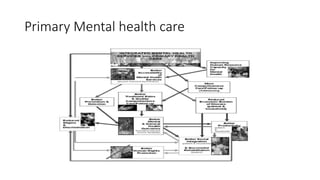
Primary Mental health care
National Mental Health Program
Objectives -
1.To ensure the availability and accessibility of
minimum mental healthcare for all in the
foreseeable future;
2.To encourage the application of mental
health knowledge in general healthcare and
in social development;
3.To promote community participation in the
mental health service development; and
4.To enhance human resource in mental health
sub-specialties.
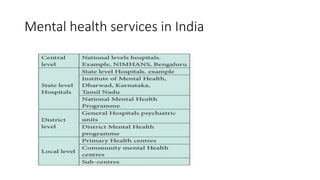
Mental health services in India

Mental Health.pptx

  • 1.
    Mental Health โ€ข Q.Characteristics of a mentally healthy person
  • 2.
    CHARACTERISTICS Mentally healthy personshas three main characteristics: 1. He feels comfortable about himself and has self respect. 2. He feels right towards others. He is able to feel a part of the group, and like and trust others. 3. He is able to meet demands of life, able to think for himself and take his own decisions, sets reasonable goals for himself and is not bowled over by his own emotions of fear, anger, love or guilt.
  • 4.
    WARNING SIGNALS OFPOOR MENTAL HEALTH
  • 5.
    Difference in illusion,delusion and hallucination
  • 6.
  • 7.
    MENTAL ILLNESS โ€ข Amental or behavioural disorder is characterized by a disturbance in thinking, mood, or behaviour, which is out of keeping with cultural beliefs and norms. โ€ข In most cases the symptoms are associated with distress and interference with personal functions. โ€ข Most of these disorders can be successfully treated.
  • 8.
    SYMPTOMS Mental disorders producesymptoms that sufferers or close to them notice. These may include: โ€ข Physical โ€“ aches and sleep disturbances โ€ข Emotional โ€“ feeling sad, scared or anxious โ€ข Cognitive โ€“ difficulty thinking clearly, abnormal beliefs, memory disturbance โ€ข Behavioral โ€“ behaving in an aggressive manner, inability to perform routine daily functions, excessive use of substances โ€ข Perceptual โ€“ seeing or hearing things that others cannot
  • 9.
    โ€ข Specific earlysigns vary from disorder to disorder. People who experience one or more of the symptoms listed above are encouraged to seek professional help if the symptoms persist, cause significant distress, or interfere with tasks of day-to-day living.
  • 10.
    TYPES OF MENTALILLNESS Mental illness can be separated into two categories: โ€ข Psychotic illness โ€ข Non โ€“ psychotic illness
  • 11.
    PSYCHOTIC ILLNESS โ€ข Psychosisis a condition which affects the mind and results in some loss of contact with reality. โ€ข When someone experiences psychosis their thoughts become disordered and they have difficulty knowing what is real and what is not. โ€ข They develop delusions, hallucinations, illusions, etc.
  • 12.
    TYPES OF PSYCHOSIS โ€ขBrief reactive psychosis occurs suddenly in response to severe stress such as bereavement or severe trauma. This lasts for less than a month. โ€ข Drug induced psychosis is brought on by the use of drugs such as cannabis, LSD, speed or magic mushrooms. This usually lasts for only a few months. โ€ข Organic psychosis can appear when someone suffers from a head injury or a physical illness which disrupts brain functioning. eg. Alzheimerโ€™s disease
  • 13.
    Contdโ€ฆ โ€ข Schizophrenia isa psychotic illness which changes behavior for at least six months. โ€ข Schizophreniform is a psychotic illness that lasts for less than six months. โ€ข Schizoaffective disorder is a psychotic illness which is not typical of a mood disorder or schizophrenia.
  • 14.
    Contdโ€ฆ โ€ข Bipolar disorder(Manic depression) is characterized by extreme mood swings between depressions and highs (mania). โ€ข Psychotic depression is a depression with psychotic symptoms, without highs (mania). Most people who experience a psychotic illness are able to live full and independent lives with effective medication and support.
  • 15.
    NON - PSYCHOTICILLNESS โ€ข Non psychotic illness occurs when the everyday feelings of depression, sadness, tension, anxiety or fear become so overwhelming that people have difficulty coping with day to day activities such as work, recreation and relationships.
  • 16.
    NON PSYCHOTIC ILLNESSINCLUDES: โ€ข Agoraphobia โ€ข Panic disorder โ€ข Social disorder โ€ข Obsessive compulsive disorder โ€ข Post traumatic stress disorder โ€ข Eating disorders โ€ข Some forms of depression
  • 17.
    โ€ข Most nonโ€“ psychotic illness can be assisted by treatments such as education, counseling, cognitive behavior therapy or in some cases meditation. โ€ข These treatments may help to develop new ways of thinking about and dealing with their illness.
  • 18.
    CAUSES OF MENTALILLNESS HEREDITY SOCIAL PATHOLOGICAL CAUSES ORGANIC CONDIOTIONS MENTAL ILLNESS
  • 19.
  • 20.
    CAUSES โ€ข Organic conditions:cerebral arteriosclerosis, neoplasm, neurological disorders, chronic diseases. โ€ข Heredity โ€ข Psychosocial factors: worries, anxieties, emotional stress, tension, frustration, unhappy marriages, broken homes, poverty, urbanization, economic insecurity.
  • 21.
    Contdโ€ฆ โ€ข Environmental factors: ๏‚งToxic substances- mercury, carbon disulfide, lead compounds etc. ๏‚ง Psychotropic drugs- barbiturates, alcohol, griseofulvin. ๏‚ง Nutritional factors- deficiency of thiamine, pyridoxine. ๏‚ง Minerals- deficiency of iodine. ๏‚ง Infectious agents- measles, rubella ๏‚ง Traumatic factors- road and occupational accidents ๏‚ง Radiation
  • 22.
    CRUCIAL POINTS IN THELIFE CYCLE OF HUMAN BEINGS
  • 23.
    PRENATAL PEROID โ€ข Pregnancyis a stressful period for some women. โ€ข They need help not only for their physical but also emotional needs.
  • 24.
    PEDIATRIC AGE โ€ข First5 yrs of life infant and young child should experience a warm, intimate and continuous relationship. โ€ข Everything that happens in school affects the mental health of the child. โ€ข Children who have emotional problems may need child guidance clinic or psychiatric services.
  • 25.
    ADOLESCENCE The basic needsof adolescents are: ๏‚ง Need to be needed by others ๏‚ง Need for increasing independence ๏‚ง Need to achive adequate adjustment to opposite sex ๏‚ง Need to rethink the cherished beliefs of oneโ€™s elders.
  • 26.
    OLD AGE Causes: ๏‚ง Organicconditions of the brain ๏‚ง Economic insecurity ๏‚ง Lack of a home ๏‚ง Poor status and insecurity
  • 27.
    Thus throughout hislife, the needs of man remain same: ๏‚ง Need for affection ๏‚ง Need for belonging ๏‚ง Need for independence ๏‚ง Need for achievement ๏‚ง Need for recognition or approval ๏‚ง Need for sense of personal worth ๏‚ง Need for self actualization
  • 28.
  • 30.
    WORLD MENTAL HEALTHDAY โ€ข The world mental health day was first proclaimed by the World Federation for Mental Health (WFMH) in 1992. โ€ข It is co- sponsored by WHO โ€ข It requests Members States "to promote mental health and healthy behaviour using the commemoration of the World Mental Health Day 10th October".
  • 31.
  • 32.
    MENTAL HEALTH PROGRAMME โ€ขThe National Mental Health Programme was launched during 1982 with a view to ensure โ€ข Comprehensive mental health program includes all community facilities pertinent in any way to prevention, treatment and rehabilitation.
  • 33.
  • 34.
    National Mental HealthProgram Objectives - 1.To ensure the availability and accessibility of minimum mental healthcare for all in the foreseeable future; 2.To encourage the application of mental health knowledge in general healthcare and in social development; 3.To promote community participation in the mental health service development; and 4.To enhance human resource in mental health sub-specialties.
  • 35.