LOGO
Department of Infectious Diseases
(Shi Hong)
MENINGOCOCCAL
MENINGITIS
www.themegallery.com LOGO
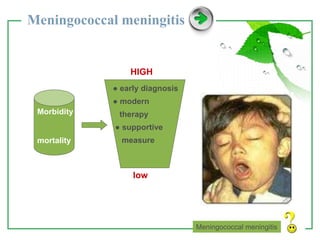
Meningococcal meningitis
Morbidity
mortality
rate
Morbidity
mortality
● early diagnosis
● modern
therapy
● supportive
measure
HIGH
low
www.themegallery.com LOGO
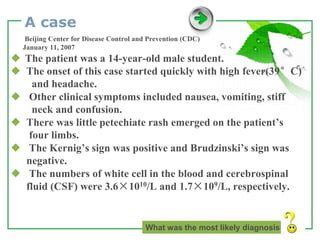
A case
Beijing Center for Disease Control and Prevention (CDC)
January 11, 2007
◆ The patient was a 14-year-old male student.
◆ The onset of this case started quickly with high fever(39°C)
and headache.
◆ Other clinical symptoms included nausea, vomiting, stiff
neck and confusion.
◆ There was little petechiate rash emerged on the patient’s
four limbs.
◆ The Kernig’s sign was positive and Brudzinski’s sign was
negative.
◆ The numbers of white cell in the blood and cerebrospinal
fluid (CSF) were 3.6×10¹⁰/L and 1.7×10⁹/L, respectively.
What was the most likely diagnosis
www.themegallery.com LOGO
Definition
Meningococcal meningitis :
★ Neisseria meningitides
★ Respiratory tract
★ Purulent meningitis
(an acute inflammation of the membranes that
cover the brain and spinal cord)
Meningococcal meningitis
www.themegallery.com LOGO
Etiology
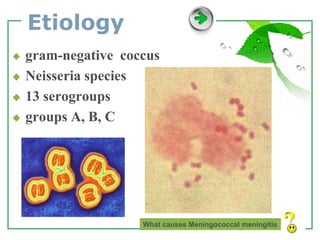
◆ gram-negative coccus
◆ Neisseria species
◆ 13 serogroups
◆ groups A, B, C
What causes Meningococcal meningitis
www.themegallery.com LOGO
Epidemiology
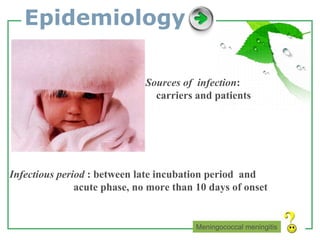
Sources of infection:
carriers and patients
Infectious period : between late incubation period and
acute phase, no more than 10 days of onset
Meningococcal meningitis
www.themegallery.com LOGO
Epidemiology
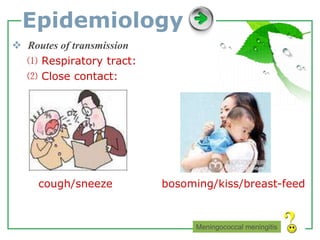
 Routes of transmission
⑴ Respiratory tract:
⑵ Close contact:
cough/sneeze bosoming/kiss/breast-feed
Meningococcal meningitis
www.themegallery.com LOGO
Epidemiology
Susceptibility
☆ Everybody without specific immunity
★ 6 months to 2 years of age.
Epidemical features
◇ the common season : in the winter and early spring
(November to May in next year)
The peak incidence is in March to April
Who is at risk?
www.themegallery.com LOGO
Pathogenesis
 Immunity>bacterial quantity and virulence
 A. bacteria eliminated.
 B. benign nasopharyngeal carriage
 or upper respiratory tract infection
 →→cured
 C. temporal meningococemia
 →→cured
Meningococcal meningitis
www.themegallery.com LOGO
Pathogenesis
 Immunity<bacterial quantity and virulence
 A. meningococcal septicemia.
 B. meningococcal meningitis.
 C. meningococcal arthritis and pericarditis
Meningococcal meningitis
www.themegallery.com LOGO
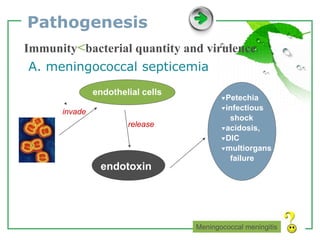
Pathogenesis
Immunity<bacterial quantity and virulence
A. meningococcal septicemia
Meningococcal meningitis
endothelial cells
endotoxin
▼Petechia
▼infectious
shock
▼acidosis,
▼DIC
▼multiorgans
failure
invade
release
www.themegallery.com LOGO
Pathogenesis
Immunity<bacterial quantity and virulence
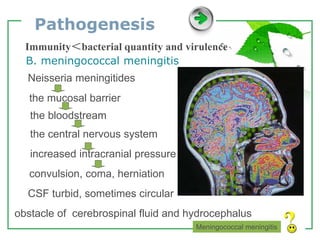
B. meningococcal meningitis
Neisseria meningitides
the mucosal barrier
the bloodstream
the central nervous system
increased intracranial pressure
convulsion, coma, herniation
CSF turbid, sometimes circular
obstacle of cerebrospinal fluid and hydrocephalus
Meningococcal meningitis
www.themegallery.com LOGO
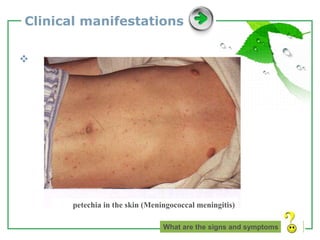
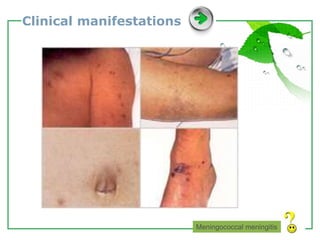
Clinical manifestations

What are the signs and symptoms
petechia in the skin (Meningococcal meningitis)
www.themegallery.com LOGO
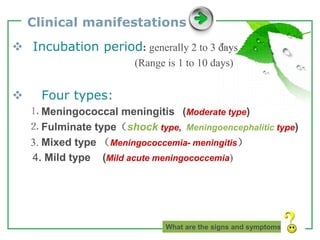
Clinical manifestations
 Incubation period: generally 2 to 3 days
(Range is 1 to 10 days)
 Four types:
⒈ Meningococcal meningitis (Moderate type)
⒉ Fulminate type(shock type, Meningoencephalitic type)
3. Mixed type (Meningococcemia- meningitis)
4. Mild type (Mild acute meningococcemia)
What are the signs and symptoms
www.themegallery.com LOGO
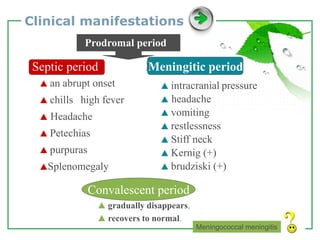
Clinical manifestations
Meningococcal meningitis
Septic period
▲ an abrupt onset
▲ chills high fever
▲ Headache
▲ Petechias
▲ purpuras
▲Splenomegaly
Meningitic period
▲ intracranial pressure
▲ headache
▲ vomiting
▲ restlessness
▲ Stiff neck
▲ Kernig (+)
▲ brudziski (+)
▲ gradually disappears,
▲ recovers to normal.
Prodromal period
Septic period Meningitic period
Convalescent period
www.themegallery.com LOGO
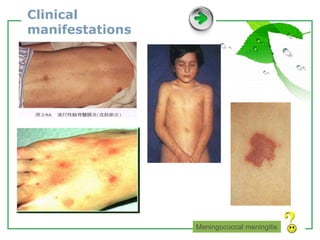
Clinical
manifestations
Meningococcal meningitis
www.themegallery.com LOGO
Clinical manifestations
Meningococcal meningitis
www.themegallery.com LOGO
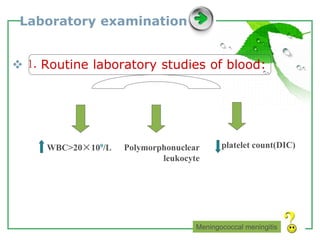
Laboratory examination
⒈ Routine laboratory studies of blood:
Meningococcal meningitis
WBC>20×109/L Polymorphonuclear
leukocyte
platelet count(DIC)
www.themegallery.com LOGO
Laboratory examination
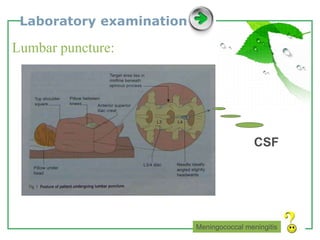
Lumbar puncture:
Meningococcal meningitis
CSF
www.themegallery.com LOGO
Laboratory examination
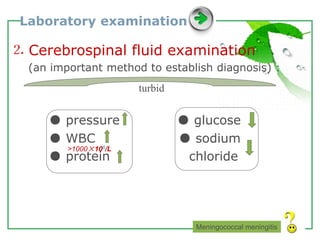
⒉ Cerebrospinal fluid examination
(an important method to establish diagnosis) :
● pressure ● glucose
● WBC ● sodium
● protein chloride
Meningococcal meningitis
turbid
>1000×106/L
www.themegallery.com LOGO
Laboratory examination
⒊ Bacteriological examination
(an important method to definitive diagnosis) :
Meningococcal meningitis
Smear: skin lesions
spun sediment of CSF
Bacterial culture
of blood and CSF
www.themegallery.com LOGO
Laboratory examination
Meningococcal meningitis
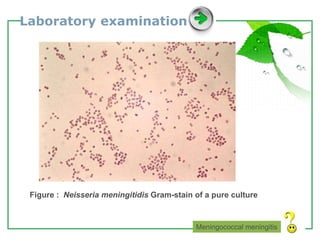
Figure : Neisseria meningitidis Gram-stain of a pure culture
www.themegallery.com LOGO
Diagnosis
 ⒈ Epidemic season, age and epidemic situations.
 ⒉ Clinical features.

⒊Manifestations of severe form in sepsis and
meningoencephalitis
⒋Increased leukocytes and polymorphonuclear
leukocytes predominantly in peripheral blood.
⒌ Increased intracranial pressure and purulent changes
in CSF.
⒍ Positive results in bacteriological examination.
Meningococcal meningitis
www.themegallery.com LOGO
Differential diagnosis
⒈ Purulent meningitis caused by
other purulent bacteria.
⑴ Streptococcus pneumonia meningitis,
⑵ Haemophilus influenzae meningitis,
⑶ Staphylococcus aureus meningitis.

& (no overt season,no petechae or purpura)
⒉ Meningeal tuberculosis.
& (the history, no petechae or purpura,Bacillus tuberculosis)
⒊ Sepsis (Shock type)
& (other causative bacteria in blood cultures)
How to diagnose Meningococcal meningitis
www.themegallery.com LOGO
A case
Beijing Center for Disease Control and Prevention (CDC)
January 11, 2007
◆ The patient was a 14-year-old male student.
◆ The onset of this case started quickly with high fever(39°C)
and headache.
◆ Other clinical symptoms included nausea, vomiting, stiff
neck and confusion.
◆ There was little petechiate rash emerged on the patient’s
four limbs.
◆ The Kernig’s sign was positive and Brudzinski’s sign was
negative.
◆ The numbers of white cell in the blood and cerebrospinal
fluid (CSF) were 3.6×10¹⁰/L and 1.7×10⁹/L, respectively.
What was the most likely diagnosis
www.themegallery.com LOGO
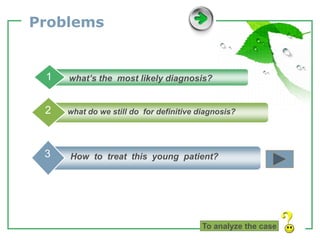
Problems
what’s the most likely diagnosis?
1
what do we still do for definitive diagnosis?
2
How to treat this young patient?
3
To analyze the case
www.themegallery.com LOGO
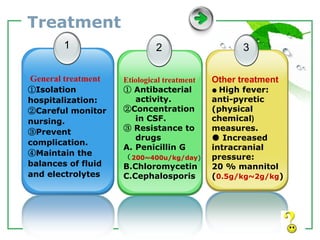
Treatment
1
General treatment
①Isolation
hospitalization:
②Careful monitor
nursing.
③Prevent
complication.
④Maintain the
balances of fluid
and electrolytes
2
Etiological treatment
① Antibacterial
activity.
②Concentration
in CSF.
③ Resistance to
drugs
A. Penicillin G
(200~400u/kg/day)
B.Chloromycetin
C.Cephalosporis
3
Other treatment
● High fever:
anti-pyretic
(physical
chemical)
measures.
● Increased
intracranial
pressure:
20 % mannitol
(0.5g/kg~2g/kg)
www.themegallery.com LOGO
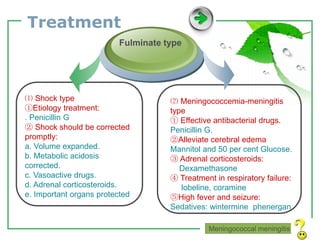
Treatment
⑴ Shock type
①Etiology treatment:
. Penicillin G
② Shock should be corrected
promptly:
a. Volume expanded.
b. Metabolic acidosis
corrected.
c. Vasoactive drugs.
d. Adrenal corticosteroids.
e. Important organs protected
Fulminate type
⑵ Meningococcemia-meningitis
type
① Effective antibacterial drugs.
Penicillin G.
②Alleviate cerebral edema
Mannitol and 50 per cent Glucose.
③ Adrenal corticosteroids:
Dexamethasone
④ Treatment in respiratory failure:
lobeline, coramine
⑤High fever and seizure:
Sedatives: wintermine phenergan
Meningococcal meningitis
www.themegallery.com LOGO
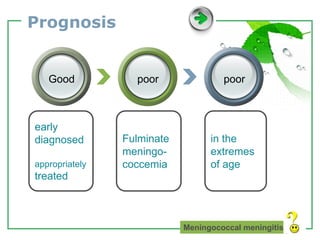
Prognosis
Fulminate
meningo-
coccemia
early
diagnosed
appropriately
treated
in the
extremes
of age
Good poor poor
Meningococcal meningitis
www.themegallery.com LOGO
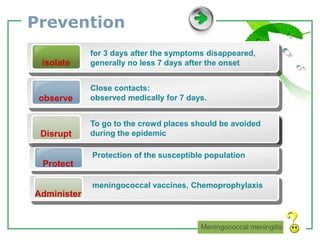
Prevention
Protect
Protection of the susceptible population
Protect
Protection of the susceptible population
Administer
meningococcal vaccines, Chemoprophylaxis
isolate
for 3 days after the symptoms disappeared,
generally no less 7 days after the onset
observe
Close contacts:
observed medically for 7 days.
Disrupt
To go to the crowd places should be avoided
during the epidemic
Meningococcal meningitis
www.themegallery.com LOGO
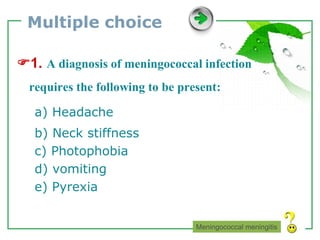
Multiple choice
1. A diagnosis of meningococcal infection
requires the following to be present:
a) Headache
b) Neck stiffness
c) Photophobia
d) vomiting
e) Pyrexia
Meningococcal meningitis
www.themegallery.com LOGO
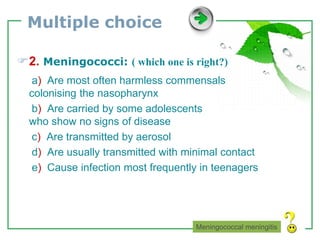
Multiple choice
2. Meningococci: ( which one is right?)
a) Are most often harmless commensals
colonising the nasopharynx
b) Are carried by some adolescents
who show no signs of disease
c) Are transmitted by aerosol
d) Are usually transmitted with minimal contact
e) Cause infection most frequently in teenagers
Meningococcal meningitis
www.themegallery.com LOGO
Summarization
⒈ Definition
Meningococcal meningitis is an acute purulent meningitis
caused by meningococci
⒉ Transmission route
occurs through respiratory tract.
⒊ The incidence of meningococcal meningitis
The incidence of meningococcal meningitis is the first in
purulent meningitis among children.
Meningococcal meningitis
www.themegallery.com LOGO
Summarization
⒋ Clinical characteristics
⑴ high fever rapidly;
⑵ severe headache;
⑶ vomiting frequently;
⑷ petechiae and purpura in the skin;
⑸ meningeal irritations;
⑹ infectious shock and injuries in brain parenchyma occurred in
severe cases and often result in death.
Meningococcal meningitis
www.themegallery.com LOGO
Summarization
 What is meningitis? What is encephalitis?
What causes meningitis and encephalitis?
Who is at risk for encephalitis and meningitis?
How are these disorders transmitted?
What are the signs and symptoms?
How are meningitis and encephalitis diagnosed?
How are these infections treated?
Can meningitis and encephalitis be prevented?
What is the prognosis for these infections? .
Meningococcal meningitis
LOGO
E-mail:
shihongsysu@hotmail.com
Qq: 673162735
LOGO
www.themegallery.com LOGO
Features of meningococcal
meningitis in infants
⒈ Causes of atypical symptoms
are that the crania and fontanelle are not still closed and the
central nervous system is not well developed.
⒉ The features of clinical manifestations
⑴ Respiratory symptoms
always presents with cough.
⑵ Gastroenteric symptoms
Refusal to take food, vomiting and diarrhea are common
gastroenteric symptoms.
⑶ Increased intracranial pressure
includes irritability, shrill, seizures and fullness of the fontanelle.
⑷ Meningeal irritation
always is not overt
Meningococcal meningitis
www.themegallery.com LOGO
Features of menigococcal
meningitis in the old
⒈ The causes of high incidence in fulminate type
In the old the immunity is lower, properdin deficiency and
sensitive to endotoxin.
⒉ Clinical manifestations
⑴ Symptoms of upper respiratory tract
are commonly presented in the old.
⑵ Mental obtundation
is overt.
⑶ Petechia and purpura
are more common.
⒊ Complications and prognosis
usually can be seen with high mortality.
⒋ Leukocytes
Leukopenia is often seen due to lower human body’ reaction
Meningococcal meningitis

meningococcal meningitis manifestations.ppt

  • 1.
    LOGO Department of InfectiousDiseases (Shi Hong) MENINGOCOCCAL MENINGITIS
  • 2.
    www.themegallery.com LOGO Meningococcal meningitis Meningococcalmeningitis Morbidity mortality rate Morbidity mortality ● early diagnosis ● modern therapy ● supportive measure HIGH low
  • 3.
    www.themegallery.com LOGO A case BeijingCenter for Disease Control and Prevention (CDC) January 11, 2007 ◆ The patient was a 14-year-old male student. ◆ The onset of this case started quickly with high fever(39°C) and headache. ◆ Other clinical symptoms included nausea, vomiting, stiff neck and confusion. ◆ There was little petechiate rash emerged on the patient’s four limbs. ◆ The Kernig’s sign was positive and Brudzinski’s sign was negative. ◆ The numbers of white cell in the blood and cerebrospinal fluid (CSF) were 3.6×10¹⁰/L and 1.7×10⁹/L, respectively. What was the most likely diagnosis
  • 4.
    www.themegallery.com LOGO Definition Meningococcal meningitis: ★ Neisseria meningitides ★ Respiratory tract ★ Purulent meningitis (an acute inflammation of the membranes that cover the brain and spinal cord) Meningococcal meningitis
  • 5.
    www.themegallery.com LOGO Etiology ◆ gram-negativecoccus ◆ Neisseria species ◆ 13 serogroups ◆ groups A, B, C What causes Meningococcal meningitis
  • 6.
    www.themegallery.com LOGO Epidemiology Sources ofinfection: carriers and patients Infectious period : between late incubation period and acute phase, no more than 10 days of onset Meningococcal meningitis
  • 7.
    www.themegallery.com LOGO Epidemiology  Routesof transmission ⑴ Respiratory tract: ⑵ Close contact: cough/sneeze bosoming/kiss/breast-feed Meningococcal meningitis
  • 8.
    www.themegallery.com LOGO Epidemiology Susceptibility ☆ Everybodywithout specific immunity ★ 6 months to 2 years of age. Epidemical features ◇ the common season : in the winter and early spring (November to May in next year) The peak incidence is in March to April Who is at risk?
  • 9.
    www.themegallery.com LOGO Pathogenesis  Immunity>bacterialquantity and virulence  A. bacteria eliminated.  B. benign nasopharyngeal carriage  or upper respiratory tract infection  →→cured  C. temporal meningococemia  →→cured Meningococcal meningitis
  • 10.
    www.themegallery.com LOGO Pathogenesis  Immunity<bacterialquantity and virulence  A. meningococcal septicemia.  B. meningococcal meningitis.  C. meningococcal arthritis and pericarditis Meningococcal meningitis
  • 11.
    www.themegallery.com LOGO Pathogenesis Immunity<bacterial quantityand virulence A. meningococcal septicemia Meningococcal meningitis endothelial cells endotoxin ▼Petechia ▼infectious shock ▼acidosis, ▼DIC ▼multiorgans failure invade release
  • 12.
    www.themegallery.com LOGO Pathogenesis Immunity<bacterial quantityand virulence B. meningococcal meningitis Neisseria meningitides the mucosal barrier the bloodstream the central nervous system increased intracranial pressure convulsion, coma, herniation CSF turbid, sometimes circular obstacle of cerebrospinal fluid and hydrocephalus Meningococcal meningitis
  • 13.
    www.themegallery.com LOGO Clinical manifestations  Whatare the signs and symptoms petechia in the skin (Meningococcal meningitis)
  • 14.
    www.themegallery.com LOGO Clinical manifestations Incubation period: generally 2 to 3 days (Range is 1 to 10 days)  Four types: ⒈ Meningococcal meningitis (Moderate type) ⒉ Fulminate type(shock type, Meningoencephalitic type) 3. Mixed type (Meningococcemia- meningitis) 4. Mild type (Mild acute meningococcemia) What are the signs and symptoms
  • 15.
    www.themegallery.com LOGO Clinical manifestations Meningococcalmeningitis Septic period ▲ an abrupt onset ▲ chills high fever ▲ Headache ▲ Petechias ▲ purpuras ▲Splenomegaly Meningitic period ▲ intracranial pressure ▲ headache ▲ vomiting ▲ restlessness ▲ Stiff neck ▲ Kernig (+) ▲ brudziski (+) ▲ gradually disappears, ▲ recovers to normal. Prodromal period Septic period Meningitic period Convalescent period
  • 16.
  • 17.
  • 18.
    www.themegallery.com LOGO Laboratory examination ⒈Routine laboratory studies of blood: Meningococcal meningitis WBC>20×109/L Polymorphonuclear leukocyte platelet count(DIC)
  • 19.
    www.themegallery.com LOGO Laboratory examination Lumbarpuncture: Meningococcal meningitis CSF
  • 20.
    www.themegallery.com LOGO Laboratory examination ⒉Cerebrospinal fluid examination (an important method to establish diagnosis) : ● pressure ● glucose ● WBC ● sodium ● protein chloride Meningococcal meningitis turbid >1000×106/L
  • 21.
    www.themegallery.com LOGO Laboratory examination ⒊Bacteriological examination (an important method to definitive diagnosis) : Meningococcal meningitis Smear: skin lesions spun sediment of CSF Bacterial culture of blood and CSF
  • 22.
    www.themegallery.com LOGO Laboratory examination Meningococcalmeningitis Figure : Neisseria meningitidis Gram-stain of a pure culture
  • 23.
    www.themegallery.com LOGO Diagnosis  ⒈Epidemic season, age and epidemic situations.  ⒉ Clinical features. ⒊Manifestations of severe form in sepsis and meningoencephalitis ⒋Increased leukocytes and polymorphonuclear leukocytes predominantly in peripheral blood. ⒌ Increased intracranial pressure and purulent changes in CSF. ⒍ Positive results in bacteriological examination. Meningococcal meningitis
  • 24.
    www.themegallery.com LOGO Differential diagnosis ⒈Purulent meningitis caused by other purulent bacteria. ⑴ Streptococcus pneumonia meningitis, ⑵ Haemophilus influenzae meningitis, ⑶ Staphylococcus aureus meningitis. & (no overt season,no petechae or purpura) ⒉ Meningeal tuberculosis. & (the history, no petechae or purpura,Bacillus tuberculosis) ⒊ Sepsis (Shock type) & (other causative bacteria in blood cultures) How to diagnose Meningococcal meningitis
  • 25.
    www.themegallery.com LOGO A case BeijingCenter for Disease Control and Prevention (CDC) January 11, 2007 ◆ The patient was a 14-year-old male student. ◆ The onset of this case started quickly with high fever(39°C) and headache. ◆ Other clinical symptoms included nausea, vomiting, stiff neck and confusion. ◆ There was little petechiate rash emerged on the patient’s four limbs. ◆ The Kernig’s sign was positive and Brudzinski’s sign was negative. ◆ The numbers of white cell in the blood and cerebrospinal fluid (CSF) were 3.6×10¹⁰/L and 1.7×10⁹/L, respectively. What was the most likely diagnosis
  • 26.
    www.themegallery.com LOGO Problems what’s themost likely diagnosis? 1 what do we still do for definitive diagnosis? 2 How to treat this young patient? 3 To analyze the case
  • 27.
    www.themegallery.com LOGO Treatment 1 General treatment ①Isolation hospitalization: ②Carefulmonitor nursing. ③Prevent complication. ④Maintain the balances of fluid and electrolytes 2 Etiological treatment ① Antibacterial activity. ②Concentration in CSF. ③ Resistance to drugs A. Penicillin G (200~400u/kg/day) B.Chloromycetin C.Cephalosporis 3 Other treatment ● High fever: anti-pyretic (physical chemical) measures. ● Increased intracranial pressure: 20 % mannitol (0.5g/kg~2g/kg)
  • 28.
    www.themegallery.com LOGO Treatment ⑴ Shocktype ①Etiology treatment: . Penicillin G ② Shock should be corrected promptly: a. Volume expanded. b. Metabolic acidosis corrected. c. Vasoactive drugs. d. Adrenal corticosteroids. e. Important organs protected Fulminate type ⑵ Meningococcemia-meningitis type ① Effective antibacterial drugs. Penicillin G. ②Alleviate cerebral edema Mannitol and 50 per cent Glucose. ③ Adrenal corticosteroids: Dexamethasone ④ Treatment in respiratory failure: lobeline, coramine ⑤High fever and seizure: Sedatives: wintermine phenergan Meningococcal meningitis
  • 29.
  • 30.
    www.themegallery.com LOGO Prevention Protect Protection ofthe susceptible population Protect Protection of the susceptible population Administer meningococcal vaccines, Chemoprophylaxis isolate for 3 days after the symptoms disappeared, generally no less 7 days after the onset observe Close contacts: observed medically for 7 days. Disrupt To go to the crowd places should be avoided during the epidemic Meningococcal meningitis
  • 31.
    www.themegallery.com LOGO Multiple choice 1.A diagnosis of meningococcal infection requires the following to be present: a) Headache b) Neck stiffness c) Photophobia d) vomiting e) Pyrexia Meningococcal meningitis
  • 32.
    www.themegallery.com LOGO Multiple choice 2.Meningococci: ( which one is right?) a) Are most often harmless commensals colonising the nasopharynx b) Are carried by some adolescents who show no signs of disease c) Are transmitted by aerosol d) Are usually transmitted with minimal contact e) Cause infection most frequently in teenagers Meningococcal meningitis
  • 33.
    www.themegallery.com LOGO Summarization ⒈ Definition Meningococcalmeningitis is an acute purulent meningitis caused by meningococci ⒉ Transmission route occurs through respiratory tract. ⒊ The incidence of meningococcal meningitis The incidence of meningococcal meningitis is the first in purulent meningitis among children. Meningococcal meningitis
  • 34.
    www.themegallery.com LOGO Summarization ⒋ Clinicalcharacteristics ⑴ high fever rapidly; ⑵ severe headache; ⑶ vomiting frequently; ⑷ petechiae and purpura in the skin; ⑸ meningeal irritations; ⑹ infectious shock and injuries in brain parenchyma occurred in severe cases and often result in death. Meningococcal meningitis
  • 35.
    www.themegallery.com LOGO Summarization  Whatis meningitis? What is encephalitis? What causes meningitis and encephalitis? Who is at risk for encephalitis and meningitis? How are these disorders transmitted? What are the signs and symptoms? How are meningitis and encephalitis diagnosed? How are these infections treated? Can meningitis and encephalitis be prevented? What is the prognosis for these infections? . Meningococcal meningitis
  • 36.
  • 37.
  • 38.
    www.themegallery.com LOGO Features ofmeningococcal meningitis in infants ⒈ Causes of atypical symptoms are that the crania and fontanelle are not still closed and the central nervous system is not well developed. ⒉ The features of clinical manifestations ⑴ Respiratory symptoms always presents with cough. ⑵ Gastroenteric symptoms Refusal to take food, vomiting and diarrhea are common gastroenteric symptoms. ⑶ Increased intracranial pressure includes irritability, shrill, seizures and fullness of the fontanelle. ⑷ Meningeal irritation always is not overt Meningococcal meningitis
  • 39.
    www.themegallery.com LOGO Features ofmenigococcal meningitis in the old ⒈ The causes of high incidence in fulminate type In the old the immunity is lower, properdin deficiency and sensitive to endotoxin. ⒉ Clinical manifestations ⑴ Symptoms of upper respiratory tract are commonly presented in the old. ⑵ Mental obtundation is overt. ⑶ Petechia and purpura are more common. ⒊ Complications and prognosis usually can be seen with high mortality. ⒋ Leukocytes Leukopenia is often seen due to lower human body’ reaction Meningococcal meningitis