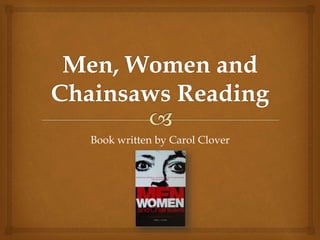
Book written by Carol Clover

In Clover’s book Men, Women and Chainsaw’s she describes
the female victim-hero as a character “whose status in both
roles has indeed been enabled by 'women's liberation'.
Feminism, that is, has given a language to her victimization
and a new force to the anger that subsidizes her own act of
horrific revenge". This means that are aspects throughout
the film, which demonstrate some concept of evil. There
could be different forms of evil whether it be something that
the character needs to defeat that is apart of her or it could
be physically evil. This allows her to redeem her character
with some heroic acts. Although, as an audience we are
aware of her victimization which later causes her to be evil
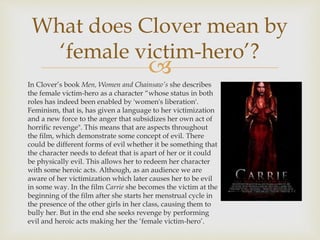
in some way. In the film Carrie she becomes the victim at the
beginning of the film after she starts her menstrual cycle in
the presence of the other girls in her class, causing them to
bully her. But in the end she seeks revenge by performing
evil and heroic acts making her the ‘female victim-hero’.
What does Clover mean by
‘female victim-hero’?

The reason why males relate to females in horror films,
especially the ‘final girl’ is because they identify with the
victimization of pranks and picking on each other. Clover
describes it in her book as “Pulling gym shorts down and
thumb-rubbing glasses are things boys do to each other…
not things that girls do to each other”. So in Carrie, written by
Stephen King, the boy who is threatened and humiliated is
the boy who acknowledges himself in the ‘final girl’ who
finds herself being tormented by classmates by having
tampons thrown at her and pigs blood poured over her. Due
to the men understanding these situations, they root for the
female rather than the villain as they are familiar with the
practical jokes that they play on each other.
Why does Clover say that males
relate to the females in horror films,
in particular, the ‘final girl’?
Clover believes that “horror audiences are especially understudied”
and are less analyzed then film audiences. Clover claims that
productions don’t aim for a specific audience but instead focus on
more mainstream genres and ideas aimed at a wider audience. In
addition, the statistical surveys that are carried out are sponsored by
major studios even though a large percentage of horror films are
produced independently. Therefore, horror films are not made on the
basis of statistical research but on the basis of a hunch or for high-
budget films, on the basis of test audience results. To cause further
problems, many horror films do not have a long theatrical run and
some have none at all meaning that investments are returned on
videocassette rentals, which is an audience that is hidden from
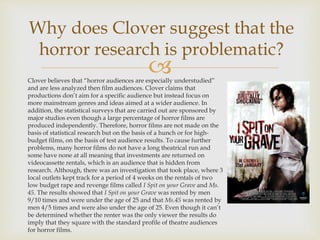
research. Although, there was an investigation that took place, where 3
local outlets kept track for a period of 4 weeks on the rentals of two
low budget rape and revenge films called I Spit on your Grave and Ms.
45. The results showed that I Spit on your Grave was rented by men
9/10 times and were under the age of 25 and that Ms.45 was rented by
men 4/5 times and were also under the age of 25. Even though it can’t
be determined whether the renter was the only viewer the results do
imply that they square with the standard profile of theatre audiences
for horror films.
Why does Clover suggest that the
horror research is problematic?

Even though horror audiences are highly understudied and the
statistical surveys cannot be fully reliable, it does seem that there is
a consistency of adolescent males hold the pride of place as
presumed by Stephen King. Clover’s book depicts the typical break
down of groups in horror audiences. These are:
 Young men, often in groups (but also solo)
 Male-Female couples of various ages
 Solo “rogue males” (older men)
 A group of adolescent girls
Although, the proportions do vary depending on the subgenre to
the film, so the more mainstream the film, the more ‘normal’ the
audience. However, it does seem apparent that numbers of young
males remains consistent making them the obvious target audience
of horror fanzines.
Who does Clover suggest make
up the typical horror audience?

From the research taken out on horror audiences it is
obvious that young men are the predominant target
audience for horror films at the theatre. When looking
at Clover’s research regarding film rentals, it was
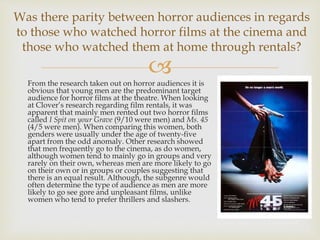
apparent that mainly men rented out two horror films
called I Spit on your Grave (9/10 were men) and Ms. 45
(4/5 were men). When comparing this women, both
genders were usually under the age of twenty-five
apart from the odd anomaly. Other research showed
that men frequently go to the cinema, as do women,
although women tend to mainly go in groups and very
rarely on their own, whereas men are more likely to go
on their own or in groups or couples suggesting that
there is an equal result. Although, the subgenre would
often determine the type of audience as men are more
likely to go see gore and unpleasant films, unlike
women who tend to prefer thrillers and slashers.
Was there parity between horror audiences in regards
to those who watched horror films at the cinema and
those who watched them at home through rentals?

 One way in which Clover thought audiences identify with
characters was by Primary Identification. This is when the
camera moves the audiences attention to wherever it goes
and whatever its up to. Clover describes how the camera
is able to entertain different positions including character
positions and also “omniscient ones and with different
degrees of personality.
 The second way Clover identifies is called Secondary
Identification, meaning the character of empathetic
choice. In her book Clover describes it as “competing
figures resonate with competing parts of the viewer’s
psyche”, for instance the masochistic victim and the
sadistic monster.
What are the two ways identified by
Clover in which audiences identify with
characters?

Men Women and Chainsaws

  • 1.
    Book written byCarol Clover
  • 2.
     In Clover’s bookMen, Women and Chainsaw’s she describes the female victim-hero as a character “whose status in both roles has indeed been enabled by 'women's liberation'. Feminism, that is, has given a language to her victimization and a new force to the anger that subsidizes her own act of horrific revenge". This means that are aspects throughout the film, which demonstrate some concept of evil. There could be different forms of evil whether it be something that the character needs to defeat that is apart of her or it could be physically evil. This allows her to redeem her character with some heroic acts. Although, as an audience we are aware of her victimization which later causes her to be evil in some way. In the film Carrie she becomes the victim at the beginning of the film after she starts her menstrual cycle in the presence of the other girls in her class, causing them to bully her. But in the end she seeks revenge by performing evil and heroic acts making her the ‘female victim-hero’. What does Clover mean by ‘female victim-hero’?
  • 3.
     The reason whymales relate to females in horror films, especially the ‘final girl’ is because they identify with the victimization of pranks and picking on each other. Clover describes it in her book as “Pulling gym shorts down and thumb-rubbing glasses are things boys do to each other… not things that girls do to each other”. So in Carrie, written by Stephen King, the boy who is threatened and humiliated is the boy who acknowledges himself in the ‘final girl’ who finds herself being tormented by classmates by having tampons thrown at her and pigs blood poured over her. Due to the men understanding these situations, they root for the female rather than the villain as they are familiar with the practical jokes that they play on each other. Why does Clover say that males relate to the females in horror films, in particular, the ‘final girl’?
  • 4.
    Clover believes that“horror audiences are especially understudied” and are less analyzed then film audiences. Clover claims that productions don’t aim for a specific audience but instead focus on more mainstream genres and ideas aimed at a wider audience. In addition, the statistical surveys that are carried out are sponsored by major studios even though a large percentage of horror films are produced independently. Therefore, horror films are not made on the basis of statistical research but on the basis of a hunch or for high- budget films, on the basis of test audience results. To cause further problems, many horror films do not have a long theatrical run and some have none at all meaning that investments are returned on videocassette rentals, which is an audience that is hidden from research. Although, there was an investigation that took place, where 3 local outlets kept track for a period of 4 weeks on the rentals of two low budget rape and revenge films called I Spit on your Grave and Ms. 45. The results showed that I Spit on your Grave was rented by men 9/10 times and were under the age of 25 and that Ms.45 was rented by men 4/5 times and were also under the age of 25. Even though it can’t be determined whether the renter was the only viewer the results do imply that they square with the standard profile of theatre audiences for horror films. Why does Clover suggest that the horror research is problematic?
  • 5.
     Even though horroraudiences are highly understudied and the statistical surveys cannot be fully reliable, it does seem that there is a consistency of adolescent males hold the pride of place as presumed by Stephen King. Clover’s book depicts the typical break down of groups in horror audiences. These are:  Young men, often in groups (but also solo)  Male-Female couples of various ages  Solo “rogue males” (older men)  A group of adolescent girls Although, the proportions do vary depending on the subgenre to the film, so the more mainstream the film, the more ‘normal’ the audience. However, it does seem apparent that numbers of young males remains consistent making them the obvious target audience of horror fanzines. Who does Clover suggest make up the typical horror audience?
  • 6.
     From the researchtaken out on horror audiences it is obvious that young men are the predominant target audience for horror films at the theatre. When looking at Clover’s research regarding film rentals, it was apparent that mainly men rented out two horror films called I Spit on your Grave (9/10 were men) and Ms. 45 (4/5 were men). When comparing this women, both genders were usually under the age of twenty-five apart from the odd anomaly. Other research showed that men frequently go to the cinema, as do women, although women tend to mainly go in groups and very rarely on their own, whereas men are more likely to go on their own or in groups or couples suggesting that there is an equal result. Although, the subgenre would often determine the type of audience as men are more likely to go see gore and unpleasant films, unlike women who tend to prefer thrillers and slashers. Was there parity between horror audiences in regards to those who watched horror films at the cinema and those who watched them at home through rentals?
  • 7.
      One wayin which Clover thought audiences identify with characters was by Primary Identification. This is when the camera moves the audiences attention to wherever it goes and whatever its up to. Clover describes how the camera is able to entertain different positions including character positions and also “omniscient ones and with different degrees of personality.  The second way Clover identifies is called Secondary Identification, meaning the character of empathetic choice. In her book Clover describes it as “competing figures resonate with competing parts of the viewer’s psyche”, for instance the masochistic victim and the sadistic monster. What are the two ways identified by Clover in which audiences identify with characters?