Name : ALI RAZA
Father Name: MUHAMMAD ARSHAD
Roll No: CY-06
Course No: CY-507
Subject: Advanced Chromatographic Techniques
Teacher: Dr. Anjum
Membrane Separation Process
• Microfiltration
• Ultrafiltration
• Nano filtration
• Reverse Osmosis
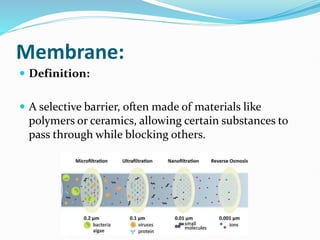
Membrane:
ď‚— Definition:
ď‚— A selective barrier, often made of materials like
polymers or ceramics, allowing certain substances to
pass through while blocking others.
ď‚— Separation Occur:
ď‚— Mechanism: The separation occurs based on the
size, shape, charge, or other properties of molecules
or particles.
ď‚— Driving Force:
ď‚— Pressure: Typically, a driving force, either through
applied pressure or concentration gradients, propels
substances through the membrane.
Types of Process
Classification aaccording to pore size,
ď‚— Microfiltration
ď‚— Ultrafiltration
ď‚— Nanofiltration
ď‚— Reverse Osmosis
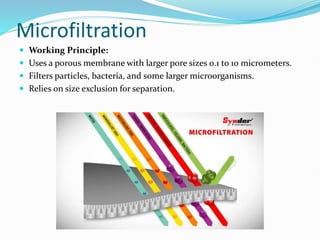
Microfiltration
ď‚— Working Principle:
ď‚— Uses a porous membrane with larger pore sizes 0.1 to 10 micrometers.
ď‚— Filters particles, bacteria, and some larger microorganisms.
ď‚— Relies on size exclusion for separation.
Microfiltration
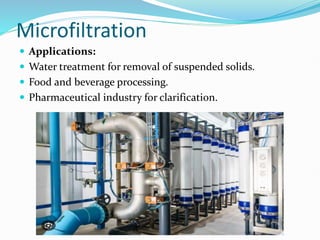
ď‚— Applications:
ď‚— Water treatment for removal of suspended solids.
ď‚— Food and beverage processing.
ď‚— Pharmaceutical industry for clarification.
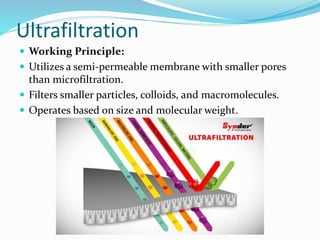
Ultrafiltration
ď‚— Working Principle:
ď‚— Utilizes a semi-permeable membrane with smaller pores
than microfiltration.
ď‚— Filters smaller particles, colloids, and macromolecules.
ď‚— Operates based on size and molecular weight.
Ultrafiltration
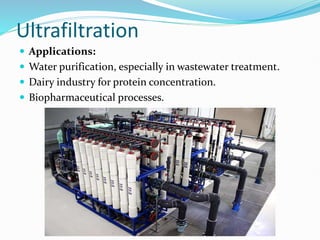
ď‚— Applications:
ď‚— Water purification, especially in wastewater treatment.
ď‚— Dairy industry for protein concentration.
ď‚— Biopharmaceutical processes.
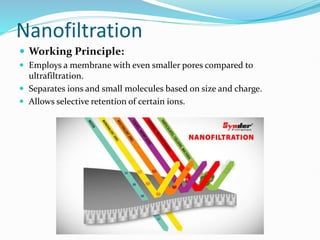
Nanofiltration
ď‚— Working Principle:
ď‚— Employs a membrane with even smaller pores compared to
ultrafiltration.
ď‚— Separates ions and small molecules based on size and charge.
ď‚— Allows selective retention of certain ions.
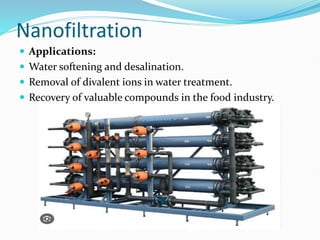
Nanofiltration
ď‚— Applications:
ď‚— Water softening and desalination.
ď‚— Removal of divalent ions in water treatment.
ď‚— Recovery of valuable compounds in the food industry.
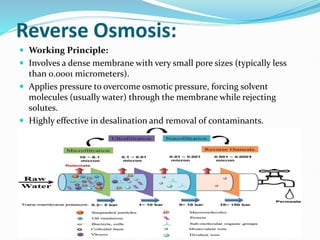
Reverse Osmosis:
ď‚— Working Principle:
ď‚— Involves a dense membrane with very small pore sizes (typically less
than 0.0001 micrometers).
ď‚— Applies pressure to overcome osmotic pressure, forcing solvent
molecules (usually water) through the membrane while rejecting
solutes.
ď‚— Highly effective in desalination and removal of contaminants.
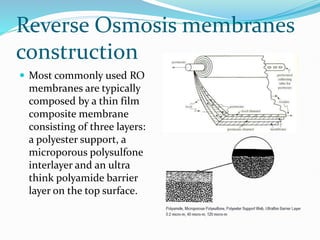
Reverse Osmosis membranes
construction
ď‚— Most commonly used RO
membranes are typically
composed by a thin film
composite membrane
consisting of three layers:
a polyester support, a
microporous polysulfone
interlayer and an ultra
think polyamide barrier
layer on the top surface.
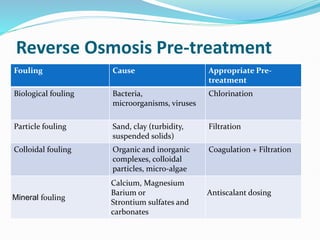
Reverse Osmosis Pre-treatment
Fouling Cause Appropriate Pre-
treatment
Biological fouling Bacteria,
microorganisms, viruses
Chlorination
Particle fouling Sand, clay (turbidity,
suspended solids)
Filtration
Colloidal fouling Organic and inorganic
complexes, colloidal
particles, micro-algae
Coagulation + Filtration
Mineral fouling
Calcium, Magnesium
Barium or
Strontium sulfates and
carbonates
Antiscalant dosing
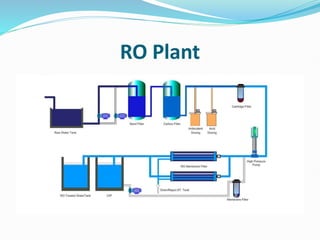
RO Plant
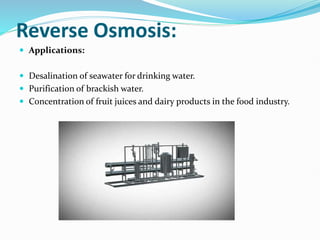
Reverse Osmosis:
ď‚— Applications:
ď‚— Desalination of seawater for drinking water.
ď‚— Purification of brackish water.
ď‚— Concentration of fruit juices and dairy products in the food industry.
Health Benefits
ď‚— The removal of contaminants and impurities by RO
contributes to better-tasting and safer drinking water,
potentially reducing health risks associated with
consuming waterborne pollutants.
Membrane Separation Process (Water Treatment)

Membrane Separation Process (Water Treatment)

  • 1.
    Name : ALIRAZA Father Name: MUHAMMAD ARSHAD Roll No: CY-06 Course No: CY-507 Subject: Advanced Chromatographic Techniques Teacher: Dr. Anjum
  • 2.
    Membrane Separation Process •Microfiltration • Ultrafiltration • Nano filtration • Reverse Osmosis
  • 3.
    Membrane: ď‚— Definition: ď‚— Aselective barrier, often made of materials like polymers or ceramics, allowing certain substances to pass through while blocking others.
  • 4.
    ď‚— Separation Occur: ď‚—Mechanism: The separation occurs based on the size, shape, charge, or other properties of molecules or particles. ď‚— Driving Force: ď‚— Pressure: Typically, a driving force, either through applied pressure or concentration gradients, propels substances through the membrane.
  • 5.
    Types of Process Classificationaaccording to pore size, ď‚— Microfiltration ď‚— Ultrafiltration ď‚— Nanofiltration ď‚— Reverse Osmosis
  • 6.
    Microfiltration ď‚— Working Principle: ď‚—Uses a porous membrane with larger pore sizes 0.1 to 10 micrometers. ď‚— Filters particles, bacteria, and some larger microorganisms. ď‚— Relies on size exclusion for separation.
  • 7.
    Microfiltration ď‚— Applications: ď‚— Watertreatment for removal of suspended solids. ď‚— Food and beverage processing. ď‚— Pharmaceutical industry for clarification.
  • 8.
    Ultrafiltration ď‚— Working Principle: ď‚—Utilizes a semi-permeable membrane with smaller pores than microfiltration. ď‚— Filters smaller particles, colloids, and macromolecules. ď‚— Operates based on size and molecular weight.
  • 9.
    Ultrafiltration ď‚— Applications: ď‚— Waterpurification, especially in wastewater treatment. ď‚— Dairy industry for protein concentration. ď‚— Biopharmaceutical processes.
  • 10.
    Nanofiltration ď‚— Working Principle: ď‚—Employs a membrane with even smaller pores compared to ultrafiltration. ď‚— Separates ions and small molecules based on size and charge. ď‚— Allows selective retention of certain ions.
  • 11.
    Nanofiltration ď‚— Applications: ď‚— Watersoftening and desalination. ď‚— Removal of divalent ions in water treatment. ď‚— Recovery of valuable compounds in the food industry.
  • 12.
    Reverse Osmosis: ď‚— WorkingPrinciple: ď‚— Involves a dense membrane with very small pore sizes (typically less than 0.0001 micrometers). ď‚— Applies pressure to overcome osmotic pressure, forcing solvent molecules (usually water) through the membrane while rejecting solutes. ď‚— Highly effective in desalination and removal of contaminants.
  • 13.
    Reverse Osmosis membranes construction ď‚—Most commonly used RO membranes are typically composed by a thin film composite membrane consisting of three layers: a polyester support, a microporous polysulfone interlayer and an ultra think polyamide barrier layer on the top surface.
  • 14.
    Reverse Osmosis Pre-treatment FoulingCause Appropriate Pre- treatment Biological fouling Bacteria, microorganisms, viruses Chlorination Particle fouling Sand, clay (turbidity, suspended solids) Filtration Colloidal fouling Organic and inorganic complexes, colloidal particles, micro-algae Coagulation + Filtration Mineral fouling Calcium, Magnesium Barium or Strontium sulfates and carbonates Antiscalant dosing
  • 15.
  • 16.
    Reverse Osmosis: ď‚— Applications: ď‚—Desalination of seawater for drinking water. ď‚— Purification of brackish water. ď‚— Concentration of fruit juices and dairy products in the food industry.
  • 17.
    Health Benefits ď‚— Theremoval of contaminants and impurities by RO contributes to better-tasting and safer drinking water, potentially reducing health risks associated with consuming waterborne pollutants.