
59 Megatrend Fact Sheets
(briefing document for long-term planning and
innovation sessions)
2015 edition
@fdemeyer
frederic@i4fi.com
fredericdemeyer.com
Instituteforfutureinsights
fdemeyer
• This document has been acquired for the internal use of
the acquiring company. It can be spread and shown
internally in the company. It can be shown but not
distributed to people external to the acquiring company.
• The trends discussed in this document are not
predictions, but developments that are currently
deploying and of which the full extend and long-term
impact are relatively unknown.
• The categorization in ‘themes’ is not a scientific exercise.
Some of the trends discussed under a specific theme
could have been included in other themes.
• The ‘Major industries impacted’ and ‘Impact certitude’
sections are based on judgment from i4fi. They are
meant as ‘eye-opener’ and do not result from any
scientific process.
Top industries
impacted
1-2 key graphics
or charts relating
to the megatrend
1-2 key graphics
or charts relating
to the megatrend‘Sources and
further reading’
leads you to +300
valuable reports,
articles and
infographs, saving
you hours of
research
‘Back to menu’
button for easy
navigation
4 new trends
covered, 1 left out
Refreshed ‘look
& feel’ of the
slides; neutral
coloring scheme;
logo free
>75% new charts
and graphics
Refreshed
‘Sources and
further reading’
notes. +98%
date after 2010
Step 1: discuss megatrends
Step 2: Whiteboard selection &
discussion of trends with highest
impact
Step 3: Idea generation on how to
prepare for threats or benefit from
opportunities, discussion an
selection of best idea
Works best with:
• 2 teams of 5-6 people per theme;
• people from different background and
seniority level;
• send fact sheets prior to workshop.
Conduct a preliminary survey to generate insights and discussion points
Step 1: select 20-25 trends
Step 2: send the survey
4 questions for each trend
(score 1-5):
• Disruptive impact on your industry
• Threat level on your company
• Opportunity level for your company
• How prepared is your company for
these threats & opportunities?
Step 3: analyze results
Step 4: Discuss the findings
• What does it mean for us?
• How can we prepare for future threats?
• How to catch new opportunities?
• How do competitors prepare?
We can help you with designing the survey and
producing a world-class document of the findings!
Contact frederic@i4fi.com for more information
Institutions-organizations
• Asian Development Bank
• Conference Board
• Eurostat
• The Heritage Foundation
• London Management School
• MIT
• NASA
• OECD
• Schwab Foundation
• UNEP-GRID
• UNFPO
• United Nations
• Vlerick Management School
• World Bank
• World Economic Forum
• World Futurist Society
• World Health Organization
• World Resources Forum
• World Resource Institute
• World Wildlife Fund (WWF)
Blogs:
• Alaklett
• Brandon Gaille
• Business Insider
• Crowdsourcing.org
• I4fi
• Inhabitat
• Mashable
• Nextnature
• Quartz
• Renewable Energy
• Social Media Today
• Techcrunch
• Trendhunter
• Urban Mining
• Venturebeat
Consultancies:
• Accenture
• AT Kearney
• Board of Innovation
• Boston Consultancy
Group
• Eurominotor
• E&Y
• Forrester
• Gallup
• IDC
• JWT Intelligence
• KPMG
• McKinsey
• McKinsey Global
Institute
• Nielsen
• PEW Research
• PWC
News and media:
• BBC
• Business Week
• CIO Magazine
• The Economist
• Energy Bulletin
• Entrepreneur Magazine
• The Fast Company
• Forbes Magazine
• The Guardian
• Huffington Post
• Inc. Magazine
• Information Week
• MSNBC
• PR Newswire
• Scientific American
• Thomson Reuters
• Wall Street Journal
• Washington Post
• Wired
Corporations:
• Alcatel-Lucent
• Cisco
• Credit Suisse
• Ericsson
• Intel
• Microsoft
• Saatchi
• SAP
• Symantec
(go to presentation mode to navigate from and to this slide)
• Demographic trends
– Growing world population
– Ageing population
– Migration patterns
– Urbanization
– Gap rich-poor
– Generation Y
– Generation Z
– War for talent
• Environment and
sustainability
– Climate change
– Scarce resources
– Peak oil
– Water shortage
– Food stress
– Clean energy
– Smart cities
– Bio materials
– Cradle-to-cradle
– Biomimicry
– Urban farming
– Eco activism
• Geopolitical trends
– Power shift
– Globalization 3.0
– Rising middle class
– Energy dependence
– The Market State
• Consumer & societal trends
– Mass customization
– Ethical buying
– ‘Buy local’
– Social & Group buying
– Personalization
– Sharing economy
– Radical transparency
– Massive Open Online Courses
(MOOCs)
– Personal Health
– Digital divide
– Virtual Currencies
• Technology trends
– Big Data/ data science
– Internet of Things (IoT)
– Augmented Reality
– Consumerization of IT (BYOD)
– Technology ‘as a Service’
– Home 3D printing
– Business 3D printing
– Bioprinting
– Enhanced Humans
– Wearable Technologies
• Business trends
– Life Cycle Assessment
– Disintermediation
– Crowdsourcing & funding
– Open innovation
– Gamification
– Corporate Social Responsibility
(CSR)
– Cause Marketing
– Social Business Innovation
– Social entrepreneurs
– Intrapreneurship
– Businesses get social
– Holacracy
– Virtualization of the corporation
RETURN TO
MENU
RETURN
TO MENU
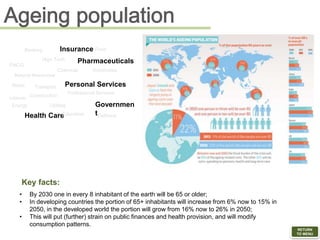
• By 2030 one in every 8 inhabitant of the earth will be 65 or older;
• In developing countries the portion of 65+ inhabitants will increase from 6% now to 15% in
2050, in the developed world the portion will grow from 16% now to 26% in 2050;
• This will put (further) strain on public finances and health provision, and will modify
consumption patterns.
Key facts:
FMCG
Banking Insurance
Governmen
t
Pharmaceuticals
Leisure
Health CareEducation
Transport
High Tech
Retail
Natural Resources
Utilities
Personal Services
Professional Services
Chemical Automotive
Energy
Defence
Food
Construction
RETURN TO
MENU
Key facts:
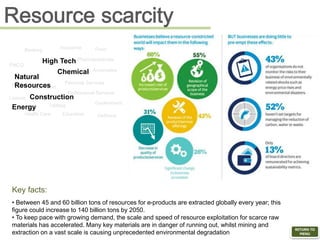
• Between 45 and 60 billion tons of resources for e-products are extracted globally every year; this
figure could increase to 140 billion tons by 2050.
• To keep pace with growing demand, the scale and speed of resource exploitation for scarce raw
materials has accelerated. Many key materials are in danger of running out, whilst mining and
extraction on a vast scale is causing unprecedented environmental degradation
RETURN TO
MENU
FMCG
Banking
Insurance
Government
Pharmaceuticals
Leisure
Health Care Education
Transport
High Tech
Retail
Natural
Resources
Utilities
Personal Services
Professional Services
Chemical Automotive
Energy
Defence
Food
Construction
RETURN TO
MENU
Key facts:
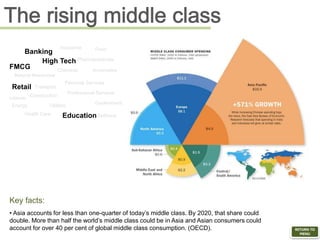
• Asia accounts for less than one-quarter of today’s middle class. By 2020, that share could
double. More than half the world’s middle class could be in Asia and Asian consumers could
account for over 40 per cent of global middle class consumption. (OECD). RETURN TO
MENU
FMCG
Banking
Insurance
Government
Pharmaceuticals
Leisure
Health Care Education
Transport
High Tech
Retail
Natural Resources
Utilities
Personal Services
Professional Services
Chemical Automotive
Energy
Defence
Food
Construction
RETURN TO
MENU
Key facts:
•. According to Juniper: Combining revenues from paid downloads, post-download items and
advertising, the total market for mobile AR will reach $5.2B in 2017, up from $82M in 2012.
• More than 2.5 billion AR apps [are] to be downloaded to smartphones and tablets per annum by
2017, with games accounting for the largest share of downloads. RETURN TO
MENU
FMCG
Banking
Insurance
Government
Pharmaceuticals
Leisure
Health Care Education
Transport
High Tech
Retail
Natural Resources
Utilities
Personal Services
Professional Services
Chemical Automotive
Energy
Defence
Food
Construction
RETURN TO
MENU
Key facts:
•. According to a Saatchi survey in the US:
o 55% of Americans said they were interested in working for a company that uses
gamification to increase productivity;
o 58% said it is important for brands to be fun and playful;
o When asked how they would like to hear about a new product, 37% would choose some
kind of online game experience .
RETURN TO
MENU
FMCG
Banking
Insurance
Government
Pharmaceuticals
Leisure
Health Care Education
Transport
High Tech
Retail
Natural Resources
Utilities
Personal Services
Professional
Services
Chemical Automotive
Energy
Defence
Food
Construction
any additional questions: frederic@i4fi.com
megatrend blog: www.fredericdemeyer.com
additional services: www.i4fi.com
twitter: @fdemeyer
LinkedIn & Facebook: Institute for Future Insights
Pinterest: fdemeyer

Megatrends fact sheets 2015 sample

  • 1.
    59 Megatrend FactSheets (briefing document for long-term planning and innovation sessions) 2015 edition @fdemeyer frederic@i4fi.com fredericdemeyer.com Instituteforfutureinsights fdemeyer
  • 2.
    • This documenthas been acquired for the internal use of the acquiring company. It can be spread and shown internally in the company. It can be shown but not distributed to people external to the acquiring company.
  • 3.
    • The trendsdiscussed in this document are not predictions, but developments that are currently deploying and of which the full extend and long-term impact are relatively unknown. • The categorization in ‘themes’ is not a scientific exercise. Some of the trends discussed under a specific theme could have been included in other themes. • The ‘Major industries impacted’ and ‘Impact certitude’ sections are based on judgment from i4fi. They are meant as ‘eye-opener’ and do not result from any scientific process.
  • 4.
    Top industries impacted 1-2 keygraphics or charts relating to the megatrend 1-2 key graphics or charts relating to the megatrend‘Sources and further reading’ leads you to +300 valuable reports, articles and infographs, saving you hours of research ‘Back to menu’ button for easy navigation
  • 5.
    4 new trends covered,1 left out Refreshed ‘look & feel’ of the slides; neutral coloring scheme; logo free >75% new charts and graphics Refreshed ‘Sources and further reading’ notes. +98% date after 2010
  • 6.
    Step 1: discussmegatrends Step 2: Whiteboard selection & discussion of trends with highest impact Step 3: Idea generation on how to prepare for threats or benefit from opportunities, discussion an selection of best idea Works best with: • 2 teams of 5-6 people per theme; • people from different background and seniority level; • send fact sheets prior to workshop.
  • 7.
    Conduct a preliminarysurvey to generate insights and discussion points Step 1: select 20-25 trends Step 2: send the survey 4 questions for each trend (score 1-5): • Disruptive impact on your industry • Threat level on your company • Opportunity level for your company • How prepared is your company for these threats & opportunities? Step 3: analyze results Step 4: Discuss the findings • What does it mean for us? • How can we prepare for future threats? • How to catch new opportunities? • How do competitors prepare? We can help you with designing the survey and producing a world-class document of the findings! Contact frederic@i4fi.com for more information
  • 8.
    Institutions-organizations • Asian DevelopmentBank • Conference Board • Eurostat • The Heritage Foundation • London Management School • MIT • NASA • OECD • Schwab Foundation • UNEP-GRID • UNFPO • United Nations • Vlerick Management School • World Bank • World Economic Forum • World Futurist Society • World Health Organization • World Resources Forum • World Resource Institute • World Wildlife Fund (WWF) Blogs: • Alaklett • Brandon Gaille • Business Insider • Crowdsourcing.org • I4fi • Inhabitat • Mashable • Nextnature • Quartz • Renewable Energy • Social Media Today • Techcrunch • Trendhunter • Urban Mining • Venturebeat Consultancies: • Accenture • AT Kearney • Board of Innovation • Boston Consultancy Group • Eurominotor • E&Y • Forrester • Gallup • IDC • JWT Intelligence • KPMG • McKinsey • McKinsey Global Institute • Nielsen • PEW Research • PWC News and media: • BBC • Business Week • CIO Magazine • The Economist • Energy Bulletin • Entrepreneur Magazine • The Fast Company • Forbes Magazine • The Guardian • Huffington Post • Inc. Magazine • Information Week • MSNBC • PR Newswire • Scientific American • Thomson Reuters • Wall Street Journal • Washington Post • Wired Corporations: • Alcatel-Lucent • Cisco • Credit Suisse • Ericsson • Intel • Microsoft • Saatchi • SAP • Symantec
  • 9.
    (go to presentationmode to navigate from and to this slide) • Demographic trends – Growing world population – Ageing population – Migration patterns – Urbanization – Gap rich-poor – Generation Y – Generation Z – War for talent • Environment and sustainability – Climate change – Scarce resources – Peak oil – Water shortage – Food stress – Clean energy – Smart cities – Bio materials – Cradle-to-cradle – Biomimicry – Urban farming – Eco activism • Geopolitical trends – Power shift – Globalization 3.0 – Rising middle class – Energy dependence – The Market State • Consumer & societal trends – Mass customization – Ethical buying – ‘Buy local’ – Social & Group buying – Personalization – Sharing economy – Radical transparency – Massive Open Online Courses (MOOCs) – Personal Health – Digital divide – Virtual Currencies • Technology trends – Big Data/ data science – Internet of Things (IoT) – Augmented Reality – Consumerization of IT (BYOD) – Technology ‘as a Service’ – Home 3D printing – Business 3D printing – Bioprinting – Enhanced Humans – Wearable Technologies • Business trends – Life Cycle Assessment – Disintermediation – Crowdsourcing & funding – Open innovation – Gamification – Corporate Social Responsibility (CSR) – Cause Marketing – Social Business Innovation – Social entrepreneurs – Intrapreneurship – Businesses get social – Holacracy – Virtualization of the corporation
  • 10.
  • 11.
    RETURN TO MENU • By2030 one in every 8 inhabitant of the earth will be 65 or older; • In developing countries the portion of 65+ inhabitants will increase from 6% now to 15% in 2050, in the developed world the portion will grow from 16% now to 26% in 2050; • This will put (further) strain on public finances and health provision, and will modify consumption patterns. Key facts: FMCG Banking Insurance Governmen t Pharmaceuticals Leisure Health CareEducation Transport High Tech Retail Natural Resources Utilities Personal Services Professional Services Chemical Automotive Energy Defence Food Construction
  • 12.
  • 13.
    Key facts: • Between45 and 60 billion tons of resources for e-products are extracted globally every year; this figure could increase to 140 billion tons by 2050. • To keep pace with growing demand, the scale and speed of resource exploitation for scarce raw materials has accelerated. Many key materials are in danger of running out, whilst mining and extraction on a vast scale is causing unprecedented environmental degradation RETURN TO MENU FMCG Banking Insurance Government Pharmaceuticals Leisure Health Care Education Transport High Tech Retail Natural Resources Utilities Personal Services Professional Services Chemical Automotive Energy Defence Food Construction
  • 14.
  • 15.
    Key facts: • Asiaaccounts for less than one-quarter of today’s middle class. By 2020, that share could double. More than half the world’s middle class could be in Asia and Asian consumers could account for over 40 per cent of global middle class consumption. (OECD). RETURN TO MENU FMCG Banking Insurance Government Pharmaceuticals Leisure Health Care Education Transport High Tech Retail Natural Resources Utilities Personal Services Professional Services Chemical Automotive Energy Defence Food Construction
  • 16.
  • 17.
    Key facts: •. Accordingto Juniper: Combining revenues from paid downloads, post-download items and advertising, the total market for mobile AR will reach $5.2B in 2017, up from $82M in 2012. • More than 2.5 billion AR apps [are] to be downloaded to smartphones and tablets per annum by 2017, with games accounting for the largest share of downloads. RETURN TO MENU FMCG Banking Insurance Government Pharmaceuticals Leisure Health Care Education Transport High Tech Retail Natural Resources Utilities Personal Services Professional Services Chemical Automotive Energy Defence Food Construction
  • 18.
  • 19.
    Key facts: •. Accordingto a Saatchi survey in the US: o 55% of Americans said they were interested in working for a company that uses gamification to increase productivity; o 58% said it is important for brands to be fun and playful; o When asked how they would like to hear about a new product, 37% would choose some kind of online game experience . RETURN TO MENU FMCG Banking Insurance Government Pharmaceuticals Leisure Health Care Education Transport High Tech Retail Natural Resources Utilities Personal Services Professional Services Chemical Automotive Energy Defence Food Construction
  • 20.
    any additional questions:frederic@i4fi.com megatrend blog: www.fredericdemeyer.com additional services: www.i4fi.com twitter: @fdemeyer LinkedIn & Facebook: Institute for Future Insights Pinterest: fdemeyer

Editor's Notes

  • #12 SOURCES AND FURTHER READING: United Nations report ‘The World Population Situation in 2014’ (2014): http://www.un.org/en/development/desa/population/publications/pdf/trends/Concise%20Report%20on%20the%20World%20Population%20Situation%202014/en.pdf Euromonitor ‘Ageing and Urbanization trends march on but global demographic devide persists’ (2014): http://blog.euromonitor.com/2014/01/2014-ageing-and-urbanisation-trends-march-on-but-global-demographic-divide-persists.html Thomson Reuters infographic on global Ageing population (2012): http://blog.thomsonreuters.com/index.php/worlds-ageing-population-graphic-of-the-day/ United Nations report ‘World Population Ageing 1950-2050’ (2002): http://www.un.org/esa/population/publications/worldageing19502050/ Center for Strategic & International Studies, Global Aging Preparedness Index: http://csis.org/program/global-aging-preparedness-index Survey of Health, Ageing and Retirement in Europe (SHARE): http://www.share-project.org/
  • #14 SOURCES AND FURTHER READING: Carbontrust article “Are companies sleepwalking into a resource crunch?” (2012): http://www.carbontrust.com/news/2012/12/business-resource-efficiency-resource-crunch McKinsey&Compant article and video “How resource scarcity is driving the Third industrial revolution” (2014): http://www.mckinsey.com/insights/energy_resources_materials/how_resource_scarcity_is_driving_the_third_industrial_revolution PWC article & video “Resource scarcity and climate change”: http://www.pwc.com/gx/en/issues/megatrends/climate-change-and-resource-scarcity-dennis-nally.jhtml Eforgood coverage of e-waste issue: http://www.eforgood.org/e-waste-issues/scarcity/ Urban Mining article “A scarcety of rare metals is hindering green technologies” (2013): http://urbanmining.org/2013/11/19/scarcity-rare-metals-hindering-green-technologies/ Energy Bulletin: http://www.energybulletin.net/stories/2010-04-06/increasing-global-nonrenewable-natural-resource-scarcity%E2%80%94-analysis The Hague Centre for Strategic Studies ‘Resource scarcity in the 21st century: conflict or cooperation?’: http://static.hcss.nl/files/uploads/37.pdf New York University report ‘Globalization and scarcity’: http://www.energybulletin.net/stories/2010-04-06/increasing-global-nonrenewable-natural-resource-scarcity%E2%80%94-analysis World Resources Forum website: http://www.worldresourcesforum.org/
  • #16 SOURCES AND FURTHER READING: EY Report “Hitting the sweet spot – The growth of the middle class in emerging markets” (2013): http://www.ey.com/Publication/vwLUAssets/Hitting_the_sweet_spot/$FILE/Hitting_the_sweet_spot.pdf McKinsey article ‘Mapping China’s middle class” (2013): http://www.mckinsey.com/insights/consumer_and_retail/mapping_chinas_middle_class Quartz article “The world’s middle class will number 5 billion by 2030” (2013): http://qz.com/43411/the-worlds-middle-class-will-number-5-billion-by-2030/ FT chart of the week “Tracking the rising EM middle class” (2012): http://blogs.ft.com/beyond-brics/2012/10/22/chart-of-the-week-tracking-the-rising-em-middle-classes/#axzz2nuIkoPdg KPMG article “The rise of the middle class in Asian emerging markets” (2012): http://www.kpmg.com/cn/en/IssuesAndInsights/ArticlesPublications/Documents/Middle-Class-Asia-Emerging-Markets-201206-2.pdf Americas Quarterly article “Latin America’s middle class in global perspective” (2012): http://www.americasquarterly.org/Latin-Americas-Middle-Class-in-Global-Perspective Reuters article “Africa’s emerging middle class drives growth and democracy” (2013): http://www.reuters.com/article/2013/05/10/us-africa-investment-idUSBRE9490DV20130510 Worldbank presentation “The emerging middle class in developing countries” (2011): http://siteresources.worldbank.org/EXTABCDE/Resources/7455676-1292528456380/7626791-1303141641402/7878676-1306699356046/Parallel-Sesssion-6-Homi-Kharas.pdf OECD Working Paper (2010) ‘The emerging middle class in developing countries’: http://www.oecd.org/dataoecd/12/52/44457738.pdf Asian Development Bank ‘The rise of Asia’s middle class’ (2010): http://www.adb.org/Documents/books/key_indicators/2010/pdf/KI2010-Special-Chapter.pdf
  • #18 SOURCES AND FURTHER READING: Fierce Developer article “Augmented Reality apps could blossom to 300M$ in 2013” (2012): http://www.fiercedeveloper.com/story/augmented-reality-apps-market-could-blossom-300m-2013/2012-11-26 Hiddenltd “AR Statistics: what marketers really think” (2011): http://hiddenltd.com/blog/augmented-reality-statistics-what-marketers-really-think/ Forbes article “Augmented reality without the glasses” (2015): http://www.forbes.com/sites/alanmcglade/2015/02/08/augmented-reality-without-the-glasses/ Marxentlab article “5 Top virtual reality and Augmented reality trends” (2015): http://www.marxentlabs.com/top-virtual-reality-augmented-reality-trends-2015/ Upcoming Media (Canada) infographic “Augmented Reality” (2013): http://upcomingmedia.com/augmentedrealityinfographic/ Concrete examples of Augmented Reality applications: http://www.arshowcase.com/ Smarter Technologies 10 smart examples of Augmented Reality: http://www.smartertechnology.com/c/a/Smarter-Strategies/10-Smart-Examples-of-Augmented-Reality/ Business Week CEO guide to Augmented reality (2010): http://www.businessweek.com/technology/special_reports/20091103ceo_guide_to_augmented_reality.htm Horizon reports Augmented Rality 2-3 years horizon: http://wp.nmc.org/horizon2011/sections/augmented-reality
  • #20 SOURCES AND FURTHER READING: Saatchi survey presentation ‘Gamification for business, brands and loyalty’ (2011): http://www.slideshare.net/Saatchi_S/gamification-study Technology Advise post “A beginners’ guide to gamification”: http://technologyadvice.com/gamification/smart-advisor/ Bunchball blog post “5 Gamification trends in 2015” (2015): http://www.bunchball.com/blog/post/1616/5-gamification-trends-watch-2015 Business Insider article “Playing to win: mobile gamification done right” (2013): http://www.businessinsider.com/mobile-gamification-is-a-serious-market-2013-9 M2 Research presentation “Gamification in 2012: Trends in consumer and business markets with metrics” (2012): http://www.slideshare.net/wandameloni/gamification-in-2012-trends-in-consumer-and-enterprise-markets-13453048 Forbes article: “The gamification of Business” (2013): http://www.forbes.com/sites/gartnergroup/2013/01/21/the-gamification-of-business/ Gamesindustry International article “Gamification market to reach 2.6B$ by 2016” (2012): http://www.gamesindustry.biz/articles/2012-05-21-gamification-market-to-reach-USD2-8-billion-in-2016 Business 2 Community article “5 ways brands gamify their social media marketing” (2013): http://www.business2community.com/social-media/5-ways-brands-gamify-their-social-media-marketing-0387767#!qvBTS Gamification examples: http://gamification.co/