
Python, numerical optimization,
genetic algorithms
Davide Rizzo
PyCon Italia Qu4ttro

daviderizzo.net
Python, numerical optimization, genetic algorithms   daviderizzo.net


Optimization
• Actually operations research
 ▫ Mathematical optimization is the tool
• Applied maths
 ▫ Major academic and industrial research topic
• Computationally oriented
 ▫ Many commercial solutions
 ▫ Yes, you can use Python
• Not code optimization!
Python, numerical optimization, genetic algorithms   daviderizzo.net


Operations research applications
• Airlines
  ▫ scheduling planes and crews, pricing tickets, taking
    reservations, and planning fleet size
• Logistics
  ▫ routing and planning
• Financial services
  ▫ credit scoring, marketing, and internal operations
• Deployment of emergency services
• Policy studies and regulation
  ▫ environmental pollution, air traffic safety, AIDS, and
    criminal justice policy
Python, numerical optimization, genetic algorithms   daviderizzo.net


More operations research applications
•   Project planning
•   Network optimization
•   Resources allocation
•   Supply chain management
•   Automation
•   Scheduling
•   Pricing
Python, numerical optimization, genetic algorithms   daviderizzo.net


Optimization problem
• Many decision variables
 ▫ How should I price my new products?
 ▫ How many server resources should I assign to
   each client?
• An objective
 ▫ Maximize net profit
 ▫ Minimize client waiting time
Python, numerical optimization, genetic algorithms   daviderizzo.net


Objective function
• Objective: find the best choice for the decision
  variables
  ▫ the values that give the maximum yield (or the
    minimum cost)
• Objective function: the yield (or the cost) I get
  for a given choice
Python, numerical optimization, genetic algorithms   daviderizzo.net


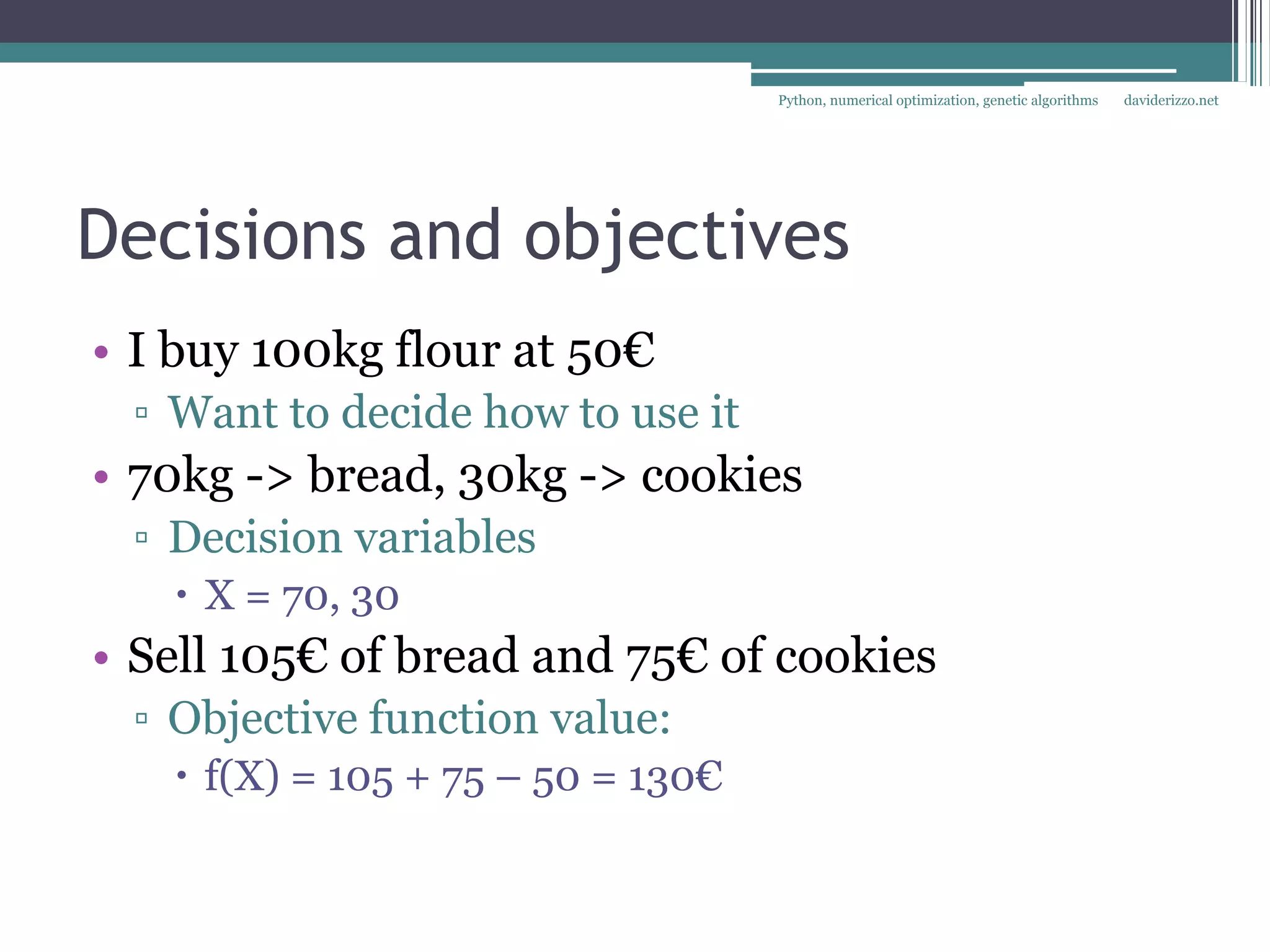
Decisions and objectives
• I buy 100kg flour at 50€
 ▫ Want to decide how to use it
• 70kg -> bread, 30kg -> cookies
 ▫ Decision variables
    X = 70, 30
• Sell 105€ of bread and 75€ of cookies
 ▫ Objective function value:
    f(X) = 105 + 75 – 50 = 130€
Python, numerical optimization, genetic algorithms   daviderizzo.net


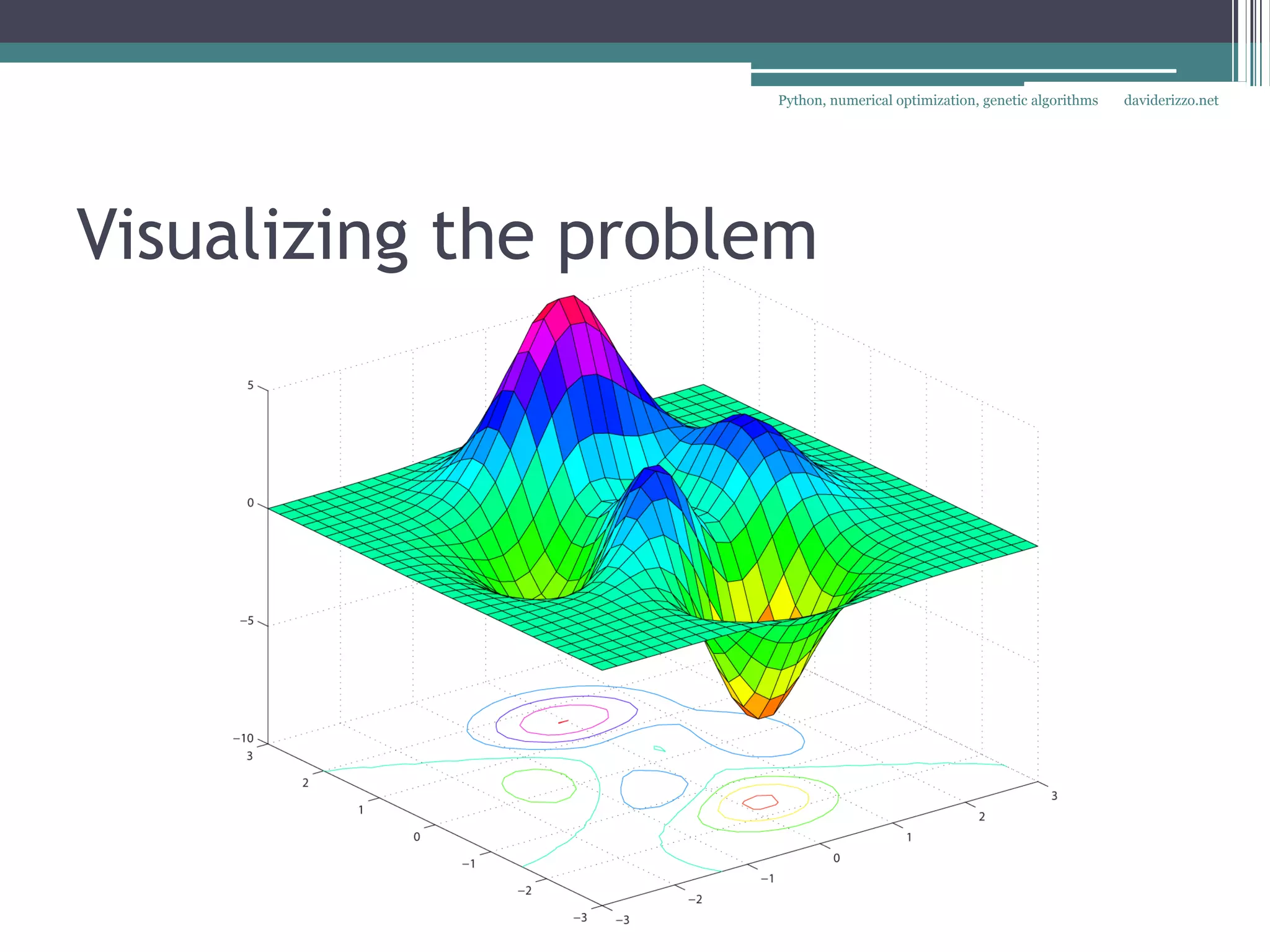
Visualizing the problem
Python, numerical optimization, genetic algorithms   daviderizzo.net


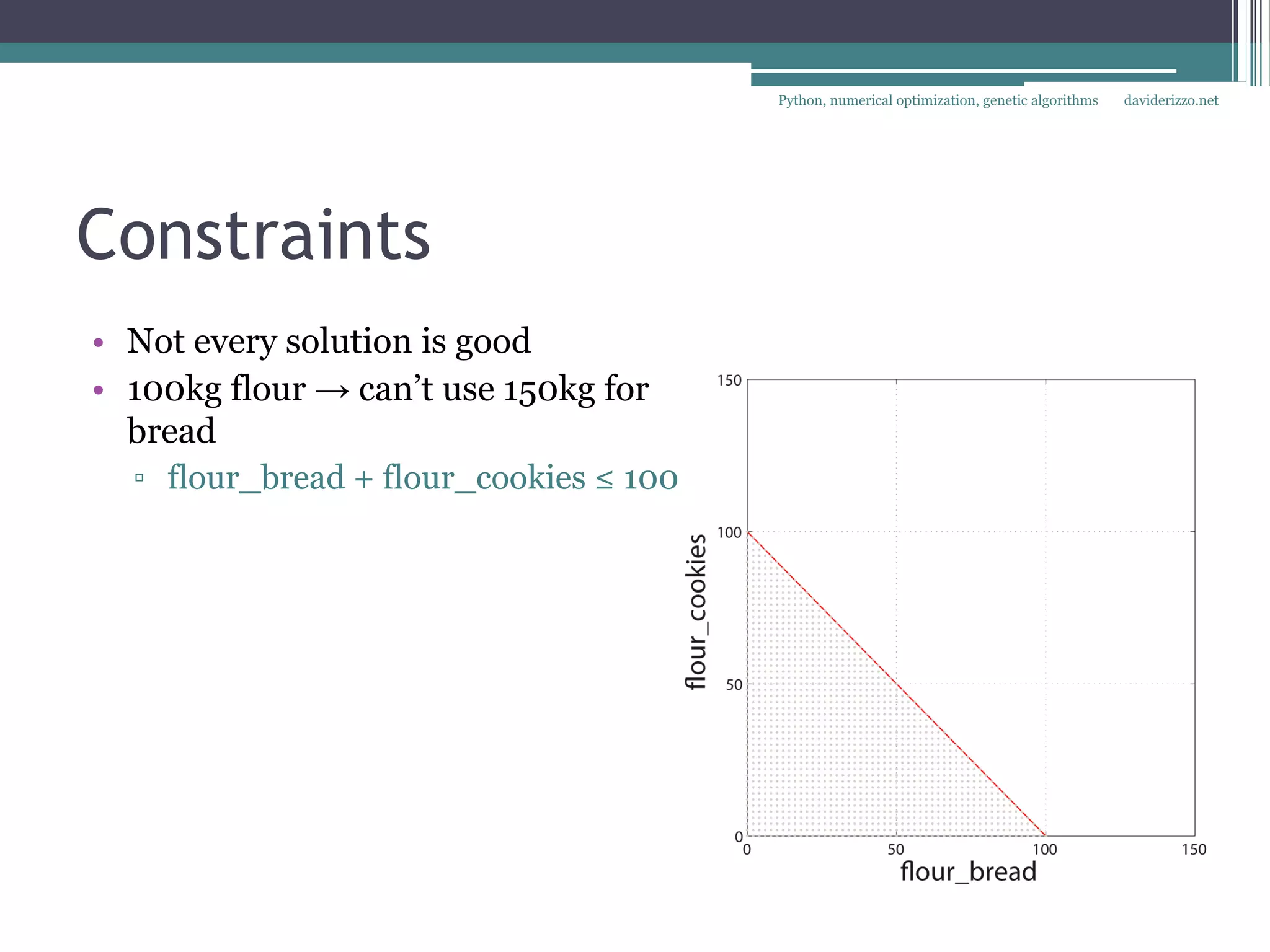
Constraints
• Not every solution is good
• 100kg flour → can’t use 150kg for
  bread
  ▫ flour_bread + flour_cookies ≤ 100
Python, numerical optimization, genetic algorithms   daviderizzo.net


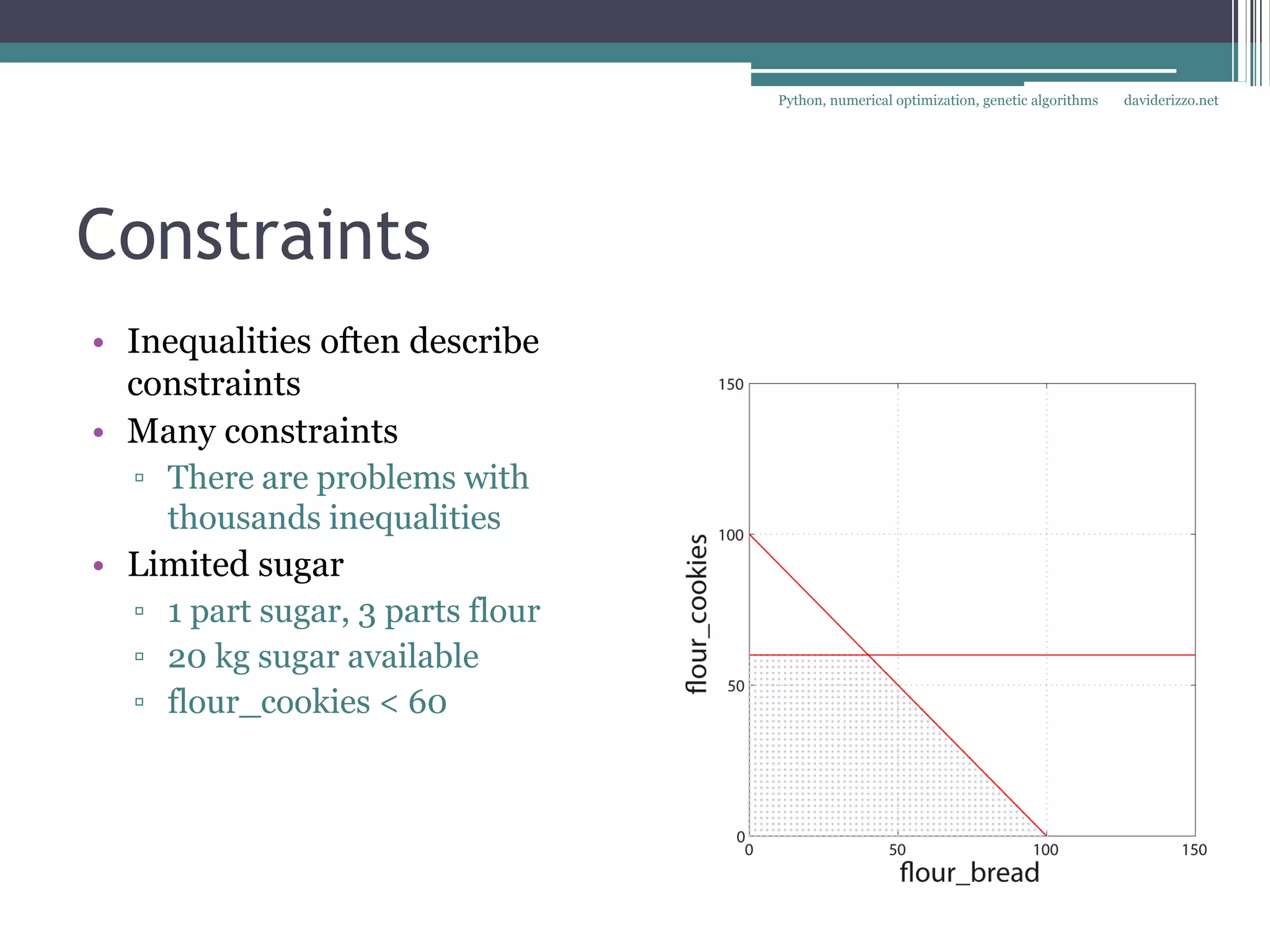
Constraints
• Inequalities often describe
  constraints
• Many constraints
  ▫ There are problems with
    thousands inequalities
• Limited sugar
  ▫ 1 part sugar, 3 parts flour
  ▫ 20 kg sugar available
  ▫ flour_cookies < 60
Python, numerical optimization, genetic algorithms   daviderizzo.net


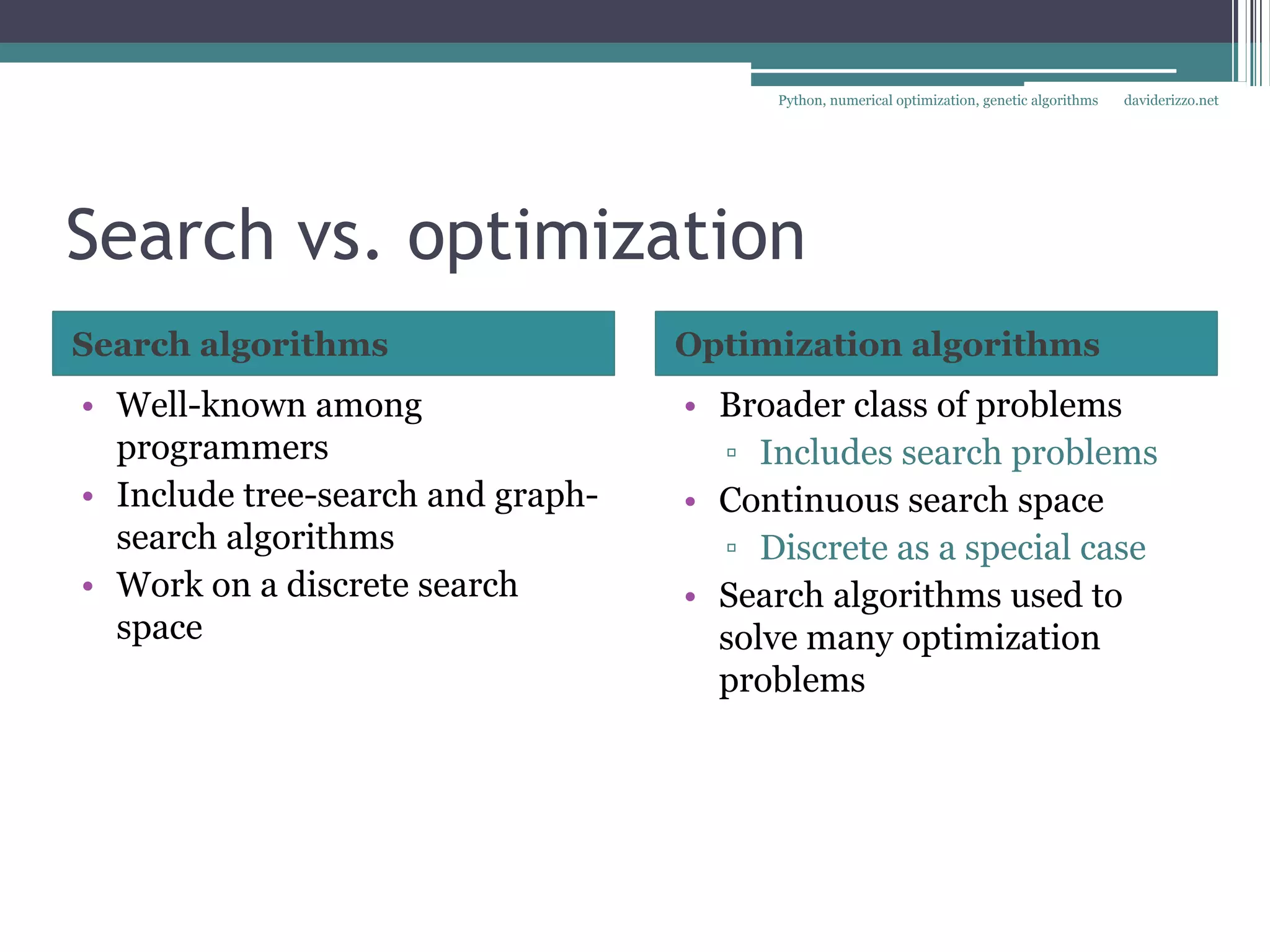
Search vs. optimization
Search algorithms                  Optimization algorithms
• Well-known among                 • Broader class of problems
  programmers                        ▫ Includes search problems
• Include tree-search and graph-   • Continuous search space
  search algorithms                  ▫ Discrete as a special case
• Work on a discrete search        • Search algorithms used to
  space                              solve many optimization
                                     problems
Python, numerical optimization, genetic algorithms   daviderizzo.net


Finding the optimum in linear and non-linear problems with
exact methods
Python, numerical optimization, genetic algorithms   daviderizzo.net


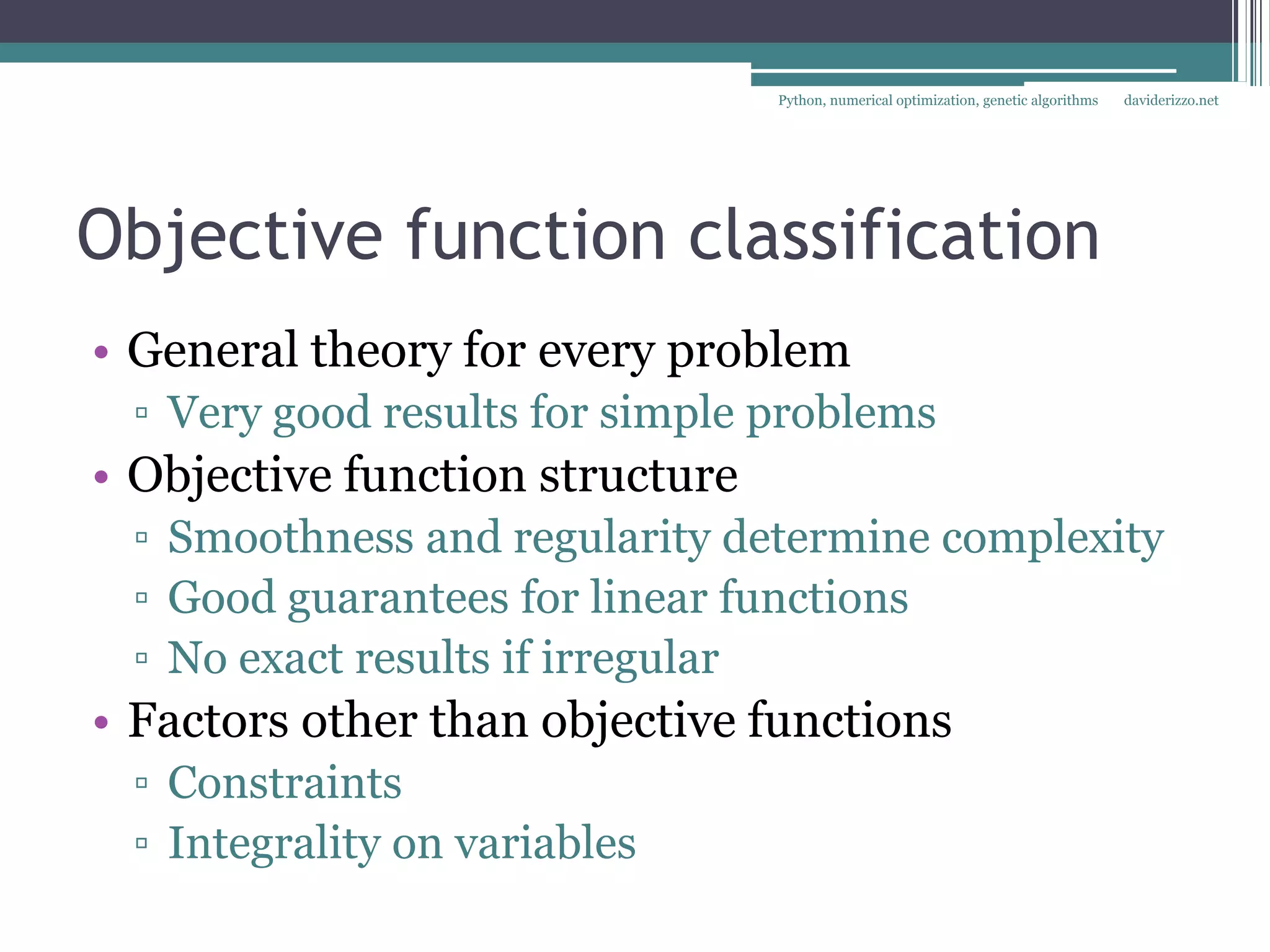
Objective function classification
• General theory for every problem
 ▫ Very good results for simple problems
• Objective function structure
 ▫ Smoothness and regularity determine complexity
 ▫ Good guarantees for linear functions
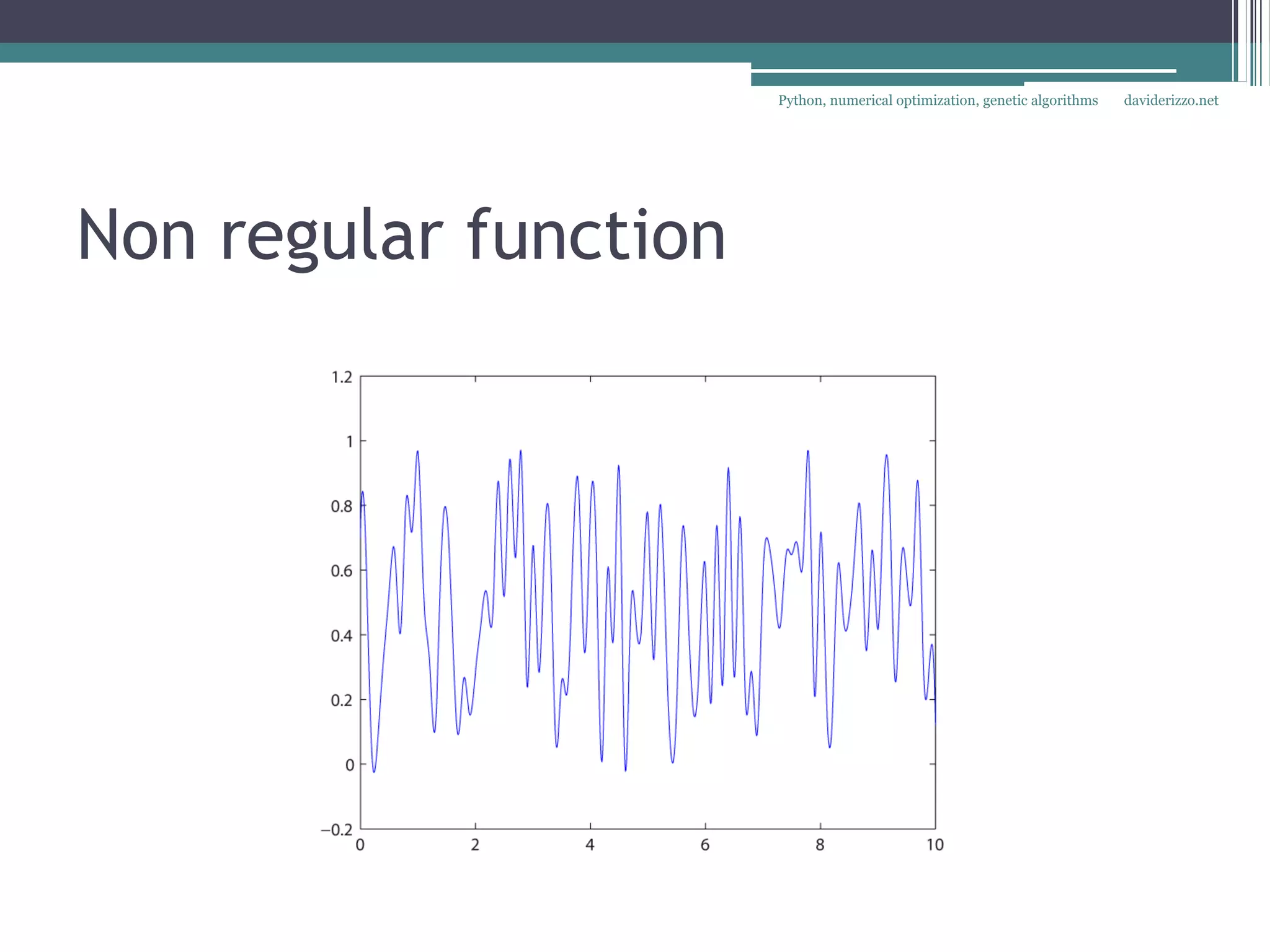
 ▫ No exact results if irregular
• Factors other than objective functions
 ▫ Constraints
 ▫ Integrality on variables
Python, numerical optimization, genetic algorithms   daviderizzo.net


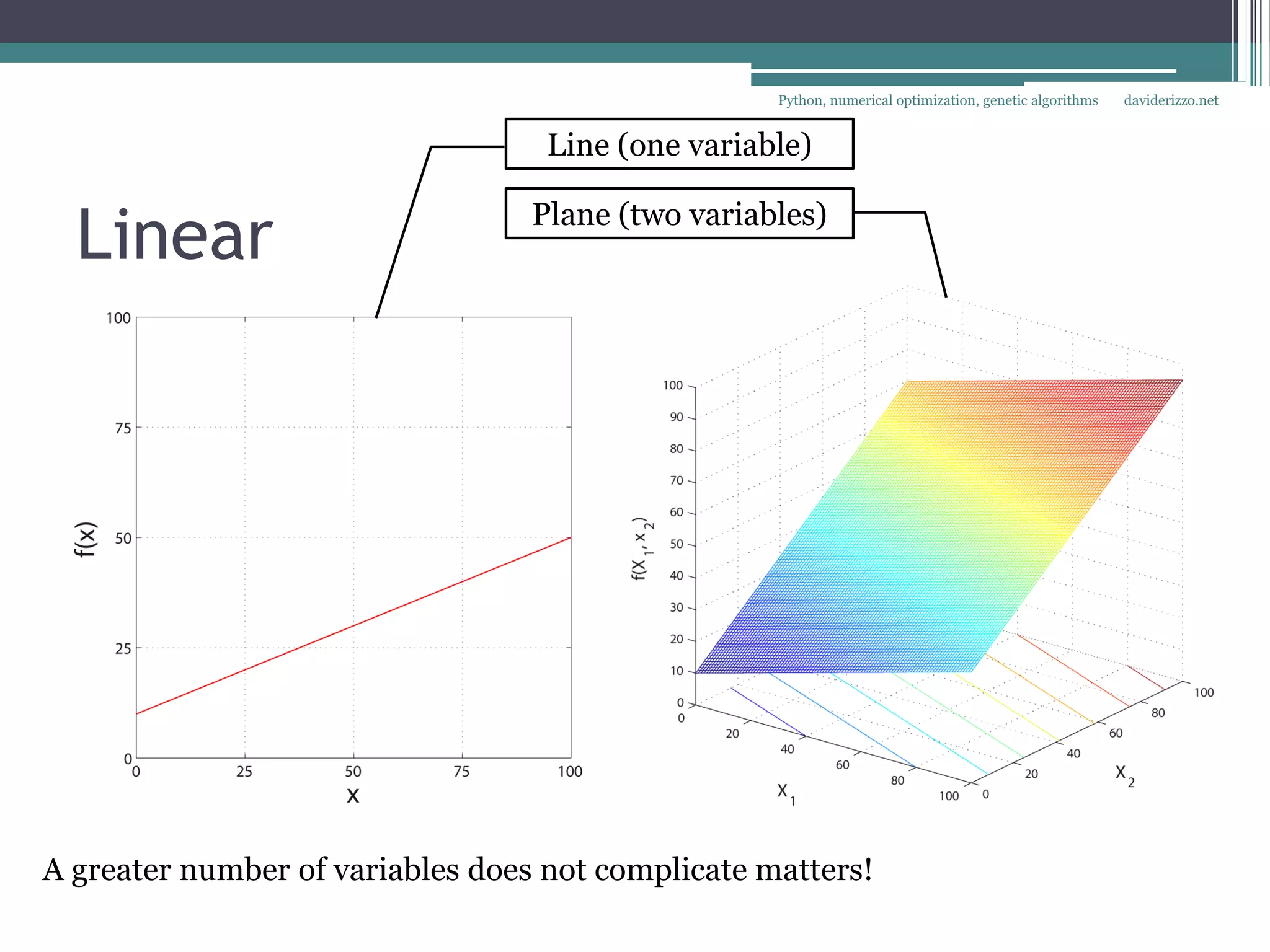
                                   Line (one variable)


  Linear                          Plane (two variables)


A greater number of variables does not complicate matters!
Python, numerical optimization, genetic algorithms   daviderizzo.net


Linear
• Linear objective function
 ▫ c0 + sum(c[i]*x[i] for i in range(len(vars)))


 ▫ Bakery example
   vars = ['flour_bread', 'flour_cookies']
   c = [1.5, 2.5]; c0 = -50
   >>> obj_fun([70, 30])
    130.0
Python, numerical optimization, genetic algorithms   daviderizzo.net


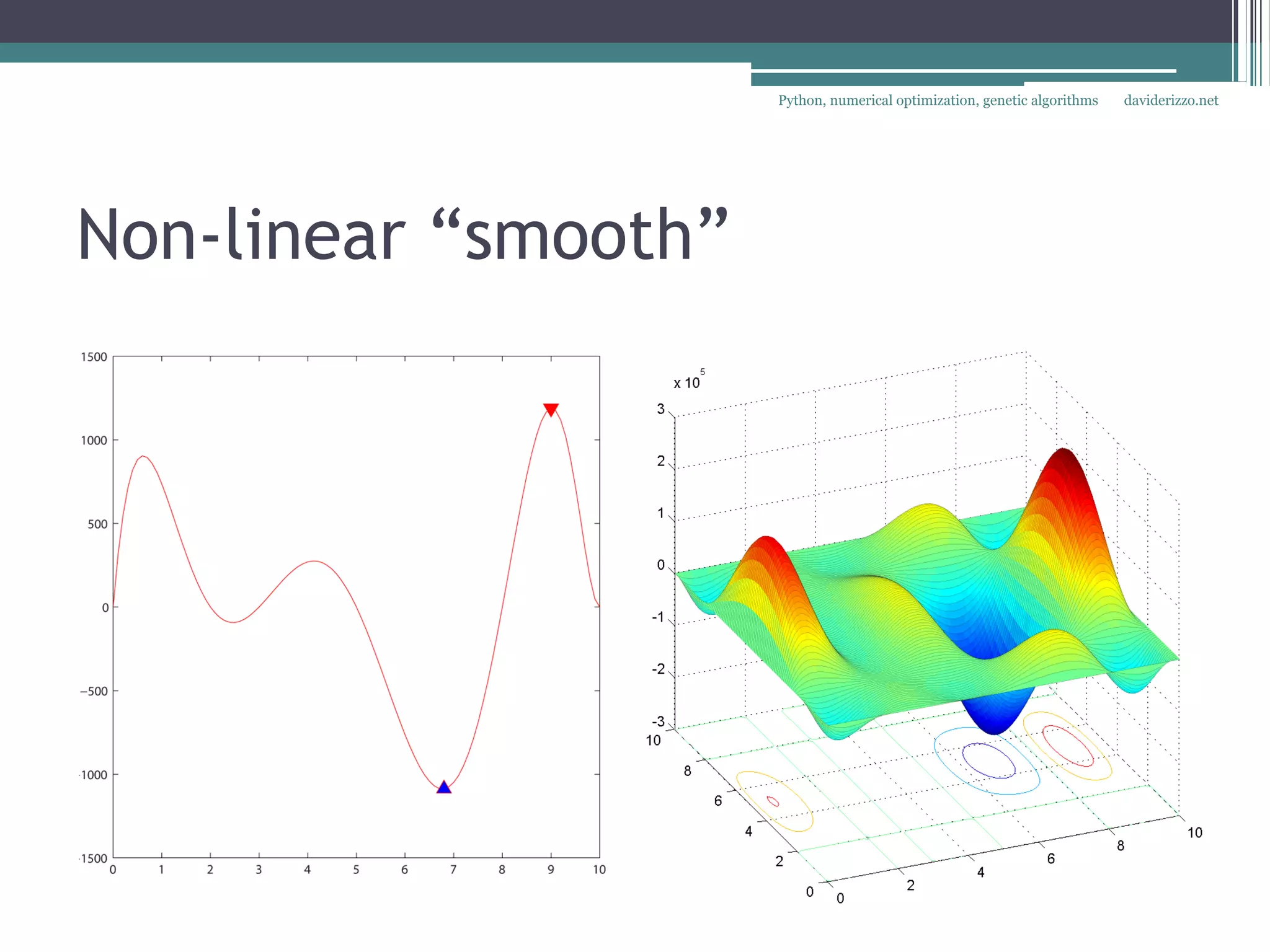
Non-linear “smooth”
Python, numerical optimization, genetic algorithms   daviderizzo.net


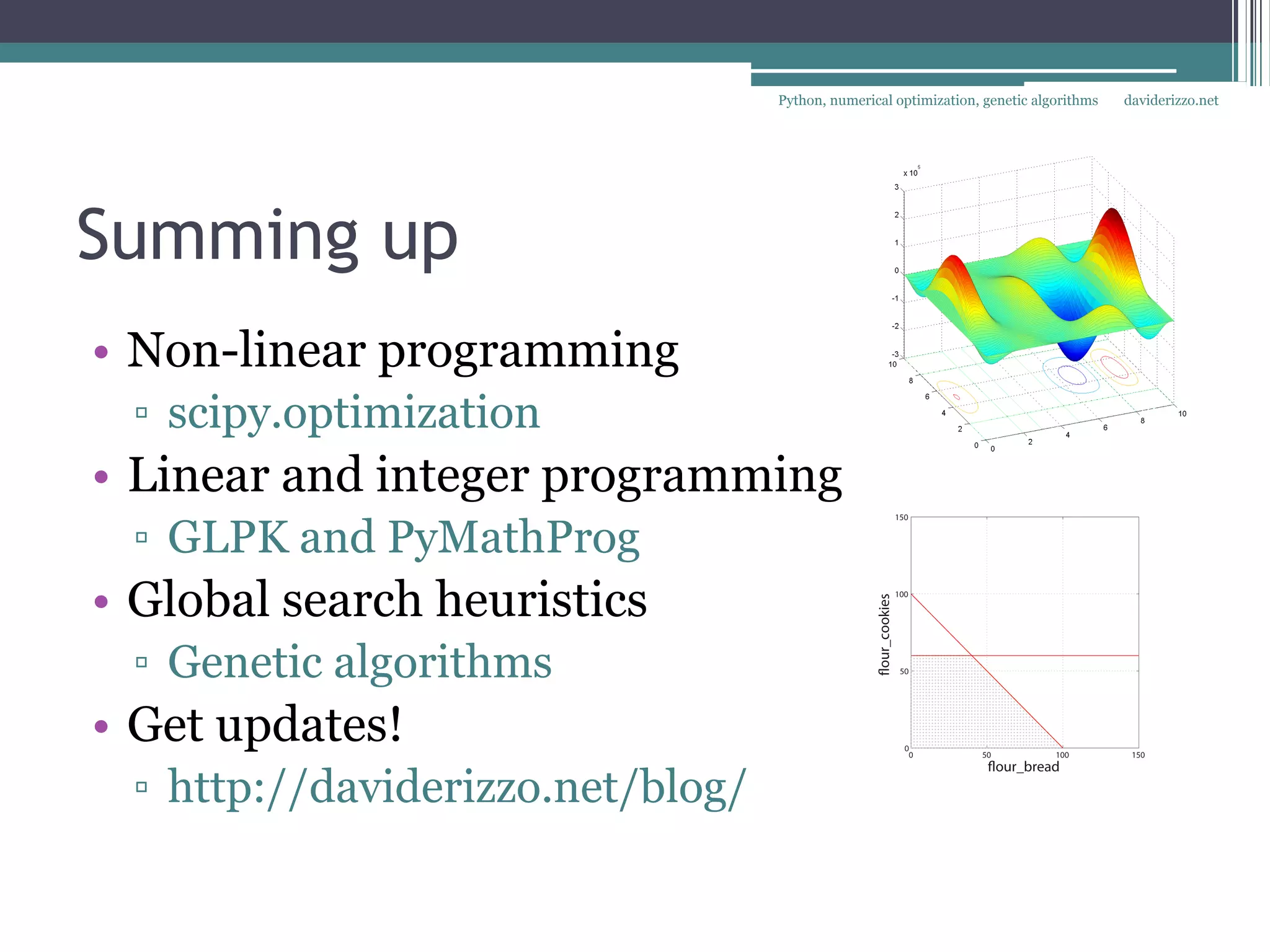
Non-linear “smooth”
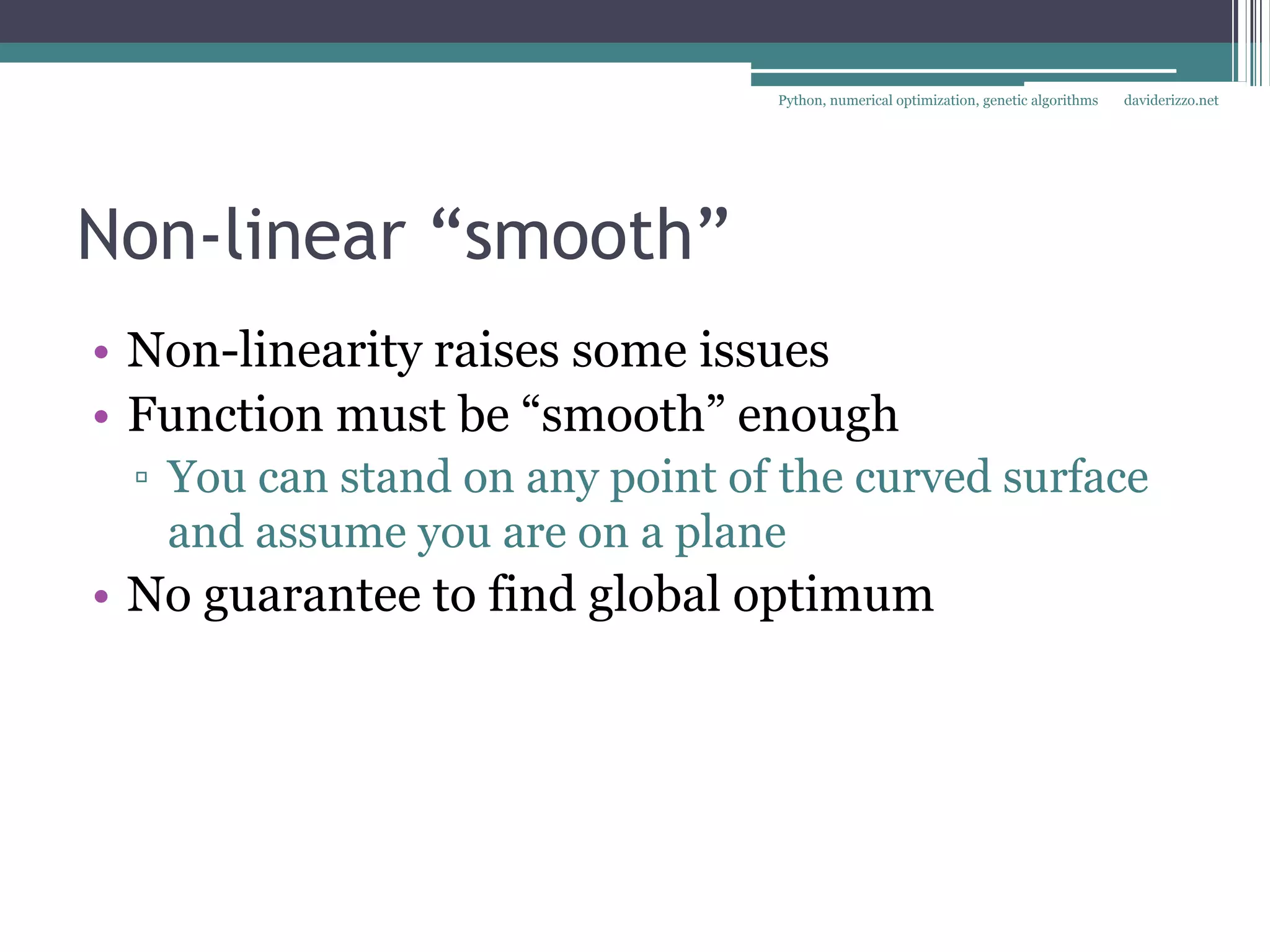
• Non-linearity raises some issues
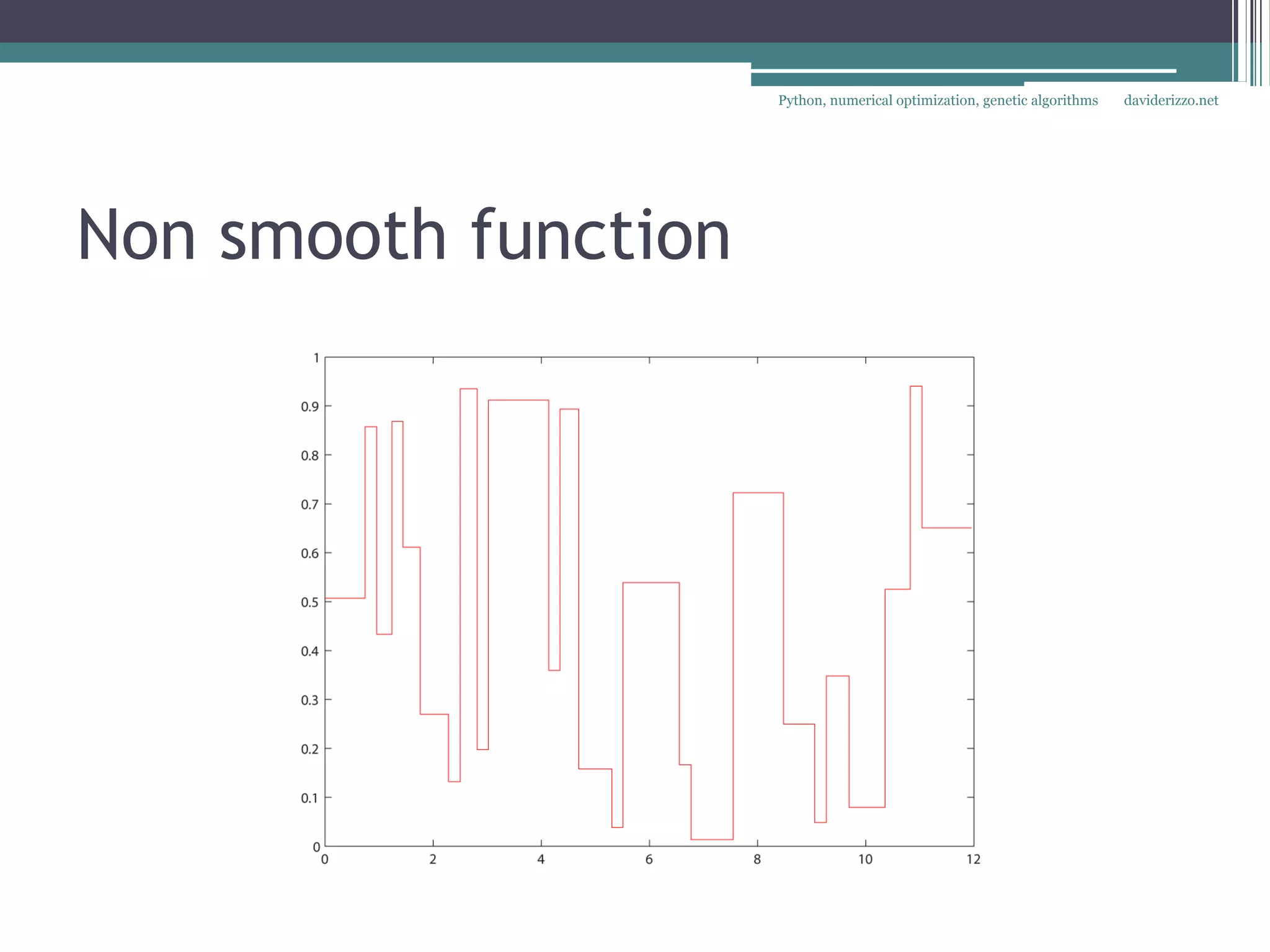
• Function must be “smooth” enough
 ▫ You can stand on any point of the curved surface
   and assume you are on a plane
• No guarantee to find global optimum
Python, numerical optimization, genetic algorithms   daviderizzo.net


Non regular function
Python, numerical optimization, genetic algorithms   daviderizzo.net


Non smooth function
Python, numerical optimization, genetic algorithms   daviderizzo.net


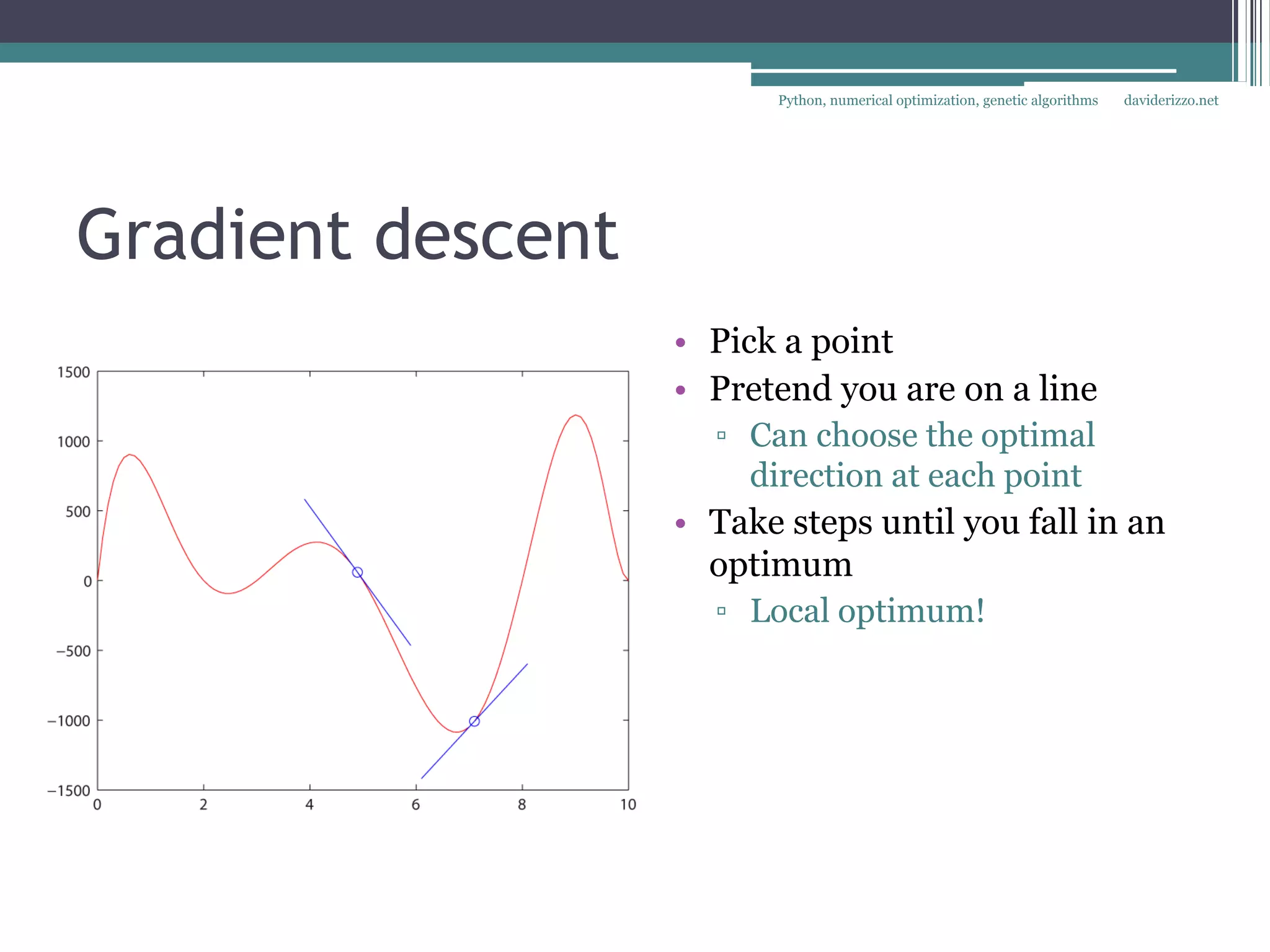
Gradient descent
                   • Pick a point
                   • Pretend you are on a line
                     ▫ Can choose the optimal
                        direction at each point
                   • Take steps until you fall in an
                     optimum
                     ▫ Local optimum!
Python, numerical optimization, genetic algorithms   daviderizzo.net


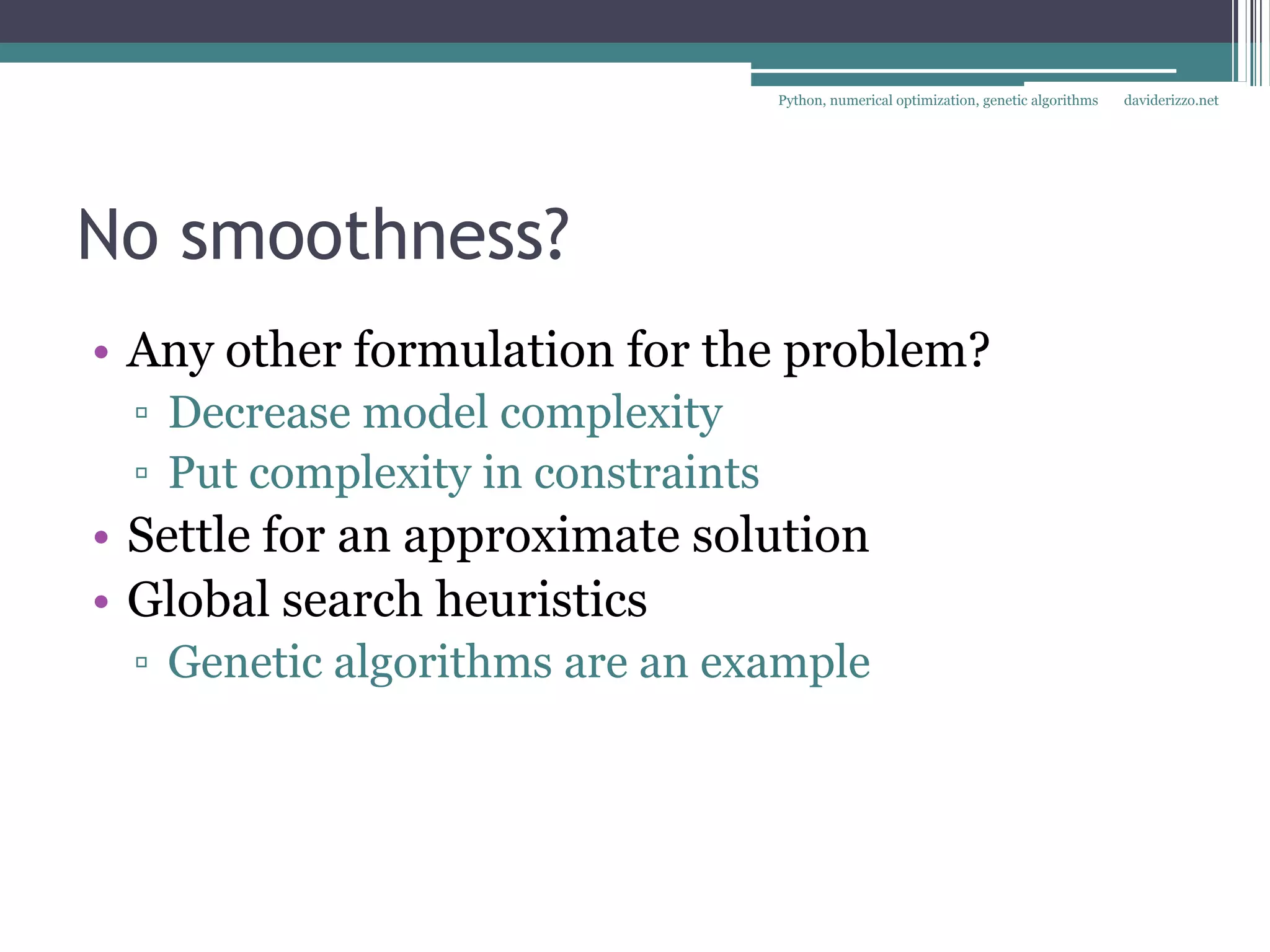
No smoothness?
• Any other formulation for the problem?
 ▫ Decrease model complexity
 ▫ Put complexity in constraints
• Settle for an approximate solution
• Global search heuristics
 ▫ Genetic algorithms are an example
Python, numerical optimization, genetic algorithms   daviderizzo.net


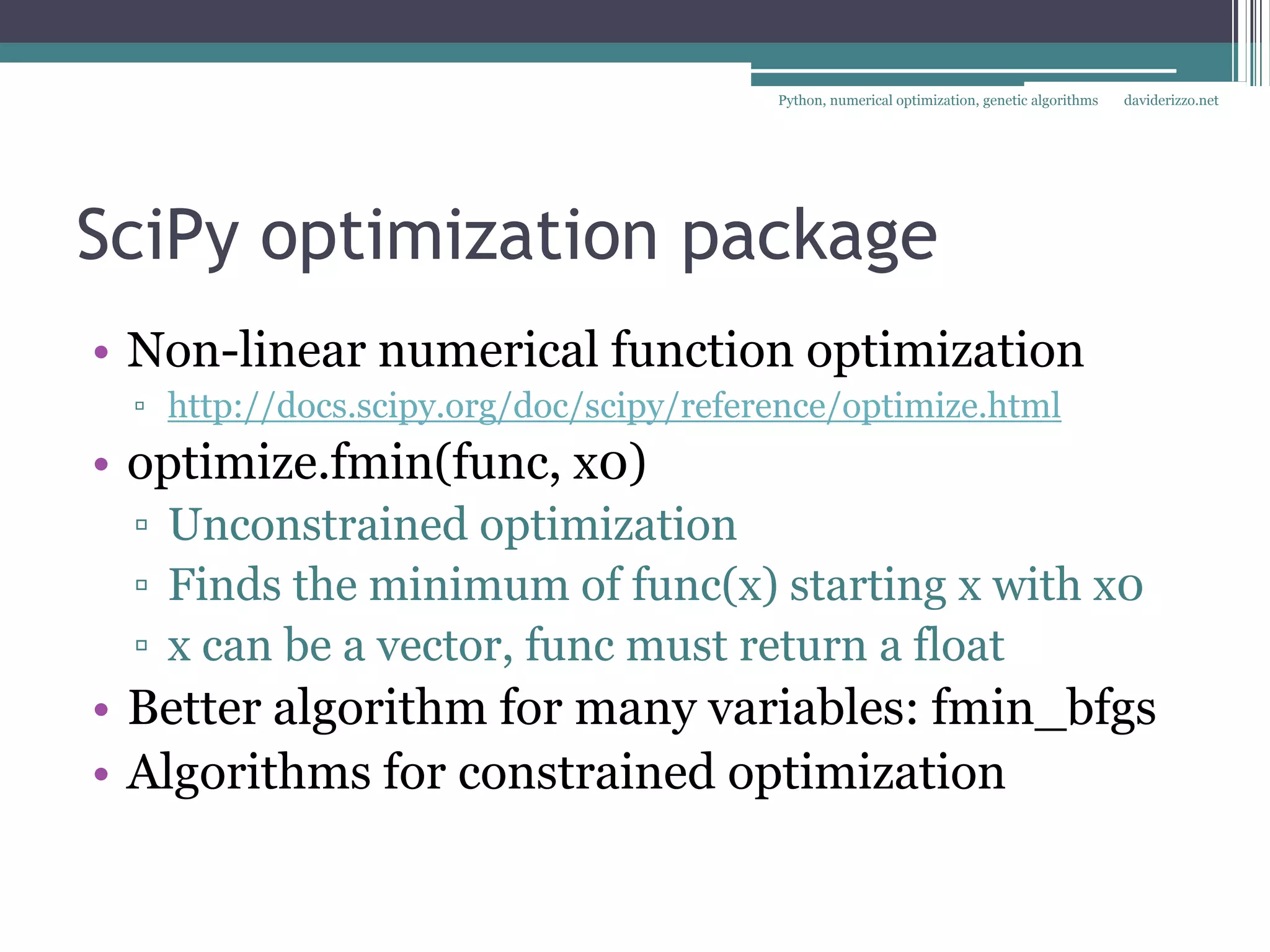
SciPy optimization package
• Non-linear numerical function optimization
 ▫ http://docs.scipy.org/doc/scipy/reference/optimize.html
• optimize.fmin(func, x0)
 ▫ Unconstrained optimization
 ▫ Finds the minimum of func(x) starting x with x0
 ▫ x can be a vector, func must return a float
• Better algorithm for many variables: fmin_bfgs
• Algorithms for constrained optimization
Python, numerical optimization, genetic algorithms   daviderizzo.net


Give me the code!
• from scipy import optimize

 def f(x):
     return x[0]**2 + (x[1]-2)**2

 print optimize.fmin(f, [0,0])

• Optimization terminated successfully.
           Current function value: 0.000000
           Iterations: 63
           Function evaluations: 120
  [ -4.04997873e-06   2.00004847e+00]
Python, numerical optimization, genetic algorithms   daviderizzo.net


Many variables
• from scipy import optimize
  from numpy import array
  from random import uniform
 n = 50
 center = array([uniform(0, 10)
                 for i in range(n)])
 def f(x):
     return sum((x-center)**2)
 optimum = optimize.fmin_bfgs(f, [0]*n)
 print optimum - center
Python, numerical optimization, genetic algorithms   daviderizzo.net


Optimization terminated successfully.
         Current function value: 0.000000
         Iterations: 3
         Function evaluations: 312
         Gradient evaluations: 6
[ 1.09850102e-08    1.00864010e-08 -3.44023343e-09            1.45686556e-08
   1.95572314e-09   1.63218594e-09   3.37632766e-09           1.44865293e-08
   1.52201984e-08   1.29321513e-08 -1.59485092e-09            1.23136292e-08
   1.62830638e-08 -3.52261820e-09 -5.56838653e-09             1.24844490e-08
   8.54035953e-09   1.55625752e-08   8.50658477e-09           1.08354117e-08
   1.62710236e-08 -3.44068374e-09 -5.63388847e-09             1.13670406e-09
   1.14938468e-08 -1.92982030e-09 -1.66206160e-09            -1.50014312e-09
   1.12226592e-08 -5.60273883e-09    3.07106607e-09           6.95412705e-09
  -4.58609706e-09   1.24199513e-08 -5.76112080e-09           -7.69927677e-10
  -6.56263044e-10 -6.08281736e-09    1.10073151e-08           3.35045769e-09
   1.25477273e-09   5.98582162e-09 -5.60075986e-10            1.00968194e-08
  -1.23273258e-09 -2.11921281e-09 -6.40983949e-09             8.99856101e-09
  -1.08943476e-09   1.55362354e-08]
Python, numerical optimization, genetic algorithms   daviderizzo.net


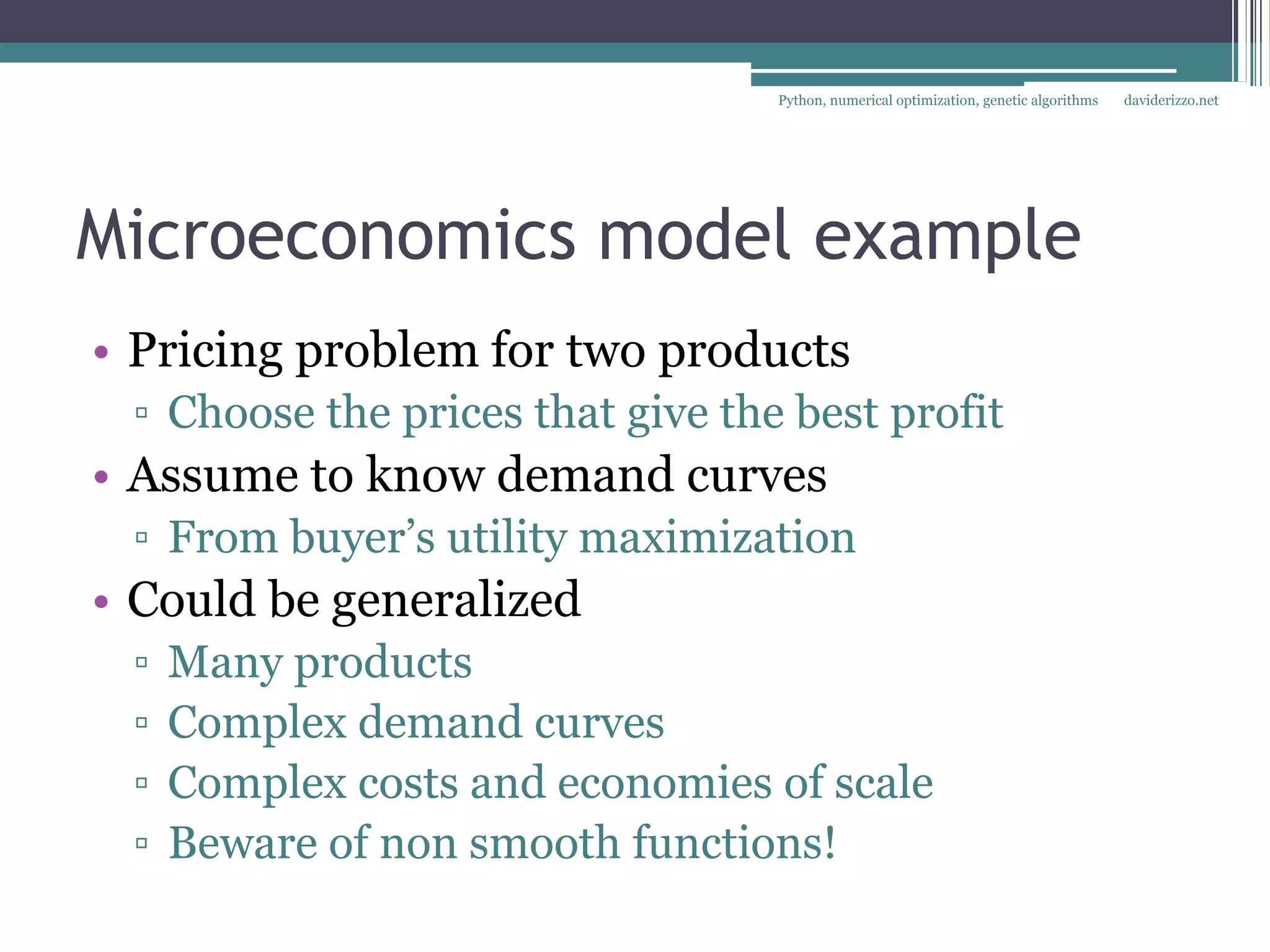
Microeconomics model example
• Pricing problem for two products
 ▫ Choose the prices that give the best profit
• Assume to know demand curves
 ▫ From buyer’s utility maximization
• Could be generalized
 ▫   Many products
 ▫   Complex demand curves
 ▫   Complex costs and economies of scale
 ▫   Beware of non smooth functions!
Python, numerical optimization, genetic algorithms   daviderizzo.net


Microeconomics model example
def profit(p1, p2):              from scipy import optimize
    x1 = demand1(p1, p2)
    x2 = demand2(p1, p2)         def objective(x):
    income = x1*p1 + x2*p2           return -profit(*x)
    cost = costf(x1, x2)
    return income - cost         price = optimize.fmin(objective,
                                                       [1, 1])
def demand1(p1, p2):
    return 20*(20 - p1)          print 'prices:', price
                                 print 'amounts:‘
def demand2(p1, p2):             print demand1(*price), demand2(*price)
    return 40*(40 - p2)

def costf(x1, x2):
    c1 = 10*(x1**0.5)
    c2 = 20*(x2**0.5) + 2*x2
    cbase = 1000 + 5*(x1 + x2)
    return c1 + c2 + cbase
Python, numerical optimization, genetic algorithms   daviderizzo.net


Microeconomics model results
Optimization terminated successfully.
         Current function value: -10381.085398
         Iterations: 63
         Function evaluations: 122
prices: [ 12.7070282   23.69579991]
amounts: 145.859435961 652.168003412
Python, numerical optimization, genetic algorithms   daviderizzo.net


Linear programming problem
• Linear objective function
  ▫ Weighted sum of variables
• Constraints are linear inequalities
  ▫ Weighted sum of some variables ≤ 0
• Variables can also be integer or binary
  ▫ Mixed integer programming
  ▫ NP-complete
Python, numerical optimization, genetic algorithms   daviderizzo.net


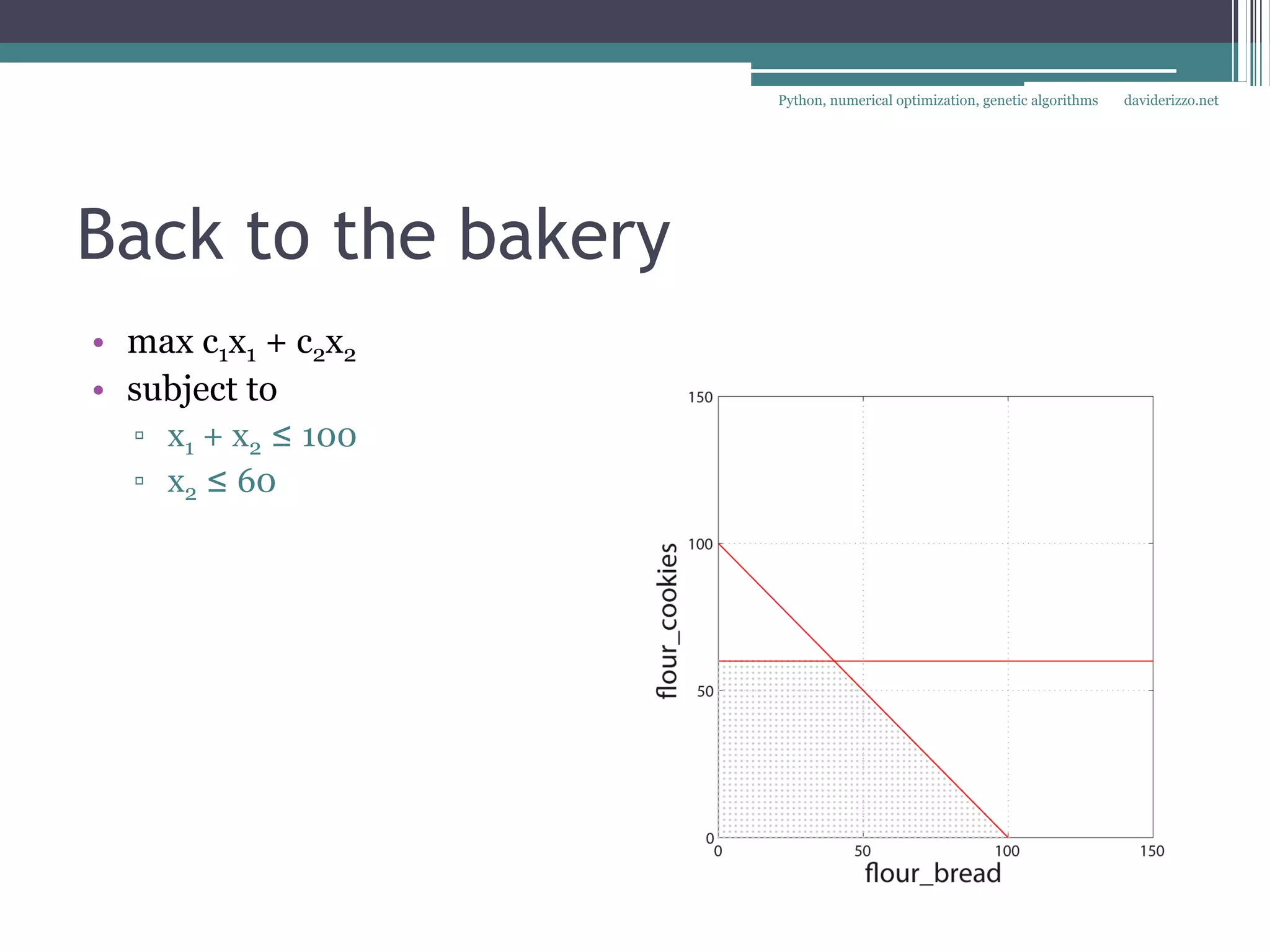
Back to the bakery
• max c1x1 + c2x2
• subject to
  ▫ x1 + x2 ≤ 100
  ▫ x2 ≤ 60
Python, numerical optimization, genetic algorithms   daviderizzo.net


GNU Linear Programming Kit
• C library for linear programming
 ▫ Bindings for many languages
• Solver for large-scale problems
 ▫ Linear programming
 ▫ Mixed integer programming
• GNU MathProg modeling language
 ▫ Subset of the AMPL proprietary language
Python, numerical optimization, genetic algorithms   daviderizzo.net


PyMathProg
• Pure Python modeling language
 ▫ http://pymprog.sourceforge.net/
 ▫ Model described with natural Python operators
• Easy integration in the process workflow
• Interface to GLPK solver
Python, numerical optimization, genetic algorithms   daviderizzo.net


PyMathProg bakery
import pymprog

# inits a model
m = pymprog.model('bakery')

# defines two named variables
x = m.var(range(2), 'x')

# objective function
m.max(1.5*x[0]+2.5*x[1])

# constraints
m.st(x[0]+x[1]<=100)
m.st(x[1]<=60)

m.solve()
print x
{0: x[0]=40.000000,
1: x[1]=60.000000}
Python, numerical optimization, genetic algorithms   daviderizzo.net


Binary variables: Sudoku
p = pymprog.model("sudoku")
I, J, K = range(9), range(9), range(1, 10)
T = pymprog.iprod(I,J,K) #create Indice tuples
x = p.var(T, 'x', bool)
#x[i,j,k] = 1 means cell [i,j] is assigned number k
#assign pre-defined numbers using the "givens"
p.st( [ +x[i,j,k] == (1 if g[i][j] == k else 0)
       for (i,j,k) in T if g[i][j] > 0 ], 'given')
#each cell must be assigned exactly one number
p.st([sum(x[i,j,k] for k in K)==1 for i in I for j in J], 'cell')
#cells in the same row must be assigned distinct numbers
p.st([sum(x[i,j,k] for j in J)==1 for i in I for k in K], 'row')
#cells in the same column must be assigned distinct numbers
p.st([sum(x[i,j,k] for i in I)==1 for j in J for k in K], 'col')
#cells in the same region must be assigned distinct numbers
p.st([sum(x[i,j,k] for i in range(r,r+3) for j in range(c, c+3))==1
    for r in range(0,9,3) for c in range(0,9,3) for k in K],'reg')
Python, numerical optimization, genetic algorithms   daviderizzo.net


CLV model example
• Marketing problem
• Potential and acquired customers
 ▫ Lifetime value (expected cash flow)
 ▫ Sensibility to promotions
• Limited budget for promotions
• Choose promotions as to maximize the total cash
  flow
Python, numerical optimization, genetic algorithms   daviderizzo.net


CLV model example code
BUDGET = 5000

# model
m = pymprog.model('clv')

y = m.var(customers, 'y', bool)
x = m.var(c_p, 'x', bool)

m.max(sum(CLV[c]*y[c] for c in customers) -
       sum(C[p]*sum(x[c,p] for c in customers) for p in promos))

m.st(sum(x[c,p]*C[p] for c, p in c_p) <= BUDGET)
for c in customers:
    m.st(y[c] <= sum(x[c,p]*S[c][p] for p in promos))

m.solve()
Python, numerical optimization, genetic algorithms   daviderizzo.net


CLV with activation costs
y = m.var(customers, 'y', bool)
x = m.var(c_p, 'x', bool)
z = m.var(promos, 'z', bool)

m.max(sum(CLV[c]*y[c] for c in customers) -
       sum(C[p]*sum(x[c,p] for c in customers) for p in promos) -
       sum(CP[p]*z[c] for p in promos))

m.st(sum(x[c,p]*C[p] for c, p in c_p)<=BUDGET)
m.st([([y[c] <= sum(x[c,p]*S[c][p] for p in promos))
       for c in customers])
m.st([(z[c] <= sum(x[c,p] for c in customers) for p in promos])
Python, numerical optimization, genetic algorithms   daviderizzo.net


«Take a bunch of random solutions, mix them randomly, repeat
an undefined number of times, get the optimum»
Python, numerical optimization, genetic algorithms   daviderizzo.net


Genetic algorithms
• Biological metaphor for an optimization
  technique
 ▫ Individual = proposed solution
 ▫ Gene = decision variable
 ▫ Fitness = objective function
• Natural selection-like
 ▫ The most fit individuals breed
 ▫ The children are similar to the parents
 ▫ Every generation better than the previous one
Python, numerical optimization, genetic algorithms   daviderizzo.net


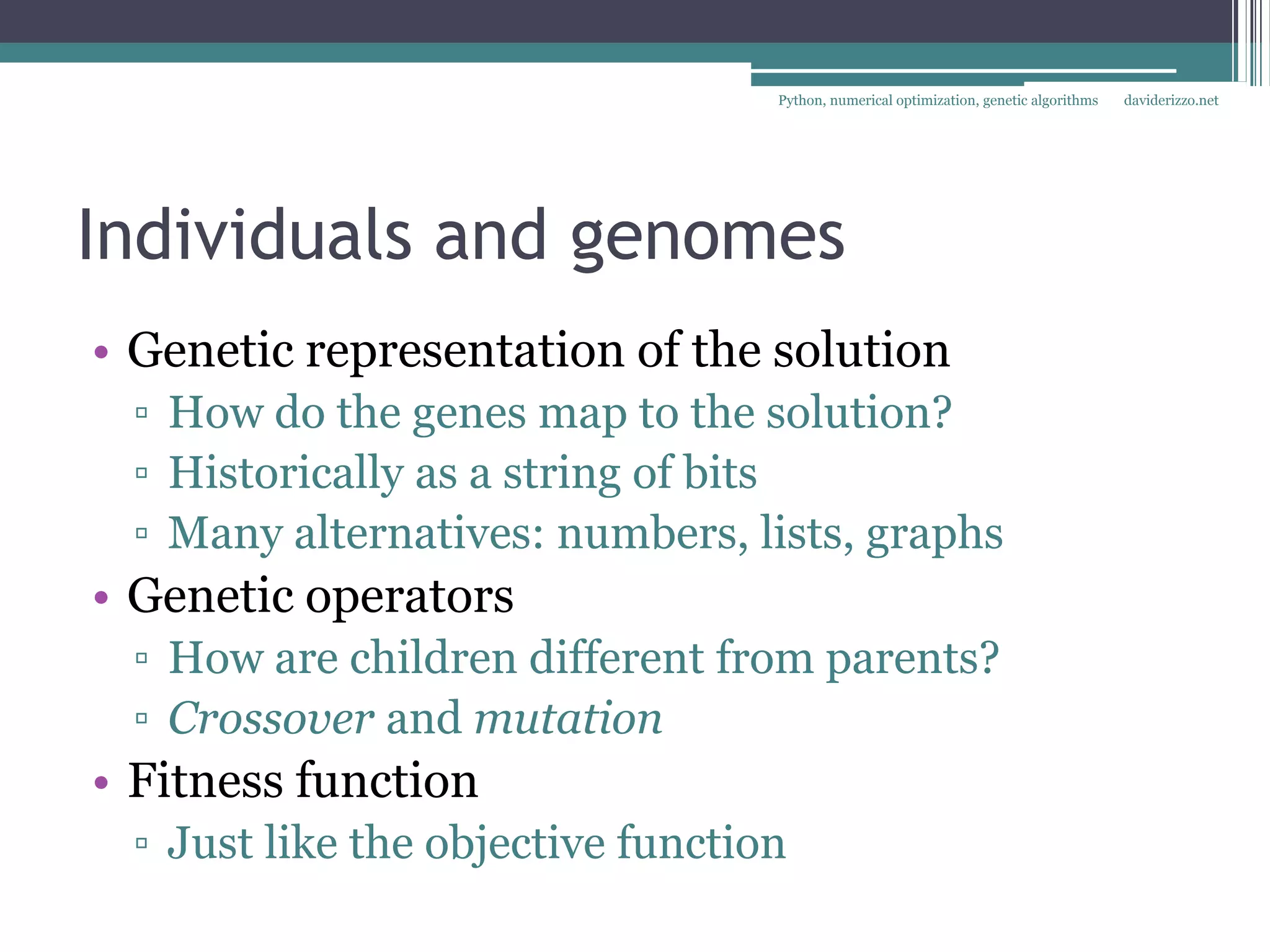
Individuals and genomes
• Genetic representation of the solution
 ▫ How do the genes map to the solution?
 ▫ Historically as a string of bits
 ▫ Many alternatives: numbers, lists, graphs
• Genetic operators
 ▫ How are children different from parents?
 ▫ Crossover and mutation
• Fitness function
 ▫ Just like the objective function
Python, numerical optimization, genetic algorithms   daviderizzo.net


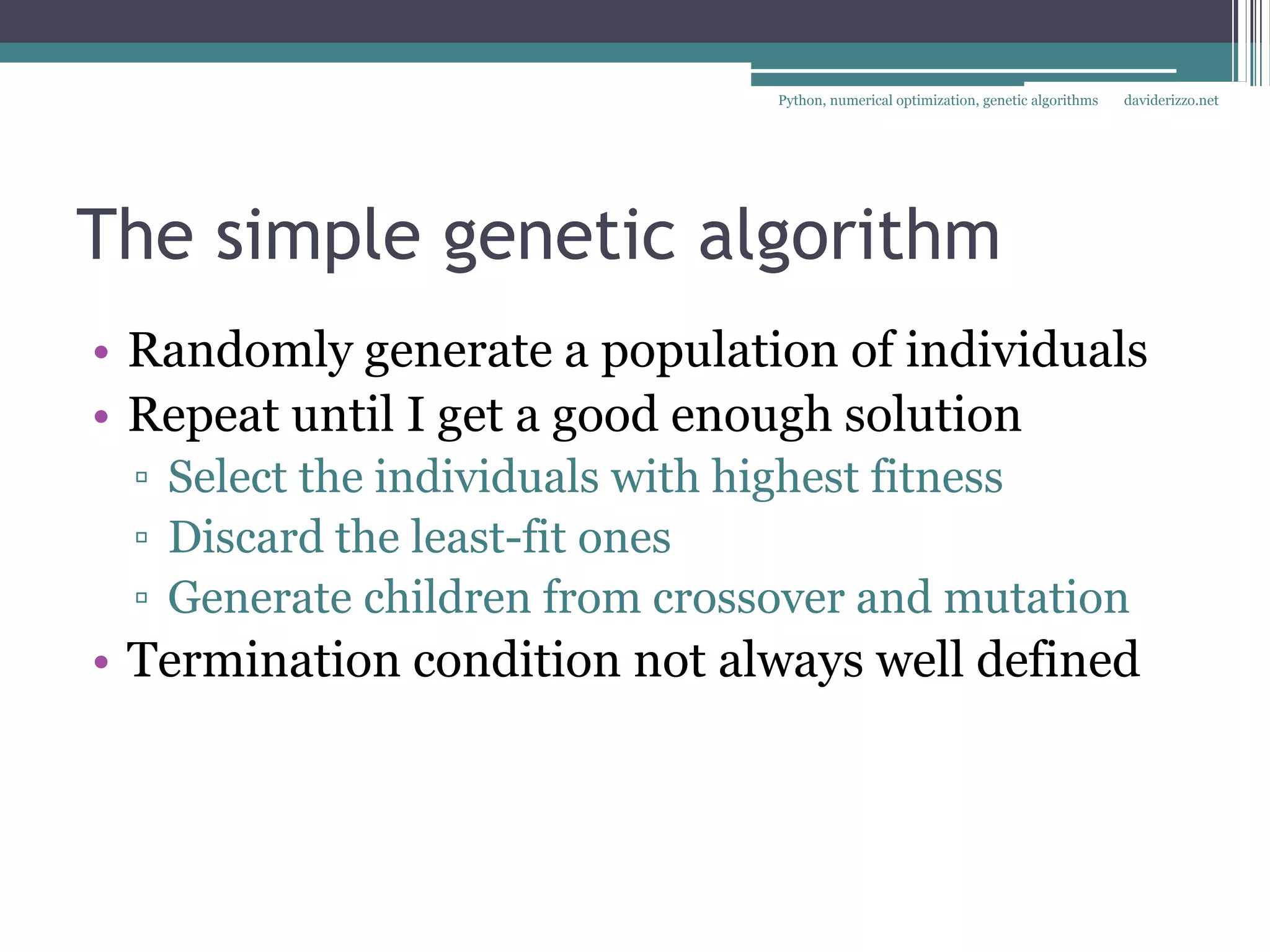
The simple genetic algorithm
• Randomly generate a population of individuals
• Repeat until I get a good enough solution
 ▫ Select the individuals with highest fitness
 ▫ Discard the least-fit ones
 ▫ Generate children from crossover and mutation
• Termination condition not always well defined
Python, numerical optimization, genetic algorithms   daviderizzo.net


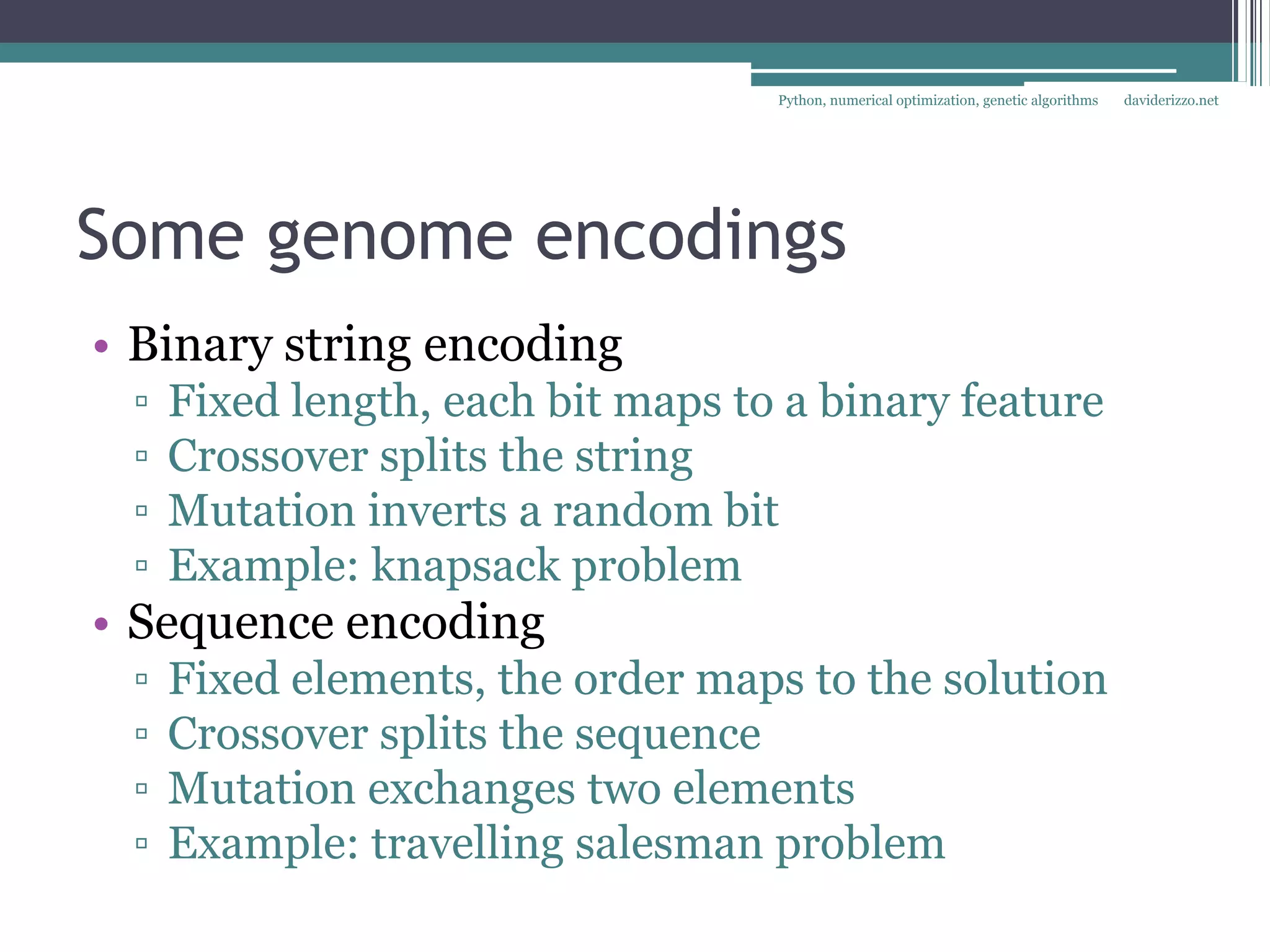
Some genome encodings
• Binary string encoding
 ▫   Fixed length, each bit maps to a binary feature
 ▫   Crossover splits the string
 ▫   Mutation inverts a random bit
 ▫   Example: knapsack problem
• Sequence encoding
 ▫   Fixed elements, the order maps to the solution
 ▫   Crossover splits the sequence
 ▫   Mutation exchanges two elements
 ▫   Example: travelling salesman problem
Python, numerical optimization, genetic algorithms   daviderizzo.net


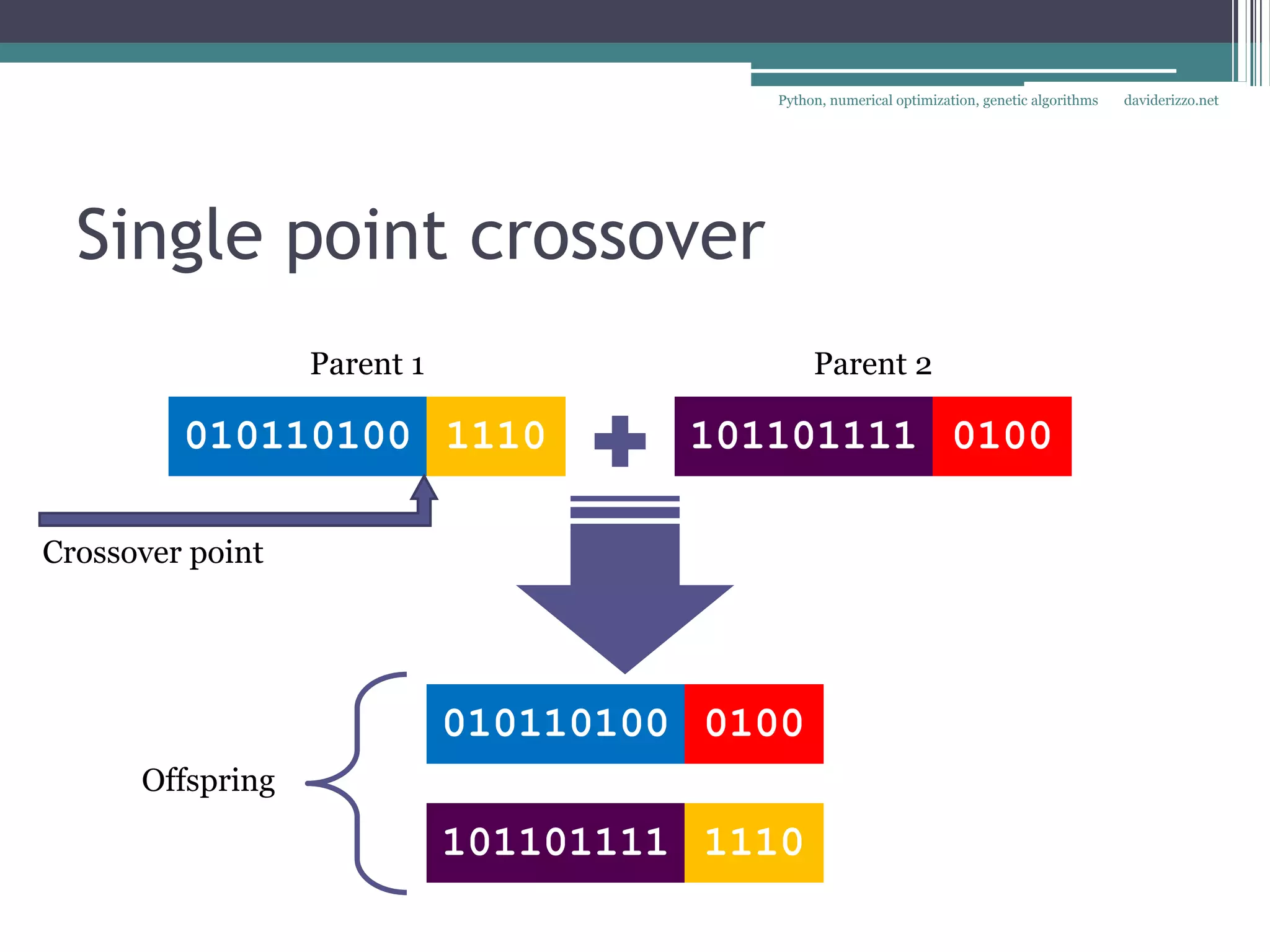
  Single point crossover
                  Parent 1                    Parent 2

         010110100 1110               101101111 0100

Crossover point


                             010110100 0100
      Offspring

                             101101111 1110
Python, numerical optimization, genetic algorithms   daviderizzo.net


Example: knapsack problem
Python, numerical optimization, genetic algorithms   daviderizzo.net


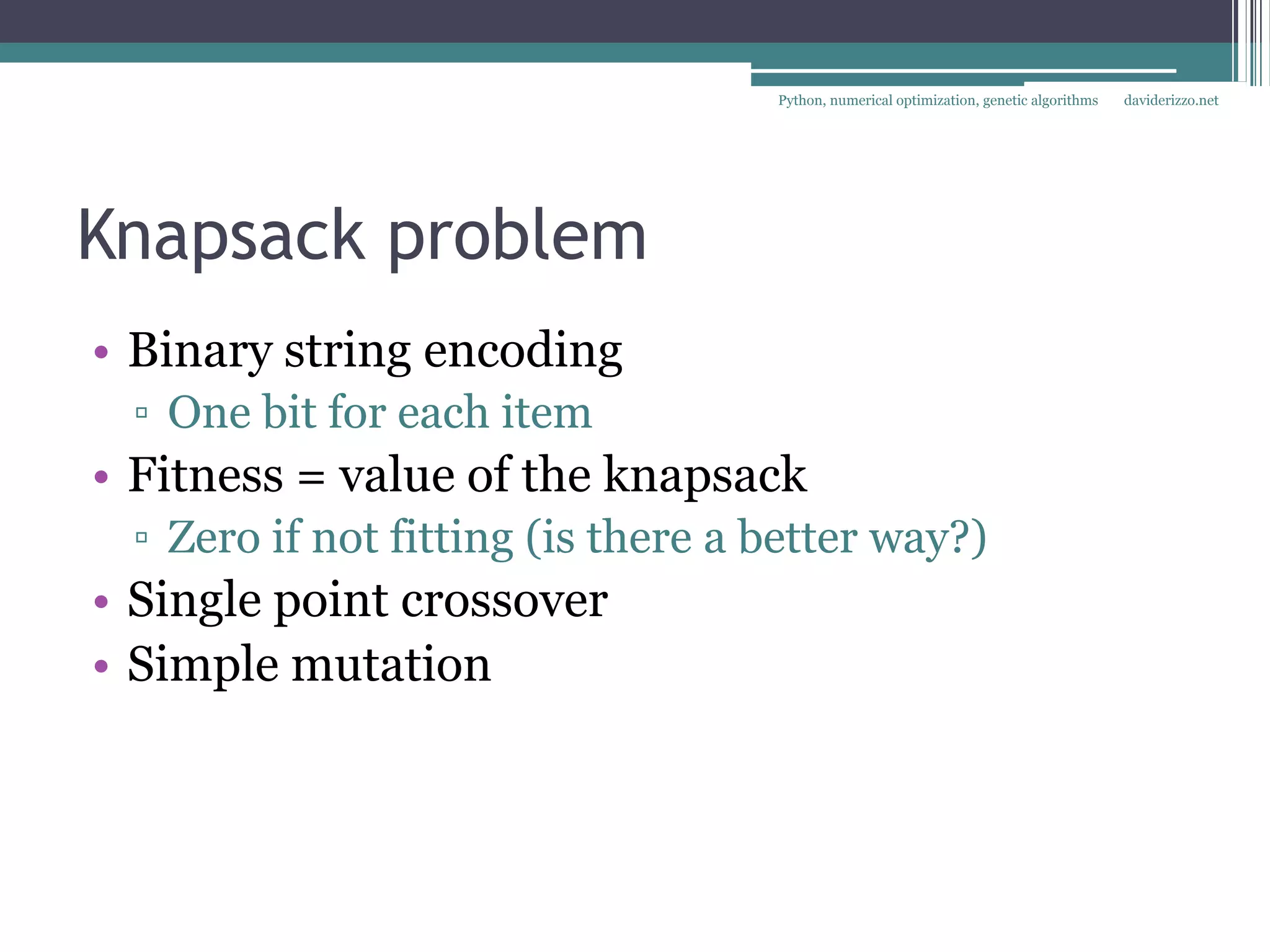
Knapsack problem
• Binary string encoding
 ▫ One bit for each item
• Fitness = value of the knapsack
 ▫ Zero if not fitting (is there a better way?)
• Single point crossover
• Simple mutation
Python, numerical optimization, genetic algorithms   daviderizzo.net


GAs pros and cons
•   Very easy to implement
•   Quite easy to get right
•   Good at problems where exact methods fail
•   Relatively very slow
•   Don’t scale well
•   Not well defined end condition
Python, numerical optimization, genetic algorithms   daviderizzo.net


Summing up
• Non-linear programming
 ▫ scipy.optimization
• Linear and integer programming
 ▫ GLPK and PyMathProg
• Global search heuristics
 ▫ Genetic algorithms
• Get updates!
 ▫ http://daviderizzo.net/blog/
Python, numerical optimization, genetic algorithms   daviderizzo.net

Python: ottimizzazione numerica algoritmi genetici

  • 1.
    Python, numerical optimization, geneticalgorithms Davide Rizzo PyCon Italia Qu4ttro daviderizzo.net
  • 2.
    Python, numerical optimization,genetic algorithms daviderizzo.net Optimization • Actually operations research ▫ Mathematical optimization is the tool • Applied maths ▫ Major academic and industrial research topic • Computationally oriented ▫ Many commercial solutions ▫ Yes, you can use Python • Not code optimization!
  • 3.
    Python, numerical optimization,genetic algorithms daviderizzo.net Operations research applications • Airlines ▫ scheduling planes and crews, pricing tickets, taking reservations, and planning fleet size • Logistics ▫ routing and planning • Financial services ▫ credit scoring, marketing, and internal operations • Deployment of emergency services • Policy studies and regulation ▫ environmental pollution, air traffic safety, AIDS, and criminal justice policy
  • 4.
    Python, numerical optimization,genetic algorithms daviderizzo.net More operations research applications • Project planning • Network optimization • Resources allocation • Supply chain management • Automation • Scheduling • Pricing
  • 5.
    Python, numerical optimization,genetic algorithms daviderizzo.net Optimization problem • Many decision variables ▫ How should I price my new products? ▫ How many server resources should I assign to each client? • An objective ▫ Maximize net profit ▫ Minimize client waiting time
  • 6.
    Python, numerical optimization,genetic algorithms daviderizzo.net Objective function • Objective: find the best choice for the decision variables ▫ the values that give the maximum yield (or the minimum cost) • Objective function: the yield (or the cost) I get for a given choice
  • 7.
    Python, numerical optimization,genetic algorithms daviderizzo.net Decisions and objectives • I buy 100kg flour at 50€ ▫ Want to decide how to use it • 70kg -> bread, 30kg -> cookies ▫ Decision variables  X = 70, 30 • Sell 105€ of bread and 75€ of cookies ▫ Objective function value:  f(X) = 105 + 75 – 50 = 130€
  • 8.
    Python, numerical optimization,genetic algorithms daviderizzo.net Visualizing the problem
  • 9.
    Python, numerical optimization,genetic algorithms daviderizzo.net Constraints • Not every solution is good • 100kg flour → can’t use 150kg for bread ▫ flour_bread + flour_cookies ≤ 100
  • 10.
    Python, numerical optimization,genetic algorithms daviderizzo.net Constraints • Inequalities often describe constraints • Many constraints ▫ There are problems with thousands inequalities • Limited sugar ▫ 1 part sugar, 3 parts flour ▫ 20 kg sugar available ▫ flour_cookies < 60
  • 11.
    Python, numerical optimization,genetic algorithms daviderizzo.net Search vs. optimization Search algorithms Optimization algorithms • Well-known among • Broader class of problems programmers ▫ Includes search problems • Include tree-search and graph- • Continuous search space search algorithms ▫ Discrete as a special case • Work on a discrete search • Search algorithms used to space solve many optimization problems
  • 12.
    Python, numerical optimization,genetic algorithms daviderizzo.net Finding the optimum in linear and non-linear problems with exact methods
  • 13.
    Python, numerical optimization,genetic algorithms daviderizzo.net Objective function classification • General theory for every problem ▫ Very good results for simple problems • Objective function structure ▫ Smoothness and regularity determine complexity ▫ Good guarantees for linear functions ▫ No exact results if irregular • Factors other than objective functions ▫ Constraints ▫ Integrality on variables
  • 14.
    Python, numerical optimization,genetic algorithms daviderizzo.net Line (one variable) Linear Plane (two variables) A greater number of variables does not complicate matters!
  • 15.
    Python, numerical optimization,genetic algorithms daviderizzo.net Linear • Linear objective function ▫ c0 + sum(c[i]*x[i] for i in range(len(vars))) ▫ Bakery example vars = ['flour_bread', 'flour_cookies'] c = [1.5, 2.5]; c0 = -50 >>> obj_fun([70, 30]) 130.0
  • 16.
    Python, numerical optimization,genetic algorithms daviderizzo.net Non-linear “smooth”
  • 17.
    Python, numerical optimization,genetic algorithms daviderizzo.net Non-linear “smooth” • Non-linearity raises some issues • Function must be “smooth” enough ▫ You can stand on any point of the curved surface and assume you are on a plane • No guarantee to find global optimum
  • 18.
    Python, numerical optimization,genetic algorithms daviderizzo.net Non regular function
  • 19.
    Python, numerical optimization,genetic algorithms daviderizzo.net Non smooth function
  • 20.
    Python, numerical optimization,genetic algorithms daviderizzo.net Gradient descent • Pick a point • Pretend you are on a line ▫ Can choose the optimal direction at each point • Take steps until you fall in an optimum ▫ Local optimum!
  • 21.
    Python, numerical optimization,genetic algorithms daviderizzo.net No smoothness? • Any other formulation for the problem? ▫ Decrease model complexity ▫ Put complexity in constraints • Settle for an approximate solution • Global search heuristics ▫ Genetic algorithms are an example
  • 22.
    Python, numerical optimization,genetic algorithms daviderizzo.net SciPy optimization package • Non-linear numerical function optimization ▫ http://docs.scipy.org/doc/scipy/reference/optimize.html • optimize.fmin(func, x0) ▫ Unconstrained optimization ▫ Finds the minimum of func(x) starting x with x0 ▫ x can be a vector, func must return a float • Better algorithm for many variables: fmin_bfgs • Algorithms for constrained optimization
  • 23.
    Python, numerical optimization,genetic algorithms daviderizzo.net Give me the code! • from scipy import optimize def f(x): return x[0]**2 + (x[1]-2)**2 print optimize.fmin(f, [0,0]) • Optimization terminated successfully. Current function value: 0.000000 Iterations: 63 Function evaluations: 120 [ -4.04997873e-06 2.00004847e+00]
  • 24.
    Python, numerical optimization,genetic algorithms daviderizzo.net Many variables • from scipy import optimize from numpy import array from random import uniform n = 50 center = array([uniform(0, 10) for i in range(n)]) def f(x): return sum((x-center)**2) optimum = optimize.fmin_bfgs(f, [0]*n) print optimum - center
  • 25.
    Python, numerical optimization,genetic algorithms daviderizzo.net Optimization terminated successfully. Current function value: 0.000000 Iterations: 3 Function evaluations: 312 Gradient evaluations: 6 [ 1.09850102e-08 1.00864010e-08 -3.44023343e-09 1.45686556e-08 1.95572314e-09 1.63218594e-09 3.37632766e-09 1.44865293e-08 1.52201984e-08 1.29321513e-08 -1.59485092e-09 1.23136292e-08 1.62830638e-08 -3.52261820e-09 -5.56838653e-09 1.24844490e-08 8.54035953e-09 1.55625752e-08 8.50658477e-09 1.08354117e-08 1.62710236e-08 -3.44068374e-09 -5.63388847e-09 1.13670406e-09 1.14938468e-08 -1.92982030e-09 -1.66206160e-09 -1.50014312e-09 1.12226592e-08 -5.60273883e-09 3.07106607e-09 6.95412705e-09 -4.58609706e-09 1.24199513e-08 -5.76112080e-09 -7.69927677e-10 -6.56263044e-10 -6.08281736e-09 1.10073151e-08 3.35045769e-09 1.25477273e-09 5.98582162e-09 -5.60075986e-10 1.00968194e-08 -1.23273258e-09 -2.11921281e-09 -6.40983949e-09 8.99856101e-09 -1.08943476e-09 1.55362354e-08]
  • 26.
    Python, numerical optimization,genetic algorithms daviderizzo.net Microeconomics model example • Pricing problem for two products ▫ Choose the prices that give the best profit • Assume to know demand curves ▫ From buyer’s utility maximization • Could be generalized ▫ Many products ▫ Complex demand curves ▫ Complex costs and economies of scale ▫ Beware of non smooth functions!
  • 27.
    Python, numerical optimization,genetic algorithms daviderizzo.net Microeconomics model example def profit(p1, p2): from scipy import optimize x1 = demand1(p1, p2) x2 = demand2(p1, p2) def objective(x): income = x1*p1 + x2*p2 return -profit(*x) cost = costf(x1, x2) return income - cost price = optimize.fmin(objective, [1, 1]) def demand1(p1, p2): return 20*(20 - p1) print 'prices:', price print 'amounts:‘ def demand2(p1, p2): print demand1(*price), demand2(*price) return 40*(40 - p2) def costf(x1, x2): c1 = 10*(x1**0.5) c2 = 20*(x2**0.5) + 2*x2 cbase = 1000 + 5*(x1 + x2) return c1 + c2 + cbase
  • 28.
    Python, numerical optimization,genetic algorithms daviderizzo.net Microeconomics model results Optimization terminated successfully. Current function value: -10381.085398 Iterations: 63 Function evaluations: 122 prices: [ 12.7070282 23.69579991] amounts: 145.859435961 652.168003412
  • 29.
    Python, numerical optimization,genetic algorithms daviderizzo.net Linear programming problem • Linear objective function ▫ Weighted sum of variables • Constraints are linear inequalities ▫ Weighted sum of some variables ≤ 0 • Variables can also be integer or binary ▫ Mixed integer programming ▫ NP-complete
  • 30.
    Python, numerical optimization,genetic algorithms daviderizzo.net Back to the bakery • max c1x1 + c2x2 • subject to ▫ x1 + x2 ≤ 100 ▫ x2 ≤ 60
  • 31.
    Python, numerical optimization,genetic algorithms daviderizzo.net GNU Linear Programming Kit • C library for linear programming ▫ Bindings for many languages • Solver for large-scale problems ▫ Linear programming ▫ Mixed integer programming • GNU MathProg modeling language ▫ Subset of the AMPL proprietary language
  • 32.
    Python, numerical optimization,genetic algorithms daviderizzo.net PyMathProg • Pure Python modeling language ▫ http://pymprog.sourceforge.net/ ▫ Model described with natural Python operators • Easy integration in the process workflow • Interface to GLPK solver
  • 33.
    Python, numerical optimization,genetic algorithms daviderizzo.net PyMathProg bakery import pymprog # inits a model m = pymprog.model('bakery') # defines two named variables x = m.var(range(2), 'x') # objective function m.max(1.5*x[0]+2.5*x[1]) # constraints m.st(x[0]+x[1]<=100) m.st(x[1]<=60) m.solve() print x {0: x[0]=40.000000, 1: x[1]=60.000000}
  • 34.
    Python, numerical optimization,genetic algorithms daviderizzo.net Binary variables: Sudoku p = pymprog.model("sudoku") I, J, K = range(9), range(9), range(1, 10) T = pymprog.iprod(I,J,K) #create Indice tuples x = p.var(T, 'x', bool) #x[i,j,k] = 1 means cell [i,j] is assigned number k #assign pre-defined numbers using the "givens" p.st( [ +x[i,j,k] == (1 if g[i][j] == k else 0) for (i,j,k) in T if g[i][j] > 0 ], 'given') #each cell must be assigned exactly one number p.st([sum(x[i,j,k] for k in K)==1 for i in I for j in J], 'cell') #cells in the same row must be assigned distinct numbers p.st([sum(x[i,j,k] for j in J)==1 for i in I for k in K], 'row') #cells in the same column must be assigned distinct numbers p.st([sum(x[i,j,k] for i in I)==1 for j in J for k in K], 'col') #cells in the same region must be assigned distinct numbers p.st([sum(x[i,j,k] for i in range(r,r+3) for j in range(c, c+3))==1 for r in range(0,9,3) for c in range(0,9,3) for k in K],'reg')
  • 35.
    Python, numerical optimization,genetic algorithms daviderizzo.net CLV model example • Marketing problem • Potential and acquired customers ▫ Lifetime value (expected cash flow) ▫ Sensibility to promotions • Limited budget for promotions • Choose promotions as to maximize the total cash flow
  • 36.
    Python, numerical optimization,genetic algorithms daviderizzo.net CLV model example code BUDGET = 5000 # model m = pymprog.model('clv') y = m.var(customers, 'y', bool) x = m.var(c_p, 'x', bool) m.max(sum(CLV[c]*y[c] for c in customers) - sum(C[p]*sum(x[c,p] for c in customers) for p in promos)) m.st(sum(x[c,p]*C[p] for c, p in c_p) <= BUDGET) for c in customers: m.st(y[c] <= sum(x[c,p]*S[c][p] for p in promos)) m.solve()
  • 37.
    Python, numerical optimization,genetic algorithms daviderizzo.net CLV with activation costs y = m.var(customers, 'y', bool) x = m.var(c_p, 'x', bool) z = m.var(promos, 'z', bool) m.max(sum(CLV[c]*y[c] for c in customers) - sum(C[p]*sum(x[c,p] for c in customers) for p in promos) - sum(CP[p]*z[c] for p in promos)) m.st(sum(x[c,p]*C[p] for c, p in c_p)<=BUDGET) m.st([([y[c] <= sum(x[c,p]*S[c][p] for p in promos)) for c in customers]) m.st([(z[c] <= sum(x[c,p] for c in customers) for p in promos])
  • 38.
    Python, numerical optimization,genetic algorithms daviderizzo.net «Take a bunch of random solutions, mix them randomly, repeat an undefined number of times, get the optimum»
  • 39.
    Python, numerical optimization,genetic algorithms daviderizzo.net Genetic algorithms • Biological metaphor for an optimization technique ▫ Individual = proposed solution ▫ Gene = decision variable ▫ Fitness = objective function • Natural selection-like ▫ The most fit individuals breed ▫ The children are similar to the parents ▫ Every generation better than the previous one
  • 40.
    Python, numerical optimization,genetic algorithms daviderizzo.net Individuals and genomes • Genetic representation of the solution ▫ How do the genes map to the solution? ▫ Historically as a string of bits ▫ Many alternatives: numbers, lists, graphs • Genetic operators ▫ How are children different from parents? ▫ Crossover and mutation • Fitness function ▫ Just like the objective function
  • 41.
    Python, numerical optimization,genetic algorithms daviderizzo.net The simple genetic algorithm • Randomly generate a population of individuals • Repeat until I get a good enough solution ▫ Select the individuals with highest fitness ▫ Discard the least-fit ones ▫ Generate children from crossover and mutation • Termination condition not always well defined
  • 42.
    Python, numerical optimization,genetic algorithms daviderizzo.net Some genome encodings • Binary string encoding ▫ Fixed length, each bit maps to a binary feature ▫ Crossover splits the string ▫ Mutation inverts a random bit ▫ Example: knapsack problem • Sequence encoding ▫ Fixed elements, the order maps to the solution ▫ Crossover splits the sequence ▫ Mutation exchanges two elements ▫ Example: travelling salesman problem
  • 43.
    Python, numerical optimization,genetic algorithms daviderizzo.net Single point crossover Parent 1 Parent 2 010110100 1110 101101111 0100 Crossover point 010110100 0100 Offspring 101101111 1110
  • 44.
    Python, numerical optimization,genetic algorithms daviderizzo.net Example: knapsack problem
  • 45.
    Python, numerical optimization,genetic algorithms daviderizzo.net Knapsack problem • Binary string encoding ▫ One bit for each item • Fitness = value of the knapsack ▫ Zero if not fitting (is there a better way?) • Single point crossover • Simple mutation
  • 46.
    Python, numerical optimization,genetic algorithms daviderizzo.net GAs pros and cons • Very easy to implement • Quite easy to get right • Good at problems where exact methods fail • Relatively very slow • Don’t scale well • Not well defined end condition
  • 47.
    Python, numerical optimization,genetic algorithms daviderizzo.net Summing up • Non-linear programming ▫ scipy.optimization • Linear and integer programming ▫ GLPK and PyMathProg • Global search heuristics ▫ Genetic algorithms • Get updates! ▫ http://daviderizzo.net/blog/
  • 48.
    Python, numerical optimization,genetic algorithms daviderizzo.net