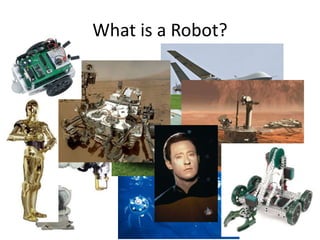
What is a Robot?
What is a Robot? 
• An automatic mechanical device 
• Usually an electro-mechanical machine guided 
by a computer program or electronic circuitry.
Why use Robots? 
• To go where people can’t 
– To dangerous, expensive, or difficult 
– radioactive areas, undersea, space, combat 
• To do things people can’t or don’t want to do 
– monotonous jobs 
• To go where no one has gone before. 
– Exploring space, the ocean, volcanoes, glaciers 
• To learn engineering 
• To have fun!
How do we design & build a robot? 
• Designing and building is engineering 
• What are goals of engineering? 
– To understand human needs or desires 
– To design and build tools or technology to meet 
those needs or desires 
– To make life easier, more pleasant, & better 
• Just as scientists use scientific methods, 
engineers follow a design process
Design Process: Relationships 
• Don’t start by grabbing parts & building 
without thinking 
• Start with who, what, when, where & how? 
– Who is in charge? To whom do you report? 
– Who will you work with as a team? 
– What is the job? What is your part of it? 
– When is the work due? When are deadlines? 
– Where will you work? 
– How will you document and verify your work? 
– How will you deal with challenges that arise?
Design Process: Strategic Design 
• What are the “rules of the game”? 
– What are the ways to score points? 
– How can we stop opponents from scoring points? 
– What is the highest possible score? 
– What is a reasonable score in a match? 
– What are our backup plans if we start losing? 
– What are the penalties if we break the rules? 
Swept Away video
Design Process: Strategic Design 
• What do we want the robot to do? 
– What are all the possible robot tasks for scoring? 
– What are all possible robot tasks to prevent 
opponent scoring? 
– Rank each task (1-10) on benefit toward winning 
– Rank each task (1-10) on how difficult the task will 
be to accomplish 
– Calculate benefit to difficulty ratios for each task 
– Discuss and determine which tasks will give best 
odds of success at winning the game
Design Process: Mechanical Design 
• What do we have to work with? 
– What materials, supplies, tools, equipment, hardware, 
software, building space and time do we have to work 
with? 
– How is the robot going to move, pick up objects, 
score, avoid blocking by opponents? 
• What are the limitations and parameters to work 
within? 
– What are the limits on size, power, number of parts, 
software, trial runs, space and time? 
– What are the penalties for exceeding limits or 
breaking rules?
Design Process: Mechanical Design 
• What are the subsystems? 
– Structure = “skeleton” of the robot 
• Chassis, screws, nuts, bolts, spacers, & other hardware 
• Tools needed to assemble and disassemble the robot 
• Concepts: center of gravity, support polygon, stability 
– Motion = “muscles” of the robot 
• Square shafts, gears, motors, servos 
• Concepts: motors vs. servos, gear ratios, torque, speed
Design Process: Mechanical Design 
• What are the subsystems? 
– Power = “heart and blood” pumps electric current 
• Battery pack, battery box, chargers, wires 
• Concepts: excessively draining, voltage drop, 
overcharging, trickle charge, heat 
– Sensors = “eyes & ears” essential for autonomous 
functioning 
• Bumper switches, limit switch, IR sensors, light sensors 
• Concepts: analog, digital, ADC, DAC
Design Process: Mechanical Design 
• What are the subsystems? 
– Control = radio link with a human operator 
• 75 MHz transmitter & receiver, VEXnet joystick 
• Concepts: frequency, FM, channels, crystals, RFI 
– Logic = “brain” of the robot that coordinates flow 
of information and power 
• VEX microcontroller, jumpers 
• Concepts: input/output, digital electronics, logic gates
Design Process: Mechanical Design 
• What are the subsystems? 
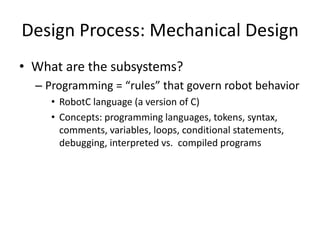
– Programming = “rules” that govern robot behavior 
• RobotC language (a version of C) 
• Concepts: programming languages, tokens, syntax, 
comments, variables, loops, conditional statements, 
debugging, interpreted vs. compiled programs
Design Process: System Integration 
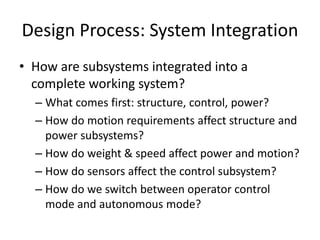
• How are subsystems integrated into a 
complete working system? 
– What comes first: structure, control, power? 
– How do motion requirements affect structure and 
power subsystems? 
– How do weight & speed affect power and motion? 
– How do sensors affect the control subsystem? 
– How do we switch between operator control 
mode and autonomous mode?
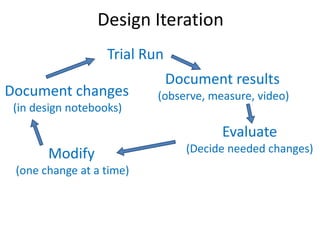
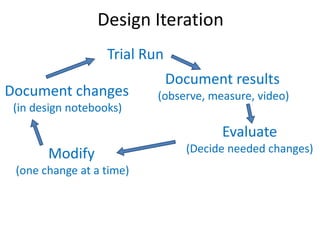
Design Iteration 
Trial Run 
Document results 
(observe, measure, video) 
Document changes 
(in design notebooks) 
Modify 
(one change at a time) 
Evaluate 
(Decide needed changes)
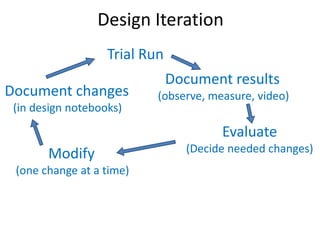
Design Iteration 
Trial Run 
Document results 
(observe, measure, video) 
Document changes 
(in design notebooks) 
Modify 
(one change at a time) 
Evaluate 
(Decide needed changes)
Design Iteration 
Trial Run 
Document results 
(observe, measure, video) 
Document changes 
(in design notebooks) 
Modify 
(one change at a time) 
Evaluate 
(Decide needed changes)
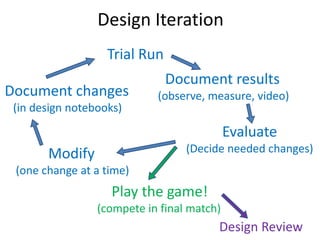
Design Iteration 
Trial Run 
Document results 
(observe, measure, video) 
Document changes 
(in design notebooks) 
Modify 
(one change at a time) 
Evaluate 
(Decide needed changes) 
Play the game! 
(compete in final match) 
Design Review
Meet the robots!

Meet the robots!

  • 2.
    What is aRobot?
  • 3.
    What is aRobot? • An automatic mechanical device • Usually an electro-mechanical machine guided by a computer program or electronic circuitry.
  • 4.
    Why use Robots? • To go where people can’t – To dangerous, expensive, or difficult – radioactive areas, undersea, space, combat • To do things people can’t or don’t want to do – monotonous jobs • To go where no one has gone before. – Exploring space, the ocean, volcanoes, glaciers • To learn engineering • To have fun!
  • 5.
    How do wedesign & build a robot? • Designing and building is engineering • What are goals of engineering? – To understand human needs or desires – To design and build tools or technology to meet those needs or desires – To make life easier, more pleasant, & better • Just as scientists use scientific methods, engineers follow a design process
  • 6.
    Design Process: Relationships • Don’t start by grabbing parts & building without thinking • Start with who, what, when, where & how? – Who is in charge? To whom do you report? – Who will you work with as a team? – What is the job? What is your part of it? – When is the work due? When are deadlines? – Where will you work? – How will you document and verify your work? – How will you deal with challenges that arise?
  • 7.
    Design Process: StrategicDesign • What are the “rules of the game”? – What are the ways to score points? – How can we stop opponents from scoring points? – What is the highest possible score? – What is a reasonable score in a match? – What are our backup plans if we start losing? – What are the penalties if we break the rules? Swept Away video
  • 8.
    Design Process: StrategicDesign • What do we want the robot to do? – What are all the possible robot tasks for scoring? – What are all possible robot tasks to prevent opponent scoring? – Rank each task (1-10) on benefit toward winning – Rank each task (1-10) on how difficult the task will be to accomplish – Calculate benefit to difficulty ratios for each task – Discuss and determine which tasks will give best odds of success at winning the game
  • 9.
    Design Process: MechanicalDesign • What do we have to work with? – What materials, supplies, tools, equipment, hardware, software, building space and time do we have to work with? – How is the robot going to move, pick up objects, score, avoid blocking by opponents? • What are the limitations and parameters to work within? – What are the limits on size, power, number of parts, software, trial runs, space and time? – What are the penalties for exceeding limits or breaking rules?
  • 10.
    Design Process: MechanicalDesign • What are the subsystems? – Structure = “skeleton” of the robot • Chassis, screws, nuts, bolts, spacers, & other hardware • Tools needed to assemble and disassemble the robot • Concepts: center of gravity, support polygon, stability – Motion = “muscles” of the robot • Square shafts, gears, motors, servos • Concepts: motors vs. servos, gear ratios, torque, speed
  • 11.
    Design Process: MechanicalDesign • What are the subsystems? – Power = “heart and blood” pumps electric current • Battery pack, battery box, chargers, wires • Concepts: excessively draining, voltage drop, overcharging, trickle charge, heat – Sensors = “eyes & ears” essential for autonomous functioning • Bumper switches, limit switch, IR sensors, light sensors • Concepts: analog, digital, ADC, DAC
  • 12.
    Design Process: MechanicalDesign • What are the subsystems? – Control = radio link with a human operator • 75 MHz transmitter & receiver, VEXnet joystick • Concepts: frequency, FM, channels, crystals, RFI – Logic = “brain” of the robot that coordinates flow of information and power • VEX microcontroller, jumpers • Concepts: input/output, digital electronics, logic gates
  • 13.
    Design Process: MechanicalDesign • What are the subsystems? – Programming = “rules” that govern robot behavior • RobotC language (a version of C) • Concepts: programming languages, tokens, syntax, comments, variables, loops, conditional statements, debugging, interpreted vs. compiled programs
  • 14.
    Design Process: SystemIntegration • How are subsystems integrated into a complete working system? – What comes first: structure, control, power? – How do motion requirements affect structure and power subsystems? – How do weight & speed affect power and motion? – How do sensors affect the control subsystem? – How do we switch between operator control mode and autonomous mode?
  • 15.
    Design Iteration TrialRun Document results (observe, measure, video) Document changes (in design notebooks) Modify (one change at a time) Evaluate (Decide needed changes)
  • 16.
    Design Iteration TrialRun Document results (observe, measure, video) Document changes (in design notebooks) Modify (one change at a time) Evaluate (Decide needed changes)
  • 17.
    Design Iteration TrialRun Document results (observe, measure, video) Document changes (in design notebooks) Modify (one change at a time) Evaluate (Decide needed changes)
  • 18.
    Design Iteration TrialRun Document results (observe, measure, video) Document changes (in design notebooks) Modify (one change at a time) Evaluate (Decide needed changes) Play the game! (compete in final match) Design Review