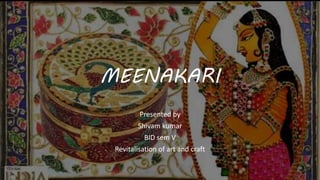
MEENAKARI
Presented by
Shivam kumar
BID sem V
Revitalisation of art and craft
INTRODUCTION
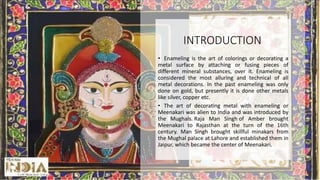
• Enameling is the art of colorings or decorating a
metal surface by attaching or fusing pieces of
different mineral substances, over it. Enameling is
considered the most alluring and technical of all
metal decorations. In the past enameling was only
done on gold, but presently it is done other metals
like silver, copper etc.
• The art of decorating metal with enameling or
Meenakari was alien to India and was introduced by
the Mughals. Raja Man Singh of Amber brought
Meenakari to Rajasthan at the turn of the 16th
century. Man Singh brought skillful minakars from
the Mughal palace at Lahore and established them in
Jaipur, which became the center of Meenakari.
INTRODUCTION
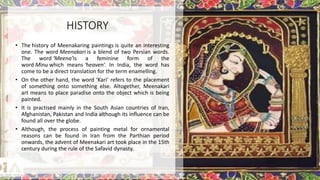
• The history of Meenakaring paintings is quite an interesting
one. The word Meenakari is a blend of two Persian words.
The word ‘Meena’is a feminine form of the
word Minu which means ‘heaven‘. In India, the word has
come to be a direct translation for the term enamelling.
• On the other hand, the word ‘Kari’ refers to the placement
of something onto something else. Altogether, Meenakari
art means to place paradise onto the object which is being
painted.
• It is practised mainly in the South Asian countries of Iran,
Afghanistan, Pakistan and India although its influence can be
found all over the globe.
• Although, the process of painting metal for ornamental
reasons can be found in Iran from the Parthian period
onwards, the advent of Meenakari art took place in the 15th
century during the rule of the Safavid dynasty.
HISTORY
PROCESS OF MAKING
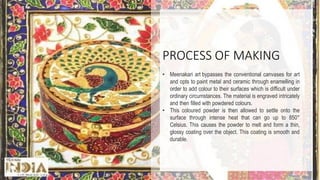
• Meenakari art bypasses the conventional canvases for art
and opts to paint metal and ceramic through enamelling in
order to add colour to their surfaces which is difficult under
ordinary circumstances. The material is engraved intricately
and then filled with powdered colours.
• This coloured powder is then allowed to settle onto the
surface through intense heat that can go up to 850°
Celsius. This causes the powder to melt and form a thin,
glossy coating over the object. This coating is smooth and
durable.
• Each colour needs to be heated individually, hence the most
heat resistant colours are added first. The substrate that is
painted is referred to as ‘chitras’ and cleaned afterwards with a
mixture of tamarind and lime.
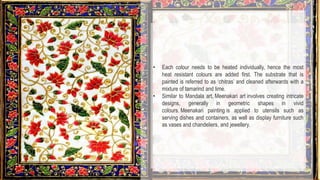
• Similar to Mandala art, Meenakari art involves creating intricate
designs, generally in geometric shapes in vivid
colours. Meenakari painting is applied to utensils such as
serving dishes and containers, as well as display furniture such
as vases and chandeliers, and jewellery.
EVOLUTION OF
MEENAKARI ART IN INDIA
• In India, Meenakari art form was introduced by the Mughals
who shared a deep bonding with the Rajputs. Due to the
amicable relationship between them and the Rajputs, the
artform gained prominence in Rajasthan and Gujarat.
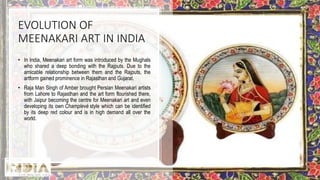
• Raja Man Singh of Amber brought Persian Meenakari artists
from Lahore to Rajasthan and the art form flourished there,
with Jaipur becoming the centre for Meenakari art and even
developing its own Champlevé style which can be identified
by its deep red colour and is in high demand all over the
world.
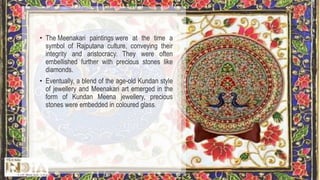
• The Meenakari paintings were at the time a
symbol of Rajputana culture, conveying their
integrity and aristocracy. They were often
embellished further with precious stones like
diamonds.
• Eventually, a blend of the age-old Kundan style
of jewellery and Meenakari art emerged in the
form of Kundan Meena jewellery, precious
stones were embedded in coloured glass.
Thankyou

meenakari art.pptx

  • 1.
    MEENAKARI Presented by Shivam kumar BIDsem V Revitalisation of art and craft
  • 2.
    INTRODUCTION • Enameling isthe art of colorings or decorating a metal surface by attaching or fusing pieces of different mineral substances, over it. Enameling is considered the most alluring and technical of all metal decorations. In the past enameling was only done on gold, but presently it is done other metals like silver, copper etc. • The art of decorating metal with enameling or Meenakari was alien to India and was introduced by the Mughals. Raja Man Singh of Amber brought Meenakari to Rajasthan at the turn of the 16th century. Man Singh brought skillful minakars from the Mughal palace at Lahore and established them in Jaipur, which became the center of Meenakari. INTRODUCTION
  • 3.
    • The historyof Meenakaring paintings is quite an interesting one. The word Meenakari is a blend of two Persian words. The word ‘Meena’is a feminine form of the word Minu which means ‘heaven‘. In India, the word has come to be a direct translation for the term enamelling. • On the other hand, the word ‘Kari’ refers to the placement of something onto something else. Altogether, Meenakari art means to place paradise onto the object which is being painted. • It is practised mainly in the South Asian countries of Iran, Afghanistan, Pakistan and India although its influence can be found all over the globe. • Although, the process of painting metal for ornamental reasons can be found in Iran from the Parthian period onwards, the advent of Meenakari art took place in the 15th century during the rule of the Safavid dynasty. HISTORY
  • 4.
    PROCESS OF MAKING •Meenakari art bypasses the conventional canvases for art and opts to paint metal and ceramic through enamelling in order to add colour to their surfaces which is difficult under ordinary circumstances. The material is engraved intricately and then filled with powdered colours. • This coloured powder is then allowed to settle onto the surface through intense heat that can go up to 850° Celsius. This causes the powder to melt and form a thin, glossy coating over the object. This coating is smooth and durable.
  • 5.
    • Each colourneeds to be heated individually, hence the most heat resistant colours are added first. The substrate that is painted is referred to as ‘chitras’ and cleaned afterwards with a mixture of tamarind and lime. • Similar to Mandala art, Meenakari art involves creating intricate designs, generally in geometric shapes in vivid colours. Meenakari painting is applied to utensils such as serving dishes and containers, as well as display furniture such as vases and chandeliers, and jewellery.
  • 6.
    EVOLUTION OF MEENAKARI ARTIN INDIA • In India, Meenakari art form was introduced by the Mughals who shared a deep bonding with the Rajputs. Due to the amicable relationship between them and the Rajputs, the artform gained prominence in Rajasthan and Gujarat. • Raja Man Singh of Amber brought Persian Meenakari artists from Lahore to Rajasthan and the art form flourished there, with Jaipur becoming the centre for Meenakari art and even developing its own Champlevé style which can be identified by its deep red colour and is in high demand all over the world.
  • 7.
    • The Meenakaripaintings were at the time a symbol of Rajputana culture, conveying their integrity and aristocracy. They were often embellished further with precious stones like diamonds. • Eventually, a blend of the age-old Kundan style of jewellery and Meenakari art emerged in the form of Kundan Meena jewellery, precious stones were embedded in coloured glass.
  • 8.