The view of audiologists on medicalisation
and its desirability within NHS services
Definitions
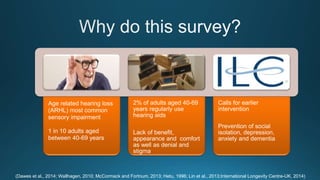
Why do this survey?
Method and results
Discussion/Conclusion
Moving forward
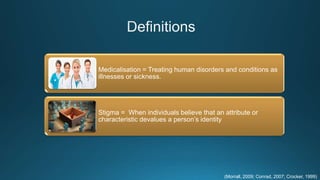
Medicalisation = Treating human disorders and conditions as
illnesses or sickness.
Stigma = When individuals believe that an attribute or
characteristic devalues a person’s identity
(Morrall, 2009; Conrad, 2007; Crocker, 1999)
Age related hearing loss
(ARHL) most common
sensory impairment
1 in 10 adults aged
between 40-69 years
2% of adults aged 40-69
years regularly use
hearing aids
Lack of benefit,
appearance and comfort
as well as denial and
stigma
Calls for earlier
intervention
Prevention of social
isolation, depression,
anxiety and dementia
(Dawes et al., 2014; Wallhagen, 2010; McCormack and Fortnum, 2013; Hetu, 1996; Lin et al., 2013;International Longevity Centre-UK, 2014)
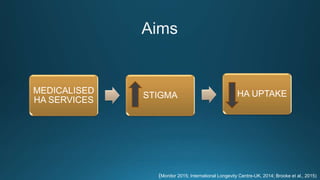
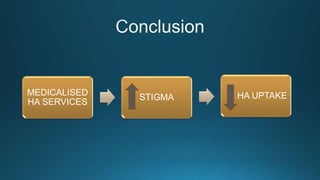
MEDICALISED
HA SERVICES
STIGMA HA UPTAKE
(Monitor 2015; International Longevity Centre-UK, 2014; Brooke et al., 2015)
Online
Pilot Study
Clinical partners
Results
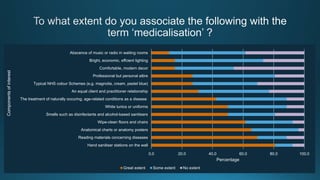
Hand sanitiser stations on the wall
Reading materials concerning diseases
Anatomical charts or anatomy posters
Wipe-clean floors and chairs
Smells such as disinfectants and alcohol-based sanitisers
White tunics or uniforms
The treatment of naturally occuring, age-related conditions as a disease
An equal client and practitioner relationship
Typical NHS colour Schemes (e.g. magnolia, cream, pastel blue)
Professional but personal attire
Comfortable, modern decor
Bright, economic, effcient lighting
Abscence of music or radio in waiting rooms
0.0 20.0 40.0 60.0 80.0 100.0
Componentsofinterest
Percentage
Great extent Some extent No extent
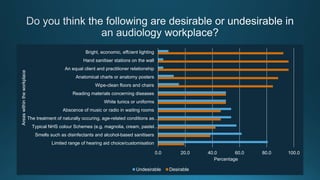
0.0 20.0 40.0 60.0 80.0 100.0
Limited range of hearing aid choice/customisation
Smells such as disinfectants and alcohol-based sanitisers
Typical NHS colour Schemes (e.g. magnolia, cream, pastel…
The treatment of naturally occuring, age-related conditions as…
Abscence of music or radio in waiting rooms
White tunics or uniforms
Reading materials concerning diseases
Wipe-clean floors and chairs
Anatomical charts or anatomy posters
An equal client and practitioner relationship
Hand sanitiser stations on the wall
Bright, economic, effcient lighting
Percentage
Areaswithintheworkplace
Undesirable Desirable
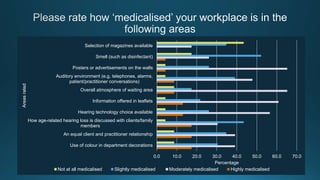
0.0 10.0 20.0 30.0 40.0 50.0 60.0 70.0
Use of colour in department decorations
An equal client and practitioner relationship
How age-related hearing loss is discussed with clients/family
members
Hearing technology choice available
Information offered in leaflets
Overall atmosphere of waiting area
Auditory environment (e.g. telephones, alarms,
patient/practitioner conversations)
Posters or advertisements on the walls
Smell (such as disinfectant)
Selection of magazines available
Percentage
Areasrated
Not at all medicalised Slightly medicalised Moderately medicalised Highly medicalised
Discussion and
Conclusion
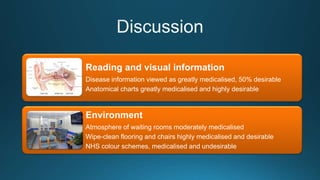
Reading and visual information
Disease information viewed as greatly medicalised, 50% desirable
Anatomical charts greatly medicalised and highly desirable
Environment
Atmosphere of waiting rooms moderately medicalised
Wipe-clean flooring and chairs highly medicalised and desirable
NHS colour schemes, medicalised and undesirable
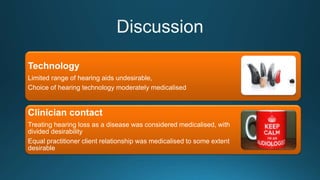
Technology
Limited range of hearing aids undesirable,
Choice of hearing technology moderately medicalised
Clinician contact
Treating hearing loss as a disease was considered medicalised, with
divided desirability
Equal practitioner client relationship was medicalised to some extent
desirable
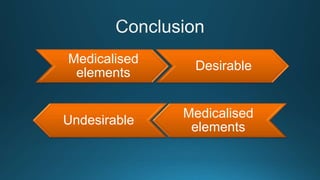
Medicalised
elements
Desirable
Medicalised
elements
Undesirable
MEDICALISED
HA SERVICES
STIGMA HA UPTAKE
MEDICALISED
HA SERVICES
STIGMA HA UPTAKE
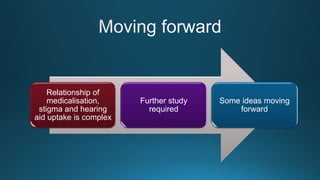
Relationship of
medicalisation,
stigma and hearing
aid uptake is complex
Further study
required
Some ideas moving
forward
Brooke R; Killan EC; Morrall P. NHS hearing-aid services: some ideas to modify medicalisation and decrease stigma. Audacity. 2014; (4):50-52.
Brooke, R.E. et al. 2015. Moderate-medicalisation and an age-neutral NHS hearing aid service. British Journal of Healthcare Management. 21(3), pp.117-122.
Chisolm, T.H. et al. 2007. A systematic review of health-related quality of life and hearing aids: final report of the American Academy of Audiology Task Force On the Health-Related Quality of Life Benefits
of Amplification in Adults. J Am Acad Audiol. 18(2), pp.151-83.
Conrad, P. 2007. The medicalization of society : on the transformation of human conditions into treatable disorders. Baltimore: Johns Hopkins University Press.
Crocker, J. 1999. Social stigma and self-esteem: Situational construction of self-worth. Journal of Experimental Social Psychology. 35(1), pp.89-107.
Davis, A. et al. 2007. Acceptability, benefit and costs of early screening for hearing disability: a study of potential screening tests and models. Health Technol Assess. 11(42), pp.1-294..
Dawes, P. et al. 2014. Hearing in middle age: a population snapshot of 40- to 69-year olds in the United Kingdom. Ear Hear. 35(3), pp.e44-51.
Erler, S.F. and Garstecki, D.C. 2002. Hearing loss- and hearing aid-related stigma: perceptions of women with age-normal hearing. Am J Audiol. 11(2), pp.83-91.
Garstecki, D.C. and Erler, S.F. 1998. Hearing loss, control, and demographic factors influencing hearing aid use among older adults. J Speech Lang Hear Res. 41(3), pp.527-37.
Hetu, R. 1996. The stigma attached to hearing impairment. Scand Audiol Suppl. 43, pp.12-24.
Hosford-Dunn, H. and Halpern, J. 2001. Clinical application of the SADL scale in private practice II: predictive validity of fitting variables. Satisfaction with Amplification in Daily Life. J Am Acad Audiol. 12(1),
pp.15-36.
International Longevity Centre UK. 2014. Commission on Hearing Loss: Final report. [Online]. [Accessed 15 March 2015] Available from: http://www.ilcuk.org.uk/.
Knudsen, L.V. et al. 2010. Factors influencing help seeking, hearing aid uptake, hearing aid use and satisfaction with hearing aids: a review of the literature. Trends Amplif. 14(3), pp.127-54..
Lin, F.R. et al. 2013. Hearing loss and cognitive decline in older adults. JAMA Intern Med. 173(4), pp.293-9.
McCormack, A. and Fortnum, H. 2013. Why do people fitted with hearing aids not wear them? International Journal of Audiology. 52(5), pp.360-368.
Meister, H. et al. 2008. The relationship between pre-fitting expectations and willingness to use hearing aids. Int J Audiol. 47(4), pp.153-9.
Morgan-Jones, R.A. 2001. Hearing differently : the impact of hearing impairment on family life. London: Whurr.
Morrall, P. 2009. Sociology and health : an introduction. 2nd ed. Abingdon, Oxon ; New York: Routledge.
Wallhagen, M.I. 2010. The stigma of hearing loss. Gerontologist. 50(1), pp.66-75.
Young, M.E. et al. 2008. The role of medical language in changing public perceptions of illness. PLoS One. 3(12), pe3875.

Medicalisation presentation

  • 1.
    The view ofaudiologists on medicalisation and its desirability within NHS services
  • 2.
    Definitions Why do thissurvey? Method and results Discussion/Conclusion Moving forward
  • 3.
    Medicalisation = Treatinghuman disorders and conditions as illnesses or sickness. Stigma = When individuals believe that an attribute or characteristic devalues a person’s identity (Morrall, 2009; Conrad, 2007; Crocker, 1999)
  • 4.
    Age related hearingloss (ARHL) most common sensory impairment 1 in 10 adults aged between 40-69 years 2% of adults aged 40-69 years regularly use hearing aids Lack of benefit, appearance and comfort as well as denial and stigma Calls for earlier intervention Prevention of social isolation, depression, anxiety and dementia (Dawes et al., 2014; Wallhagen, 2010; McCormack and Fortnum, 2013; Hetu, 1996; Lin et al., 2013;International Longevity Centre-UK, 2014)
  • 5.
    MEDICALISED HA SERVICES STIGMA HAUPTAKE (Monitor 2015; International Longevity Centre-UK, 2014; Brooke et al., 2015)
  • 6.
  • 7.
  • 8.
    Hand sanitiser stationson the wall Reading materials concerning diseases Anatomical charts or anatomy posters Wipe-clean floors and chairs Smells such as disinfectants and alcohol-based sanitisers White tunics or uniforms The treatment of naturally occuring, age-related conditions as a disease An equal client and practitioner relationship Typical NHS colour Schemes (e.g. magnolia, cream, pastel blue) Professional but personal attire Comfortable, modern decor Bright, economic, effcient lighting Abscence of music or radio in waiting rooms 0.0 20.0 40.0 60.0 80.0 100.0 Componentsofinterest Percentage Great extent Some extent No extent
  • 9.
    0.0 20.0 40.060.0 80.0 100.0 Limited range of hearing aid choice/customisation Smells such as disinfectants and alcohol-based sanitisers Typical NHS colour Schemes (e.g. magnolia, cream, pastel… The treatment of naturally occuring, age-related conditions as… Abscence of music or radio in waiting rooms White tunics or uniforms Reading materials concerning diseases Wipe-clean floors and chairs Anatomical charts or anatomy posters An equal client and practitioner relationship Hand sanitiser stations on the wall Bright, economic, effcient lighting Percentage Areaswithintheworkplace Undesirable Desirable
  • 10.
    0.0 10.0 20.030.0 40.0 50.0 60.0 70.0 Use of colour in department decorations An equal client and practitioner relationship How age-related hearing loss is discussed with clients/family members Hearing technology choice available Information offered in leaflets Overall atmosphere of waiting area Auditory environment (e.g. telephones, alarms, patient/practitioner conversations) Posters or advertisements on the walls Smell (such as disinfectant) Selection of magazines available Percentage Areasrated Not at all medicalised Slightly medicalised Moderately medicalised Highly medicalised
  • 11.
  • 12.
    Reading and visualinformation Disease information viewed as greatly medicalised, 50% desirable Anatomical charts greatly medicalised and highly desirable Environment Atmosphere of waiting rooms moderately medicalised Wipe-clean flooring and chairs highly medicalised and desirable NHS colour schemes, medicalised and undesirable
  • 13.
    Technology Limited range ofhearing aids undesirable, Choice of hearing technology moderately medicalised Clinician contact Treating hearing loss as a disease was considered medicalised, with divided desirability Equal practitioner client relationship was medicalised to some extent desirable
  • 14.
  • 15.
  • 16.
  • 17.
    Relationship of medicalisation, stigma andhearing aid uptake is complex Further study required Some ideas moving forward
  • 19.
    Brooke R; KillanEC; Morrall P. NHS hearing-aid services: some ideas to modify medicalisation and decrease stigma. Audacity. 2014; (4):50-52. Brooke, R.E. et al. 2015. Moderate-medicalisation and an age-neutral NHS hearing aid service. British Journal of Healthcare Management. 21(3), pp.117-122. Chisolm, T.H. et al. 2007. A systematic review of health-related quality of life and hearing aids: final report of the American Academy of Audiology Task Force On the Health-Related Quality of Life Benefits of Amplification in Adults. J Am Acad Audiol. 18(2), pp.151-83. Conrad, P. 2007. The medicalization of society : on the transformation of human conditions into treatable disorders. Baltimore: Johns Hopkins University Press. Crocker, J. 1999. Social stigma and self-esteem: Situational construction of self-worth. Journal of Experimental Social Psychology. 35(1), pp.89-107. Davis, A. et al. 2007. Acceptability, benefit and costs of early screening for hearing disability: a study of potential screening tests and models. Health Technol Assess. 11(42), pp.1-294.. Dawes, P. et al. 2014. Hearing in middle age: a population snapshot of 40- to 69-year olds in the United Kingdom. Ear Hear. 35(3), pp.e44-51. Erler, S.F. and Garstecki, D.C. 2002. Hearing loss- and hearing aid-related stigma: perceptions of women with age-normal hearing. Am J Audiol. 11(2), pp.83-91. Garstecki, D.C. and Erler, S.F. 1998. Hearing loss, control, and demographic factors influencing hearing aid use among older adults. J Speech Lang Hear Res. 41(3), pp.527-37. Hetu, R. 1996. The stigma attached to hearing impairment. Scand Audiol Suppl. 43, pp.12-24. Hosford-Dunn, H. and Halpern, J. 2001. Clinical application of the SADL scale in private practice II: predictive validity of fitting variables. Satisfaction with Amplification in Daily Life. J Am Acad Audiol. 12(1), pp.15-36. International Longevity Centre UK. 2014. Commission on Hearing Loss: Final report. [Online]. [Accessed 15 March 2015] Available from: http://www.ilcuk.org.uk/. Knudsen, L.V. et al. 2010. Factors influencing help seeking, hearing aid uptake, hearing aid use and satisfaction with hearing aids: a review of the literature. Trends Amplif. 14(3), pp.127-54.. Lin, F.R. et al. 2013. Hearing loss and cognitive decline in older adults. JAMA Intern Med. 173(4), pp.293-9. McCormack, A. and Fortnum, H. 2013. Why do people fitted with hearing aids not wear them? International Journal of Audiology. 52(5), pp.360-368. Meister, H. et al. 2008. The relationship between pre-fitting expectations and willingness to use hearing aids. Int J Audiol. 47(4), pp.153-9. Morgan-Jones, R.A. 2001. Hearing differently : the impact of hearing impairment on family life. London: Whurr. Morrall, P. 2009. Sociology and health : an introduction. 2nd ed. Abingdon, Oxon ; New York: Routledge. Wallhagen, M.I. 2010. The stigma of hearing loss. Gerontologist. 50(1), pp.66-75. Young, M.E. et al. 2008. The role of medical language in changing public perceptions of illness. PLoS One. 3(12), pe3875.

Editor's Notes

  • #5 similar finding to previous studies
  • #6 Longevity and action hearing loss thing
  • #13 Reading and visual information Diseases Great extent medcailised 69% information offered wthin leaflets moderetally medcialised 61%
  • #16 Limited agreement with audiologsit
  • #18 To summerise