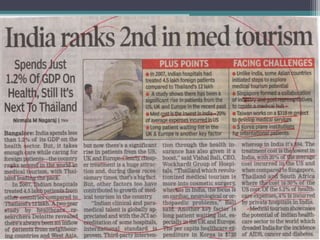
Medical Tourism
By :- Rishith P
Introduction :-
• “ Medical Tourism is a term initially coined by travel
agencies & the mass media to describe the rapidly
growing practice of travelling across international
borders to obtain health care. ”
Definition :-
• According to Goodrich (1987), Medical Tourism is the
attempt to attract tourists by deliberately promoting its
health-care services and facilities, in addition to its
regular tourist amenities.
• According to GATS (General Agreement on Trade and
Services), Medical Tourism is the second mode of trade
in health services. In this mode, customers (patients)
leave their home country to obtain health care services
with high quality and affordable prices
Reasons :-
• Normally, the majority of medical tourists come from the
industrialized countries of the world especially Europe,
the UK, Middle East, Japan, U.S. and Canada where the
cost of medical treatment is very expensive and there are
often long waiting times for treatments.
• Other than India, countries that are currently promoting
medical tourism are Thailand, Malaysia, Singapore,
South Korea Bolivia, Brazil, Belgium, Cuba, Costa Rica,
Hungary, and Jordan.
• Medical tourism or health care tourism is fast growing
multibillion-dollar industry around the world. It is an
economic activity that entails trade in services and
represents the mixing of two of the largest world
industries: Medicine & Tourism.
• Medical tourism is becoming a popular option for
tourists across the globe. It encompasses primarily and
predominantly biomedical procedures, combined with
travel and tourism
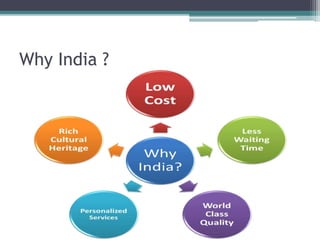
Why India ?
The key competitive advantages of India in medical
tourism stem from the following:
• Low cost advantage
• Strong reputation in the advanced healthcare segment
(cardiovascular surgery, organ transplants, eye surgery
etc.)
• The diversity of tourist destinations available in the
country.
The key concerns facing the industry include:
• Absence of government initiative
• Lack of a coordinated effort to promote the industry
• No accreditation mechanism for hospitals and the lack of
uniform pricing policies and standards across hospitals.
The main reasons for the growing popularity in medical
tourism in India are:
• The long waiting lists in the developed countries
• The low cost of medical treatments in India than the
other developed countries. In India, complicated surgical
procedures are being done at one-tenth of the cost as
compared to the procedures in the developed countries
• The affordable international air fares and favorable
exchange rates
• The Internet; with the development of communications,
new companies have emerged who acts as middlemen
between international patients and hospital networks,
giving patients easy access to information, prices and
option
• The state-of-art technology, specialist doctors, nurses
and para-medical staffs that has been adopted by the big
hospitals and diagnostics centers in India.
• The major service providers in Indian medical
tourism are:
• The Apollo Hospitals
• Escorts Hospital
• Fortis Hospitals
• Hinduja
• Mumbai’s Asian Heart Institute
• Arvind Eye Hospitals
• Manipal Hospitals
• Mallya Hospital, Shankara Nethralaya etc
• In terms of locations – Delhi, Chennai, Bangalore and
Mumbai cater to the maximum number of health tourists
and are fast emerging as medical tourism hubs
Nowadays medical tourism in India includes :-
Advanced and life savings health care services like
• Open transplants
• Cardio vascular surgery
• Eye treatment
• Knee/Hip Replacement & different cosmetic surgeries.
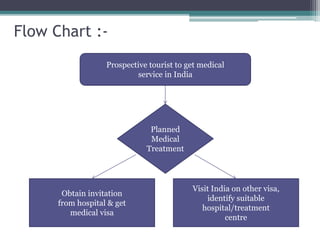
Flow Chart :-
Prospective tourist to get medical
service in India
Planned
Medical
Treatment
Obtain invitation
from hospital & get
medical visa
Visit India on other visa,
identify suitable
hospital/treatment
centre
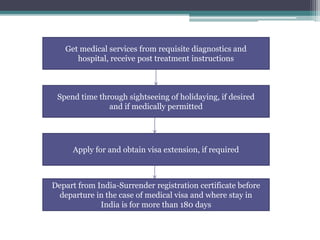
Get medical services from requisite diagnostics and
hospital, receive post treatment instructions
Spend time through sightseeing of holidaying, if desired
and if medically permitted
Apply for and obtain visa extension, if required
Depart from India-Surrender registration certificate before
departure in the case of medical visa and where stay in
India is for more than 180 days
SWOT Analysis of Medical Tourism :-
Strengths :-
• Quality Service at Affordable Cost
• Vast supply of qualified doctors
• Strong presence in advanced healthcare
e.g. cardiovascular, organ transplants – high success rate
in operations
• International Reputation of hospitals and Doctors
• Diversity of tourism destinations and experiences
Weakness :-
• No strong government support / initiative to promote
medical tourism
• Low Coordination between the various players in the
industry– airline operators, hotels and hospitals
• Customer Perception as an unhygienic country
• No proper accreditation and regulation system for
hospitals
• Lack of uniform pricing policies across hospitals
Opportunities :-
• Increased demand for healthcare services from countries
with aging population (U.S, U.K)
• Fast-paced lifestyle increases demand for wellness
tourism and alternative cures
• Shortage of supply in National Health Systems in
countries like U.K, Canada
• Demand from countries with underdeveloped healthcare
facilities
• Demand for retirement homes for elderly people
especially Japanese
Threats :-
• Strong competition from countries like Thailand,
Malaysia, Singapore
• Lack of international accreditation
• Overseas medical care not covered by insurance
providers
• Under-investment in health infrastructure
Destinations for Medical Tourism :-
• Canada :- In comparison to US the patient can save
30% on health care cost with internationally comparable
standards of care.
• Costa Rica :- Preferred place for dental tourism.
Patients can save up to 80% cost on healthcare.
• Cuba :- Fine reputation of cuban doctors with nearby
beaches.
• Dominican Republic :- Popular destination for plastic
surgery.
• Mexico :- Popular specialties are dentistry & plastic
surgery.
• Panama :- Popular for Dental implants, plastic surgery,
assisted reproduction, cardiology, cosmetic dentistry,
pulmonology & orthopedics.
• Brazil :- Destination for cosmetic surgery.
• Colombia :- Cosmetic surgery, eye surgery,
cardiovascular surgery. Columbia has such an organ
donor & banking system which makes organs available
for foreigners with certain legal regulations.
• Hong Kong :- Has 12 Private Hospitals & more than 50
public hospitals to treat with wide range of heath care
services.
• Malaysia :- Excellent Hospitals with international
accreditions.
• India :- India is known for heart surgery , hip/knee joint
replacement . Chennai has been declared as health
capital of India, as it nets in 45% of medical tourists from
abroad & 30–40% domestic medical tourists. Kerala is
the destination for ayurveda & yoga.
• New Zealand :- The cost of care is cheaper than UK &
USA. There are packages for air fares, accommodation,
medical service etc. For procedures like hip/joint
replacement , coronary artery bye pass surgery. The total
cost is 40% less than US cost.
• Singapore :- The health care is affordable & many
hospitals are internationally accrediated.
• Thailand :- It offers everything from cardiac surgery to
organ transplant at a price much lower than the US or
Europe in a safe & clean environment.
• Germany :- They are the latest in spine surgery & novel
cancer treatment much lesser than US.
• Portugal :- Portugal’s health system was highly rated by
WHO in the year 2000. It is well known for low crime
rates.
• Spain :- Strong economy & modern hospitals with well
trained manpower making it an up coming tourism
destination.
• Turkey :- Average medical cost is 50 % - 75% lower than
USA with international accredited heath care services.
• Ukraine :- Modern Dental clinics with high quality
equipments.
• Israel :- For surgeries & In Vitro Fertilization [IVF].
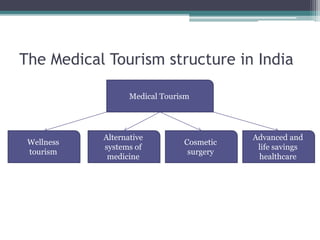
The Medical Tourism structure in India
Medical Tourism
Wellness
tourism
Alternative
systems of
medicine
Cosmetic
surgery
Advanced and
life savings
healthcare
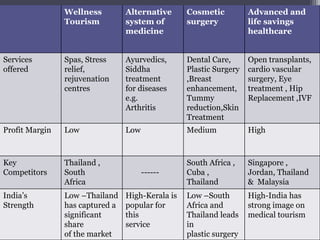
Wellness
Tourism
Alternative
system of
medicine
Cosmetic
surgery
Advanced and
life savings
healthcare
Services
offered
Spas, Stress
relief,
rejuvenation
centres
Ayurvedics,
Siddha
treatment
for diseases
e.g.
Arthritis
Dental Care,
Plastic Surgery
,Breast
enhancement,
Tummy
reduction,Skin
Treatment
Open transplants,
cardio vascular
surgery, Eye
treatment , Hip
Replacement ,IVF
Profit Margin Low Low Medium High
Key
Competitors
Thailand ,
South
Africa
------
South Africa ,
Cuba ,
Thailand
Singapore ,
Jordan, Thailand
& Malaysia
India’s
Strength
Low –Thailand
has captured a
significant
share
of the market
High-Kerala is
popular for
this
service
Low –South
Africa and
Thailand leads
in
plastic surgery
High-India has
strong image on
medical tourism
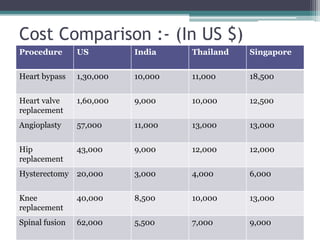
Cost Comparison :- (In US $)
Procedure US India Thailand Singapore
Heart bypass 1,30,000 10,000 11,000 18,500
Heart valve
replacement
1,60,000 9,000 10,000 12,500
Angioplasty 57,000 11,000 13,000 13,000
Hip
replacement
43,000 9,000 12,000 12,000
Hysterectomy 20,000 3,000 4,000 6,000
Knee
replacement
40,000 8,500 10,000 13,000
Spinal fusion 62,000 5,500 7,000 9,000
World’s Best Hospitals :-
1. Prince Court Medical Center, Kuala Lumpur,
Malaysia
2. Asklepios Klinik Barmbek, Hamburg, Germany
3. Clemenceau Medical Centre, Beirut, Lebanon
4. Fortis Hospital, Bangalore, India
5. Wooridul Spine Hospital, Seoul, Korea
6. Bumrungrad International, Bangkok, Thailand
7. Anadolu Medical Center, Istanbul, Turkey
8. Bangkok Hospital Medical Centre, Bangkok,
Thailand
9. Gleneagles Hospital, Singapore
10. Asian Heart Institute, Mumbai, India
A Survey Done by Medical Travel Quality Alliance
Conclusion :-
• India is in an advantageous position to tap the global
opportunities in the medical tourism sector. The
government’s role is crucial to the development of
medical tourism.
• There is also a need to develop supporting infrastructure
such as transport services to facilitate tourism in India.
• The tourism, health & information technology
departments need to work in tandem for efficient patient
care.
Reference :-
• International Journal of Multidisciplinary Research -Dr.
Suman Kumar Dawn
• DC Joshi

Medical Tourism

  • 1.
  • 2.
    Introduction :- • “Medical Tourism is a term initially coined by travel agencies & the mass media to describe the rapidly growing practice of travelling across international borders to obtain health care. ”
  • 3.
    Definition :- • Accordingto Goodrich (1987), Medical Tourism is the attempt to attract tourists by deliberately promoting its health-care services and facilities, in addition to its regular tourist amenities. • According to GATS (General Agreement on Trade and Services), Medical Tourism is the second mode of trade in health services. In this mode, customers (patients) leave their home country to obtain health care services with high quality and affordable prices
  • 4.
    Reasons :- • Normally,the majority of medical tourists come from the industrialized countries of the world especially Europe, the UK, Middle East, Japan, U.S. and Canada where the cost of medical treatment is very expensive and there are often long waiting times for treatments. • Other than India, countries that are currently promoting medical tourism are Thailand, Malaysia, Singapore, South Korea Bolivia, Brazil, Belgium, Cuba, Costa Rica, Hungary, and Jordan.
  • 5.
    • Medical tourismor health care tourism is fast growing multibillion-dollar industry around the world. It is an economic activity that entails trade in services and represents the mixing of two of the largest world industries: Medicine & Tourism. • Medical tourism is becoming a popular option for tourists across the globe. It encompasses primarily and predominantly biomedical procedures, combined with travel and tourism
  • 6.
  • 7.
    The key competitiveadvantages of India in medical tourism stem from the following: • Low cost advantage • Strong reputation in the advanced healthcare segment (cardiovascular surgery, organ transplants, eye surgery etc.) • The diversity of tourist destinations available in the country.
  • 8.
    The key concernsfacing the industry include: • Absence of government initiative • Lack of a coordinated effort to promote the industry • No accreditation mechanism for hospitals and the lack of uniform pricing policies and standards across hospitals.
  • 9.
    The main reasonsfor the growing popularity in medical tourism in India are: • The long waiting lists in the developed countries • The low cost of medical treatments in India than the other developed countries. In India, complicated surgical procedures are being done at one-tenth of the cost as compared to the procedures in the developed countries • The affordable international air fares and favorable exchange rates
  • 10.
    • The Internet;with the development of communications, new companies have emerged who acts as middlemen between international patients and hospital networks, giving patients easy access to information, prices and option • The state-of-art technology, specialist doctors, nurses and para-medical staffs that has been adopted by the big hospitals and diagnostics centers in India.
  • 11.
    • The majorservice providers in Indian medical tourism are: • The Apollo Hospitals • Escorts Hospital • Fortis Hospitals • Hinduja • Mumbai’s Asian Heart Institute • Arvind Eye Hospitals • Manipal Hospitals • Mallya Hospital, Shankara Nethralaya etc
  • 12.
    • In termsof locations – Delhi, Chennai, Bangalore and Mumbai cater to the maximum number of health tourists and are fast emerging as medical tourism hubs
  • 13.
    Nowadays medical tourismin India includes :- Advanced and life savings health care services like • Open transplants • Cardio vascular surgery • Eye treatment • Knee/Hip Replacement & different cosmetic surgeries.
  • 14.
    Flow Chart :- Prospectivetourist to get medical service in India Planned Medical Treatment Obtain invitation from hospital & get medical visa Visit India on other visa, identify suitable hospital/treatment centre
  • 15.
    Get medical servicesfrom requisite diagnostics and hospital, receive post treatment instructions Spend time through sightseeing of holidaying, if desired and if medically permitted Apply for and obtain visa extension, if required Depart from India-Surrender registration certificate before departure in the case of medical visa and where stay in India is for more than 180 days
  • 16.
    SWOT Analysis ofMedical Tourism :- Strengths :- • Quality Service at Affordable Cost • Vast supply of qualified doctors • Strong presence in advanced healthcare e.g. cardiovascular, organ transplants – high success rate in operations • International Reputation of hospitals and Doctors • Diversity of tourism destinations and experiences
  • 17.
    Weakness :- • Nostrong government support / initiative to promote medical tourism • Low Coordination between the various players in the industry– airline operators, hotels and hospitals • Customer Perception as an unhygienic country • No proper accreditation and regulation system for hospitals • Lack of uniform pricing policies across hospitals
  • 18.
    Opportunities :- • Increaseddemand for healthcare services from countries with aging population (U.S, U.K) • Fast-paced lifestyle increases demand for wellness tourism and alternative cures • Shortage of supply in National Health Systems in countries like U.K, Canada • Demand from countries with underdeveloped healthcare facilities • Demand for retirement homes for elderly people especially Japanese
  • 19.
    Threats :- • Strongcompetition from countries like Thailand, Malaysia, Singapore • Lack of international accreditation • Overseas medical care not covered by insurance providers • Under-investment in health infrastructure
  • 20.
    Destinations for MedicalTourism :- • Canada :- In comparison to US the patient can save 30% on health care cost with internationally comparable standards of care. • Costa Rica :- Preferred place for dental tourism. Patients can save up to 80% cost on healthcare. • Cuba :- Fine reputation of cuban doctors with nearby beaches. • Dominican Republic :- Popular destination for plastic surgery. • Mexico :- Popular specialties are dentistry & plastic surgery.
  • 21.
    • Panama :-Popular for Dental implants, plastic surgery, assisted reproduction, cardiology, cosmetic dentistry, pulmonology & orthopedics. • Brazil :- Destination for cosmetic surgery. • Colombia :- Cosmetic surgery, eye surgery, cardiovascular surgery. Columbia has such an organ donor & banking system which makes organs available for foreigners with certain legal regulations. • Hong Kong :- Has 12 Private Hospitals & more than 50 public hospitals to treat with wide range of heath care services. • Malaysia :- Excellent Hospitals with international accreditions.
  • 22.
    • India :-India is known for heart surgery , hip/knee joint replacement . Chennai has been declared as health capital of India, as it nets in 45% of medical tourists from abroad & 30–40% domestic medical tourists. Kerala is the destination for ayurveda & yoga. • New Zealand :- The cost of care is cheaper than UK & USA. There are packages for air fares, accommodation, medical service etc. For procedures like hip/joint replacement , coronary artery bye pass surgery. The total cost is 40% less than US cost. • Singapore :- The health care is affordable & many hospitals are internationally accrediated.
  • 23.
    • Thailand :-It offers everything from cardiac surgery to organ transplant at a price much lower than the US or Europe in a safe & clean environment. • Germany :- They are the latest in spine surgery & novel cancer treatment much lesser than US. • Portugal :- Portugal’s health system was highly rated by WHO in the year 2000. It is well known for low crime rates. • Spain :- Strong economy & modern hospitals with well trained manpower making it an up coming tourism destination.
  • 24.
    • Turkey :-Average medical cost is 50 % - 75% lower than USA with international accredited heath care services. • Ukraine :- Modern Dental clinics with high quality equipments. • Israel :- For surgeries & In Vitro Fertilization [IVF].
  • 26.
    The Medical Tourismstructure in India Medical Tourism Wellness tourism Alternative systems of medicine Cosmetic surgery Advanced and life savings healthcare
  • 27.
    Wellness Tourism Alternative system of medicine Cosmetic surgery Advanced and lifesavings healthcare Services offered Spas, Stress relief, rejuvenation centres Ayurvedics, Siddha treatment for diseases e.g. Arthritis Dental Care, Plastic Surgery ,Breast enhancement, Tummy reduction,Skin Treatment Open transplants, cardio vascular surgery, Eye treatment , Hip Replacement ,IVF Profit Margin Low Low Medium High Key Competitors Thailand , South Africa ------ South Africa , Cuba , Thailand Singapore , Jordan, Thailand & Malaysia India’s Strength Low –Thailand has captured a significant share of the market High-Kerala is popular for this service Low –South Africa and Thailand leads in plastic surgery High-India has strong image on medical tourism
  • 28.
    Cost Comparison :-(In US $) Procedure US India Thailand Singapore Heart bypass 1,30,000 10,000 11,000 18,500 Heart valve replacement 1,60,000 9,000 10,000 12,500 Angioplasty 57,000 11,000 13,000 13,000 Hip replacement 43,000 9,000 12,000 12,000 Hysterectomy 20,000 3,000 4,000 6,000 Knee replacement 40,000 8,500 10,000 13,000 Spinal fusion 62,000 5,500 7,000 9,000
  • 29.
    World’s Best Hospitals:- 1. Prince Court Medical Center, Kuala Lumpur, Malaysia 2. Asklepios Klinik Barmbek, Hamburg, Germany 3. Clemenceau Medical Centre, Beirut, Lebanon 4. Fortis Hospital, Bangalore, India 5. Wooridul Spine Hospital, Seoul, Korea
  • 30.
    6. Bumrungrad International,Bangkok, Thailand 7. Anadolu Medical Center, Istanbul, Turkey 8. Bangkok Hospital Medical Centre, Bangkok, Thailand 9. Gleneagles Hospital, Singapore 10. Asian Heart Institute, Mumbai, India A Survey Done by Medical Travel Quality Alliance
  • 31.
    Conclusion :- • Indiais in an advantageous position to tap the global opportunities in the medical tourism sector. The government’s role is crucial to the development of medical tourism. • There is also a need to develop supporting infrastructure such as transport services to facilitate tourism in India. • The tourism, health & information technology departments need to work in tandem for efficient patient care.
  • 32.
    Reference :- • InternationalJournal of Multidisciplinary Research -Dr. Suman Kumar Dawn • DC Joshi