MEDICAL TEXTILES
             OPPORTUNITIES AND
           CHALLENGES AHEAD FOR
           INDIAN MANUFACTURERS
                  Presentation By:
                 RAHUL BANSAL
                 A.G.M. - MARKETING
             GINNI NONWOVENS
            (A Unit of Ginni Filaments Ltd.)
27/03/12                                       1
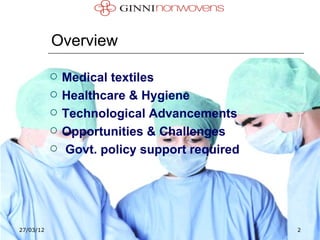
Overview

              Medical textiles
              Healthcare & Hygiene
              Technological Advancements
              Opportunities & Challenges
              Govt. policy support required


27/03/12                                       2
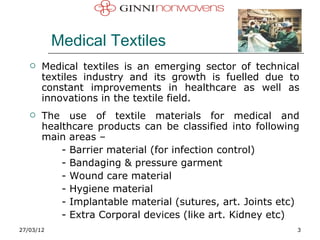
Medical Textiles
      Medical textiles is an emerging sector of technical
       textiles industry and its growth is fuelled due to
       constant improvements in healthcare as well as
       innovations in the textile field.
      The use of textile materials for medical and
       healthcare products can be classified into following
       main areas –
           - Barrier material (for infection control)
           - Bandaging & pressure garment
           - Wound care material
           - Hygiene material
           - Implantable material (sutures, art. Joints etc)
           - Extra Corporal devices (like art. Kidney etc)
27/03/12                                                   3
Medical Textiles
          Requirements of textile material for
           medical applications
              Biocompatible
              Good resistance to alkalis, acids and
               micro-organisms
              Good dimensional stability
              Elasticity
              Free from contamination or impurities
              Absorption / Repellency
              Air permeability.

27/03/12                                           4
Healthcare & Hygiene
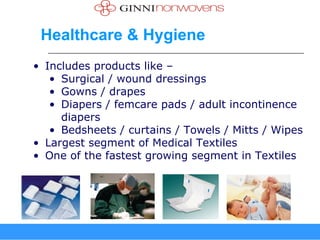
• Includes products like –
   • Surgical / wound dressings
   • Gowns / drapes
   • Diapers / femcare pads / adult incontinence
     diapers
   • Bedsheets / curtains / Towels / Mitts / Wipes
• Largest segment of Medical Textiles
• One of the fastest growing segment in Textiles
Healthcare & Hygiene
• In India, traditionally this segment is dominated
  by Woven Textiles
• Lately, new technology Nonwoven products
  have provided innovative product options
• Reasons for growth of this segment –
   • Growing awareness among society for
     hygiene and safety
   • Frequent       interactions     of     medical
     professionals with international medical
     societies
   • Availability of new technologically advanced
     products
   • Medical tourism
Technological Advancements
• Fabrics with anti-microbial properties
• Fire retardant fabrics
• Nonwoven fabrics – They are engineered fabrics
  from sheet of fibres, with desired properties
  (performance characteristics) to suite specific
  applications; such as –
   • Very high fluid repellency or absorbency
   • Extremely low linting
   • Fast wicking of liquids
   • Anti-static
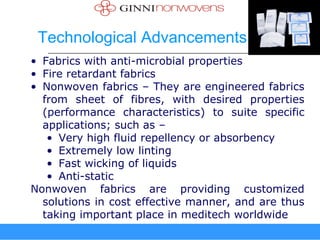
Nonwoven fabrics are providing customized
  solutions in cost effective manner, and are thus
  taking important place in meditech worldwide
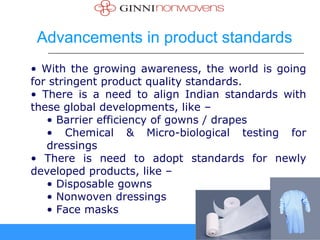
Advancements in product standards
• With the growing awareness, the world is going
for stringent product quality standards.
• There is a need to align Indian standards with
these global developments, like –
   • Barrier efficiency of gowns / drapes
   • Chemical & Micro-biological testing for
   dressings
• There is need to adopt standards for newly
developed products, like –
   • Disposable gowns
   • Nonwoven dressings
   • Face masks
Opportunities & Challenges ahead
     Opportunities –
          Consumption is increasing rapidly
          Pvt. Hospital chains are growing
          Doctor/patient awareness for hygiene is increasing
          Medical tourism
     Challenges –
           China has become very strong in most of Healthcare
           & hygiene products
           There are very few BIS standards in place leading to
           substandard quality products being used
           Export benefits like DD/DEPB not notified for many
27/03/12   products                                            9
Govt. Policy Support Required
    ⇒ Fast development of BIS standards in lieu with
    the International standards. Lot of new product
    standards to be added

    ⇒ Amendment of Drugs & Cosmetics Act to
    accommodate   new technologies such  as
    nonwoven products

    ⇒ To promote new technology products, Govt.
    hospitals to be advised on the advantages of
    these products and their BIS standards

27/03/12                                           10
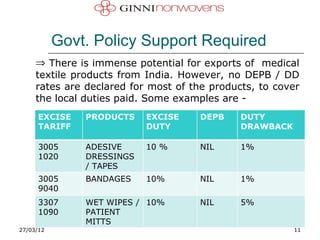
Govt. Policy Support Required
     ⇒ There is immense potential for exports of medical
     textile products from India. However, no DEPB / DD
     rates are declared for most of the products, to cover
     the local duties paid. Some examples are -
      EXCISE   PRODUCTS    EXCISE     DEPB    DUTY
      TARIFF               DUTY               DRAWBACK

      3005     ADESIVE     10 %       NIL     1%
      1020     DRESSINGS
               / TAPES
      3005     BANDAGES    10%        NIL     1%
      9040
      3307     WET WIPES / 10%        NIL     5%
      1090     PATIENT
               MITTS
27/03/12                                                 11
THANK YOU
27/03/12               12

medical tex

  • 1.
    MEDICAL TEXTILES OPPORTUNITIES AND CHALLENGES AHEAD FOR INDIAN MANUFACTURERS Presentation By: RAHUL BANSAL A.G.M. - MARKETING GINNI NONWOVENS (A Unit of Ginni Filaments Ltd.) 27/03/12 1
  • 2.
    Overview  Medical textiles  Healthcare & Hygiene  Technological Advancements  Opportunities & Challenges  Govt. policy support required 27/03/12 2
  • 3.
    Medical Textiles  Medical textiles is an emerging sector of technical textiles industry and its growth is fuelled due to constant improvements in healthcare as well as innovations in the textile field.  The use of textile materials for medical and healthcare products can be classified into following main areas – - Barrier material (for infection control) - Bandaging & pressure garment - Wound care material - Hygiene material - Implantable material (sutures, art. Joints etc) - Extra Corporal devices (like art. Kidney etc) 27/03/12 3
  • 4.
    Medical Textiles  Requirements of textile material for medical applications  Biocompatible  Good resistance to alkalis, acids and micro-organisms  Good dimensional stability  Elasticity  Free from contamination or impurities  Absorption / Repellency  Air permeability. 27/03/12 4
  • 5.
    Healthcare & Hygiene •Includes products like – • Surgical / wound dressings • Gowns / drapes • Diapers / femcare pads / adult incontinence diapers • Bedsheets / curtains / Towels / Mitts / Wipes • Largest segment of Medical Textiles • One of the fastest growing segment in Textiles
  • 6.
    Healthcare & Hygiene •In India, traditionally this segment is dominated by Woven Textiles • Lately, new technology Nonwoven products have provided innovative product options • Reasons for growth of this segment – • Growing awareness among society for hygiene and safety • Frequent interactions of medical professionals with international medical societies • Availability of new technologically advanced products • Medical tourism
  • 7.
    Technological Advancements • Fabricswith anti-microbial properties • Fire retardant fabrics • Nonwoven fabrics – They are engineered fabrics from sheet of fibres, with desired properties (performance characteristics) to suite specific applications; such as – • Very high fluid repellency or absorbency • Extremely low linting • Fast wicking of liquids • Anti-static Nonwoven fabrics are providing customized solutions in cost effective manner, and are thus taking important place in meditech worldwide
  • 8.
    Advancements in productstandards • With the growing awareness, the world is going for stringent product quality standards. • There is a need to align Indian standards with these global developments, like – • Barrier efficiency of gowns / drapes • Chemical & Micro-biological testing for dressings • There is need to adopt standards for newly developed products, like – • Disposable gowns • Nonwoven dressings • Face masks
  • 9.
    Opportunities & Challengesahead Opportunities –  Consumption is increasing rapidly  Pvt. Hospital chains are growing  Doctor/patient awareness for hygiene is increasing  Medical tourism Challenges –  China has become very strong in most of Healthcare & hygiene products  There are very few BIS standards in place leading to substandard quality products being used  Export benefits like DD/DEPB not notified for many 27/03/12 products 9
  • 10.
    Govt. Policy SupportRequired ⇒ Fast development of BIS standards in lieu with the International standards. Lot of new product standards to be added ⇒ Amendment of Drugs & Cosmetics Act to accommodate new technologies such as nonwoven products ⇒ To promote new technology products, Govt. hospitals to be advised on the advantages of these products and their BIS standards 27/03/12 10
  • 11.
    Govt. Policy SupportRequired ⇒ There is immense potential for exports of medical textile products from India. However, no DEPB / DD rates are declared for most of the products, to cover the local duties paid. Some examples are - EXCISE PRODUCTS EXCISE DEPB DUTY TARIFF DUTY DRAWBACK 3005 ADESIVE 10 % NIL 1% 1020 DRESSINGS / TAPES 3005 BANDAGES 10% NIL 1% 9040 3307 WET WIPES / 10% NIL 5% 1090 PATIENT MITTS 27/03/12 11
  • 12.

Editor's Notes

  • #4 Biomaterial: Any material which replace the function of living tissues or organs in humans such as synthetic polymers polyester