Unit 1 Presentation
By Caleb Browning
Contents
  Slide 3 – P1: BBDO agency profile
  Slide 9 – P2: Print Case Study on WPP
  Slide 15 – P3: Audience Research
  Slide 22 – P4: Distribution Channels
  Slide 28 – P5: Legal and Ethical Issues
Agency Profile: BBDO
Ownership of BBDO
  BBDO is a huge advertising company branching out globally. It is
6th in the top 50 advertisement agencies in the world.
BBDO as an organisation that was founded by 4 men:
William H. Johns
  Bruce Fairchild Barton
Roy Sarles Durstine
  Alex Faickney Osborn
Operation Model and
Products
  The business model across BBDO used is known as ‘Allied-
unrelated’; where the different companies under the BBDO
banner all are given core components to start up the
company without help from others. However, clients and
customers may be shared across the board.
  Some of the products that AMV BBDO have worked on are very
prestigious; one example of this is the ‘You’re not you when
you’re hungry’ campaign created for Snickers. It worked so well
when it was released that the campaign ‘saw some double digit
growth in value sales in some channels as well as an increase of
705,000 sales of Snickers in comparison to the last year in
England.
Snickers ‘Googel’
Market Position and
Competitors
“AMV themselves are the biggest agency in the UK,
working with 92 brands. However, BBDO is absolutely
huge – being the third largest agency in the world, with
288 offices in 90 countries.”
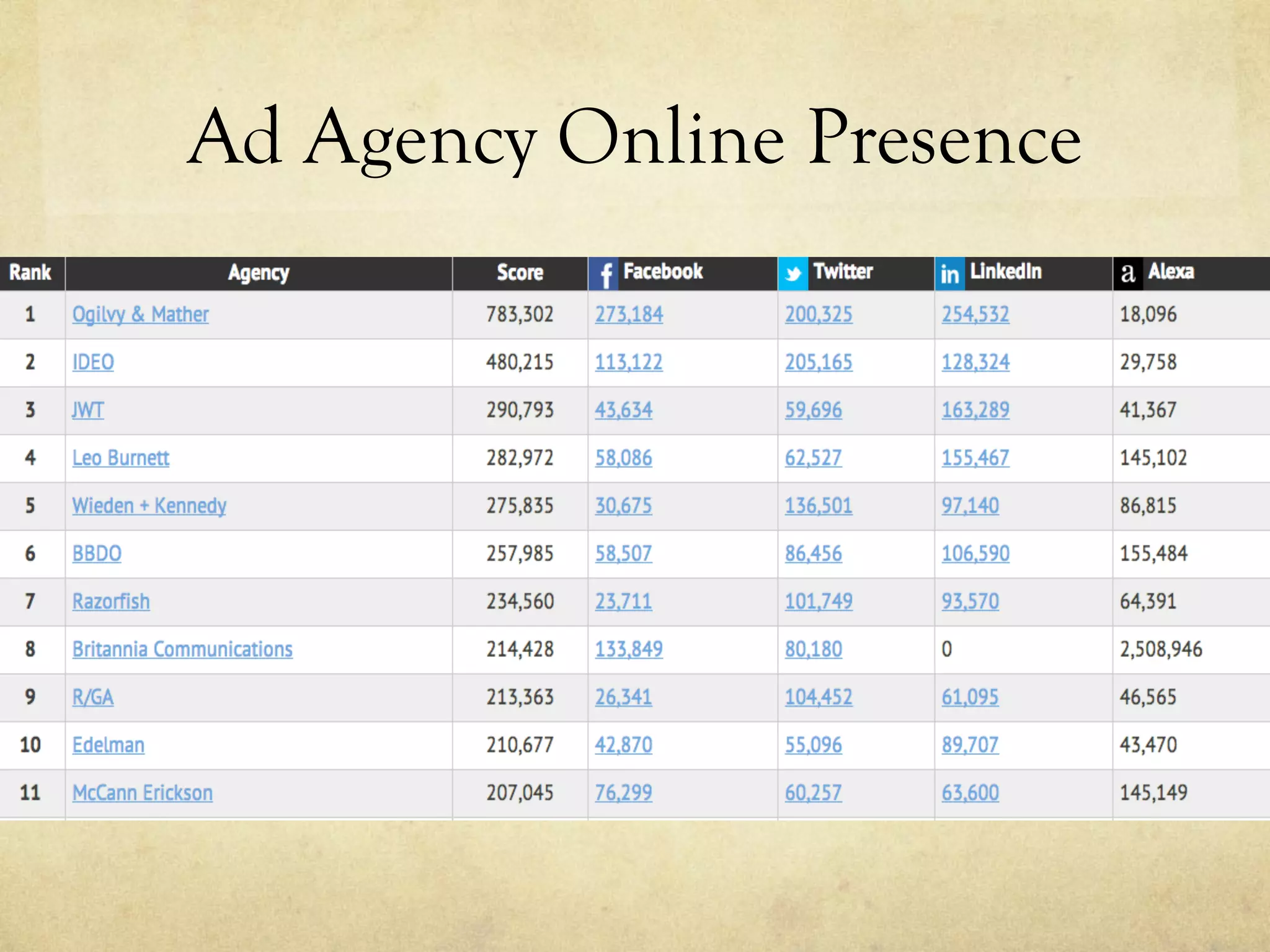
BBDO is rated the 6th top ad agency in the world based on
statistics from their online presence rated by
http://www.top50adagencies.com/ .
However, BBDO has been crowned ‘Network of the Year’ 5
times at Cannes, and is currently ranked the most creative
agency in the Gunn Report.
Ad Agency Online Presence
P2: Print Case Study
M1:D1
BBDO’s Client:
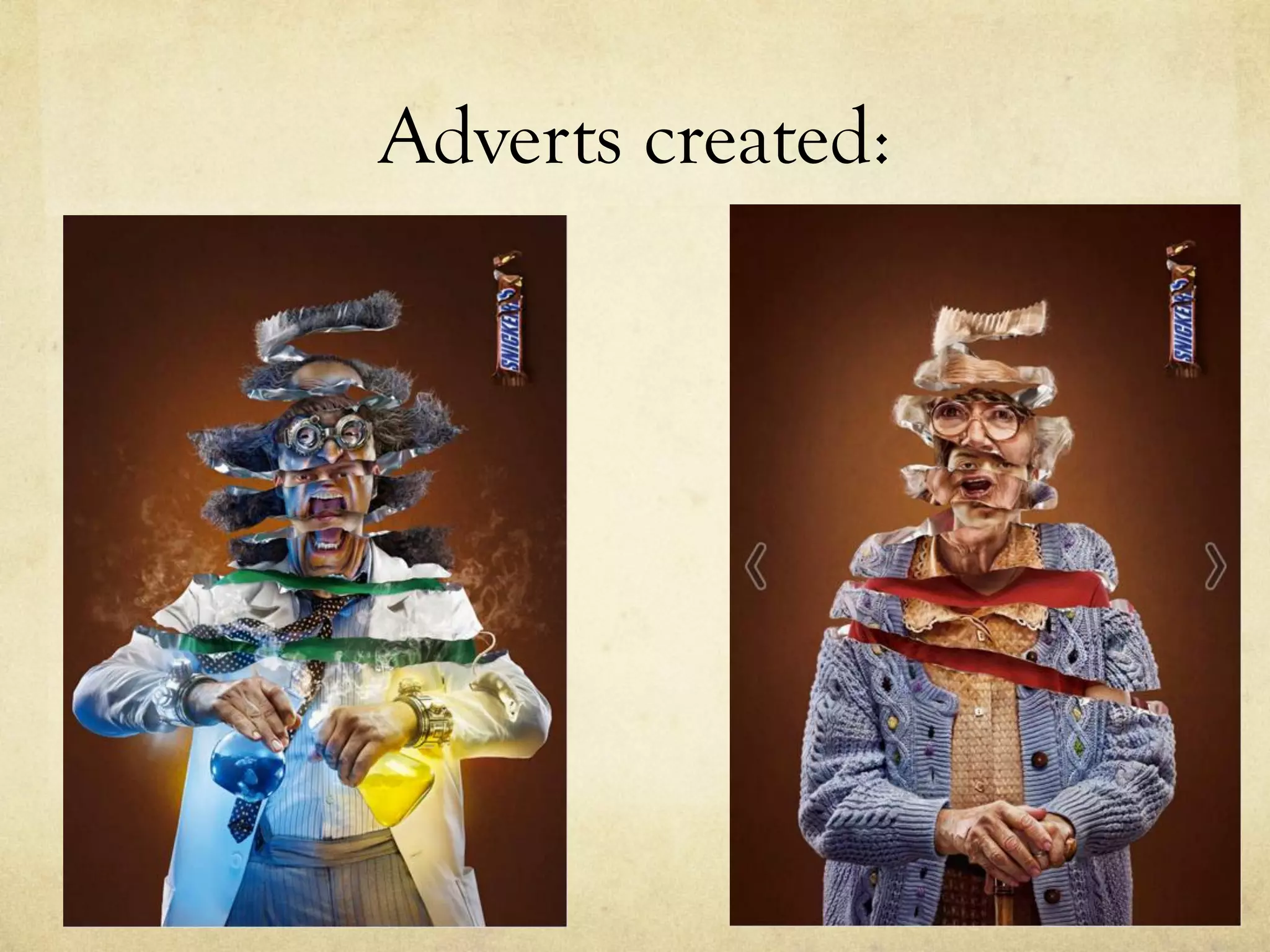
Adverts created:
Purposes, genre, and forms.
The genre of the adverts are
based on purely reminding
people to pick up a Snickers bar.
It relies on being seen many times
to sell the product (in this case, a
Snickers bar). Therefore, they’re
product based.
The form of the advert is print
based, but they are also
digitally printed based. This is
because it allows Snickers to
tap into a cold audience.
The purpose of these set of
adverts was to try to branch
out from the stereotypical
chocolate bar advert and to be
more adventurous with what
the brand’s meaning is while
still incorporating the ‘you’re
not you when you’re hungry’
slogan in a subtle way. These
sets of adverts also branch out
from social media and
television advertisements into
the print-based form in a more
controversial way.
Content, style, meaning
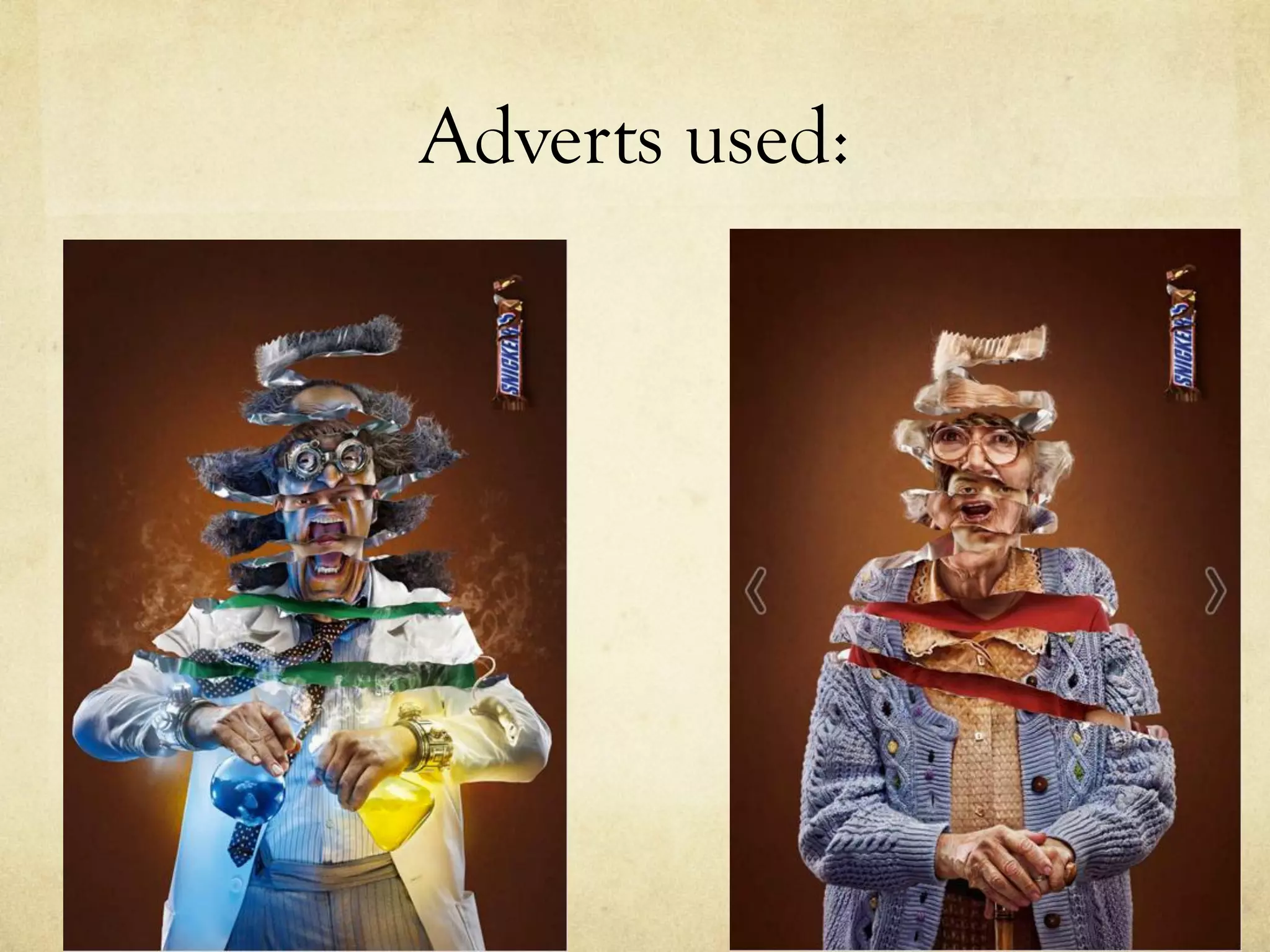
  The style of the advert is complex but well-made. The
outer layer of the individual is almost unwrapped like
a chocolate bar wrapping to suggest that when
Snickers are eaten, you will return from a hungry
‘monster’ back to reality. The print advert is not fluid,
and the cuts between the two individuals almost
suggests chaos. However, it is centered which allows us
to directly focus on the object at hand and uses a
brown background to create a spark plug from
Snickers to the brown colour.
  The meaning of the advert is honest
but controversial on a subtle level – if
you want to be considered normal,
then eat this chocolate bar. That is the
main objective; to create an
establishment between integrated
audiences that eating Snickers will
make you feel more ‘in’ with everyone
else. It also means that when you are
hungry, you make rash decisions and
that Snickers is the cure for that.
  The content of the adverts
is to portray an every-day
individual as something
‘wacky’ or ‘crazy’ on the
outside and their normal
form on the inside. This
revolves around their
slogan ‘you’re not you
when you’re hungry’ and
plays in a clever way with
the slogan itself.
Production process of the
advert
  Planning: the beginning was to base an advert around the slogan of Snickers:
“You aren’t you when you’re hungry”. This gave BBDO something to work
from while also keeping recognition of the brand.
  Pre-production: Two different methods would have had to been used to
create the idea. Firstly, the idea had to be mind mapped and thought of in the
first place, and documented. Secondly, sketches of the idea would have been
created and pitched to officials in BBDO/Snickers.
  Production: The production of the advert would have been starting slowly
with an original version of the advert, then building from feedback from
Snickers on what could be improved. This includes adding additional colours,
changing the look of how the characters are portrayed and branding.
  Post-production: The last part of the production process would involve
finalizing the advert as we see it now as well as checking to see if all
requirements had been fulfilled for the advert. For example; whether it met
budget costs, whether the colour scheme was followed, if it portrays the advert
in a good light.
P3: Audience Research
Adverts used:
Brief of Audience Research
I took two Snickers adverts that were created within the BBDO
corporation (produced by ‘IMPACT BBDO’ in Dubai) and I
showed them to my friends and relatives of different ages to ask
them three questions that would:
  Find out their initial response and reading of the adverts
  Upon closer inspection the relationship and understanding
of the advert
  And if the advert makes them want to buy a Snickers after
seeing the advert.
Analysis of the data collected
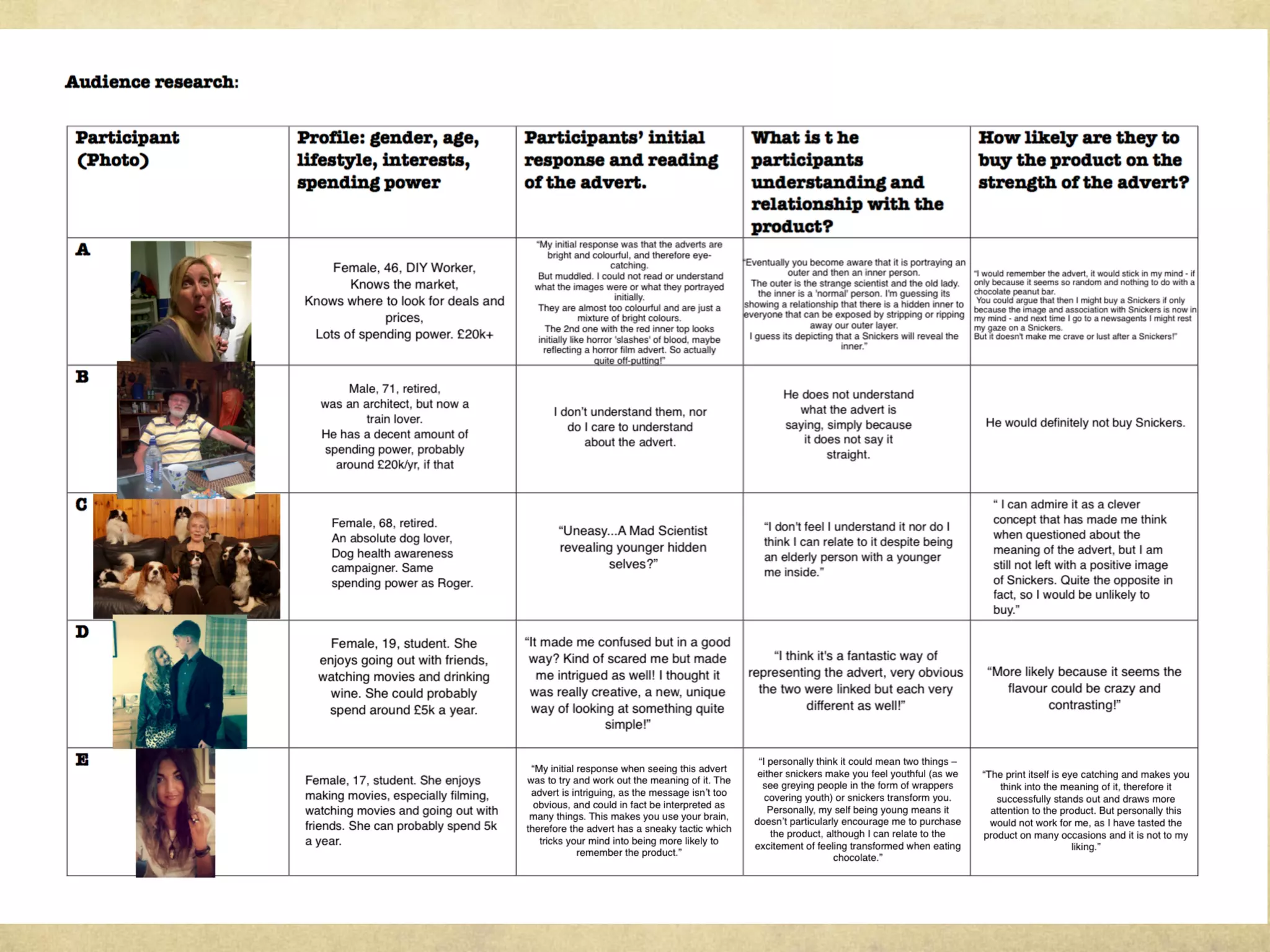
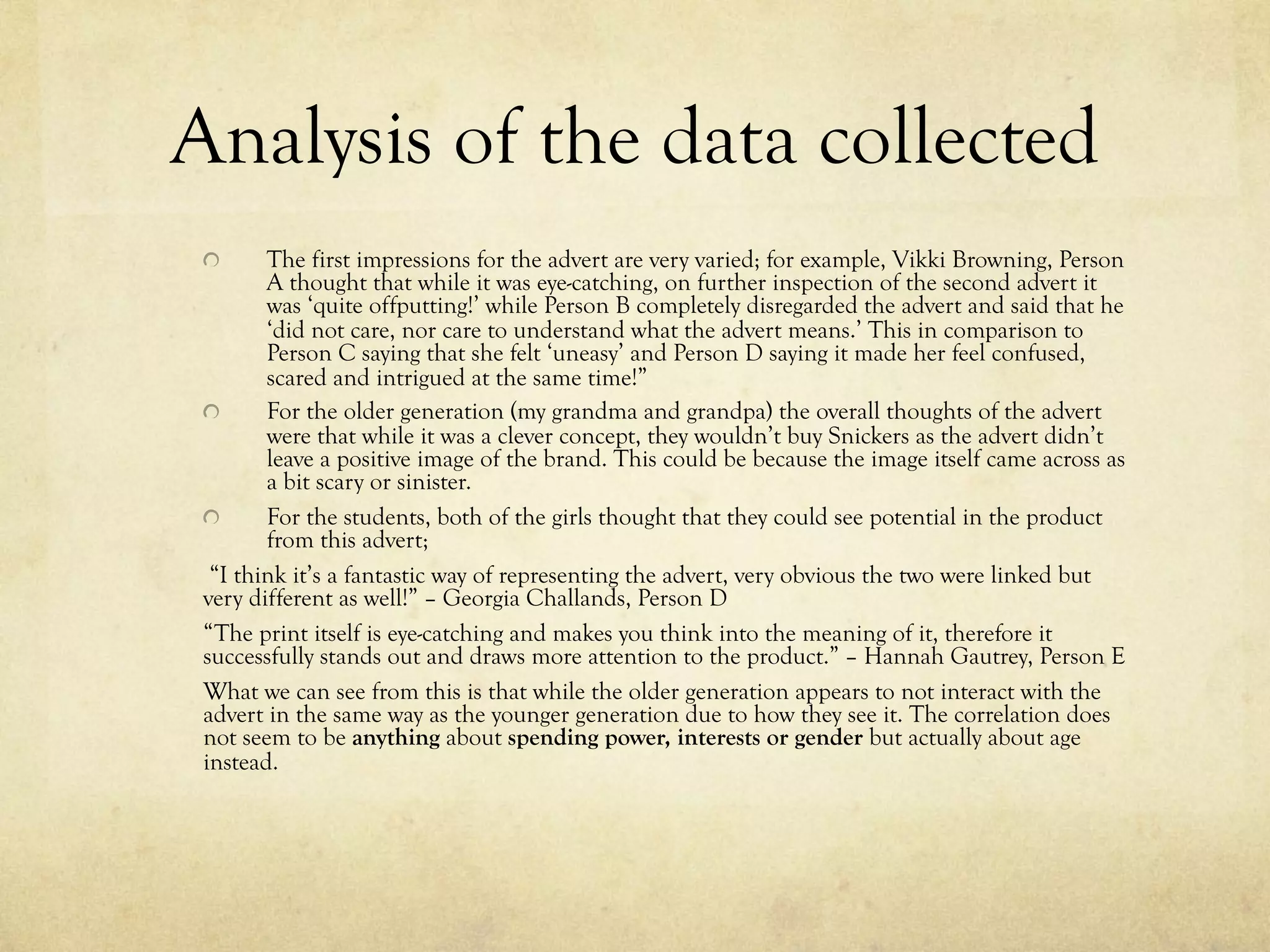
  The first impressions for the advert are very varied; for example, Vikki Browning, Person
A thought that while it was eye-catching, on further inspection of the second advert it
was ‘quite offputting!’ while Person B completely disregarded the advert and said that he
‘did not care, nor care to understand what the advert means.’ This in comparison to
Person C saying that she felt ‘uneasy’ and Person D saying it made her feel confused,
scared and intrigued at the same time!”
  For the older generation (my grandma and grandpa) the overall thoughts of the advert
were that while it was a clever concept, they wouldn’t buy Snickers as the advert didn’t
leave a positive image of the brand. This could be because the image itself came across as
a bit scary or sinister.
  For the students, both of the girls thought that they could see potential in the product
from this advert;
“I think it’s a fantastic way of representing the advert, very obvious the two were linked but
very different as well!” – Georgia Challands, Person D
“The print itself is eye-catching and makes you think into the meaning of it, therefore it
successfully stands out and draws more attention to the product.” – Hannah Gautrey, Person E
What we can see from this is that while the older generation appears to not interact with the
advert in the same way as the younger generation due to how they see it. The correlation does
not seem to be anything about spending power, interests or gender but actually about age
instead.
What could be done to make the product
more attractive to maximize reach
  The elder generations complained that it was too complex but also quite
intimidating at the same time. This may involve the ‘mad scientist’ image
being very convincing. One way this could be targeted and dealt with is by
making the image of the mad scientist less threatening and sinister as well as
the
  Including an image of the chocolate bar itself in the advert could be an USP
because it shows the significance of the chocolate to catalyze the effect.
  The switch-over from ‘Get Some Nuts’ campaign to the ‘You’re not you when
you’re hungry’ campaign was a wise decision because it targeted the ‘lad’
audience who want to man up – but the question that should be asked is what
could the campaign do to extend the reach to the elder generations? One
solution could be involved older celebrities shown performing while also
getting transformed from being undesirable.
P4: Distribution Channels
Videos used:
  https://www.youtube.com/watch?v=18ya0-OZ58s
  https://www.youtube.com/watch?v=qIVDxL2lgN4
Social Media
Social media has become a huge part of every-day life of the
modern UK person. Mars Inc found a way to use this to their
advantage via the social media platform ‘Twitter’ by using
celebrities to advertise their campaign.
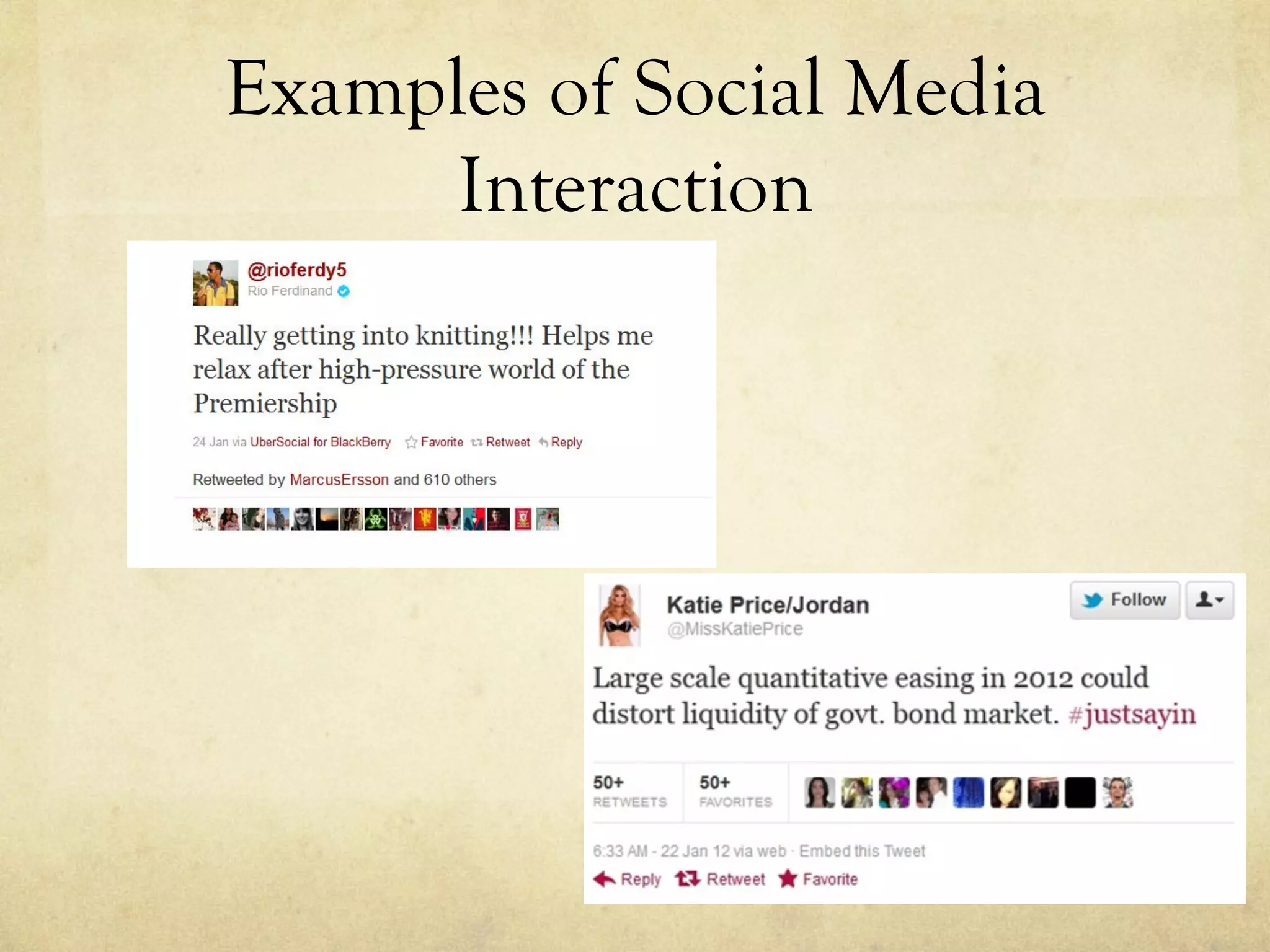
This included tweets from TV celebrities such as Katie Price,
footballer Rio Ferdinand and boxer Amir Khan.
Some of these examples include Rio Ferdinand talking about
knitting, and Katie Price commenting of China’s GDP. This
allowed Mars Inc connect with a different type of audience and
achieve a higher reach. It is estimated that the reach of the social
media campaign achieved 27 million while only costing £70,000.
Celebrity Endorsement
Celebrity endorsement is one of the easiest ways to gain
support for your product. The reason for this is because
celebrities often have a large following of people due the
interest in the characters. One example of this is Mr Bean
(Rowan Atkinson) who was involved in a 2014 Snickers
commercial.
Because of this, the advert went viral with over 5 million
views.
Examples of Social Media
Interaction
Super Bowl – an expensive but
extreme payoff
  “The average cost for a Super Bowl ad (which if we cut back
earlier is the Betty White one) is said to around $4m.
However, the reason why the cost of the advertisement is so
worth the exposure your brand would get is simply based on
how many people actually watch the Super Bowl - with the
last Super Bowl (2014) having had a whopping 111.5m
viewers.”
Because of the extreme amount of reach that the adverts Super
Bowl reach out to, the cost of $4m becomes suddenly a very
small number. For a large company such as the creators of
Snickers (Mars Inc) it becomes a very small cost for such a huge
expansion to their viewer base.
Conclusion about distribution
channels & advertising
  Social Media is becoming much more prominent in
advertising, and with this comes ever-increasing in Word of
Mouth advertising. Celebrities say something ridiculous and
funny, then say that Snickers stops them from being out of
character. People ‘retweet’ or share the messages and it
spreads from then on.
  Celebrity endorsement is popular because of the following
the celebrities have. This attracts a new fan-base to your
product.
  TV Advertising can be very effective, especially on the much
larger scale such as Super Bowl if the advert is just as
effective.
P5: Legal and Ethical Issues
ASA are the regulatory body that is used to make sure that every advert created
is created on a fair playing field for every business.
They also respond to the concerns from the members of public and check to see
if the advert could be taken offensively, if it is misleading or if it is offensive.
ASA Part 2
  The ASA consists of 13 people for the council, of which these 13 people
can still on the council for a maximum of 6 years (in three year
increments). They have written two codes:
  "The UK Code of Non-broadcast Advertising, Sales Promotion and Direct
Marketing (CAP Code) applies to advertisements across media including
newspapers, magazines, billboards, posters, leaflets, mailings, e-mails, texts
and on UK based company websites.
  The UK Code of Broadcast Advertising (BCAP Code) applies to the
content and scheduling of television and radio advertisements (including
teleshopping). It also covers programme sponsorship credits on radio and
television services but complaints about these are handled by Ofcom.”
The Snickers’ Social Media extended
As mentioned before in the last few slides about the Snickers advertising via
‘Twitter’, the reach that was achieved also helped raise sales.
“The act of being so out of character simply by itself caused a media storm as people
wondered how Katie Price got around to talking about China’s GDP figures. 4
other celebrities such as Rio Ferdinand and Cher Lloyd followed suit.
The reaction to this was both shock but also interest displayed by the public, and
due to this and the handing out of Snickers in the London Tube as ‘emergency
snickers’ for those who displayed signs of hunger. This in turn created an increase
of 705,000 sales of Snickers for that year.”
However, this was not just that easy. The campaign sparked two complaints about
Rio Ferdinand and Katie Price advertising as not being ‘obvious forms of marketing
communication. However due to the use of the hashtag #spon - the hashtag for
sponsored content was used to show specifically that Snickers was sponsoring the
celebrities after the digital campaign had been checked with the CAP Code.
Therefore, no action was taken.
Betty White: Snickers & Super Bowl
“This is the 2010 Super Bowl snickers advert that restarted the ‘You’re not you
when you’re hungry’ campaign. The representational problems that could exist with
this advert is that it could give the impression that older people are weaker not only
physically but also mentally. This could come across as offensive to older people -
however it would be a long shot as it is meant to be comedic to the majority of the
middle-aged to younger audience.
It is giving the impression that if you eat Snickers, you will be a stronger and better
person, which is what appeals to our ‘fight or flight’ instincts.”
To add on to what I wrote in the last paragraph, this type of advertising could be
seen as quite aggressive because it is declaring that you are weak in a subtle way
without Snickers. It holds the same message as the ‘Get some Nuts’ campaign,
however it does not declare it so publically.
https://www.youtube.com/watch?v=OTPJYZLD6L8
Thank you for watching!
Bibliography
  AMV logo: http://www.amvlab.com/wp-content/uploads/2011/05/About_AMVBBDO.jpg
  WPP Campaign and advert:
http://www.wpp.com/corporateresponsibilityreports/2010/the-impact-of-our-work/
sustainability-in-marketing/campaign-dont-consume-the-nature.html
  Guidelines of Production Process:
http://smallbusiness.chron.com/advertising-production-process-45162.html
  Portraits of founders of AMV:
http://www.benschott.com/wp-content/uploads/2012/05/amv-schott.jpg -
http://cached.imagescaler.hbpl.co.uk/resize/scaleWidth/618/?sURL=http://
offlinehbpl.hbpl.co.uk/News/OMC/Mead_Peter_cdp_03_rt-20130731010330339.png -
http://www.thedrum.com/uploads/news/168316/davidAbbott.jpg

Media unit1 updated

  • 1.
    Unit 1 Presentation ByCaleb Browning
  • 2.
    Contents   Slide 3– P1: BBDO agency profile   Slide 9 – P2: Print Case Study on WPP   Slide 15 – P3: Audience Research   Slide 22 – P4: Distribution Channels   Slide 28 – P5: Legal and Ethical Issues
  • 3.
  • 4.
    Ownership of BBDO  BBDO is a huge advertising company branching out globally. It is 6th in the top 50 advertisement agencies in the world. BBDO as an organisation that was founded by 4 men: William H. Johns   Bruce Fairchild Barton Roy Sarles Durstine   Alex Faickney Osborn
  • 5.
    Operation Model and Products  The business model across BBDO used is known as ‘Allied- unrelated’; where the different companies under the BBDO banner all are given core components to start up the company without help from others. However, clients and customers may be shared across the board.   Some of the products that AMV BBDO have worked on are very prestigious; one example of this is the ‘You’re not you when you’re hungry’ campaign created for Snickers. It worked so well when it was released that the campaign ‘saw some double digit growth in value sales in some channels as well as an increase of 705,000 sales of Snickers in comparison to the last year in England.
  • 6.
  • 7.
    Market Position and Competitors “AMVthemselves are the biggest agency in the UK, working with 92 brands. However, BBDO is absolutely huge – being the third largest agency in the world, with 288 offices in 90 countries.” BBDO is rated the 6th top ad agency in the world based on statistics from their online presence rated by http://www.top50adagencies.com/ . However, BBDO has been crowned ‘Network of the Year’ 5 times at Cannes, and is currently ranked the most creative agency in the Gunn Report.
  • 8.
  • 9.
    P2: Print CaseStudy M1:D1
  • 10.
  • 11.
  • 12.
    Purposes, genre, andforms. The genre of the adverts are based on purely reminding people to pick up a Snickers bar. It relies on being seen many times to sell the product (in this case, a Snickers bar). Therefore, they’re product based. The form of the advert is print based, but they are also digitally printed based. This is because it allows Snickers to tap into a cold audience. The purpose of these set of adverts was to try to branch out from the stereotypical chocolate bar advert and to be more adventurous with what the brand’s meaning is while still incorporating the ‘you’re not you when you’re hungry’ slogan in a subtle way. These sets of adverts also branch out from social media and television advertisements into the print-based form in a more controversial way.
  • 13.
    Content, style, meaning  The style of the advert is complex but well-made. The outer layer of the individual is almost unwrapped like a chocolate bar wrapping to suggest that when Snickers are eaten, you will return from a hungry ‘monster’ back to reality. The print advert is not fluid, and the cuts between the two individuals almost suggests chaos. However, it is centered which allows us to directly focus on the object at hand and uses a brown background to create a spark plug from Snickers to the brown colour.   The meaning of the advert is honest but controversial on a subtle level – if you want to be considered normal, then eat this chocolate bar. That is the main objective; to create an establishment between integrated audiences that eating Snickers will make you feel more ‘in’ with everyone else. It also means that when you are hungry, you make rash decisions and that Snickers is the cure for that.   The content of the adverts is to portray an every-day individual as something ‘wacky’ or ‘crazy’ on the outside and their normal form on the inside. This revolves around their slogan ‘you’re not you when you’re hungry’ and plays in a clever way with the slogan itself.
  • 14.
    Production process ofthe advert   Planning: the beginning was to base an advert around the slogan of Snickers: “You aren’t you when you’re hungry”. This gave BBDO something to work from while also keeping recognition of the brand.   Pre-production: Two different methods would have had to been used to create the idea. Firstly, the idea had to be mind mapped and thought of in the first place, and documented. Secondly, sketches of the idea would have been created and pitched to officials in BBDO/Snickers.   Production: The production of the advert would have been starting slowly with an original version of the advert, then building from feedback from Snickers on what could be improved. This includes adding additional colours, changing the look of how the characters are portrayed and branding.   Post-production: The last part of the production process would involve finalizing the advert as we see it now as well as checking to see if all requirements had been fulfilled for the advert. For example; whether it met budget costs, whether the colour scheme was followed, if it portrays the advert in a good light.
  • 15.
  • 16.
  • 17.
    Brief of AudienceResearch I took two Snickers adverts that were created within the BBDO corporation (produced by ‘IMPACT BBDO’ in Dubai) and I showed them to my friends and relatives of different ages to ask them three questions that would:   Find out their initial response and reading of the adverts   Upon closer inspection the relationship and understanding of the advert   And if the advert makes them want to buy a Snickers after seeing the advert.
  • 19.
    Analysis of thedata collected   The first impressions for the advert are very varied; for example, Vikki Browning, Person A thought that while it was eye-catching, on further inspection of the second advert it was ‘quite offputting!’ while Person B completely disregarded the advert and said that he ‘did not care, nor care to understand what the advert means.’ This in comparison to Person C saying that she felt ‘uneasy’ and Person D saying it made her feel confused, scared and intrigued at the same time!”   For the older generation (my grandma and grandpa) the overall thoughts of the advert were that while it was a clever concept, they wouldn’t buy Snickers as the advert didn’t leave a positive image of the brand. This could be because the image itself came across as a bit scary or sinister.   For the students, both of the girls thought that they could see potential in the product from this advert; “I think it’s a fantastic way of representing the advert, very obvious the two were linked but very different as well!” – Georgia Challands, Person D “The print itself is eye-catching and makes you think into the meaning of it, therefore it successfully stands out and draws more attention to the product.” – Hannah Gautrey, Person E What we can see from this is that while the older generation appears to not interact with the advert in the same way as the younger generation due to how they see it. The correlation does not seem to be anything about spending power, interests or gender but actually about age instead.
  • 20.
    What could bedone to make the product more attractive to maximize reach   The elder generations complained that it was too complex but also quite intimidating at the same time. This may involve the ‘mad scientist’ image being very convincing. One way this could be targeted and dealt with is by making the image of the mad scientist less threatening and sinister as well as the   Including an image of the chocolate bar itself in the advert could be an USP because it shows the significance of the chocolate to catalyze the effect.   The switch-over from ‘Get Some Nuts’ campaign to the ‘You’re not you when you’re hungry’ campaign was a wise decision because it targeted the ‘lad’ audience who want to man up – but the question that should be asked is what could the campaign do to extend the reach to the elder generations? One solution could be involved older celebrities shown performing while also getting transformed from being undesirable.
  • 21.
  • 22.
    Videos used:   https://www.youtube.com/watch?v=18ya0-OZ58s  https://www.youtube.com/watch?v=qIVDxL2lgN4
  • 23.
    Social Media Social mediahas become a huge part of every-day life of the modern UK person. Mars Inc found a way to use this to their advantage via the social media platform ‘Twitter’ by using celebrities to advertise their campaign. This included tweets from TV celebrities such as Katie Price, footballer Rio Ferdinand and boxer Amir Khan. Some of these examples include Rio Ferdinand talking about knitting, and Katie Price commenting of China’s GDP. This allowed Mars Inc connect with a different type of audience and achieve a higher reach. It is estimated that the reach of the social media campaign achieved 27 million while only costing £70,000.
  • 24.
    Celebrity Endorsement Celebrity endorsementis one of the easiest ways to gain support for your product. The reason for this is because celebrities often have a large following of people due the interest in the characters. One example of this is Mr Bean (Rowan Atkinson) who was involved in a 2014 Snickers commercial. Because of this, the advert went viral with over 5 million views.
  • 25.
    Examples of SocialMedia Interaction
  • 26.
    Super Bowl –an expensive but extreme payoff   “The average cost for a Super Bowl ad (which if we cut back earlier is the Betty White one) is said to around $4m. However, the reason why the cost of the advertisement is so worth the exposure your brand would get is simply based on how many people actually watch the Super Bowl - with the last Super Bowl (2014) having had a whopping 111.5m viewers.” Because of the extreme amount of reach that the adverts Super Bowl reach out to, the cost of $4m becomes suddenly a very small number. For a large company such as the creators of Snickers (Mars Inc) it becomes a very small cost for such a huge expansion to their viewer base.
  • 27.
    Conclusion about distribution channels& advertising   Social Media is becoming much more prominent in advertising, and with this comes ever-increasing in Word of Mouth advertising. Celebrities say something ridiculous and funny, then say that Snickers stops them from being out of character. People ‘retweet’ or share the messages and it spreads from then on.   Celebrity endorsement is popular because of the following the celebrities have. This attracts a new fan-base to your product.   TV Advertising can be very effective, especially on the much larger scale such as Super Bowl if the advert is just as effective.
  • 28.
    P5: Legal andEthical Issues
  • 29.
    ASA are theregulatory body that is used to make sure that every advert created is created on a fair playing field for every business. They also respond to the concerns from the members of public and check to see if the advert could be taken offensively, if it is misleading or if it is offensive.
  • 30.
    ASA Part 2  The ASA consists of 13 people for the council, of which these 13 people can still on the council for a maximum of 6 years (in three year increments). They have written two codes:   "The UK Code of Non-broadcast Advertising, Sales Promotion and Direct Marketing (CAP Code) applies to advertisements across media including newspapers, magazines, billboards, posters, leaflets, mailings, e-mails, texts and on UK based company websites.   The UK Code of Broadcast Advertising (BCAP Code) applies to the content and scheduling of television and radio advertisements (including teleshopping). It also covers programme sponsorship credits on radio and television services but complaints about these are handled by Ofcom.”
  • 31.
    The Snickers’ SocialMedia extended As mentioned before in the last few slides about the Snickers advertising via ‘Twitter’, the reach that was achieved also helped raise sales. “The act of being so out of character simply by itself caused a media storm as people wondered how Katie Price got around to talking about China’s GDP figures. 4 other celebrities such as Rio Ferdinand and Cher Lloyd followed suit. The reaction to this was both shock but also interest displayed by the public, and due to this and the handing out of Snickers in the London Tube as ‘emergency snickers’ for those who displayed signs of hunger. This in turn created an increase of 705,000 sales of Snickers for that year.” However, this was not just that easy. The campaign sparked two complaints about Rio Ferdinand and Katie Price advertising as not being ‘obvious forms of marketing communication. However due to the use of the hashtag #spon - the hashtag for sponsored content was used to show specifically that Snickers was sponsoring the celebrities after the digital campaign had been checked with the CAP Code. Therefore, no action was taken.
  • 32.
    Betty White: Snickers& Super Bowl “This is the 2010 Super Bowl snickers advert that restarted the ‘You’re not you when you’re hungry’ campaign. The representational problems that could exist with this advert is that it could give the impression that older people are weaker not only physically but also mentally. This could come across as offensive to older people - however it would be a long shot as it is meant to be comedic to the majority of the middle-aged to younger audience. It is giving the impression that if you eat Snickers, you will be a stronger and better person, which is what appeals to our ‘fight or flight’ instincts.” To add on to what I wrote in the last paragraph, this type of advertising could be seen as quite aggressive because it is declaring that you are weak in a subtle way without Snickers. It holds the same message as the ‘Get some Nuts’ campaign, however it does not declare it so publically. https://www.youtube.com/watch?v=OTPJYZLD6L8
  • 33.
    Thank you forwatching!
  • 34.
    Bibliography   AMV logo:http://www.amvlab.com/wp-content/uploads/2011/05/About_AMVBBDO.jpg   WPP Campaign and advert: http://www.wpp.com/corporateresponsibilityreports/2010/the-impact-of-our-work/ sustainability-in-marketing/campaign-dont-consume-the-nature.html   Guidelines of Production Process: http://smallbusiness.chron.com/advertising-production-process-45162.html   Portraits of founders of AMV: http://www.benschott.com/wp-content/uploads/2012/05/amv-schott.jpg - http://cached.imagescaler.hbpl.co.uk/resize/scaleWidth/618/?sURL=http:// offlinehbpl.hbpl.co.uk/News/OMC/Mead_Peter_cdp_03_rt-20130731010330339.png - http://www.thedrum.com/uploads/news/168316/davidAbbott.jpg