Media Language
Technical elements:
 Mise-en-scene
 Setting
 Performance/ Expression
 Costume/ make-up
 Colour
 Props
 Lighting
 Composition/ Framing/ Blocking
 Camera
 Framing: Defines the position from which the images was created.
 Angle: The angle of vision refers to the camera’s angle in relation to the
vertical.
 Type: This refers to the shot type = long/ medium/ close
 Movement: This refers to the movement of the camera – pan/ track
 Sound
 Used to tell the audience how to react at different points in a film or
television programme.
 Distinctive sound devices are used for particular genre. It is an important
device in establishing the genre for an audience and getting them in the
mood for watching something.
 Diegetic: This is the sound that comes from the world of the film/
programme
 Non-Diegetic: Sound that comes from outside the world of the filmor
programme
 Synchronous: sounds are matched to what us viewed – if you see someone
play the piano, you hear a piano playing
 Asynchronous: sound is not matched with a visible source of sound on screen
– a couple argue, you hear police sirens – this adds realismand connotes
meaning
 Editing
 Refers to the join between shots
 The purpose of conventional editing is to make this join as smooth as
possible – invisible
 The need for a narrative flow, to tell a story, led to the development of the
continuity system of editing
In Media, the word ‘text’ is used to describe any media product such as television
programmes, photographs, adverts, film, newspaper adverts, radio programmes, web pages
etc.
One of the keys to understanding the meaning in text is the use of codes
CODES – Rules or conventions by which signs are put together tocreate meaning.
In most cases, the text will use a variety of codes – visual, audio and written – that ‘fit’
together in a certain way to create a particularmeaning.
Semiotics: The “study of signs”
This is an attempt to create a science of the study of sign systems and their roles in the
construction and reconstruction of meaning in media texts
Swiss linguist Ferdinand de Saussure (1857-1913)
Signifier + Signified = Sign
The form which the sign takes the concept it represents
‘Open’ sign The shop is open
But in order to work there must be a shared reference or experience
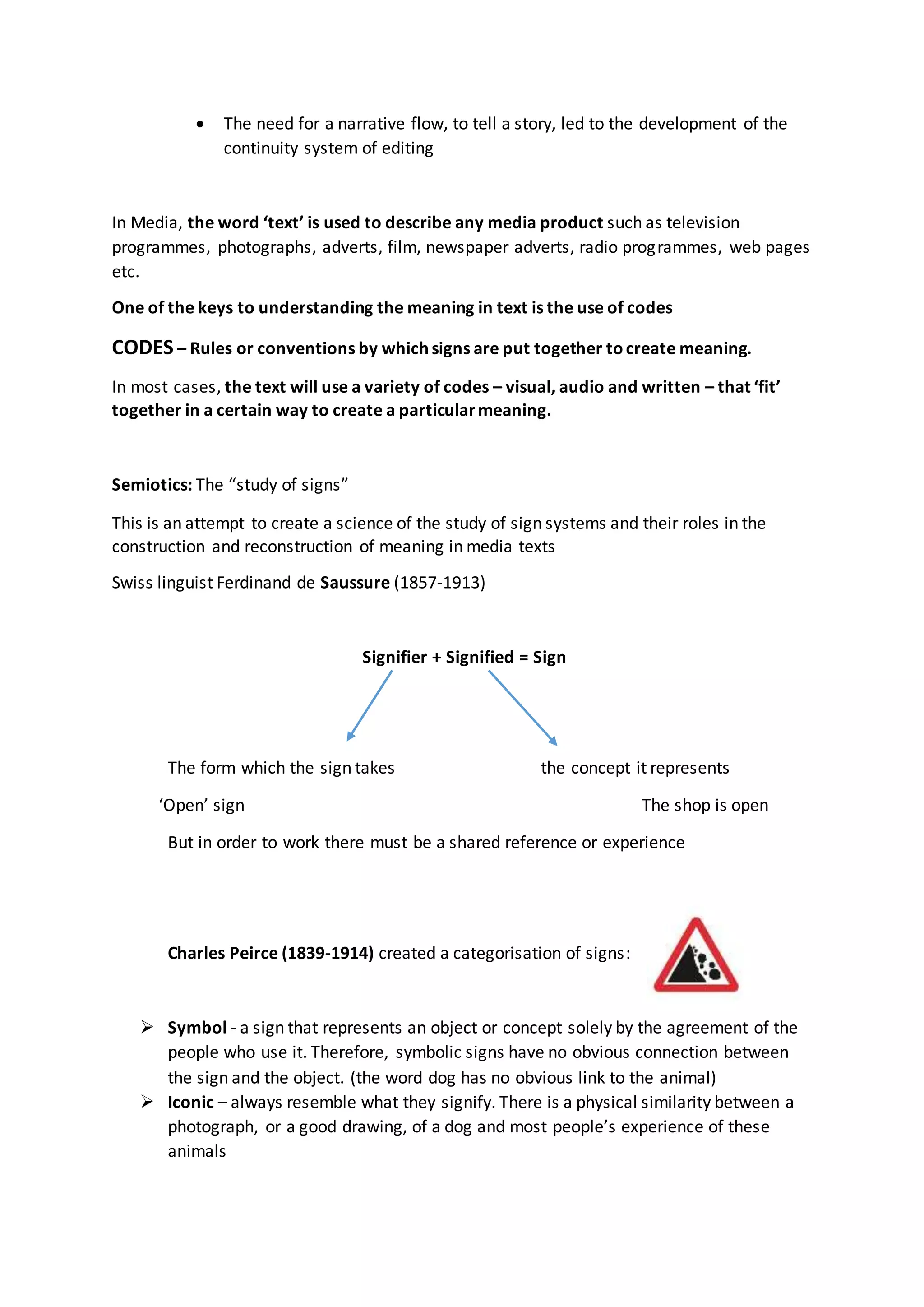
Charles Peirce (1839-1914) created a categorisation of signs:
 Symbol - a sign that represents an object or concept solely by the agreement of the
people who use it. Therefore, symbolic signs have no obvious connection between
the sign and the object. (the word dog has no obvious link to the animal)
 Iconic – always resemble what they signify. There is a physical similarity between a
photograph, or a good drawing, of a dog and most people’s experience of these
animals
 Index – Lie between symbolic and iconic signs. Indexical signs have some sort of
direct connection with what is being ‘signified’. For example, smoke is often used as
an indexical sign for fire and a tear running down a cheek cab be an indexical sign for
sorrow.
Roland Barthes (1913-1980), applied abstract ideas to daily life and culture.
Barthes looked at how signs take on the dominant value systemof a particular
society and make these values seem natural. The dominant value system of a society is
known as ideology, a way of looking at things shared by the majority of that society.
Barthes showed that Saussure’s sign can become a signifier to create, not only a
connotation, but a myth.
Another example is a red rose.
It is hard to understand “A red rose on Valentine’s Day” (denotation) as anything
other than meaning “romance” (connotation), I seems that what appears to be a
denotation (“a red rose on Valentine’s Day”) is actually a connotation (“romance”).
Signs can disguise themselves, a trick that allows myths to structure the meaning of
communication without appearing to do so.

Media language - A2 Media

  • 1.
    Media Language Technical elements: Mise-en-scene  Setting  Performance/ Expression  Costume/ make-up  Colour  Props  Lighting  Composition/ Framing/ Blocking  Camera  Framing: Defines the position from which the images was created.  Angle: The angle of vision refers to the camera’s angle in relation to the vertical.  Type: This refers to the shot type = long/ medium/ close  Movement: This refers to the movement of the camera – pan/ track  Sound  Used to tell the audience how to react at different points in a film or television programme.  Distinctive sound devices are used for particular genre. It is an important device in establishing the genre for an audience and getting them in the mood for watching something.  Diegetic: This is the sound that comes from the world of the film/ programme  Non-Diegetic: Sound that comes from outside the world of the filmor programme  Synchronous: sounds are matched to what us viewed – if you see someone play the piano, you hear a piano playing  Asynchronous: sound is not matched with a visible source of sound on screen – a couple argue, you hear police sirens – this adds realismand connotes meaning  Editing  Refers to the join between shots  The purpose of conventional editing is to make this join as smooth as possible – invisible
  • 2.
     The needfor a narrative flow, to tell a story, led to the development of the continuity system of editing In Media, the word ‘text’ is used to describe any media product such as television programmes, photographs, adverts, film, newspaper adverts, radio programmes, web pages etc. One of the keys to understanding the meaning in text is the use of codes CODES – Rules or conventions by which signs are put together tocreate meaning. In most cases, the text will use a variety of codes – visual, audio and written – that ‘fit’ together in a certain way to create a particularmeaning. Semiotics: The “study of signs” This is an attempt to create a science of the study of sign systems and their roles in the construction and reconstruction of meaning in media texts Swiss linguist Ferdinand de Saussure (1857-1913) Signifier + Signified = Sign The form which the sign takes the concept it represents ‘Open’ sign The shop is open But in order to work there must be a shared reference or experience Charles Peirce (1839-1914) created a categorisation of signs:  Symbol - a sign that represents an object or concept solely by the agreement of the people who use it. Therefore, symbolic signs have no obvious connection between the sign and the object. (the word dog has no obvious link to the animal)  Iconic – always resemble what they signify. There is a physical similarity between a photograph, or a good drawing, of a dog and most people’s experience of these animals
  • 3.
     Index –Lie between symbolic and iconic signs. Indexical signs have some sort of direct connection with what is being ‘signified’. For example, smoke is often used as an indexical sign for fire and a tear running down a cheek cab be an indexical sign for sorrow. Roland Barthes (1913-1980), applied abstract ideas to daily life and culture. Barthes looked at how signs take on the dominant value systemof a particular society and make these values seem natural. The dominant value system of a society is known as ideology, a way of looking at things shared by the majority of that society. Barthes showed that Saussure’s sign can become a signifier to create, not only a connotation, but a myth. Another example is a red rose. It is hard to understand “A red rose on Valentine’s Day” (denotation) as anything other than meaning “romance” (connotation), I seems that what appears to be a denotation (“a red rose on Valentine’s Day”) is actually a connotation (“romance”). Signs can disguise themselves, a trick that allows myths to structure the meaning of communication without appearing to do so.