Audiences
Hierarchy of needs
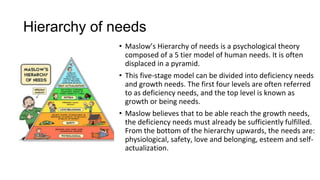
• Maslow’s Hierarchy of needs is a psychological theory
composed of a 5 tier model of human needs. It is often
displaced in a pyramid.
• This five-stage model can be divided into deficiency needs
and growth needs. The first four levels are often referred
to as deficiency needs, and the top level is known as
growth or being needs.
• Maslow believes that to be able reach the growth needs,
the deficiency needs must already be sufficiently fulfilled.
From the bottom of the hierarchy upwards, the needs are:
physiological, safety, love and belonging, esteem and self-
actualization.
Types of audiences
• There are 3 different theories of audiences. The earliest idea was that
mass audience are passive and inactive. It was thought that audiences
did not require the active use of the brain, they just sit and consume the
media.
• A newer model argues that audiences are individuals who interact with
the communication process and use media texts for their own purposes.
Audiences can make active decisions about what they consume in
relation to their social and cultural setting and their needs.
• With the creation of the internet, it has opened new ways to receive and
interact with information. We can ‘read’ texts that are downloaded to
our computers, or mobiles, or watch TV-on-demand and not just when
the broadcasters want us to receive it.This meant that audiences have
become interactive.
Hypodermic Model
• The Hypodermic needle theory is a linear communication theory
that suggests that media messages are transferred directly into
the brains of passive audiences. In this theory the media is seen
as powerful and able to ‘inject’ ideas into an audience who are
seen as weak and static and could be influenced by a message.
• It suggests that a media text has only one message which the
audience must pick up. This implies the audience is powerless
towards resisting the impact of the message, which, in some
cases, could be viewed as dangerous.
• Examples of this in modern era is TV adverts affecting viewers
through subconsciously manipulating them to buy their products.
A great example of this is the Levis advert for Jeans in 1985, this
advert boosted sales 800%.
Cultivation Theory
• The Cultivation theory was an approach developed by Professor George
Gerbner. Cultivation theorists argue that television has long-term effects
which are small, gradual, indirect but cumulative and significant. This
happens as audiences are treated as passive.
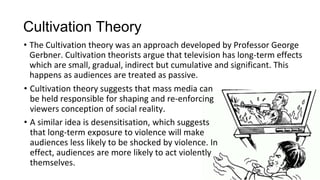
• Cultivation theory suggests that mass media can
be held responsible for shaping and re-enforcing
viewers conception of social reality.
• A similar idea is desensitisation, which suggests
that long-term exposure to violence will make
audiences less likely to be shocked by violence. In
effect, audiences are more likely to act violently
themselves.
Cultivation Theory experiment
• A key aspect of this theory is that time is essential when influencing viewers.
There is also a clear distinction between the heavy and light viewers. People
who watch a lot of television are likely to be more influenced by the ways in
which the world is framed by television programs than are individuals who
watch less.
• This idea is supported by an experiment taken out, in which 2 groups of
college students. One group was made to watch a lot of action and
adventure programs, whereas the other was made to watch little television.
The results showed that the group who watched lots of television became
more fearful of life in the everyday world than the ones who watched less
television. This showed that television did indeed have a small effect on
viewers overtime.
Two-step flow theory
•The two-step flow of communication hypothesis was first introduced
by Paul Lazarsfeld. Lazarsfeld researched the influence of media
messages on voting intentions. He found that informal, personal
contacts were mentioned far more frequently than exposure to radio
or newspaper as sources of influence on voting behaviour. From this,
he suggested messages from the media move in two distinct ways.
• This theory assumes a slightly more active audience. This is because
audiences are active in choosing where they get their information
Two-step flow continued
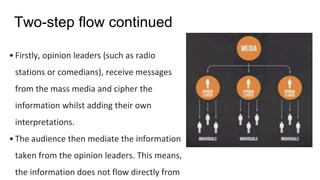
• Firstly, opinion leaders (such as radio
stations or comedians), receive messages
from the mass media and cipher the
information whilst adding their own
interpretations.
• The audience then mediate the information
taken from the opinion leaders. This means,
the information does not flow directly from
Uses and Gratifications Model
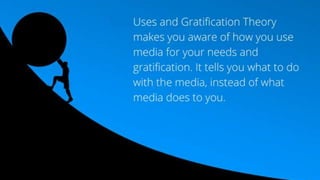
•Uses and Gratifications theory as developed by Bulmer and Katz suggests that media users
play an active role in choosing and using the media. Bulmer and Katz believed that the user
seeks out the media source that best fulfils their needs.
•The uses and gratifications theory assumes the audience chooses what it wants to watch
for five different reasons:
•Information and Education – the viewer wants to acquire information, knowledge and
understanding by watching programmes like The News or Documentaries.
•Entertainment – Viewers watch programmes for enjoyment.
•Personal Identity - Viewers can recognise a person or product, role models that reflect
similar values to themselves and mimic or copy some of their characteristics.
•Integration and social interaction – the ability for media products to produce a topic of
conversation between people. For example who is the best contestant on The X-factor who
which was the best goal shown on Match of the day.
•Escapism – Computer games and action films let viewers escape their real lives and imagine
themselves in those situations. All types of television programmes can be ‘used’ to wind
down and offer diversion, as well as satisfying some of the other needs at the same time.
Audience theories

Audience theories

  • 1.
  • 2.
    Hierarchy of needs •Maslow’s Hierarchy of needs is a psychological theory composed of a 5 tier model of human needs. It is often displaced in a pyramid. • This five-stage model can be divided into deficiency needs and growth needs. The first four levels are often referred to as deficiency needs, and the top level is known as growth or being needs. • Maslow believes that to be able reach the growth needs, the deficiency needs must already be sufficiently fulfilled. From the bottom of the hierarchy upwards, the needs are: physiological, safety, love and belonging, esteem and self- actualization.
  • 3.
    Types of audiences •There are 3 different theories of audiences. The earliest idea was that mass audience are passive and inactive. It was thought that audiences did not require the active use of the brain, they just sit and consume the media. • A newer model argues that audiences are individuals who interact with the communication process and use media texts for their own purposes. Audiences can make active decisions about what they consume in relation to their social and cultural setting and their needs. • With the creation of the internet, it has opened new ways to receive and interact with information. We can ‘read’ texts that are downloaded to our computers, or mobiles, or watch TV-on-demand and not just when the broadcasters want us to receive it.This meant that audiences have become interactive.
  • 4.
    Hypodermic Model • TheHypodermic needle theory is a linear communication theory that suggests that media messages are transferred directly into the brains of passive audiences. In this theory the media is seen as powerful and able to ‘inject’ ideas into an audience who are seen as weak and static and could be influenced by a message. • It suggests that a media text has only one message which the audience must pick up. This implies the audience is powerless towards resisting the impact of the message, which, in some cases, could be viewed as dangerous. • Examples of this in modern era is TV adverts affecting viewers through subconsciously manipulating them to buy their products. A great example of this is the Levis advert for Jeans in 1985, this advert boosted sales 800%.
  • 5.
    Cultivation Theory • TheCultivation theory was an approach developed by Professor George Gerbner. Cultivation theorists argue that television has long-term effects which are small, gradual, indirect but cumulative and significant. This happens as audiences are treated as passive. • Cultivation theory suggests that mass media can be held responsible for shaping and re-enforcing viewers conception of social reality. • A similar idea is desensitisation, which suggests that long-term exposure to violence will make audiences less likely to be shocked by violence. In effect, audiences are more likely to act violently themselves.
  • 6.
    Cultivation Theory experiment •A key aspect of this theory is that time is essential when influencing viewers. There is also a clear distinction between the heavy and light viewers. People who watch a lot of television are likely to be more influenced by the ways in which the world is framed by television programs than are individuals who watch less. • This idea is supported by an experiment taken out, in which 2 groups of college students. One group was made to watch a lot of action and adventure programs, whereas the other was made to watch little television. The results showed that the group who watched lots of television became more fearful of life in the everyday world than the ones who watched less television. This showed that television did indeed have a small effect on viewers overtime.
  • 7.
    Two-step flow theory •Thetwo-step flow of communication hypothesis was first introduced by Paul Lazarsfeld. Lazarsfeld researched the influence of media messages on voting intentions. He found that informal, personal contacts were mentioned far more frequently than exposure to radio or newspaper as sources of influence on voting behaviour. From this, he suggested messages from the media move in two distinct ways. • This theory assumes a slightly more active audience. This is because audiences are active in choosing where they get their information
  • 8.
    Two-step flow continued •Firstly, opinion leaders (such as radio stations or comedians), receive messages from the mass media and cipher the information whilst adding their own interpretations. • The audience then mediate the information taken from the opinion leaders. This means, the information does not flow directly from
  • 9.
    Uses and GratificationsModel •Uses and Gratifications theory as developed by Bulmer and Katz suggests that media users play an active role in choosing and using the media. Bulmer and Katz believed that the user seeks out the media source that best fulfils their needs. •The uses and gratifications theory assumes the audience chooses what it wants to watch for five different reasons: •Information and Education – the viewer wants to acquire information, knowledge and understanding by watching programmes like The News or Documentaries. •Entertainment – Viewers watch programmes for enjoyment. •Personal Identity - Viewers can recognise a person or product, role models that reflect similar values to themselves and mimic or copy some of their characteristics. •Integration and social interaction – the ability for media products to produce a topic of conversation between people. For example who is the best contestant on The X-factor who which was the best goal shown on Match of the day. •Escapism – Computer games and action films let viewers escape their real lives and imagine themselves in those situations. All types of television programmes can be ‘used’ to wind down and offer diversion, as well as satisfying some of the other needs at the same time.