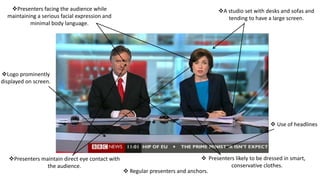
 Regular presenters and anchors.
 Use of headlines
A studio set with desks and sofas and
tending to have a large screen.
Presenters maintain direct eye contact with
the audience.
Presenters facing the audience while
maintaining a serious facial expression and
minimal body language.
Logo prominently
displayed on screen.
 Presenters likely to be dressed in smart,
conservative clothes.
British Broadcasting Corporation (BBC)
• The department is the world's largest broadcast news organisation and generates about 120 hours of radio
and television output each day.
• James Harding has been Director of News and Current Affairs since April 2013.
• the role of BBC news is to ct as the UK's main broadcasting station and to ensure that every
household/person can watch the programmes aired.
• current affairs
• breaking news
• very frequently shows soft news
• aired at more times in the day, the most breaking stories are either in the morning or at BBC news at 10pm.
• accused for political bias
• more employees, 3,500 to be exact
• on radio, internet and television
• more and older presenters
• more formal.
 Regular presenters and anchors.
 A studio set with desks and sofas and tending to have a
large screen.
Presenters maintain direct eye contact with the audience.
Logo prominently displayed on screen.
 As this is a children's
programme, presenter is
dressed in casual,
colourful yet smart
clothes.
 Only one
presenter on
screen at a
time.
 Presenter not in
the MCU (media
close up) it’s a full
body shot, casual
stance. Presenter is
not sitting on a
sofa or behind
a desk.
 includes a
constant colour
scheme but much
brighter colours. As
it links to the target
audience.
News round
• The programme is aimed at 6 to 12-year-olds.
• Created by Edward Barnes & John Craven.
• soft news
• television and internet
• younger presenters
• rarely any breaking news
• more video footage
• there is less talking and more imagery
• much shorter, only 5-15 minutes long and only on twice in a day
• aired in the morning before school so around 8 and then aired again at around 4 when children are mainly
home from school.
• similar opening sequence for 15 years
• more guests on the show
• more informal

Meddddia

  • 1.
     Regular presentersand anchors.  Use of headlines A studio set with desks and sofas and tending to have a large screen. Presenters maintain direct eye contact with the audience. Presenters facing the audience while maintaining a serious facial expression and minimal body language. Logo prominently displayed on screen.  Presenters likely to be dressed in smart, conservative clothes.
  • 2.
    British Broadcasting Corporation(BBC) • The department is the world's largest broadcast news organisation and generates about 120 hours of radio and television output each day. • James Harding has been Director of News and Current Affairs since April 2013. • the role of BBC news is to ct as the UK's main broadcasting station and to ensure that every household/person can watch the programmes aired. • current affairs • breaking news • very frequently shows soft news • aired at more times in the day, the most breaking stories are either in the morning or at BBC news at 10pm. • accused for political bias • more employees, 3,500 to be exact • on radio, internet and television • more and older presenters • more formal.
  • 3.
     Regular presentersand anchors.  A studio set with desks and sofas and tending to have a large screen. Presenters maintain direct eye contact with the audience. Logo prominently displayed on screen.  As this is a children's programme, presenter is dressed in casual, colourful yet smart clothes.  Only one presenter on screen at a time.  Presenter not in the MCU (media close up) it’s a full body shot, casual stance. Presenter is not sitting on a sofa or behind a desk.  includes a constant colour scheme but much brighter colours. As it links to the target audience.
  • 4.
    News round • Theprogramme is aimed at 6 to 12-year-olds. • Created by Edward Barnes & John Craven. • soft news • television and internet • younger presenters • rarely any breaking news • more video footage • there is less talking and more imagery • much shorter, only 5-15 minutes long and only on twice in a day • aired in the morning before school so around 8 and then aired again at around 4 when children are mainly home from school. • similar opening sequence for 15 years • more guests on the show • more informal