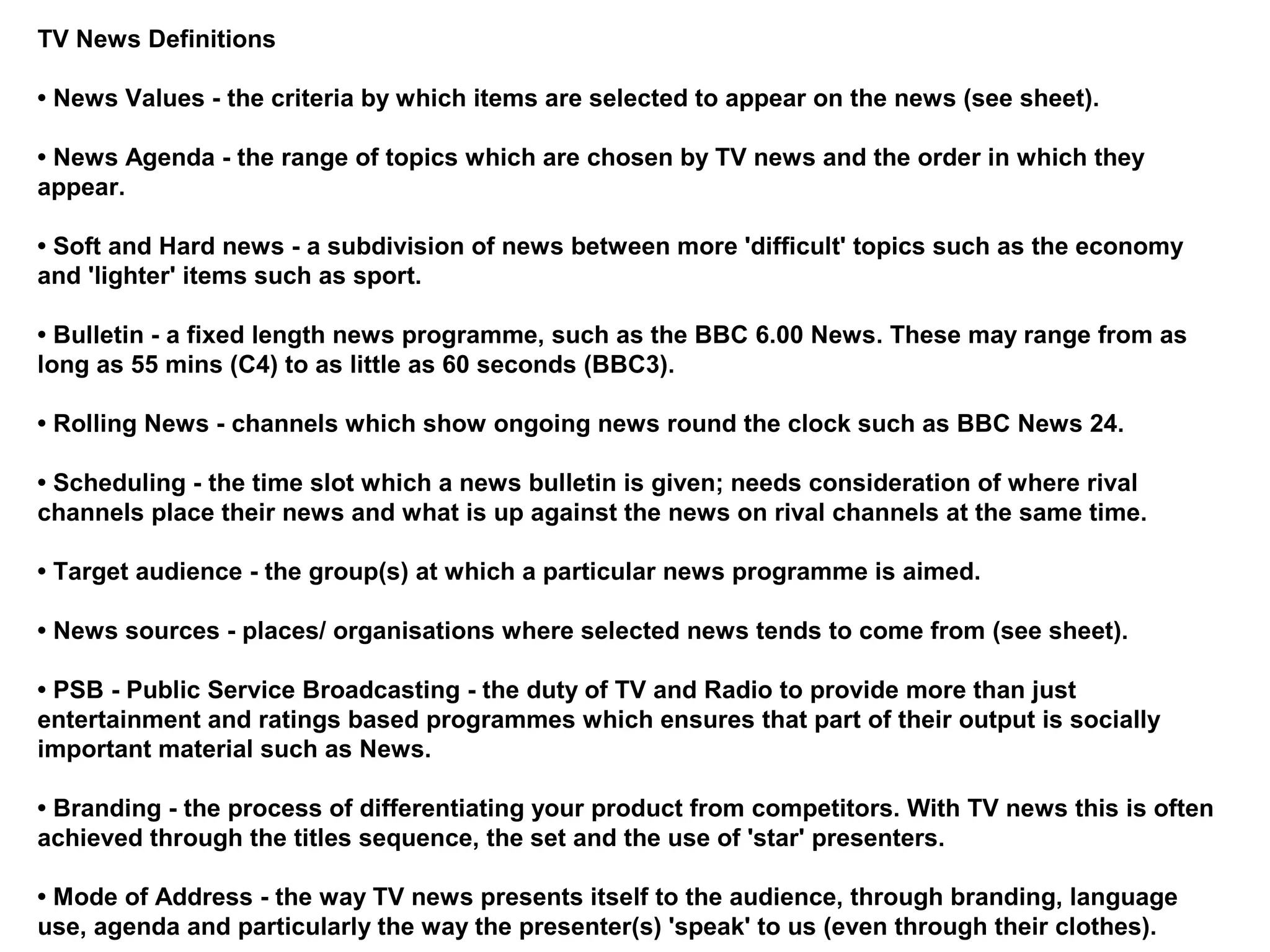
TV News Definitions
• News Values - the criteria by which items are selected to appear on the news (see sheet).
• News Agenda - the range of topics which are chosen by TV news and the order in which they
appear.
• Soft and Hard news - a subdivision of news between more 'difficult' topics such as the economy
and 'lighter' items such as sport.
• Bulletin - a fixed length news programme, such as the BBC 6.00 News. These may range from as
long as 55 mins (C4) to as little as 60 seconds (BBC3).
• Rolling News - channels which show ongoing news round the clock such as BBC News 24.
• Scheduling - the time slot which a news bulletin is given; needs consideration of where rival
channels place their news and what is up against the news on rival channels at the same time.
• Target audience - the group(s) at which a particular news programme is aimed.
• News sources - places/ organisations where selected news tends to come from (see sheet).
• PSB - Public Service Broadcasting - the duty of TV and Radio to provide more than just
entertainment and ratings based programmes which ensures that part of their output is socially
important material such as News.
• Branding - the process of differentiating your product from competitors. With TV news this is often
achieved through the titles sequence, the set and the use of 'star' presenters.
• Mode of Address - the way TV news presents itself to the audience, through branding, language
use, agenda and particularly the way the presenter(s) 'speak' to us (even through their clothes).
How to prepare for an essay on TV News
1. Tape a TV news broadcast to keep.
2. Go through the broadcast and identify which stories are hard news and
which are soft and why.
3. Note how the programme's news agenda is constructed and who you
think the target audience is and why.
4. For each item, decide what news values are present (why the item will
have been chosen).
5. Decide the news source of each item.
6. Pick two items and note in detail how each uses a variety of techniques:
presenter, interview, outside broadcast, stock footage, vox pop, graphics,
etc.
7. Use the page of notes on how to structure the essay
Remember! The mark out of 30 features 10 for structure, organisation and
readability, 10 for understanding of concept
and 10 for use of appropriate examples in detail.

News terms and definitions

  • 1.
    TV News Definitions •News Values - the criteria by which items are selected to appear on the news (see sheet). • News Agenda - the range of topics which are chosen by TV news and the order in which they appear. • Soft and Hard news - a subdivision of news between more 'difficult' topics such as the economy and 'lighter' items such as sport. • Bulletin - a fixed length news programme, such as the BBC 6.00 News. These may range from as long as 55 mins (C4) to as little as 60 seconds (BBC3). • Rolling News - channels which show ongoing news round the clock such as BBC News 24. • Scheduling - the time slot which a news bulletin is given; needs consideration of where rival channels place their news and what is up against the news on rival channels at the same time. • Target audience - the group(s) at which a particular news programme is aimed. • News sources - places/ organisations where selected news tends to come from (see sheet). • PSB - Public Service Broadcasting - the duty of TV and Radio to provide more than just entertainment and ratings based programmes which ensures that part of their output is socially important material such as News. • Branding - the process of differentiating your product from competitors. With TV news this is often achieved through the titles sequence, the set and the use of 'star' presenters. • Mode of Address - the way TV news presents itself to the audience, through branding, language use, agenda and particularly the way the presenter(s) 'speak' to us (even through their clothes).
  • 2.
    How to preparefor an essay on TV News 1. Tape a TV news broadcast to keep. 2. Go through the broadcast and identify which stories are hard news and which are soft and why. 3. Note how the programme's news agenda is constructed and who you think the target audience is and why. 4. For each item, decide what news values are present (why the item will have been chosen). 5. Decide the news source of each item. 6. Pick two items and note in detail how each uses a variety of techniques: presenter, interview, outside broadcast, stock footage, vox pop, graphics, etc. 7. Use the page of notes on how to structure the essay Remember! The mark out of 30 features 10 for structure, organisation and readability, 10 for understanding of concept and 10 for use of appropriate examples in detail.