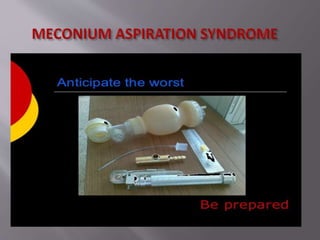
Meconium Aspiration syndrome
 Meconium aspiration syndrome (MAS) is a
respiratory disorder caused by inhalation of
meconium in amniotic fluid into the
tracheobronchial tree.
 Meconium is first found in the fetal ileum
between the 10 th and 16 th week of gestation
Meconium passage is uncommon before 34 wks,
but occurs in more than 30% of pregnancy
beyond 42 wks
In utero passage of meconium is uncommon due
to ,
 lack of strong peristalsis,
 good anal sphincter tone
 A cap of viscous meconium in the rectum
 Out of the 130 million annual births worldwide it is
estimated that aproximately 15 million newborn
infants aspirate meconium and 750000 to 1.8 million
of these develop MAS.
 It occurs more frequently in infants who are post
mature and small for gestational age.
 Mortality rates vary between 4-12% representing
approximately 30,000 to 200,000 deaths annually.
 MAS occurs in approx. 35% of live births with MSAF
 4% of all live birth
 Placental insufficiency
 Maternal hypertension
 Preeclampsia
 Oligohydramnios
 Maternal drug abuse, especially of tobacco
and cocaine
 Maternal infection/chorioamnionitis
 Fetal gasping secondary to hypoxia
 intrauterine stress causing:
 fetal hypoxia: Hypoxia causes increased gastrointestinal
peristalsis and relaxed anal sphincter tone.
 asphyxia
 acidosis
 Mature fetus (post dated babies):
 increases in the concentration of motilin (a peptide that
stimulates the contraction of the intestinal muscle).
 Vagal stimulation produced by cord or head compression
leading to in utero fetal stress.

 Other factors:
 Increased maternal age
 Prenatal complications
 Prolonged gestation,
 Obesity,
 Toxemia
 Hypertension
 Anemia
 Inadequate removal of meconium from the
airway prior to the first breath
 Use of PPV prior to clearing the airway of
meconium
• Meconium directly alters the amniotic
fluid, reducing antibacterial activity and
subsequently increasing the risk of perinatal
bacterial infection
• Meconium is irritating to fetal skin
• The most severe complication of meconium
passage in utero is aspiration of stained
amniotic fluid before, during, and after birth
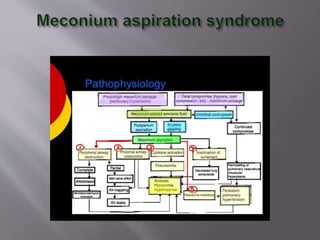
 Aspiration induces hypoxia via 4 major pulmonary
effects,
 airway obstruction
 chemical pneumonitis,
 PPHN,
 surfactant dysfunction.

 Severe respiratory distress may be present. Symptoms
include the following:
 Cyanosis
 Grunting
 Nasal flaring
 Intercostal retractions
 Tachypnea
 Barrel chest due to the presence of air trapping
 Auscultated rales and rhonchi (in some cases)
 Yellow-green staining of fingernails, umbilical cord,
and skin
 Signs of cerebral irritation resulting from cerebral
edema or hypoxia may appear soon after birth or
later.
 Jitteriness
 seizures
 Mild MAS
 Disease requiring <40% O 2 for < 48 hours
 Moderate MAS
 Disease requiring >40% O 2 for > 48 hours without
air leak
 Severe MAS
 Disease requiring assisted ventilation for >48 hours,
often associated with PPHN
 Arterial blood gases
 Continuous measurement of oxygenation
by pulse oximetry is necessary for
appropriate management.
 Serum Electrolytes
 CBC
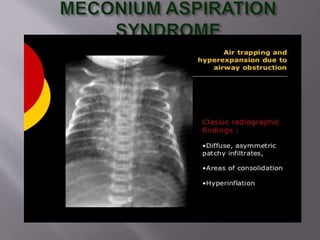
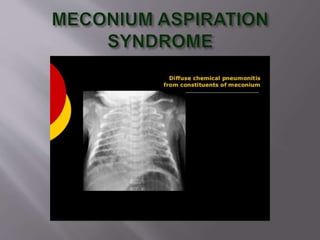
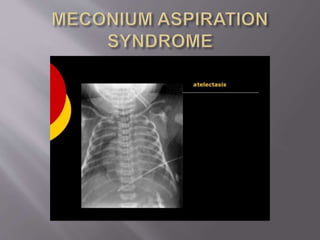
 A chest radiograph is essential to do the
following:
 Determine the extent of intrathoracic
pathology
 Identify areas of atelectasis and air block
syndromes
 Assure appropriate positioning of the
endotracheal tube and umbilical
catheters.
 Later in the course of MAS when the
infant is stable, imaging procedures of
the brain, such as MRI, CT scan, or
cranial ultrasound, are indicated if the
infant's neurologic examination is
abnormal.
 To ensure normal cardiac
structure,
 To assess cardiac function,
 To assess the severity of
pulmonary hypertension and
right-to-left shunting.
 Increased risk of perinatal and neonatal mortality
 Severe acidemia
 Need for CS delivery
 Need for Intensive Care and O 2 administration
 Adverse neurologic outcome
 In preterm's,
 increased incidence of Gr 3 to 4 IVH
 Cystic periventricular leukomalacia
 Cerebral palsy
 Obstetricians should monitor the mothers CTG
 When meconium is detected, administering
amnioinfusion with warm sterile saline may be
beneficial.
 Timing of delivery: In pregnancies that continue
past due date, induction as early as 41 wks may
help prevent MAS.
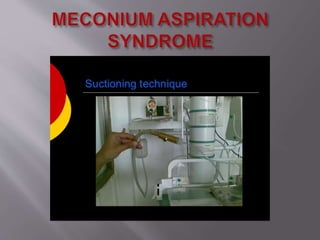
 Upon delivery of the head of the baby, careful
suctioning of the posterior pharynx decreases the
potential for aspiration of meconium.
 If the baby is not vigorous:
 Suction the trachea immediately after delivery.
 Suction for no longer than 5 seconds.
 If no meconium is retrieved, do not repeat intubation and
suction.
 If meconium is retrieved and no bradycardia is present,
reintubate and suction.
 If the heart rate is low, administer positive pressure
ventilation and consider suctioning again later.
 If the baby is vigorous:
 Clear secretions and meconium from the mouth and nose
with a bulb syringe or a large-bore suction catheter.
 Dry, stimulate, reposition, and administer oxygen as
necessary.
 Maintain an optimal thermal environment.
 Minimal handling to prevent right-to-left shunting,
leading to hypoxia and acidosis.
 Continue respiratory care.
 Oxygen therapy via hood or positive pressure
 Mechanical ventilation .
 Broad Spectrum Antibiotics according to
sensitivity pattern.
 I V . Dextrose,
 Fluids restricted as much as possible to prevent
cerebral and pulmonary edema
 correction of severe metabolic acidosis
 Protein, lipids, and vitamins to ensure
adequate nutrition and prevent essential
amino acid and essential fatty acid
deficiencies.
 Provide sufficient O2 to prevent PAH.
 CPAP: if FiO2 requirements >0.40, a trial of CPAP
with pressures of 2-6 cm of H2O before mechanical
ventilation.
 Indication for Conventional Mechanical Ventilation
 PaO2 < 50mmHg
 PaCO2 > 60 mmHg
 Persistent Acidosis with pH < 7.25
 Apnea
 Clinical Deterioration with increasing RD
 Inhaled nitric oxide has replaced the use of most
intravenous pulmonary vasodilators.
 Maintain systemic BP
 Volume expansion,
 Transfusion therapy, and
 Systemic vasopressors incl. dopamine
 Surfactant therapy is now commonly used to
replace displaced or inactivated surfactant and as
a detergent to remove meconium.
 May decrease resp. failure with MAS within 6 hrs
with 3 doses.
 Effective in treating MAS but associated with poor
neurological outcomes.
 ECMO is a lung bypass system that allows for
oxygenation of blood while the lung recovers.
 Extracorporeal membrane oxygenation (ECMO) is
employed if all other therapeutic options have
been exhausted.
 Thoracic Drainage tubes to be inserted in
cases of severe Pneumothorax
 Therapy with fibrin glue has been shown to
be effective in patients with a persistent air
leak
 Morphine
 Fentanyl
 Phenobabitone
 Dopamine
 Dobutamine
 Ephinephrine
 Cardiac consultation
 Neuro Consultation
 Developmental assessments
 Most infants with meconium aspiration syndrome
(MAS) have complete recovery of pulmonary
function. Severely affected infants have
approximately a 50% risk of developing reactive
airway disease in the first 6 months of life.
 Prenatal and intrapartum events initiating the
meconium passage may cause the infant to have
long-term neurologic deficits, including CNS
damage, seizures, mental retardation, and
cerebral palsy.
MAS in newborn new.pptx

MAS in newborn new.pptx

  • 1.
  • 2.
     Meconium aspirationsyndrome (MAS) is a respiratory disorder caused by inhalation of meconium in amniotic fluid into the tracheobronchial tree.
  • 3.
     Meconium isfirst found in the fetal ileum between the 10 th and 16 th week of gestation Meconium passage is uncommon before 34 wks, but occurs in more than 30% of pregnancy beyond 42 wks In utero passage of meconium is uncommon due to ,  lack of strong peristalsis,  good anal sphincter tone  A cap of viscous meconium in the rectum
  • 4.
     Out ofthe 130 million annual births worldwide it is estimated that aproximately 15 million newborn infants aspirate meconium and 750000 to 1.8 million of these develop MAS.  It occurs more frequently in infants who are post mature and small for gestational age.  Mortality rates vary between 4-12% representing approximately 30,000 to 200,000 deaths annually.  MAS occurs in approx. 35% of live births with MSAF  4% of all live birth
  • 5.
     Placental insufficiency Maternal hypertension  Preeclampsia  Oligohydramnios  Maternal drug abuse, especially of tobacco and cocaine  Maternal infection/chorioamnionitis  Fetal gasping secondary to hypoxia
  • 6.
     intrauterine stresscausing:  fetal hypoxia: Hypoxia causes increased gastrointestinal peristalsis and relaxed anal sphincter tone.  asphyxia  acidosis  Mature fetus (post dated babies):  increases in the concentration of motilin (a peptide that stimulates the contraction of the intestinal muscle).  Vagal stimulation produced by cord or head compression leading to in utero fetal stress.
  • 7.
     Other factors: Increased maternal age  Prenatal complications  Prolonged gestation,  Obesity,  Toxemia  Hypertension  Anemia
  • 8.
     Inadequate removalof meconium from the airway prior to the first breath  Use of PPV prior to clearing the airway of meconium
  • 9.
    • Meconium directlyalters the amniotic fluid, reducing antibacterial activity and subsequently increasing the risk of perinatal bacterial infection • Meconium is irritating to fetal skin • The most severe complication of meconium passage in utero is aspiration of stained amniotic fluid before, during, and after birth
  • 10.
     Aspiration induceshypoxia via 4 major pulmonary effects,  airway obstruction  chemical pneumonitis,  PPHN,  surfactant dysfunction.
  • 12.
     Severe respiratorydistress may be present. Symptoms include the following:  Cyanosis  Grunting  Nasal flaring  Intercostal retractions  Tachypnea  Barrel chest due to the presence of air trapping  Auscultated rales and rhonchi (in some cases)  Yellow-green staining of fingernails, umbilical cord, and skin
  • 13.
     Signs ofcerebral irritation resulting from cerebral edema or hypoxia may appear soon after birth or later.  Jitteriness  seizures
  • 14.
     Mild MAS Disease requiring <40% O 2 for < 48 hours  Moderate MAS  Disease requiring >40% O 2 for > 48 hours without air leak  Severe MAS  Disease requiring assisted ventilation for >48 hours, often associated with PPHN
  • 15.
     Arterial bloodgases  Continuous measurement of oxygenation by pulse oximetry is necessary for appropriate management.  Serum Electrolytes  CBC
  • 16.
     A chestradiograph is essential to do the following:  Determine the extent of intrathoracic pathology  Identify areas of atelectasis and air block syndromes  Assure appropriate positioning of the endotracheal tube and umbilical catheters.
  • 20.
     Later inthe course of MAS when the infant is stable, imaging procedures of the brain, such as MRI, CT scan, or cranial ultrasound, are indicated if the infant's neurologic examination is abnormal.
  • 21.
     To ensurenormal cardiac structure,  To assess cardiac function,  To assess the severity of pulmonary hypertension and right-to-left shunting.
  • 22.
     Increased riskof perinatal and neonatal mortality  Severe acidemia  Need for CS delivery  Need for Intensive Care and O 2 administration  Adverse neurologic outcome  In preterm's,  increased incidence of Gr 3 to 4 IVH  Cystic periventricular leukomalacia  Cerebral palsy
  • 23.
     Obstetricians shouldmonitor the mothers CTG  When meconium is detected, administering amnioinfusion with warm sterile saline may be beneficial.  Timing of delivery: In pregnancies that continue past due date, induction as early as 41 wks may help prevent MAS.  Upon delivery of the head of the baby, careful suctioning of the posterior pharynx decreases the potential for aspiration of meconium.
  • 24.
     If thebaby is not vigorous:  Suction the trachea immediately after delivery.  Suction for no longer than 5 seconds.  If no meconium is retrieved, do not repeat intubation and suction.  If meconium is retrieved and no bradycardia is present, reintubate and suction.  If the heart rate is low, administer positive pressure ventilation and consider suctioning again later.  If the baby is vigorous:  Clear secretions and meconium from the mouth and nose with a bulb syringe or a large-bore suction catheter.  Dry, stimulate, reposition, and administer oxygen as necessary.
  • 26.
     Maintain anoptimal thermal environment.  Minimal handling to prevent right-to-left shunting, leading to hypoxia and acidosis.  Continue respiratory care.  Oxygen therapy via hood or positive pressure  Mechanical ventilation .  Broad Spectrum Antibiotics according to sensitivity pattern.
  • 27.
     I V. Dextrose,  Fluids restricted as much as possible to prevent cerebral and pulmonary edema  correction of severe metabolic acidosis  Protein, lipids, and vitamins to ensure adequate nutrition and prevent essential amino acid and essential fatty acid deficiencies.
  • 28.
     Provide sufficientO2 to prevent PAH.  CPAP: if FiO2 requirements >0.40, a trial of CPAP with pressures of 2-6 cm of H2O before mechanical ventilation.  Indication for Conventional Mechanical Ventilation  PaO2 < 50mmHg  PaCO2 > 60 mmHg  Persistent Acidosis with pH < 7.25  Apnea  Clinical Deterioration with increasing RD
  • 29.
     Inhaled nitricoxide has replaced the use of most intravenous pulmonary vasodilators.  Maintain systemic BP  Volume expansion,  Transfusion therapy, and  Systemic vasopressors incl. dopamine
  • 30.
     Surfactant therapyis now commonly used to replace displaced or inactivated surfactant and as a detergent to remove meconium.  May decrease resp. failure with MAS within 6 hrs with 3 doses.
  • 31.
     Effective intreating MAS but associated with poor neurological outcomes.  ECMO is a lung bypass system that allows for oxygenation of blood while the lung recovers.  Extracorporeal membrane oxygenation (ECMO) is employed if all other therapeutic options have been exhausted.
  • 32.
     Thoracic Drainagetubes to be inserted in cases of severe Pneumothorax  Therapy with fibrin glue has been shown to be effective in patients with a persistent air leak
  • 33.
     Morphine  Fentanyl Phenobabitone  Dopamine  Dobutamine  Ephinephrine
  • 34.
     Cardiac consultation Neuro Consultation  Developmental assessments
  • 35.
     Most infantswith meconium aspiration syndrome (MAS) have complete recovery of pulmonary function. Severely affected infants have approximately a 50% risk of developing reactive airway disease in the first 6 months of life.  Prenatal and intrapartum events initiating the meconium passage may cause the infant to have long-term neurologic deficits, including CNS damage, seizures, mental retardation, and cerebral palsy.