MECHANICAL OPERATIONS
(CHE1022)
Dr. Aabid Hussain Shaik
Associate Professor
Chemical Engineering Department,
SCHEME
Contact information:
Room no. SMV 221
Email: aabidhussain.s@vit.ac.in
Module 1
• Introduction to particulate solids
• Particle shape, size
• Mixed particle sizes
• Size analysis – cumulative and differential
• Various mean diameters
• Screen analysis
• Standard screens
• Various Industrial screens
• LO’s
• Will be able to use different size analysis methods to determine
particle size.
• Will be able to calculate the particle size distribution using screen
analysis.
Particulate – Assembly of small particles
They are characterized by
*Size
*Shape
*Density
Regular –specified by size, shape
Irregular-arbitrarily defined
•
Equivalent diameter (irregular shaped particles)
•
Volume: V
Sp
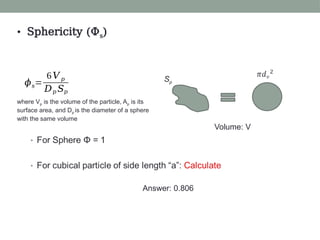
• Sphericity (Φs)
𝜙𝑠=
6𝑉 𝑝
𝐷𝑝 𝑆𝑝
where Vp is the volume of the particle, Ap is its
surface area, and Dp is the diameter of a sphere
with the same volume
Answer: 0.806
Spherecity of cube
• Ψ = As / Ap Where: As is the surface area of the equivalent
sphere and Ap is the measured surface area.
The sphericity can have a value ranging from 0-1, where Ψ = 1
for an ideal sphere.
• The volume of a spherical particle is:
• Vp= (1/6) π dp
3
Where: dp is the diameter of the particle.
• The surface area of a sphere is:
• As = π dp
2
= π [ (6 Vp / π)(1/3)
]2
Thus, for a particle, Ψ can be
calculated by measuring its volume and surface area:
• Ψ = As / Ap = π (6 Vp / π)(2/3)
/ Ap An example: A cube measuring
1 × 1 × 1 cm has a volume of 1 cm3
, and a surface area of 6 ×
(1 × 1) = 6 cm2
. Its sphericity is:
• Ψ = π × (6 × 1 / π)(2/3)
/ 6 = 0.806
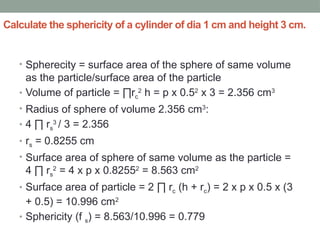
Calculate the sphericity of a cylinder of dia 1 cm and height 3 cm.
• Spherecity = surface area of the sphere of same volume
as the particle/surface area of the particle
• Volume of particle = ∏rc
2
h = p x 0.52
x 3 = 2.356 cm3
• Radius of sphere of volume 2.356 cm3
:
• 4 ∏ rs
3
/ 3 = 2.356
• rs = 0.8255 cm
• Surface area of sphere of same volume as the particle =
4 ∏ rs
2
= 4 x p x 0.82552
= 8.563 cm2
• Surface area of particle = 2 ∏ rc (h + rc) = 2 x p x 0.5 x (3
+ 0.5) = 10.996 cm2
• Sphericity (f s) = 8.563/10.996 = 0.779
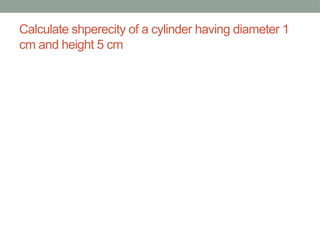
Calculate shperecity of a cylinder having diameter 1
cm and height 5 cm
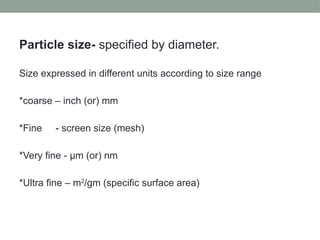
Particle size- specified by diameter.
Size expressed in different units according to size range
*coarse – inch (or) mm
*Fine - screen size (mesh)
*Very fine - µm (or) nm
*Ultra fine – m2
/gm (specific surface area)
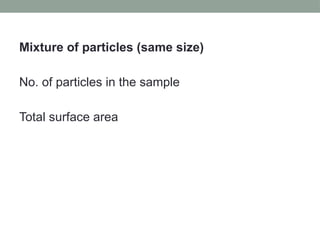
Mixture of particles (same size)
No. of particles in the sample
Total surface area
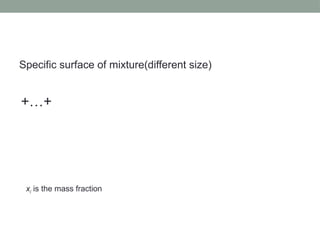
Specific surface of mixture(different size)
+…+
xi is the mass fraction
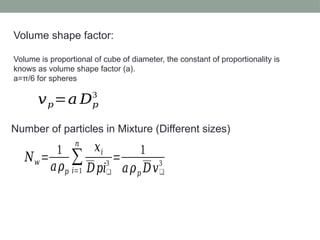
Number of particles in Mixture (Different sizes)
𝑁𝑤 =
1
𝑎𝜌𝑝
∑
𝑖=1
𝑛
𝑥𝑖
𝐷𝑝𝑖❑
3
=
1
𝑎𝜌𝑝 𝐷𝑣❑
3
𝑣𝑝=𝑎 𝐷𝑝
3
Volume shape factor:
Volume is proportional of cube of diameter, the constant of proportionality is
knows as volume shape factor (a).
a=π/6 for spheres
Average particle size
Volume – Surface mean diameter
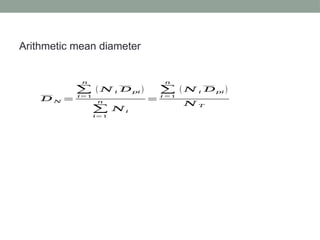
Arithmetic mean diameter
𝐷 𝑁 =
∑
𝑖=1
𝑛
( 𝑁 𝑖 𝐷𝑝𝑖 )
∑
𝑖=1
𝑛
𝑁𝑖
=
∑
𝑖 =1
𝑛
( 𝑁 𝑖 𝐷𝑝𝑖 )
𝑁 𝑇
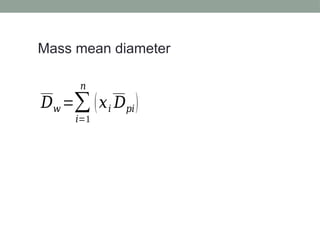
Mass mean diameter
𝐷𝑤 =∑
𝑖=1
𝑛
(𝑥𝑖 𝐷𝑝𝑖)
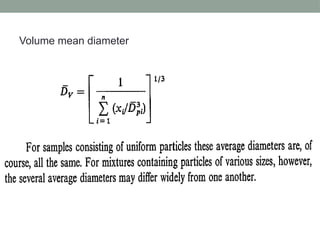
Volume mean diameter
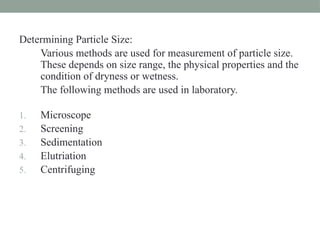
Determining Particle Size:
Various methods are used for measurement of particle size.
These depends on size range, the physical properties and the
condition of dryness or wetness.
The following methods are used in laboratory.
1. Microscope
2. Screening
3. Sedimentation
4. Elutriation
5. Centrifuging
Screening (Sieving)
Importance of screening:
• Removes the fine from the feed material before a reduction equipment.
• Prevents oversized material to enter into unit operations.
• Produce a process grade material to meet specific feed size.
• Removes fines from finished product before packing.
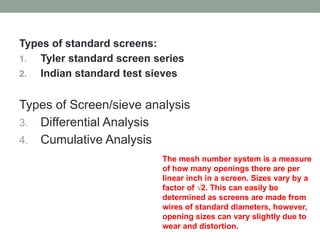
Types of standard screens:
1. Tyler standard screen series
2. Indian standard test sieves
Types of Screen/sieve analysis
3. Differential Analysis
4. Cumulative Analysis
The mesh number system is a measure
of how many openings there are per
linear inch in a screen. Sizes vary by a
factor of √2. This can easily be
determined as screens are made from
wires of standard diameters, however,
opening sizes can vary slightly due to
wear and distortion.
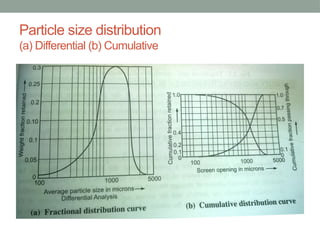
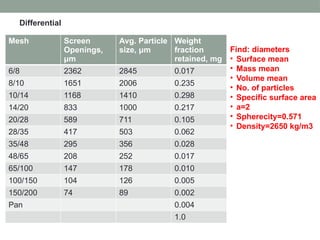
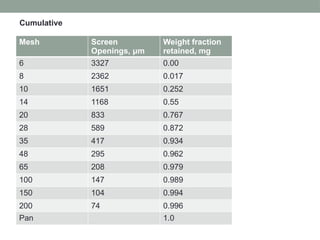
Particle size distribution
(a) Differential (b) Cumulative
Mesh Screen
Openings,
μm
Avg. Particle
size, μm
Weight
fraction
retained, mg
6/8 2362 2845 0.017
8/10 1651 2006 0.235
10/14 1168 1410 0.298
14/20 833 1000 0.217
20/28 589 711 0.105
28/35 417 503 0.062
35/48 295 356 0.028
48/65 208 252 0.017
65/100 147 178 0.010
100/150 104 126 0.005
150/200 74 89 0.002
Pan 0.004
1.0
Differential
Find: diameters
• Surface mean
• Mass mean
• Volume mean
• No. of particles
• Specific surface area
• a=2
• Spherecity=0.571
• Density=2650 kg/m3
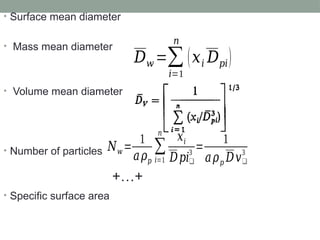
• Surface mean diameter
• Mass mean diameter
• Volume mean diameter
• Number of particles
• Specific surface area
𝐷𝑤 =∑
𝑖=1
𝑛
(𝑥𝑖 𝐷𝑝𝑖)
𝑁𝑤 =
1
𝑎𝜌𝑝
∑
𝑖=1
𝑛
𝑥𝑖
𝐷𝑝𝑖❑
3
=
1
𝑎𝜌𝑝 𝐷𝑣❑
3
+…+
Mesh Screen
Openings, μm
Weight fraction
retained, mg
6 3327 0.00
8 2362 0.017
10 1651 0.252
14 1168 0.55
20 833 0.767
28 589 0.872
35 417 0.934
48 295 0.962
65 208 0.979
100 147 0.989
150 104 0.994
200 74 0.996
Pan 1.0
Cumulative
Storage of solids
1. Bulk storage
2. Bin storage
Bin - not so tall but usually wider
Silo – tall and relatively small in diameter
Hopper - vessel with sloping at the bottom
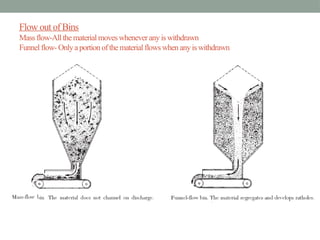
Flow out of Bins
Massflow-All thematerialmoveswheneverany iswithdrawn
Funnel flow- Onlyaportionofthematerial flowswhenanyiswithdrawn
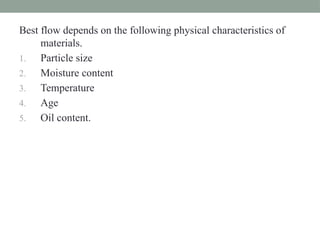
Best flow depends on the following physical characteristics of
materials.
1. Particle size
2. Moisture content
3. Temperature
4. Age
5. Oil content.
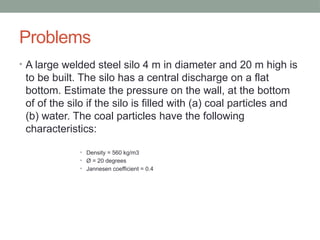
Problems
• A large welded steel silo 4 m in diameter and 20 m high is
to be built. The silo has a central discharge on a flat
bottom. Estimate the pressure on the wall, at the bottom
of of the silo if the silo is filled with (a) coal particles and
(b) water. The coal particles have the following
characteristics:
• Density = 560 kg/m3
• Ø = 20 degrees
• Jannesen coefficient = 0.4
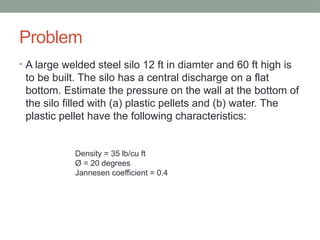
Problem
• A large welded steel silo 12 ft in diamter and 60 ft high is
to be built. The silo has a central discharge on a flat
bottom. Estimate the pressure on the wall at the bottom of
the silo filled with (a) plastic pellets and (b) water. The
plastic pellet have the following characteristics:
Density = 35 lb/cu ft
Ø = 20 degrees
Jannesen coefficient = 0.4

Mechanical Operations slides for chemical engineers

  • 1.
    MECHANICAL OPERATIONS (CHE1022) Dr. AabidHussain Shaik Associate Professor Chemical Engineering Department, SCHEME Contact information: Room no. SMV 221 Email: aabidhussain.s@vit.ac.in
  • 2.
    Module 1 • Introductionto particulate solids • Particle shape, size • Mixed particle sizes • Size analysis – cumulative and differential • Various mean diameters • Screen analysis • Standard screens • Various Industrial screens • LO’s • Will be able to use different size analysis methods to determine particle size. • Will be able to calculate the particle size distribution using screen analysis.
  • 3.
    Particulate – Assemblyof small particles They are characterized by *Size *Shape *Density Regular –specified by size, shape Irregular-arbitrarily defined
  • 4.
  • 5.
    • Volume: V Sp • Sphericity(Φs) 𝜙𝑠= 6𝑉 𝑝 𝐷𝑝 𝑆𝑝 where Vp is the volume of the particle, Ap is its surface area, and Dp is the diameter of a sphere with the same volume Answer: 0.806
  • 6.
    Spherecity of cube •Ψ = As / Ap Where: As is the surface area of the equivalent sphere and Ap is the measured surface area. The sphericity can have a value ranging from 0-1, where Ψ = 1 for an ideal sphere. • The volume of a spherical particle is: • Vp= (1/6) π dp 3 Where: dp is the diameter of the particle. • The surface area of a sphere is: • As = π dp 2 = π [ (6 Vp / π)(1/3) ]2 Thus, for a particle, Ψ can be calculated by measuring its volume and surface area: • Ψ = As / Ap = π (6 Vp / π)(2/3) / Ap An example: A cube measuring 1 × 1 × 1 cm has a volume of 1 cm3 , and a surface area of 6 × (1 × 1) = 6 cm2 . Its sphericity is: • Ψ = π × (6 × 1 / π)(2/3) / 6 = 0.806
  • 7.
    Calculate the sphericityof a cylinder of dia 1 cm and height 3 cm. • Spherecity = surface area of the sphere of same volume as the particle/surface area of the particle • Volume of particle = ∏rc 2 h = p x 0.52 x 3 = 2.356 cm3 • Radius of sphere of volume 2.356 cm3 : • 4 ∏ rs 3 / 3 = 2.356 • rs = 0.8255 cm • Surface area of sphere of same volume as the particle = 4 ∏ rs 2 = 4 x p x 0.82552 = 8.563 cm2 • Surface area of particle = 2 ∏ rc (h + rc) = 2 x p x 0.5 x (3 + 0.5) = 10.996 cm2 • Sphericity (f s) = 8.563/10.996 = 0.779
  • 8.
    Calculate shperecity ofa cylinder having diameter 1 cm and height 5 cm
  • 9.
    Particle size- specifiedby diameter. Size expressed in different units according to size range *coarse – inch (or) mm *Fine - screen size (mesh) *Very fine - µm (or) nm *Ultra fine – m2 /gm (specific surface area)
  • 10.
    Mixture of particles(same size) No. of particles in the sample Total surface area
  • 11.
    Specific surface ofmixture(different size) +…+ xi is the mass fraction
  • 12.
    Number of particlesin Mixture (Different sizes) 𝑁𝑤 = 1 𝑎𝜌𝑝 ∑ 𝑖=1 𝑛 𝑥𝑖 𝐷𝑝𝑖❑ 3 = 1 𝑎𝜌𝑝 𝐷𝑣❑ 3 𝑣𝑝=𝑎 𝐷𝑝 3 Volume shape factor: Volume is proportional of cube of diameter, the constant of proportionality is knows as volume shape factor (a). a=π/6 for spheres
  • 13.
    Average particle size Volume– Surface mean diameter
  • 14.
    Arithmetic mean diameter 𝐷𝑁 = ∑ 𝑖=1 𝑛 ( 𝑁 𝑖 𝐷𝑝𝑖 ) ∑ 𝑖=1 𝑛 𝑁𝑖 = ∑ 𝑖 =1 𝑛 ( 𝑁 𝑖 𝐷𝑝𝑖 ) 𝑁 𝑇
  • 15.
    Mass mean diameter 𝐷𝑤=∑ 𝑖=1 𝑛 (𝑥𝑖 𝐷𝑝𝑖)
  • 16.
  • 17.
    Determining Particle Size: Variousmethods are used for measurement of particle size. These depends on size range, the physical properties and the condition of dryness or wetness. The following methods are used in laboratory. 1. Microscope 2. Screening 3. Sedimentation 4. Elutriation 5. Centrifuging
  • 18.
    Screening (Sieving) Importance ofscreening: • Removes the fine from the feed material before a reduction equipment. • Prevents oversized material to enter into unit operations. • Produce a process grade material to meet specific feed size. • Removes fines from finished product before packing.
  • 19.
    Types of standardscreens: 1. Tyler standard screen series 2. Indian standard test sieves Types of Screen/sieve analysis 3. Differential Analysis 4. Cumulative Analysis The mesh number system is a measure of how many openings there are per linear inch in a screen. Sizes vary by a factor of √2. This can easily be determined as screens are made from wires of standard diameters, however, opening sizes can vary slightly due to wear and distortion.
  • 20.
    Particle size distribution (a)Differential (b) Cumulative
  • 21.
    Mesh Screen Openings, μm Avg. Particle size,μm Weight fraction retained, mg 6/8 2362 2845 0.017 8/10 1651 2006 0.235 10/14 1168 1410 0.298 14/20 833 1000 0.217 20/28 589 711 0.105 28/35 417 503 0.062 35/48 295 356 0.028 48/65 208 252 0.017 65/100 147 178 0.010 100/150 104 126 0.005 150/200 74 89 0.002 Pan 0.004 1.0 Differential Find: diameters • Surface mean • Mass mean • Volume mean • No. of particles • Specific surface area • a=2 • Spherecity=0.571 • Density=2650 kg/m3
  • 22.
    • Surface meandiameter • Mass mean diameter • Volume mean diameter • Number of particles • Specific surface area 𝐷𝑤 =∑ 𝑖=1 𝑛 (𝑥𝑖 𝐷𝑝𝑖) 𝑁𝑤 = 1 𝑎𝜌𝑝 ∑ 𝑖=1 𝑛 𝑥𝑖 𝐷𝑝𝑖❑ 3 = 1 𝑎𝜌𝑝 𝐷𝑣❑ 3 +…+
  • 23.
    Mesh Screen Openings, μm Weightfraction retained, mg 6 3327 0.00 8 2362 0.017 10 1651 0.252 14 1168 0.55 20 833 0.767 28 589 0.872 35 417 0.934 48 295 0.962 65 208 0.979 100 147 0.989 150 104 0.994 200 74 0.996 Pan 1.0 Cumulative
  • 24.
    Storage of solids 1.Bulk storage 2. Bin storage Bin - not so tall but usually wider Silo – tall and relatively small in diameter Hopper - vessel with sloping at the bottom
  • 25.
    Flow out ofBins Massflow-All thematerialmoveswheneverany iswithdrawn Funnel flow- Onlyaportionofthematerial flowswhenanyiswithdrawn
  • 26.
    Best flow dependson the following physical characteristics of materials. 1. Particle size 2. Moisture content 3. Temperature 4. Age 5. Oil content.
  • 27.
    Problems • A largewelded steel silo 4 m in diameter and 20 m high is to be built. The silo has a central discharge on a flat bottom. Estimate the pressure on the wall, at the bottom of of the silo if the silo is filled with (a) coal particles and (b) water. The coal particles have the following characteristics: • Density = 560 kg/m3 • Ø = 20 degrees • Jannesen coefficient = 0.4
  • 28.
    Problem • A largewelded steel silo 12 ft in diamter and 60 ft high is to be built. The silo has a central discharge on a flat bottom. Estimate the pressure on the wall at the bottom of the silo filled with (a) plastic pellets and (b) water. The plastic pellet have the following characteristics: Density = 35 lb/cu ft Ø = 20 degrees Jannesen coefficient = 0.4