Jig Washers
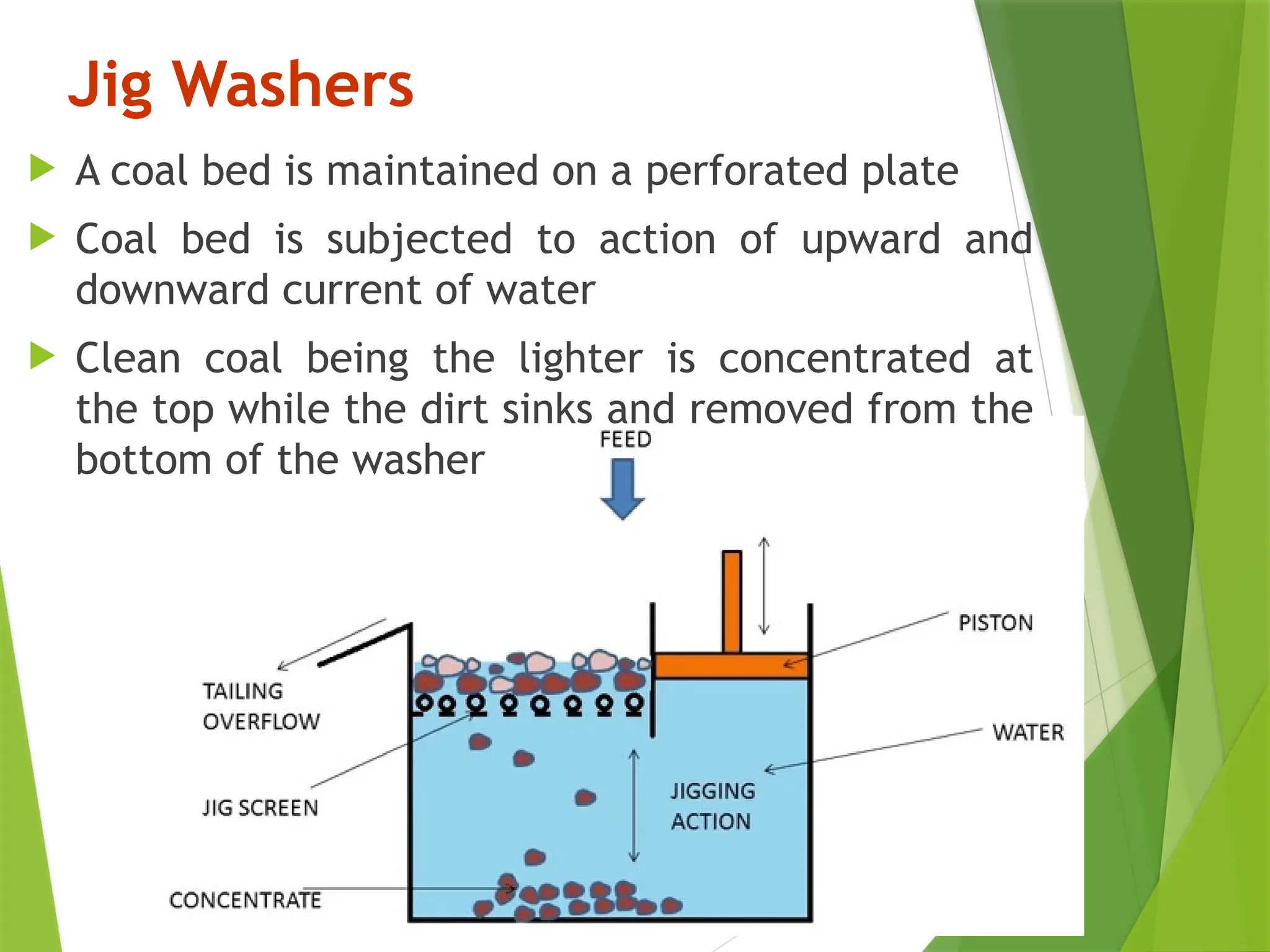
 A coal bed is maintained on a perforated plate
 Coal bed is subjected to action of upward and
downward current of water
 Clean coal being the lighter is concentrated at
the top while the dirt sinks and removed from the
bottom of the washer
Baum Jig
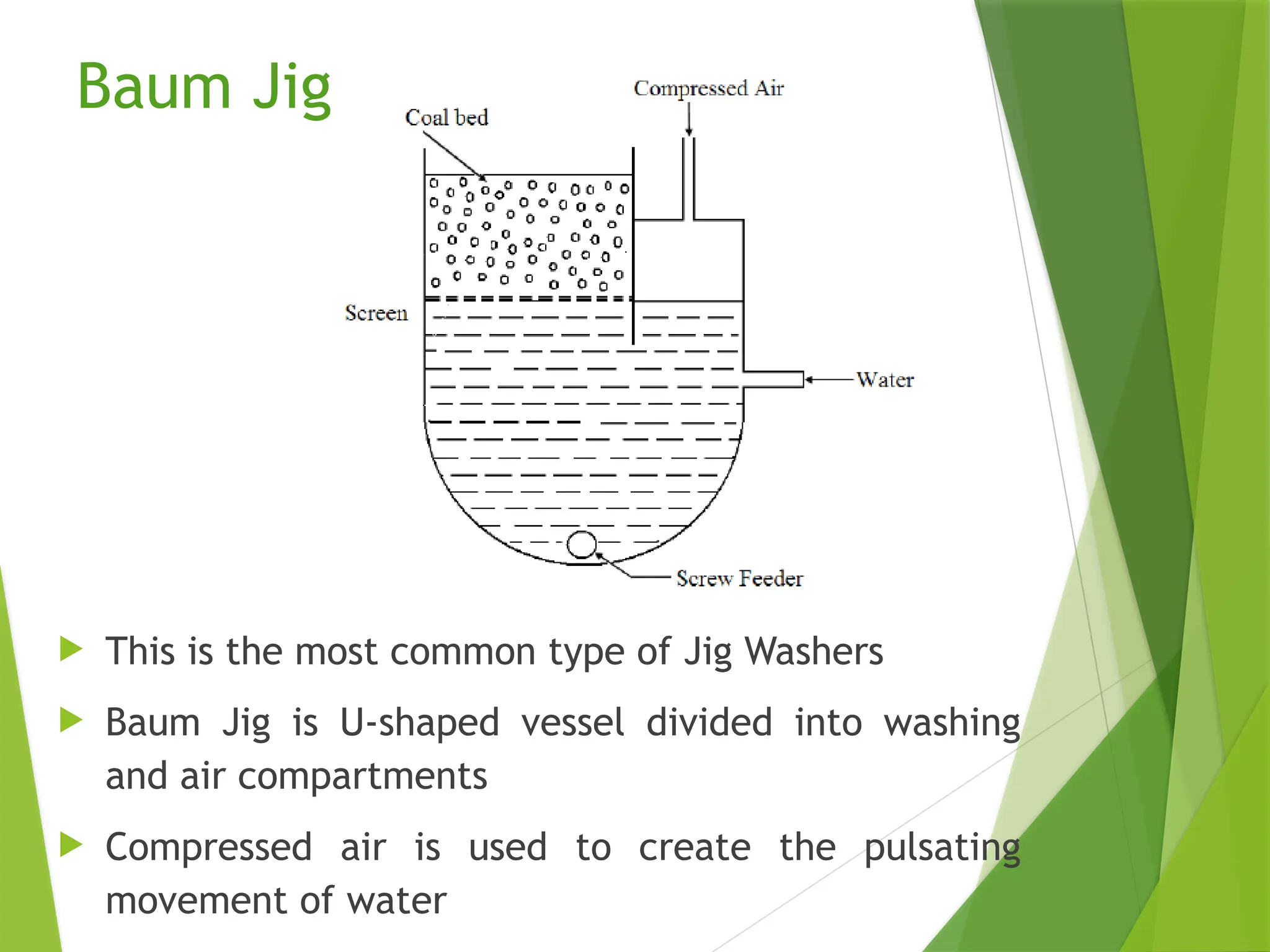
 This is the most common type of Jig Washers
 Baum Jig is U-shaped vessel divided into washing
and air compartments
 Compressed air is used to create the pulsating
movement of water
Advantages of Jig Washers
 Better separation efficiency for finer
sizes of coal (25-200mm)
Cyclone Washer
 The cyclone washer employs the same
principle as cyclone dust collector except that
the coal is fed in a STREAM OF WATER (or
dense medium) instead in air
 It is a settling chamber in which settling force
is replaced by centrifugal force
 The clean coal is obtained as an overflow from
the cyclone
 The underflow from the cyclone contains the
heavier material or impurities
Advantages
 Efficient for small sized coal
 High flexibility of operation with respect to
near gravity material, coal size and feed size
Disadvantages :
 Higher power consumption
 Higher maintenance cost
Cyclone Washer
Froth Floatation process
 Froth is made in a floatation cell by
bubbling air through water in presence
of frothing agents
 Frothing agents used are normally
cresol, pine oil or alcohols
 When dirty coal powder is added to cell,
the pure coal particles adhere to the
bubbles of the froth
 Dirt particles sink in the cell
 The clean coal is recovered by filtration
Froth Floatation process
Advantages:
 It can produce ultra pure coal
 It is suitable for fine coals
Disadvantages:
 High capital and running cost
 Coal must be grinded to less than 0.5 mm
9
Coal Storage and Handling
 Solid fuels are stored in bunkers-normally
a quantity equivalent to 100 hours at peak
firing rate is the target storage capacity,
with a minimum amount of 20 tonnes.
 Coal is usually conveyed into storage from
the delivery vehicle by tipping or by
pneumatic conveyance along pipes.

Jigging operations for washing the surface impurities

  • 1.
    Jig Washers  Acoal bed is maintained on a perforated plate  Coal bed is subjected to action of upward and downward current of water  Clean coal being the lighter is concentrated at the top while the dirt sinks and removed from the bottom of the washer
  • 2.
    Baum Jig  Thisis the most common type of Jig Washers  Baum Jig is U-shaped vessel divided into washing and air compartments  Compressed air is used to create the pulsating movement of water
  • 3.
    Advantages of JigWashers  Better separation efficiency for finer sizes of coal (25-200mm)
  • 4.
    Cyclone Washer  Thecyclone washer employs the same principle as cyclone dust collector except that the coal is fed in a STREAM OF WATER (or dense medium) instead in air  It is a settling chamber in which settling force is replaced by centrifugal force  The clean coal is obtained as an overflow from the cyclone  The underflow from the cyclone contains the heavier material or impurities
  • 5.
    Advantages  Efficient forsmall sized coal  High flexibility of operation with respect to near gravity material, coal size and feed size Disadvantages :  Higher power consumption  Higher maintenance cost Cyclone Washer
  • 6.
    Froth Floatation process Froth is made in a floatation cell by bubbling air through water in presence of frothing agents  Frothing agents used are normally cresol, pine oil or alcohols  When dirty coal powder is added to cell, the pure coal particles adhere to the bubbles of the froth  Dirt particles sink in the cell  The clean coal is recovered by filtration
  • 8.
    Froth Floatation process Advantages: It can produce ultra pure coal  It is suitable for fine coals Disadvantages:  High capital and running cost  Coal must be grinded to less than 0.5 mm
  • 9.
    9 Coal Storage andHandling  Solid fuels are stored in bunkers-normally a quantity equivalent to 100 hours at peak firing rate is the target storage capacity, with a minimum amount of 20 tonnes.  Coal is usually conveyed into storage from the delivery vehicle by tipping or by pneumatic conveyance along pipes.