Ahmed Kovacevic, City University London
1
1
Mechanical Analysis
Belt and chain drives
Prof Ahmed Kovacevic
Lecture 3
School of Engineering and Mathematical Sciences
Room CG25, Phone: 8780, E-Mail: a.kovacevic@city.ac.uk
www.staff.city.ac.uk/~ra600/intro.htm
Mechanical Analysis and Design
ME 2104
Ahmed Kovacevic, City University London
2
Plan for the analysis of
mechanical elements
Objective:
Procedures for design and selection of
mechanical elements
 Week 1 – Shafts and keyways
 Week 2 – Bearings and screws
 Week 3 – Belt and chain drives
 Week 4 – Gears and gear trains
 Week 5 – Design Project Review
Ahmed Kovacevic, City University London
3
Plan for this week
 Flexible mechanical elements -
introduction
 Flat and round belts (with examples)
 V belts (with examples)
 Chains (with examples)
Ahmed Kovacevic, City University London
4
Overview – why use?
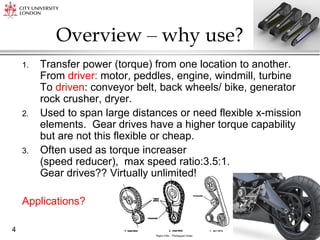
1. Transfer power (torque) from one location to another.
From driver: motor, peddles, engine, windmill, turbine
To driven: conveyor belt, back wheels/ bike, generator
rock crusher, dryer.
2. Used to span large distances or need flexible x-mission
elements. Gear drives have a higher torque capability
but are not this flexible or cheap.
3. Often used as torque increaser
(speed reducer), max speed ratio:3.5:1.
Gear drives?? Virtually unlimited!
Applications?
Ahmed Kovacevic, City University London
5
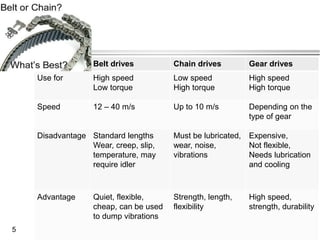
Belt drives Chain drives Gear drives
Use for High speed
Low torque
Low speed
High torque
High speed
High torque
Speed 12 – 40 m/s Up to 10 m/s Depending on the
type of gear
Disadvantage Standard lengths
Wear, creep, slip,
temperature, may
require idler
Must be lubricated,
wear, noise,
vibrations
Expensive,
Not flexible,
Needs lubrication
and cooling
Advantage Quiet, flexible,
cheap, can be used
to dump vibrations
Strength, length,
flexibility
High speed,
strength, durability
Ahmed Kovacevic, City University London
6
Types of Belts:
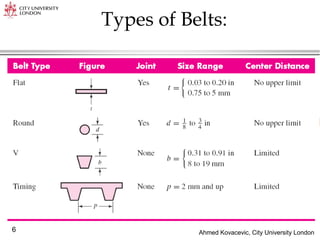
V-belt most common for machine design,
several types (a & b)
Timing belt (c & d) have mating
pulleys to minimize slippage.
Pos retention due to
mating pulleys (c)
Pos retention due to increased
contact area (d & e)
Flat belt - rubber/leather
(not shown) run on
tapered pulleys
Ahmed Kovacevic, City University London
7
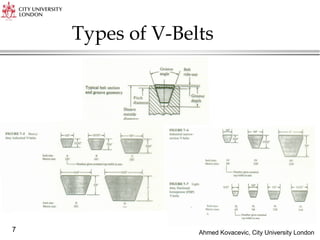
Types of V-Belts
Ahmed Kovacevic, City University London
8
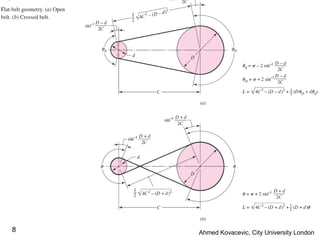
Belt drive configurations
Ahmed Kovacevic, City University London
9
V-belt Drive Design Process
1. Rated power of the driving motor/prime mover.
2. Service factor based on type of driver and driven load.
3. Center distance (adjustment for center distance must be
provided or use idler pulley)
4. Power rating for one belt as a function of size and speed of the
smaller pulley
5. Belt length (then choose standard size)
6. Sizing of sheaves/pulleys (use standard size). Most
commercially available sheaves should be limited to 35 m/s
belt speed.
7. Belt length correction factor
8. Angle of wrap correction factor. Angle of wrap on smaller
sheave should be greater than 120 deg.
9. Number of belts
10. Initial tension in belts
Ahmed Kovacevic, City University London
10
Key Equations
Belt speed (no slip) [m/s]
Speed ratio
Belt length [m]
Centre distance [m]
2
2 2
1
1
1
2
2 2
( )
2 ( )
2 4
32( )
16
4 2 ( )
2sin
2
2sin
2
d
D
b D D d d
D
b D
d
d
D
R R
D
Dn
d
D d
L C D d
C
B B D d
C
B L D d
D d
C
D d
C


  

 



 
 


   
 

   
  

  

 
   
 

 
   
 
Recommended:
D < C < 3(D+d)
Use standard lengths
Ahmed Kovacevic, City University London
11
Forces
1 2
1 2
1
2
2
'
'
'
1 2
( )
( )
2
( )
2
ow b
f
c
c
c b
i c
P F F
d
T F F
F F
e
F F
F m
w bt
m
g g
F F
F F




  
  




 

 
Transmitted power [W]
Torque [Nm]
Centrifugal force [N]
Mass per unit length
Initial belt tension [N]
Ahmed Kovacevic, City University London
12
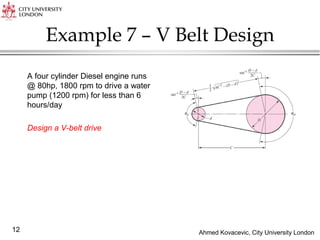
Example 7 – V Belt Design
A four cylinder Diesel engine runs
@ 80hp, 1800 rpm to drive a water
pump (1200 rpm) for less than 6
hours/day
Design a V-belt drive
Ahmed Kovacevic, City University London
13
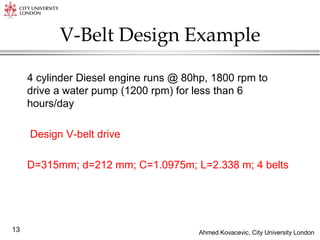
V-Belt Design Example
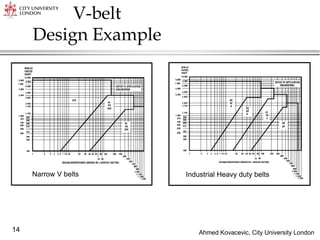
4 cylinder Diesel engine runs @ 80hp, 1800 rpm to
drive a water pump (1200 rpm) for less than 6
hours/day
Design V-belt drive
D=315mm; d=212 mm; C=1.0975m; L=2.338 m; 4 belts
Ahmed Kovacevic, City University London
14
V-belt
Design Example
Narrow V belts Industrial Heavy duty belts
Ahmed Kovacevic, City University London
15
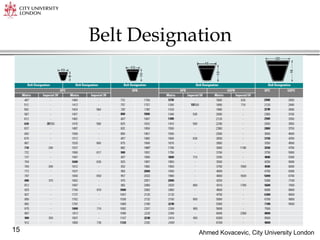
Belt Designation
Ahmed Kovacevic, City University London
16
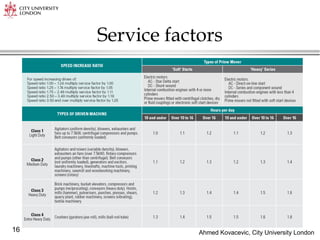
Service factors
Ahmed Kovacevic, City University London
17
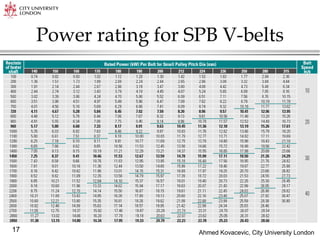
Power rating for SPB V-belts
Ahmed Kovacevic, City University London
18
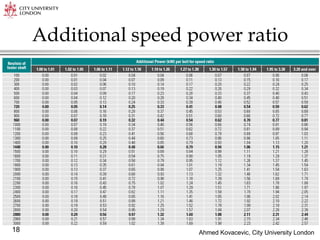
Additional speed power ratio
Ahmed Kovacevic, City University London
19
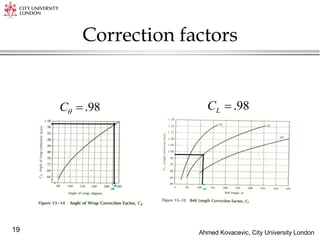
Correction factors
98
.


C 98
.

L
C
Ahmed Kovacevic, City University London
20
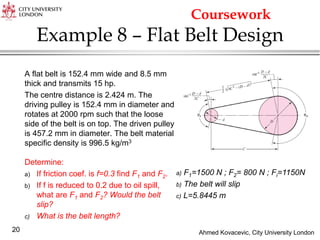
Example 8 – Flat Belt Design
A flat belt is 152.4 mm wide and 8.5 mm
thick and transmits 15 hp.
The centre distance is 2.424 m. The
driving pulley is 152.4 mm in diameter and
rotates at 2000 rpm such that the loose
side of the belt is on top. The driven pulley
is 457.2 mm in diameter. The belt material
specific density is 996.5 kg/m3
Determine:
a) If friction coef. is f=0.3 find F1 and F2.
b) If f is reduced to 0.2 due to oil spill,
what are F1 and F2? Would the belt
slip?
c) What is the belt length?
a) F1=1500 N ; F2= 800 N ; Fi=1150N
b) The belt will slip
c) L=5.8445 m
Coursework
Ahmed Kovacevic, City University London
21
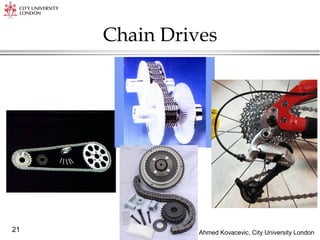
Chain Drives
Ahmed Kovacevic, City University London
22
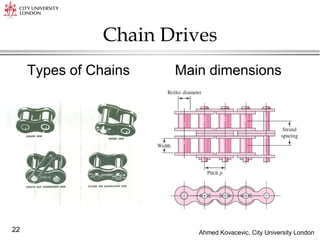
Chain Drives
Types of Chains Main dimensions
Ahmed Kovacevic, City University London
23
P – pitch
 – pitch angle
/2 – angle of articulation
D – pitch diameter
e – cordial rise (factor for smoothness)
   
 
2
1 1
1 2
2
sin 2 sin
/ 60
2
2
4
30 50
p p
D
N
v Npn
N N
L C N N
p p C
p
C
p
 

 


  
  
 
 
 
 
 
 
 
 
 
L – chain length
v – chain speed
N  number of teeth in the sprocket
n – [rpm]
Ahmed Kovacevic, City University London
24
Chain Design Process
1. # of sprocket teeth, N1 (smaller sprocket) > 17
(unless low speed < 100 rpm.)
2. Speed ratio = n1/n2 <= 7
3. 30 x Pitch Length < Center Distance < 50 x Pitch
Length
4. Angle of contact of chain on smaller sprocket > 120°
5. # sprocket teeth, N2 (larger sprocket) < 120
Ahmed Kovacevic, City University London
25
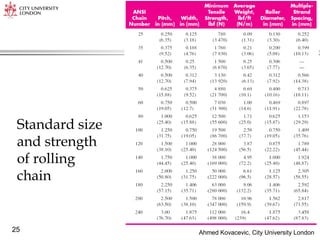
Standard size
and strength
of rolling
chain
Ahmed Kovacevic, City University London
26
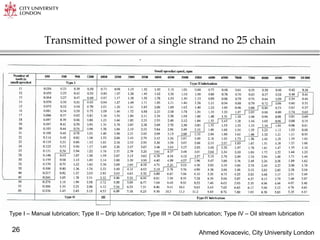
Transmitted power of a single strand no 25 chain
Type I – Manual lubrication; Type II – Drip lubrication; Type III = Oil bath lubrication; Type IV – Oil stream lubrication
Ahmed Kovacevic, City University London
27
Ahmed Kovacevic, City University London
28
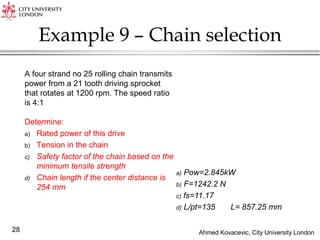
Example 9 – Chain selection
A four strand no 25 rolling chain transmits
power from a 21 tooth driving sprocket
that rotates at 1200 rpm. The speed ratio
is 4:1
Determine:
a) Rated power of this drive
b) Tension in the chain
c) Safety factor of the chain based on the
minimum tensile strength
d) Chain length if the center distance is
254 mm
a) Pow=2.845kW
b) F=1242.2 N
c) fs=11.17
d) L/pt=135 L= 857.25 mm
Ahmed Kovacevic, City University London
29
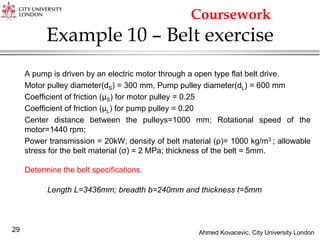
Example 10 – Belt exercise
A pump is driven by an electric motor through a open type flat belt drive.
Motor pulley diameter(dS) = 300 mm, Pump pulley diameter(dL) = 600 mm
Coefficient of friction (μS) for motor pulley = 0.25
Coefficient of friction (μL) for pump pulley = 0.20
Center distance between the pulleys=1000 mm; Rotational speed of the
motor=1440 rpm;
Power transmission = 20kW; density of belt material (ρ)= 1000 kg/m3 ; allowable
stress for the belt material (σ) = 2 MPa; thickness of the belt = 5mm.
Determine the belt specifications.
Length L=3436mm; breadth b=240mm and thickness t=5mm
Coursework

Mechanical Analysis Belt and chain drives.pdf

  • 1.
    Ahmed Kovacevic, CityUniversity London 1 1 Mechanical Analysis Belt and chain drives Prof Ahmed Kovacevic Lecture 3 School of Engineering and Mathematical Sciences Room CG25, Phone: 8780, E-Mail: a.kovacevic@city.ac.uk www.staff.city.ac.uk/~ra600/intro.htm Mechanical Analysis and Design ME 2104
  • 2.
    Ahmed Kovacevic, CityUniversity London 2 Plan for the analysis of mechanical elements Objective: Procedures for design and selection of mechanical elements  Week 1 – Shafts and keyways  Week 2 – Bearings and screws  Week 3 – Belt and chain drives  Week 4 – Gears and gear trains  Week 5 – Design Project Review
  • 3.
    Ahmed Kovacevic, CityUniversity London 3 Plan for this week  Flexible mechanical elements - introduction  Flat and round belts (with examples)  V belts (with examples)  Chains (with examples)
  • 4.
    Ahmed Kovacevic, CityUniversity London 4 Overview – why use? 1. Transfer power (torque) from one location to another. From driver: motor, peddles, engine, windmill, turbine To driven: conveyor belt, back wheels/ bike, generator rock crusher, dryer. 2. Used to span large distances or need flexible x-mission elements. Gear drives have a higher torque capability but are not this flexible or cheap. 3. Often used as torque increaser (speed reducer), max speed ratio:3.5:1. Gear drives?? Virtually unlimited! Applications?
  • 5.
    Ahmed Kovacevic, CityUniversity London 5 Belt drives Chain drives Gear drives Use for High speed Low torque Low speed High torque High speed High torque Speed 12 – 40 m/s Up to 10 m/s Depending on the type of gear Disadvantage Standard lengths Wear, creep, slip, temperature, may require idler Must be lubricated, wear, noise, vibrations Expensive, Not flexible, Needs lubrication and cooling Advantage Quiet, flexible, cheap, can be used to dump vibrations Strength, length, flexibility High speed, strength, durability
  • 6.
    Ahmed Kovacevic, CityUniversity London 6 Types of Belts: V-belt most common for machine design, several types (a & b) Timing belt (c & d) have mating pulleys to minimize slippage. Pos retention due to mating pulleys (c) Pos retention due to increased contact area (d & e) Flat belt - rubber/leather (not shown) run on tapered pulleys
  • 7.
    Ahmed Kovacevic, CityUniversity London 7 Types of V-Belts
  • 8.
    Ahmed Kovacevic, CityUniversity London 8 Belt drive configurations
  • 9.
    Ahmed Kovacevic, CityUniversity London 9 V-belt Drive Design Process 1. Rated power of the driving motor/prime mover. 2. Service factor based on type of driver and driven load. 3. Center distance (adjustment for center distance must be provided or use idler pulley) 4. Power rating for one belt as a function of size and speed of the smaller pulley 5. Belt length (then choose standard size) 6. Sizing of sheaves/pulleys (use standard size). Most commercially available sheaves should be limited to 35 m/s belt speed. 7. Belt length correction factor 8. Angle of wrap correction factor. Angle of wrap on smaller sheave should be greater than 120 deg. 9. Number of belts 10. Initial tension in belts
  • 10.
    Ahmed Kovacevic, CityUniversity London 10 Key Equations Belt speed (no slip) [m/s] Speed ratio Belt length [m] Centre distance [m] 2 2 2 1 1 1 2 2 2 ( ) 2 ( ) 2 4 32( ) 16 4 2 ( ) 2sin 2 2sin 2 d D b D D d d D b D d d D R R D Dn d D d L C D d C B B D d C B L D d D d C D d C                                                      Recommended: D < C < 3(D+d) Use standard lengths
  • 11.
    Ahmed Kovacevic, CityUniversity London 11 Forces 1 2 1 2 1 2 2 ' ' ' 1 2 ( ) ( ) 2 ( ) 2 ow b f c c c b i c P F F d T F F F F e F F F m w bt m g g F F F F                    Transmitted power [W] Torque [Nm] Centrifugal force [N] Mass per unit length Initial belt tension [N]
  • 12.
    Ahmed Kovacevic, CityUniversity London 12 Example 7 – V Belt Design A four cylinder Diesel engine runs @ 80hp, 1800 rpm to drive a water pump (1200 rpm) for less than 6 hours/day Design a V-belt drive
  • 13.
    Ahmed Kovacevic, CityUniversity London 13 V-Belt Design Example 4 cylinder Diesel engine runs @ 80hp, 1800 rpm to drive a water pump (1200 rpm) for less than 6 hours/day Design V-belt drive D=315mm; d=212 mm; C=1.0975m; L=2.338 m; 4 belts
  • 14.
    Ahmed Kovacevic, CityUniversity London 14 V-belt Design Example Narrow V belts Industrial Heavy duty belts
  • 15.
    Ahmed Kovacevic, CityUniversity London 15 Belt Designation
  • 16.
    Ahmed Kovacevic, CityUniversity London 16 Service factors
  • 17.
    Ahmed Kovacevic, CityUniversity London 17 Power rating for SPB V-belts
  • 18.
    Ahmed Kovacevic, CityUniversity London 18 Additional speed power ratio
  • 19.
    Ahmed Kovacevic, CityUniversity London 19 Correction factors 98 .   C 98 .  L C
  • 20.
    Ahmed Kovacevic, CityUniversity London 20 Example 8 – Flat Belt Design A flat belt is 152.4 mm wide and 8.5 mm thick and transmits 15 hp. The centre distance is 2.424 m. The driving pulley is 152.4 mm in diameter and rotates at 2000 rpm such that the loose side of the belt is on top. The driven pulley is 457.2 mm in diameter. The belt material specific density is 996.5 kg/m3 Determine: a) If friction coef. is f=0.3 find F1 and F2. b) If f is reduced to 0.2 due to oil spill, what are F1 and F2? Would the belt slip? c) What is the belt length? a) F1=1500 N ; F2= 800 N ; Fi=1150N b) The belt will slip c) L=5.8445 m Coursework
  • 21.
    Ahmed Kovacevic, CityUniversity London 21 Chain Drives
  • 22.
    Ahmed Kovacevic, CityUniversity London 22 Chain Drives Types of Chains Main dimensions
  • 23.
    Ahmed Kovacevic, CityUniversity London 23 P – pitch  – pitch angle /2 – angle of articulation D – pitch diameter e – cordial rise (factor for smoothness)       2 1 1 1 2 2 sin 2 sin / 60 2 2 4 30 50 p p D N v Npn N N L C N N p p C p C p                                L – chain length v – chain speed N  number of teeth in the sprocket n – [rpm]
  • 24.
    Ahmed Kovacevic, CityUniversity London 24 Chain Design Process 1. # of sprocket teeth, N1 (smaller sprocket) > 17 (unless low speed < 100 rpm.) 2. Speed ratio = n1/n2 <= 7 3. 30 x Pitch Length < Center Distance < 50 x Pitch Length 4. Angle of contact of chain on smaller sprocket > 120° 5. # sprocket teeth, N2 (larger sprocket) < 120
  • 25.
    Ahmed Kovacevic, CityUniversity London 25 Standard size and strength of rolling chain
  • 26.
    Ahmed Kovacevic, CityUniversity London 26 Transmitted power of a single strand no 25 chain Type I – Manual lubrication; Type II – Drip lubrication; Type III = Oil bath lubrication; Type IV – Oil stream lubrication
  • 27.
    Ahmed Kovacevic, CityUniversity London 27
  • 28.
    Ahmed Kovacevic, CityUniversity London 28 Example 9 – Chain selection A four strand no 25 rolling chain transmits power from a 21 tooth driving sprocket that rotates at 1200 rpm. The speed ratio is 4:1 Determine: a) Rated power of this drive b) Tension in the chain c) Safety factor of the chain based on the minimum tensile strength d) Chain length if the center distance is 254 mm a) Pow=2.845kW b) F=1242.2 N c) fs=11.17 d) L/pt=135 L= 857.25 mm
  • 29.
    Ahmed Kovacevic, CityUniversity London 29 Example 10 – Belt exercise A pump is driven by an electric motor through a open type flat belt drive. Motor pulley diameter(dS) = 300 mm, Pump pulley diameter(dL) = 600 mm Coefficient of friction (μS) for motor pulley = 0.25 Coefficient of friction (μL) for pump pulley = 0.20 Center distance between the pulleys=1000 mm; Rotational speed of the motor=1440 rpm; Power transmission = 20kW; density of belt material (ρ)= 1000 kg/m3 ; allowable stress for the belt material (σ) = 2 MPa; thickness of the belt = 5mm. Determine the belt specifications. Length L=3436mm; breadth b=240mm and thickness t=5mm Coursework