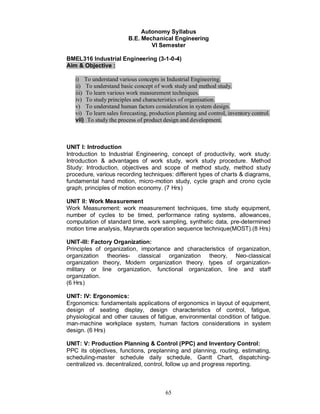
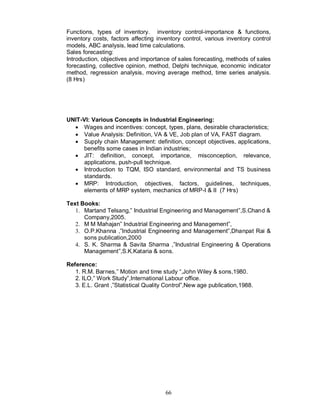
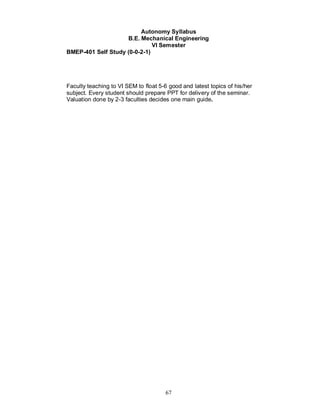
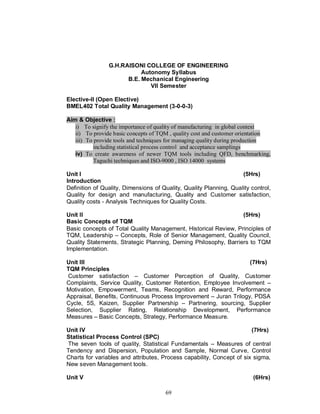
B. E. Mechanical Engineering

Objective and Mission of programme:
Aim :- The programme is aimed at imparting education and training in mechanical
engineering at graduate level as a core description of engineering education and build
a competent HR base for handling professional challenges in design, thermal sciences
and manufacturing engineering areas Considering national and international
requirements.
 Mission :- The mission of the programme is to develop graduate level
professional engineers possessing traditional as well as the state of art knowledge
and technical skill required for entrepreneurial opportunities and employment
nationally and globally

                                  III Semester
BAML203 Applied Mathematics III (3-1-0-4)
Aim & Objective:
  I. To get familiar with mathematical object
 II. To get familiar with important mathematical models used in own engineering
     branch
III. Learn to manipulate the relevant mathematical objects with paper and pencil
     with mathematical software
IV.  Teaching of basic numeracy skills to all pupils
 V.  The teaching of selected areas of mathematics such as calculus as an example
     of intellectual achievements of modern world
VI.  The ability to conceptualize, inquire, reason and communicate mathematically
     and to use mathematics to formulate and solve the problems in daily life.

`Unit I:                                                              [7 Hrs]
Laplace Transforms.
Laplace transform: definition and their simple properties, transform of
derivatives and integrals, evaluation of integrals by L.T. , inverse L.T. & its
properties, convolution theorem, Laplace transforms of periodic function & unit
step function, applications of Laplace transforms to solve ordinary differential
equations & partial differential equations (one-dimensional wave & diffusion
equations).

Unit II:                                                             [6 Hrs]
Z- Transform
Definition and properties, inversion z-transform, z-transforms pairs, relation
with Laplace transform, Application of Z-transform to solve different equation
with constant coefficients.

Unit III:                                                             [6 Hrs]
Fourier Transform
Definition, Fourier integral theorem, Fourier sine & cosine integrals, finite
Fourier sine & cosine transforms, Parseval’s identity, convolution theorem,

Unit IV:                                                                    [9 Hrs]
Complex Variables


                                          6
Analytic function, Cauchy-Riemann conditions, conjugate functions,
singularities, Cauchy’s integral theorem and integral formula (statement only),
Taylor’s and Lautent’s theorem (Statement only), Residue theorem, contour
integration, evaluation of real & complex integral by residue theorem.
Conformal mapping, mapping by linear & inverse transformation.

Unit V:                                                        [6 Hrs]
Special function & series solution
Series solution of differential equation by frobanious method, Bessel’s
function Legendres polynomials, Recurrence relations, Rodrigue formula,
generating function, orthogonal properties of Jn(x) & Pn (x).

Unit VI:                                                                [8 Hrs]
Fourier series & Partial differential equations
Periodic function & their Fourier series expansion, Fourier series for even &
function, change of interval, half range expansion.
Partial differential equation: Partial differential equation of first order first
degree i.e. Langrage’s form, Linear homogeneous partial differential equation
of higher order with constant coefficient, method of separation of variables,
Application to one dimensional heat &diffusion equation, two dimensional
Heat equations. (Only steady state).


Text Books:
   1. Grewal B.S. Higher Engineering Mathematics (Thirty eight Edition)
      Khanna Publishers; 2004.
   2. Kreyszig, E: Advanced Engineering Mathematics (Eight Edition); John
      Wiley & Sons; 2000.
   3. Jain, R.K. and Lyengar, S.R.K.; Advanced Engineering Mathematics;
      Narosa Publishers; 2003.
   4. Text book of Engineering Mathematics: Bali Iyengar (Laxmi Prakashan)
   5. Spiegel, M.R.: Advanced Mathematics for Engnrs and Scientists;
      McGraw-Hill Book Company; 2000.
   6. Applied Mathematics Volume 1: J. Wartikar & P.N. Wartikar
   7. Engineering Mathematics H.K. Dass, S.Chand, Publication, New Delhi

   Reference Books:
   1. Mathematics for engineers: Chandrika Prasad
   2. Advanced Mathematics for engineers: Chandrika Prasad


                                       7
AUTONOMY Syllabus
                        B. E. Mechanical Engineering
                                 III Semester

BMEL201 Machine Drawing(2-0-4-4)
Aim & Objectives:-

   i.     To study the basics of engineering drawing in mechanical engineering and
          applications
   ii.    To provide the exposure to the orthographic and sectional views with
          dimensions
   iii.   To study of a design data and hand book for selection of standard
          components
   iv)    To understand the principles, techniques of assembly drawing and
          production drawing with geometrical and dimensional

Unit-I
Drawing Standards                                            ( 2 Hrs)
BIS Specificition-Welding sybols,Machining Symbols, Surface Finish
Symbols,Heat Treatment, Manufacturing Instuctions

Unit-II
Interpretation of Orthographic Projection                        ( 5 Hrs)
Orthographic Projections of elements , Sectional-Multiple-Missing views,
Profiles , Cross Sectons, Refernces, Alignment & Dimentioning.

Unit-III
Standard Practices and Study for following elements (Excluding
design calculations)                                              (4 Hrs)
Reference to Hand Book for selection of Standard Components like – Bolts ,
Washers, rivets, Welds, Keys and Keyways, Splins, Couplings,
Cotterjoints,Fabrication Bolts.

Unit-IV
 Fits and Tolerence                                                    (4Hrs)
Fits and Tolerence allocation for mating parts- tolerance data sheet -
tolerance table preparation - Geometric Tolerance and Allowance. Indicating
on the drawing of position, as per standard and as per prevalent in industry

Unit-V
 Assembly Drawing                                                 ( 8 Hrs)
Principles, Techniques, Types and Standards for Preparation of assembled
views given parts details - couplings: flange, universal - Bearing: footstep,
Plummer block - Lathe tailstock - Stop valves, Screw Jack – etc

Unit-VI
Production Drawing                                                ( 5 Hrs)
 Elements of production drawing Information (Plates, Part list, Formats) on:
tolerances, manufacturing methods, Production planning Sheet, Process
planning Sheet.


                                        8
Practical
1. Pencil Drawing of some standard components
2. Pencil Drawing of standard assemblies with components.
3. The students must be made to disassemble machines and take actual
   dimensions and prepare parts drawings, assembly drawings, exploded
   views and isometric views as record work.


                                   9
Some Machines of Interest are:

              1. Lathe Chuck
              2. Gear Reducer
              3. Gear Pump
              4. Steam Stop Valve
              5. Pneumatic Cylinder assembly
              6. Pneumatic Valves
              7. Centrifugal Pump Assembly
              8. I.C. Engine Cylinder-Piston, Connection Rod And Crankshaft
                 Assembly
              9. Automobile Gear Box

4. Computer printout of production drawing ad process sheet for two
   components
5. Open ended experiments.

Note: The examination must include:

          1. Total Assembly Test
          2. Identifying The Missing Element Of The Assembly

Text Book:
Production drawing by: Dr. K.L.Narayan, Dr. P. Kannaih

Machine drawing by          : Ajeet Singh (TMH)
                            : R.K.Dhawan
                            : N.D.Bhatt
                            : PSG DATA Book
                            : CMTI DATA Book


List of Practicals:

 1.   Sheet   1 : Dimensioning, Symbols(Welding, Machining & Surface Finish)
 2.   Sheet   2 : Orthographic Projections & Missing Views
 3.   Sheet   3 : Sectional Views
 4.   Sheet   4 : Sketching Of Machine Components
 5.   Sheet   5 : Keys, Cotters & Coupling Joint
 6.   Sheet   6 : Disassembling
 7.   Sheet   7 : Assembly(1 Big Assembly)
 8.   Sheet   8 : Production Drawing & Process Planning Sheets(On A4
                  Size Pages)


                                      10
Autonomy Syllabus
                         B. E. Mechanical Engineering
                                  III Semester

BMEL202 Fluid Power- I (3-1-0-4)

Aim & Objectives :-
   i) To understand the basic fluid properties like density, specific gravity etc
  ii) To understand type of fluid flows, continuity equation, ventury meter, orifice
      meter
iii) To understand the concept of boundary layer
 iv)  To understand the momentum equation and its application to various fluid
      machineries
  v)  To study various techniques of dimensional analysis

UNIT- I                                                             [7hrs]
Properties of Fluid:
Density, Specific gravity, Specific Weight, Specific Volume Dynamic Viscosity,
Kinematic Viscosity, Surface tension, Capillarity ,Vapour Pressure,
Compressibility Fluid pressure, Pressure head, Pressure intensity Concept of
absolute vacuum, gauge pressure, atmospheric Pressure, absolute pressure.
Simple and differential manometers, Bourdon pressure gauge. Concept of
Total pressure on immersed bodies, center of pressure.

UNIT- II                                                               [7hrs]
Fluid Flow:
Types of fluid flows, Kinematics of fluid flow, Continuity equation, Eulers and
Bernoulli’s theorem and equation ,Venturimeter – Construction, principle of
working, Coefficient of discharge, Derivation for discharge through
venturimeter. Orifice meter – Construction, Principle of working, hydraulic
coefficients, Derivation for discharge through Orifice meter Pitot tube –
Construction, Principle of Working ,Current Meter, Turbine Meter,
Elbowmeter.

UNIT-III                                                             [8 hrs]
 Flow through Pipes:
Laws of fluid friction (Laminar and turbulent), Darcy’s equation and Chezy’s
equation for frictional losses. Minor losses in pipes Hydrauligradient and total
gradient line. Hydraulic power transmission through pipe, Energy Gradient;
Pipe in series and parallel ; Branched pipes; three reservoir system; Syphon;
Transmission of power through pipes; Water Hammer pressure due to sudden
closure of valve.

UNIT-IV                                                                  [8hrs]
Boundary Layer Concepts:
Nominal thickness, Displacement thickness and Momentum thickness .energy
of the boundary layer; Boundary layer along a long thin plate and its
characteristics; Laminar boundary layer; Turbulent boundary layer; Separation
of boundary layer on plane and curved surfaces.
Drag & Lift: Definition of drag and lift; Flow past plates, Cylinders and sphere;
Drag on sphere, cylinder and flat plate.


                                        11
UNIT-V                                                            [6hrs]
 Momentum principle and its application:
Impulse- momentum principle, Calculation of force exerted on fixed plate,
moving flat plates& curved vanes, Calculation force exerted on series of
moving vanes, velocity diagrams & their analysis.


UNIT-VI                                                            [6hrs]
Dimensional Analysis:
Fundamental dimensions, dimensional Homogeneity, Rayleigh's method and
Buckingham’s' method. dimension less numbers and their significance.
Hydraulic similitudes , Type of models, Problems related to Reynolds number
& Froude number.


Reference Books
1. Lal Jagdish; Hydraulic machines, 6th Ed; Metropolitan Book Co.Pvt. Ltd.,
1984
2. D.S. Kumar D.S.; Fluid Mechanics and Fluid Machines, 4th Ed; S. K.
Kataria & Sons, 1992
3. Bansal R.K.; Fluid Mechanics and Fluid Machines, 7th Ed; Laxmi
Publications, 2002
4. Massey B.S.; Mechanics of Fluids, 6th Ed; Van Nostrand Reinhold Co.,
1989
5 R.K.Rajput, A Text book of Fluid Mechanics and Hydraulic Machines,
S.Chand
 Co.Ltd.,2002
6 Modi & Seth ,Fluid Mechanics & Fluid Machinery,Standard Book House
2002.


                                    12
Autonomy Syllabus
                        B. E. Mechanical Engineering
                                 III Semester

BMEL203 Materials Engineering (3-0-2-4)
Aim & Objective :-

  i)   To introduce about various materials being used in manufacturing the metallic
       components
 ii)   To introduce & correlate between science and Engineering of metallic
       materials
iii)   To introduce various techniques for enhancing the inherent characteristics of
       materials
iv)     To introduce with the quantitative measurement of material properties.

Unit- I                                                            [8Hrs]
 Constitution of alloys and Phase Diagrams
 Introduction to Basic Terms (System, Phase, Variables, Components Etc.)
related to equilibrium diagram. Alloys and solid solutions, compounds.
Polymorphism, Hume Rothery rulesTime Temperature cooling curves,
Construction of equilibrium diagrams using cooling curves, Binary phase
diagrams Isomorphous systems, Partial miscibility, Metallic systems
completely miscible in liquid state and completely immiscible in solid state.
Lever rule, equilibrium cooling, Microstructures under equilibrium cooling
conditions, Eutectic, Hyper and hypoeutectic alloys.

Unit- II                                                              [10 Hrs]
Ferrous materials -Plain Carbon Steel and Alloy Steels
a) Allotropy of Iron, Iron –Iron carbide equilibrium diagram, Invarient reactions,
microstructure under equilibrium cooling condition, Critical temperature,
definition of different phases, Estimation of carbon from microstructures,
structure property relationship.
b) Purpose of alloying, Different alloying elements and their effect on
enhancing the different characteristics, Tool steels, Stainless steels, spring
steels etc Designation of steels. AISI, ASTM, EN etc.

Unit- III                                                                 [5 Hrs]
Cast Irons
Cast iron, White cast iron, Maurer Diagram, malleable cast iron, malleablizing
cycle, Grey cast iron, Types of grey cast iron, Nodular cast iron., Alloy cast
iron. Microstructure, Properties and Application of each type of cast iron.

Unit- IV                                                              [10 hrs]
Heat Treatment
a) Introduction, importance of heat treatment, Basic heat treatments such as
annealing, normalizing, hardening and tempering, procedure, allied phases -
martensite, retained austenite etc related properties, and microstructure and
their co-relation.
TTT diagram, construction, heat treatment based on it .Industrial applications
of different heat treatment processes Hardenability, Jominy end quench Test.
b) Surface Treatments based on above such as Induction Hardening


                                        13
Unit- V                                                                  [5 Hrs]
Non-Ferrous materials and new generation materials
Brief introduction to different nonferrous materials and study of the Aluminium
and its alloy, eg. Aluminium Silicon, related phase diagram, Na modification
Copper and its alloys, eg. Copper-zinc, Copper –tin, Dezincification, Seasons
cracking. Introduction to nano materials, high temperature smart materials,
properties and relevant applications,


Unit- VI                                                                [4 hrs]
Testing of materials
Need of testing .Destructive and non destructive testing Mechanical testing,
Tensile test, Impact test Izod and Charpy test Hardness measurement,
Rockwell , Brinell hardness, micro hardness. Magnetic particle inspection. .

Books:
 1. Introduction to Physical Metallurgy by S. H. Avener McGraw Hill
    Publication,,2001Engineering Physical Metallurgy & Heat Treatment,
    Lakhtin Y.; 6th Ed; Mir Publishers, 1998.
 2. Metallurgy for Engineers, Rollason E.C.; Edward Arnold publications,
    1959.
 3. Introduction to Engineering Metallurgy, Grewal B.K.;


Practical
(Any 10 experiments from the following list)
  1) Preparation of the specimen for metallographic examination
  2) Detailed study of the optical microscope for metallographic examination.
  3) Phase identification of equilibrium cooled plain carbon steels
         a) Hypo eutectoid
         b) Eutectoid
         c) Hyper eutectoid
  4) Micro structural examination of cast iron
         a) Grey
         b) Malleable
         c) Nodular
  5) Property Structural co-relation for basic heat treatment processes for
     plain carbon steels
         a) Annealing
         b) Normalizing
         c) Hardening
  6) Hardenability measurement using Jominy End Quench set up.
  7) Hardness measurement and detailed study of Rockwell hardness testing
     machine.
  8) Tensile Testing of Mild Steel using universal Testing machine
  9) Impact testing of metallic material using charpy/izod test procedure
  10)Phase identification nonferrous materials (Al-si, brass, Bronzes)
  11)Study of the SEM used for advanced material characterization.
  12)Study of the TEM used for nano material characterization.
  13) Study of Non destructive methods for testing of materials.
  14) Open ended experiments.


                                       14
Autonomy Syllabus
                   B. E. Mechanical Engineering
                            III Semester
BMEL204 Kinematics of Machines (3-1-0-4)

Aim & Objectives :
   i) To understand basic concepts of different mechanisms and its applications to
           various fields.
   ii) To develop competency in graphical and analytical methods in solving
           problems of quantitative kinematic analysis of mechanism.
   iii) To make students conversant with Concepts of cam mechanism.
   iv) To make the students conversant with basic concepts of gears, its applications
           and torque analysis.
   v) To develop analytical competency in designing efficiency of various gears.
   vi) To make the students conversant with static force analysis and synthesis of
           mechanism.
   vii) To give exposure to students the advances in synthesis of mechanism.

Unit I                                                                [6 Hrs.]
Basic concept of mechanism, link, kinematic pairs, kinematic chain,
mechanism, machine, simple and compound chain, Degree of freedom,
estimation of degree of freedom of mechanism by Grubbler’s criterion and
other methods. Harding’s notations, classification of four bar chain [class – I
& class – II], inversion of four–bar–chain, Kutchbach theory of multiple drives.

Unit II                                                           [4Hrs.]
Quantitative kinematic analysis of mechanism :- Displacement, Velocity and
Acceleration analysis of planer mechanism by graphical method as well as
analytical method [complex number method / matrix method’], Coriolis
component of acceleration, Instantaneous center method, Kennedy’s
theorem.

Unit III                                                              [6Hrs.]
Concepts of cam mechanism, comparison of cam mechanism with linkages.
Types of cams and followers and applications. Synthesis of cam for different
types of follower motion like constant velocity, parabolic, SHM, cycloidal etc.
 Pressure angle in cam, parameters affecting cam performance.

Unit IV                                                                [10Hrs.]
Concept of motion transmission by toothed wheels, comparison with cams
and linkages, various tooth profiles, their advantages and limitations, gear
tooth terminologies, concept of conjugate action, law of conjugate action,
kinematics of involutes gear tooth pairs during the contact duration,
highlighting locus of the point of contact, arc of contact, numbers of pairs of
teeth in contact, path of approach and path of recess, interference,
undercutting for involutes profile teeth.

Unit V                                                               [10Hrs.]
Kinematics of helical, bevel, spiral, worm gears, rack and pinion gears,
kinematic analysis, and torque analysis of simple epicyclic and double
epicyclic gear trains.


                                         15
Unit VI                                                              [ 6Hrs.]
Static force analysis : Free body diagram, condition of equilibrium. Analysis of
all links of given linkage, cam, gear mechanism and their combinations
without friction. Introduction to coupler curves, Robert’s Law of cognate
linkages. Synthesis of four bar chain for gross motion, transmission angle
optimization. Frudenstein equation and its application for function generation.


List of Tutorials
1]     Drawing sheets on Inversion of
          i. Class I & Class II four bar cham
         ii. Single slider crank chain
        iii.  Double slider crank chain


2]    Problems on kinematic analysis
        i. Graphical method
       ii. Analytical method
3]    Cam constructions
4]    Cams with specified contour
5]    Analysis of epicyclic gear train with torque analysis
6]    Problems on static force analysis
            I]      Linkages
            Ii]     Cam
            Iii]    Gear
7]    Problems on synthesis
            I]      Graphical method
            Ii]     Analytical method


Recommended Books
  1. Theory of mechanisms and machines by Shigley J.E.
  2. Theory of Mechanism and Machine by Ghosh and Malik
  3. Mechanism and Machine Theory by J.S. Rao & Dukki Patti
  4. Theory of Machine by Rattan


Reference Books
   1. Theory of Machine by Thoman Bevan CBS publication
   2. Theory of Machines by Sandor and Erdman.


                                      16
Autonomy Syllabus
                        B. E. Mechanical Engineering
                                 III Semester

BMEL205 Engineering Thermodynamics (3-1-0-4)
Aim & Objectives :
   i) Identify the unique vocabulary associated with thermodynamics through the
      precise definition of basic concepts to form a sound foundation for the
      development of the scientific principles to follow and to prevent possible
      misunderstandings.
  ii) Review the English and the metric SI unit systems that will be used
      throughout the text.
iii) Explain the basic concepts of thermodynamics such as system, state, state
      postulate, equilibrium, process, cycle, energy, and various forms of energy.
 iv)  Review concepts of temperature, temperature scales, pressure, and absolute
      and gage pressure.
  v)  Introducing basics of ideal and real gases, steam formation, basic laws of
      thermodynamics, and their applications.
 vi)  Introduce an intuitive systematic problem-solving technique that can be used
      as a model in solving engineering problems.

Unit: - I                                                     [6 Hrs]
 Basic concepts and properties:
Introduction, thermodynamic system, control volume, macroscopic and
microscopic approaches, properties and state of a system, point and path
functions, thermodynamic equilibrium, processes and cycles, quasi-static
process, properties such as specific volume, pressure, temperature, zeroth
law of thermodynamics, temperature scales.

Unit: - II                                                          [7 Hrs]

Ideal gases and vapors:
Difference between gases and vapors, ideal gases, gas laws, equation of
state, gas constant, universal gas constant, work and heat, definition of work,
thermodynamic work, work in compressible system, work-a path function,
work done during various processes, p-v diagram, definition of heat, heat
transfer a path function, comparison of heat and work, Phase change process
of a pure substance: specific heats, sensible heat and latent heat, triple point,
critical point, superheat and total heat of steam.

Unit: - III                                                            [7 Hrs]
First law of thermodynamics:
Energy of systems, classification of energy, law of conservation of energy,
first law applied to closed system undergoing a cycle, Joule experiment,
energy-a property of system, internal energy: a function of temperature,
enthalpy, specific heat at constant volume and constant pressure, change in
internal energy and heat transfer during various non-flow processes. First law
applied to flow processes: steady-state steady flow process, mass balance
and energy balance in steady flow process, steady flow energy equation and
its application to nozzles and diffusers, throttling valve, turbines and
compressors, pumps, heat exchangers etc. Work done and heat transfer
during steady flow processes.

                                       17
Unit: - IV                                                          [8 Hrs]
Second law of thermodynamics:
Limitations of first law, heat engines, refrigerators and heat pumps, Kelvin-
plank and Clausius statements, their equivalence, reversible and irreversible
processes, factors that render processes irreversible, Carnot cycle, perpetual
motion machine.Thermodynamic temperature scale, reversed Carnot cycle,
COP of heat pump and refrigeration. Entropy: Inequality of Clausius, entropy:
a property of system, entropy change for ideal gases, entropy change of a
system during irreversible process, lost work, principle of increase of entropy.


Unit: - V                                                             [7 Hrs]
Thermodynamic processes and Power cycles:

Thermodynamic processes: Constant volume, isothermal, adiabatic,
polytropic processes, throttling and free expansion- p-v and T-s diagrams-
work done, heat exchanged, change in internal energy. Availability and
irreversibility:
Gas power cycles: Otto cycle, Diesel cycle, semi-Diesel, Sterling cycles, their
efficiency and mean effective pressure calculations, Dual cycle, Ericsson
cycle.
Unit: - VI                                                            [7 Hrs]
Vapors power cycles:
Properties of steam, specific volume and entropy of steam, dryness fraction of
steam, throttling of steam, determination of dryness fraction, steam tables and
their use, T-s and H-s diagram, Rankine and modified Rankine cycle, work
done and efficiency, specific steam consumption, comparison of Rankine and
Carnot cycle, representation on P-v, T-s and h-s diagram.

Text Books Recommended:
1. Thermodynamics: An Engineering Approach, 3rd Edition, Yunus Çengel
   and Michael, Boles, Tata McGraw Hill.
2. Basic and Applied Thermodynamics, 4th Edition, Nag P. K., Tata McGraw-
   Hill.
3. Engineering Thermodynamics, R.K.Rajput, Laxmi Publication.


Reference Books:
1. Fundamentals of Thermodynamics, 5th Edition, Richard E. Songtag, Claus
   Borgnakke and Gordon J. Van Wylen, John Wiley and Sons, Inc.
2. Thermodynamics, 4th Edition, J.P. Holman, McGraw-Hill.
3. Engineering Thermodynamics, 2nd Edition, Jones J.B. and Hawkins G.A.,
   John Wyley and Sons.
4. Fundamentals of Engineering Thermodynamics, Moran M.S. and Shapiro
   H.N., John Wyley and Sons, 1988.
5. Thermodynamics, 5th Edition, K. Wark, McGraw-Hill.


                                       18
Autonomy Syllabus
                        B. E. Mechanical Engineering
                                 III Semester

BMEP206 Computer Aided Component Design (0-0-2-Audit course)

Practical per Week : 2 Hrs.                      Credits: Audit Course

Aim & Objective:-
      i)     To develop competency in computer software for design and drafting
             of mechanical components.
      ii)     To give hands on experience on CAD software.
      iii)    To make students conversant with various CAD software and tools for
             drafting.
      iv)     To develop basic knowledge and experience of engineering modeling
             concepts.

A group of students (not more than 9 students in a group) should design
mechanical components of some system or assembly, using any one of the
design software. Students should submit brief report on the work.

   ·   Importance of Computer Aided Software.
   ·   Design any mechanical component by using available CAD software
       package.
   ·   Report submission.


                                       19
Autonomy Syllabus
                            B. E. Mechanical Engineering
                                     III Semester

    MBL 102 General Proficiency-II: German / French / Spanish languages.
    (1-0-2-3 Audit course)

    AIM: to introduce Foreign Languages course fro strengthening student profile

    OBJECTIVE: To learn Foreign Languages helps in improving their
    interpersonal skills with global standards. The students will have easier
    access to valuable literature; so that language will not be a barrier for them.
    They will be in a position to interact at international Fora. They may develop
    liking for foreign languages, which will be also helpful for them in shaping their
    carrier at International level.


         Topic                 Learning goals                 Activities
The Alphabets and          Pronunciations              Worksheet and charts.
accents.                   techniques.
Number 1 to 20.
Greetings & Salutations.   Articles, Personal          Day timing, Daily routines
                           Pronoun.                    forms of respects,
                                                       Vocabulary.
Family and relations.      Shapes and colors,          Relations, day of week
                           Possessive Pronouns,
                           Gender, Negative
                           Sentence.
Weather and Seasons        Climate, Fabrics &          Group Activities, Paragraph
                           Clothes, sizes,             writing including, Names of
                           interrogatives, Basic       months, seasons, sky,
                           verbs.                      stars.
House & Household          Describing                  Furniture, Household
things                     neighborhood. Present       articles, Colors
                           Tense
Visit to supermarket       Learning the shopping       Project on vocabulary of
                           etiquettes, vocabulary of   vegetables and fruits,
                           food items, conversing      Bakery products, Group
                           with shopkeepers etc,       Activity/ Role play.
                           Plurals
Timing, Telephonic         How to ask time,            Timing and clock (Hours &
Conversions                converse on telephone       Minutes)
Visit to city, Prominent   Nature, Directions,         Self introductions, Role-
place and park             Means of                    play, preparing charts
                           transportations, Tenses
                           contd….
In Restaurant / Hotel      Ordering eatables,          Enhancing vocabulary of
cutlery                    Table manner. Verbs         food Dishes,
Visit to Doctor             Health matter, illness.    Worksheet, projects
                           Commonly used verbs
                           contd…

                                           20
French / German /          Vocabulary of clothes,   Presentation by students,
Spanish culture –          Accessories, Cuisines,   situation based
monuments, delicacies,     Beverages, Adjectives    conversations
wines visa vis Indian
culture Diwali festival.
Receiving Guests /         Customs, Traditions,     Activities, Role play,
Entertaining people /      Manners, welcome &       Assignments.
Good Bye’s                 Audieu’s


                                         21
G. H. RAISONI COLLEGE OF ENGINEERING
                           Autonomy Syllabus
                       B.E. Mechanical Engineering
                              IV Semester
BAML207 Applied Mathematics - IV (3-1-0-4)
Aim & Objective :
  I.   To get familiar with mathematical object
 II.   To get familiar with important mathematical models used in own engineering
       branch
III. Learn to manipulate the relevant mathematical objects with paper and pencil
       with mathematical software
IV.    Teaching of basic numeracy skills to all pupils
 V.    The teaching of selected areas of mathematics such as calculus as an example
       of intellectual achievements of modern world
VI.    The ability to conceptualize, inquire, reason and communicate mathematically
       and to use mathematics to formulate and solve the problems in daily life.
Unit I                                                                      [7 Hrs]
Numerical methods
Error analysis, Solution of algebraic and transcendental equations by false
position method, Newton-Raphson method, Newton-Raphson method for
multiple roots, solution of system simultaneous linear equations, Gauss
elimination method, Gauss Jordan method, Gauss-Seidel method, Crout’s
method.


Unit II                                                               [7 Hrs]
Numerical method
Eigen values & eigen vector by iteration method, jacobi method, Givens
method & Householder’s method, solution of ordinary differential equations by
Taylor’s series method, Runge-Kutta fourth order method, Modified Euler
method, Milne’s predictor corrector method.

Unit III                                                                   [6 Hrs]
Calculus of Variation
Functional, extremals of functions, Variational principle, Euler’s equation,
constrained extremals, Hamilton principle & lagrange’s equation in solid
mechanics.

Unit IV                                                               [7 Hrs]
Random Variables
Random Variables, Distribution functions of continuous & discrete random
variables, Joint distributions, mathematical expectations, moment, Moment
generating function & characteristic function.

Unit V                                                                 [7 Hrs]
Special probability distribution
Geometric, Bionomial, Poisson’s, normal, Expoential, Uniform, Weibul
provability distribution. Random process, esemble average & temporal
anerage, Auto correlation & rosscorrelation, stationary random process,
power spectrum stationary process & ergodic random process.


                                        22
Unit VI                                                            [8 Hrs]
Introduction to optimization techniques
Linear programming, mathematical model formulation, Solutions by Graphical
& Simplex method.


Text Books:
   1. Higher Engg. Mathematics: B.S. Grewal.
   2. Theory & problems of probability & statistics: M.R. Spiegel (Mc
      grawhill) Schaum series.
   3. Introductory methods of numerical analysis: S.S.Sastri

Reference Books.
   1. Advanced Engineering mathematics :Kreyszih
   2. Mathematics for engineers: Chandrika Prasad
   3. Advanced mathematics for engineers: Chandrika Prasad
   4. Applied mathematics for engineering & Physics: L.A. Pipes & Harvile.
   5. Calculus of Variations : Forrey


                                     23
Autonomy Syllabus
                       B.E. Mechanical Engineering
                               IV Semester
BMEL 207 Mechanics of Materials (3-1-0-4)

Aim & Objective :

   i) To teach the fundamentals of simple stresses and strains.
   ii) II. To enhance skills in Principal stresses and strains.
   iii) To imbibe concept of shear force and bending moment with practical
           exposure and applications.
   iv) To facilitate the concept of bending and its theoretical analysis.
   v) To learn torsion of shaft
   vi) To study strain energy and impact loading conditions for various applications.
   vii) To learn and apply statistical methods in determining various factors.

Unit I                                                                 [8 Hrs.]
Concept of simple stresses and strains: Introduction, stress, strain, types of
stresses, stress – strain diagram for brittle and ductile material, elastic limit,
Hooks law, modulus of elasticity. Modulus of rigidity, factor of safety, analysis
of tapered rod, analysis of composite section, thermal stress and strain,
thermal stresses with heat flow in cylinders and plates, Hertz’s contact
stresses Longitudinal strain and stress, lateral stresses and strains, Poisson’s
ration, volumetric stresses and strain with uni-axial, bi-axial and tri-axial
loading, bulk modulus, relation between Young’s modulus and modulus or
rigidity, Poisson’s ratio and bulk modulus.
Principal stresses and strains :- Definition of principal planes and principal
stresses, analytical method of determining stresses on oblique section when
member is subjected to direct stresses in one plan in mutually perpendicular
two planes, when member is subjected to shear stress and direct stresses in
two mutually perpendicular planes, Mohr’s circle for representation of
stresses. Derivation of maximum and minimum principal stresses and
maximum shear stresses when the member is subjected to different types of
stresses simultaneously (i.e. combined stress)

Unit II                                                            [8 Hrs.]
Shear force and bending moment: Types of beam (cantilever beam, simply
supported beam, overhung beam etc.). Types of loads (Concentrated and
UDL), shear force and bending moment diagrams for different types of beams
subjected to different types of loads, sign conventions for bending moment
and shear force, shear force and bending moment diagrams for beams
subjected to couple, Relation between load, shear force and bending moment.
Stresses in beams: Pure bending, theory of simple bending with assumptions
and expressions for bending stress, derivation of bending equation, bending
stresses in symmetrical sections, section modulus for various shapes of beam
sections. Shear stresses in beams: Concept, derivation of share stress
distribution formula, shear stress distribution diagram for common
symmetrical sections, maximum and average shear stress.

Unit III                                                            [7 Hrs.]
Deflection of beams: Derivation of differential equation of elastic curve with
the assumptions made in it. Deflection and slope of cantilever, simply

                                         24
supported, overhung beams subjected to concentrated load UDL, Relation
between slope, deflection and radius curvature Macaulay’s method, area
moment method to determine deflection of beam.

Unit IV                                                               [8 Hrs.]
Torsion of circular shafts: Derivation of torsion equation with the assumptions
made int. Torsion shear stress induced in the shaft, when it is subjected to
torque. Strength and rigidity criteria. For design of shaft. Torque transmitted
by solid and hollow circular shaft. Derivation of maximum, minimum principal
stresses and maximum shear stress induced in shaft when it is subjected to
bending moment, torque and axial load.
Column and Struts: Failure of long and short column, slenderness ration,
assumptions made in Euler’s column theory, end conditions for column.
Expression for crippling load for various end conditions if column. Effective
length of column, limitations of Euler’s formula, Rankine formula, Johnson’s
parabolic formula.

Unit V                                                              [5 Hrs.]
Strain energy and impact loading: Definition of strain energy stored in a body
when it is subjected to gradually applied load, suddenly applied loads and
impact loads. Strain energy stored in bending and torsion. Castingliano’s
theorem.

Unit VI                                                                    [6Hrs.]
Factor of safety, Statistical methods in determining factor of safety. Theories
of failure, modes of failure, compound stresses, eccentric axial loading,
variable stresses in machine parts, stress concentration and stress raisers,
notch sensitivity, stress concentration factor, methods for reducing stress
concentration. Goodmans criteria, Soderberg criteria, Gerber’s criteria,
fatigue design for finite and infinite life of the parts subjected to variable loads.


Tutorials
   1. Two problems on principle stresses
   2. Two problems on Mohr’s circle
   3. Two problems on Thermal stresses with heat flow
   4. Three problems on S.F. & B.M. diagrams
   5. Two problems on Stresses in beam bending
   6. Two problems on shear stresses
   7. Two Problems on Macaulay’s methods
   8. Two problems on area moment method
   9. Two problems on shafts
   10. Two problems on columns and struts
   11. Two problems on compound loading
   12. Two problems on fatigue and variable loads.

Books Recommended
       1.   Strength of Materials – Timoshenko
       2.   Strength of Materials by – F.L. Singer
       3.   Machine Design – Shigley
       4.   Machine Design – Black and Adams
       5.   Design Data for Machine elements – B.D. Shiwalkar

                                         25
Autonomy Syllabus
                         B.E. Mechanical Engineering
                                     IV Semester

BMEL208 Manufacturing Process I (3-0-2-4)
   i.      To develop an insight into metal cutting principles
   ii.     to provide details of the construction of conventional metal cutting
           machine tools
   iii.    To provide details of manufacturing operations for gears and super
           finishing processes
   iv.     To enable drawing detail specifications of machine tool for drilling,
           grinding, milling etc.
   v.      To select machining parameters for optimum utilization of resources and
           time for high productivity and dimensional accuracy

Unit I                                                              [5Hrs.]
Introduction to Machining Parameters : Introduction to machining, tool
materials and their properties nomenclature and tools geometry of single point
cutting tool, classification, HSS, carbide tool, coated tools, diamond coated
tool, coolant materials.

Unit II                                                              [8 Hrs.]
Lathe : Introduction, type, construction of simple lathe, mechanism and
attachments for various operations, machine specifications, basis for selection
of cutting speed, feed and depth of cut, time estimation for turning operations
such as facing, step turning, taper turning, threading, knurling.

Unit III                                                          [8 Hrs.]
Milling: Introduction, specifications, types, column and knee type milling
machine, fixed bed type milling machines, production milling machines,
special purpose milling machines such as thread milling machines, profile
milling machine, Gear Milling / Hobbing machines. Mechanisms and
Attachments for Milling. Cutting parameters, Types of milling operations,
Types of milling cutters, Tool geometry and their specifications.

Unit IV                                                              [8 Hrs.]
Grinding operations, grinding wheel, specifications and selection, cylindrical
and centreless grinding operation, surface grinding, tool and cutter grinding,
time estimation for grinding operations.

Unit V                                                                     [7 Hrs.]
Drilling: Introduction, tools for drilling, classification of drills, twist drills, drill
size and specifications, carbide tipped drills, type of drilling machines –
portable drilling machine, bench drilling machine, upright drilling machine,
radial drilling machine, universal drilling machine, multi-spindle drilling
machine, Drilling machines operations, time estimation for drilling.
Reaming: Introduction, description of reamers, type of reaming operations.
Boring: Introduction, types of boring machine, horizontal boring machine,
vertical boring machine, jig boring machine, micro boring, boring operations.

Unit V I                                                                     [ 6Hrs.]

                                           26
Super finishing process: Honing, Lapping, polishing, buffing, metal spraying,
galvanizing and electroplating. Process parameters and attainable grades of
surface finish, surface roughness measurement.
Broaching: Introduction, type of broaches, nomenclature of broaches and type
of broaching machines. Introduction to advance machining processes.


Books Recommended
   1. Manufacturing Technology (Metal Cutting and Machine Tools) – P.N.
      Rao
   2. Manufacturing science – Ghosh and Malik
   3. Workshop Technology (Volume – II) – By Hajra Choudhary

Reference Books
   1. Manufacturing Engineering and Technology – S. Kalpakjian and SR
      Schmid
   2. Technology of machine Tools – Krar and Oswald
   3. Manufacturing Processes – M Begman
   4. Processes and Materials of Manufacture – R. Lindberg
   5. Production Technology – HMT
   6. Workshop Technology (Volume I & II) – By Bawa


Practical
   1.  Study of single point cutting tool
   2.  Tools for left hand and right hand turning
   3.  Tools for external and internal turning (Boring)
   4.  Study of cutting tool manual (any one)
   5.  Study of mechanisms in Lathe
   6.  Study of mechanism in drilling
   7.  Study of grinding operations
   8.  Study of mechanism in milling
   9.  Practical on turning involving facing, step turning, taper turning, boring,
       boring with internal steps and taper, drilling (on lathe), internal and
       external threading
   10. Practical on grinding
   11. Practical on Milling machine – Gear Milling
   12. Practical on use of drilling machines.
   13. Open ended Practicals.


Tutorials
   1.   Geometry and nomenclature of various tools
   2.   Time estimation for lathe, shaper and planer operations
   3.   Time estimation for milling, drilling and grinding operations
   4.   Study of cutting parameters and their effect on machining
   5.   Selection of process for machine components


                                        27
Autonomy Syllabus
                        B.E. Mechanical Engineering
                           IV Semester
BMEL 301 Dynamics of Machines (3-0-2-4)

   i) To make the students conversant with force analysis
   ii) To understand gyroscopic principle and its effects in various applications.
   iii) To develop competency in graphical and analytical methods in solving
           problems in rotating and reciprocating machineries.
   iv) To make the students conversant with basic concepts of vibrations, it’s effects
           and measurement
Unit I                                                                     [6 Hrs]
Static Force and Dynamic Force Analysis
Static force Analysis in linkages, Superposition Method, FBD, Equilibrium of
four force members, Principal of Virtual Work, D’Alembert’s Principal,
Dynamic Analysis of Four Link Mechanism, Engine Force Analysis,
Dynamically Equivalent System. Computer aided mechanism design


Unit II                                                            [8 Hrs]
Turning Moment Diagram, Flywheel and Gyroscope
Turning moment Vs crank angle diagram for single – cylinder and multiple –
cylinder engines, punching machines etc. Flywheel selection.
Simple precession and gyroscopic couple, Gyroscopic effect on airplane, ship,
vehicles.

Unit III                                                          [8 Hrs]
Balancing of Rotary Masses and Governors
Static and Dynamic balancing of Rotary masses, Balancing of several masses
rotating in different planes. Centrifugal and Inertia Governors.

Unit IV                                                               [8 Hrs]
Balancing of Reciprocating masses
Partial balancing of locomotive, balancing of primary and secondary forces of
Multicylinder In-Line Engine. Crankshaft and associated components, gas
forces and inertia forces on crankshaft.

Unit V .                                                                [8 Hrs]
Longitudinal and Transverse Vibration
Free Vibration, Critical or whirling speed of shaft, free and forced damped
vibration, vibration isolation and transmissibility, Vibration Measurement
techniques

Unit VI                                                            [4 Hrs]
Torsional Vibration
Free Torsional Vibration, mode shape, Single, Two and Three rotor system,
Torsionally equivalent shaft, geared system

Books and Reference
   1. Theory of mechanisms and machines by Shigley J.E.

                                         28
2.   Theory of machines by R.S.Khurmi
3.   Theory of Machine by S.S Rattan
4.   Theory of Mechanism and Machine by Ghosh and Malik
5.   Mechanism and Machine Theory by J.S. Rao & Dukki Patti
6.   Theory of Machine by Thoman Bevan
7.   Theory of Machines by Sandor and Erdman.


                                 29
Autonomy Syllabus
                         B.E. Mechanical Engineering
                                    IV Semester

BMEL302 Fluid Power - II (4-0-2-5)
Aim & Objective :

  i)      To understand the momentum principle and its application to various fluid
          machineries
 ii)      To understand the working principles of centrifugal pumps & study the
          performance characteristic
iii)       To understand the basic concepts and applications of CFD

Unit I                                                               [8Hrs.]

Hydraulic Turbines
Prime Movers: - Theory of impulse and reaction machines. Pelton, Francis
and Kaplan turbines, their construction, analysis, characteristics and
governing.
Impulse Turbines : Principle, constructional features, Installation of pelton
turbine, Design parameters, Performance characteristics and their analysis
Main components and constructional features of Kaplan and Francis turbines,
Cavitations in water turbines, Governing mechanism, safety devices,
Performance characteristics and their analysis, specific speed.

Unit II                                                                [8 Hrs.]

Hydraulic Pumps
Centrifugal Pumps: Principles of operation, Classification, basic theory, types,
construction, installation, characteristics. and their analysis, Cavitations in
pumps,
Reciprocating Pumps : Basic theory, types, construction, installation and
characteristics. Classification, working principle, indicator diagram, Air
vessels.

Unit III                                                             [8Hrs]
Pumps
Positive displacement Pumps:
Rotary Pumps: - Basic theory, types, construction and variable delivery
pumps.
Rotary Displacement Pumps: Introduction to gear pumps, sliding vane pumps,
Screw pumps.
Axial flow pump: - Basic theory, construction, operation, and characteristics

Unit IV                                                           [7 Hrs]
Compressible Flow
Perfect gas relationship, speed of sound wave, mach number, Isothermal and
isotropic flows, shock waves, fanno and Rayliegh lines.

Unit V                                                                  [8 hrs]


                                         30
Hydrostatic and Hydrokinetic systems
Hydrostatic systems, their function, components and application such as
Hydraulic press, lift, crane and fluid drive for machine tools. Intensifier and
accumulator.
Hydrokinetic systems: Fluid couplings and torque converter.


Unit VI                                                                   [7hrs]
Experimental Testing and Modelling

Model Testing: application to hydraulic turbines and hydrodynamic pumps.
Water Lifting devices, incomplete similarities, Wind tunnel testing, flow with
free surfaces.

   Books Recommended
   1. Fluid Mechanics with Engineering Applications – Daugherty and
         Fanzine.
   2. Hydraulic Machines – Theory and Design – V.P. Vasandani
   3. Fluid Mechanics – A.K. Jain
   4. Fluid mechanics and Fluid Power Engineering – D.S. Kumar
   5. Fluid Mechanics and Machines – R.K. Bansal
   6. Theory of Machines - .AT. Sayers
   7. Industrial Hydraulics – J.J. Pippenger
   8. Pneumatics – Gadre
   9. Hydraulic Machines – Jagdish Lal.
   10. Hydraulics and Pneumatics – H.L. Stewart
   11. Fluid Mechanics & Fluid Machinery, Standard Book House, Modi &
        Seth         Pneumatic Systems Principles and Maintenance, Tata
        McGraw-Hill, N.Delhi, S.R. Majumdar.
   12. Oil Hydraulic Systems and Maintenance, Tata McGraw-Hill, N.Delhi,.
        S.R. Majumdar,
   13. Hydraulics and Pneumatics, Oxford, UK, Andrew Parr, Butterworth and
         Heinemann,

Tutorials
   1. Selection of Turbines
   2. Design of Centrifugal Pumps
   3. Design of Francis Turbine
   4. Design of Reciprocating Pumps
   5. Governing of Turbines
   6. Study of Hydro – Kinetic Systems.

Practical
   (Minimum ten to be performed: six experiments and four study)
   1. To verify Bernoulli’s theorem
   2. To find the value of coefficient of a given venturi meter fitted in a pipe.
   3. To find the value of coefficient of discharge for a given of orifice meter.
   4. Performance characteristics of Pelton Wheel.
   5. Performance characteristics of Francis Turbine
   6. Performance characteristics of Kaplan Turbine
   7. Performance characteristics of Reciprocating Pump.

                                        31
8. Performance characteristics of Variable speed pumps
9. Performance characteristics of Axial flow pump
10. Study experiment on Fluidic devices
11. Study experiment on CFD
12. Performance of Hydraulic Ram
13. Visit to Hydro Electric Power Plant.
14. Open ended Practicals.


                                32
Autonomy Syllabus
                      B.E. Mechanical Engineering
                             IV Semester
BMEP303 Industrial Safety Practices & Work Culture (0-0-2-Audit course)

Aim & Objective :-

    i.    To enable understanding of the importance of industrial safety
    ii.   To develop personal habits and work culture aimed at minimizing hazards
          accidents and waste

Practical per Week : 2 Hrs.                Credits: Audit Course

It is expected to visit the nearby industry and study the industrial safety
practices and work culture. Students are required to submit the brief report on
the safety practices and work culture in the industry.


                                      33
Autonomy Syllabus
                       B.E. Mechanical Engineering
                             IV Semester
MBL 103: General Proficiency- III: Soft Skills (1-0-2-3 Audit course)

AIM: To enhance the inherent qualities of the students and provide a platform
to show students hidden talents.

OBJECTIVE: To identify one’s special capabilities in activities like sports,
drama, singing etc. Through these activities the students will grow in a
broader sense. After day’s hard work, one must have a hobby, to refresh.
Looking at the above aspect hobby club is formed.


                                       34
G.H.RAISONI COLLEGE OF ENGINEERING
                          Autonomy Syllabus
                       B.E. Mechanical Engineering
                                      V Semester
BMEL 304 Machine Design I (3-1-0-4)
Aim & Objective :
   i) To make students conversant with fundamental aspect of design.
   ii) To develop competency in designing various components of various joints.
   iii) To develop competency in designing a system involving the various
           component, as a design project in practical.
   iv) To develop statistical skills in designing various drives.
   v) To make students conversant with tools for designing pressure vessel.
   vi) To give exposure of designing of transmission shafts.


UNIT I :
    (5Hrs.)

       Definition of design, types of design, design process, need, defining the
problem, feasibility, preliminary, design alternatives, final design selection,
preliminary and final plans & drawings.
       Failure criterion and manufacturing considerations in design, basis of
good design, failure of machine parts, deformations, wear, corrosion,
manufacturing methods, machining tolerance, surface finish, cost design
consideration in casting and forging.
       Mechanical Properties, applications and designations as per ISI and
their equivalence with other standards of engineering materials, selection of
materials, temperature effects on properties of materials such as cast Iron,
plane carbon steel, allloy steels, aluminum and copper alloys, cast steel,
plastics, polymers and composites and their applications. Introduction to
fracture mechanics: modes of fracture, stress intensity factors, crack
propagation. Paris law, creep phenomenon, design for creep.

UNIT II :                                                                  (8Hrs.)
         Design of Cotter and Knuckle Joint, shrink and press fit joints.
         Riveted Joint : Riveted joint for boilers, structural works (Uniform
Strength Joint), and eccentric loaded riveted Joint.
         Welded Joint : Design of single transverse, double transverse, parallel
fillet, combination fillet butt joint, eccentrically loaded welded joints.
         Bolted Joint ; Design of bolted fasteners, bolts of uniform strength,
bolted joints under eccentric loading design of lever : hand lever, foot lever,
and bell crank lever.

UNIT III :                                                        (6Hrs.)
       Design of Power Screw:
       Derivation of expression for deflection and shear stress in helical
spring, Design of helical spring, design of leaf spring.

UNIT IV :                                                                 (8Hrs.)


                                       35
Kinematics of Friction Drives such as brakes, clutches, design of
friction clutch, single plate, multiple plate, cone, centrifugal clutch, design of
brake, shoe brake, band brake, internal expanding brake.
UNIT V:                                                                   (7 Hrs.)
        Classification of thin and thick cylindrical pressure vessel, stresses in
thin and thick cylindrical pressure vessels. ASME code of pressure vessel and
piping. When It Is subjected to internal pressure, Expression for
circumferential and longitudinal stresses, design of pressure vessel, heads
and cover Plate.


UNIT VI:                                                            (8Hrs.)
        Design of transmission shafts on the basis of strength, rigidity and
critical speed, ASME code for shaft design, design of stepped shaft axle
splined shaft, keys.


TEXT BOOKS :
  1. Martin J.Siegel, Vladimir L.Maleev, James Busse Hartman,”Mechanical
  Design of Machine”, International Textbook Co,1965.
  2. P.H. Black ,”Machine Design”, McGraw-Hill,1955.
  3. J.E.Shigley,Charles R.Mischke,Richard G.Budynas,”Mechanical Engg.
  Design”, McGraw-Hill,2003.
  4. V.B. Bhandari ,”Design of Machine Elements “,Tata McGraw-Hill
  Education,2008.
  5.R.S. Khurmi and J.K.Gupta ,“A Textbook of Machine Design”,Eurasia
  Publishing House,2005.
  6.B.D. Shiwalkar ,”Design Data book “,Benett & Co Publishing Division, 2nd
  edition,2005.


                                       36
Autonomy Syllabus
                       B.E. Mechanical Engineering
                                   V Semester


 BMEL 209 Computer Applications in Mechanical Engineering
(3-0-2-4)
Aim & Objective :-

   i) To teach the fundamentals of algorithms.
   ii) To develop theoretical foundations and appropriate use of data structures.
   iii) To enhance skills in statistical techniques in DBMS and to Understand data
           base management and their models.
   iv) To provide hands on experience on various models of data and their
           operators.
   v) To inculcate knowledge of constraints and design.

Unit I                                                            (8 Hrs)
Introduction to algorithm, expressing algorithm, narrative description,
flowchart, an algorithm language. data, data types and primitive operations.
variables and expressions from algorithm to program , decision structures,
sub algorithms.
Unit II                                                           (7 Hrs)
Composite data structures, arrays and vector sorting algorithms. 1-2
dimensions.

Unit III                                                            (7 Hrs)
Linear data structures, linked list, stacks, queues, recursion non-linear data
structures, trees, general trees and their searching techniques

UNIT    IV                                                        (8 Hrs)
      An introduction to DBMS: data and database systems concepts and
meaning. disadvantages of file systems advantages of database approach
disadvantages of using DBMS, database languages, database administrator
& user, system structure. computer network networking, topologies, protocols,
network model, internet & E-commerce B – B.

UNIT    V                                                               (7 Hrs)
       Entity relationship model entities and entity sets, relationship and

relationship sets, mapping constraints, keys, entity relationship diagram,

reducing E-R diagrams to table, generalization, aggregation, design of an E-R

database scheme. relational database & SQl: structure of relational database,

relational algebra. basic structure of        SQL, set operations, aggregate,

functions, nested sub queries, derives relations


                                         37
UNIT    VI                                                           (8 Hrs)
       Integrity constraints & relational database design : domain constraints,
referential integrity, functional dependencies, assertions, triggers, pitfalls, in
relational database, normalization using functional dependencies, using multi-
valued dependencies, domain key normal form.           indexing and hashing
basic concepts , indexing B+ tree index files, B – tree , index files, static
hashing


Recommended Books
1 J.P. Tremblay and R.B. Bunt, “Introduction to Computer Science: An
Algorithmic Approach”McGraw-Hill Pub Company,1988.
2.Ellis Horowitz,Sartaj Sahni,”Fundamentals of Da ta Structures”,W H
Freeman & Co,1983.
3.A.V. Aho, J E Hopcioftand and           J.D. Ullman,”Data Structures and
Algorithm”,Pearson Education,1983.
4. Niklaus Wirth ,”Algorithms and Data Structures” ,Prentice Hall,1985.
5. C.J. Date “An introduction to Data Base System”,Addison Wesley,8
edition,2003.
6. A Silberschatz H F Korth, A Sudarshan ,”Data Base System
Concept”,McGraw-Hill,2010.
7. AndrewsTannmban,” Computer Network”,Prentice Hall,2003.


Reference Books
1. R. L. Kruse, Bruce P.Leung and Clovis L. Tondo
“Data Structures and Program Design in C “,Prentice Hall,2nd edition,1996.
2. James R.Rambaug,Michael R.Blaha,” Object oriented Modeling & Design”,
Prentice Hall,1st edition,1990.
3. J.P.Tremblay and P.G.Sonerson “An Introduction to Data Structures with
applications”,McGraw-Hill,1984.


Tutorials
Programming in C/C++/SQL or any other suitable package based on above
syllabus.


Practical
   1. Algorithm and Program Development Programs are expected in any
       suitable language preferably C.
   2. Programming using simple numerical computation, simple, compound
       & nested if-else statements
   3. Programming using simple & nested looping (for, while loops)
   4. Programming using Arrays
   5. Programming using Sorting Techniques, Searching Techniques

                                       38
6. Use of SQL for creation and modification of table.
7. Use of SQL for creation of table with constraints.
8. Use of SQL for insertion of data in the table.
9. Use of SQL or single table retrieval.
10. Use of SQL having & group by clause.
11. Use of SQL joins and correlations.
12. Use of SQL set functions, concatenation.
13. Use of SQL nested queries.
14. Study of indexing and hashing.
15. Study of various network topologies.


                                     39
Autonomy Syllabus
                          B.E. Mechanical Engineering
                                      V Semester
    BMEL 305 Mechanical Measurements (4-0-2-5)
    Aim & Objective:
      i) To understand the basic concept of measurement system and functional
         elements of measurement system
     ii) To understand the performance characteristics of measuring instruments
    iii) To understand various measuring instruments for strain measurement, pressure
         measurements,
iv)       To understand the data acquisition system and it’s application


  UNIT I                                                             (9 Hrs)
      1. Generalized Measurement system:
              Significance of measurement, generalized systems, application
              of measuring instruments, Types of measuring instruments.
           2. General configuration and functional elements of measuring
              instruments, types of inputs, various methods of correction for
              interfering and modifying inputs.

  UNIT II                                                              (8 Hrs)
  General performance Characteristics: -
           1. Static characteristics, different types of errors, combination of
              component errors in overall systems.
           2. Dynamic characteristics: General mathematical model of zero
              order, first order and second order instruments, response of first
              and second order instruments to following inputs step, ramp,
              impulse and frequency.

  UNIT III                                                         (8 Hrs)
      1. Strain Measurement
              Types of strain gauges, strain gauge circuits, calibration,
              Temperature compensation, use of strain gauges on rotating
              shafts, selection and installation of strain gauges.
           2. Pressure Measurements:-
              Basic methods of pressure measurement, dead weight gauges
              and manometers, elastic transducers and force balance
              transducers ,strain gauge pressure cell, High pressure
              measurement Bridgeman type, low pressure Measurement -
              Mcleod, Krudsen, ionization, Thermal conductivity gauges.

  UNIT IV                                                             (7 hrs)
  1.  Force, torque and shaft power measurement–
                Force measurement using transducer (pneumatic and
              hydraulic load cells, strain gauge load cells, piezoelectric load


                                          40
cells), torque measurement on rotating shaft, electrical type
            dynamometer
             2. Motion measurements           Measurements of displacement,
             velocity & accelerate strain gauges, LVDT, capacitive,
             photoelectric & Inductive transducers, encoder.
            3. Flow Measurements: Construction- Venturi, orifice, Dall tube,
            rotameter, Pressure probes- Pitot static tube, yaw tube
            anemometer, positive displacement flow meters, turbine meter,
            electro-magnetic flow meter.

UNIT V                                                           (8 Hrs)
    1. Temperature measurement
          Measurement of temperature using Liquid in glass thermometer,
           pressure      thermometers,    thermocouples,      resistance
           thermometers, bimetallic thermometers, thermistors, radiation
           and optical pyrometer.

UNIT VI                                                         (8 Hrs)
1. Speed Measurements: -
           Various mechanical type tachometers, electrical type
           tachometers, stroboscope etc.
        2. Other Measurements:         Vibration Measurements, Humidity
           measurement, liquid level Measurements.


LIST PRACTICALS: - At least of eight practical from the following list.
1.   Measurement of strain using strain gauges.
2.   Calibration of pressure gauge with pressure gauge tester.
3.   Measurement of linear displacement by LDR and inductive pick-up
     transducers.
4.   Performance of capacitance transducer as an angular displacement
     measuring device.
5.   Performance of inductive Transducers.
6.   Speed measurement by magnetic pick up.
7.   Pressure measurement by strains gauge type transducer.
8. Vacuum measurement using McLeod gauge.
9    Temperature measurement. Using RTD, Thermistors

REFERENCES:-
1.  Measurement Systems:- By Erenest O.Doebeling -Mc Graw Hill.
2.  Mechanical Measurements:- By T.G.Beckwith & N.L.Bulk - Addison
    Werlly.
3.  Experimental Methods for Engineers:- By J.P.Holman - Mc Graw Hill.
4.  Instrumental Measurement & Analysis : By Nakra Choudhari Tata Mc
    Graw Hill.
5.  Instrumentation : Ramgan: Sharma & Mani - Tata Mc Graw Hill.
6.  Mechanical Measurement & Control : By D.S.Kumar.
7.  Engineeing Measurement : By Collette & Hope ELBS.

                                   41
Autonomy Syllabus
                       B.E. Mechanical Engineering
                                   V Semester

BMEL 306 Manufacturing Process II (3-0-2-4)
Aim & Objective :-
   i.   To stress importance and use of basic properties for bulk material shaping
   ii.  To provide basic principles of metal flow and design considerations for
        manufacturing sand casting
   iii. To provide details of different joining processes for large scale
        manufacturing
   iv.  To enable understanding basic concept and principles of rolling forging
        and sheet metal working
   v.   To use state of the art newer technologies including powder metallurgy as
        well as plastic as widely accepted new age material for mass production

Unit I                                                             (8 Hrs.)
Casting process: introduction, pattern making: types, materials used, pattern
making allowances, colour codes core making: - types, core material and its
properties. recent development in pattern making
Molding: types of sand moulds, molding sand composition, molding sand
properties, molding machines.

Unit II                                                                  (8 Hrs.)
Gating design – elements of gating systems, pouring time, riser design
melting furnaces – types, electric furnace, induction furnace, Cupola –
construction and operation, cleaning, inspection and casting defects. recent
trends in melting.
Foundry mechanism : special casting processes such as investment casting,
centrifugal casting, shell molding, co molding, slush casting, die casting.
automation in foundry operations.

Unit III                                                       (7 Hrs.)
Forming processes, advantages and drawbacks. rolling, forging, extrusion ,
wire drawing, embossing. etc

Unit IV                                                           (6 Hrs.)
Powder metallurgy : powder manufacture and conditioning, production of
sintered structural components. self lubricating bearing. cemented carbides,
ceramics, sintered carbide cutting tools.
Composite materials : classification, different types of composite materials
and its applications.

Unit V                                                          (7 Hrs.)
Joining processes : introduction to welding, soldering, brazing processes.
types of welding. arc welding and gas welding processes, defects and
inspection of welding joints, electrodes, weldability of metals, welding
equipments of fixtures.

Unit VI                                                           (6 Hrs.)
Processing of plastics, thermoplastic, thermosetting plastics, general
properties and applications of thermosetting and thermo plastics.

                                        42
general plastic processes: extrusion, injection moulding, compression
moulding, transfer moulding blow moulding, calendaring,


List of Practicals
       1. Practical on Molding
       2. Simulation Practical on Casting –I
       3. Simulation Practical on Casting –II
       4. Study of Mechanization in Foundry
       5. Study in Sintering operation
       6. Practical on Welding, Soldering & Brazing Processes
       7. Practical on Arc Welding
       8. Practical on Gas Welding

   Recommended Books:
   1. P.N. Rao ,“Manufacturing Technology (foundry Forming and
      Welding),TMH education,2006.
   2. Ghosh and Malik ,“Manufacturing Science “,Affiliated East-West Press
      Private Limited,1996
   3. Hajra Choudhary ,”Workshop Technology (Volume – I) “,Media
      Promoters and Publishers,2007.
   4. S. Kalpakjain and SR Schmid ,”Manufacturing Engineering and
      Technology”,Wesley Publication,1995.


   Reference Books
   1. W.A.J Chapman,” Workshop Technology Vol I-III”, Oxford and IBH
      Publishing Company Private Limited,1988.
   2. Manufacturing Processes – M Begman
   3. R Lindberg ,”Processes and Materials of Manufacture”,CBS
      Publication and Distributors,2002.
   4. Bawa H.S ,”Workshop Technology (Volume I & II) “,Tata McGraw
      Hill,1995.
   5. B.S. Raghuvanshi ,”Workshop Technology Vol. I & II “,Dhanpat Rai
      Publications,2009.


                                    43
Autonomy Syllabus
                      B.E. Mechanical Engineering
                                 V Semester

BMEL-210 Energy Conversion        I (3-1-0-4)
Aim & Objective :-

 i)    To apply fundamentals of Engineering Thermodynamics to steam turbines,
       steam nozzles, boilers and condensers
 ii)   To learn the concept of steam generation
iii)    To study the performance of cooling towers , coal handling systems

UNIT I                                                          (8 hrs)
Principles of Steam Generation, Classification Of Steam Generators, Fire
Tube And Water Tube Steam Generators, High Pressure Steam Generators.
Boiler Mountings and Accessories.


UNIT II                                                              (6 hrs)
Draught And Its Classification, Chimney Height, Chimney Diamter , Efficiency,
condition For Maximum Discharge. Performance Of Steam Generators.
Evaporation Capacity, Equivalent Evaporation, Boiler Efficiency.


UNIT III                                                            (7 hrs)
Fluidized Bed Boilers: Bubbling Fluidized Bed Boilers, Circulating Fluidized
Bed Boilers (Elementary Treatment Expected).
Fuels for Steam Generators, Gradaton & Analysis, of Coal, Coal Handling
Systems, Ash Collection and Handling Systems, Flue Gas Analysis, Feed
Water Supply Systems.

UNIT IV                                                              (8 hrs)
Steam Nozzles: Adiabatic Expansion In Nozzles, Maximum Discharge, Critical
Pressure Ratio And Effects Of Friction, Calculation Of Throat And Exit Areas,
Supersaturated Flow, Wilson Line.       Steam Turbines :Principles Of
Working Of Steam Turbines, Classification Of Steam Turbines, Comparison of
Impulse And Reaction Turbines, Compounding Of Steam Turbines.


UNIT V                                                              (7 hrs)
Energy Losses In Steam Turbines, Flow Of Steam Through Turbine Blades,
Ideal And Actual Reheat Factors, Velocity Diagrams, Graphical And Analytical
Methods, Work Done, Thrust And Power, Dimensions And Proportioning Of
the Blades , Steam Turbine Efficiencies, Condition For Maximum Efficiencies,
Reheat And Regenerative Cycles, Governing Of Steam Turbines


UNIT VI                                                      (6 hrs)
Introduction to Steam Engine. Steam Condensers: Types Of Condensers,
Classification Of Condensers, And Quantity Of Cooling Water Required,
Design Calculations For Surface Condensers, Daltons Law Of Pressures,

                                     44
Sources Of Air Leakages And Air Removal, Air Ejectors. Cooling Towers: Wet
Cooling, Dry Cooling Towers Cooling Ponds.


Reference Books
   1.   Thermal Engineering by P.L. Ballaney.
   2.   Thermal Engineering by Mathur & Mehta.
   3.   Thermal Engineering by Vasaudani & Kumar
   4.   Power Plant Engineering by V.M. Do mkundwar


                                    45
Autonomy Syllabus
                       B.E. Mechanical Engineering
                                   V Semester

BMEP-307 Industrial Case Study (0-0-2-2)


Aim & Objective :

   i.     To enable developing abilities of team work to find solution to real life
          problem in industry
   ii.    To develop ability of systematically collecting data and it’s analysis
          through brain storming
   iii.   To develop ability of decision making based on systematic qualitative and
          quantitative data analysis techniques
   iv.     To provide exposure to real life engineering problems and solve them in
          holistic manner

   Practical per Week       : 2 Hrs.

   Industrial case study should be based on the study of some specific
   case/issue/problem related to any industrial/business establishment. Data
   should be collected from industry with the objective of studying some
   specific case/issue/problem. The collected data should be analyzed using
   one or more theories studied in the curriculum. The results should be
   worked out and conclusions should be drawn. A group of maximum nine
   students should be formed for one case study.
       A report should be submitted. The report should consist of the problem/
   issue identified methodology of data collection, data collected, and method
   of analysis, result and conclusion.
       Minimum two presentations should be made.


                                        46
Autonomy Syllabus
                   B.E. Mechanical Engineering
                               V Semester

MBL 104: General Proficiency   IV: Technical Report writing (2-0-0-2)


                                  47
G.H.RAISONI COLLEGE OF ENGINEERING
                                   Autonomy Syllabus
                              B.E. Mechanical Engineering
                                      VI Semester

       ELECTIVE     I

       BMEL307 POWER PLANT ENGINEERING (3-0-0-3)

       Aim & Objective :

  i)     To study the economics of power generation
 ii)     To study various methods of power generation
iii)     To study performance of various power plants


       UNIT   I                                                               [7 hrs]

       Nuclear Power Generation
         Introduction to Nuclear Engineering: Binding Energy, Energy release,
         Nuclear reactions & its initiation, Fission, Component of nuclear reactors &
         its material, Numericals based on energy release.
         Nuclear Reactors :        Types of reactors, PWR, BWR, CANDU ,Gas
         cooled liquid metal cooled, Breeder reactor problems of operation ,
         location of nuclear station, present & proposed nuclear plant in India.
         Nuclear Waste Disposal : Effects of nuclear waste on environment, its
         disposal to soil , water air, sea etc. Comparison with other power plants.


       UNIT II
       [ 6 hrs]

       Hydroelectric Power Plant
         Hydrology : Rainfall , Runoff, Hydrograph , flow duration curve , mass
         curve.
         Hydroelectric power plant : Site selection ,classification of hydroelectric
         power plant, general arrangement, details of different components prime
         movers, governing, model & model testing advantages, comparison with
         other power plant.


       UNIT III
       [7 hrs]

       Steam Power Plant
         Introduction: Coal – its properties, handling & storage, fuel firing methods
         ash & dust handling boiler accessories, high pressure boiler, draught


                                             48
system, steam turbine, condenser, cooling towers. Water treatment, steam
   pipes, power plant layouts, pollution from steam power plant.


UNIT IV
[8 hrs]
   Gas Turbine Power Plant
   Introduction, classification, various components, different arrangement,
   governing, methods to improve efficiency, comparison with other power
   plant. Diesel Electric Power Plant: Introduction, Outline, type of engines,
   different components, performance, plant layout comparison with other
   power plant.
   Introduction to unconventional power sources – Solar, wind, Tidal,
   geothermal, MHD.

   UNIT   V                                                                [7
   hrs]


   Peak load plants, waste heat recovery system, various energy storage –
   systems like pumped hydro, compressed au. Flywheel, battery storage,
   thermal sensible & latent heat storage, chemical energy storage.
   Automation & Instrumentation: Measurement of water purity, 02, C02
   measurement, gas analysis, smoke & dust measurement, moisture
   measurement, nuclear measurement.


   UNIT   VI                                                               [7
   hrs]


   Fluctuating Load: Load curves, various terms & definition, effect of
   fluctuating load.
   Economic Analysis: Tariffs, load division, and cost of electric energy.
   Combined Operation: Need, division, combination of different plant & their
   coordination, advantages.

TEXT BOOK
   1. Power Plant Engineering – Domkundwar


REFERENCE BOOKS
  1.   Power Plant Engineering – Vopal & Slortzki
  2.   Power Plant Engineering – P.K. Nag
  3.   Power Plant Engineering – R.K. Rajpur
  4.   Power Plant Engineering – M.M. Wakil


                                     49
Autonomy syllabus
                         B.E. Mechanical Engineering
                                  VI Semester
ELECTIVE      I
BMEL309 ARTIFICIAL INTELLIGENCE (3-0-0-3)
Aim & Objective :-
  i.    To understand the artificial Intelligence in the environment of mechanical
        engineering
  ii.   To understand the Artificial intelligence first order logic and concepts in
        knowledge engineering
  iii.  To provide exposure information extraction and machine translation


UNIT I INTRODUCTION                                                    (8Hrs)
Intelligent agents – agents and environments - good behavior – the nature of
environments – structure of agents - problem solving - problem solving agents
– example problems – searching for solutions – uniformed search strategies -
avoiding repeated states – searching with partial information.

UNIT II SEARCHING TECHNIQUES                                            (9Hrs)
Informed search and exploration – informed search strategies – heuristic
function – local search algorithms and optimistic problems – local search in
continuous spaces – online search agents and unknown environments -
constraint satisfaction problems (CSP) – backtracking search and local search
for CSP – structure of problems - adversarial search – games – optimal
decisions in games – alpha – beta pruning – imperfect real-time decision –
games that include an element of chance.

UNIT III KNOWLEDGE REPRESENTATION
(10Hrs)
First order logic – representation revisited – syntax and semantics for first
order logic – using first order logic – knowledge engineering in first order logic
- inference in first order logic – prepositional versus first order logic –
unification and lifting – forward chaining – backward chaining - resolution -
knowledge representation - ontological engineering - categories and objects –
actions - simulation and events - mental events and mental objects

UNIT IV LEARNING                                                         (8Hrs)
Learning from observations - forms of learning - inductive learning - learning
decision trees - ensemble learning - knowledge in learning – logical
formulation of learning – explanation based learning – learning using relevant
information – inductive logic programming - statistical learning methods -
learning with complete data - learning with hidden variable - EM algorithm -
instance based learning - neural networks - reinforcement learning – passive
reinforcement learning - active reinforcement learning - generalization in
reinforcement learning.

UNIT V APPLICATIONS                                                        (7Hrs)

                                        50
Communication – communication as action – formal grammar for a fragment
of english – syntactic analysis – augmented grammars – semantic
interpretation – ambiguity and disambiguation – discourse understanding –
grammar induction - probabilistic language processing - probabilistic language
models – information retrieval –information extraction – machine translation.


TEXT BOOK
1. Stuart Russell, Peter Norvig, “Artificial Intelligence – A Modern Approach”,
2nd Edition, Pearson Education / Prentice Hall of India, 2004.

REFERENCES
1. Nils J. Nilsson, “Artificial Intelligence: A new Synthesis”, Harcourt Asia Pvt.
Ltd., 2000.
2. Elaine Rich and Kevin Knight, “Artificial Intelligence”, 2nd Edition, Tata
McGraw-Hill, 2003.
3. George F. Luger, “Artificial Intelligence-Structures And Strategies For
Complex Problem Solving”, Pearson Education / PHI, 2002.
For more details, visit www.annauniv.edu/academics/index.html/


                                        51
Autonomy Syllabus
                          B.E. Mechanical Engineering
                                  VI Semester
Elective - I
BMEL 310 Quality And Reliability Engineering (3-0-0-3)

Aim & Objective :-

  i)   To study the significance and meaning of quality.
 ii)   To study different quality control tools i.e various charts.
iii)   To study various sampling techniques used in industries.
iv)    To study product life cycle in industries.


UNIT I Introduction to Quality                                                 [7
Hrs]

Quality - the changing business condition. significance and meaning of
quality, quality function, definition of SQC, benefits and limitation of SQC, brief
discussion on quality of design, quality of manufacturing and quality
assurance, quality cost.

UNIT II Process Control for Variables
[8Hrs]
Variation in process- factors – process capability – process capability studies
and simple problems – Normality and Histogram ,theory of control chart- uses
of control chart – control chart for variables – X chart, R chart, design of
experiments ,Taguchi method, orthogonal arrays.

UNIT III Process Control For Attributes                                         [7
Hrs]
 Control chart for attributes –control chart for proportion or fraction defectives
– P chart and NP chart – control chart for defects – C and U charts, state of
control and process out of control identification in charts.

UNIT IV Acceptance Sampling
[8Hrs]

 Lot by lot sampling – types – probability of acceptance in single, double,
multiple sampling techniques – O.C. curves – producer’s risk and consumer’s
risk. AQL, LTPD, AOQL concepts-standard sampling plans for AQL and
LTPD- uses of standard sampling plans.
UNIT V Life Testing - Reliability                                           [7
Hrs]

Life testing – objective – failure data analysis, mean failure rate, mean time to
failure, mean time between failure, hazard rate, system reliability, series,
parallel and mixed configuration – simple problems, maintainability and


                                           52
availability – simple problems, acceptance sampling based on reliability test –
O.C Curves.

UNIT VI Quality and Reliability                                                [6
Hrs]

Reliability improvements – techniques- use of Pareto analysis – design for
reliability – redundancy unit and standby redundancy – optimization in
reliability – product design – product analysis – product development –
product life cycles.


Note : Use of approved statistical table permitted in the examination.


Text Books:
1. Grant, Eugene.L “Statistical Quality Control”, McGraw-Hill, 1996.
2. L.S.Srinath, “Reliability Engineering”, Affiliated East west press, 1991.

References:
1. Manohar Mahajan, “Statistical Quality Control”, Dhanpat Rai & Sons, 2001.
2. R.C.Gupta, “Statistical Quality control”, Khanna Publishers, 1997.
3. Besterfield D.H., “Quality Control”, Prentice Hall, 1993.
4. Sharma S.C., “Inspection Quality Control and Reliability”, Khanna
Publishers, 1998.
5. Danny Samson, “Manufacturing & Operations Strategy”, Prentice Hall,
1991
6. Connor, P.D.T.O., “Practical Reliability Engineering”, John Wiley, 1993


                                       53
Autonomy Syllabus
                         B.E. Mechanical Engineering
                                 VI Semester

ELECTIVE-I BMEL 311 Mechanical Vibration (3-0-0-3)
Aim & Objective :-

    i) To understand basic concepts of mechanical vibrations.
    ii) To develop competency in analytical methods in solving problems of
            vibrations.
    iii) To make students conversant with Concepts of Degrees of freedom.
    iv) To make the students conversant with basic concepts of Rotor dynamics.
    v) To make the students conversant with various techniques of vibration
            measurement and to give exposure to students the advances in vibration
            measurement.
UNIT I                                                                         (2Hrs)
 Introduction
Need & scope, concepts & terms used, SHM, method of representing
vibration, Fourier series & harmonic analysis.

UNIT                                                                             II
(7Hrs)
Single DOF system
(a) Damped free vibrations, types of damping, logarithmic decrement,
coulomb damping, and damping materials.
(b) Forced Vibrations: types of excitation, forced excitation, support excitation,
excitation due to unbalance in machines, response due to above types of
excitations, transmissibility, force transmissibility & motion transmissibility,
vibration isolators, commercial isolation materials & shock mounts.

UNIT                                                                       III
(7Hrs)
Two DOF system: -
(a) Free un-damped vibrations – principal modes and natural frequencies, co-
ordinate coupling and principal co-ordinates.
(b) Forced vibrations (undamped) – harmonic excitation, vibration, dampers &
absorbers, dynamic vibration absorber – tuned & untuned type

UNIT                                                                  IV
(8Hrs)
Multi DOF systems
Close couple systems, far coupled systems, orthogonality of mode shapes,
modal analysis, forced vibration

UNIT                                                                   V
(8Hrs)
Rotor Dynamics
Single mass system- torsional vibration in rotary machinery, two mass
system, multi mass system, balancing of rotor, dynamic behavior of rotor,
gyroscopic effects.


                                         54
UNIT                                                                   VI
(9Hrs)
Conditioning Monitoring
Vibration instrumentation- displacement, velocity, acceleration, shock
measurement, transducer, terminal devices spectrum analyzer, exciter,
special mounting techniques signature analyzer, concept of signature and
prediction of trouble by signature monitoring
Vibration Measurements- vibration pick ups, accelerometers; inductance
and capacitance type pick ups, piezoelectric pickups; exciters, vibration
meter, FFT analyzer, fault detection based on vibration.


Text Book:-
1. Mechanical Vibration by S.S. Rao.
2. Theory And Practice of Mechanical Vibration by J.S. Rao and K. Gupta
3. Elements of vibration analysis by Leonard Meirovitch.
4. Vibration base Conditioning Monitoring by Kolacoat
5. Mechanical Vibration by G. K. Grover, Published by Nemchand &
Brothers,
    Roorkee
6. Mechanical Vibration by Dr. V. P. Singh, Published by S. Chand & Sons
New
    Delhi.
7. Analytical Methods In Rotor Dynamics by AD Dimarogonas, SA Paipetis
8. Rotor Dynamics by JS Rao


                                    55
G.H.RAISONI COLLEGE OF ENGINEERING
                              Autonomy Syllabus
                         B.E. Mechanical Engineering
                                 VI Semester


ELECTIVE-I
BMEL 312 Advance I. C. Engines (3-0-0-3)
Aim & Objective :-

          i)    Identify the unique vocabulary associated with Engines through the
                precise definition of basic concepts to form a sound foundation for the
                development of the scientific principles to follow and to prevent
                possible misunderstandings.
          ii)   To explain the principles of operation, the different classifications, and
                the measurements and performance standards of an internal
                combustion engine.
         iii)   To introduce Combustion phenomenon in I.C.Engines
         iv)    Making awareness about exhaust emissions, their controlling methods
                and environmental hazards


UNIT-I                                                                             [7 hrs]

Classification of I.C. engines, General description of Petrol and Diesel engine,
working, performance and evaluation, Types, Fuel air cycles and their significance,
Comparison with air standard cycles ,Actual cycles, Time and heat loss factors,
Exhaust blow down.


UNIT-II                                                                                [7
hrs]

Combustion phenomenon in S.I and C.I. Engines, Pre combustion,
Knock, Detonation, Combustion chambers. System Components, Carburetor, Fuel
injection in S.I. and C.I. engines, MPFI. , CRDI Introduction to Supercharging and
turbo charging. Starting, Ignition, Governing, Lubrication, Cooling and Exhaust
systems
UNIT-III                                                                        [8
hrs]
Determination of IP, BP, FP, Mean effective pressure, Fuel consumption, Air
Consumption, Engine efficiencies, Performance characteristics, Energy balance.

UNIT IV                                                                                [7
hrs]
Carburetion: - Factors affecting carburetion, Design of carburetion, A: F mixture,
principle of carburetion, calculation of air fuel ratio, size of carburetor, compensation
devices, types of carburetors, modern carburetors.


                                           56
UNIT V                                                                                [7
hrs]
Diesel Injection : Mechanical injection system, classification of injection system, fuel
feed pump, injection pump, governors , Fuel nozzles, electronic injection system,
electronic fuel injection system (EFI),multi point fuel injection, (MPFI), Electronic
control system.

UNIT VI                                                                                [6
hrs]
Air pollution due to I.C. Engines, Emissions, Euro norms, Emission control methods,
Catalytic converters. EGR system, Diesel Particulate Filter, effect of design and
operating parameters on IC engine emission. Catalyst, Alternative fuels, Methanol,
Ethanol, vegetable oils, biogas, comparison of their properties with diesel and petrol


References:
   1. John B. Heywood,” Internal Combustion Engine,” McGraweHill publication.
   2. Edward E. Obert, “Internal Combustion Engines and Air Pollution”, Internal
      Educational Pub, 1973
   3. I.C Engine, V Ganesan , Tata McGraw publication
   4. Osamu Hirao and Richard K. Pefley, “Present and Future Automotive Fuels ",
      John Wiley and Sons, 1988.

List of experiments:

   1. Trial on Diesel engine
   2. Trial on Petrol engine
   3. Study of Modern Carburetor, Fuel Injector Pump & Nozzle.
   4. Study of Ignition and Governing System
   5. Study & Demonstration on five gas analyzer and smoke meter for exhaust
      emissions of Petrol engine.
   6. Study of various carbureters.
   7. Visit to Automobile Industry


                                           57
G.H.RAISONI COLLEGE OF ENGINEERING
                            Autonomy Syllabus
                       B.E. Mechanical Engineering
                                   VI Semester

BMEL-313 Energy Conversion               II (3-1-2-5)
Aim & Objective –
   i) To study various power generation equipments
  ii) To learn the concept of compressors,I.C.Engines,gas turbines
 iii) To learn the various methods of performance analysis of I.C.Engine,Gas
      Turbine

   UNIT I                                                                        [7
   Hrs.]
   Positive displacement Compressors.
   Reciprocating compressors : Parts, Operations, Work done during isothermal,
   polytropic and adiabatic compression process, PV diagram, isothermal efficiency,
   Effect of clearance, volumetric efficiency, Mechanical efficiency, Multistage
   compressor, condition for minimum work input, capacity control, Actual indicator
   diagram.

   UNIT                                                                             II
   [7Hrs.]
   Rotary Compressors:
   Rotary and vanes blower and screw compressor:
   Principle, operation, parts, indicator diagram, work done, Rodts efficiency, vanes
   efficiency. (No analytical treatment expected)
   Centrifugal Compressor:
   Principle, operation, parts, velocity diagram, static & total head quantities, work
   done by impeller, isentropic efficiency of compressor, slip factor, pressure
   coefficient, power input factor.
   Axial flow compressor:
   Principle, operation, parts, velocity diagram, work done, Degree of reaction stage
   efficiency compressor characteristics, surgin & chocking. Poly tropic efficiency.


   UNIT                                                                             III
   [7Hrs.]
   I.C. Engines:
   Air standard & fuel air cycles, parts of I.C. Engines, working of I.C. Engines, Two
   stroke and four stroke I.C. Engines SI & CI Engines, Introduction to combustion
   in SI & CI Engine, carburetion and fuel injection. (Analytical treatment not
   expected)

   UNIT IV                                                                         [6
   Hrs.]
   I.C. Engine Testing:
   Measurement of power: Indicated, friction and brake power, measurement of
   speed, fuel land air consumption, calculation of indicated and brake thermal
   efficiency, volumetric efficiency, mechanical efficiency, percentage of excess air,


                                         58
Heat balance sheet, performance, characteristics and factors influencing the
   performance of I.C. Engines.

   UNIT V                                                                            [6
   Hrs.]
   Gas Turbines and Jet propulsion
   Ideal cycles isentropic and small stage efficiency, application of gas turbine
   pressure losses, effect of inter-cooling, reheat and regeneration, fuel – air ratio,
   combustion efficiency performance calculation, open cycle and closed cycle gas
   turbine plants co-generations and combined power cycles. Principles and working
   of turbojet, turboprop, Ramjet and pulse jet simple turbojet cycle, Thrust power,
   propulsive power. Thermal efficiency propulsive efficiency, overall efficiency.


   UNIT VI                                                                          [9
   Hrs.]

   Refrigeration and Air-conditioning
   Introduction, capacity of refrigerating unit, refrigeration methods, vapours
   refrigeration cycle, vapours compression refrigeration cycle, selection of
   refrigerant, vapour absorption cycle, Electrolux refrigerator,dry air, moist air and
   saturated air, specific humidity ,reparative humadity

   TEXT BOOKS:
   1. Thermal Engineering : B.K.Sarkar, Tata McGraw publication
   2. Thermal Engineering : By R.Yadav
   3. Heat Power Engg. : By Kumar and Vasandani
   4. Internal Combustion Engine : By V. Ganeshan, Tata McGraw publication
   5. Gas Turbine: V.Ganeshan,Second edition, Tata McGraw publication
   6. Gas Turbine Theory – By cohen and Rogers
   7. Refrigeration and air-conditioning ; C.P.Arora ,Second edition , Tata McGraw
      publication

Practicals:
   1.      Trial on reciprocating compressor
   2.      Trial on rotary compressor
   3.      Study of internal combustion engines
   4.      Performance testing of a single cylinder four stroke S.I. Engine
   5.      Study of Engine Cooling and lubrication systems
   6.      Trial on Multi-cylinder Diesel Engine with energy balance sheet.
   7.      Study of Carburetors such as zenith, carter, soles, S.U. etc.
   8.      Study of Cogeneration GT Plant and Jet propulsion systems
   9.      Trial on variable compression ratio I.C. Engine.
   10.     Technical report on visit to thermal power plant
   11.     Trial on Vapour compression refrigeration cycle.
   12.     Trial on Air-Conditioning cycle
   13.     Trial on Desert cooler


                                         59
Autonomy Syllabus
                          B.E. Mechanical Engineering
                                      VI Semester
BMEL314 Machine Design II (3-0-2-5)
Aim & Objective :
   i) To develop competency in designing couplings, flywheel.
   ii) To develop competency in designing bearings.
   iii) To develop statistical skills in designing various drives.
   iv) To make students conversant with tools for designing gear drive.
   v) To give exposure to haulage system.

UNIT I:                                                                      (7
Hrs.)
Coupling : types of shaft coupling, design of flange coupling, flexible bush
coupling.
Flywheel : coefficient of fluctuation of energy and coefficient of fluctuation of
speed, energy store in flywheel, stresses in flywheel, design of flywheel.


UNIT II:                                                                        (7
Hrs.)
Surface finish, friction wear, lubrication, oil seals, design of journal bearings
for radial and thrust loads, selection of ball and roller bearing for radial and
thrust loads, failures of antifriction bearing, design of hydrostatic pocket type
thrust bearing such as circular step thrust bearing, bearing housing.

UNIT III:
(8Hrs.)
Flat belt drive : types of belts and belt material, analysis of belt tension,
condition for transmitting maximum power, design of flat belt, flat belt pulley.
V belt drive : types of V-belt, analysis of V-belt tension, design of V belt pulley,
Roller change drive : velocity ratio and length of chain, design of chain,
dimensions of tooth profile, sprocket.


UNIT IV:
(8Hrs.)
Review of kinematics of gears and terminology, interference, tooth profiles,
formative number of teeth etc. Buckingham equation, design of spur gear
drive, helical gear drive, hypoid gear, spiral gear

UNIT V:
(8Hrs.)
Worm gear drive : types and proportion of worm and worm gear, force
analysis, beam strength of worm gear teeth, dynamic tooth load, wear load ,
thermal rating of worm gear, design of worm and worm gear.
Bevel gear drive ; types of bevel gear, proportions of bevel gear, force
analysis of bevel gear drive design of bevel gear drive.


UNIT VI:
(8Hrs.)

                                        60
Introduction to haulage system, design of wire rope, sheave and drums,
electric motor rating, types of motor like AC, DC, their characteristics,
controls, selection motors.


List of Practical:
Numerical problem (at least 10 problems should be included in the journal)
   1.     Design of fly wheel
   2.     Design of coupling
   3.     Design of Journal Bearing
   4.     Design of Selection Antifriction bearing
   5.     Design of Belt drive
   6.     Design of chain drive
   7.     Design of wire rope
   8.     Design of Gear drive
   9.     Design of Crankshaft.
   10.    Design of Camshaft.
   Each students shall submit two assembly design report along with the
   drawing for assembly / sub assembly for any mechanical system
   consisting of not less than four members included in the syllabus.

   TEXT BOOKS :
   1. Martin J.Siegel,Vladimir L.Maleev,James Busse Hartman,”Mechanical
   Design of Machine”,International Textbook Co,1965.
   2. P.H. Black ,”Machine Design”,McGraw-Hill,1955.
   3. J.E.Shigley,Charles R.Mischke,Richard G.Budynas,”Mechanical Engg.
   Design”, McGraw-Hill,2003.
   4. V.B. Bhandari ,”Design of Machine Elements “,Tata McGraw-Hill
   Education,2008.
   5.R.S. Khurmi and J.K.Gupta ,“A Textbook of Machine Design”,Eurasia
   Publishing House,2005.
   6.B.D. Shiwalkar ,”Design Data book “,Benett & Co Publishing Division, 2nd
   edition,2005.

   REFERENCE BOOKS :
   1. Joseph Shigley, Charles Mischke,Thomas Brown,”Standard hand book
   of Machine Design     “,Mc-Graw-Hill Professional,3rd edition,2004.

   2. Kent,William,”     Mechanical       Engineering     Hand      Book
   “,NewYork,Wiley,1918.
   3. PSG College of Technology, “Design Data Book”, PSG College of
   Technology,1966.
   4. Central Machine Tool Institute,”Machine Tool Design Handbook”, Tata
   McGraw-Hill Education, 1982.


                                     61
Autonomy Syllabus
                           B.E. Mechanical Engineering
                                     VI Semester
BMEL 315 Heat Transfer (4-0-2-5)
Aim & Objective :
   i) To provide a general knowledge on the basic mechanisms of heat transfer
  ii) Make the right assumptions and approximations for tackling practical
      situations
iii) To develop intellectual skills of providing analytical solutions to variety of
      real life situation involving heat transfer.
 iv)   Exploring the advanced career opportunities in the area of heat transfer like
      Design of heat exchangers, heat transfer augmentation methods, Thermal
      analysis etc.

UNIT:                                                                              I
(10Hrs)

Introduction: Basic Modes Of Heat Transfer, Conduction, Convection And Radiation.
Laws Of Heat Transfer And Conservation Of Energy Requirement General Heat
Conduction Equation In Cartesian, Cylindrical And Spherical Coordinates Thermal
Conductivity And Diffusivity. One Dimensional Steady State Conduction Equation
For The Plane Wall, Cylinder And Sphere. Thermal Resistance Of Composite
Structures, Contact Resistance, Overall Heat Transfer Coefficient, Critical Thickness
Of Insulation.

UNIT: II                                                                          (9
Hrs)

Conduction with Internal Heat Generation For Plane Wall, Cylinder And Sphere.
Extended Surfaces, Types Of Fins. Fins Of Uniform Cross Section Area, Temperature
Distribution And Heat Transfer Rate, Fin Efficiency And Effectiveness. Error In
Temperature Measurement. Unsteady State Heat Transfer, Lumped Heat Capacity
Analysis Heister Charts. Biot Number, Fourier Number & Their Significance.


UNIT: III                                                                         (9
Hrs)

Forced Convection, Physical Signification Of Non-Dimensional Parameters. Flow Of
High Moderate & Low Prandtl Number Fluid Over A Flat Surface. Concept Of
Velocity & Thermal Boundary Layer Thickness, Local And Average Heat Transfer
Coefficients. Empirical Co-Relations For External, Internal Flow, Laminar &
Turbulent Flow Through Conduits.

UNIT: IV
(9Hrs)
Free Or Natural Convection, Grashof Number, Rayleigh Number. Horizontal And
Vertical Plate. Empirical Co-Relations For Cylinders And Spheres Heat Transfer
With Phase Change, Pool Boiling Curve & Regimes Of Pool Boiling. Film & Drop
Wise Condensation, Laminar Film Condensation On Vertical Surface, Film
Condensation On Horizontal Tubes, Effect Of Super Heated & Non-Condensable
Gases On Condensation Heat Transfer, Introduction To Heat Pipe.

                                         62
UNIT: V                                                                              (9
Hrs)

Radiation, Nature Of Thermal Radiation, Black Body Radiation, Radiation Intensity,
Laws Of Radiation – Kirchoffs , Planks, Weins Displacement, Stefan Boltzmann &
Lamberts Co-Sine Low. Emissivity, Absorbtivity, Transmissivity, Reflectivity,
Radiosity, Emissive Power, Irradiation. Radiation Network, Radiation Exchange
between Surfaces, Idea Of Shape Factor & Reciprocity Theorem, Radiation Between
Parallel Plates, Cylinder & Spheres. Radiation Shields, Effect Of Radiation On Temp
Measurement.


UNIT: VI                                                                    (9
Hrs)
Heat Exchanger: Classification, Overall Heat Transfer Coefficient, Fouling Factor,
LMTD Method of Heat Exchanger Analysis for Parallel, Counter Flow & Cross Flow
Arrangement. Effectiveness NTU Method, Heat Exchanger Analysis By NTU
Method, Design Aspects Of Heat Exchangers. Introduction to Compact Heat
Exchanger.


Text Books:
1. J.P. Holman: Heat Transfer; McGraw Hill Book Company, New York.
2. Incropera and Dewitt: Fundamentals of Heat and Mass Transfer; John Wiley and
    Sons.
3. YVC Rao; Heat Transfer; Universities press.
4. Yunus .A.,Cengel,Heat and Mass Tranfer, Tata McGraw Hill Publication

List of Practical

1) Determination of thermal conductivity and total thermal resistance of composite
    wall.
2) Determination of thermal conductivity of metal rod.
3) Determination of emissivity of non – black surface.
4) Determination of thermal conductivity of an insulating material in powder form.
5) Determination of temperature distribution and heat transfer rate from a fin
    Under A) Free Convection           B) Forced Convection Conditions
6) Determination of free convection heat transfer coefficient for air flow over a
    vertical surface.
7) To determine heat transfer coefficient in agitated vessel & its comparison with
    Non agitated situation
8) To study temperature history of specimen with respect to time and its comparison
    with lumped capacitance theory.
9) To find out the heat flow rate & rate heat transfer coefficient of water for Shell &
    Tube Heat exchanger.
10) To find out temperature distribution heat transfer rate overall heat transfer
    coefficient effectiveness of parallel & counter flow heat exchanger.
11) To find out heat transfer rate overall heat transfer coefficient & effectiveness and
    cross flow heat exchanger.


                                          63
12) To find out temperature distribution heat transfer coefficient & effectiveness of
    plate type heat exchanger.
13) To determine heat flow rate through lagged pipe & thermal conductivity of
    lagging material through lagged pipe.
14) Determine of forced convection heat transfer heat transfer coefficient for air over
    a surface.


                                          64
Autonomy Syllabus
                         B.E. Mechanical Engineering
                                 VI Semester

BMEL316 Industrial Engineering (3-1-0-4)
Aim & Objective :

   i) To understand various concepts in Industrial Engineering.
   ii) To understand basic concept of work study and method study.
   iii) To learn various work measurement techniques.
   iv) To study principles and characteristics of organisation.
   v) To understand human factors consideration in system design.
   vi) To learn sales forecasting, production planning and control, inventory control.
   vii) To study the process of product design and development.


UNIT I: Introduction
Introduction to Industrial Engineering, concept of productivity, work study:
Introduction & advantages of work study, work study procedure. Method
Study: Introduction, objectives and scope of method study, method study
procedure, various recording techniques: different types of charts & diagrams,
fundamental hand motion, micro-motion study, cycle graph and crono cycle
graph, principles of motion economy. (7 Hrs)

UNIT II: Work Measurement
Work Measurement: work measurement techniques, time study equipment,
number of cycles to be timed, performance rating systems, allowances,
computation of standard time, work sampling, synthetic data, pre-determined
motion time analysis, Maynards operation sequence technique(MOST).(8 Hrs)

UNIT-III: Factory Organization:
Principles of organization, importance and characteristics of organization,
organization theories- classical organization theory, Neo-classical
organization theory, Modern organization theory. types of organization-
military or line organization, functional organization, line and staff
organization.
(6 Hrs)

UNIT: IV: Ergonomics:
Ergonomics: fundamentals applications of ergonomics in layout of equipment,
design of seating display, design characteristics of control, fatigue,
physiological and other causes of fatigue, environmental condition of fatigue.
man-machine workplace system, human factors considerations in system
design. (6 Hrs)

UNIT: V: Production Planning & Control (PPC) and Inventory Control:
PPC its objectives, functions, preplanning and planning, routing, estimating,
scheduling-master schedule daily schedule, Gantt Chart, dispatching-
centralized vs. decentralized, control, follow up and progress reporting.


                                         65
Functions, types of inventory. inventory control-importance & functions,
inventory costs, factors affecting inventory control, various inventory control
models, ABC analysis, lead time calculations.
Sales forecasting:
Introduction, objectives and importance of sales forecasting, methods of sales
forecasting, collective opinion, method, Delphi technique, economic indicator
method, regression analysis, moving average method, time series analysis.
(8 Hrs)


UNIT-VI: Various Concepts in Industrial Engineering:
  · Wages and incentives: concept, types, plans, desirable characteristics;
  · Value Analysis: Definition, VA & VE, Job plan of VA, FAST diagram.
  · Supply chain Management: definition, concept objectives, applications,
     benefits some cases in Indian industries;
  · JIT: definition, concept, importance, misconception, relevance,
     applications, push-pull technique.
  · Introduction to TQM, ISO standard, environmental and TS business
     standards.
  · MRP: Introduction, objectives, factors, guidelines, techniques,
     elements of MRP system, mechanics of MRP-I & II (7 Hrs)

Text Books:
   1. Martand Telsang,” Industrial Engineering and Management”,S.Chand &
      Company,2005.
   2. M M Mahajan” Industrial Engineering and Management”,
   3. O.P.Khanna ,”Industrial Engineering and Management”,Dhanpat Rai &
      sons publication,2000
   4. S. K. Sharma & Savita Sharma ,”Industrial Engineering & Operations
      Management”,S.K.Kataria & sons.

Reference:
   1. R.M. Barnes,” Motion and time study “,John Wiley & sons,1980.
   2. ILO,” Work Study”,International Labour office.
   3. E.L. Grant ,”Statistical Quality Control”,New age publication,1988.


                                      66
Autonomy Syllabus
                    B.E. Mechanical Engineering
                              VI Semester
BMEP-401 Self Study (0-0-2-1)


Faculty teaching to VI SEM to float 5-6 good and latest topics of his/her
subject. Every student should prepare PPT for delivery of the seminar.
Valuation done by 2-3 faculties decides one main guide.


                                      67
Autonomy Syllabus
                     B.E. Mechanical Engineering
                             VI Semester
MBL 105- General Proficiency- V: GDPI (Group discussion & personal
Interview) (2-0-0-2)


                                 68
G.H.RAISONI COLLEGE OF ENGINEERING
                           Autonomy Syllabus
                      B.E. Mechanical Engineering
                              VII Semester

Elective-II (Open Elective)
BMEL402 Total Quality Management (3-0-0-3)

Aim & Objective :
   i) To signify the importance of quality of manufacturing in global context
   ii) To provide basic concepts of TQM , quality cost and customer orientation
   iii) To provide tools and techniques for managing quality during production
           including statistical process control and acceptance samplings
   iv) To create awareness of newer TQM tools including QFD, benchmarking,
           Taguchi techniques and ISO-9000 , ISO 14000 systems

Unit I                                                              (5Hrs)
Introduction
Definition of Quality, Dimensions of Quality, Quality Planning, Quality control,
Quality for design and manufacturing, Quality and Customer satisfaction,
Quality costs - Analysis Techniques for Quality Costs.

Unit II                                                          (5Hrs)
Basic Concepts of TQM
Basic concepts of Total Quality Management, Historical Review, Principles of
TQM, Leadership – Concepts, Role of Senior Management, Quality Council,
Quality Statements, Strategic Planning, Deming Philosophy, Barriers to TQM
Implementation.

Unit III                                                           (7Hrs)
TQM Principles
Customer satisfaction – Customer Perception of Quality, Customer
Complaints, Service Quality, Customer Retention, Employee Involvement –
Motivation, Empowerment, Teams, Recognition and Reward, Performance
Appraisal, Benefits, Continuous Process Improvement – Juran Trilogy, PDSA
Cycle, 5S, Kaizen, Supplier Partnership – Partnering, sourcing, Supplier
Selection, Supplier Rating, Relationship Development, Performance
Measures – Basic Concepts, Strategy, Performance Measure.

Unit IV                                                                (7Hrs)
Statistical Process Control (SPC)
The seven tools of quality, Statistical Fundamentals – Measures of central
Tendency and Dispersion, Population and Sample, Normal Curve, Control
Charts for variables and attributes, Process capability, Concept of six sigma,
New seven Management tools.

Unit V                                                                   (6Hrs)

                                      69
TQM Tools
Benchmarking – Reasons to Benchmark, Benchmarking Process, Quality
Function Deployment (QFD) – House of Quality, QFD Process, Benefits,
Taguchi Quality Loss Function, Total Productive Maintenance (TPM) –
Concept, Improvement Needs, FMEA – Stages of FMEA.

Unit IV                                                    (6Hrs)
Quality Systems
Need for ISO 9000 and Other Quality Systems, ISO 9000:2000 Quality
System – Elements, Implementation of Quality System, Documentation,
Quality Auditing, TS 16949, ISO 14000 – Concept, Requirements and
Benefits


TEXT BOOKS
1. Dale H.Besterfield, et al., “Total Quality Management”, Pearson Education.
2. Subburaj Ramasami, Total Quality Management, Tata McGraw Hill, 2005.


REFERENCES
1. Feigenbaum.A.V. “Total Quality Management”, McGraw-Hill, 1991.
2. Narayana V. and Sreenivasan, N.S. “Quality Management – Concepts and
Tasks”, New Age International 1996.
3. Zeiri. “Total Quality Management for Engineers”, Wood Head Publishers,
1991.


                                     70
Autonomy Syllabus
                       B.E. Mechanical Engineering
                               VII Semester
Elective-II (Open Elective)
BMEL403 Mechatronics (3-0-0-3)

Aim & Objective :


UNIT I                                                                (7 hrs)
  Need and scope of the subject recent trend of designing machine units
  along with electronic circuits for operation and supervision of mechanisms.
  Techniques of interfacing mechanical device with computer hardware and
  development of software for driving them.

UNIT II                                                             (8 hrs)
  Basic principles and specific applications of armature and field and control
  of D.C. Motors, Variable voltage and variable frequency control of 3 phase
  and single phase Induction motors, speed control of Synchronous motors.
  Different types of stepper motors hold on torques and position control of
  stepper motors.

UNIT III                                                           (8 hrs)
  Common and commercial ICs used for amplification, timing and digital
  indication.
  Different types of actuators, working of synchro transmitter and receiver
  set, pair of P/I, pressure to current and I/P type for pneumatic position
  control, Electrical and hydraulic servomotors.
  Design of AC and DC solenoid plungers and pressure and force
  amplification devices.


UNIT IV                                                            ( 7 hrs)
  Adon cards for sampling and actuation , 4-20 MA ports, AD-DA
  Conversion, Peripheral interface organization, general layout of data bus
  and data transfer through serial and parallel modes of communication,
  schemes of computer networking and hierarchy in supervisory control.


UNIT V                                                            (8 hrs)
  Working of integrated systems by using combined block diagrams. Study
  of systems used in Ink Jet Printers, Photo copying . Washing Machines. IC
  Engine fuel injection system etc.

UNIT VI                                                             (7 hrs)
  General philosophy of Artificial Neural Network simulations. Fuzzy logic for
  operation and control of mechatronic systems.


                                     71
Autonomy Syllabus
                          B.E. Mechanical Engineering
                                  VII Semester

Elective (Open Elective)
BMEL 404 Renewable Energy Systems (3-0-0-3)
Aim & Objective :
   i)  To learn the concept of solar energy storage, various sources, solar collector
  ii) To study the performance of various alternative sources of energy
 iii)  To analyze the various energy sources

Unit I.                                                                 (8 Hrs)
Solar Energy :- Energy Sources, convectional energy sources, prospects of
Renewable& non Renewable energy sources ,Solar radiation & its
measurement, solar energy collectors, performance of flat plate, cylindrical
parabolic concentric collectors, solar energy storage, applications

Unit II                                                               (8 Hrs)
Wind Energy :- Introduction, Basic principles, classification of WECS
Systems, wind data & energy estimate, site selection, wind machines,
performances of wind machines, energy storage, environmental aspects.

Unit III                                                                 (7 Hrs)
Energy from Biomass :- Introduction, Biomass conversion Technology,
biogas generation, biogas plant ,materials used, site selection, fuel property
of biogas, , methods for obtaining biomass ,gasification,

Unit IV                                                                        (7 Hrs)

Chemicals energy sources :- Introduction , Fuel Cell, design & principle of
operation, classification, types, applications, MHD power generation,
methods, MHD design problems, status, Thermo electrical power, Thermionic
generation

Unit V                                                              (7 Hrs)
Tidal, wave and ocean thermal energy conversion plants, geothermal plants.

Unit VI                                                          (5 Hrs)
Economical analysis of renewable energy system, problem on Economical
analysis.


Text Book:
1. Renewable Energy Recourses , Basic principle and applications :
   G.N.Tiwari and M.K.Ghosal, Narosa publication
2. Non-conventional energy resources: B.H..Khan ,Tata McGraw Hill
Publication
2. Solar Energy Utilization by G.D.Rai.
3. Non-conventional Energy Sources by G.D.Rai.
4. Solar Energy ; S.P.Shukhatme


                                          72
Autonomy Syllabus
                          B.E. Mechanical Engineering

                                  VII Semester

BMEL 405 Automation in Production (5-0-2-6)
Aim & Objective:
     i) To introduce concept of fixed automation through design of transfer lines and
            automated handling systems
ii.     To introduce numerical control of machine tools, their construction as well as
manual and automated part programming of components
iii.    To provide exposure to automated material handling and tool handling
systems such as industrial robots ,AGVs and AS/RS
iv.     To introduce FMS and group technology as modern systems of flexible
manufacturing
v.      To provide awareness of usage of computers in process planning and quality
control


UNIT    I                                                                   (8Hrs)


Automation – Definition, Comparison of fixed, programmable and flexible
automation, automation strategies, reasons for automation, applications.
Automated Flow Line - Methods of work part transport, transfer mechanisms,
analysis of transfer lines with and without buffer storage,
Assembly line: Line balancing problem, methods of line balancing, parts
delivery system.


UNIT II
(8Hrs)
Numerical Control – Basic concepts, components of NC, types of NC Systems
– point to point, straight cut and continuous path, applications and economics
of NC
CNC part programming: Manual part programming and APT programming
Extensions of NC technology: Direct numerical control, Computer numerical
control and Adaptive control.


UNIT III
(8Hrs)
Industrial Robotics – Definition, robot anatomy, robot configurations, robot
specifications.
Robot peripherals: End effectors, sensors
Robot applications – Characteristics of robot applications, work cell layout,
robot applications in material handling processing, assembly and inspection .


                                         73
UNIT IV
(7Hrs)

Automated Guided Vehicle Systems : Types, Vehicle guidance & Routing ,
Traffic control & Safety system management, Analysis of AGVS systems,
AGVS applications.
Automated Storage & Retrieval System: Types, Basic components & special
features of AS/RS, Carousel storage systems, quantitative analysis of AS/RS
& Carousel.


UNIT V
(8Hrs)
Flexible manufacturing system and Group technology
FMS – Components, Types of systems, FMS layout configuration computer
functions, level of flexibility, data files system reports, FMS benefits
GT - GT philosophy, part families, parts classification & coding, Optiz
classification systems, production flow analysis, Machine cell design –
composite part concept, types of cell design, best machine arrangement,
benefits of GT


UNIT VI
(7Hrs)
Computer Aided Process Planning and Computer Aided Quality Control
CAPP - Retrieval & generative CAPP systems, benefits of CAPP
CAQC – Use of computers in QC, off line & online inspection, shop floor
control, contact and non-contact inspection techniques, optical and non-
optical inspection methods, prominently cover CMM, Machine vision.

TEXT BOOKS :
  1. Automation, production System & CIMS by M.P. Groover, PHI.
  2. CAD/CAM by Zimmers & Groover, PHI.

REFERENCE BOOKS:
  1. CAD/CAM/CAE by Radhakrishnan
  2. CNC MACHINES BY Pabla Adinathan.
  3. Computer control of Manufacturing by Yoren Koren.

PRACTICALS :
  1.   Case Study on Automated System of any Industry.
  2.   Practice programming on Manual part Program.
  3.   Practice Programming on APT
  4.   Performance, Simulation on CNC lathe (at least two Complex
       Geometric)


                                    74
5.      Performance, Simulation on CNC milling (at least two Complex
           Geometric)
   6.      Performance on Robot.
   7.      A case example on Part Coding in Group Technology.
   8.      Study of CAQC in any organization.
   9.      A case study of Computer Aided Process Planning system.
   10.     Study of Flexible manufacturing system.


                                Autonomy Syllabus
                           B.E. Mechanical Engineering
                                    VII Semester
BMEL 317 Metrology And Quality Control (5-0-2-6)
Aim & Objective :
 i)     To provide understanding of the significance of accuracy of dimensional
        measurement
ii.     To provide exposure to the measurement practices as well as systems and
standards of measurement
iii.    To provide basic concept of measurement of flattens and straightness as well
as standard practices for measuring profiles of components such as gears, screw
threads
iv.     To provide exposure to newer measuring systems namely CMM
v.      To introduce the concept of in process and post process quality control
through use of control charts and acceptance sampling.
vi.     To introduce international quality system ISO 9000, TQM concepts


UNIT I                                                                   (8 Hrs)

      Interpretation of Production Drawing, Break-Even Analysis ,
Tolerance Analysis: Limits & Fits, Types Of Fits, Shaft Basis System, Hole
Basis System, Selective Assembly, Allowances, IS Specifications. Design of


                                         75
Limit Gauges Process Planning Sheet and Tolerance Chart Preparation.

UNIT II                                                        (8 Hrs)
       Measurement Through Comparators : Comparators – Mechanical,
Electrical and Electronic Comparators, pneumatic comparators and their uses
in mass production. Screw Thread Measurement : Element of measurement –
measurement of effective diameter, angle of thread and thread pitch, profile
thread gauges.

UNIT III                                                            (8 Hrs)
       Flat Surface Measurement : Measurement of flat surfaces –
instruments used – straight edges – surface plates – optical flat and auto
collimator.
       Gear Measurement: Gear measuring instruments, Gear tooth profile
measurement. Measurement of diameter, pitch pressure angle and tooth
thickness.
Coordinate Measuring Machines: Types of CMM, and Applications of CMM

UNIT IV                                                          (7Hrs)
       Quality Control : Definition, Function, Objectives, Characteristics,
Quality, Quality Of Design, Quality Of Conformance, process Control Charts
And Process Capability Statistical Quality Control.


UNIT V                                                      (7Hrs)
      Acceptance Sampling Techniques, O.C Curves, AQL, LTPD, concept
of AOQL, Sampling Plans Single, Double and Sequential Sampling, ,
Inspection Types And Objectives.


UNIV VI                                                        (7Hrs)
      Introduction To ISO9000, BIS 14000 Series, TQM Concepts, Quality
Assurance, Quality Audit, Quality Circles.


PRACTICALS :
  1.   Measurement of Linear Dimensions.
  2.   Measurement of Angular Dimension Using Sine Bar, Clinometers.
  3.   Measurement of Screw Thread by Floating Carriage Micro Meter.
  4.   Measurement of Flatness and Straightness.
  5.   Study and Measurement of Parameters Using Tool Makers
       Microscope.
  6.   Calibration of Micrometer/Dial Gauge.
  7.   Use Of Optical Flat
  8.   Cast Studies On Process Control
  9.   Design of Sampling Plans.
  10.  Preparation of Process Planning Sheet And Tolerance Chart.
  11.  Design of Limit Gauges.
  12.  Problems On Tolerance Analysis (Limit & Fits)

BOOKS :

                                      76
1.    Metrology By R.K. Jain
2.    Metrology By I.C. Gupta.
3.    Quality Control Handbook By Juran
4.    Statistical Quality Control – Grant
5.    Total Quality Management – Zaire
6.    Production Engg. By P. C. Sharma
7.    Statistical Quality Control By Mahajan
   Seminar should be based on any advanced relevant technical topic.
Report should be based on the information collected from Handbooks,
Journals and Reference Books. Seminar (at least one) should be delivered
on reported work.


                                 77
Autonomy Syllabus
                   B.E. Mechanical Engineering
                           VII Semester
BMEP406 Project Seminar (0-0-2-2)
Aim & Objective :

   i) To enable student to understand comprehensively a problem of significance in
          industrial or research domains
   ii) To carry out research oriented and need based literature analysis and collect
          field data
   iii) To develop ability to present findings of investigations dully substantiated
          and backed by data and analysis
   iv) To work as a team member in investigative analysis
   v) To provide opportunity wherein the basic knowledge acquired through earlier
          learning may be applied for identifying and solving practical engineering
          problem


It is expected to select Project topic as per the guidelines of the Project to be
undertaken in VIII semester. Also it is expected to carry out the literature
survey for their project work and finalize the methodology and schedule of the
project. Each student of the concern project batch shall work on approved
project topic under the project guide and shall present a seminar using audio
visual aids of about 15 minutes duration on their project , methodology and
schedule of completion. Seminar delivery will be followed by question answer
session. The student shall also be required to submit in advance the detail
type written report on his work.
A committee of staff member called seminar committee shall be constituted
for the purpose of evaluating the seminar.


BMEP 407 Industrial Training (0-0-0- Audit Course)
Aim & Objective :

   i) To enable student to understand comprehensively a problem of significance in
        industrial or research domains
   ii) To carry out research oriented and need based literature analysis and collect
           field data
   iii) To develop ability to present findings of investigations dully substantiated
           and backed by data and analysis

Compulsory Industrial Training of 10 weeks, commencing from first week of
June to second week of August. Theory classes will start from third week of
August.


                                        78
G.H.RAISONI COLLEGE OF ENGINEERING
                           Autonomy Syllabus
                      B.E. Mechanical Engineering
                              VIII Semeste r
BMEL 318 Operations Research & Management (3-1-0-4)

Aim & Objective :-

    i) To study importance of OR.
    ii) To study how real life problems is to be converted into mathematical model.
    iii) To study optimization techniques for Transportation & Assignment problems.
    IV) How to do project management.

UNIT I                                                                  (7 Hrs)
Introduction
OR methodology, Definition of OR, Application of OR to engineering and Managerial
problems, Features of OR models, Limitation of OR.

UNIT II                                                                  (8 Hrs)
LINEAR Programming
Definition, mathematical formulation, standard form, solution space, solution –
feasible, basic feasible, optimal, infeasible, multiple, optimal, Redundancy,
Degeneracy. Graphical and simplex methods, Big M Method , formulation of Dual of
LPP.

UNIT III                                                                     (7 Hrs)
Transportation & Assignment Problems
Formulation of transportation model, Basic feasible solution using different methods
(North-West corner, Least Cost, Vogel’s Approximation Method) Optimality Methods,
Unbalanced transportation problem, Variants          in Transportation Problems,
Applications of Transportation problems. Transshipment problems. Formulation of
the Assignment problem, unbalanced assignment problem, typical assignment &
travelling salesman problem.

UNIT IV                                                                             (7 Hrs)
Project Management
Introduction Project Management, concept of Project Management & its definition,
classification of projects, project life cycle, project identification, project formulation,
Project planning, Project organization, Project scheduling, tools & techniques of
projects scheduling, project monitoring & control, project audit.

UNIT V                                                                  (8 Hrs)
Project Planning
Project Management: Drawing of Network, CPM & PERT, Probability of completion of
project, Cost analysis of project, Allocation & updating of Network.

UNIT IV                                                                      (8 Hrs)
Inventory control & simulation
Inventory control models, analysis of single product deterministic Models. Simulation
:Introduction , advantages , limitations & application of simulation, Generation of
Random Numbers, Monte Carlo Simulation.


BOOKS :
Operation Research                     Hira & Gupta


                                            79
Operation Research   J.K. Sharma
Operation Research   Ashkhedkar & Kulkarni
Operation Research   Vohra N D
Operation Research   Liberman
Operation Research   A P Verma
Operation Research   Manohar & Mahajan


                         80
Autonomy Syllabus
                          B.E. Mechanical Engineering
                                  VIII Semeste r


BMEL408 Computer Aided Design (3-0-2-4)
Aim & Objective :

   i) To develop basic knowledge and experience of engineering modeling
          concepts.
   ii) To understand various transformations used in CAD.
   iii) To develop basic knowledge and experience of various curve representations
          and generations.
   iv) To teach the fundamentals of Finite element method.
   v) To study and use various analysis techniques.
   vi) To develop competency in optimization techniques


UNIT I                                                         (6 Hrs)
Introduction to CAD, application and advantages of CAD to Mechanical Engineering
filed etc. CAD Softwares modules (Operating System, Graphics, Applications,
Programming, Communication). Rasterization Principle, Rasterization of line, frame
buffer, N- bit plane buffers, simple colour frame buffer.

UNIT II                                                                 (7 Hrs)
Line, Circle and Ellipse Generation using Bresenham algorithms and Line Generation
using DDA Algorithm. Two dimensional transformation- Rotaion Scaling, translation,
reflection, mirror and shear. Homogeneous transformation ,concatenation. Inverse
transformations.

UNIT III                                                                (9 Hrs)
Three dimensional geometric and co-ordinate transformation- Scaling, translation,
reflection.. Geometric Modeling- Wireframe, Surface and Solid Modeling.
Representation of Curves and surfaces – parametric Form, Design of Curve shape-
Cubic Spline,Bezier Curve, B-Spline, design of surfaces. CSG and B-rep.

UNIT IV                                                                 (8 Hrs)
Finite Element Method: introduction- Basic Concept of Finite Element Method-Plain
Stress and Strain, Minimum potential energy principle. Displacement function, shape
function for linear and quadratic bar element. Matrices- Stiffness, Force and
displacement. Finite Element analysis of 1-D Problem.

UNIT V                                                                (7 Hrs)
 Truss: - Finite Element analysis of 2-D problems- constant Stain Triangle, Mesh
generation Techniques, Problems on Beams and Frames.

UNIT VI                                                                  (9 Hrs)
Optimization: Optimal Problem Formation, Engineering optimization problems.
Optimization Algorithms: single Variable optimization algorithm using Golden Search
method, Bisection method.       Multivariable Optimizations using Simplex search
method. Penalty faction method.


                                        81
PRACTICALS

   1.     Introduction to CAD softwares.
   2.     Program on Bresenham’s Line Algorithm.
   3.     Program on Bresenham’s Circle Algorithm
   4.     Program on Bresenham’s Ellipse Algorithm
   5.     Simple examples of two dimensional transformations.
   6.     Simple examples on three dimensional transformation
   7.     generation of sketches showing geometric properties using any CAD
          software.
   8.     Generation of solid models showing geometric properties using any CAD
          software.
   9.     Assembly generation using any CAD software.(At least two)
   10.    One dimensional problems of Finite Element Method.
   11.    Finite Element Method problems on truss
   12.    Finite Element Method problems using two dimensional element.
   13.    open ended experiments

TEXT BOOKS :
   1.   CAD / CAM, Theory and Practice : Ibrahim Zeid
   2.   Procedural elements for computer Graphics : D. Rogers
   3.   Introduction to Finite Elements in Engineering : Chandrupatla and A.D.
        Belegundu
   4.   Optimization for Engineering Design : Kalyanmoy Deb

References :
   1.    Computer Graphics : D. Hearn and M.P. Baker
   2.    Computer Graphics : S. Harrington

Additonal Readings :
   1.     Mathematical Elements for Computer Graphics : Dravid F. Rogers, J. Alan
          Adams
   2.     Schaum’s Outline Series : Theory and Problems of Computer Graphics :
          Roy A. Plastock, Gordon Kalley


                                       82
Autonomy Syllabus
                           B.E. Mechanical Engineering
                                   VIII Semeste r


ELECTIVE-II

BMEL 501 Computer Integrated Manufacturing (3-0-2-4)

Aim & Objective :
  i)   To study different types of automation.
 ii)   To study importance of computer in automation.
iii)   To study various CAD Software’s used in automated industries.
iv)    To study FMS, advanced AS/RS system.
 v)     To aware various online quality inspections techniques used in industries such
       as CMM.

UNIT I                                                                   (7Hrs)
Introduction: Historical background, role of computers in manufacturing, automation,
comparison of fixed, programmable and flexible automation, organization and
information processing cycle, difference between Automation and CIMS.
Evolution of CIM: Segments of CIM- Computer Aided Design, Computer Aided
Manufacturing and Computer Aided Business Functions, CIM models.


UNIT II                                                             (8Hrs)
Computer Aided Design: Fundamentals of CAD, design process, product design and
development through CAD and CAE, Modeling techniques- wire frame, surface and
solid modeling, concept of sequential and concurrent engineering.
Introduction to CAD software: Development of solid model using any one CAD
software, facilities available in CAD software.


UNIT III                                                               (8Hrs)
Introduction and components of Flexible manufacturing system, application
workstations, computer control and functions, planning, scheduling and control of
FMS, knowledge based scheduling, hierarchy of computer control, supervisory
control. Manufacturing data systems, data, CAD/CAM, considerations, planning FMS
database.


UNIT IV                                                                (7Hrs)
Automated storage and retrieval system, Automated guided vehicle system, Process
planning in the manufacturing cycle, forward and backward planning, logical design
of process planning, variant and generative process planning, totally integrated
process planning systems-an overview, modulus structure, data structure operation,
report generation, expert process planning.


UNIT V                                                                (8Hrs)
Computer aided business functions:
Forecasting, Master production schedule, Materials requirement planning, capacity
requirement planning, production planning, Bill of materials, Purchase order
                                         83
receiving, inventory management, financial control, job costing, sales and marketing
applications.


UNIT VI                                                             (7Hrs)
Computer aided quality control: Machine vision and CMM.
Simulation: Need, simulation methodology, simulation languages and packages,
types of simulation approaches-Event scheduling approach, Activity scanning
approach, process interaction approach. Interfacing requirements for integrating
manufacturing systems.

TEXT BOOKS :
   3. Automation, production System & CIMS by M.P. Groover, PHI.
   4. CAD/CAM/CAE by Radhakrishnan


REFERENCE BOOKS:
  4. CAD/CAM by Zimmers & Groover, PHI
  5. CNC MACHINES BY Pabla Adinathan.
  6. Computer control of Manufacturing by Yoren Koren.
  7. Handbook of Flexible Manufacturing system by N.K.Jha,Academic Press
     Inc,1991.

PRACTICALS :
  1. CIM Model for Any Industry.
  2. Manual Part Programming on CNC Lathe, Milling and Drilling.
  3. Simulation on CNC Lathe and CNC Mill.
  4. Study and Performance on Robots .
  5. Computer Aided Process Planning.
  6. Exercise on Group Technology, Part Coding.
  7. Computer Aided Quality Control.
  8. Introduction to CAD Software.
  9. Introduction to CAM Software.
  10. Study of Computer Controlled Business Functions.
  11. Study of Interfacing Requirements in CIMS
  12. Generation of Any One Simple Solid Model Using Any CAD Software.
  13. open ended experiments


                                        84
Autonomy Syllabus
                          B.E. Mechanical Engineering
                                  VIII Semeste r

ELECTIVE-II
BMEL 502 Refrigeration & Air Conditioning (3-0-2-4)
Aim & Objective :
   i) To get awareness and importance of refrigeration and air conditioning
   ii) To familiarize with the latest developments in refrigeration and air-
           conditioning
   iii) To study both conventional and non conventional refrigeration systems
   iv) To know environment related issues with use of refrigerants
   v) To know ecofriendly refrigerants in refrigeration and air conditioning
           applications.
   vi) To know air conditioning equipments
   vii) To study design of air conditioning systems ducts

UNIT    I                                                                  (8 Hrs)

Refrigeration:
Introduction, Definition, Applications. Study of simple vapour compressions
refrigeration system : Analysis of simple vapour compression refrigeration system ,
effect of subcooling, superheating, polytropic compression & pressure drops on the
performance of the system.
Study of vapour absorption refrigeration system: Introduction Ammonia –Water,
Lithium bromide-water systems, three fluid refrigerator.
Refrigerants:
Nomenclature of refrigerants, refrigerant properties, mixture refrigerants, global
warming potential & Ozone depletion potential Montreal & Kyoto protocol. Alternate
refrigerants.
UNIT II                                                                     (8Hrs)
Multistage vapour compression Refrigeration systems:
Multiple compressor & multiple evaporator systems, cascade refrigeration systems.
Study of equipments such as compressors, evaporators expansion devices & controls
defrosting Methods (types & principle only). Testing & charging of refrigeration
systems.

UNIT III                                                                   (7Hrs)
OTHER REFRIGERATION TECHNIQUES:
Air cycle refrigeration, Applications in air refrigeration systems, Vortex tube, and
thermoelectric refrigeration.
CRYOGENICS:
Introduction Application of cryogenics Houle – Thomson coefficient, inversion curve
methods of liquefaction of air.

UNIT IV                                                              (7Hrs)
PSYCHROMETRY
Introduction, Psychometric properties of air, psychometric chart psychometric
processes by pass factor, apparatus dew point temperature.
HUMAN COMFORT: Mechanism of body heat losses, factors affecting human
comfort effective temperature, Comfort chart.

UNIT    V                                                                  (8 Hrs)
                                        85
ADVANCED PSYCHROMETRY:
Application of psychometric to various air-conditioning systems RSHF, GSHF,
ESHF,Air washers, air coolers. Heat Load Calculations: Data collection for load
calculation, various components of heat load estimate, method of cooling load
calculation.

UNIT VI                                                                               (7 Hrs)
AIR TRANSMISSION & DISTRIBUTION:
Principle of air distribution, types of grills & diffusers & their selection criteria, air
alteration , types of air filter, distribution of air through ducts, pressure losses in ducts,
methods of duct design, duct friction chart, air conditioning controls.

PRACTICALS:
1. Demonstration of use of various tools and equipments used by a refrigeration
mechanic
2. Study of demonstration of miscellaneous refrigeration devices such as vortex tube/
Thermoelectric Cooler, Cascade Refrigeration Unit etc.
3. Study & demonstration of window air conditioner/packaged A/c /automotive/A/c
system
4. To perform experiments on vapour compression test rig to determine COP of the
system.
5. To perform experiments on Air-conditioning test rig.
6. To perform experiments on desert cooler to evaluate its performance.
7. Demonstration of charging a vapour compression refrigeration system
Tutorials
1 Exercises on computer assisted cooling load calculation.
2. Exercises on computer assisted duct design.
Related Industrial Visit
1. Report on visit to air-conditioning or cold storage plant or ice plant.
2. Study of a central A/c plant
TEXT BOOKS:
    1. Refrigeration & Air – conditioning by Dr. C.P. Arora – TMH Pub
    2. Refrigeration & Air – conditioning by Dr. Manohar Pressed new Age Int. Pub
    3. Refrigeration & Air – conditioning by Dr. P.L.Ballany – Dhanpat Rai & Sons
          Pub.
    4. Refrigeration & Air – conditioning by Stocker & Jones – Mc Grawi – Hill
          Publication
    5. Thermal Environmental Engg. By James Throlkeld
    6. Ashrae hand books- Mc Grawi – Hill Publication


                                             86
Autonomy Syllabus
                           B.E. Mechanical Engineering
                                   VIII Semeste r

ELECTIVE-II

BMEL 503 Finite Element Method (3-0-2-4)

Aim & Objective :

i) To teach the fundamentals of finite element method with emphasize on the
underlying theory and assumption.
ii) To develop theoretical foundations and appropriate use of finite element methods.
iii) To enhance skills in numerical techniques and to Understand and perform
engineering analysis of machine members.
iv) To provide hands on experience using finite element software to model, analyze
and design systems.
v) To inculcate programming knowledge of generating algorithms.

UNIT I                                                                    (7Hrs)
Fundamentals of stress and strain, stress and strain components, stress strain
relationship, Elastic constants, plane stress, plane strain, differential equation of
equilibrium, compatibility equations, boundary conditions, Saint Venant’s principle,
Airy’s Stress function.

UNIT II :                                                                (7Hrs)
Fundamental concept of FEM – Historical background, Scope of FEM in Engg.
Applications, Principle of minimum potential energy. Concept of Virtual work Raleigh
– Ritz method. FEM analysis procedure. Mathematical understanding required for
FEM, Matrix algebra and operations, eigen values and eigen vectors. Methods for
solution of simultaneous equations. Like Gauss elimination, Matrix decomposition
method.
Concept of discritization of body into elements, degrees of freedom, bandwidth, Basic
types of 2-D & 3-D elements, displacement models, convergence requirements,
shape function Commercial FE Software’s.

UNIT III ;                                                                (8Hrs)
Finite element modeling and analysis using Bar and Beam element – stiffness matrix
assembly, boundary conditions, load vector, temperature effects.
Two dimensional plane - Local and Global coordinate system, element stiffness
matrix, assembly, boundary conditions, load vector, force and stress calculations.

UNIT IV :                                                                (8Hrs)
Two dimensional problems using CST and LST – formulation of CST and LST
elements, element stiffness matrix, assembly, boundary conditions, load vector.
Stress calculation. Axis-symmetric solids subjected to axi-symmetric loading – axi –
symmetric formulation using CST ring, element, stiffness matrix, boundary
conditions, load vector, calculation of stresses.


UNIT V:                                                                 (7Hrs)
Introduction to Isoperimetric and Higher order elements. Introduction to Numerical
Integration. Introduction to dynamic analysis, formulation of mass matrix for one-

                                         87
dimensional bar element, free vibration analysis using one – dimensional bar
element. Torsion of prismatic bars using triangular elements.


UNIT VI:                                                                  (7Hrs)
Steady state one dimensional and two dimensional heat conduction problems using
I-D and triangular element respectively.
Programming aspects of FEM – Algorithms for, reading Finite Element modeling
data, formation of element stiffness matrix, formation of elemental load vector.
Assembly of individual elemental spiffiness matrix into global ‘ stiffness’ matrix,
assembly of individual elemental load vector into global load vector, application of
boundary conditions, solution of equations, determination of stresses and strains.
Pre – Post processing in FEA.


References:
   1.    Introduction to Finite Elements in Engineering – T.R. Chandrupatla and
         AD. Belegundu
   2.    Theory of Elasticity – S.P. Timoshenko
   3.    Concept and applications of Finite element Analysis – R.D. Cook
   4.    The Finite Element Method – A basic introduction for engineers – D.W.
         Griffiths, D.A. Nethercot – Granada Publishing.


                                        88
Autonomy Syllabus
                            B.E. Mechanical Engineering
                                    VIII Semeste r

ELECTIVE-III

BMEL504 : Material Handling System(3-0-0-3)

Aim & Objective :
i) To study principles of material handling
ii) To study selection of material handling equipment.
iii) To understand the various types of material handling equipments and attachments.
iv) To study the concept of braking in material handling system.
v) To learn various drives and mechanisms used.
vi) To know the advance material handling systems like AGV, Robots.


UNIT – I                                                                          (8 Hrs)


Types of intraplant transporting facility, principal groups of material handling
equipments, choice of material handling equipment, hoisting equipment, screw type,
hydraulic and pneumatic conveyors, general characteristics of hoisting machines,
surface and overhead equipments, general characteristics of surface and overhead
equipments and their applications. Introduction to control of hoisting equipments.


UNIT II                                                                      (10 Hrs)
Flexible hoisting appliances like ropes and chains, welded load chains, roller chains,
selection of chains hemp rope and steel wire rope, selection of ropes, fastening of
chains and ropes , different types of load suspension appliances, fixed and movable
pulleys, different types of pulley systems, multiple pulley systems . Chain and rope
sheaves and sprockets.


UNIT III                                                                       (7 Hrs)
Load handling attachments, standard forged hook, hook weights, hook bearings,
cross piece and casing of hook, crane grab for unit and piece loads, carrier beams
and clamps, load platforms and side dump buckets, electric lifting magnets, grabbing
attachments for loose materials, crane attachments for handling liquid materials.


UNIT IV                                                                         (10 Hrs)
Arresting gear, ratchet type arresting gear, roller ratchet, shoe brakes and its different
types like electromagnetic, double shoe type, thruster operated, controller brakes,
shoe brakes, thermal calculations of shoe brakes and life of linings, safety handles,
load operated constant force and variable force brakes general theory of band
brakes, its types and construction.


UNIT V                                                                      (8 Hrs)
Different drives of hosting gears like individual and common motor drive for several
mechanisms, traveling gear, traveling mechanisms for moving trolleys and cranes on
runway rails, mechanisms for trackless, rubber-tyred and crawler cranes motor

                                           89
propelled trolley hoists and trolleys, rails and traveling wheels, slewing, jib and luffing
gears. Operation of hoisting gear during transient motion, selecting the motor rating
and determining braking torque for hoisting mechanisms, drive efficiency
calculations, selecting the motor rating and determining braking torque for traveling
mechanisms, slewing mechanisms, jib and luffing mechanisms. (Elementary
treatment is expected)


UNIT VI                                                                           (7 Hrs)
Cranes with rotary pillar, cranes with a fixed post, jib cranes with trolley, cranes with
luffing boom cantilever cranes, cage elevators safety devices of elevators belt and
chain conveyors and their power calculations, vibrating and oscillating conveyors
pneumatic and hydraulic conveyors, screw conveyors hoppers, gates and feeders.
Introduction to AGV’s as new material handling device, use of robot for material
handling.


TEXT BOOK
   1.   Materials Handling Equipment – N. Rudenko , Envee Publishers, New
        Delhi
   2.   Materials Handling Equipment – M.P. Alexandrov. Mie publications,
        Maskow


                                            90
Autonomy Syllabus
                          B.E. Mechanical Engineering
                                  VIII Semeste r

ELECTIVE-III

ELECTIVE-III BMEL 505 Advanced Manufacturing Techniques (3-0-0-3)

Aim & Objective :

i) To enable understanding of newer manufacturing technologies and developments in
respect of non traditional welding and machining
ii.     To understand constructional details and operations of modern CNC
manufacturing systems as well as part programming
iii.    To provide exposure to current manufacturing philosophies including FMS
lean manufacturing and JIT as well as material and enterprise resource planning

UNIT I                                                             (7 Hrs)
Non Traditional Machining Processes, its classification and historic
development. Different non-traditional machining process viz. Abrasive Jet
Machine (AJM), Ultrasonic Machining (USM), Electrochemical Machining
(ECM)

UNIT II                                                          (8 Hrs)
Electric Discharge Machining (EDM), Electron Beam Machining (EBM), Laser
beam Machining (LBM), Plasma Arc Machining (PAM). Process Parameters
and Its application of different Non-Conventional Machining Process as
above.

UNIT III                                                                   (6 Hrs)

Unconventional Welding techniques such as Inert Gas ,Laser, Electron Beam,
Plasma Arc, Atomic Hydrogen, Submerged Arc Welding,

UNIT IV                                                            (6 Hrs)
Explosive Welding techniques, Electro Slag Welding. Recent development in
welding, and comparative analysis.

UNIT V                                                               (8 Hrs)
Introduction to CNC, DNC Systems, NC part programming. CNC Turning,
Milling, Machining Center, its Classification, different parts and operations.


UNIT VI                                                             (9 Hrs)
Introduction to different Manufacturing Philosophies viz. Group Technology,
Lean Manufacturing, Flexible Manufacturing Systems, Just in Time (JIT),
Enterprise resource Planning (ERP), Material Resource Planning (MRP).


Books:
1) Processes & Materials of Manufacture, by Roy A Lindberg, Prentice Hall of
   India

                                        91
2) Product Design & Manufacturing, by A. K. Chitale & R.C. Gupta, Prentice
   Hall of India
3) Manufacturing Technology, by M. Adithan & A. B. Gupta, New Age Intl.
   Publishers
4) Mechatronics, HMT, Tata McGraw Hill
5) Manufacturing Science, by Amitabh Ghosh and Asok Kumar Malik,
   Affiliated East-West Press Private Limited
6) CNC Machines by Pabla and Adinathan, New Age Publishers


                                Autonomy Syllabus
                           B.E. Mechanical Engineering
                                   VIII Semeste r


ELECTIVE     III

BMEL506 Stress Analysis (3-0-0-3)
Aim & Objective :
i) To understand basic concepts of stress analysis.
ii) To develop competency in analytical methods in solving problems.
iii) To make students conversant with concepts of stress distribution.
iv) To make the students conversant with basics of optics related to photoelasticity.
v) To make the students conversant with 3-D photoelasticity and to give exposure on
fringes.
vi) To learn and apply various methods in stress and strain analysis and exposure to
new advancements in stress analysis.

UNIT I                                                                       ([8 Hrs.)

Two Dimensional Problems in Cartesian coordinate system – Fundamental s of stress
and strain, stress – strain relationship, Elastic constant, plane stress, plane strain,
differential equation of equilibrium Boundary conditions, Saint Venant’s principle,
compatibility equation, Airys stress function. Stress analysis of cantilever subjected
to concentrated load at it’s end and simply supported beam subjected to uniformly
distributed load.
UNIT II                                                                     ( 7 Hrs. )

Two dimensional problem in polar coordinate systems – General equations of
equilibrium in polar coordinate compatibility equation, stress distribution about
symmetric, axis, stress analysis of cylinder subjected to ~ internal and external
pressure, Pure bending of curved beams, effect of hole on the stress distribution in
plates, Stress analysis of rotating circular disk.
UNIT III                                                                       (8 Hrs.)
Two Dimensional Photoelasticity – Introduction to basic optics related to
photoelasticity, stress option law, plane and circular Polaris cope arrangements,
effect of stressed model in plane and circular polariscope, Isoclinic and Isochrmatics,
stress trajectories, calibration of photoelastic material (determination of fringe
constant).     Various photoelastic materials and their properties, Casting of
photoelastic models, Tardy’s compensation technique, Separation techniques like,
shear difference, oblique incidence and electrical analogy.

UNIT IV                                                                      (7 Hrs.)


                                          92
Introduction to 3-D photoelasticity – Phenomenon of Stress freezing, Method of
stress freezing, slicing techniques, determination of material fringe constant at critical
temperature.
Scaling Model – Prototype relations.
Birefringerent coating method – Reflection polariscope.
Introduction to fringe sharpening and fringe multiplication.

UNIT V                                                                         (8 Hrs.)
Strain gage technique for stress and strain analysis – Introduction to electrical
resistance strain gages, gage, factor, bridge circuit, bridge balance, output voltage of
Wheatstone bridge, balancing of bridge, temperature compensation, various bridge
configurations, bonding of strain gages to the specimen, determination of principle
strains and stresses using strain rosettes. Environmental effects on performance of
strain gages, Strain gages response to dynamic strains, Effect of lead wires.
Introduction to Strain measurement on rotating components, Static and Dynamic
Strain Measurement introduction to semiconductor gages, high temperature strain
gages and self – temperature compensated gages. Introduction to Commercial
strain indicators.


UNIT VI :                                                                     (7 Hrs.)

Grid technique of strain analysis, Brittle coating method for stress and strain analysis,
Morie fringe method for stress and strain analysis.

Suggested Books :
   1.    Theory of Elasticity – S.P. Timoshenko
   2.    Experimental stress Analysis – Dally and Riley
   3.    Experimental Stress Analysis – T.K Ray
   4.    Experimental Stress Analysis – L.S. Srinath

List of Practical;
    1.     Casting of Photoelastic Sheet
    2.     Preparation of Circular Disk or any model from photoelastic sheet
    3.     Determination of fringe constant using circular disk
    4.     Determination of stresses using atleast three photoelastic models
    5.     Separation of Principle Stresses using any method of stress separation
    6.     Stress freezing of photoelatic model
    7.     Fixing of strain gages to the specimen
    8.     Stress and strain measurement in cantilever beam using strain gages.
    9.     Study and demonstration of Reflection Polariscope
    10.    Study and demonstration of Fringe sharpner and multiplier.

   List of Tutorial :
   Two tutorials on each unit.


                                           93
Autonomy Syllabus
                              B.E. Mechanical Engineering
                                      VIII Semeste r


Elective    III

BMEL507 Automobile Engineering (3-0-0-3)
Aim & Objective :
  i)    To study various components of automobiles
 ii)    To understand various systems & mechanisms in automobiles
iii)    To study maintenance of automobiles
 iv)    To learn the emerging Technology in the field of automobile Engineering

UNIT I                                                                               (8Hrs )
Introduction, Automobile history and development, Chassis, articulated and rigid vehicles and
vehicles layout. Prime movers Engine construction – Structural components and materials,
Fuel supply system, cooling and lubrication system, Filters, water pumps, radiators,
Thermostats antifreezing Compounds.


UNIT II
(8 Hrs)
Clutch – Necessity, requirements of a clutch system. Types of Clutches, centrifugal clutch,
single & multi plate clutch, fluid clutch.
Gear Box: - Necessity of transmission, principle, types of transmission, sliding mesh constant
mesh, synchromesh, Transfer gear box, Gear Selector mechanism, lubrication and control.
Torque converter, Automatic Transmission.


UNIT III
(8 Hrs)
Transmission system: Propeller shaft, Universal Joint, constant velocity joint, Hotchkiss
drive, torque tube drive
Differential – Need and types Rear Axles and Front Axles
Brakes – Need, types Mechanical, hydraulic, Pneumatic brakes,
Electrical Brakes, Engine Exhaust brakes, Drum and Disc brakes, Comparison
Details of components, Brake adjustment.


UNIT IV
(8 Hrs)
Steering systems, principle of steering, center point steering Steering linkages, steering
geometry and wheel alignment, power Steering, Special steering systems Tyres, tyres
specification, factors affecting type performance, Special tyres wheel balancing , suspension
systems- Function of Spring and shock absorber, conventional and Independent suspension
System, Telescopic shock absorber, linked suspension systems.


UNIT V
(8 Hrs)
Electrical systems – construction. Operation and maintenance of
Batteries , Alternator working Principles and Operation of regulators , Starter motor, Battery
Ignition and magneto ignition systems ignition timing. Electronics ignition, Lighting, Horn,


                                             94
Side indicator wiper Automobile air-conditioning Panel board instruments. Maintenance,
Trouble shooting and service, procedures,
Overhauling, Engine tune up, Tools and equipment for repair and
Overhaul Testing equipments.


UNIT VI
(5 Hrs)
Recent Advances in automobiles such as ABS, Electronic Power
Steering , Steer by wire, Traction control , Active suspension,
Collision avoidance, Intelligent lighting, Navigational aids and
Intelligent vehicle highway system.


Text Books
    1.   John B. Heywood,” Internal Combustion Engine,” McGraweHill publication.
    2.   Kirpal Singh Automotive Engineers vol.1 & vol.2 , Standard publication
    3.   Automotive Mechanics : Joseph Heitner
    4.   Motor Vehicle Technology W.H. Crouse


                                  Autonomy Syllabus
                             B.E. Mechanical Engineering
                                     VIII Semeste r


Elective    III

BMEL508 Modeling and simulation (3-0-0-3)

Aim & Objective :
i)    To study concept of system and system environment.
ii)  To understand the concept of random number
iii) To understand simulation of systems.
iv)  To study simulation of queuing and inventory.
v)   To know about various simulation languages/packages.

    UNIT     I                                                         (7 Hrs)

   SYSTEM AND SYSTEM ENVIRONM ENT
   System and System Environment: Component of a system continuous and
   discrete systems Models of a system modeling. Steps in a simulation study.

    UNIT     II                                                        (8 Hrs)

    GENERATION OF RANDOM NUMBER
    Random Nu mber Generation: Mid Square The mid product method Constant
    multiplier method Additive congruential method Test for random numbers: the chi-
    square test, the kolmogorov-Smirnov test, Runs test, Gap test


                                             95
UNIT    III                                                             (8Hrs)

    RANDOM VARIATE GENERATION
   Random Variate Generation: Inverse transform technique Exponential distribution
   poission distribution Uniform distribution Weibull distribution Empirical distribution
   Normal distribution Building and empirical distribution The Rejection method.

   UNIT IV                                                            (8Hrs)
   SIMULATION OF SYSTEMS
   Simulation of Systems: Simulation of continuous system Simulation of discrete
   system Simulation of an event occurrence using random number table.
   Simulation of component failures using Exponential and weibull models.

   UNIT    V                                                              (7Hrs)

   SIMULATION OF QUEUING AND INVENT ORY
   Simulation of single server queue and a two server queue. Simulation of
   inventory system

   UNIT     VI                                                            (4 Hrs)

   INTRODUCTION TO SIMULATION LANGUAGE/PACKAGES
   Introduction to various Simulation languages/ packages.
   Advance topic on subject

   REFRENCES:
   1) Banks J., Carson. J.S., and Nelson B.L., Discrete Event System Simulation,
      Prentice Hall of India, New Delhi, 1996.
   2) Gottfried B.S., Elements of stochastic process Simulation., Prentice Hall,
      London, 1984.
   3) Geoffrey Gordon., System Simulation, Prentice Hall of India, 1984
   4) Narsingh Deo., Syst em Simulation with Digital Computer, Prentice Hall of
      India, 1979
   5) Averill M Law & David Kelton, Simulation modeling and analysis Tata Mcgraw
      Hill.


                                Autonomy Syllabus
                           B.E. Mechanical Engineering
                                   VIII Semeste r

ELECTIVE-III
BMEL509 Industrial Robotics (3-0-0-3)
Aim & Objective :
i) To understand robot anatomy.
ii) To study basic control system models.
iii) To learn actuation and feedback components.
iv) To study sensors and grippers.
v)To learn the applications in material handling, machining, welding, assembly, etc.
vi)To study robot cell layouts.


                                          96
UNIT – I                                                                    (7 Hrs)


Automation and Robotics, Robot anatomy, configuration of robots, joint notation
schemes, work volume, introduction to manipulator kinematics, position
representation, forward and reverse transformations of a 2- DOF arm, a 3- DOF arm
in two dimension , a 4 – DOF arm in three dimension, homogeneous transformations
in robot kinematics, D-H notations, solving kinematics equations, introduction to robot
arm dynamics.

UNIT II                                                                          (7 Hrs)
Basic control system models, slew motion, joint –interpolated motion and straight line
motion, controllers like on/off, proportional, integral, proportional plus integral,
proportional plus derivative, proportional plus integral plus derivative.

UNIT III                                                                  (8Hrs)
Robot actuation and feedback components position and velocity sensors, actuators
and power transmission devices, mechanical grippers , vacuum cups, magnetic
grippers, pneumatic, electric , hydraulic and mechanical methods of power and
control signals to end effectors.


UNIT IV                                                                        (8 Hrs)
General considerations in robot material handling, material transfer applications, pick
and place operations, palletizing and related operations, machine loading and
unloading, die casting, plastic molding, forging, machining operations, stamping
press operations using robots.


UNIT V                                                                        (7 Hrs)
Application of robot in spot welding continuous are welding, spray coatings, Robots in
Assembly Operations.


UNIT VI                                                                         (8 Hrs)
Robot cell layouts, multiple robots and machine interface, other considerations in
work cell design, work cell control, interlocks, error detection and recovery, work cell
controller, robot cycle time analysis.

Text Books
   1. M.P. Groover , M. Weiss, R.N. Nagel, N.G. Odrey “INDUSTRIAL
      ROBOTICS,” MCGRA – HILL INTERNATIONAL. Koren “Robotics”


                                          97
Autonomy Syllabus
                           B.E. Mechanical Engineering
                                   VIII Semeste r

BMEP- 409 Major Projects (0-0-6-6)
Aim & Objective :

i) To implement the design of some mechanical system.
ii) To understand the experimental verification of some engineering system.
iii) To do case study of some industry.
iv)To understand the feasibility study of small scale industry.
v) To do literature survey of the concerned area of the project.

   Practical Per Week        : 6 Hrs.                             Credits: 06


   The project may conform to anyone of the below stated types of broad based
   work.
   1. Detailed design of some mechanical system. This may comprise of
      machines, Thermal, Hydraulic / pneumatic system and design of some small
      industry and like.
   2. Detailed experimental / practical verification of some mechanical engineering,
      systems.
   3. Detailed study of some industry manufacturing some product. This study may
      be comprising of various aspects such as plant layout, mechanical handling
      systems, assembly shop, quality control system, maintenance system,
      various service systems, design, development and planning functions, techno
      – economic studies etc. Feasibility study of small scale industry.
   4. Study may also comprise of in depth and exhaustive analysis of any one of
      the above mentioned systems in the context of 2/3 factors belonging to the
      industry.
   5. Detailed study of the literature on a normal topic along with the comparative
      study of various approaches studied under literature.


                                         98

Mech sy

  • 1.
    B. E. MechanicalEngineering Objective and Mission of programme: Aim :- The programme is aimed at imparting education and training in mechanical engineering at graduate level as a core description of engineering education and build a competent HR base for handling professional challenges in design, thermal sciences and manufacturing engineering areas Considering national and international requirements. Mission :- The mission of the programme is to develop graduate level professional engineers possessing traditional as well as the state of art knowledge and technical skill required for entrepreneurial opportunities and employment nationally and globally III Semester BAML203 Applied Mathematics III (3-1-0-4) Aim & Objective: I. To get familiar with mathematical object II. To get familiar with important mathematical models used in own engineering branch III. Learn to manipulate the relevant mathematical objects with paper and pencil with mathematical software IV. Teaching of basic numeracy skills to all pupils V. The teaching of selected areas of mathematics such as calculus as an example of intellectual achievements of modern world VI. The ability to conceptualize, inquire, reason and communicate mathematically and to use mathematics to formulate and solve the problems in daily life. `Unit I: [7 Hrs] Laplace Transforms. Laplace transform: definition and their simple properties, transform of derivatives and integrals, evaluation of integrals by L.T. , inverse L.T. & its properties, convolution theorem, Laplace transforms of periodic function & unit step function, applications of Laplace transforms to solve ordinary differential equations & partial differential equations (one-dimensional wave & diffusion equations). Unit II: [6 Hrs] Z- Transform Definition and properties, inversion z-transform, z-transforms pairs, relation with Laplace transform, Application of Z-transform to solve different equation with constant coefficients. Unit III: [6 Hrs] Fourier Transform Definition, Fourier integral theorem, Fourier sine & cosine integrals, finite Fourier sine & cosine transforms, Parseval’s identity, convolution theorem, Unit IV: [9 Hrs] Complex Variables 6
  • 2.
    Analytic function, Cauchy-Riemannconditions, conjugate functions, singularities, Cauchy’s integral theorem and integral formula (statement only), Taylor’s and Lautent’s theorem (Statement only), Residue theorem, contour integration, evaluation of real & complex integral by residue theorem. Conformal mapping, mapping by linear & inverse transformation. Unit V: [6 Hrs] Special function & series solution Series solution of differential equation by frobanious method, Bessel’s function Legendres polynomials, Recurrence relations, Rodrigue formula, generating function, orthogonal properties of Jn(x) & Pn (x). Unit VI: [8 Hrs] Fourier series & Partial differential equations Periodic function & their Fourier series expansion, Fourier series for even & function, change of interval, half range expansion. Partial differential equation: Partial differential equation of first order first degree i.e. Langrage’s form, Linear homogeneous partial differential equation of higher order with constant coefficient, method of separation of variables, Application to one dimensional heat &diffusion equation, two dimensional Heat equations. (Only steady state). Text Books: 1. Grewal B.S. Higher Engineering Mathematics (Thirty eight Edition) Khanna Publishers; 2004. 2. Kreyszig, E: Advanced Engineering Mathematics (Eight Edition); John Wiley & Sons; 2000. 3. Jain, R.K. and Lyengar, S.R.K.; Advanced Engineering Mathematics; Narosa Publishers; 2003. 4. Text book of Engineering Mathematics: Bali Iyengar (Laxmi Prakashan) 5. Spiegel, M.R.: Advanced Mathematics for Engnrs and Scientists; McGraw-Hill Book Company; 2000. 6. Applied Mathematics Volume 1: J. Wartikar & P.N. Wartikar 7. Engineering Mathematics H.K. Dass, S.Chand, Publication, New Delhi Reference Books: 1. Mathematics for engineers: Chandrika Prasad 2. Advanced Mathematics for engineers: Chandrika Prasad 7
  • 3.
    AUTONOMY Syllabus B. E. Mechanical Engineering III Semester BMEL201 Machine Drawing(2-0-4-4) Aim & Objectives:- i. To study the basics of engineering drawing in mechanical engineering and applications ii. To provide the exposure to the orthographic and sectional views with dimensions iii. To study of a design data and hand book for selection of standard components iv) To understand the principles, techniques of assembly drawing and production drawing with geometrical and dimensional Unit-I Drawing Standards ( 2 Hrs) BIS Specificition-Welding sybols,Machining Symbols, Surface Finish Symbols,Heat Treatment, Manufacturing Instuctions Unit-II Interpretation of Orthographic Projection ( 5 Hrs) Orthographic Projections of elements , Sectional-Multiple-Missing views, Profiles , Cross Sectons, Refernces, Alignment & Dimentioning. Unit-III Standard Practices and Study for following elements (Excluding design calculations) (4 Hrs) Reference to Hand Book for selection of Standard Components like – Bolts , Washers, rivets, Welds, Keys and Keyways, Splins, Couplings, Cotterjoints,Fabrication Bolts. Unit-IV Fits and Tolerence (4Hrs) Fits and Tolerence allocation for mating parts- tolerance data sheet - tolerance table preparation - Geometric Tolerance and Allowance. Indicating on the drawing of position, as per standard and as per prevalent in industry Unit-V Assembly Drawing ( 8 Hrs) Principles, Techniques, Types and Standards for Preparation of assembled views given parts details - couplings: flange, universal - Bearing: footstep, Plummer block - Lathe tailstock - Stop valves, Screw Jack – etc Unit-VI Production Drawing ( 5 Hrs) Elements of production drawing Information (Plates, Part list, Formats) on: tolerances, manufacturing methods, Production planning Sheet, Process planning Sheet. 8
  • 4.
    Practical 1. Pencil Drawingof some standard components 2. Pencil Drawing of standard assemblies with components. 3. The students must be made to disassemble machines and take actual dimensions and prepare parts drawings, assembly drawings, exploded views and isometric views as record work. 9
  • 5.
    Some Machines ofInterest are: 1. Lathe Chuck 2. Gear Reducer 3. Gear Pump 4. Steam Stop Valve 5. Pneumatic Cylinder assembly 6. Pneumatic Valves 7. Centrifugal Pump Assembly 8. I.C. Engine Cylinder-Piston, Connection Rod And Crankshaft Assembly 9. Automobile Gear Box 4. Computer printout of production drawing ad process sheet for two components 5. Open ended experiments. Note: The examination must include: 1. Total Assembly Test 2. Identifying The Missing Element Of The Assembly Text Book: Production drawing by: Dr. K.L.Narayan, Dr. P. Kannaih Machine drawing by : Ajeet Singh (TMH) : R.K.Dhawan : N.D.Bhatt : PSG DATA Book : CMTI DATA Book List of Practicals: 1. Sheet 1 : Dimensioning, Symbols(Welding, Machining & Surface Finish) 2. Sheet 2 : Orthographic Projections & Missing Views 3. Sheet 3 : Sectional Views 4. Sheet 4 : Sketching Of Machine Components 5. Sheet 5 : Keys, Cotters & Coupling Joint 6. Sheet 6 : Disassembling 7. Sheet 7 : Assembly(1 Big Assembly) 8. Sheet 8 : Production Drawing & Process Planning Sheets(On A4 Size Pages) 10
  • 6.
    Autonomy Syllabus B. E. Mechanical Engineering III Semester BMEL202 Fluid Power- I (3-1-0-4) Aim & Objectives :- i) To understand the basic fluid properties like density, specific gravity etc ii) To understand type of fluid flows, continuity equation, ventury meter, orifice meter iii) To understand the concept of boundary layer iv) To understand the momentum equation and its application to various fluid machineries v) To study various techniques of dimensional analysis UNIT- I [7hrs] Properties of Fluid: Density, Specific gravity, Specific Weight, Specific Volume Dynamic Viscosity, Kinematic Viscosity, Surface tension, Capillarity ,Vapour Pressure, Compressibility Fluid pressure, Pressure head, Pressure intensity Concept of absolute vacuum, gauge pressure, atmospheric Pressure, absolute pressure. Simple and differential manometers, Bourdon pressure gauge. Concept of Total pressure on immersed bodies, center of pressure. UNIT- II [7hrs] Fluid Flow: Types of fluid flows, Kinematics of fluid flow, Continuity equation, Eulers and Bernoulli’s theorem and equation ,Venturimeter – Construction, principle of working, Coefficient of discharge, Derivation for discharge through venturimeter. Orifice meter – Construction, Principle of working, hydraulic coefficients, Derivation for discharge through Orifice meter Pitot tube – Construction, Principle of Working ,Current Meter, Turbine Meter, Elbowmeter. UNIT-III [8 hrs] Flow through Pipes: Laws of fluid friction (Laminar and turbulent), Darcy’s equation and Chezy’s equation for frictional losses. Minor losses in pipes Hydrauligradient and total gradient line. Hydraulic power transmission through pipe, Energy Gradient; Pipe in series and parallel ; Branched pipes; three reservoir system; Syphon; Transmission of power through pipes; Water Hammer pressure due to sudden closure of valve. UNIT-IV [8hrs] Boundary Layer Concepts: Nominal thickness, Displacement thickness and Momentum thickness .energy of the boundary layer; Boundary layer along a long thin plate and its characteristics; Laminar boundary layer; Turbulent boundary layer; Separation of boundary layer on plane and curved surfaces. Drag & Lift: Definition of drag and lift; Flow past plates, Cylinders and sphere; Drag on sphere, cylinder and flat plate. 11
  • 7.
    UNIT-V [6hrs] Momentum principle and its application: Impulse- momentum principle, Calculation of force exerted on fixed plate, moving flat plates& curved vanes, Calculation force exerted on series of moving vanes, velocity diagrams & their analysis. UNIT-VI [6hrs] Dimensional Analysis: Fundamental dimensions, dimensional Homogeneity, Rayleigh's method and Buckingham’s' method. dimension less numbers and their significance. Hydraulic similitudes , Type of models, Problems related to Reynolds number & Froude number. Reference Books 1. Lal Jagdish; Hydraulic machines, 6th Ed; Metropolitan Book Co.Pvt. Ltd., 1984 2. D.S. Kumar D.S.; Fluid Mechanics and Fluid Machines, 4th Ed; S. K. Kataria & Sons, 1992 3. Bansal R.K.; Fluid Mechanics and Fluid Machines, 7th Ed; Laxmi Publications, 2002 4. Massey B.S.; Mechanics of Fluids, 6th Ed; Van Nostrand Reinhold Co., 1989 5 R.K.Rajput, A Text book of Fluid Mechanics and Hydraulic Machines, S.Chand Co.Ltd.,2002 6 Modi & Seth ,Fluid Mechanics & Fluid Machinery,Standard Book House 2002. 12
  • 8.
    Autonomy Syllabus B. E. Mechanical Engineering III Semester BMEL203 Materials Engineering (3-0-2-4) Aim & Objective :- i) To introduce about various materials being used in manufacturing the metallic components ii) To introduce & correlate between science and Engineering of metallic materials iii) To introduce various techniques for enhancing the inherent characteristics of materials iv) To introduce with the quantitative measurement of material properties. Unit- I [8Hrs] Constitution of alloys and Phase Diagrams Introduction to Basic Terms (System, Phase, Variables, Components Etc.) related to equilibrium diagram. Alloys and solid solutions, compounds. Polymorphism, Hume Rothery rulesTime Temperature cooling curves, Construction of equilibrium diagrams using cooling curves, Binary phase diagrams Isomorphous systems, Partial miscibility, Metallic systems completely miscible in liquid state and completely immiscible in solid state. Lever rule, equilibrium cooling, Microstructures under equilibrium cooling conditions, Eutectic, Hyper and hypoeutectic alloys. Unit- II [10 Hrs] Ferrous materials -Plain Carbon Steel and Alloy Steels a) Allotropy of Iron, Iron –Iron carbide equilibrium diagram, Invarient reactions, microstructure under equilibrium cooling condition, Critical temperature, definition of different phases, Estimation of carbon from microstructures, structure property relationship. b) Purpose of alloying, Different alloying elements and their effect on enhancing the different characteristics, Tool steels, Stainless steels, spring steels etc Designation of steels. AISI, ASTM, EN etc. Unit- III [5 Hrs] Cast Irons Cast iron, White cast iron, Maurer Diagram, malleable cast iron, malleablizing cycle, Grey cast iron, Types of grey cast iron, Nodular cast iron., Alloy cast iron. Microstructure, Properties and Application of each type of cast iron. Unit- IV [10 hrs] Heat Treatment a) Introduction, importance of heat treatment, Basic heat treatments such as annealing, normalizing, hardening and tempering, procedure, allied phases - martensite, retained austenite etc related properties, and microstructure and their co-relation. TTT diagram, construction, heat treatment based on it .Industrial applications of different heat treatment processes Hardenability, Jominy end quench Test. b) Surface Treatments based on above such as Induction Hardening 13
  • 9.
    Unit- V [5 Hrs] Non-Ferrous materials and new generation materials Brief introduction to different nonferrous materials and study of the Aluminium and its alloy, eg. Aluminium Silicon, related phase diagram, Na modification Copper and its alloys, eg. Copper-zinc, Copper –tin, Dezincification, Seasons cracking. Introduction to nano materials, high temperature smart materials, properties and relevant applications, Unit- VI [4 hrs] Testing of materials Need of testing .Destructive and non destructive testing Mechanical testing, Tensile test, Impact test Izod and Charpy test Hardness measurement, Rockwell , Brinell hardness, micro hardness. Magnetic particle inspection. . Books: 1. Introduction to Physical Metallurgy by S. H. Avener McGraw Hill Publication,,2001Engineering Physical Metallurgy & Heat Treatment, Lakhtin Y.; 6th Ed; Mir Publishers, 1998. 2. Metallurgy for Engineers, Rollason E.C.; Edward Arnold publications, 1959. 3. Introduction to Engineering Metallurgy, Grewal B.K.; Practical (Any 10 experiments from the following list) 1) Preparation of the specimen for metallographic examination 2) Detailed study of the optical microscope for metallographic examination. 3) Phase identification of equilibrium cooled plain carbon steels a) Hypo eutectoid b) Eutectoid c) Hyper eutectoid 4) Micro structural examination of cast iron a) Grey b) Malleable c) Nodular 5) Property Structural co-relation for basic heat treatment processes for plain carbon steels a) Annealing b) Normalizing c) Hardening 6) Hardenability measurement using Jominy End Quench set up. 7) Hardness measurement and detailed study of Rockwell hardness testing machine. 8) Tensile Testing of Mild Steel using universal Testing machine 9) Impact testing of metallic material using charpy/izod test procedure 10)Phase identification nonferrous materials (Al-si, brass, Bronzes) 11)Study of the SEM used for advanced material characterization. 12)Study of the TEM used for nano material characterization. 13) Study of Non destructive methods for testing of materials. 14) Open ended experiments. 14
  • 10.
    Autonomy Syllabus B. E. Mechanical Engineering III Semester BMEL204 Kinematics of Machines (3-1-0-4) Aim & Objectives : i) To understand basic concepts of different mechanisms and its applications to various fields. ii) To develop competency in graphical and analytical methods in solving problems of quantitative kinematic analysis of mechanism. iii) To make students conversant with Concepts of cam mechanism. iv) To make the students conversant with basic concepts of gears, its applications and torque analysis. v) To develop analytical competency in designing efficiency of various gears. vi) To make the students conversant with static force analysis and synthesis of mechanism. vii) To give exposure to students the advances in synthesis of mechanism. Unit I [6 Hrs.] Basic concept of mechanism, link, kinematic pairs, kinematic chain, mechanism, machine, simple and compound chain, Degree of freedom, estimation of degree of freedom of mechanism by Grubbler’s criterion and other methods. Harding’s notations, classification of four bar chain [class – I & class – II], inversion of four–bar–chain, Kutchbach theory of multiple drives. Unit II [4Hrs.] Quantitative kinematic analysis of mechanism :- Displacement, Velocity and Acceleration analysis of planer mechanism by graphical method as well as analytical method [complex number method / matrix method’], Coriolis component of acceleration, Instantaneous center method, Kennedy’s theorem. Unit III [6Hrs.] Concepts of cam mechanism, comparison of cam mechanism with linkages. Types of cams and followers and applications. Synthesis of cam for different types of follower motion like constant velocity, parabolic, SHM, cycloidal etc. Pressure angle in cam, parameters affecting cam performance. Unit IV [10Hrs.] Concept of motion transmission by toothed wheels, comparison with cams and linkages, various tooth profiles, their advantages and limitations, gear tooth terminologies, concept of conjugate action, law of conjugate action, kinematics of involutes gear tooth pairs during the contact duration, highlighting locus of the point of contact, arc of contact, numbers of pairs of teeth in contact, path of approach and path of recess, interference, undercutting for involutes profile teeth. Unit V [10Hrs.] Kinematics of helical, bevel, spiral, worm gears, rack and pinion gears, kinematic analysis, and torque analysis of simple epicyclic and double epicyclic gear trains. 15
  • 11.
    Unit VI [ 6Hrs.] Static force analysis : Free body diagram, condition of equilibrium. Analysis of all links of given linkage, cam, gear mechanism and their combinations without friction. Introduction to coupler curves, Robert’s Law of cognate linkages. Synthesis of four bar chain for gross motion, transmission angle optimization. Frudenstein equation and its application for function generation. List of Tutorials 1] Drawing sheets on Inversion of i. Class I & Class II four bar cham ii. Single slider crank chain iii. Double slider crank chain 2] Problems on kinematic analysis i. Graphical method ii. Analytical method 3] Cam constructions 4] Cams with specified contour 5] Analysis of epicyclic gear train with torque analysis 6] Problems on static force analysis I] Linkages Ii] Cam Iii] Gear 7] Problems on synthesis I] Graphical method Ii] Analytical method Recommended Books 1. Theory of mechanisms and machines by Shigley J.E. 2. Theory of Mechanism and Machine by Ghosh and Malik 3. Mechanism and Machine Theory by J.S. Rao & Dukki Patti 4. Theory of Machine by Rattan Reference Books 1. Theory of Machine by Thoman Bevan CBS publication 2. Theory of Machines by Sandor and Erdman. 16
  • 12.
    Autonomy Syllabus B. E. Mechanical Engineering III Semester BMEL205 Engineering Thermodynamics (3-1-0-4) Aim & Objectives : i) Identify the unique vocabulary associated with thermodynamics through the precise definition of basic concepts to form a sound foundation for the development of the scientific principles to follow and to prevent possible misunderstandings. ii) Review the English and the metric SI unit systems that will be used throughout the text. iii) Explain the basic concepts of thermodynamics such as system, state, state postulate, equilibrium, process, cycle, energy, and various forms of energy. iv) Review concepts of temperature, temperature scales, pressure, and absolute and gage pressure. v) Introducing basics of ideal and real gases, steam formation, basic laws of thermodynamics, and their applications. vi) Introduce an intuitive systematic problem-solving technique that can be used as a model in solving engineering problems. Unit: - I [6 Hrs] Basic concepts and properties: Introduction, thermodynamic system, control volume, macroscopic and microscopic approaches, properties and state of a system, point and path functions, thermodynamic equilibrium, processes and cycles, quasi-static process, properties such as specific volume, pressure, temperature, zeroth law of thermodynamics, temperature scales. Unit: - II [7 Hrs] Ideal gases and vapors: Difference between gases and vapors, ideal gases, gas laws, equation of state, gas constant, universal gas constant, work and heat, definition of work, thermodynamic work, work in compressible system, work-a path function, work done during various processes, p-v diagram, definition of heat, heat transfer a path function, comparison of heat and work, Phase change process of a pure substance: specific heats, sensible heat and latent heat, triple point, critical point, superheat and total heat of steam. Unit: - III [7 Hrs] First law of thermodynamics: Energy of systems, classification of energy, law of conservation of energy, first law applied to closed system undergoing a cycle, Joule experiment, energy-a property of system, internal energy: a function of temperature, enthalpy, specific heat at constant volume and constant pressure, change in internal energy and heat transfer during various non-flow processes. First law applied to flow processes: steady-state steady flow process, mass balance and energy balance in steady flow process, steady flow energy equation and its application to nozzles and diffusers, throttling valve, turbines and compressors, pumps, heat exchangers etc. Work done and heat transfer during steady flow processes. 17
  • 13.
    Unit: - IV [8 Hrs] Second law of thermodynamics: Limitations of first law, heat engines, refrigerators and heat pumps, Kelvin- plank and Clausius statements, their equivalence, reversible and irreversible processes, factors that render processes irreversible, Carnot cycle, perpetual motion machine.Thermodynamic temperature scale, reversed Carnot cycle, COP of heat pump and refrigeration. Entropy: Inequality of Clausius, entropy: a property of system, entropy change for ideal gases, entropy change of a system during irreversible process, lost work, principle of increase of entropy. Unit: - V [7 Hrs] Thermodynamic processes and Power cycles: Thermodynamic processes: Constant volume, isothermal, adiabatic, polytropic processes, throttling and free expansion- p-v and T-s diagrams- work done, heat exchanged, change in internal energy. Availability and irreversibility: Gas power cycles: Otto cycle, Diesel cycle, semi-Diesel, Sterling cycles, their efficiency and mean effective pressure calculations, Dual cycle, Ericsson cycle. Unit: - VI [7 Hrs] Vapors power cycles: Properties of steam, specific volume and entropy of steam, dryness fraction of steam, throttling of steam, determination of dryness fraction, steam tables and their use, T-s and H-s diagram, Rankine and modified Rankine cycle, work done and efficiency, specific steam consumption, comparison of Rankine and Carnot cycle, representation on P-v, T-s and h-s diagram. Text Books Recommended: 1. Thermodynamics: An Engineering Approach, 3rd Edition, Yunus Çengel and Michael, Boles, Tata McGraw Hill. 2. Basic and Applied Thermodynamics, 4th Edition, Nag P. K., Tata McGraw- Hill. 3. Engineering Thermodynamics, R.K.Rajput, Laxmi Publication. Reference Books: 1. Fundamentals of Thermodynamics, 5th Edition, Richard E. Songtag, Claus Borgnakke and Gordon J. Van Wylen, John Wiley and Sons, Inc. 2. Thermodynamics, 4th Edition, J.P. Holman, McGraw-Hill. 3. Engineering Thermodynamics, 2nd Edition, Jones J.B. and Hawkins G.A., John Wyley and Sons. 4. Fundamentals of Engineering Thermodynamics, Moran M.S. and Shapiro H.N., John Wyley and Sons, 1988. 5. Thermodynamics, 5th Edition, K. Wark, McGraw-Hill. 18
  • 14.
    Autonomy Syllabus B. E. Mechanical Engineering III Semester BMEP206 Computer Aided Component Design (0-0-2-Audit course) Practical per Week : 2 Hrs. Credits: Audit Course Aim & Objective:- i) To develop competency in computer software for design and drafting of mechanical components. ii) To give hands on experience on CAD software. iii) To make students conversant with various CAD software and tools for drafting. iv) To develop basic knowledge and experience of engineering modeling concepts. A group of students (not more than 9 students in a group) should design mechanical components of some system or assembly, using any one of the design software. Students should submit brief report on the work. · Importance of Computer Aided Software. · Design any mechanical component by using available CAD software package. · Report submission. 19
  • 15.
    Autonomy Syllabus B. E. Mechanical Engineering III Semester MBL 102 General Proficiency-II: German / French / Spanish languages. (1-0-2-3 Audit course) AIM: to introduce Foreign Languages course fro strengthening student profile OBJECTIVE: To learn Foreign Languages helps in improving their interpersonal skills with global standards. The students will have easier access to valuable literature; so that language will not be a barrier for them. They will be in a position to interact at international Fora. They may develop liking for foreign languages, which will be also helpful for them in shaping their carrier at International level. Topic Learning goals Activities The Alphabets and Pronunciations Worksheet and charts. accents. techniques. Number 1 to 20. Greetings & Salutations. Articles, Personal Day timing, Daily routines Pronoun. forms of respects, Vocabulary. Family and relations. Shapes and colors, Relations, day of week Possessive Pronouns, Gender, Negative Sentence. Weather and Seasons Climate, Fabrics & Group Activities, Paragraph Clothes, sizes, writing including, Names of interrogatives, Basic months, seasons, sky, verbs. stars. House & Household Describing Furniture, Household things neighborhood. Present articles, Colors Tense Visit to supermarket Learning the shopping Project on vocabulary of etiquettes, vocabulary of vegetables and fruits, food items, conversing Bakery products, Group with shopkeepers etc, Activity/ Role play. Plurals Timing, Telephonic How to ask time, Timing and clock (Hours & Conversions converse on telephone Minutes) Visit to city, Prominent Nature, Directions, Self introductions, Role- place and park Means of play, preparing charts transportations, Tenses contd…. In Restaurant / Hotel Ordering eatables, Enhancing vocabulary of cutlery Table manner. Verbs food Dishes, Visit to Doctor Health matter, illness. Worksheet, projects Commonly used verbs contd… 20
  • 16.
    French / German/ Vocabulary of clothes, Presentation by students, Spanish culture – Accessories, Cuisines, situation based monuments, delicacies, Beverages, Adjectives conversations wines visa vis Indian culture Diwali festival. Receiving Guests / Customs, Traditions, Activities, Role play, Entertaining people / Manners, welcome & Assignments. Good Bye’s Audieu’s 21
  • 17.
    G. H. RAISONICOLLEGE OF ENGINEERING Autonomy Syllabus B.E. Mechanical Engineering IV Semester BAML207 Applied Mathematics - IV (3-1-0-4) Aim & Objective : I. To get familiar with mathematical object II. To get familiar with important mathematical models used in own engineering branch III. Learn to manipulate the relevant mathematical objects with paper and pencil with mathematical software IV. Teaching of basic numeracy skills to all pupils V. The teaching of selected areas of mathematics such as calculus as an example of intellectual achievements of modern world VI. The ability to conceptualize, inquire, reason and communicate mathematically and to use mathematics to formulate and solve the problems in daily life. Unit I [7 Hrs] Numerical methods Error analysis, Solution of algebraic and transcendental equations by false position method, Newton-Raphson method, Newton-Raphson method for multiple roots, solution of system simultaneous linear equations, Gauss elimination method, Gauss Jordan method, Gauss-Seidel method, Crout’s method. Unit II [7 Hrs] Numerical method Eigen values & eigen vector by iteration method, jacobi method, Givens method & Householder’s method, solution of ordinary differential equations by Taylor’s series method, Runge-Kutta fourth order method, Modified Euler method, Milne’s predictor corrector method. Unit III [6 Hrs] Calculus of Variation Functional, extremals of functions, Variational principle, Euler’s equation, constrained extremals, Hamilton principle & lagrange’s equation in solid mechanics. Unit IV [7 Hrs] Random Variables Random Variables, Distribution functions of continuous & discrete random variables, Joint distributions, mathematical expectations, moment, Moment generating function & characteristic function. Unit V [7 Hrs] Special probability distribution Geometric, Bionomial, Poisson’s, normal, Expoential, Uniform, Weibul provability distribution. Random process, esemble average & temporal anerage, Auto correlation & rosscorrelation, stationary random process, power spectrum stationary process & ergodic random process. 22
  • 18.
    Unit VI [8 Hrs] Introduction to optimization techniques Linear programming, mathematical model formulation, Solutions by Graphical & Simplex method. Text Books: 1. Higher Engg. Mathematics: B.S. Grewal. 2. Theory & problems of probability & statistics: M.R. Spiegel (Mc grawhill) Schaum series. 3. Introductory methods of numerical analysis: S.S.Sastri Reference Books. 1. Advanced Engineering mathematics :Kreyszih 2. Mathematics for engineers: Chandrika Prasad 3. Advanced mathematics for engineers: Chandrika Prasad 4. Applied mathematics for engineering & Physics: L.A. Pipes & Harvile. 5. Calculus of Variations : Forrey 23
  • 19.
    Autonomy Syllabus B.E. Mechanical Engineering IV Semester BMEL 207 Mechanics of Materials (3-1-0-4) Aim & Objective : i) To teach the fundamentals of simple stresses and strains. ii) II. To enhance skills in Principal stresses and strains. iii) To imbibe concept of shear force and bending moment with practical exposure and applications. iv) To facilitate the concept of bending and its theoretical analysis. v) To learn torsion of shaft vi) To study strain energy and impact loading conditions for various applications. vii) To learn and apply statistical methods in determining various factors. Unit I [8 Hrs.] Concept of simple stresses and strains: Introduction, stress, strain, types of stresses, stress – strain diagram for brittle and ductile material, elastic limit, Hooks law, modulus of elasticity. Modulus of rigidity, factor of safety, analysis of tapered rod, analysis of composite section, thermal stress and strain, thermal stresses with heat flow in cylinders and plates, Hertz’s contact stresses Longitudinal strain and stress, lateral stresses and strains, Poisson’s ration, volumetric stresses and strain with uni-axial, bi-axial and tri-axial loading, bulk modulus, relation between Young’s modulus and modulus or rigidity, Poisson’s ratio and bulk modulus. Principal stresses and strains :- Definition of principal planes and principal stresses, analytical method of determining stresses on oblique section when member is subjected to direct stresses in one plan in mutually perpendicular two planes, when member is subjected to shear stress and direct stresses in two mutually perpendicular planes, Mohr’s circle for representation of stresses. Derivation of maximum and minimum principal stresses and maximum shear stresses when the member is subjected to different types of stresses simultaneously (i.e. combined stress) Unit II [8 Hrs.] Shear force and bending moment: Types of beam (cantilever beam, simply supported beam, overhung beam etc.). Types of loads (Concentrated and UDL), shear force and bending moment diagrams for different types of beams subjected to different types of loads, sign conventions for bending moment and shear force, shear force and bending moment diagrams for beams subjected to couple, Relation between load, shear force and bending moment. Stresses in beams: Pure bending, theory of simple bending with assumptions and expressions for bending stress, derivation of bending equation, bending stresses in symmetrical sections, section modulus for various shapes of beam sections. Shear stresses in beams: Concept, derivation of share stress distribution formula, shear stress distribution diagram for common symmetrical sections, maximum and average shear stress. Unit III [7 Hrs.] Deflection of beams: Derivation of differential equation of elastic curve with the assumptions made in it. Deflection and slope of cantilever, simply 24
  • 20.
    supported, overhung beamssubjected to concentrated load UDL, Relation between slope, deflection and radius curvature Macaulay’s method, area moment method to determine deflection of beam. Unit IV [8 Hrs.] Torsion of circular shafts: Derivation of torsion equation with the assumptions made int. Torsion shear stress induced in the shaft, when it is subjected to torque. Strength and rigidity criteria. For design of shaft. Torque transmitted by solid and hollow circular shaft. Derivation of maximum, minimum principal stresses and maximum shear stress induced in shaft when it is subjected to bending moment, torque and axial load. Column and Struts: Failure of long and short column, slenderness ration, assumptions made in Euler’s column theory, end conditions for column. Expression for crippling load for various end conditions if column. Effective length of column, limitations of Euler’s formula, Rankine formula, Johnson’s parabolic formula. Unit V [5 Hrs.] Strain energy and impact loading: Definition of strain energy stored in a body when it is subjected to gradually applied load, suddenly applied loads and impact loads. Strain energy stored in bending and torsion. Castingliano’s theorem. Unit VI [6Hrs.] Factor of safety, Statistical methods in determining factor of safety. Theories of failure, modes of failure, compound stresses, eccentric axial loading, variable stresses in machine parts, stress concentration and stress raisers, notch sensitivity, stress concentration factor, methods for reducing stress concentration. Goodmans criteria, Soderberg criteria, Gerber’s criteria, fatigue design for finite and infinite life of the parts subjected to variable loads. Tutorials 1. Two problems on principle stresses 2. Two problems on Mohr’s circle 3. Two problems on Thermal stresses with heat flow 4. Three problems on S.F. & B.M. diagrams 5. Two problems on Stresses in beam bending 6. Two problems on shear stresses 7. Two Problems on Macaulay’s methods 8. Two problems on area moment method 9. Two problems on shafts 10. Two problems on columns and struts 11. Two problems on compound loading 12. Two problems on fatigue and variable loads. Books Recommended 1. Strength of Materials – Timoshenko 2. Strength of Materials by – F.L. Singer 3. Machine Design – Shigley 4. Machine Design – Black and Adams 5. Design Data for Machine elements – B.D. Shiwalkar 25
  • 21.
    Autonomy Syllabus B.E. Mechanical Engineering IV Semester BMEL208 Manufacturing Process I (3-0-2-4) i. To develop an insight into metal cutting principles ii. to provide details of the construction of conventional metal cutting machine tools iii. To provide details of manufacturing operations for gears and super finishing processes iv. To enable drawing detail specifications of machine tool for drilling, grinding, milling etc. v. To select machining parameters for optimum utilization of resources and time for high productivity and dimensional accuracy Unit I [5Hrs.] Introduction to Machining Parameters : Introduction to machining, tool materials and their properties nomenclature and tools geometry of single point cutting tool, classification, HSS, carbide tool, coated tools, diamond coated tool, coolant materials. Unit II [8 Hrs.] Lathe : Introduction, type, construction of simple lathe, mechanism and attachments for various operations, machine specifications, basis for selection of cutting speed, feed and depth of cut, time estimation for turning operations such as facing, step turning, taper turning, threading, knurling. Unit III [8 Hrs.] Milling: Introduction, specifications, types, column and knee type milling machine, fixed bed type milling machines, production milling machines, special purpose milling machines such as thread milling machines, profile milling machine, Gear Milling / Hobbing machines. Mechanisms and Attachments for Milling. Cutting parameters, Types of milling operations, Types of milling cutters, Tool geometry and their specifications. Unit IV [8 Hrs.] Grinding operations, grinding wheel, specifications and selection, cylindrical and centreless grinding operation, surface grinding, tool and cutter grinding, time estimation for grinding operations. Unit V [7 Hrs.] Drilling: Introduction, tools for drilling, classification of drills, twist drills, drill size and specifications, carbide tipped drills, type of drilling machines – portable drilling machine, bench drilling machine, upright drilling machine, radial drilling machine, universal drilling machine, multi-spindle drilling machine, Drilling machines operations, time estimation for drilling. Reaming: Introduction, description of reamers, type of reaming operations. Boring: Introduction, types of boring machine, horizontal boring machine, vertical boring machine, jig boring machine, micro boring, boring operations. Unit V I [ 6Hrs.] 26
  • 22.
    Super finishing process:Honing, Lapping, polishing, buffing, metal spraying, galvanizing and electroplating. Process parameters and attainable grades of surface finish, surface roughness measurement. Broaching: Introduction, type of broaches, nomenclature of broaches and type of broaching machines. Introduction to advance machining processes. Books Recommended 1. Manufacturing Technology (Metal Cutting and Machine Tools) – P.N. Rao 2. Manufacturing science – Ghosh and Malik 3. Workshop Technology (Volume – II) – By Hajra Choudhary Reference Books 1. Manufacturing Engineering and Technology – S. Kalpakjian and SR Schmid 2. Technology of machine Tools – Krar and Oswald 3. Manufacturing Processes – M Begman 4. Processes and Materials of Manufacture – R. Lindberg 5. Production Technology – HMT 6. Workshop Technology (Volume I & II) – By Bawa Practical 1. Study of single point cutting tool 2. Tools for left hand and right hand turning 3. Tools for external and internal turning (Boring) 4. Study of cutting tool manual (any one) 5. Study of mechanisms in Lathe 6. Study of mechanism in drilling 7. Study of grinding operations 8. Study of mechanism in milling 9. Practical on turning involving facing, step turning, taper turning, boring, boring with internal steps and taper, drilling (on lathe), internal and external threading 10. Practical on grinding 11. Practical on Milling machine – Gear Milling 12. Practical on use of drilling machines. 13. Open ended Practicals. Tutorials 1. Geometry and nomenclature of various tools 2. Time estimation for lathe, shaper and planer operations 3. Time estimation for milling, drilling and grinding operations 4. Study of cutting parameters and their effect on machining 5. Selection of process for machine components 27
  • 23.
    Autonomy Syllabus B.E. Mechanical Engineering IV Semester BMEL 301 Dynamics of Machines (3-0-2-4) i) To make the students conversant with force analysis ii) To understand gyroscopic principle and its effects in various applications. iii) To develop competency in graphical and analytical methods in solving problems in rotating and reciprocating machineries. iv) To make the students conversant with basic concepts of vibrations, it’s effects and measurement Unit I [6 Hrs] Static Force and Dynamic Force Analysis Static force Analysis in linkages, Superposition Method, FBD, Equilibrium of four force members, Principal of Virtual Work, D’Alembert’s Principal, Dynamic Analysis of Four Link Mechanism, Engine Force Analysis, Dynamically Equivalent System. Computer aided mechanism design Unit II [8 Hrs] Turning Moment Diagram, Flywheel and Gyroscope Turning moment Vs crank angle diagram for single – cylinder and multiple – cylinder engines, punching machines etc. Flywheel selection. Simple precession and gyroscopic couple, Gyroscopic effect on airplane, ship, vehicles. Unit III [8 Hrs] Balancing of Rotary Masses and Governors Static and Dynamic balancing of Rotary masses, Balancing of several masses rotating in different planes. Centrifugal and Inertia Governors. Unit IV [8 Hrs] Balancing of Reciprocating masses Partial balancing of locomotive, balancing of primary and secondary forces of Multicylinder In-Line Engine. Crankshaft and associated components, gas forces and inertia forces on crankshaft. Unit V . [8 Hrs] Longitudinal and Transverse Vibration Free Vibration, Critical or whirling speed of shaft, free and forced damped vibration, vibration isolation and transmissibility, Vibration Measurement techniques Unit VI [4 Hrs] Torsional Vibration Free Torsional Vibration, mode shape, Single, Two and Three rotor system, Torsionally equivalent shaft, geared system Books and Reference 1. Theory of mechanisms and machines by Shigley J.E. 28
  • 24.
    2. Theory of machines by R.S.Khurmi 3. Theory of Machine by S.S Rattan 4. Theory of Mechanism and Machine by Ghosh and Malik 5. Mechanism and Machine Theory by J.S. Rao & Dukki Patti 6. Theory of Machine by Thoman Bevan 7. Theory of Machines by Sandor and Erdman. 29
  • 25.
    Autonomy Syllabus B.E. Mechanical Engineering IV Semester BMEL302 Fluid Power - II (4-0-2-5) Aim & Objective : i) To understand the momentum principle and its application to various fluid machineries ii) To understand the working principles of centrifugal pumps & study the performance characteristic iii) To understand the basic concepts and applications of CFD Unit I [8Hrs.] Hydraulic Turbines Prime Movers: - Theory of impulse and reaction machines. Pelton, Francis and Kaplan turbines, their construction, analysis, characteristics and governing. Impulse Turbines : Principle, constructional features, Installation of pelton turbine, Design parameters, Performance characteristics and their analysis Main components and constructional features of Kaplan and Francis turbines, Cavitations in water turbines, Governing mechanism, safety devices, Performance characteristics and their analysis, specific speed. Unit II [8 Hrs.] Hydraulic Pumps Centrifugal Pumps: Principles of operation, Classification, basic theory, types, construction, installation, characteristics. and their analysis, Cavitations in pumps, Reciprocating Pumps : Basic theory, types, construction, installation and characteristics. Classification, working principle, indicator diagram, Air vessels. Unit III [8Hrs] Pumps Positive displacement Pumps: Rotary Pumps: - Basic theory, types, construction and variable delivery pumps. Rotary Displacement Pumps: Introduction to gear pumps, sliding vane pumps, Screw pumps. Axial flow pump: - Basic theory, construction, operation, and characteristics Unit IV [7 Hrs] Compressible Flow Perfect gas relationship, speed of sound wave, mach number, Isothermal and isotropic flows, shock waves, fanno and Rayliegh lines. Unit V [8 hrs] 30
  • 26.
    Hydrostatic and Hydrokineticsystems Hydrostatic systems, their function, components and application such as Hydraulic press, lift, crane and fluid drive for machine tools. Intensifier and accumulator. Hydrokinetic systems: Fluid couplings and torque converter. Unit VI [7hrs] Experimental Testing and Modelling Model Testing: application to hydraulic turbines and hydrodynamic pumps. Water Lifting devices, incomplete similarities, Wind tunnel testing, flow with free surfaces. Books Recommended 1. Fluid Mechanics with Engineering Applications – Daugherty and Fanzine. 2. Hydraulic Machines – Theory and Design – V.P. Vasandani 3. Fluid Mechanics – A.K. Jain 4. Fluid mechanics and Fluid Power Engineering – D.S. Kumar 5. Fluid Mechanics and Machines – R.K. Bansal 6. Theory of Machines - .AT. Sayers 7. Industrial Hydraulics – J.J. Pippenger 8. Pneumatics – Gadre 9. Hydraulic Machines – Jagdish Lal. 10. Hydraulics and Pneumatics – H.L. Stewart 11. Fluid Mechanics & Fluid Machinery, Standard Book House, Modi & Seth Pneumatic Systems Principles and Maintenance, Tata McGraw-Hill, N.Delhi, S.R. Majumdar. 12. Oil Hydraulic Systems and Maintenance, Tata McGraw-Hill, N.Delhi,. S.R. Majumdar, 13. Hydraulics and Pneumatics, Oxford, UK, Andrew Parr, Butterworth and Heinemann, Tutorials 1. Selection of Turbines 2. Design of Centrifugal Pumps 3. Design of Francis Turbine 4. Design of Reciprocating Pumps 5. Governing of Turbines 6. Study of Hydro – Kinetic Systems. Practical (Minimum ten to be performed: six experiments and four study) 1. To verify Bernoulli’s theorem 2. To find the value of coefficient of a given venturi meter fitted in a pipe. 3. To find the value of coefficient of discharge for a given of orifice meter. 4. Performance characteristics of Pelton Wheel. 5. Performance characteristics of Francis Turbine 6. Performance characteristics of Kaplan Turbine 7. Performance characteristics of Reciprocating Pump. 31
  • 27.
    8. Performance characteristicsof Variable speed pumps 9. Performance characteristics of Axial flow pump 10. Study experiment on Fluidic devices 11. Study experiment on CFD 12. Performance of Hydraulic Ram 13. Visit to Hydro Electric Power Plant. 14. Open ended Practicals. 32
  • 28.
    Autonomy Syllabus B.E. Mechanical Engineering IV Semester BMEP303 Industrial Safety Practices & Work Culture (0-0-2-Audit course) Aim & Objective :- i. To enable understanding of the importance of industrial safety ii. To develop personal habits and work culture aimed at minimizing hazards accidents and waste Practical per Week : 2 Hrs. Credits: Audit Course It is expected to visit the nearby industry and study the industrial safety practices and work culture. Students are required to submit the brief report on the safety practices and work culture in the industry. 33
  • 29.
    Autonomy Syllabus B.E. Mechanical Engineering IV Semester MBL 103: General Proficiency- III: Soft Skills (1-0-2-3 Audit course) AIM: To enhance the inherent qualities of the students and provide a platform to show students hidden talents. OBJECTIVE: To identify one’s special capabilities in activities like sports, drama, singing etc. Through these activities the students will grow in a broader sense. After day’s hard work, one must have a hobby, to refresh. Looking at the above aspect hobby club is formed. 34
  • 30.
    G.H.RAISONI COLLEGE OFENGINEERING Autonomy Syllabus B.E. Mechanical Engineering V Semester BMEL 304 Machine Design I (3-1-0-4) Aim & Objective : i) To make students conversant with fundamental aspect of design. ii) To develop competency in designing various components of various joints. iii) To develop competency in designing a system involving the various component, as a design project in practical. iv) To develop statistical skills in designing various drives. v) To make students conversant with tools for designing pressure vessel. vi) To give exposure of designing of transmission shafts. UNIT I : (5Hrs.) Definition of design, types of design, design process, need, defining the problem, feasibility, preliminary, design alternatives, final design selection, preliminary and final plans & drawings. Failure criterion and manufacturing considerations in design, basis of good design, failure of machine parts, deformations, wear, corrosion, manufacturing methods, machining tolerance, surface finish, cost design consideration in casting and forging. Mechanical Properties, applications and designations as per ISI and their equivalence with other standards of engineering materials, selection of materials, temperature effects on properties of materials such as cast Iron, plane carbon steel, allloy steels, aluminum and copper alloys, cast steel, plastics, polymers and composites and their applications. Introduction to fracture mechanics: modes of fracture, stress intensity factors, crack propagation. Paris law, creep phenomenon, design for creep. UNIT II : (8Hrs.) Design of Cotter and Knuckle Joint, shrink and press fit joints. Riveted Joint : Riveted joint for boilers, structural works (Uniform Strength Joint), and eccentric loaded riveted Joint. Welded Joint : Design of single transverse, double transverse, parallel fillet, combination fillet butt joint, eccentrically loaded welded joints. Bolted Joint ; Design of bolted fasteners, bolts of uniform strength, bolted joints under eccentric loading design of lever : hand lever, foot lever, and bell crank lever. UNIT III : (6Hrs.) Design of Power Screw: Derivation of expression for deflection and shear stress in helical spring, Design of helical spring, design of leaf spring. UNIT IV : (8Hrs.) 35
  • 31.
    Kinematics of FrictionDrives such as brakes, clutches, design of friction clutch, single plate, multiple plate, cone, centrifugal clutch, design of brake, shoe brake, band brake, internal expanding brake. UNIT V: (7 Hrs.) Classification of thin and thick cylindrical pressure vessel, stresses in thin and thick cylindrical pressure vessels. ASME code of pressure vessel and piping. When It Is subjected to internal pressure, Expression for circumferential and longitudinal stresses, design of pressure vessel, heads and cover Plate. UNIT VI: (8Hrs.) Design of transmission shafts on the basis of strength, rigidity and critical speed, ASME code for shaft design, design of stepped shaft axle splined shaft, keys. TEXT BOOKS : 1. Martin J.Siegel, Vladimir L.Maleev, James Busse Hartman,”Mechanical Design of Machine”, International Textbook Co,1965. 2. P.H. Black ,”Machine Design”, McGraw-Hill,1955. 3. J.E.Shigley,Charles R.Mischke,Richard G.Budynas,”Mechanical Engg. Design”, McGraw-Hill,2003. 4. V.B. Bhandari ,”Design of Machine Elements “,Tata McGraw-Hill Education,2008. 5.R.S. Khurmi and J.K.Gupta ,“A Textbook of Machine Design”,Eurasia Publishing House,2005. 6.B.D. Shiwalkar ,”Design Data book “,Benett & Co Publishing Division, 2nd edition,2005. 36
  • 32.
    Autonomy Syllabus B.E. Mechanical Engineering V Semester BMEL 209 Computer Applications in Mechanical Engineering (3-0-2-4) Aim & Objective :- i) To teach the fundamentals of algorithms. ii) To develop theoretical foundations and appropriate use of data structures. iii) To enhance skills in statistical techniques in DBMS and to Understand data base management and their models. iv) To provide hands on experience on various models of data and their operators. v) To inculcate knowledge of constraints and design. Unit I (8 Hrs) Introduction to algorithm, expressing algorithm, narrative description, flowchart, an algorithm language. data, data types and primitive operations. variables and expressions from algorithm to program , decision structures, sub algorithms. Unit II (7 Hrs) Composite data structures, arrays and vector sorting algorithms. 1-2 dimensions. Unit III (7 Hrs) Linear data structures, linked list, stacks, queues, recursion non-linear data structures, trees, general trees and their searching techniques UNIT IV (8 Hrs) An introduction to DBMS: data and database systems concepts and meaning. disadvantages of file systems advantages of database approach disadvantages of using DBMS, database languages, database administrator & user, system structure. computer network networking, topologies, protocols, network model, internet & E-commerce B – B. UNIT V (7 Hrs) Entity relationship model entities and entity sets, relationship and relationship sets, mapping constraints, keys, entity relationship diagram, reducing E-R diagrams to table, generalization, aggregation, design of an E-R database scheme. relational database & SQl: structure of relational database, relational algebra. basic structure of SQL, set operations, aggregate, functions, nested sub queries, derives relations 37
  • 33.
    UNIT VI (8 Hrs) Integrity constraints & relational database design : domain constraints, referential integrity, functional dependencies, assertions, triggers, pitfalls, in relational database, normalization using functional dependencies, using multi- valued dependencies, domain key normal form. indexing and hashing basic concepts , indexing B+ tree index files, B – tree , index files, static hashing Recommended Books 1 J.P. Tremblay and R.B. Bunt, “Introduction to Computer Science: An Algorithmic Approach”McGraw-Hill Pub Company,1988. 2.Ellis Horowitz,Sartaj Sahni,”Fundamentals of Da ta Structures”,W H Freeman & Co,1983. 3.A.V. Aho, J E Hopcioftand and J.D. Ullman,”Data Structures and Algorithm”,Pearson Education,1983. 4. Niklaus Wirth ,”Algorithms and Data Structures” ,Prentice Hall,1985. 5. C.J. Date “An introduction to Data Base System”,Addison Wesley,8 edition,2003. 6. A Silberschatz H F Korth, A Sudarshan ,”Data Base System Concept”,McGraw-Hill,2010. 7. AndrewsTannmban,” Computer Network”,Prentice Hall,2003. Reference Books 1. R. L. Kruse, Bruce P.Leung and Clovis L. Tondo “Data Structures and Program Design in C “,Prentice Hall,2nd edition,1996. 2. James R.Rambaug,Michael R.Blaha,” Object oriented Modeling & Design”, Prentice Hall,1st edition,1990. 3. J.P.Tremblay and P.G.Sonerson “An Introduction to Data Structures with applications”,McGraw-Hill,1984. Tutorials Programming in C/C++/SQL or any other suitable package based on above syllabus. Practical 1. Algorithm and Program Development Programs are expected in any suitable language preferably C. 2. Programming using simple numerical computation, simple, compound & nested if-else statements 3. Programming using simple & nested looping (for, while loops) 4. Programming using Arrays 5. Programming using Sorting Techniques, Searching Techniques 38
  • 34.
    6. Use ofSQL for creation and modification of table. 7. Use of SQL for creation of table with constraints. 8. Use of SQL for insertion of data in the table. 9. Use of SQL or single table retrieval. 10. Use of SQL having & group by clause. 11. Use of SQL joins and correlations. 12. Use of SQL set functions, concatenation. 13. Use of SQL nested queries. 14. Study of indexing and hashing. 15. Study of various network topologies. 39
  • 35.
    Autonomy Syllabus B.E. Mechanical Engineering V Semester BMEL 305 Mechanical Measurements (4-0-2-5) Aim & Objective: i) To understand the basic concept of measurement system and functional elements of measurement system ii) To understand the performance characteristics of measuring instruments iii) To understand various measuring instruments for strain measurement, pressure measurements, iv) To understand the data acquisition system and it’s application UNIT I (9 Hrs) 1. Generalized Measurement system: Significance of measurement, generalized systems, application of measuring instruments, Types of measuring instruments. 2. General configuration and functional elements of measuring instruments, types of inputs, various methods of correction for interfering and modifying inputs. UNIT II (8 Hrs) General performance Characteristics: - 1. Static characteristics, different types of errors, combination of component errors in overall systems. 2. Dynamic characteristics: General mathematical model of zero order, first order and second order instruments, response of first and second order instruments to following inputs step, ramp, impulse and frequency. UNIT III (8 Hrs) 1. Strain Measurement Types of strain gauges, strain gauge circuits, calibration, Temperature compensation, use of strain gauges on rotating shafts, selection and installation of strain gauges. 2. Pressure Measurements:- Basic methods of pressure measurement, dead weight gauges and manometers, elastic transducers and force balance transducers ,strain gauge pressure cell, High pressure measurement Bridgeman type, low pressure Measurement - Mcleod, Krudsen, ionization, Thermal conductivity gauges. UNIT IV (7 hrs) 1. Force, torque and shaft power measurement– Force measurement using transducer (pneumatic and hydraulic load cells, strain gauge load cells, piezoelectric load 40
  • 36.
    cells), torque measurementon rotating shaft, electrical type dynamometer 2. Motion measurements Measurements of displacement, velocity & accelerate strain gauges, LVDT, capacitive, photoelectric & Inductive transducers, encoder. 3. Flow Measurements: Construction- Venturi, orifice, Dall tube, rotameter, Pressure probes- Pitot static tube, yaw tube anemometer, positive displacement flow meters, turbine meter, electro-magnetic flow meter. UNIT V (8 Hrs) 1. Temperature measurement Measurement of temperature using Liquid in glass thermometer, pressure thermometers, thermocouples, resistance thermometers, bimetallic thermometers, thermistors, radiation and optical pyrometer. UNIT VI (8 Hrs) 1. Speed Measurements: - Various mechanical type tachometers, electrical type tachometers, stroboscope etc. 2. Other Measurements: Vibration Measurements, Humidity measurement, liquid level Measurements. LIST PRACTICALS: - At least of eight practical from the following list. 1. Measurement of strain using strain gauges. 2. Calibration of pressure gauge with pressure gauge tester. 3. Measurement of linear displacement by LDR and inductive pick-up transducers. 4. Performance of capacitance transducer as an angular displacement measuring device. 5. Performance of inductive Transducers. 6. Speed measurement by magnetic pick up. 7. Pressure measurement by strains gauge type transducer. 8. Vacuum measurement using McLeod gauge. 9 Temperature measurement. Using RTD, Thermistors REFERENCES:- 1. Measurement Systems:- By Erenest O.Doebeling -Mc Graw Hill. 2. Mechanical Measurements:- By T.G.Beckwith & N.L.Bulk - Addison Werlly. 3. Experimental Methods for Engineers:- By J.P.Holman - Mc Graw Hill. 4. Instrumental Measurement & Analysis : By Nakra Choudhari Tata Mc Graw Hill. 5. Instrumentation : Ramgan: Sharma & Mani - Tata Mc Graw Hill. 6. Mechanical Measurement & Control : By D.S.Kumar. 7. Engineeing Measurement : By Collette & Hope ELBS. 41
  • 37.
    Autonomy Syllabus B.E. Mechanical Engineering V Semester BMEL 306 Manufacturing Process II (3-0-2-4) Aim & Objective :- i. To stress importance and use of basic properties for bulk material shaping ii. To provide basic principles of metal flow and design considerations for manufacturing sand casting iii. To provide details of different joining processes for large scale manufacturing iv. To enable understanding basic concept and principles of rolling forging and sheet metal working v. To use state of the art newer technologies including powder metallurgy as well as plastic as widely accepted new age material for mass production Unit I (8 Hrs.) Casting process: introduction, pattern making: types, materials used, pattern making allowances, colour codes core making: - types, core material and its properties. recent development in pattern making Molding: types of sand moulds, molding sand composition, molding sand properties, molding machines. Unit II (8 Hrs.) Gating design – elements of gating systems, pouring time, riser design melting furnaces – types, electric furnace, induction furnace, Cupola – construction and operation, cleaning, inspection and casting defects. recent trends in melting. Foundry mechanism : special casting processes such as investment casting, centrifugal casting, shell molding, co molding, slush casting, die casting. automation in foundry operations. Unit III (7 Hrs.) Forming processes, advantages and drawbacks. rolling, forging, extrusion , wire drawing, embossing. etc Unit IV (6 Hrs.) Powder metallurgy : powder manufacture and conditioning, production of sintered structural components. self lubricating bearing. cemented carbides, ceramics, sintered carbide cutting tools. Composite materials : classification, different types of composite materials and its applications. Unit V (7 Hrs.) Joining processes : introduction to welding, soldering, brazing processes. types of welding. arc welding and gas welding processes, defects and inspection of welding joints, electrodes, weldability of metals, welding equipments of fixtures. Unit VI (6 Hrs.) Processing of plastics, thermoplastic, thermosetting plastics, general properties and applications of thermosetting and thermo plastics. 42
  • 38.
    general plastic processes:extrusion, injection moulding, compression moulding, transfer moulding blow moulding, calendaring, List of Practicals 1. Practical on Molding 2. Simulation Practical on Casting –I 3. Simulation Practical on Casting –II 4. Study of Mechanization in Foundry 5. Study in Sintering operation 6. Practical on Welding, Soldering & Brazing Processes 7. Practical on Arc Welding 8. Practical on Gas Welding Recommended Books: 1. P.N. Rao ,“Manufacturing Technology (foundry Forming and Welding),TMH education,2006. 2. Ghosh and Malik ,“Manufacturing Science “,Affiliated East-West Press Private Limited,1996 3. Hajra Choudhary ,”Workshop Technology (Volume – I) “,Media Promoters and Publishers,2007. 4. S. Kalpakjain and SR Schmid ,”Manufacturing Engineering and Technology”,Wesley Publication,1995. Reference Books 1. W.A.J Chapman,” Workshop Technology Vol I-III”, Oxford and IBH Publishing Company Private Limited,1988. 2. Manufacturing Processes – M Begman 3. R Lindberg ,”Processes and Materials of Manufacture”,CBS Publication and Distributors,2002. 4. Bawa H.S ,”Workshop Technology (Volume I & II) “,Tata McGraw Hill,1995. 5. B.S. Raghuvanshi ,”Workshop Technology Vol. I & II “,Dhanpat Rai Publications,2009. 43
  • 39.
    Autonomy Syllabus B.E. Mechanical Engineering V Semester BMEL-210 Energy Conversion I (3-1-0-4) Aim & Objective :- i) To apply fundamentals of Engineering Thermodynamics to steam turbines, steam nozzles, boilers and condensers ii) To learn the concept of steam generation iii) To study the performance of cooling towers , coal handling systems UNIT I (8 hrs) Principles of Steam Generation, Classification Of Steam Generators, Fire Tube And Water Tube Steam Generators, High Pressure Steam Generators. Boiler Mountings and Accessories. UNIT II (6 hrs) Draught And Its Classification, Chimney Height, Chimney Diamter , Efficiency, condition For Maximum Discharge. Performance Of Steam Generators. Evaporation Capacity, Equivalent Evaporation, Boiler Efficiency. UNIT III (7 hrs) Fluidized Bed Boilers: Bubbling Fluidized Bed Boilers, Circulating Fluidized Bed Boilers (Elementary Treatment Expected). Fuels for Steam Generators, Gradaton & Analysis, of Coal, Coal Handling Systems, Ash Collection and Handling Systems, Flue Gas Analysis, Feed Water Supply Systems. UNIT IV (8 hrs) Steam Nozzles: Adiabatic Expansion In Nozzles, Maximum Discharge, Critical Pressure Ratio And Effects Of Friction, Calculation Of Throat And Exit Areas, Supersaturated Flow, Wilson Line. Steam Turbines :Principles Of Working Of Steam Turbines, Classification Of Steam Turbines, Comparison of Impulse And Reaction Turbines, Compounding Of Steam Turbines. UNIT V (7 hrs) Energy Losses In Steam Turbines, Flow Of Steam Through Turbine Blades, Ideal And Actual Reheat Factors, Velocity Diagrams, Graphical And Analytical Methods, Work Done, Thrust And Power, Dimensions And Proportioning Of the Blades , Steam Turbine Efficiencies, Condition For Maximum Efficiencies, Reheat And Regenerative Cycles, Governing Of Steam Turbines UNIT VI (6 hrs) Introduction to Steam Engine. Steam Condensers: Types Of Condensers, Classification Of Condensers, And Quantity Of Cooling Water Required, Design Calculations For Surface Condensers, Daltons Law Of Pressures, 44
  • 40.
    Sources Of AirLeakages And Air Removal, Air Ejectors. Cooling Towers: Wet Cooling, Dry Cooling Towers Cooling Ponds. Reference Books 1. Thermal Engineering by P.L. Ballaney. 2. Thermal Engineering by Mathur & Mehta. 3. Thermal Engineering by Vasaudani & Kumar 4. Power Plant Engineering by V.M. Do mkundwar 45
  • 41.
    Autonomy Syllabus B.E. Mechanical Engineering V Semester BMEP-307 Industrial Case Study (0-0-2-2) Aim & Objective : i. To enable developing abilities of team work to find solution to real life problem in industry ii. To develop ability of systematically collecting data and it’s analysis through brain storming iii. To develop ability of decision making based on systematic qualitative and quantitative data analysis techniques iv. To provide exposure to real life engineering problems and solve them in holistic manner Practical per Week : 2 Hrs. Industrial case study should be based on the study of some specific case/issue/problem related to any industrial/business establishment. Data should be collected from industry with the objective of studying some specific case/issue/problem. The collected data should be analyzed using one or more theories studied in the curriculum. The results should be worked out and conclusions should be drawn. A group of maximum nine students should be formed for one case study. A report should be submitted. The report should consist of the problem/ issue identified methodology of data collection, data collected, and method of analysis, result and conclusion. Minimum two presentations should be made. 46
  • 42.
    Autonomy Syllabus B.E. Mechanical Engineering V Semester MBL 104: General Proficiency IV: Technical Report writing (2-0-0-2) 47
  • 43.
    G.H.RAISONI COLLEGE OFENGINEERING Autonomy Syllabus B.E. Mechanical Engineering VI Semester ELECTIVE I BMEL307 POWER PLANT ENGINEERING (3-0-0-3) Aim & Objective : i) To study the economics of power generation ii) To study various methods of power generation iii) To study performance of various power plants UNIT I [7 hrs] Nuclear Power Generation Introduction to Nuclear Engineering: Binding Energy, Energy release, Nuclear reactions & its initiation, Fission, Component of nuclear reactors & its material, Numericals based on energy release. Nuclear Reactors : Types of reactors, PWR, BWR, CANDU ,Gas cooled liquid metal cooled, Breeder reactor problems of operation , location of nuclear station, present & proposed nuclear plant in India. Nuclear Waste Disposal : Effects of nuclear waste on environment, its disposal to soil , water air, sea etc. Comparison with other power plants. UNIT II [ 6 hrs] Hydroelectric Power Plant Hydrology : Rainfall , Runoff, Hydrograph , flow duration curve , mass curve. Hydroelectric power plant : Site selection ,classification of hydroelectric power plant, general arrangement, details of different components prime movers, governing, model & model testing advantages, comparison with other power plant. UNIT III [7 hrs] Steam Power Plant Introduction: Coal – its properties, handling & storage, fuel firing methods ash & dust handling boiler accessories, high pressure boiler, draught 48
  • 44.
    system, steam turbine,condenser, cooling towers. Water treatment, steam pipes, power plant layouts, pollution from steam power plant. UNIT IV [8 hrs] Gas Turbine Power Plant Introduction, classification, various components, different arrangement, governing, methods to improve efficiency, comparison with other power plant. Diesel Electric Power Plant: Introduction, Outline, type of engines, different components, performance, plant layout comparison with other power plant. Introduction to unconventional power sources – Solar, wind, Tidal, geothermal, MHD. UNIT V [7 hrs] Peak load plants, waste heat recovery system, various energy storage – systems like pumped hydro, compressed au. Flywheel, battery storage, thermal sensible & latent heat storage, chemical energy storage. Automation & Instrumentation: Measurement of water purity, 02, C02 measurement, gas analysis, smoke & dust measurement, moisture measurement, nuclear measurement. UNIT VI [7 hrs] Fluctuating Load: Load curves, various terms & definition, effect of fluctuating load. Economic Analysis: Tariffs, load division, and cost of electric energy. Combined Operation: Need, division, combination of different plant & their coordination, advantages. TEXT BOOK 1. Power Plant Engineering – Domkundwar REFERENCE BOOKS 1. Power Plant Engineering – Vopal & Slortzki 2. Power Plant Engineering – P.K. Nag 3. Power Plant Engineering – R.K. Rajpur 4. Power Plant Engineering – M.M. Wakil 49
  • 45.
    Autonomy syllabus B.E. Mechanical Engineering VI Semester ELECTIVE I BMEL309 ARTIFICIAL INTELLIGENCE (3-0-0-3) Aim & Objective :- i. To understand the artificial Intelligence in the environment of mechanical engineering ii. To understand the Artificial intelligence first order logic and concepts in knowledge engineering iii. To provide exposure information extraction and machine translation UNIT I INTRODUCTION (8Hrs) Intelligent agents – agents and environments - good behavior – the nature of environments – structure of agents - problem solving - problem solving agents – example problems – searching for solutions – uniformed search strategies - avoiding repeated states – searching with partial information. UNIT II SEARCHING TECHNIQUES (9Hrs) Informed search and exploration – informed search strategies – heuristic function – local search algorithms and optimistic problems – local search in continuous spaces – online search agents and unknown environments - constraint satisfaction problems (CSP) – backtracking search and local search for CSP – structure of problems - adversarial search – games – optimal decisions in games – alpha – beta pruning – imperfect real-time decision – games that include an element of chance. UNIT III KNOWLEDGE REPRESENTATION (10Hrs) First order logic – representation revisited – syntax and semantics for first order logic – using first order logic – knowledge engineering in first order logic - inference in first order logic – prepositional versus first order logic – unification and lifting – forward chaining – backward chaining - resolution - knowledge representation - ontological engineering - categories and objects – actions - simulation and events - mental events and mental objects UNIT IV LEARNING (8Hrs) Learning from observations - forms of learning - inductive learning - learning decision trees - ensemble learning - knowledge in learning – logical formulation of learning – explanation based learning – learning using relevant information – inductive logic programming - statistical learning methods - learning with complete data - learning with hidden variable - EM algorithm - instance based learning - neural networks - reinforcement learning – passive reinforcement learning - active reinforcement learning - generalization in reinforcement learning. UNIT V APPLICATIONS (7Hrs) 50
  • 46.
    Communication – communicationas action – formal grammar for a fragment of english – syntactic analysis – augmented grammars – semantic interpretation – ambiguity and disambiguation – discourse understanding – grammar induction - probabilistic language processing - probabilistic language models – information retrieval –information extraction – machine translation. TEXT BOOK 1. Stuart Russell, Peter Norvig, “Artificial Intelligence – A Modern Approach”, 2nd Edition, Pearson Education / Prentice Hall of India, 2004. REFERENCES 1. Nils J. Nilsson, “Artificial Intelligence: A new Synthesis”, Harcourt Asia Pvt. Ltd., 2000. 2. Elaine Rich and Kevin Knight, “Artificial Intelligence”, 2nd Edition, Tata McGraw-Hill, 2003. 3. George F. Luger, “Artificial Intelligence-Structures And Strategies For Complex Problem Solving”, Pearson Education / PHI, 2002. For more details, visit www.annauniv.edu/academics/index.html/ 51
  • 47.
    Autonomy Syllabus B.E. Mechanical Engineering VI Semester Elective - I BMEL 310 Quality And Reliability Engineering (3-0-0-3) Aim & Objective :- i) To study the significance and meaning of quality. ii) To study different quality control tools i.e various charts. iii) To study various sampling techniques used in industries. iv) To study product life cycle in industries. UNIT I Introduction to Quality [7 Hrs] Quality - the changing business condition. significance and meaning of quality, quality function, definition of SQC, benefits and limitation of SQC, brief discussion on quality of design, quality of manufacturing and quality assurance, quality cost. UNIT II Process Control for Variables [8Hrs] Variation in process- factors – process capability – process capability studies and simple problems – Normality and Histogram ,theory of control chart- uses of control chart – control chart for variables – X chart, R chart, design of experiments ,Taguchi method, orthogonal arrays. UNIT III Process Control For Attributes [7 Hrs] Control chart for attributes –control chart for proportion or fraction defectives – P chart and NP chart – control chart for defects – C and U charts, state of control and process out of control identification in charts. UNIT IV Acceptance Sampling [8Hrs] Lot by lot sampling – types – probability of acceptance in single, double, multiple sampling techniques – O.C. curves – producer’s risk and consumer’s risk. AQL, LTPD, AOQL concepts-standard sampling plans for AQL and LTPD- uses of standard sampling plans. UNIT V Life Testing - Reliability [7 Hrs] Life testing – objective – failure data analysis, mean failure rate, mean time to failure, mean time between failure, hazard rate, system reliability, series, parallel and mixed configuration – simple problems, maintainability and 52
  • 48.
    availability – simpleproblems, acceptance sampling based on reliability test – O.C Curves. UNIT VI Quality and Reliability [6 Hrs] Reliability improvements – techniques- use of Pareto analysis – design for reliability – redundancy unit and standby redundancy – optimization in reliability – product design – product analysis – product development – product life cycles. Note : Use of approved statistical table permitted in the examination. Text Books: 1. Grant, Eugene.L “Statistical Quality Control”, McGraw-Hill, 1996. 2. L.S.Srinath, “Reliability Engineering”, Affiliated East west press, 1991. References: 1. Manohar Mahajan, “Statistical Quality Control”, Dhanpat Rai & Sons, 2001. 2. R.C.Gupta, “Statistical Quality control”, Khanna Publishers, 1997. 3. Besterfield D.H., “Quality Control”, Prentice Hall, 1993. 4. Sharma S.C., “Inspection Quality Control and Reliability”, Khanna Publishers, 1998. 5. Danny Samson, “Manufacturing & Operations Strategy”, Prentice Hall, 1991 6. Connor, P.D.T.O., “Practical Reliability Engineering”, John Wiley, 1993 53
  • 49.
    Autonomy Syllabus B.E. Mechanical Engineering VI Semester ELECTIVE-I BMEL 311 Mechanical Vibration (3-0-0-3) Aim & Objective :- i) To understand basic concepts of mechanical vibrations. ii) To develop competency in analytical methods in solving problems of vibrations. iii) To make students conversant with Concepts of Degrees of freedom. iv) To make the students conversant with basic concepts of Rotor dynamics. v) To make the students conversant with various techniques of vibration measurement and to give exposure to students the advances in vibration measurement. UNIT I (2Hrs) Introduction Need & scope, concepts & terms used, SHM, method of representing vibration, Fourier series & harmonic analysis. UNIT II (7Hrs) Single DOF system (a) Damped free vibrations, types of damping, logarithmic decrement, coulomb damping, and damping materials. (b) Forced Vibrations: types of excitation, forced excitation, support excitation, excitation due to unbalance in machines, response due to above types of excitations, transmissibility, force transmissibility & motion transmissibility, vibration isolators, commercial isolation materials & shock mounts. UNIT III (7Hrs) Two DOF system: - (a) Free un-damped vibrations – principal modes and natural frequencies, co- ordinate coupling and principal co-ordinates. (b) Forced vibrations (undamped) – harmonic excitation, vibration, dampers & absorbers, dynamic vibration absorber – tuned & untuned type UNIT IV (8Hrs) Multi DOF systems Close couple systems, far coupled systems, orthogonality of mode shapes, modal analysis, forced vibration UNIT V (8Hrs) Rotor Dynamics Single mass system- torsional vibration in rotary machinery, two mass system, multi mass system, balancing of rotor, dynamic behavior of rotor, gyroscopic effects. 54
  • 50.
    UNIT VI (9Hrs) Conditioning Monitoring Vibration instrumentation- displacement, velocity, acceleration, shock measurement, transducer, terminal devices spectrum analyzer, exciter, special mounting techniques signature analyzer, concept of signature and prediction of trouble by signature monitoring Vibration Measurements- vibration pick ups, accelerometers; inductance and capacitance type pick ups, piezoelectric pickups; exciters, vibration meter, FFT analyzer, fault detection based on vibration. Text Book:- 1. Mechanical Vibration by S.S. Rao. 2. Theory And Practice of Mechanical Vibration by J.S. Rao and K. Gupta 3. Elements of vibration analysis by Leonard Meirovitch. 4. Vibration base Conditioning Monitoring by Kolacoat 5. Mechanical Vibration by G. K. Grover, Published by Nemchand & Brothers, Roorkee 6. Mechanical Vibration by Dr. V. P. Singh, Published by S. Chand & Sons New Delhi. 7. Analytical Methods In Rotor Dynamics by AD Dimarogonas, SA Paipetis 8. Rotor Dynamics by JS Rao 55
  • 51.
    G.H.RAISONI COLLEGE OFENGINEERING Autonomy Syllabus B.E. Mechanical Engineering VI Semester ELECTIVE-I BMEL 312 Advance I. C. Engines (3-0-0-3) Aim & Objective :- i) Identify the unique vocabulary associated with Engines through the precise definition of basic concepts to form a sound foundation for the development of the scientific principles to follow and to prevent possible misunderstandings. ii) To explain the principles of operation, the different classifications, and the measurements and performance standards of an internal combustion engine. iii) To introduce Combustion phenomenon in I.C.Engines iv) Making awareness about exhaust emissions, their controlling methods and environmental hazards UNIT-I [7 hrs] Classification of I.C. engines, General description of Petrol and Diesel engine, working, performance and evaluation, Types, Fuel air cycles and their significance, Comparison with air standard cycles ,Actual cycles, Time and heat loss factors, Exhaust blow down. UNIT-II [7 hrs] Combustion phenomenon in S.I and C.I. Engines, Pre combustion, Knock, Detonation, Combustion chambers. System Components, Carburetor, Fuel injection in S.I. and C.I. engines, MPFI. , CRDI Introduction to Supercharging and turbo charging. Starting, Ignition, Governing, Lubrication, Cooling and Exhaust systems UNIT-III [8 hrs] Determination of IP, BP, FP, Mean effective pressure, Fuel consumption, Air Consumption, Engine efficiencies, Performance characteristics, Energy balance. UNIT IV [7 hrs] Carburetion: - Factors affecting carburetion, Design of carburetion, A: F mixture, principle of carburetion, calculation of air fuel ratio, size of carburetor, compensation devices, types of carburetors, modern carburetors. 56
  • 52.
    UNIT V [7 hrs] Diesel Injection : Mechanical injection system, classification of injection system, fuel feed pump, injection pump, governors , Fuel nozzles, electronic injection system, electronic fuel injection system (EFI),multi point fuel injection, (MPFI), Electronic control system. UNIT VI [6 hrs] Air pollution due to I.C. Engines, Emissions, Euro norms, Emission control methods, Catalytic converters. EGR system, Diesel Particulate Filter, effect of design and operating parameters on IC engine emission. Catalyst, Alternative fuels, Methanol, Ethanol, vegetable oils, biogas, comparison of their properties with diesel and petrol References: 1. John B. Heywood,” Internal Combustion Engine,” McGraweHill publication. 2. Edward E. Obert, “Internal Combustion Engines and Air Pollution”, Internal Educational Pub, 1973 3. I.C Engine, V Ganesan , Tata McGraw publication 4. Osamu Hirao and Richard K. Pefley, “Present and Future Automotive Fuels ", John Wiley and Sons, 1988. List of experiments: 1. Trial on Diesel engine 2. Trial on Petrol engine 3. Study of Modern Carburetor, Fuel Injector Pump & Nozzle. 4. Study of Ignition and Governing System 5. Study & Demonstration on five gas analyzer and smoke meter for exhaust emissions of Petrol engine. 6. Study of various carbureters. 7. Visit to Automobile Industry 57
  • 53.
    G.H.RAISONI COLLEGE OFENGINEERING Autonomy Syllabus B.E. Mechanical Engineering VI Semester BMEL-313 Energy Conversion II (3-1-2-5) Aim & Objective – i) To study various power generation equipments ii) To learn the concept of compressors,I.C.Engines,gas turbines iii) To learn the various methods of performance analysis of I.C.Engine,Gas Turbine UNIT I [7 Hrs.] Positive displacement Compressors. Reciprocating compressors : Parts, Operations, Work done during isothermal, polytropic and adiabatic compression process, PV diagram, isothermal efficiency, Effect of clearance, volumetric efficiency, Mechanical efficiency, Multistage compressor, condition for minimum work input, capacity control, Actual indicator diagram. UNIT II [7Hrs.] Rotary Compressors: Rotary and vanes blower and screw compressor: Principle, operation, parts, indicator diagram, work done, Rodts efficiency, vanes efficiency. (No analytical treatment expected) Centrifugal Compressor: Principle, operation, parts, velocity diagram, static & total head quantities, work done by impeller, isentropic efficiency of compressor, slip factor, pressure coefficient, power input factor. Axial flow compressor: Principle, operation, parts, velocity diagram, work done, Degree of reaction stage efficiency compressor characteristics, surgin & chocking. Poly tropic efficiency. UNIT III [7Hrs.] I.C. Engines: Air standard & fuel air cycles, parts of I.C. Engines, working of I.C. Engines, Two stroke and four stroke I.C. Engines SI & CI Engines, Introduction to combustion in SI & CI Engine, carburetion and fuel injection. (Analytical treatment not expected) UNIT IV [6 Hrs.] I.C. Engine Testing: Measurement of power: Indicated, friction and brake power, measurement of speed, fuel land air consumption, calculation of indicated and brake thermal efficiency, volumetric efficiency, mechanical efficiency, percentage of excess air, 58
  • 54.
    Heat balance sheet,performance, characteristics and factors influencing the performance of I.C. Engines. UNIT V [6 Hrs.] Gas Turbines and Jet propulsion Ideal cycles isentropic and small stage efficiency, application of gas turbine pressure losses, effect of inter-cooling, reheat and regeneration, fuel – air ratio, combustion efficiency performance calculation, open cycle and closed cycle gas turbine plants co-generations and combined power cycles. Principles and working of turbojet, turboprop, Ramjet and pulse jet simple turbojet cycle, Thrust power, propulsive power. Thermal efficiency propulsive efficiency, overall efficiency. UNIT VI [9 Hrs.] Refrigeration and Air-conditioning Introduction, capacity of refrigerating unit, refrigeration methods, vapours refrigeration cycle, vapours compression refrigeration cycle, selection of refrigerant, vapour absorption cycle, Electrolux refrigerator,dry air, moist air and saturated air, specific humidity ,reparative humadity TEXT BOOKS: 1. Thermal Engineering : B.K.Sarkar, Tata McGraw publication 2. Thermal Engineering : By R.Yadav 3. Heat Power Engg. : By Kumar and Vasandani 4. Internal Combustion Engine : By V. Ganeshan, Tata McGraw publication 5. Gas Turbine: V.Ganeshan,Second edition, Tata McGraw publication 6. Gas Turbine Theory – By cohen and Rogers 7. Refrigeration and air-conditioning ; C.P.Arora ,Second edition , Tata McGraw publication Practicals: 1. Trial on reciprocating compressor 2. Trial on rotary compressor 3. Study of internal combustion engines 4. Performance testing of a single cylinder four stroke S.I. Engine 5. Study of Engine Cooling and lubrication systems 6. Trial on Multi-cylinder Diesel Engine with energy balance sheet. 7. Study of Carburetors such as zenith, carter, soles, S.U. etc. 8. Study of Cogeneration GT Plant and Jet propulsion systems 9. Trial on variable compression ratio I.C. Engine. 10. Technical report on visit to thermal power plant 11. Trial on Vapour compression refrigeration cycle. 12. Trial on Air-Conditioning cycle 13. Trial on Desert cooler 59
  • 55.
    Autonomy Syllabus B.E. Mechanical Engineering VI Semester BMEL314 Machine Design II (3-0-2-5) Aim & Objective : i) To develop competency in designing couplings, flywheel. ii) To develop competency in designing bearings. iii) To develop statistical skills in designing various drives. iv) To make students conversant with tools for designing gear drive. v) To give exposure to haulage system. UNIT I: (7 Hrs.) Coupling : types of shaft coupling, design of flange coupling, flexible bush coupling. Flywheel : coefficient of fluctuation of energy and coefficient of fluctuation of speed, energy store in flywheel, stresses in flywheel, design of flywheel. UNIT II: (7 Hrs.) Surface finish, friction wear, lubrication, oil seals, design of journal bearings for radial and thrust loads, selection of ball and roller bearing for radial and thrust loads, failures of antifriction bearing, design of hydrostatic pocket type thrust bearing such as circular step thrust bearing, bearing housing. UNIT III: (8Hrs.) Flat belt drive : types of belts and belt material, analysis of belt tension, condition for transmitting maximum power, design of flat belt, flat belt pulley. V belt drive : types of V-belt, analysis of V-belt tension, design of V belt pulley, Roller change drive : velocity ratio and length of chain, design of chain, dimensions of tooth profile, sprocket. UNIT IV: (8Hrs.) Review of kinematics of gears and terminology, interference, tooth profiles, formative number of teeth etc. Buckingham equation, design of spur gear drive, helical gear drive, hypoid gear, spiral gear UNIT V: (8Hrs.) Worm gear drive : types and proportion of worm and worm gear, force analysis, beam strength of worm gear teeth, dynamic tooth load, wear load , thermal rating of worm gear, design of worm and worm gear. Bevel gear drive ; types of bevel gear, proportions of bevel gear, force analysis of bevel gear drive design of bevel gear drive. UNIT VI: (8Hrs.) 60
  • 56.
    Introduction to haulagesystem, design of wire rope, sheave and drums, electric motor rating, types of motor like AC, DC, their characteristics, controls, selection motors. List of Practical: Numerical problem (at least 10 problems should be included in the journal) 1. Design of fly wheel 2. Design of coupling 3. Design of Journal Bearing 4. Design of Selection Antifriction bearing 5. Design of Belt drive 6. Design of chain drive 7. Design of wire rope 8. Design of Gear drive 9. Design of Crankshaft. 10. Design of Camshaft. Each students shall submit two assembly design report along with the drawing for assembly / sub assembly for any mechanical system consisting of not less than four members included in the syllabus. TEXT BOOKS : 1. Martin J.Siegel,Vladimir L.Maleev,James Busse Hartman,”Mechanical Design of Machine”,International Textbook Co,1965. 2. P.H. Black ,”Machine Design”,McGraw-Hill,1955. 3. J.E.Shigley,Charles R.Mischke,Richard G.Budynas,”Mechanical Engg. Design”, McGraw-Hill,2003. 4. V.B. Bhandari ,”Design of Machine Elements “,Tata McGraw-Hill Education,2008. 5.R.S. Khurmi and J.K.Gupta ,“A Textbook of Machine Design”,Eurasia Publishing House,2005. 6.B.D. Shiwalkar ,”Design Data book “,Benett & Co Publishing Division, 2nd edition,2005. REFERENCE BOOKS : 1. Joseph Shigley, Charles Mischke,Thomas Brown,”Standard hand book of Machine Design “,Mc-Graw-Hill Professional,3rd edition,2004. 2. Kent,William,” Mechanical Engineering Hand Book “,NewYork,Wiley,1918. 3. PSG College of Technology, “Design Data Book”, PSG College of Technology,1966. 4. Central Machine Tool Institute,”Machine Tool Design Handbook”, Tata McGraw-Hill Education, 1982. 61
  • 57.
    Autonomy Syllabus B.E. Mechanical Engineering VI Semester BMEL 315 Heat Transfer (4-0-2-5) Aim & Objective : i) To provide a general knowledge on the basic mechanisms of heat transfer ii) Make the right assumptions and approximations for tackling practical situations iii) To develop intellectual skills of providing analytical solutions to variety of real life situation involving heat transfer. iv) Exploring the advanced career opportunities in the area of heat transfer like Design of heat exchangers, heat transfer augmentation methods, Thermal analysis etc. UNIT: I (10Hrs) Introduction: Basic Modes Of Heat Transfer, Conduction, Convection And Radiation. Laws Of Heat Transfer And Conservation Of Energy Requirement General Heat Conduction Equation In Cartesian, Cylindrical And Spherical Coordinates Thermal Conductivity And Diffusivity. One Dimensional Steady State Conduction Equation For The Plane Wall, Cylinder And Sphere. Thermal Resistance Of Composite Structures, Contact Resistance, Overall Heat Transfer Coefficient, Critical Thickness Of Insulation. UNIT: II (9 Hrs) Conduction with Internal Heat Generation For Plane Wall, Cylinder And Sphere. Extended Surfaces, Types Of Fins. Fins Of Uniform Cross Section Area, Temperature Distribution And Heat Transfer Rate, Fin Efficiency And Effectiveness. Error In Temperature Measurement. Unsteady State Heat Transfer, Lumped Heat Capacity Analysis Heister Charts. Biot Number, Fourier Number & Their Significance. UNIT: III (9 Hrs) Forced Convection, Physical Signification Of Non-Dimensional Parameters. Flow Of High Moderate & Low Prandtl Number Fluid Over A Flat Surface. Concept Of Velocity & Thermal Boundary Layer Thickness, Local And Average Heat Transfer Coefficients. Empirical Co-Relations For External, Internal Flow, Laminar & Turbulent Flow Through Conduits. UNIT: IV (9Hrs) Free Or Natural Convection, Grashof Number, Rayleigh Number. Horizontal And Vertical Plate. Empirical Co-Relations For Cylinders And Spheres Heat Transfer With Phase Change, Pool Boiling Curve & Regimes Of Pool Boiling. Film & Drop Wise Condensation, Laminar Film Condensation On Vertical Surface, Film Condensation On Horizontal Tubes, Effect Of Super Heated & Non-Condensable Gases On Condensation Heat Transfer, Introduction To Heat Pipe. 62
  • 58.
    UNIT: V (9 Hrs) Radiation, Nature Of Thermal Radiation, Black Body Radiation, Radiation Intensity, Laws Of Radiation – Kirchoffs , Planks, Weins Displacement, Stefan Boltzmann & Lamberts Co-Sine Low. Emissivity, Absorbtivity, Transmissivity, Reflectivity, Radiosity, Emissive Power, Irradiation. Radiation Network, Radiation Exchange between Surfaces, Idea Of Shape Factor & Reciprocity Theorem, Radiation Between Parallel Plates, Cylinder & Spheres. Radiation Shields, Effect Of Radiation On Temp Measurement. UNIT: VI (9 Hrs) Heat Exchanger: Classification, Overall Heat Transfer Coefficient, Fouling Factor, LMTD Method of Heat Exchanger Analysis for Parallel, Counter Flow & Cross Flow Arrangement. Effectiveness NTU Method, Heat Exchanger Analysis By NTU Method, Design Aspects Of Heat Exchangers. Introduction to Compact Heat Exchanger. Text Books: 1. J.P. Holman: Heat Transfer; McGraw Hill Book Company, New York. 2. Incropera and Dewitt: Fundamentals of Heat and Mass Transfer; John Wiley and Sons. 3. YVC Rao; Heat Transfer; Universities press. 4. Yunus .A.,Cengel,Heat and Mass Tranfer, Tata McGraw Hill Publication List of Practical 1) Determination of thermal conductivity and total thermal resistance of composite wall. 2) Determination of thermal conductivity of metal rod. 3) Determination of emissivity of non – black surface. 4) Determination of thermal conductivity of an insulating material in powder form. 5) Determination of temperature distribution and heat transfer rate from a fin Under A) Free Convection B) Forced Convection Conditions 6) Determination of free convection heat transfer coefficient for air flow over a vertical surface. 7) To determine heat transfer coefficient in agitated vessel & its comparison with Non agitated situation 8) To study temperature history of specimen with respect to time and its comparison with lumped capacitance theory. 9) To find out the heat flow rate & rate heat transfer coefficient of water for Shell & Tube Heat exchanger. 10) To find out temperature distribution heat transfer rate overall heat transfer coefficient effectiveness of parallel & counter flow heat exchanger. 11) To find out heat transfer rate overall heat transfer coefficient & effectiveness and cross flow heat exchanger. 63
  • 59.
    12) To findout temperature distribution heat transfer coefficient & effectiveness of plate type heat exchanger. 13) To determine heat flow rate through lagged pipe & thermal conductivity of lagging material through lagged pipe. 14) Determine of forced convection heat transfer heat transfer coefficient for air over a surface. 64
  • 60.
    Autonomy Syllabus B.E. Mechanical Engineering VI Semester BMEL316 Industrial Engineering (3-1-0-4) Aim & Objective : i) To understand various concepts in Industrial Engineering. ii) To understand basic concept of work study and method study. iii) To learn various work measurement techniques. iv) To study principles and characteristics of organisation. v) To understand human factors consideration in system design. vi) To learn sales forecasting, production planning and control, inventory control. vii) To study the process of product design and development. UNIT I: Introduction Introduction to Industrial Engineering, concept of productivity, work study: Introduction & advantages of work study, work study procedure. Method Study: Introduction, objectives and scope of method study, method study procedure, various recording techniques: different types of charts & diagrams, fundamental hand motion, micro-motion study, cycle graph and crono cycle graph, principles of motion economy. (7 Hrs) UNIT II: Work Measurement Work Measurement: work measurement techniques, time study equipment, number of cycles to be timed, performance rating systems, allowances, computation of standard time, work sampling, synthetic data, pre-determined motion time analysis, Maynards operation sequence technique(MOST).(8 Hrs) UNIT-III: Factory Organization: Principles of organization, importance and characteristics of organization, organization theories- classical organization theory, Neo-classical organization theory, Modern organization theory. types of organization- military or line organization, functional organization, line and staff organization. (6 Hrs) UNIT: IV: Ergonomics: Ergonomics: fundamentals applications of ergonomics in layout of equipment, design of seating display, design characteristics of control, fatigue, physiological and other causes of fatigue, environmental condition of fatigue. man-machine workplace system, human factors considerations in system design. (6 Hrs) UNIT: V: Production Planning & Control (PPC) and Inventory Control: PPC its objectives, functions, preplanning and planning, routing, estimating, scheduling-master schedule daily schedule, Gantt Chart, dispatching- centralized vs. decentralized, control, follow up and progress reporting. 65
  • 61.
    Functions, types ofinventory. inventory control-importance & functions, inventory costs, factors affecting inventory control, various inventory control models, ABC analysis, lead time calculations. Sales forecasting: Introduction, objectives and importance of sales forecasting, methods of sales forecasting, collective opinion, method, Delphi technique, economic indicator method, regression analysis, moving average method, time series analysis. (8 Hrs) UNIT-VI: Various Concepts in Industrial Engineering: · Wages and incentives: concept, types, plans, desirable characteristics; · Value Analysis: Definition, VA & VE, Job plan of VA, FAST diagram. · Supply chain Management: definition, concept objectives, applications, benefits some cases in Indian industries; · JIT: definition, concept, importance, misconception, relevance, applications, push-pull technique. · Introduction to TQM, ISO standard, environmental and TS business standards. · MRP: Introduction, objectives, factors, guidelines, techniques, elements of MRP system, mechanics of MRP-I & II (7 Hrs) Text Books: 1. Martand Telsang,” Industrial Engineering and Management”,S.Chand & Company,2005. 2. M M Mahajan” Industrial Engineering and Management”, 3. O.P.Khanna ,”Industrial Engineering and Management”,Dhanpat Rai & sons publication,2000 4. S. K. Sharma & Savita Sharma ,”Industrial Engineering & Operations Management”,S.K.Kataria & sons. Reference: 1. R.M. Barnes,” Motion and time study “,John Wiley & sons,1980. 2. ILO,” Work Study”,International Labour office. 3. E.L. Grant ,”Statistical Quality Control”,New age publication,1988. 66
  • 62.
    Autonomy Syllabus B.E. Mechanical Engineering VI Semester BMEP-401 Self Study (0-0-2-1) Faculty teaching to VI SEM to float 5-6 good and latest topics of his/her subject. Every student should prepare PPT for delivery of the seminar. Valuation done by 2-3 faculties decides one main guide. 67
  • 63.
    Autonomy Syllabus B.E. Mechanical Engineering VI Semester MBL 105- General Proficiency- V: GDPI (Group discussion & personal Interview) (2-0-0-2) 68
  • 64.
    G.H.RAISONI COLLEGE OFENGINEERING Autonomy Syllabus B.E. Mechanical Engineering VII Semester Elective-II (Open Elective) BMEL402 Total Quality Management (3-0-0-3) Aim & Objective : i) To signify the importance of quality of manufacturing in global context ii) To provide basic concepts of TQM , quality cost and customer orientation iii) To provide tools and techniques for managing quality during production including statistical process control and acceptance samplings iv) To create awareness of newer TQM tools including QFD, benchmarking, Taguchi techniques and ISO-9000 , ISO 14000 systems Unit I (5Hrs) Introduction Definition of Quality, Dimensions of Quality, Quality Planning, Quality control, Quality for design and manufacturing, Quality and Customer satisfaction, Quality costs - Analysis Techniques for Quality Costs. Unit II (5Hrs) Basic Concepts of TQM Basic concepts of Total Quality Management, Historical Review, Principles of TQM, Leadership – Concepts, Role of Senior Management, Quality Council, Quality Statements, Strategic Planning, Deming Philosophy, Barriers to TQM Implementation. Unit III (7Hrs) TQM Principles Customer satisfaction – Customer Perception of Quality, Customer Complaints, Service Quality, Customer Retention, Employee Involvement – Motivation, Empowerment, Teams, Recognition and Reward, Performance Appraisal, Benefits, Continuous Process Improvement – Juran Trilogy, PDSA Cycle, 5S, Kaizen, Supplier Partnership – Partnering, sourcing, Supplier Selection, Supplier Rating, Relationship Development, Performance Measures – Basic Concepts, Strategy, Performance Measure. Unit IV (7Hrs) Statistical Process Control (SPC) The seven tools of quality, Statistical Fundamentals – Measures of central Tendency and Dispersion, Population and Sample, Normal Curve, Control Charts for variables and attributes, Process capability, Concept of six sigma, New seven Management tools. Unit V (6Hrs) 69
  • 65.
    TQM Tools Benchmarking –Reasons to Benchmark, Benchmarking Process, Quality Function Deployment (QFD) – House of Quality, QFD Process, Benefits, Taguchi Quality Loss Function, Total Productive Maintenance (TPM) – Concept, Improvement Needs, FMEA – Stages of FMEA. Unit IV (6Hrs) Quality Systems Need for ISO 9000 and Other Quality Systems, ISO 9000:2000 Quality System – Elements, Implementation of Quality System, Documentation, Quality Auditing, TS 16949, ISO 14000 – Concept, Requirements and Benefits TEXT BOOKS 1. Dale H.Besterfield, et al., “Total Quality Management”, Pearson Education. 2. Subburaj Ramasami, Total Quality Management, Tata McGraw Hill, 2005. REFERENCES 1. Feigenbaum.A.V. “Total Quality Management”, McGraw-Hill, 1991. 2. Narayana V. and Sreenivasan, N.S. “Quality Management – Concepts and Tasks”, New Age International 1996. 3. Zeiri. “Total Quality Management for Engineers”, Wood Head Publishers, 1991. 70
  • 66.
    Autonomy Syllabus B.E. Mechanical Engineering VII Semester Elective-II (Open Elective) BMEL403 Mechatronics (3-0-0-3) Aim & Objective : UNIT I (7 hrs) Need and scope of the subject recent trend of designing machine units along with electronic circuits for operation and supervision of mechanisms. Techniques of interfacing mechanical device with computer hardware and development of software for driving them. UNIT II (8 hrs) Basic principles and specific applications of armature and field and control of D.C. Motors, Variable voltage and variable frequency control of 3 phase and single phase Induction motors, speed control of Synchronous motors. Different types of stepper motors hold on torques and position control of stepper motors. UNIT III (8 hrs) Common and commercial ICs used for amplification, timing and digital indication. Different types of actuators, working of synchro transmitter and receiver set, pair of P/I, pressure to current and I/P type for pneumatic position control, Electrical and hydraulic servomotors. Design of AC and DC solenoid plungers and pressure and force amplification devices. UNIT IV ( 7 hrs) Adon cards for sampling and actuation , 4-20 MA ports, AD-DA Conversion, Peripheral interface organization, general layout of data bus and data transfer through serial and parallel modes of communication, schemes of computer networking and hierarchy in supervisory control. UNIT V (8 hrs) Working of integrated systems by using combined block diagrams. Study of systems used in Ink Jet Printers, Photo copying . Washing Machines. IC Engine fuel injection system etc. UNIT VI (7 hrs) General philosophy of Artificial Neural Network simulations. Fuzzy logic for operation and control of mechatronic systems. 71
  • 67.
    Autonomy Syllabus B.E. Mechanical Engineering VII Semester Elective (Open Elective) BMEL 404 Renewable Energy Systems (3-0-0-3) Aim & Objective : i) To learn the concept of solar energy storage, various sources, solar collector ii) To study the performance of various alternative sources of energy iii) To analyze the various energy sources Unit I. (8 Hrs) Solar Energy :- Energy Sources, convectional energy sources, prospects of Renewable& non Renewable energy sources ,Solar radiation & its measurement, solar energy collectors, performance of flat plate, cylindrical parabolic concentric collectors, solar energy storage, applications Unit II (8 Hrs) Wind Energy :- Introduction, Basic principles, classification of WECS Systems, wind data & energy estimate, site selection, wind machines, performances of wind machines, energy storage, environmental aspects. Unit III (7 Hrs) Energy from Biomass :- Introduction, Biomass conversion Technology, biogas generation, biogas plant ,materials used, site selection, fuel property of biogas, , methods for obtaining biomass ,gasification, Unit IV (7 Hrs) Chemicals energy sources :- Introduction , Fuel Cell, design & principle of operation, classification, types, applications, MHD power generation, methods, MHD design problems, status, Thermo electrical power, Thermionic generation Unit V (7 Hrs) Tidal, wave and ocean thermal energy conversion plants, geothermal plants. Unit VI (5 Hrs) Economical analysis of renewable energy system, problem on Economical analysis. Text Book: 1. Renewable Energy Recourses , Basic principle and applications : G.N.Tiwari and M.K.Ghosal, Narosa publication 2. Non-conventional energy resources: B.H..Khan ,Tata McGraw Hill Publication 2. Solar Energy Utilization by G.D.Rai. 3. Non-conventional Energy Sources by G.D.Rai. 4. Solar Energy ; S.P.Shukhatme 72
  • 68.
    Autonomy Syllabus B.E. Mechanical Engineering VII Semester BMEL 405 Automation in Production (5-0-2-6) Aim & Objective: i) To introduce concept of fixed automation through design of transfer lines and automated handling systems ii. To introduce numerical control of machine tools, their construction as well as manual and automated part programming of components iii. To provide exposure to automated material handling and tool handling systems such as industrial robots ,AGVs and AS/RS iv. To introduce FMS and group technology as modern systems of flexible manufacturing v. To provide awareness of usage of computers in process planning and quality control UNIT I (8Hrs) Automation – Definition, Comparison of fixed, programmable and flexible automation, automation strategies, reasons for automation, applications. Automated Flow Line - Methods of work part transport, transfer mechanisms, analysis of transfer lines with and without buffer storage, Assembly line: Line balancing problem, methods of line balancing, parts delivery system. UNIT II (8Hrs) Numerical Control – Basic concepts, components of NC, types of NC Systems – point to point, straight cut and continuous path, applications and economics of NC CNC part programming: Manual part programming and APT programming Extensions of NC technology: Direct numerical control, Computer numerical control and Adaptive control. UNIT III (8Hrs) Industrial Robotics – Definition, robot anatomy, robot configurations, robot specifications. Robot peripherals: End effectors, sensors Robot applications – Characteristics of robot applications, work cell layout, robot applications in material handling processing, assembly and inspection . 73
  • 69.
    UNIT IV (7Hrs) Automated GuidedVehicle Systems : Types, Vehicle guidance & Routing , Traffic control & Safety system management, Analysis of AGVS systems, AGVS applications. Automated Storage & Retrieval System: Types, Basic components & special features of AS/RS, Carousel storage systems, quantitative analysis of AS/RS & Carousel. UNIT V (8Hrs) Flexible manufacturing system and Group technology FMS – Components, Types of systems, FMS layout configuration computer functions, level of flexibility, data files system reports, FMS benefits GT - GT philosophy, part families, parts classification & coding, Optiz classification systems, production flow analysis, Machine cell design – composite part concept, types of cell design, best machine arrangement, benefits of GT UNIT VI (7Hrs) Computer Aided Process Planning and Computer Aided Quality Control CAPP - Retrieval & generative CAPP systems, benefits of CAPP CAQC – Use of computers in QC, off line & online inspection, shop floor control, contact and non-contact inspection techniques, optical and non- optical inspection methods, prominently cover CMM, Machine vision. TEXT BOOKS : 1. Automation, production System & CIMS by M.P. Groover, PHI. 2. CAD/CAM by Zimmers & Groover, PHI. REFERENCE BOOKS: 1. CAD/CAM/CAE by Radhakrishnan 2. CNC MACHINES BY Pabla Adinathan. 3. Computer control of Manufacturing by Yoren Koren. PRACTICALS : 1. Case Study on Automated System of any Industry. 2. Practice programming on Manual part Program. 3. Practice Programming on APT 4. Performance, Simulation on CNC lathe (at least two Complex Geometric) 74
  • 70.
    5. Performance, Simulation on CNC milling (at least two Complex Geometric) 6. Performance on Robot. 7. A case example on Part Coding in Group Technology. 8. Study of CAQC in any organization. 9. A case study of Computer Aided Process Planning system. 10. Study of Flexible manufacturing system. Autonomy Syllabus B.E. Mechanical Engineering VII Semester BMEL 317 Metrology And Quality Control (5-0-2-6) Aim & Objective : i) To provide understanding of the significance of accuracy of dimensional measurement ii. To provide exposure to the measurement practices as well as systems and standards of measurement iii. To provide basic concept of measurement of flattens and straightness as well as standard practices for measuring profiles of components such as gears, screw threads iv. To provide exposure to newer measuring systems namely CMM v. To introduce the concept of in process and post process quality control through use of control charts and acceptance sampling. vi. To introduce international quality system ISO 9000, TQM concepts UNIT I (8 Hrs) Interpretation of Production Drawing, Break-Even Analysis , Tolerance Analysis: Limits & Fits, Types Of Fits, Shaft Basis System, Hole Basis System, Selective Assembly, Allowances, IS Specifications. Design of 75
  • 71.
    Limit Gauges ProcessPlanning Sheet and Tolerance Chart Preparation. UNIT II (8 Hrs) Measurement Through Comparators : Comparators – Mechanical, Electrical and Electronic Comparators, pneumatic comparators and their uses in mass production. Screw Thread Measurement : Element of measurement – measurement of effective diameter, angle of thread and thread pitch, profile thread gauges. UNIT III (8 Hrs) Flat Surface Measurement : Measurement of flat surfaces – instruments used – straight edges – surface plates – optical flat and auto collimator. Gear Measurement: Gear measuring instruments, Gear tooth profile measurement. Measurement of diameter, pitch pressure angle and tooth thickness. Coordinate Measuring Machines: Types of CMM, and Applications of CMM UNIT IV (7Hrs) Quality Control : Definition, Function, Objectives, Characteristics, Quality, Quality Of Design, Quality Of Conformance, process Control Charts And Process Capability Statistical Quality Control. UNIT V (7Hrs) Acceptance Sampling Techniques, O.C Curves, AQL, LTPD, concept of AOQL, Sampling Plans Single, Double and Sequential Sampling, , Inspection Types And Objectives. UNIV VI (7Hrs) Introduction To ISO9000, BIS 14000 Series, TQM Concepts, Quality Assurance, Quality Audit, Quality Circles. PRACTICALS : 1. Measurement of Linear Dimensions. 2. Measurement of Angular Dimension Using Sine Bar, Clinometers. 3. Measurement of Screw Thread by Floating Carriage Micro Meter. 4. Measurement of Flatness and Straightness. 5. Study and Measurement of Parameters Using Tool Makers Microscope. 6. Calibration of Micrometer/Dial Gauge. 7. Use Of Optical Flat 8. Cast Studies On Process Control 9. Design of Sampling Plans. 10. Preparation of Process Planning Sheet And Tolerance Chart. 11. Design of Limit Gauges. 12. Problems On Tolerance Analysis (Limit & Fits) BOOKS : 76
  • 72.
    1. Metrology By R.K. Jain 2. Metrology By I.C. Gupta. 3. Quality Control Handbook By Juran 4. Statistical Quality Control – Grant 5. Total Quality Management – Zaire 6. Production Engg. By P. C. Sharma 7. Statistical Quality Control By Mahajan Seminar should be based on any advanced relevant technical topic. Report should be based on the information collected from Handbooks, Journals and Reference Books. Seminar (at least one) should be delivered on reported work. 77
  • 73.
    Autonomy Syllabus B.E. Mechanical Engineering VII Semester BMEP406 Project Seminar (0-0-2-2) Aim & Objective : i) To enable student to understand comprehensively a problem of significance in industrial or research domains ii) To carry out research oriented and need based literature analysis and collect field data iii) To develop ability to present findings of investigations dully substantiated and backed by data and analysis iv) To work as a team member in investigative analysis v) To provide opportunity wherein the basic knowledge acquired through earlier learning may be applied for identifying and solving practical engineering problem It is expected to select Project topic as per the guidelines of the Project to be undertaken in VIII semester. Also it is expected to carry out the literature survey for their project work and finalize the methodology and schedule of the project. Each student of the concern project batch shall work on approved project topic under the project guide and shall present a seminar using audio visual aids of about 15 minutes duration on their project , methodology and schedule of completion. Seminar delivery will be followed by question answer session. The student shall also be required to submit in advance the detail type written report on his work. A committee of staff member called seminar committee shall be constituted for the purpose of evaluating the seminar. BMEP 407 Industrial Training (0-0-0- Audit Course) Aim & Objective : i) To enable student to understand comprehensively a problem of significance in industrial or research domains ii) To carry out research oriented and need based literature analysis and collect field data iii) To develop ability to present findings of investigations dully substantiated and backed by data and analysis Compulsory Industrial Training of 10 weeks, commencing from first week of June to second week of August. Theory classes will start from third week of August. 78
  • 74.
    G.H.RAISONI COLLEGE OFENGINEERING Autonomy Syllabus B.E. Mechanical Engineering VIII Semeste r BMEL 318 Operations Research & Management (3-1-0-4) Aim & Objective :- i) To study importance of OR. ii) To study how real life problems is to be converted into mathematical model. iii) To study optimization techniques for Transportation & Assignment problems. IV) How to do project management. UNIT I (7 Hrs) Introduction OR methodology, Definition of OR, Application of OR to engineering and Managerial problems, Features of OR models, Limitation of OR. UNIT II (8 Hrs) LINEAR Programming Definition, mathematical formulation, standard form, solution space, solution – feasible, basic feasible, optimal, infeasible, multiple, optimal, Redundancy, Degeneracy. Graphical and simplex methods, Big M Method , formulation of Dual of LPP. UNIT III (7 Hrs) Transportation & Assignment Problems Formulation of transportation model, Basic feasible solution using different methods (North-West corner, Least Cost, Vogel’s Approximation Method) Optimality Methods, Unbalanced transportation problem, Variants in Transportation Problems, Applications of Transportation problems. Transshipment problems. Formulation of the Assignment problem, unbalanced assignment problem, typical assignment & travelling salesman problem. UNIT IV (7 Hrs) Project Management Introduction Project Management, concept of Project Management & its definition, classification of projects, project life cycle, project identification, project formulation, Project planning, Project organization, Project scheduling, tools & techniques of projects scheduling, project monitoring & control, project audit. UNIT V (8 Hrs) Project Planning Project Management: Drawing of Network, CPM & PERT, Probability of completion of project, Cost analysis of project, Allocation & updating of Network. UNIT IV (8 Hrs) Inventory control & simulation Inventory control models, analysis of single product deterministic Models. Simulation :Introduction , advantages , limitations & application of simulation, Generation of Random Numbers, Monte Carlo Simulation. BOOKS : Operation Research Hira & Gupta 79
  • 75.
    Operation Research J.K. Sharma Operation Research Ashkhedkar & Kulkarni Operation Research Vohra N D Operation Research Liberman Operation Research A P Verma Operation Research Manohar & Mahajan 80
  • 76.
    Autonomy Syllabus B.E. Mechanical Engineering VIII Semeste r BMEL408 Computer Aided Design (3-0-2-4) Aim & Objective : i) To develop basic knowledge and experience of engineering modeling concepts. ii) To understand various transformations used in CAD. iii) To develop basic knowledge and experience of various curve representations and generations. iv) To teach the fundamentals of Finite element method. v) To study and use various analysis techniques. vi) To develop competency in optimization techniques UNIT I (6 Hrs) Introduction to CAD, application and advantages of CAD to Mechanical Engineering filed etc. CAD Softwares modules (Operating System, Graphics, Applications, Programming, Communication). Rasterization Principle, Rasterization of line, frame buffer, N- bit plane buffers, simple colour frame buffer. UNIT II (7 Hrs) Line, Circle and Ellipse Generation using Bresenham algorithms and Line Generation using DDA Algorithm. Two dimensional transformation- Rotaion Scaling, translation, reflection, mirror and shear. Homogeneous transformation ,concatenation. Inverse transformations. UNIT III (9 Hrs) Three dimensional geometric and co-ordinate transformation- Scaling, translation, reflection.. Geometric Modeling- Wireframe, Surface and Solid Modeling. Representation of Curves and surfaces – parametric Form, Design of Curve shape- Cubic Spline,Bezier Curve, B-Spline, design of surfaces. CSG and B-rep. UNIT IV (8 Hrs) Finite Element Method: introduction- Basic Concept of Finite Element Method-Plain Stress and Strain, Minimum potential energy principle. Displacement function, shape function for linear and quadratic bar element. Matrices- Stiffness, Force and displacement. Finite Element analysis of 1-D Problem. UNIT V (7 Hrs) Truss: - Finite Element analysis of 2-D problems- constant Stain Triangle, Mesh generation Techniques, Problems on Beams and Frames. UNIT VI (9 Hrs) Optimization: Optimal Problem Formation, Engineering optimization problems. Optimization Algorithms: single Variable optimization algorithm using Golden Search method, Bisection method. Multivariable Optimizations using Simplex search method. Penalty faction method. 81
  • 77.
    PRACTICALS 1. Introduction to CAD softwares. 2. Program on Bresenham’s Line Algorithm. 3. Program on Bresenham’s Circle Algorithm 4. Program on Bresenham’s Ellipse Algorithm 5. Simple examples of two dimensional transformations. 6. Simple examples on three dimensional transformation 7. generation of sketches showing geometric properties using any CAD software. 8. Generation of solid models showing geometric properties using any CAD software. 9. Assembly generation using any CAD software.(At least two) 10. One dimensional problems of Finite Element Method. 11. Finite Element Method problems on truss 12. Finite Element Method problems using two dimensional element. 13. open ended experiments TEXT BOOKS : 1. CAD / CAM, Theory and Practice : Ibrahim Zeid 2. Procedural elements for computer Graphics : D. Rogers 3. Introduction to Finite Elements in Engineering : Chandrupatla and A.D. Belegundu 4. Optimization for Engineering Design : Kalyanmoy Deb References : 1. Computer Graphics : D. Hearn and M.P. Baker 2. Computer Graphics : S. Harrington Additonal Readings : 1. Mathematical Elements for Computer Graphics : Dravid F. Rogers, J. Alan Adams 2. Schaum’s Outline Series : Theory and Problems of Computer Graphics : Roy A. Plastock, Gordon Kalley 82
  • 78.
    Autonomy Syllabus B.E. Mechanical Engineering VIII Semeste r ELECTIVE-II BMEL 501 Computer Integrated Manufacturing (3-0-2-4) Aim & Objective : i) To study different types of automation. ii) To study importance of computer in automation. iii) To study various CAD Software’s used in automated industries. iv) To study FMS, advanced AS/RS system. v) To aware various online quality inspections techniques used in industries such as CMM. UNIT I (7Hrs) Introduction: Historical background, role of computers in manufacturing, automation, comparison of fixed, programmable and flexible automation, organization and information processing cycle, difference between Automation and CIMS. Evolution of CIM: Segments of CIM- Computer Aided Design, Computer Aided Manufacturing and Computer Aided Business Functions, CIM models. UNIT II (8Hrs) Computer Aided Design: Fundamentals of CAD, design process, product design and development through CAD and CAE, Modeling techniques- wire frame, surface and solid modeling, concept of sequential and concurrent engineering. Introduction to CAD software: Development of solid model using any one CAD software, facilities available in CAD software. UNIT III (8Hrs) Introduction and components of Flexible manufacturing system, application workstations, computer control and functions, planning, scheduling and control of FMS, knowledge based scheduling, hierarchy of computer control, supervisory control. Manufacturing data systems, data, CAD/CAM, considerations, planning FMS database. UNIT IV (7Hrs) Automated storage and retrieval system, Automated guided vehicle system, Process planning in the manufacturing cycle, forward and backward planning, logical design of process planning, variant and generative process planning, totally integrated process planning systems-an overview, modulus structure, data structure operation, report generation, expert process planning. UNIT V (8Hrs) Computer aided business functions: Forecasting, Master production schedule, Materials requirement planning, capacity requirement planning, production planning, Bill of materials, Purchase order 83
  • 79.
    receiving, inventory management,financial control, job costing, sales and marketing applications. UNIT VI (7Hrs) Computer aided quality control: Machine vision and CMM. Simulation: Need, simulation methodology, simulation languages and packages, types of simulation approaches-Event scheduling approach, Activity scanning approach, process interaction approach. Interfacing requirements for integrating manufacturing systems. TEXT BOOKS : 3. Automation, production System & CIMS by M.P. Groover, PHI. 4. CAD/CAM/CAE by Radhakrishnan REFERENCE BOOKS: 4. CAD/CAM by Zimmers & Groover, PHI 5. CNC MACHINES BY Pabla Adinathan. 6. Computer control of Manufacturing by Yoren Koren. 7. Handbook of Flexible Manufacturing system by N.K.Jha,Academic Press Inc,1991. PRACTICALS : 1. CIM Model for Any Industry. 2. Manual Part Programming on CNC Lathe, Milling and Drilling. 3. Simulation on CNC Lathe and CNC Mill. 4. Study and Performance on Robots . 5. Computer Aided Process Planning. 6. Exercise on Group Technology, Part Coding. 7. Computer Aided Quality Control. 8. Introduction to CAD Software. 9. Introduction to CAM Software. 10. Study of Computer Controlled Business Functions. 11. Study of Interfacing Requirements in CIMS 12. Generation of Any One Simple Solid Model Using Any CAD Software. 13. open ended experiments 84
  • 80.
    Autonomy Syllabus B.E. Mechanical Engineering VIII Semeste r ELECTIVE-II BMEL 502 Refrigeration & Air Conditioning (3-0-2-4) Aim & Objective : i) To get awareness and importance of refrigeration and air conditioning ii) To familiarize with the latest developments in refrigeration and air- conditioning iii) To study both conventional and non conventional refrigeration systems iv) To know environment related issues with use of refrigerants v) To know ecofriendly refrigerants in refrigeration and air conditioning applications. vi) To know air conditioning equipments vii) To study design of air conditioning systems ducts UNIT I (8 Hrs) Refrigeration: Introduction, Definition, Applications. Study of simple vapour compressions refrigeration system : Analysis of simple vapour compression refrigeration system , effect of subcooling, superheating, polytropic compression & pressure drops on the performance of the system. Study of vapour absorption refrigeration system: Introduction Ammonia –Water, Lithium bromide-water systems, three fluid refrigerator. Refrigerants: Nomenclature of refrigerants, refrigerant properties, mixture refrigerants, global warming potential & Ozone depletion potential Montreal & Kyoto protocol. Alternate refrigerants. UNIT II (8Hrs) Multistage vapour compression Refrigeration systems: Multiple compressor & multiple evaporator systems, cascade refrigeration systems. Study of equipments such as compressors, evaporators expansion devices & controls defrosting Methods (types & principle only). Testing & charging of refrigeration systems. UNIT III (7Hrs) OTHER REFRIGERATION TECHNIQUES: Air cycle refrigeration, Applications in air refrigeration systems, Vortex tube, and thermoelectric refrigeration. CRYOGENICS: Introduction Application of cryogenics Houle – Thomson coefficient, inversion curve methods of liquefaction of air. UNIT IV (7Hrs) PSYCHROMETRY Introduction, Psychometric properties of air, psychometric chart psychometric processes by pass factor, apparatus dew point temperature. HUMAN COMFORT: Mechanism of body heat losses, factors affecting human comfort effective temperature, Comfort chart. UNIT V (8 Hrs) 85
  • 81.
    ADVANCED PSYCHROMETRY: Application ofpsychometric to various air-conditioning systems RSHF, GSHF, ESHF,Air washers, air coolers. Heat Load Calculations: Data collection for load calculation, various components of heat load estimate, method of cooling load calculation. UNIT VI (7 Hrs) AIR TRANSMISSION & DISTRIBUTION: Principle of air distribution, types of grills & diffusers & their selection criteria, air alteration , types of air filter, distribution of air through ducts, pressure losses in ducts, methods of duct design, duct friction chart, air conditioning controls. PRACTICALS: 1. Demonstration of use of various tools and equipments used by a refrigeration mechanic 2. Study of demonstration of miscellaneous refrigeration devices such as vortex tube/ Thermoelectric Cooler, Cascade Refrigeration Unit etc. 3. Study & demonstration of window air conditioner/packaged A/c /automotive/A/c system 4. To perform experiments on vapour compression test rig to determine COP of the system. 5. To perform experiments on Air-conditioning test rig. 6. To perform experiments on desert cooler to evaluate its performance. 7. Demonstration of charging a vapour compression refrigeration system Tutorials 1 Exercises on computer assisted cooling load calculation. 2. Exercises on computer assisted duct design. Related Industrial Visit 1. Report on visit to air-conditioning or cold storage plant or ice plant. 2. Study of a central A/c plant TEXT BOOKS: 1. Refrigeration & Air – conditioning by Dr. C.P. Arora – TMH Pub 2. Refrigeration & Air – conditioning by Dr. Manohar Pressed new Age Int. Pub 3. Refrigeration & Air – conditioning by Dr. P.L.Ballany – Dhanpat Rai & Sons Pub. 4. Refrigeration & Air – conditioning by Stocker & Jones – Mc Grawi – Hill Publication 5. Thermal Environmental Engg. By James Throlkeld 6. Ashrae hand books- Mc Grawi – Hill Publication 86
  • 82.
    Autonomy Syllabus B.E. Mechanical Engineering VIII Semeste r ELECTIVE-II BMEL 503 Finite Element Method (3-0-2-4) Aim & Objective : i) To teach the fundamentals of finite element method with emphasize on the underlying theory and assumption. ii) To develop theoretical foundations and appropriate use of finite element methods. iii) To enhance skills in numerical techniques and to Understand and perform engineering analysis of machine members. iv) To provide hands on experience using finite element software to model, analyze and design systems. v) To inculcate programming knowledge of generating algorithms. UNIT I (7Hrs) Fundamentals of stress and strain, stress and strain components, stress strain relationship, Elastic constants, plane stress, plane strain, differential equation of equilibrium, compatibility equations, boundary conditions, Saint Venant’s principle, Airy’s Stress function. UNIT II : (7Hrs) Fundamental concept of FEM – Historical background, Scope of FEM in Engg. Applications, Principle of minimum potential energy. Concept of Virtual work Raleigh – Ritz method. FEM analysis procedure. Mathematical understanding required for FEM, Matrix algebra and operations, eigen values and eigen vectors. Methods for solution of simultaneous equations. Like Gauss elimination, Matrix decomposition method. Concept of discritization of body into elements, degrees of freedom, bandwidth, Basic types of 2-D & 3-D elements, displacement models, convergence requirements, shape function Commercial FE Software’s. UNIT III ; (8Hrs) Finite element modeling and analysis using Bar and Beam element – stiffness matrix assembly, boundary conditions, load vector, temperature effects. Two dimensional plane - Local and Global coordinate system, element stiffness matrix, assembly, boundary conditions, load vector, force and stress calculations. UNIT IV : (8Hrs) Two dimensional problems using CST and LST – formulation of CST and LST elements, element stiffness matrix, assembly, boundary conditions, load vector. Stress calculation. Axis-symmetric solids subjected to axi-symmetric loading – axi – symmetric formulation using CST ring, element, stiffness matrix, boundary conditions, load vector, calculation of stresses. UNIT V: (7Hrs) Introduction to Isoperimetric and Higher order elements. Introduction to Numerical Integration. Introduction to dynamic analysis, formulation of mass matrix for one- 87
  • 83.
    dimensional bar element,free vibration analysis using one – dimensional bar element. Torsion of prismatic bars using triangular elements. UNIT VI: (7Hrs) Steady state one dimensional and two dimensional heat conduction problems using I-D and triangular element respectively. Programming aspects of FEM – Algorithms for, reading Finite Element modeling data, formation of element stiffness matrix, formation of elemental load vector. Assembly of individual elemental spiffiness matrix into global ‘ stiffness’ matrix, assembly of individual elemental load vector into global load vector, application of boundary conditions, solution of equations, determination of stresses and strains. Pre – Post processing in FEA. References: 1. Introduction to Finite Elements in Engineering – T.R. Chandrupatla and AD. Belegundu 2. Theory of Elasticity – S.P. Timoshenko 3. Concept and applications of Finite element Analysis – R.D. Cook 4. The Finite Element Method – A basic introduction for engineers – D.W. Griffiths, D.A. Nethercot – Granada Publishing. 88
  • 84.
    Autonomy Syllabus B.E. Mechanical Engineering VIII Semeste r ELECTIVE-III BMEL504 : Material Handling System(3-0-0-3) Aim & Objective : i) To study principles of material handling ii) To study selection of material handling equipment. iii) To understand the various types of material handling equipments and attachments. iv) To study the concept of braking in material handling system. v) To learn various drives and mechanisms used. vi) To know the advance material handling systems like AGV, Robots. UNIT – I (8 Hrs) Types of intraplant transporting facility, principal groups of material handling equipments, choice of material handling equipment, hoisting equipment, screw type, hydraulic and pneumatic conveyors, general characteristics of hoisting machines, surface and overhead equipments, general characteristics of surface and overhead equipments and their applications. Introduction to control of hoisting equipments. UNIT II (10 Hrs) Flexible hoisting appliances like ropes and chains, welded load chains, roller chains, selection of chains hemp rope and steel wire rope, selection of ropes, fastening of chains and ropes , different types of load suspension appliances, fixed and movable pulleys, different types of pulley systems, multiple pulley systems . Chain and rope sheaves and sprockets. UNIT III (7 Hrs) Load handling attachments, standard forged hook, hook weights, hook bearings, cross piece and casing of hook, crane grab for unit and piece loads, carrier beams and clamps, load platforms and side dump buckets, electric lifting magnets, grabbing attachments for loose materials, crane attachments for handling liquid materials. UNIT IV (10 Hrs) Arresting gear, ratchet type arresting gear, roller ratchet, shoe brakes and its different types like electromagnetic, double shoe type, thruster operated, controller brakes, shoe brakes, thermal calculations of shoe brakes and life of linings, safety handles, load operated constant force and variable force brakes general theory of band brakes, its types and construction. UNIT V (8 Hrs) Different drives of hosting gears like individual and common motor drive for several mechanisms, traveling gear, traveling mechanisms for moving trolleys and cranes on runway rails, mechanisms for trackless, rubber-tyred and crawler cranes motor 89
  • 85.
    propelled trolley hoistsand trolleys, rails and traveling wheels, slewing, jib and luffing gears. Operation of hoisting gear during transient motion, selecting the motor rating and determining braking torque for hoisting mechanisms, drive efficiency calculations, selecting the motor rating and determining braking torque for traveling mechanisms, slewing mechanisms, jib and luffing mechanisms. (Elementary treatment is expected) UNIT VI (7 Hrs) Cranes with rotary pillar, cranes with a fixed post, jib cranes with trolley, cranes with luffing boom cantilever cranes, cage elevators safety devices of elevators belt and chain conveyors and their power calculations, vibrating and oscillating conveyors pneumatic and hydraulic conveyors, screw conveyors hoppers, gates and feeders. Introduction to AGV’s as new material handling device, use of robot for material handling. TEXT BOOK 1. Materials Handling Equipment – N. Rudenko , Envee Publishers, New Delhi 2. Materials Handling Equipment – M.P. Alexandrov. Mie publications, Maskow 90
  • 86.
    Autonomy Syllabus B.E. Mechanical Engineering VIII Semeste r ELECTIVE-III ELECTIVE-III BMEL 505 Advanced Manufacturing Techniques (3-0-0-3) Aim & Objective : i) To enable understanding of newer manufacturing technologies and developments in respect of non traditional welding and machining ii. To understand constructional details and operations of modern CNC manufacturing systems as well as part programming iii. To provide exposure to current manufacturing philosophies including FMS lean manufacturing and JIT as well as material and enterprise resource planning UNIT I (7 Hrs) Non Traditional Machining Processes, its classification and historic development. Different non-traditional machining process viz. Abrasive Jet Machine (AJM), Ultrasonic Machining (USM), Electrochemical Machining (ECM) UNIT II (8 Hrs) Electric Discharge Machining (EDM), Electron Beam Machining (EBM), Laser beam Machining (LBM), Plasma Arc Machining (PAM). Process Parameters and Its application of different Non-Conventional Machining Process as above. UNIT III (6 Hrs) Unconventional Welding techniques such as Inert Gas ,Laser, Electron Beam, Plasma Arc, Atomic Hydrogen, Submerged Arc Welding, UNIT IV (6 Hrs) Explosive Welding techniques, Electro Slag Welding. Recent development in welding, and comparative analysis. UNIT V (8 Hrs) Introduction to CNC, DNC Systems, NC part programming. CNC Turning, Milling, Machining Center, its Classification, different parts and operations. UNIT VI (9 Hrs) Introduction to different Manufacturing Philosophies viz. Group Technology, Lean Manufacturing, Flexible Manufacturing Systems, Just in Time (JIT), Enterprise resource Planning (ERP), Material Resource Planning (MRP). Books: 1) Processes & Materials of Manufacture, by Roy A Lindberg, Prentice Hall of India 91
  • 87.
    2) Product Design& Manufacturing, by A. K. Chitale & R.C. Gupta, Prentice Hall of India 3) Manufacturing Technology, by M. Adithan & A. B. Gupta, New Age Intl. Publishers 4) Mechatronics, HMT, Tata McGraw Hill 5) Manufacturing Science, by Amitabh Ghosh and Asok Kumar Malik, Affiliated East-West Press Private Limited 6) CNC Machines by Pabla and Adinathan, New Age Publishers Autonomy Syllabus B.E. Mechanical Engineering VIII Semeste r ELECTIVE III BMEL506 Stress Analysis (3-0-0-3) Aim & Objective : i) To understand basic concepts of stress analysis. ii) To develop competency in analytical methods in solving problems. iii) To make students conversant with concepts of stress distribution. iv) To make the students conversant with basics of optics related to photoelasticity. v) To make the students conversant with 3-D photoelasticity and to give exposure on fringes. vi) To learn and apply various methods in stress and strain analysis and exposure to new advancements in stress analysis. UNIT I ([8 Hrs.) Two Dimensional Problems in Cartesian coordinate system – Fundamental s of stress and strain, stress – strain relationship, Elastic constant, plane stress, plane strain, differential equation of equilibrium Boundary conditions, Saint Venant’s principle, compatibility equation, Airys stress function. Stress analysis of cantilever subjected to concentrated load at it’s end and simply supported beam subjected to uniformly distributed load. UNIT II ( 7 Hrs. ) Two dimensional problem in polar coordinate systems – General equations of equilibrium in polar coordinate compatibility equation, stress distribution about symmetric, axis, stress analysis of cylinder subjected to ~ internal and external pressure, Pure bending of curved beams, effect of hole on the stress distribution in plates, Stress analysis of rotating circular disk. UNIT III (8 Hrs.) Two Dimensional Photoelasticity – Introduction to basic optics related to photoelasticity, stress option law, plane and circular Polaris cope arrangements, effect of stressed model in plane and circular polariscope, Isoclinic and Isochrmatics, stress trajectories, calibration of photoelastic material (determination of fringe constant). Various photoelastic materials and their properties, Casting of photoelastic models, Tardy’s compensation technique, Separation techniques like, shear difference, oblique incidence and electrical analogy. UNIT IV (7 Hrs.) 92
  • 88.
    Introduction to 3-Dphotoelasticity – Phenomenon of Stress freezing, Method of stress freezing, slicing techniques, determination of material fringe constant at critical temperature. Scaling Model – Prototype relations. Birefringerent coating method – Reflection polariscope. Introduction to fringe sharpening and fringe multiplication. UNIT V (8 Hrs.) Strain gage technique for stress and strain analysis – Introduction to electrical resistance strain gages, gage, factor, bridge circuit, bridge balance, output voltage of Wheatstone bridge, balancing of bridge, temperature compensation, various bridge configurations, bonding of strain gages to the specimen, determination of principle strains and stresses using strain rosettes. Environmental effects on performance of strain gages, Strain gages response to dynamic strains, Effect of lead wires. Introduction to Strain measurement on rotating components, Static and Dynamic Strain Measurement introduction to semiconductor gages, high temperature strain gages and self – temperature compensated gages. Introduction to Commercial strain indicators. UNIT VI : (7 Hrs.) Grid technique of strain analysis, Brittle coating method for stress and strain analysis, Morie fringe method for stress and strain analysis. Suggested Books : 1. Theory of Elasticity – S.P. Timoshenko 2. Experimental stress Analysis – Dally and Riley 3. Experimental Stress Analysis – T.K Ray 4. Experimental Stress Analysis – L.S. Srinath List of Practical; 1. Casting of Photoelastic Sheet 2. Preparation of Circular Disk or any model from photoelastic sheet 3. Determination of fringe constant using circular disk 4. Determination of stresses using atleast three photoelastic models 5. Separation of Principle Stresses using any method of stress separation 6. Stress freezing of photoelatic model 7. Fixing of strain gages to the specimen 8. Stress and strain measurement in cantilever beam using strain gages. 9. Study and demonstration of Reflection Polariscope 10. Study and demonstration of Fringe sharpner and multiplier. List of Tutorial : Two tutorials on each unit. 93
  • 89.
    Autonomy Syllabus B.E. Mechanical Engineering VIII Semeste r Elective III BMEL507 Automobile Engineering (3-0-0-3) Aim & Objective : i) To study various components of automobiles ii) To understand various systems & mechanisms in automobiles iii) To study maintenance of automobiles iv) To learn the emerging Technology in the field of automobile Engineering UNIT I (8Hrs ) Introduction, Automobile history and development, Chassis, articulated and rigid vehicles and vehicles layout. Prime movers Engine construction – Structural components and materials, Fuel supply system, cooling and lubrication system, Filters, water pumps, radiators, Thermostats antifreezing Compounds. UNIT II (8 Hrs) Clutch – Necessity, requirements of a clutch system. Types of Clutches, centrifugal clutch, single & multi plate clutch, fluid clutch. Gear Box: - Necessity of transmission, principle, types of transmission, sliding mesh constant mesh, synchromesh, Transfer gear box, Gear Selector mechanism, lubrication and control. Torque converter, Automatic Transmission. UNIT III (8 Hrs) Transmission system: Propeller shaft, Universal Joint, constant velocity joint, Hotchkiss drive, torque tube drive Differential – Need and types Rear Axles and Front Axles Brakes – Need, types Mechanical, hydraulic, Pneumatic brakes, Electrical Brakes, Engine Exhaust brakes, Drum and Disc brakes, Comparison Details of components, Brake adjustment. UNIT IV (8 Hrs) Steering systems, principle of steering, center point steering Steering linkages, steering geometry and wheel alignment, power Steering, Special steering systems Tyres, tyres specification, factors affecting type performance, Special tyres wheel balancing , suspension systems- Function of Spring and shock absorber, conventional and Independent suspension System, Telescopic shock absorber, linked suspension systems. UNIT V (8 Hrs) Electrical systems – construction. Operation and maintenance of Batteries , Alternator working Principles and Operation of regulators , Starter motor, Battery Ignition and magneto ignition systems ignition timing. Electronics ignition, Lighting, Horn, 94
  • 90.
    Side indicator wiperAutomobile air-conditioning Panel board instruments. Maintenance, Trouble shooting and service, procedures, Overhauling, Engine tune up, Tools and equipment for repair and Overhaul Testing equipments. UNIT VI (5 Hrs) Recent Advances in automobiles such as ABS, Electronic Power Steering , Steer by wire, Traction control , Active suspension, Collision avoidance, Intelligent lighting, Navigational aids and Intelligent vehicle highway system. Text Books 1. John B. Heywood,” Internal Combustion Engine,” McGraweHill publication. 2. Kirpal Singh Automotive Engineers vol.1 & vol.2 , Standard publication 3. Automotive Mechanics : Joseph Heitner 4. Motor Vehicle Technology W.H. Crouse Autonomy Syllabus B.E. Mechanical Engineering VIII Semeste r Elective III BMEL508 Modeling and simulation (3-0-0-3) Aim & Objective : i) To study concept of system and system environment. ii) To understand the concept of random number iii) To understand simulation of systems. iv) To study simulation of queuing and inventory. v) To know about various simulation languages/packages. UNIT I (7 Hrs) SYSTEM AND SYSTEM ENVIRONM ENT System and System Environment: Component of a system continuous and discrete systems Models of a system modeling. Steps in a simulation study. UNIT II (8 Hrs) GENERATION OF RANDOM NUMBER Random Nu mber Generation: Mid Square The mid product method Constant multiplier method Additive congruential method Test for random numbers: the chi- square test, the kolmogorov-Smirnov test, Runs test, Gap test 95
  • 91.
    UNIT III (8Hrs) RANDOM VARIATE GENERATION Random Variate Generation: Inverse transform technique Exponential distribution poission distribution Uniform distribution Weibull distribution Empirical distribution Normal distribution Building and empirical distribution The Rejection method. UNIT IV (8Hrs) SIMULATION OF SYSTEMS Simulation of Systems: Simulation of continuous system Simulation of discrete system Simulation of an event occurrence using random number table. Simulation of component failures using Exponential and weibull models. UNIT V (7Hrs) SIMULATION OF QUEUING AND INVENT ORY Simulation of single server queue and a two server queue. Simulation of inventory system UNIT VI (4 Hrs) INTRODUCTION TO SIMULATION LANGUAGE/PACKAGES Introduction to various Simulation languages/ packages. Advance topic on subject REFRENCES: 1) Banks J., Carson. J.S., and Nelson B.L., Discrete Event System Simulation, Prentice Hall of India, New Delhi, 1996. 2) Gottfried B.S., Elements of stochastic process Simulation., Prentice Hall, London, 1984. 3) Geoffrey Gordon., System Simulation, Prentice Hall of India, 1984 4) Narsingh Deo., Syst em Simulation with Digital Computer, Prentice Hall of India, 1979 5) Averill M Law & David Kelton, Simulation modeling and analysis Tata Mcgraw Hill. Autonomy Syllabus B.E. Mechanical Engineering VIII Semeste r ELECTIVE-III BMEL509 Industrial Robotics (3-0-0-3) Aim & Objective : i) To understand robot anatomy. ii) To study basic control system models. iii) To learn actuation and feedback components. iv) To study sensors and grippers. v)To learn the applications in material handling, machining, welding, assembly, etc. vi)To study robot cell layouts. 96
  • 92.
    UNIT – I (7 Hrs) Automation and Robotics, Robot anatomy, configuration of robots, joint notation schemes, work volume, introduction to manipulator kinematics, position representation, forward and reverse transformations of a 2- DOF arm, a 3- DOF arm in two dimension , a 4 – DOF arm in three dimension, homogeneous transformations in robot kinematics, D-H notations, solving kinematics equations, introduction to robot arm dynamics. UNIT II (7 Hrs) Basic control system models, slew motion, joint –interpolated motion and straight line motion, controllers like on/off, proportional, integral, proportional plus integral, proportional plus derivative, proportional plus integral plus derivative. UNIT III (8Hrs) Robot actuation and feedback components position and velocity sensors, actuators and power transmission devices, mechanical grippers , vacuum cups, magnetic grippers, pneumatic, electric , hydraulic and mechanical methods of power and control signals to end effectors. UNIT IV (8 Hrs) General considerations in robot material handling, material transfer applications, pick and place operations, palletizing and related operations, machine loading and unloading, die casting, plastic molding, forging, machining operations, stamping press operations using robots. UNIT V (7 Hrs) Application of robot in spot welding continuous are welding, spray coatings, Robots in Assembly Operations. UNIT VI (8 Hrs) Robot cell layouts, multiple robots and machine interface, other considerations in work cell design, work cell control, interlocks, error detection and recovery, work cell controller, robot cycle time analysis. Text Books 1. M.P. Groover , M. Weiss, R.N. Nagel, N.G. Odrey “INDUSTRIAL ROBOTICS,” MCGRA – HILL INTERNATIONAL. Koren “Robotics” 97
  • 93.
    Autonomy Syllabus B.E. Mechanical Engineering VIII Semeste r BMEP- 409 Major Projects (0-0-6-6) Aim & Objective : i) To implement the design of some mechanical system. ii) To understand the experimental verification of some engineering system. iii) To do case study of some industry. iv)To understand the feasibility study of small scale industry. v) To do literature survey of the concerned area of the project. Practical Per Week : 6 Hrs. Credits: 06 The project may conform to anyone of the below stated types of broad based work. 1. Detailed design of some mechanical system. This may comprise of machines, Thermal, Hydraulic / pneumatic system and design of some small industry and like. 2. Detailed experimental / practical verification of some mechanical engineering, systems. 3. Detailed study of some industry manufacturing some product. This study may be comprising of various aspects such as plant layout, mechanical handling systems, assembly shop, quality control system, maintenance system, various service systems, design, development and planning functions, techno – economic studies etc. Feasibility study of small scale industry. 4. Study may also comprise of in depth and exhaustive analysis of any one of the above mentioned systems in the context of 2/3 factors belonging to the industry. 5. Detailed study of the literature on a normal topic along with the comparative study of various approaches studied under literature. 98