Page | 1
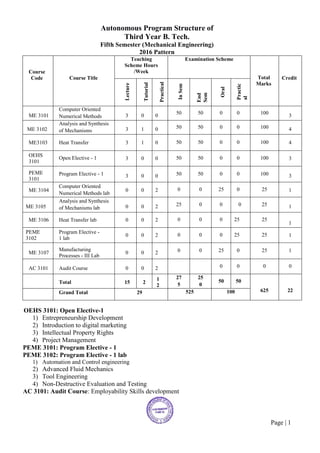
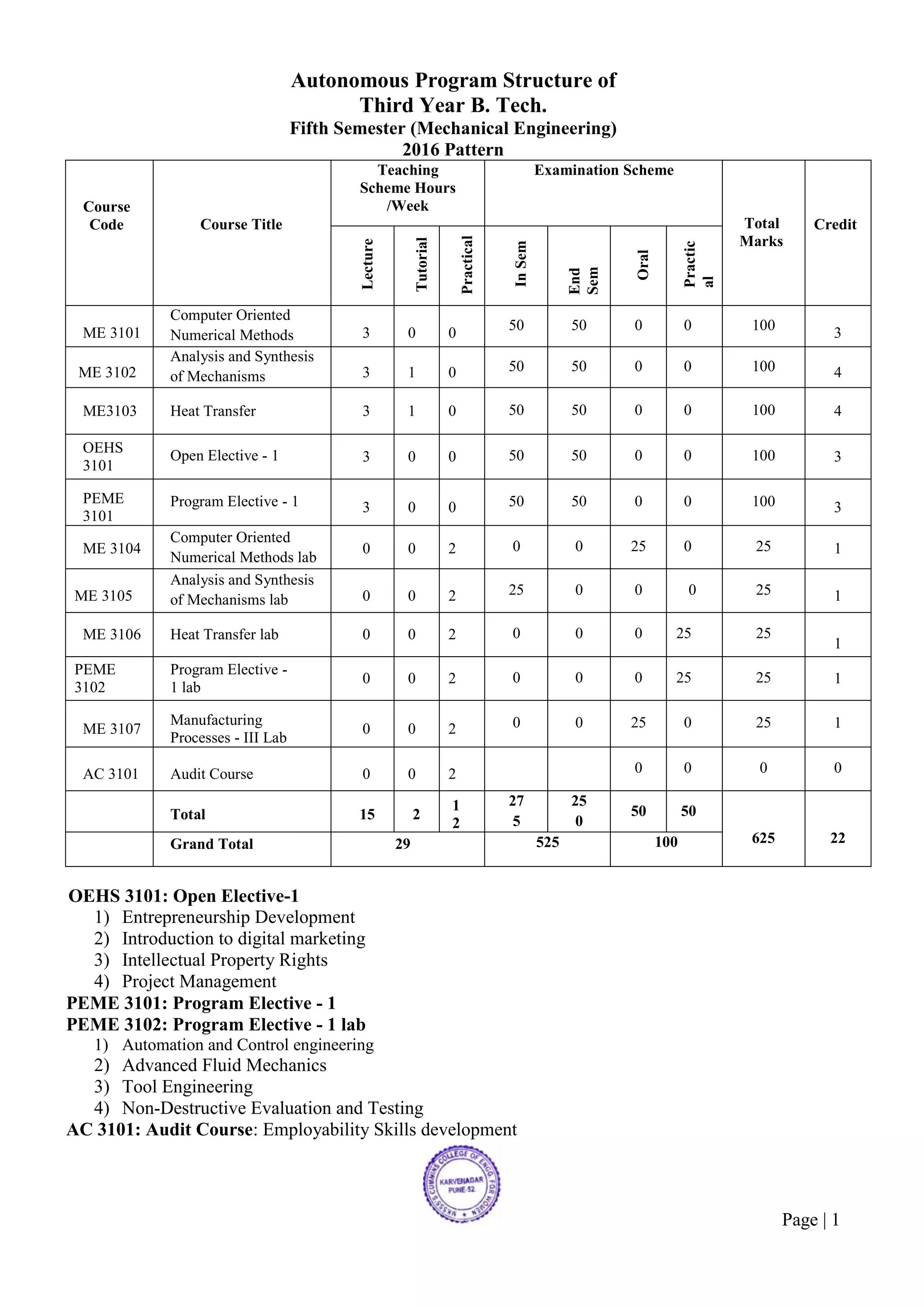
Autonomous Program Structure of
Third Year B. Tech.
Fifth Semester (Mechanical Engineering)
2016 Pattern
Course
Code Course Title
Teaching
Scheme Hours
/Week
Examination Scheme
Total
Marks
Credit
Lecture
Tutorial
Practical
In
Sem
End
Sem
Oral
Practic
al
ME 3101
Computer Oriented
Numerical Methods 3 0 0 50 50 0 0 100 3
ME 3102
Analysis and Synthesis
of Mechanisms 3 1 0 50 50 0 0 100 4
ME3103 Heat Transfer 3 1 0 50 50 0 0 100 4
OEHS
3101
Open Elective - 1 3 0 0 50 50 0 0 100 3
PEME
3101
Program Elective - 1 3 0 0 50 50 0 0 100 3
ME 3104
Computer Oriented
Numerical Methods lab
0 0 2 0 0 25 0 25 1
ME 3105
Analysis and Synthesis
of Mechanisms lab 0 0 2 25 0 0 0 25 1
ME 3106 Heat Transfer lab 0 0 2 0 0 0 25 25
1
PEME
3102
Program Elective -
1 lab
0 0 2 0 0 0 25 25 1
ME 3107
Manufacturing
Processes - III Lab
0 0 2 0 0 25 0 25 1
AC 3101 Audit Course 0 0 2 0 0 0 0
Total 15 2
1
2
27
5
25
0
50 50
625 22
Grand Total 29 525 100
OEHS 3101: Open Elective-1
1) Entrepreneurship Development
2) Introduction to digital marketing
3) Intellectual Property Rights
4) Project Management
PEME 3101: Program Elective - 1
PEME 3102: Program Elective - 1 lab
1) Automation and Control engineering
2) Advanced Fluid Mechanics
3) Tool Engineering
4) Non-Destructive Evaluation and Testing
AC 3101: Audit Course: Employability Skills development
Page | 2
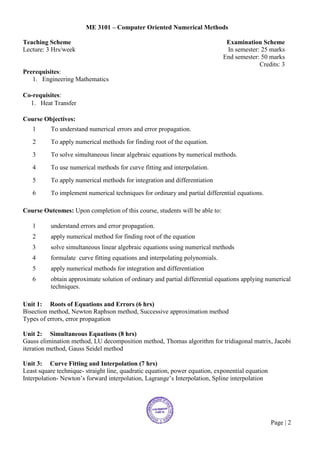
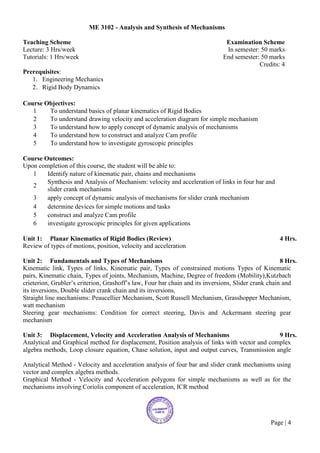
ME 3101 – Computer Oriented Numerical Methods
Teaching Scheme Examination Scheme
Lecture: 3 Hrs/week In semester: 25 marks
End semester: 50 marks
Credits: 3
Prerequisites:
1. Engineering Mathematics
Co-requisites:
1. Heat Transfer
Course Objectives:
1 To understand numerical errors and error propagation.
2 To apply numerical methods for finding root of the equation.
3 To solve simultaneous linear algebraic equations by numerical methods.
4 To use numerical methods for curve fitting and interpolation.
5 To apply numerical methods for integration and differentiation
6 To implement numerical techniques for ordinary and partial differential equations.
Course Outcomes: Upon completion of this course, students will be able to:
1 understand errors and error propagation.
2 apply numerical method for finding root of the equation
3 solve simultaneous linear algebraic equations using numerical methods
4 formulate curve fitting equations and interpolating polynomials.
5 apply numerical methods for integration and differentiation
6 obtain approximate solution of ordinary and partial differential equations applying numerical
techniques.
Unit 1: Roots of Equations and Errors (6 hrs)
Bisection method, Newton Raphson method, Successive approximation method
Types of errors, error propagation
Unit 2: Simultaneous Equations (8 hrs)
Gauss elimination method, LU decomposition method, Thomas algorithm for tridiagonal matrix, Jacobi
iteration method, Gauss Seidel method
Unit 3: Curve Fitting and Interpolation (7 hrs)
Least square technique- straight line, quadratic equation, power equation, exponential equation
Interpolation- Newton’s forward interpolation, Lagrange’s Interpolation, Spline interpolation
Page | 3
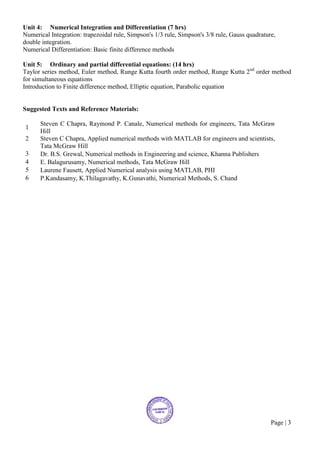
Unit 4: Numerical Integration and Differentiation (7 hrs)
Numerical Integration: trapezoidal rule, Simpson's 1/3 rule, Simpson's 3/8 rule, Gauss quadrature,
double integration.
Numerical Differentiation: Basic finite difference methods
Unit 5: Ordinary and partial differential equations: (14 hrs)
Taylor series method, Euler method, Runge Kutta fourth order method, Runge Kutta 2nd
order method
for simultaneous equations
Introduction to Finite difference method, Elliptic equation, Parabolic equation
Suggested Texts and Reference Materials:
1
Steven C Chapra, Raymond P. Canale, Numerical methods for engineers, Tata McGraw
Hill
2 Steven C Chapra, Applied numerical methods with MATLAB for engineers and scientists,
Tata McGraw Hill
3 Dr. B.S. Grewal, Numerical methods in Engineering and science, Khanna Publishers
4 E. Balagurusamy, Numerical methods, Tata McGraw Hill
5 Laurene Fausett, Applied Numerical analysis using MATLAB, PHI
6 P.Kandasamy, K.Thilagavathy, K.Gunavathi, Numerical Methods, S. Chand
Page | 4
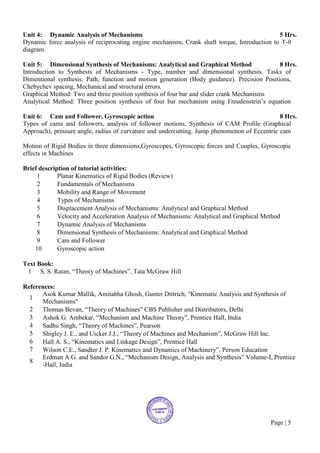
ME 3102 - Analysis and Synthesis of Mechanisms
Teaching Scheme Examination Scheme
Lecture: 3 Hrs/week In semester: 50 marks
Tutorials: 1 Hrs/week End semester: 50 marks
Credits: 4
Prerequisites:
1. Engineering Mechanics
2. Rigid Body Dynamics
Course Objectives:
1 To understand basics of planar kinematics of Rigid Bodies
2 To understand drawing velocity and acceleration diagram for simple mechanism
3 To understand how to apply concept of dynamic analysis of mechanisms
4 To understand how to construct and analyze Cam profile
5 To understand how to investigate gyroscopic principles
Course Outcomes:
Upon completion of this course, the student will be able to:
1 Identify nature of kinematic pair, chains and mechanisms
2
Synthesis and Analysis of Mechanism: velocity and acceleration of links in four bar and
slider crank mechanisms
3 apply concept of dynamic analysis of mechanisms for slider crank mechanism
4 determine devices for simple motions and tasks
5 construct and analyze Cam profile
6 investigate gyroscopic principles for given applications
Unit 1: Planar Kinematics of Rigid Bodies (Review) 4 Hrs.
Review of types of motions, position, velocity and acceleration
Unit 2: Fundamentals and Types of Mechanisms 8 Hrs.
Kinematic link, Types of links, Kinematic pair, Types of constrained motions Types of Kinematic
pairs, Kinematic chain, Types of joints, Mechanism, Machine, Degree of freedom (Mobility),Kutzbach
crieterion, Grubler’s criterion, Grashoff’s law, Four bar chain and its inversions, Slider crank chain and
its inversions, Double slider crank chain and its inversions,
Straight line mechanisms: Peaucellier Mechanism, Scott Russell Mechanism, Grasshopper Mechanism,
watt mechanism
Steering gear mechanisms: Condition for correct steering, Davis and Ackermann steering gear
mechanism
Unit 3: Displacement, Velocity and Acceleration Analysis of Mechanisms 9 Hrs.
Analytical and Graphical method for displacement, Position analysis of links with vector and complex
algebra methods, Loop closure equation, Chase solution, input and output curves, Transmission angle
Analytical Method - Velocity and acceleration analysis of four bar and slider crank mechanisms using
vector and complex algebra methods.
Graphical Method - Velocity and Acceleration polygons for simple mechanisms as well as for the
mechanisms involving Coriolis component of acceleration, ICR method
Page | 5
Unit 4: Dynamic Analysis of Mechanisms 5 Hrs.
Dynamic force analysis of reciprocating engine mechanism, Crank shaft torque, Introduction to T-θ
diagram.
Unit 5: Dimensional Synthesis of Mechanisms: Analytical and Graphical Method 8 Hrs.
Introduction to Synthesis of Mechanisms - Type, number and dimensional synthesis. Tasks of
Dimentional synthesis: Path, function and motion generation (Body guidance). Precision Positions,
Chebychev spacing, Mechanical and structural errors.
Graphical Method: Two and three position synthesis of four bar and slider crank Mechanisms
Analytical Method: Three position synthesis of four bar mechanism using Freudenstein’s equation
Unit 6: Cam and Follower, Gyroscopic action 8 Hrs.
Types of cams and followers, analysis of follower motions, Synthesis of CAM Profile (Graphical
Approach), pressure angle, radius of curvature and undercutting. Jump phenomenon of Eccentric cam
Motion of Rigid Bodies in three dimensions,Gyroscopes, Gyroscopic forces and Couples, Gyroscopic
effects in Machines
Brief description of tutorial activities:
1 Planar Kinematics of Rigid Bodies (Review)
2 Fundamentals of Mechanisms
3 Mobility and Range of Movement
4 Types of Mechanisms
5 Displacement Analysis of Mechanisms: Analytical and Graphical Method
6 Velocity and Acceleration Analysis of Mechanisms: Analytical and Graphical Method
7 Dynamic Analysis of Mechanisms
8 Dimensional Synthesis of Mechanisms: Analytical and Graphical Method
9 Cam and Follower
10 Gyroscopic action
Text Book:
1 S. S. Ratan, “Theory of Machines”, Tata McGraw Hill
References:
1
Asok Kumar Mallik, Amitabha Ghosh, Gunter Dittrich, "Kinematic Analysis and Synthesis of
Mechanisms"
2 Thomas Bevan, “Theory of Machines” CBS Publisher and Distributors, Delhi
3 Ashok G. Ambekar, “Mechanism and Machine Theory”, Prentice Hall, India
4 Sadhu Singh, “Theory of Machines”, Pearson
5 Shigley J. E., and Uicker J.J., “Theory of Machines and Mechanism”, McGraw Hill Inc.
6 Hall A. S., “Kinematics and Linkage Design”, Prentice Hall
7 Wilson C.E., Sandler J. P. Kinematics and Dynamics of Machinery”, Person Education
8
Erdman A.G. and Sandor G.N., “Mechanism Design, Analysis and Synthesis” Volume-I, Prentice
-Hall, India
Page | 6
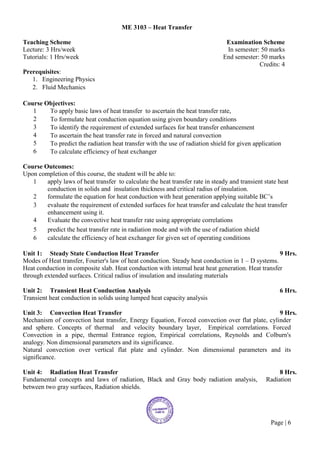
ME 3103 – Heat Transfer
Teaching Scheme Examination Scheme
Lecture: 3 Hrs/week In semester: 50 marks
Tutorials: 1 Hrs/week End semester: 50 marks
Credits: 4
Prerequisites:
1. Engineering Physics
2. Fluid Mechanics
Course Objectives:
1 To apply basic laws of heat transfer to ascertain the heat transfer rate,
2 To formulate heat conduction equation using given boundary conditions
3 To identify the requirement of extended surfaces for heat transfer enhancement
4 To ascertain the heat transfer rate in forced and natural convection
5 To predict the radiation heat transfer with the use of radiation shield for given application
6 To calculate efficiency of heat exchanger
Course Outcomes:
Upon completion of this course, the student will be able to:
1 apply laws of heat transfer to calculate the heat transfer rate in steady and transient state heat
conduction in solids and insulation thickness and critical radius of insulation.
2 formulate the equation for heat conduction with heat generation applying suitable BC’s
3 evaluate the requirement of extended surfaces for heat transfer and calculate the heat transfer
enhancement using it.
4 Evaluate the convective heat transfer rate using appropriate correlations
5 predict the heat transfer rate in radiation mode and with the use of radiation shield
6 calculate the efficiency of heat exchanger for given set of operating conditions
Unit 1: Steady State Conduction Heat Transfer 9 Hrs.
Modes of Heat transfer, Fourier's law of heat conduction. Steady heat conduction in 1 – D systems.
Heat conduction in composite slab. Heat conduction with internal heat heat generation. Heat transfer
through extended surfaces. Critical radius of insulation and insulating materials
Unit 2: Transient Heat Conduction Analysis 6 Hrs.
Transient heat conduction in solids using lumped heat capacity analysis
Unit 3: Convection Heat Transfer 9 Hrs.
Mechanism of convection heat transfer, Energy Equation, Forced convection over flat plate, cylinder
and sphere. Concepts of thermal and velocity boundary layer, Empirical correlations. Forced
Convection in a pipe, thermal Entrance region, Empirical correlations, Reynolds and Colburn's
analogy. Non dimensional parameters and its significance.
Natural convection over vertical flat plate and cylinder. Non dimensional parameters and its
significance.
Unit 4: Radiation Heat Transfer 8 Hrs.
Fundamental concepts and laws of radiation, Black and Gray body radiation analysis, Radiation
between two gray surfaces, Radiation shields.
Page | 7
Unit 5: Heat Exchangers 8 Hrs.
Introduction and classification. Overall heat transfer coefficient. Heat exchanger analysis using LMTD
and NTU method. Effectiveness of heat exchanger.
Brief description of tutorial activities:
1 Conduction
2 Convection
3 Radiation
4 Heat Exchangers
Suggested Texts and Reference Materials:
1 F.P. Incropera, D.P. Dewitt, Fundamentals of Heat and Mass Transfer, John Wiley
2 Y. A. Cengel and A.J. Ghajar, Heat and Mass Transfer – Fundamentals and Applications,
Tata McGraw Hill Education Private Limited.
3 S.P. Sukhatme, A Textbook on Heat Transfer, Universities Press.
Page | 8
PEME 3101 Program Elective I – (A) Automation and Control Engineering
Teaching Scheme Examination Scheme
Lecture: 3 Hrs/week In semester: 25 marks
End semester: 50 marks
Credits: 3
Prerequisites:
1. Fluid mechanics.
2. Electronics and Electrical Engineering.
Course Objectives:
1 To familiarize with the basic concepts of industrial automation
2 To acquaint with the concept of low cost automation with pneumatic and hydraulic
systems.
3 To acquaint with the concepts related to fluid power.
4 To familiarize with the elements of control systems.
Course Outcomes:
Upon completion of this course, the student will be able to:
1 Identify automation need, level, required components and process control.
2 Analyze given needs of automation to design Hydraulic circuit(s)
3 Analyze given needs of automation to design Pneumatic circuit(s).
4 Justify selected component(s)/system from given catalogue(s) for automation application
under study.
Unit 1: Introduction to Automation 4 Hrs.
Definition; Automation in production systems; Automation principles and strategies; Basic elements of
an automated system; Advanced automation functions; Levels of automation; Types of automation;
Benefits and Impact of Automation in Manufacturing and Process Industries, Architecture of Industrial
Automation Systems
Unit 2 Hydraulic and pneumatic devices 8 Hrs.
Hydraulic and pneumatic devices: Different types of valves: DCV,FCV,PCV, Actuators and auxiliary
elements in Pneumatics and hydraulics, their applications and use of their ISO symbols
Unit 3: Hydraulic systems 8 Hrs.
Basic hydraulic circuits involving linear and rotary actuators. Fundamental concepts of digital and
servo hydraulic controls. Comparison between proportional, digital and servo hydraulic control
systems.
Unit 4: Pneumatic systems 8 Hrs.
Basic Pneumatic circuits involving linear and rotary actuators. Design of Pneumatic circuits using
Cascade method and Shift register method (up to 3 cylinders). Design of Electro-Pneumatic Circuits
using single solenoid and double solenoid valves with and without grouping. Design of Pneumatic
circuits using PLC Control (ladder programming only and up to 3 cylinders) with applications of
Timers and Counters and concept of Flag and latching.
Unit 5: Assembly line Automation 8 Hrs.
Page | 9
automated assembly systems, transfer systems, vibratory bowl feeders, non-vibratory feeders, part
orienting, feed track, part placing & part escapement systems Introduction to Material storage/ handling
and transport systems, and its automation using AS/RS, AGVS and conveyors etc
Unit 6: Fundamentals of Control System 4 Hrs.
Control system concepts, classification of control systems, mathematical representation of system
equations, response characteristics of components and systems through classical solution
Suggested Texts and Reference Materials:
1 Anthony Esposito, Fluid power with applications, 7 th Edn., 2008, Prentice Hall. 2. M P.
2 Groover, Industrial Robotics: Technology, Programming and Applications, McGrawHill,
2 nd Edn., 2012, ISBN: 9780070265097
3
Automation, Production Systems, and Computer-integrated Manufacturing (3rd Edition),
by Mikell P. Groover, PHI Learning Private Limited, New Delhi.
4 Pneumatic Controls, by Joji P., Wiley India Pvt. Ltd
5 Principles Of Control Systems, by U.A.Bakshi, V.U.Bakshi, Technical Publications Pune .
6
Pneumatics Basic Level, by Peter Croser, Frank Ebel, Festo Didactic GmbH & Co.
Germany
7
Electropneumatics Basic Level, by G. Prede, D. Scholz, Festo Didactic GmbH & Co.
Germany.
8
Introduction to Hydraulics and Pneumatics, by S.Ilango and V. Soundararajan, PHI
Learning Pvt. Ltd. New Delhi
9
Vickers Industrial Hydraulics Manual (3rd Edition), Vickers Inc.; Maumee, OH.
Hydraulic and Pneumatic Controls (2nd Edition), by R. Srinivasan, Vijay Nicole Imprints
Pvt. Ltd. Chennai.
Page | 10
PEME 3101 Program Elective I – (B) Advanced Fluid Mechanics
Teaching Scheme Examination Scheme
Lecture: 3 Hrs/week In semester: 25 marks
End semester: 50 marks
Credits: 3
Prerequisites:
1. Engineering Physics
2. Engineering mathematics
3. Fluid Mechanics
Course Objectives:
1 To Interpret the mathematical and physical foundations of the continuum mechanics of
fluids,
2 To apply the conservation laws to viscous, inviscid, incompressible flows; and boundary
layer flows
3 Be able to apply the principles of fluid mechanics to solve engineering problems and to
design systems or components to meet desired needs
4 To derive the generic form of N-S equation and able to deduce an analytical solution for
simple fluid mechanics problems.
Course Outcomes:
Upon completion of this course, the student will be able to:
1 Student will be able understand the concepts of continuum mechanics of fluids,
2 Student will be relate the conservation laws to different types of fluid flow conditions
3 Student will produce the solution for complex fluid mechanics problems and to design
system using fundamental principles.
4 Student will derive the generic form of N-S equations and illustrate the analytical solution
for simple flow problems
Unit 1: Reynolds Transport Theorem 9 Hrs.
Brief recapitulation of some preliminary concepts of Fluid Mechanics: Fluid Kinematics , RTT,
Integral and differential forms of governing equations: mass, momentum and energy conservation
equations, Navier-Stokes equations, Euler’s equation, Bernoulli’s Equation.
Unit 2: Navier Stokes Equation 6 Hrs.
Dynamics of viscous flows - Derivation of Navier-Stokes equation
Unit 3: Exact Solution of N-S Equations 9 Hrs.
Some exact solutions of Navier-Stokes equation- Couette flows, Poiseuille flows, Fully developed
flows in non-circular cross-sections, Unsteady flows, Creeping flows.
Unit 4: Introduction to turbulence 8 Hrs.
Fundamental concepts turbulence, Prandtl mixing length theory, Turbulent stresses, Turbulence
modelling concept and requirement
Unit 5: Boundary Layer theory 8 Hrs.
Page | 11
Boundary layer equations, Boundary layer thickness, Boundary layer on a flat plate, similarity
solutions, Integral form of boundary layer equations, Approximate Methods, Flow separation, Entry
flow into a duct.
Unit 6: Compressible Flow 8 Hrs.
Speed of sound and Mach number, Basic equations for one dimensional flows, Isentropic relations,
Normal-shock wave, Fanno and Rayleigh curve, Mach waves, Oblique shock wave,
Suggested Texts and Reference Materials:
1 Introduction to Fluid Mechanics R. Fox and A. MacDonald, John Wiley and Sons
2 Introduction to Fluid Mechanics and Fluid Machines: S. K. Som, Gautam Biswas and
Suman Chakraborty, McGraw-Hill Education
3 Fluid Mechanics and its Applications, Vijay Gupta Santosh Gupta New Age international
4 Fluid Mechanics: Pijush K. Kundu, Ira M. Cohen, David R Dowling, Academic Press
Page | 12
PEME 3101 Program Elective I – (C) Tool Engineering
Teaching Scheme Examination Scheme
Lecture: 3 Hrs/week In semester: 25 marks
End semester: 50 marks
Credits: 3
Prerequisites:
1. Materials Technology
2. Manufacturing Process
Course Objectives:
1 Student will be able to learn cutting tool nomenclature of single point cutting tool, drill,
milling cutter etc.
2 Student will able to understand cutting tool parameters on which different cutting tools are
designed.
3 Student will able to draw technical drawing of cutting tools with its nomenclature.
Course Outcomes:
Upon completion of this course, the student will be able to:
1 select proper material for cutting tools depending upon different machining conditions
2 Apply appropriate cutting tool parameters (viz. rack angle, clearance angle, etc.) to design
of tools
3 design different cutting tools depending upon cutting forces in machining operation
Unit 1: Introduction to Tool Engineering 4 Hrs.
Introduction,Tool Classifications, Tool Design Objectives , Tool Design in manufacturing Challenges
and requirements- Standards in tool design.
Unit 2: Design of single Point cutting tools 9 Hrs.
Cutting tool forces, Selection of different cutting tool angles, design tool on basis of bending and
stiffness, design of form tools
Unit 3: Design of Milling Cutters 9 Hrs.
Force calculation in up and down milling, selection of milling cutter depending upon applications,
Unit 4: Design of Twist Drill 9 Hrs.
Drill nomenclature , Point angle selection, shank diameter section morse taper selection, Taps and
selection of taps
Unit 5: Design of Broach 9 Hrs.
Force Calculation, Pull /Push broach selection, chip breaker design,
Suggested Texts and Reference Materials:
1
Cyrll Donaldson, George H.LeCain, V.C. Goold, “Tool Design”, Tata McGraw Hill
Publishing Company Ltd., 2000.
2 Haslehurst M., “Manufacturing Technology”, The ELBS, 1978
3 Fundamentals of tool design ASTME PHI.
4 Doyal Tool engineering
Page | 13
PEME 3101 Program Elective I – (D) Non Destructive Evaluation and Testing
Teaching Scheme Examination Scheme
Lecture: 3 Hrs/week In semester: 25 marks
End semester: 50 marks
Credits: 3
Prerequisites:
1. Materials technology 1
2. Materials technology 2
3. Basic Physics
Co-requisites:
Manufacturing Process
Course Objectives:
1 To educate on the concept of fault tolerance in components
2
The course aims to provide an insight on the applications of fundamental sciences to Non
Destructive Testing (NDT)
3 To understand the capabilities of non destructive test methods.
4 The course aims to make the students aware of codes, standards
Course Outcomes:
Upon completion of this course, students will be able to:
1 Predict the source of flaw
2 Characterise the flaw
3 Propose an appropriate method of NDT.
4 Interpret and apply codes and standards in the NDT practices
Unit 1: Origins and significance of flaws (9 hrs)
Overview of Manufacturing process related flaws. Type of flaws arising out of casting, forging, rolling,
Welding, Extrusion. Definitions, Identification, risk assessment.
Unit 2: Surface and near surface Non Destructive methods (10 hrs)
Dye Penetrant test: Principle, Theory, Methods and techniques,
Basic principle and Theory of Magnetism, Magnetic particle test: Techniques, methods, Interpretation
and evaluation, Magnetic particle test equipment and its calibration, field indicators.
Unit 3: Volumetric non destructive methods (10 hrs)
Ultrasonic Flaw detection: Acoustic principles, Basic principles of instrument, Methods of testing,
Transducer material properties and sizes, calibration, Various scan techniques: A scan, B scan, C scan.
Radiography: X-ray and gamma ray and their properties, Image formation, image quality sharpness,
accuracy. Interpretation of X ray images, Safety, health and license considerations in radiography
Unit 4: NDT practices (9 hrs)
Page | 14
Visual testing, Report writing and data presentation, Acquaintance with codes, standards, specification,
and inspection practice.
Suggested Texts and Reference Materials:
1 ASM Metals Handbook, Vol. 17, Nondestructive Evaluation and Quality Control.
2 Baldev Raj, T JayaKumar, M. Thavasimuthu, "Practical Non Destructive testing", Narosa
Publishing House, 3e
3 Subramanian C.V., “Practical Ultrasonics”, Narosa Publishing house, 2008
4 ASNT Continuing education in Non destructive testing manuals, Level II.
5 ASME Section V, VIIID, I and Section IX.
Page | 15
ME 3104 Computer Oriented Numerical Methods Lab
Teaching Scheme Examination Scheme
Practical: 2 Hrs/week End semester: 25 marks
Credits: 1
Prerequisites:
1. Engineering Mathematics
Co - requisites:
1. Heat Transfer
Course Objectives:
1. To use numerical methods to solve problems.
2. To use mathematical solver.
3. To prepare flowcharts for numerical methods.
4. To write programs for numerical methods.
Course Outcomes:
Upon completion of this lab course, the student will be able to:
1. apply numerical methods to solve problems.
2. use Matlab solver.
3. prepare flowcharts for numerical methods.
4. write computer programs to obtain solution using numerical methods
List of Practical Activities:
Implementation of solution algorithms and write efficient Matlab code for following class of
problems;
I. Finding roots of equations
II. Solving systems of algebraic equations
III. Curve fitting
IV. Interpolation
V. Numerical differentiation
VI. Numerical integration
VII. Solutions of ordinary differential equations including:
a. Initial value problems
b. Systems of equations
VIII. Solutions of partial differential equations including:
a. Initial value problems
b. Boundary condition problems
Text Book:
1. Steven C Chapra, Raymond P. Canale, Numerical methods for engineers, Tata McGraw Hill
Page | 16
ME 3105 Analysis and Synthesis of Mechanisms Lab
Teaching Scheme Examination Scheme
Practical: 2 Hrs/week In semester: 25 marks
Credits: 1
Prerequisites:
1. Engineering Mechanics
2. Rigid Body Dynamics
Course Objectives:
1. To understand drawing velocity and acceleration diagram for simple mechanism
2. To understand how to apply concept of dynamic analysis of mechanisms
3. To understand how to construct and analyze Cam profile
4. To understand how to investigate gyroscopic principles
Course Outcomes:
Upon completion of this lab course, the student will be able to:
1. identify nature of kinematic pair, chains and mechanisms
2. construct and analyze velocity and acceleration of links in four bar and slider crank mechanisms
3. determine devices for simple motions and tasks
4. construct and analyze Cam profile
5. investigate gyroscopic principles for given applications
List of Experiments:
1. To draw mechanisms for practical applications
2. To Draw Straight Line Mechanisms
3. Velocity and acceleration analysis using Graphical methods - Polygon and ICR
4. Velocity and acceleration analysis using Graphical methods - polygons involving Coriolis
component and Klein’s construction
5. To synthesize the four bar and slider crank mechanisms using relative pole and inversion
methods with three precision positions
6. To draw the cam profiles
7. To verify the cam jump phenomenon for an eccentric cam
8. To verify the gyroscopic principles
9. Introduction to software of Analysis and Synthesis of Mechanisms
Text Book:
1 S. S. Ratan, “Theory of Machines”, Tata McGraw Hill
Page | 17
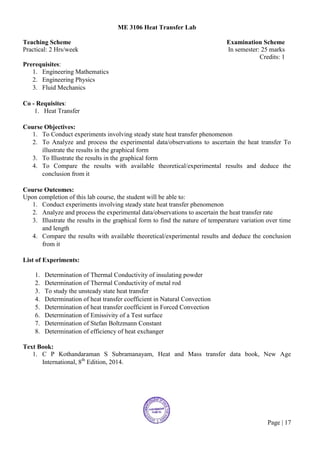
ME 3106 Heat Transfer Lab
Teaching Scheme Examination Scheme
Practical: 2 Hrs/week In semester: 25 marks
Credits: 1
Prerequisites:
1. Engineering Mathematics
2. Engineering Physics
3. Fluid Mechanics
Co - Requisites:
1. Heat Transfer
Course Objectives:
1. To Conduct experiments involving steady state heat transfer phenomenon
2. To Analyze and process the experimental data/observations to ascertain the heat transfer To
illustrate the results in the graphical form
3. To Illustrate the results in the graphical form
4. To Compare the results with available theoretical/experimental results and deduce the
conclusion from it
Course Outcomes:
Upon completion of this lab course, the student will be able to:
1. Conduct experiments involving steady state heat transfer phenomenon
2. Analyze and process the experimental data/observations to ascertain the heat transfer rate
3. Illustrate the results in the graphical form to find the nature of temperature variation over time
and length
4. Compare the results with available theoretical/experimental results and deduce the conclusion
from it
List of Experiments:
1. Determination of Thermal Conductivity of insulating powder
2. Determination of Thermal Conductivity of metal rod
3. To study the unsteady state heat transfer
4. Determination of heat transfer coefficient in Natural Convection
5. Determination of heat transfer coefficient in Forced Convection
6. Determination of Emissivity of a Test surface
7. Determination of Stefan Boltzmann Constant
8. Determination of efficiency of heat exchanger
Text Book:
1. C P Kothandaraman S Subramanayam, Heat and Mass transfer data book, New Age
International, 8th
Edition, 2014.
Page | 18
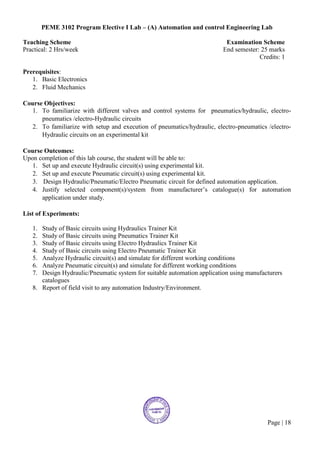
PEME 3102 Program Elective I Lab – (A) Automation and control Engineering Lab
Teaching Scheme Examination Scheme
Practical: 2 Hrs/week End semester: 25 marks
Credits: 1
Prerequisites:
1. Basic Electronics
2. Fluid Mechanics
Course Objectives:
1. To familiarize with different valves and control systems for pneumatics/hydraulic, electro-
pneumatics /electro-Hydraulic circuits
2. To familiarize with setup and execution of pneumatics/hydraulic, electro-pneumatics /electro-
Hydraulic circuits on an experimental kit
Course Outcomes:
Upon completion of this lab course, the student will be able to:
1. Set up and execute Hydraulic circuit(s) using experimental kit.
2. Set up and execute Pneumatic circuit(s) using experimental kit.
3. Design Hydraulic/Pneumatic/Electro Pneumatic circuit for defined automation application.
4. Justify selected component(s)/system from manufacturer’s catalogue(s) for automation
application under study.
List of Experiments:
1. Study of Basic circuits using Hydraulics Trainer Kit
2. Study of Basic circuits using Pneumatics Trainer Kit
3. Study of Basic circuits using Electro Hydraulics Trainer Kit
4. Study of Basic circuits using Electro Pneumatic Trainer Kit
5. Analyze Hydraulic circuit(s) and simulate for different working conditions
6. Analyze Pneumatic circuit(s) and simulate for different working conditions
7. Design Hydraulic/Pneumatic system for suitable automation application using manufacturers
catalogues
8. Report of field visit to any automation Industry/Environment.
Page | 19
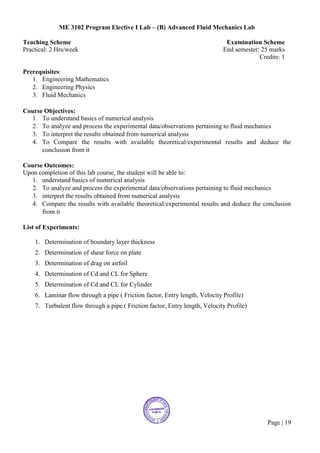
ME 3102 Program Elective I Lab – (B) Advanced Fluid Mechanics Lab
Teaching Scheme Examination Scheme
Practical: 2 Hrs/week End semester: 25 marks
Credits: 1
Prerequisites:
1. Engineering Mathematics
2. Engineering Physics
3. Fluid Mechanics
Course Objectives:
1. To understand basics of numerical analysis
2. To analyze and process the experimental data/observations pertaining to fluid mechanics
3. To interpret the results obtained from numerical analysis
4. To Compare the results with available theoretical/experimental results and deduce the
conclusion from it
Course Outcomes:
Upon completion of this lab course, the student will be able to:
1. understand basics of numerical analysis
2. To analyze and process the experimental data/observations pertaining to fluid mechanics
3. interpret the results obtained from numerical analysis
4. Compare the results with available theoretical/experimental results and deduce the conclusion
from it
List of Experiments:
1. Determination of boundary layer thickness
2. Determination of shear force on plate
3. Determination of drag on airfoil
4. Determination of Cd and CL for Sphere
5. Determination of Cd and CL for Cylinder
6. Laminar flow through a pipe ( Friction factor, Entry length, Velocity Profile)
7. Turbulent flow through a pipe ( Friction factor, Entry length, Velocity Profile)
Page | 20
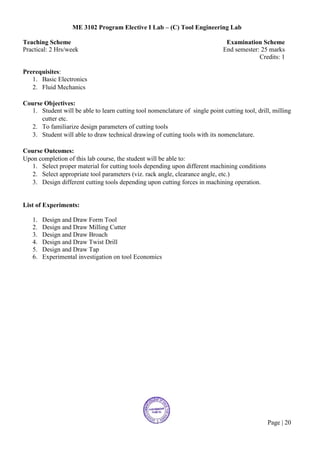
ME 3102 Program Elective I Lab – (C) Tool Engineering Lab
Teaching Scheme Examination Scheme
Practical: 2 Hrs/week End semester: 25 marks
Credits: 1
Prerequisites:
1. Basic Electronics
2. Fluid Mechanics
Course Objectives:
1. Student will be able to learn cutting tool nomenclature of single point cutting tool, drill, milling
cutter etc.
2. To familiarize design parameters of cutting tools
3. Student will able to draw technical drawing of cutting tools with its nomenclature.
Course Outcomes:
Upon completion of this lab course, the student will be able to:
1. Select proper material for cutting tools depending upon different machining conditions
2. Select appropriate tool parameters (viz. rack angle, clearance angle, etc.)
3. Design different cutting tools depending upon cutting forces in machining operation.
List of Experiments:
1. Design and Draw Form Tool
2. Design and Draw Milling Cutter
3. Design and Draw Broach
4. Design and Draw Twist Drill
5. Design and Draw Tap
6. Experimental investigation on tool Economics
Page | 21
ME 3102 Program Elective I Lab – (D) Non Destructive Evaluation and Testing Lab
Teaching Scheme Examination Scheme
Practical: 2 Hrs/week End semester: 25 marks
Credits: 1
Prerequisites:
1. Materials Technology 1
2. Materials technology 2
3. Manufacturing process
Course Objectives:
1. To understand the application of the tools at hand to maximize the efficiency and quality of
inspections.
2. To understand the context of NDT in the process of making safe components.
3. To conduct non destructive testing
Course Outcomes:
Upon completion of this lab course, the student will be able to:
1. Set up and calibrate non destructive testing equipment
2. Use techniques for proper examination of objects under inspection, ensuring strict adherence to
safety regulations.
3. Interpret and evaluate results with respect to applicable codes, standards, and specifications.
List of Experiments:
1. Task based practical on Visual Inspection
2. Interpretations and discussions
3. Task based practical on Dye penetrant test
4. Interpretations and discussions
5. Task based practical on Magnetic particle test
6. Discussions and interpretations
7. Task based practical on Ultrasonic flaw detection
8. Discussions and interpretations
Page | 22
ME 3107 Manufacturing Processes III Lab
Teaching Scheme Examination Scheme
Practical: 2 Hrs/week End semester: 25 marks
Credits: 1
Course Objectives:
1. To study conventional machining operations.
2. Understand the different types of cutting of ferrous and non-ferrous metals by various methods
and welding processes and characteristics.
3. Understand the concepts of unconventional machining process, types of unconventional
machining process.
Course Outcomes:
Learner will be able to:
1. Select required manufacturing process for selected component.
2. Analyze and estimate machining time for lathe machine, drilling machine, milling machine etc.
3. Estimate approximate cost of assembly; prepare conferral (investiture) of manufactured
assembly.
4. Understand codes used in programing for CNC machine and basics of manufacturing selected
component on CNC machine.
Course Contents:
Manufacture assembly involving following operations of minimum 5 components.
1. Turning, Step turning, Taper turning, Grooving, Precision turning, Thread cutting, knurling,
2. Shaping, Drilling, Milling, Grinding, Welding or suitable joining process.
3. Use of CNC machine for precision manufacturing.
Term Work:
Manufacture any one assembly from following assembly list:
1. Press Tool Assembly.
2. Couplings.
3. Joints.
4. Wheel Support Assembly.
5. Bearing Puller.
Text Book:
1. Elements of Workshop Technology, Hazra Chaudhary Vol I, II.
Reference Books:
1. Manufacturing, Engineering and Technology SI, Serope Kalpakjian, Steven R. Schmid,
Prentice Hall.
2. Workshop Technology part I, II & III, W. A. J. Chapman.
3. Introduction to Manufacturing Processes, John A. Schey, McGraw-Hill.

Syllabus_Mech_Sem-V_2016Pattern.pdf

  • 1.
    Page | 1 AutonomousProgram Structure of Third Year B. Tech. Fifth Semester (Mechanical Engineering) 2016 Pattern Course Code Course Title Teaching Scheme Hours /Week Examination Scheme Total Marks Credit Lecture Tutorial Practical In Sem End Sem Oral Practic al ME 3101 Computer Oriented Numerical Methods 3 0 0 50 50 0 0 100 3 ME 3102 Analysis and Synthesis of Mechanisms 3 1 0 50 50 0 0 100 4 ME3103 Heat Transfer 3 1 0 50 50 0 0 100 4 OEHS 3101 Open Elective - 1 3 0 0 50 50 0 0 100 3 PEME 3101 Program Elective - 1 3 0 0 50 50 0 0 100 3 ME 3104 Computer Oriented Numerical Methods lab 0 0 2 0 0 25 0 25 1 ME 3105 Analysis and Synthesis of Mechanisms lab 0 0 2 25 0 0 0 25 1 ME 3106 Heat Transfer lab 0 0 2 0 0 0 25 25 1 PEME 3102 Program Elective - 1 lab 0 0 2 0 0 0 25 25 1 ME 3107 Manufacturing Processes - III Lab 0 0 2 0 0 25 0 25 1 AC 3101 Audit Course 0 0 2 0 0 0 0 Total 15 2 1 2 27 5 25 0 50 50 625 22 Grand Total 29 525 100 OEHS 3101: Open Elective-1 1) Entrepreneurship Development 2) Introduction to digital marketing 3) Intellectual Property Rights 4) Project Management PEME 3101: Program Elective - 1 PEME 3102: Program Elective - 1 lab 1) Automation and Control engineering 2) Advanced Fluid Mechanics 3) Tool Engineering 4) Non-Destructive Evaluation and Testing AC 3101: Audit Course: Employability Skills development
  • 2.
    Page | 2 ME3101 – Computer Oriented Numerical Methods Teaching Scheme Examination Scheme Lecture: 3 Hrs/week In semester: 25 marks End semester: 50 marks Credits: 3 Prerequisites: 1. Engineering Mathematics Co-requisites: 1. Heat Transfer Course Objectives: 1 To understand numerical errors and error propagation. 2 To apply numerical methods for finding root of the equation. 3 To solve simultaneous linear algebraic equations by numerical methods. 4 To use numerical methods for curve fitting and interpolation. 5 To apply numerical methods for integration and differentiation 6 To implement numerical techniques for ordinary and partial differential equations. Course Outcomes: Upon completion of this course, students will be able to: 1 understand errors and error propagation. 2 apply numerical method for finding root of the equation 3 solve simultaneous linear algebraic equations using numerical methods 4 formulate curve fitting equations and interpolating polynomials. 5 apply numerical methods for integration and differentiation 6 obtain approximate solution of ordinary and partial differential equations applying numerical techniques. Unit 1: Roots of Equations and Errors (6 hrs) Bisection method, Newton Raphson method, Successive approximation method Types of errors, error propagation Unit 2: Simultaneous Equations (8 hrs) Gauss elimination method, LU decomposition method, Thomas algorithm for tridiagonal matrix, Jacobi iteration method, Gauss Seidel method Unit 3: Curve Fitting and Interpolation (7 hrs) Least square technique- straight line, quadratic equation, power equation, exponential equation Interpolation- Newton’s forward interpolation, Lagrange’s Interpolation, Spline interpolation
  • 3.
    Page | 3 Unit4: Numerical Integration and Differentiation (7 hrs) Numerical Integration: trapezoidal rule, Simpson's 1/3 rule, Simpson's 3/8 rule, Gauss quadrature, double integration. Numerical Differentiation: Basic finite difference methods Unit 5: Ordinary and partial differential equations: (14 hrs) Taylor series method, Euler method, Runge Kutta fourth order method, Runge Kutta 2nd order method for simultaneous equations Introduction to Finite difference method, Elliptic equation, Parabolic equation Suggested Texts and Reference Materials: 1 Steven C Chapra, Raymond P. Canale, Numerical methods for engineers, Tata McGraw Hill 2 Steven C Chapra, Applied numerical methods with MATLAB for engineers and scientists, Tata McGraw Hill 3 Dr. B.S. Grewal, Numerical methods in Engineering and science, Khanna Publishers 4 E. Balagurusamy, Numerical methods, Tata McGraw Hill 5 Laurene Fausett, Applied Numerical analysis using MATLAB, PHI 6 P.Kandasamy, K.Thilagavathy, K.Gunavathi, Numerical Methods, S. Chand
  • 4.
    Page | 4 ME3102 - Analysis and Synthesis of Mechanisms Teaching Scheme Examination Scheme Lecture: 3 Hrs/week In semester: 50 marks Tutorials: 1 Hrs/week End semester: 50 marks Credits: 4 Prerequisites: 1. Engineering Mechanics 2. Rigid Body Dynamics Course Objectives: 1 To understand basics of planar kinematics of Rigid Bodies 2 To understand drawing velocity and acceleration diagram for simple mechanism 3 To understand how to apply concept of dynamic analysis of mechanisms 4 To understand how to construct and analyze Cam profile 5 To understand how to investigate gyroscopic principles Course Outcomes: Upon completion of this course, the student will be able to: 1 Identify nature of kinematic pair, chains and mechanisms 2 Synthesis and Analysis of Mechanism: velocity and acceleration of links in four bar and slider crank mechanisms 3 apply concept of dynamic analysis of mechanisms for slider crank mechanism 4 determine devices for simple motions and tasks 5 construct and analyze Cam profile 6 investigate gyroscopic principles for given applications Unit 1: Planar Kinematics of Rigid Bodies (Review) 4 Hrs. Review of types of motions, position, velocity and acceleration Unit 2: Fundamentals and Types of Mechanisms 8 Hrs. Kinematic link, Types of links, Kinematic pair, Types of constrained motions Types of Kinematic pairs, Kinematic chain, Types of joints, Mechanism, Machine, Degree of freedom (Mobility),Kutzbach crieterion, Grubler’s criterion, Grashoff’s law, Four bar chain and its inversions, Slider crank chain and its inversions, Double slider crank chain and its inversions, Straight line mechanisms: Peaucellier Mechanism, Scott Russell Mechanism, Grasshopper Mechanism, watt mechanism Steering gear mechanisms: Condition for correct steering, Davis and Ackermann steering gear mechanism Unit 3: Displacement, Velocity and Acceleration Analysis of Mechanisms 9 Hrs. Analytical and Graphical method for displacement, Position analysis of links with vector and complex algebra methods, Loop closure equation, Chase solution, input and output curves, Transmission angle Analytical Method - Velocity and acceleration analysis of four bar and slider crank mechanisms using vector and complex algebra methods. Graphical Method - Velocity and Acceleration polygons for simple mechanisms as well as for the mechanisms involving Coriolis component of acceleration, ICR method
  • 5.
    Page | 5 Unit4: Dynamic Analysis of Mechanisms 5 Hrs. Dynamic force analysis of reciprocating engine mechanism, Crank shaft torque, Introduction to T-θ diagram. Unit 5: Dimensional Synthesis of Mechanisms: Analytical and Graphical Method 8 Hrs. Introduction to Synthesis of Mechanisms - Type, number and dimensional synthesis. Tasks of Dimentional synthesis: Path, function and motion generation (Body guidance). Precision Positions, Chebychev spacing, Mechanical and structural errors. Graphical Method: Two and three position synthesis of four bar and slider crank Mechanisms Analytical Method: Three position synthesis of four bar mechanism using Freudenstein’s equation Unit 6: Cam and Follower, Gyroscopic action 8 Hrs. Types of cams and followers, analysis of follower motions, Synthesis of CAM Profile (Graphical Approach), pressure angle, radius of curvature and undercutting. Jump phenomenon of Eccentric cam Motion of Rigid Bodies in three dimensions,Gyroscopes, Gyroscopic forces and Couples, Gyroscopic effects in Machines Brief description of tutorial activities: 1 Planar Kinematics of Rigid Bodies (Review) 2 Fundamentals of Mechanisms 3 Mobility and Range of Movement 4 Types of Mechanisms 5 Displacement Analysis of Mechanisms: Analytical and Graphical Method 6 Velocity and Acceleration Analysis of Mechanisms: Analytical and Graphical Method 7 Dynamic Analysis of Mechanisms 8 Dimensional Synthesis of Mechanisms: Analytical and Graphical Method 9 Cam and Follower 10 Gyroscopic action Text Book: 1 S. S. Ratan, “Theory of Machines”, Tata McGraw Hill References: 1 Asok Kumar Mallik, Amitabha Ghosh, Gunter Dittrich, "Kinematic Analysis and Synthesis of Mechanisms" 2 Thomas Bevan, “Theory of Machines” CBS Publisher and Distributors, Delhi 3 Ashok G. Ambekar, “Mechanism and Machine Theory”, Prentice Hall, India 4 Sadhu Singh, “Theory of Machines”, Pearson 5 Shigley J. E., and Uicker J.J., “Theory of Machines and Mechanism”, McGraw Hill Inc. 6 Hall A. S., “Kinematics and Linkage Design”, Prentice Hall 7 Wilson C.E., Sandler J. P. Kinematics and Dynamics of Machinery”, Person Education 8 Erdman A.G. and Sandor G.N., “Mechanism Design, Analysis and Synthesis” Volume-I, Prentice -Hall, India
  • 6.
    Page | 6 ME3103 – Heat Transfer Teaching Scheme Examination Scheme Lecture: 3 Hrs/week In semester: 50 marks Tutorials: 1 Hrs/week End semester: 50 marks Credits: 4 Prerequisites: 1. Engineering Physics 2. Fluid Mechanics Course Objectives: 1 To apply basic laws of heat transfer to ascertain the heat transfer rate, 2 To formulate heat conduction equation using given boundary conditions 3 To identify the requirement of extended surfaces for heat transfer enhancement 4 To ascertain the heat transfer rate in forced and natural convection 5 To predict the radiation heat transfer with the use of radiation shield for given application 6 To calculate efficiency of heat exchanger Course Outcomes: Upon completion of this course, the student will be able to: 1 apply laws of heat transfer to calculate the heat transfer rate in steady and transient state heat conduction in solids and insulation thickness and critical radius of insulation. 2 formulate the equation for heat conduction with heat generation applying suitable BC’s 3 evaluate the requirement of extended surfaces for heat transfer and calculate the heat transfer enhancement using it. 4 Evaluate the convective heat transfer rate using appropriate correlations 5 predict the heat transfer rate in radiation mode and with the use of radiation shield 6 calculate the efficiency of heat exchanger for given set of operating conditions Unit 1: Steady State Conduction Heat Transfer 9 Hrs. Modes of Heat transfer, Fourier's law of heat conduction. Steady heat conduction in 1 – D systems. Heat conduction in composite slab. Heat conduction with internal heat heat generation. Heat transfer through extended surfaces. Critical radius of insulation and insulating materials Unit 2: Transient Heat Conduction Analysis 6 Hrs. Transient heat conduction in solids using lumped heat capacity analysis Unit 3: Convection Heat Transfer 9 Hrs. Mechanism of convection heat transfer, Energy Equation, Forced convection over flat plate, cylinder and sphere. Concepts of thermal and velocity boundary layer, Empirical correlations. Forced Convection in a pipe, thermal Entrance region, Empirical correlations, Reynolds and Colburn's analogy. Non dimensional parameters and its significance. Natural convection over vertical flat plate and cylinder. Non dimensional parameters and its significance. Unit 4: Radiation Heat Transfer 8 Hrs. Fundamental concepts and laws of radiation, Black and Gray body radiation analysis, Radiation between two gray surfaces, Radiation shields.
  • 7.
    Page | 7 Unit5: Heat Exchangers 8 Hrs. Introduction and classification. Overall heat transfer coefficient. Heat exchanger analysis using LMTD and NTU method. Effectiveness of heat exchanger. Brief description of tutorial activities: 1 Conduction 2 Convection 3 Radiation 4 Heat Exchangers Suggested Texts and Reference Materials: 1 F.P. Incropera, D.P. Dewitt, Fundamentals of Heat and Mass Transfer, John Wiley 2 Y. A. Cengel and A.J. Ghajar, Heat and Mass Transfer – Fundamentals and Applications, Tata McGraw Hill Education Private Limited. 3 S.P. Sukhatme, A Textbook on Heat Transfer, Universities Press.
  • 8.
    Page | 8 PEME3101 Program Elective I – (A) Automation and Control Engineering Teaching Scheme Examination Scheme Lecture: 3 Hrs/week In semester: 25 marks End semester: 50 marks Credits: 3 Prerequisites: 1. Fluid mechanics. 2. Electronics and Electrical Engineering. Course Objectives: 1 To familiarize with the basic concepts of industrial automation 2 To acquaint with the concept of low cost automation with pneumatic and hydraulic systems. 3 To acquaint with the concepts related to fluid power. 4 To familiarize with the elements of control systems. Course Outcomes: Upon completion of this course, the student will be able to: 1 Identify automation need, level, required components and process control. 2 Analyze given needs of automation to design Hydraulic circuit(s) 3 Analyze given needs of automation to design Pneumatic circuit(s). 4 Justify selected component(s)/system from given catalogue(s) for automation application under study. Unit 1: Introduction to Automation 4 Hrs. Definition; Automation in production systems; Automation principles and strategies; Basic elements of an automated system; Advanced automation functions; Levels of automation; Types of automation; Benefits and Impact of Automation in Manufacturing and Process Industries, Architecture of Industrial Automation Systems Unit 2 Hydraulic and pneumatic devices 8 Hrs. Hydraulic and pneumatic devices: Different types of valves: DCV,FCV,PCV, Actuators and auxiliary elements in Pneumatics and hydraulics, their applications and use of their ISO symbols Unit 3: Hydraulic systems 8 Hrs. Basic hydraulic circuits involving linear and rotary actuators. Fundamental concepts of digital and servo hydraulic controls. Comparison between proportional, digital and servo hydraulic control systems. Unit 4: Pneumatic systems 8 Hrs. Basic Pneumatic circuits involving linear and rotary actuators. Design of Pneumatic circuits using Cascade method and Shift register method (up to 3 cylinders). Design of Electro-Pneumatic Circuits using single solenoid and double solenoid valves with and without grouping. Design of Pneumatic circuits using PLC Control (ladder programming only and up to 3 cylinders) with applications of Timers and Counters and concept of Flag and latching. Unit 5: Assembly line Automation 8 Hrs.
  • 9.
    Page | 9 automatedassembly systems, transfer systems, vibratory bowl feeders, non-vibratory feeders, part orienting, feed track, part placing & part escapement systems Introduction to Material storage/ handling and transport systems, and its automation using AS/RS, AGVS and conveyors etc Unit 6: Fundamentals of Control System 4 Hrs. Control system concepts, classification of control systems, mathematical representation of system equations, response characteristics of components and systems through classical solution Suggested Texts and Reference Materials: 1 Anthony Esposito, Fluid power with applications, 7 th Edn., 2008, Prentice Hall. 2. M P. 2 Groover, Industrial Robotics: Technology, Programming and Applications, McGrawHill, 2 nd Edn., 2012, ISBN: 9780070265097 3 Automation, Production Systems, and Computer-integrated Manufacturing (3rd Edition), by Mikell P. Groover, PHI Learning Private Limited, New Delhi. 4 Pneumatic Controls, by Joji P., Wiley India Pvt. Ltd 5 Principles Of Control Systems, by U.A.Bakshi, V.U.Bakshi, Technical Publications Pune . 6 Pneumatics Basic Level, by Peter Croser, Frank Ebel, Festo Didactic GmbH & Co. Germany 7 Electropneumatics Basic Level, by G. Prede, D. Scholz, Festo Didactic GmbH & Co. Germany. 8 Introduction to Hydraulics and Pneumatics, by S.Ilango and V. Soundararajan, PHI Learning Pvt. Ltd. New Delhi 9 Vickers Industrial Hydraulics Manual (3rd Edition), Vickers Inc.; Maumee, OH. Hydraulic and Pneumatic Controls (2nd Edition), by R. Srinivasan, Vijay Nicole Imprints Pvt. Ltd. Chennai.
  • 10.
    Page | 10 PEME3101 Program Elective I – (B) Advanced Fluid Mechanics Teaching Scheme Examination Scheme Lecture: 3 Hrs/week In semester: 25 marks End semester: 50 marks Credits: 3 Prerequisites: 1. Engineering Physics 2. Engineering mathematics 3. Fluid Mechanics Course Objectives: 1 To Interpret the mathematical and physical foundations of the continuum mechanics of fluids, 2 To apply the conservation laws to viscous, inviscid, incompressible flows; and boundary layer flows 3 Be able to apply the principles of fluid mechanics to solve engineering problems and to design systems or components to meet desired needs 4 To derive the generic form of N-S equation and able to deduce an analytical solution for simple fluid mechanics problems. Course Outcomes: Upon completion of this course, the student will be able to: 1 Student will be able understand the concepts of continuum mechanics of fluids, 2 Student will be relate the conservation laws to different types of fluid flow conditions 3 Student will produce the solution for complex fluid mechanics problems and to design system using fundamental principles. 4 Student will derive the generic form of N-S equations and illustrate the analytical solution for simple flow problems Unit 1: Reynolds Transport Theorem 9 Hrs. Brief recapitulation of some preliminary concepts of Fluid Mechanics: Fluid Kinematics , RTT, Integral and differential forms of governing equations: mass, momentum and energy conservation equations, Navier-Stokes equations, Euler’s equation, Bernoulli’s Equation. Unit 2: Navier Stokes Equation 6 Hrs. Dynamics of viscous flows - Derivation of Navier-Stokes equation Unit 3: Exact Solution of N-S Equations 9 Hrs. Some exact solutions of Navier-Stokes equation- Couette flows, Poiseuille flows, Fully developed flows in non-circular cross-sections, Unsteady flows, Creeping flows. Unit 4: Introduction to turbulence 8 Hrs. Fundamental concepts turbulence, Prandtl mixing length theory, Turbulent stresses, Turbulence modelling concept and requirement Unit 5: Boundary Layer theory 8 Hrs.
  • 11.
    Page | 11 Boundarylayer equations, Boundary layer thickness, Boundary layer on a flat plate, similarity solutions, Integral form of boundary layer equations, Approximate Methods, Flow separation, Entry flow into a duct. Unit 6: Compressible Flow 8 Hrs. Speed of sound and Mach number, Basic equations for one dimensional flows, Isentropic relations, Normal-shock wave, Fanno and Rayleigh curve, Mach waves, Oblique shock wave, Suggested Texts and Reference Materials: 1 Introduction to Fluid Mechanics R. Fox and A. MacDonald, John Wiley and Sons 2 Introduction to Fluid Mechanics and Fluid Machines: S. K. Som, Gautam Biswas and Suman Chakraborty, McGraw-Hill Education 3 Fluid Mechanics and its Applications, Vijay Gupta Santosh Gupta New Age international 4 Fluid Mechanics: Pijush K. Kundu, Ira M. Cohen, David R Dowling, Academic Press
  • 12.
    Page | 12 PEME3101 Program Elective I – (C) Tool Engineering Teaching Scheme Examination Scheme Lecture: 3 Hrs/week In semester: 25 marks End semester: 50 marks Credits: 3 Prerequisites: 1. Materials Technology 2. Manufacturing Process Course Objectives: 1 Student will be able to learn cutting tool nomenclature of single point cutting tool, drill, milling cutter etc. 2 Student will able to understand cutting tool parameters on which different cutting tools are designed. 3 Student will able to draw technical drawing of cutting tools with its nomenclature. Course Outcomes: Upon completion of this course, the student will be able to: 1 select proper material for cutting tools depending upon different machining conditions 2 Apply appropriate cutting tool parameters (viz. rack angle, clearance angle, etc.) to design of tools 3 design different cutting tools depending upon cutting forces in machining operation Unit 1: Introduction to Tool Engineering 4 Hrs. Introduction,Tool Classifications, Tool Design Objectives , Tool Design in manufacturing Challenges and requirements- Standards in tool design. Unit 2: Design of single Point cutting tools 9 Hrs. Cutting tool forces, Selection of different cutting tool angles, design tool on basis of bending and stiffness, design of form tools Unit 3: Design of Milling Cutters 9 Hrs. Force calculation in up and down milling, selection of milling cutter depending upon applications, Unit 4: Design of Twist Drill 9 Hrs. Drill nomenclature , Point angle selection, shank diameter section morse taper selection, Taps and selection of taps Unit 5: Design of Broach 9 Hrs. Force Calculation, Pull /Push broach selection, chip breaker design, Suggested Texts and Reference Materials: 1 Cyrll Donaldson, George H.LeCain, V.C. Goold, “Tool Design”, Tata McGraw Hill Publishing Company Ltd., 2000. 2 Haslehurst M., “Manufacturing Technology”, The ELBS, 1978 3 Fundamentals of tool design ASTME PHI. 4 Doyal Tool engineering
  • 13.
    Page | 13 PEME3101 Program Elective I – (D) Non Destructive Evaluation and Testing Teaching Scheme Examination Scheme Lecture: 3 Hrs/week In semester: 25 marks End semester: 50 marks Credits: 3 Prerequisites: 1. Materials technology 1 2. Materials technology 2 3. Basic Physics Co-requisites: Manufacturing Process Course Objectives: 1 To educate on the concept of fault tolerance in components 2 The course aims to provide an insight on the applications of fundamental sciences to Non Destructive Testing (NDT) 3 To understand the capabilities of non destructive test methods. 4 The course aims to make the students aware of codes, standards Course Outcomes: Upon completion of this course, students will be able to: 1 Predict the source of flaw 2 Characterise the flaw 3 Propose an appropriate method of NDT. 4 Interpret and apply codes and standards in the NDT practices Unit 1: Origins and significance of flaws (9 hrs) Overview of Manufacturing process related flaws. Type of flaws arising out of casting, forging, rolling, Welding, Extrusion. Definitions, Identification, risk assessment. Unit 2: Surface and near surface Non Destructive methods (10 hrs) Dye Penetrant test: Principle, Theory, Methods and techniques, Basic principle and Theory of Magnetism, Magnetic particle test: Techniques, methods, Interpretation and evaluation, Magnetic particle test equipment and its calibration, field indicators. Unit 3: Volumetric non destructive methods (10 hrs) Ultrasonic Flaw detection: Acoustic principles, Basic principles of instrument, Methods of testing, Transducer material properties and sizes, calibration, Various scan techniques: A scan, B scan, C scan. Radiography: X-ray and gamma ray and their properties, Image formation, image quality sharpness, accuracy. Interpretation of X ray images, Safety, health and license considerations in radiography Unit 4: NDT practices (9 hrs)
  • 14.
    Page | 14 Visualtesting, Report writing and data presentation, Acquaintance with codes, standards, specification, and inspection practice. Suggested Texts and Reference Materials: 1 ASM Metals Handbook, Vol. 17, Nondestructive Evaluation and Quality Control. 2 Baldev Raj, T JayaKumar, M. Thavasimuthu, "Practical Non Destructive testing", Narosa Publishing House, 3e 3 Subramanian C.V., “Practical Ultrasonics”, Narosa Publishing house, 2008 4 ASNT Continuing education in Non destructive testing manuals, Level II. 5 ASME Section V, VIIID, I and Section IX.
  • 15.
    Page | 15 ME3104 Computer Oriented Numerical Methods Lab Teaching Scheme Examination Scheme Practical: 2 Hrs/week End semester: 25 marks Credits: 1 Prerequisites: 1. Engineering Mathematics Co - requisites: 1. Heat Transfer Course Objectives: 1. To use numerical methods to solve problems. 2. To use mathematical solver. 3. To prepare flowcharts for numerical methods. 4. To write programs for numerical methods. Course Outcomes: Upon completion of this lab course, the student will be able to: 1. apply numerical methods to solve problems. 2. use Matlab solver. 3. prepare flowcharts for numerical methods. 4. write computer programs to obtain solution using numerical methods List of Practical Activities: Implementation of solution algorithms and write efficient Matlab code for following class of problems; I. Finding roots of equations II. Solving systems of algebraic equations III. Curve fitting IV. Interpolation V. Numerical differentiation VI. Numerical integration VII. Solutions of ordinary differential equations including: a. Initial value problems b. Systems of equations VIII. Solutions of partial differential equations including: a. Initial value problems b. Boundary condition problems Text Book: 1. Steven C Chapra, Raymond P. Canale, Numerical methods for engineers, Tata McGraw Hill
  • 16.
    Page | 16 ME3105 Analysis and Synthesis of Mechanisms Lab Teaching Scheme Examination Scheme Practical: 2 Hrs/week In semester: 25 marks Credits: 1 Prerequisites: 1. Engineering Mechanics 2. Rigid Body Dynamics Course Objectives: 1. To understand drawing velocity and acceleration diagram for simple mechanism 2. To understand how to apply concept of dynamic analysis of mechanisms 3. To understand how to construct and analyze Cam profile 4. To understand how to investigate gyroscopic principles Course Outcomes: Upon completion of this lab course, the student will be able to: 1. identify nature of kinematic pair, chains and mechanisms 2. construct and analyze velocity and acceleration of links in four bar and slider crank mechanisms 3. determine devices for simple motions and tasks 4. construct and analyze Cam profile 5. investigate gyroscopic principles for given applications List of Experiments: 1. To draw mechanisms for practical applications 2. To Draw Straight Line Mechanisms 3. Velocity and acceleration analysis using Graphical methods - Polygon and ICR 4. Velocity and acceleration analysis using Graphical methods - polygons involving Coriolis component and Klein’s construction 5. To synthesize the four bar and slider crank mechanisms using relative pole and inversion methods with three precision positions 6. To draw the cam profiles 7. To verify the cam jump phenomenon for an eccentric cam 8. To verify the gyroscopic principles 9. Introduction to software of Analysis and Synthesis of Mechanisms Text Book: 1 S. S. Ratan, “Theory of Machines”, Tata McGraw Hill
  • 17.
    Page | 17 ME3106 Heat Transfer Lab Teaching Scheme Examination Scheme Practical: 2 Hrs/week In semester: 25 marks Credits: 1 Prerequisites: 1. Engineering Mathematics 2. Engineering Physics 3. Fluid Mechanics Co - Requisites: 1. Heat Transfer Course Objectives: 1. To Conduct experiments involving steady state heat transfer phenomenon 2. To Analyze and process the experimental data/observations to ascertain the heat transfer To illustrate the results in the graphical form 3. To Illustrate the results in the graphical form 4. To Compare the results with available theoretical/experimental results and deduce the conclusion from it Course Outcomes: Upon completion of this lab course, the student will be able to: 1. Conduct experiments involving steady state heat transfer phenomenon 2. Analyze and process the experimental data/observations to ascertain the heat transfer rate 3. Illustrate the results in the graphical form to find the nature of temperature variation over time and length 4. Compare the results with available theoretical/experimental results and deduce the conclusion from it List of Experiments: 1. Determination of Thermal Conductivity of insulating powder 2. Determination of Thermal Conductivity of metal rod 3. To study the unsteady state heat transfer 4. Determination of heat transfer coefficient in Natural Convection 5. Determination of heat transfer coefficient in Forced Convection 6. Determination of Emissivity of a Test surface 7. Determination of Stefan Boltzmann Constant 8. Determination of efficiency of heat exchanger Text Book: 1. C P Kothandaraman S Subramanayam, Heat and Mass transfer data book, New Age International, 8th Edition, 2014.
  • 18.
    Page | 18 PEME3102 Program Elective I Lab – (A) Automation and control Engineering Lab Teaching Scheme Examination Scheme Practical: 2 Hrs/week End semester: 25 marks Credits: 1 Prerequisites: 1. Basic Electronics 2. Fluid Mechanics Course Objectives: 1. To familiarize with different valves and control systems for pneumatics/hydraulic, electro- pneumatics /electro-Hydraulic circuits 2. To familiarize with setup and execution of pneumatics/hydraulic, electro-pneumatics /electro- Hydraulic circuits on an experimental kit Course Outcomes: Upon completion of this lab course, the student will be able to: 1. Set up and execute Hydraulic circuit(s) using experimental kit. 2. Set up and execute Pneumatic circuit(s) using experimental kit. 3. Design Hydraulic/Pneumatic/Electro Pneumatic circuit for defined automation application. 4. Justify selected component(s)/system from manufacturer’s catalogue(s) for automation application under study. List of Experiments: 1. Study of Basic circuits using Hydraulics Trainer Kit 2. Study of Basic circuits using Pneumatics Trainer Kit 3. Study of Basic circuits using Electro Hydraulics Trainer Kit 4. Study of Basic circuits using Electro Pneumatic Trainer Kit 5. Analyze Hydraulic circuit(s) and simulate for different working conditions 6. Analyze Pneumatic circuit(s) and simulate for different working conditions 7. Design Hydraulic/Pneumatic system for suitable automation application using manufacturers catalogues 8. Report of field visit to any automation Industry/Environment.
  • 19.
    Page | 19 ME3102 Program Elective I Lab – (B) Advanced Fluid Mechanics Lab Teaching Scheme Examination Scheme Practical: 2 Hrs/week End semester: 25 marks Credits: 1 Prerequisites: 1. Engineering Mathematics 2. Engineering Physics 3. Fluid Mechanics Course Objectives: 1. To understand basics of numerical analysis 2. To analyze and process the experimental data/observations pertaining to fluid mechanics 3. To interpret the results obtained from numerical analysis 4. To Compare the results with available theoretical/experimental results and deduce the conclusion from it Course Outcomes: Upon completion of this lab course, the student will be able to: 1. understand basics of numerical analysis 2. To analyze and process the experimental data/observations pertaining to fluid mechanics 3. interpret the results obtained from numerical analysis 4. Compare the results with available theoretical/experimental results and deduce the conclusion from it List of Experiments: 1. Determination of boundary layer thickness 2. Determination of shear force on plate 3. Determination of drag on airfoil 4. Determination of Cd and CL for Sphere 5. Determination of Cd and CL for Cylinder 6. Laminar flow through a pipe ( Friction factor, Entry length, Velocity Profile) 7. Turbulent flow through a pipe ( Friction factor, Entry length, Velocity Profile)
  • 20.
    Page | 20 ME3102 Program Elective I Lab – (C) Tool Engineering Lab Teaching Scheme Examination Scheme Practical: 2 Hrs/week End semester: 25 marks Credits: 1 Prerequisites: 1. Basic Electronics 2. Fluid Mechanics Course Objectives: 1. Student will be able to learn cutting tool nomenclature of single point cutting tool, drill, milling cutter etc. 2. To familiarize design parameters of cutting tools 3. Student will able to draw technical drawing of cutting tools with its nomenclature. Course Outcomes: Upon completion of this lab course, the student will be able to: 1. Select proper material for cutting tools depending upon different machining conditions 2. Select appropriate tool parameters (viz. rack angle, clearance angle, etc.) 3. Design different cutting tools depending upon cutting forces in machining operation. List of Experiments: 1. Design and Draw Form Tool 2. Design and Draw Milling Cutter 3. Design and Draw Broach 4. Design and Draw Twist Drill 5. Design and Draw Tap 6. Experimental investigation on tool Economics
  • 21.
    Page | 21 ME3102 Program Elective I Lab – (D) Non Destructive Evaluation and Testing Lab Teaching Scheme Examination Scheme Practical: 2 Hrs/week End semester: 25 marks Credits: 1 Prerequisites: 1. Materials Technology 1 2. Materials technology 2 3. Manufacturing process Course Objectives: 1. To understand the application of the tools at hand to maximize the efficiency and quality of inspections. 2. To understand the context of NDT in the process of making safe components. 3. To conduct non destructive testing Course Outcomes: Upon completion of this lab course, the student will be able to: 1. Set up and calibrate non destructive testing equipment 2. Use techniques for proper examination of objects under inspection, ensuring strict adherence to safety regulations. 3. Interpret and evaluate results with respect to applicable codes, standards, and specifications. List of Experiments: 1. Task based practical on Visual Inspection 2. Interpretations and discussions 3. Task based practical on Dye penetrant test 4. Interpretations and discussions 5. Task based practical on Magnetic particle test 6. Discussions and interpretations 7. Task based practical on Ultrasonic flaw detection 8. Discussions and interpretations
  • 22.
    Page | 22 ME3107 Manufacturing Processes III Lab Teaching Scheme Examination Scheme Practical: 2 Hrs/week End semester: 25 marks Credits: 1 Course Objectives: 1. To study conventional machining operations. 2. Understand the different types of cutting of ferrous and non-ferrous metals by various methods and welding processes and characteristics. 3. Understand the concepts of unconventional machining process, types of unconventional machining process. Course Outcomes: Learner will be able to: 1. Select required manufacturing process for selected component. 2. Analyze and estimate machining time for lathe machine, drilling machine, milling machine etc. 3. Estimate approximate cost of assembly; prepare conferral (investiture) of manufactured assembly. 4. Understand codes used in programing for CNC machine and basics of manufacturing selected component on CNC machine. Course Contents: Manufacture assembly involving following operations of minimum 5 components. 1. Turning, Step turning, Taper turning, Grooving, Precision turning, Thread cutting, knurling, 2. Shaping, Drilling, Milling, Grinding, Welding or suitable joining process. 3. Use of CNC machine for precision manufacturing. Term Work: Manufacture any one assembly from following assembly list: 1. Press Tool Assembly. 2. Couplings. 3. Joints. 4. Wheel Support Assembly. 5. Bearing Puller. Text Book: 1. Elements of Workshop Technology, Hazra Chaudhary Vol I, II. Reference Books: 1. Manufacturing, Engineering and Technology SI, Serope Kalpakjian, Steven R. Schmid, Prentice Hall. 2. Workshop Technology part I, II & III, W. A. J. Chapman. 3. Introduction to Manufacturing Processes, John A. Schey, McGraw-Hill.