



MEASURING SOCIAL IMPACT 
SAJAD NAZARI
LEARNING OBJECTIVES 
 To gain an understanding of the value of measuring an 
entity’s CSR activities’ social impact. 
 To understand the multiple benefit of learning how to 
measure social impact. 
 To examine the steps involved in measuring, quantifying and 
monetizing the impact for CSR activity’s stakeholders 
(investors, management team, employees, etc.)
INTRODUCTION 
 For all organizations, the question of the management of the 
organization depends upon the ability to measure 
performance and evaluate and then report on that 
performance. When we are considering CRS, this is equally 
true, although it becomes more difficult to evaluate and report 
on CSR performance.
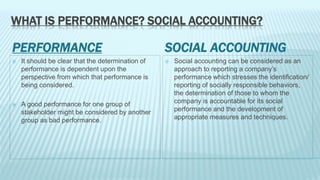
WHAT IS PERFORMANCE? SOCIAL ACCOUNTING? 
PERFORMANCE SOCIAL ACCOUNTING 
 It should be clear that the determination of 
performance is dependent upon the 
perspective from which that performance is 
being considered. 
 A good performance for one group of 
stakeholder might be considered by another 
group as bad performance. 
 Social accounting can be considered as an 
approach to reporting a company’s 
performance which stresses the identification/ 
reporting of socially responsible behaviors, 
the determination of those to whom the 
company is accountable for its social 
performance and the development of 
appropriate measures and techniques.
DIFFICULTY IN MEASURING SOCIAL PERFORMANCE 
1) The general lack of maturity in social program 
evaluation.
DIFFICULTY IN MEASURING SOCIAL PERFORMANCE 
2) The variety of purposes that organizations have for 
conducting these analyses.
THE BENEFITS OF LEARNING HOW TO MEASURE SOCIAL IMPACT 
1) Clear picture measuring the organization’s work. 
2) Organization’s impact to the society.
THE BENEFITS OF LEARNING HOW TO MEASURE SOCIAL IMPACT 
3) Identifying the organization’s stand in the industry of 
social impacting projects.
STEPS TO MEASURING SOCIAL IMPACT 
1. Define your Social Value Proposition (SVP) 
2. Quantify your Social Value 
3. Monetize Your Social Value
THE ENVIRONMENTAL AUDIT 
An environmental audit is merely the investigation and 
recording of activities that the organization undertakes in 
order to develop an understanding on the impact of these 
activities.
APPROACHES TO ESTIMATING SOCIAL IMPACT
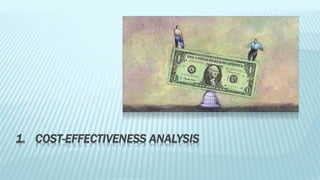
1. COST-EFFECTIVENESS ANALYSIS
Cost-Effectiveness Analysis 
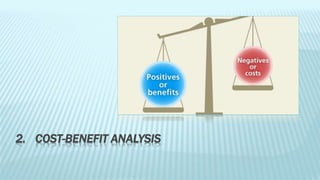
2. COST-BENEFIT ANALYSIS
3. REDF’S SOCIAL RETURN ON INVESTMENT (SROI)
4. THE ROBIN HOOD FOUNDATION’S BENEFIT-COST 
RATIO
5. THE ACUMEN FUND’S BEST AVAILABLE 
CHARITABLE OPTION RATIO
6. THE WILLIAM AND FLORA HEWLETT 
FOUNDATION’S EXPECTED RETURN (ER)
7. THE CENTER FOR HIGH IMPACT PHILANTHROPY’S 
(CHIP) COST PER IMPACT
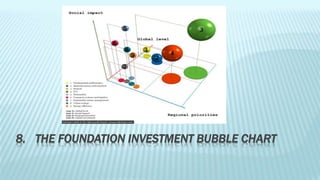
8. THE FOUNDATION INVESTMENT BUBBLE CHART
9. TOOLS AND RESOURCES FOR ASSESSING SOCIAL 
IMPACT (TRASI) FOUNDATION INVESTMENT
Thank You!

Measuring social impact

  • 1.
  • 2.
    LEARNING OBJECTIVES To gain an understanding of the value of measuring an entity’s CSR activities’ social impact.  To understand the multiple benefit of learning how to measure social impact.  To examine the steps involved in measuring, quantifying and monetizing the impact for CSR activity’s stakeholders (investors, management team, employees, etc.)
  • 3.
    INTRODUCTION  Forall organizations, the question of the management of the organization depends upon the ability to measure performance and evaluate and then report on that performance. When we are considering CRS, this is equally true, although it becomes more difficult to evaluate and report on CSR performance.
  • 4.
    WHAT IS PERFORMANCE?SOCIAL ACCOUNTING? PERFORMANCE SOCIAL ACCOUNTING  It should be clear that the determination of performance is dependent upon the perspective from which that performance is being considered.  A good performance for one group of stakeholder might be considered by another group as bad performance.  Social accounting can be considered as an approach to reporting a company’s performance which stresses the identification/ reporting of socially responsible behaviors, the determination of those to whom the company is accountable for its social performance and the development of appropriate measures and techniques.
  • 5.
    DIFFICULTY IN MEASURINGSOCIAL PERFORMANCE 1) The general lack of maturity in social program evaluation.
  • 6.
    DIFFICULTY IN MEASURINGSOCIAL PERFORMANCE 2) The variety of purposes that organizations have for conducting these analyses.
  • 7.
    THE BENEFITS OFLEARNING HOW TO MEASURE SOCIAL IMPACT 1) Clear picture measuring the organization’s work. 2) Organization’s impact to the society.
  • 8.
    THE BENEFITS OFLEARNING HOW TO MEASURE SOCIAL IMPACT 3) Identifying the organization’s stand in the industry of social impacting projects.
  • 9.
    STEPS TO MEASURINGSOCIAL IMPACT 1. Define your Social Value Proposition (SVP) 2. Quantify your Social Value 3. Monetize Your Social Value
  • 10.
    THE ENVIRONMENTAL AUDIT An environmental audit is merely the investigation and recording of activities that the organization undertakes in order to develop an understanding on the impact of these activities.
  • 11.
  • 12.
  • 13.
    Cost-Effectiveness Analysis 2.COST-BENEFIT ANALYSIS
  • 14.
    3. REDF’S SOCIALRETURN ON INVESTMENT (SROI)
  • 15.
    4. THE ROBINHOOD FOUNDATION’S BENEFIT-COST RATIO
  • 16.
    5. THE ACUMENFUND’S BEST AVAILABLE CHARITABLE OPTION RATIO
  • 17.
    6. THE WILLIAMAND FLORA HEWLETT FOUNDATION’S EXPECTED RETURN (ER)
  • 18.
    7. THE CENTERFOR HIGH IMPACT PHILANTHROPY’S (CHIP) COST PER IMPACT
  • 19.
    8. THE FOUNDATIONINVESTMENT BUBBLE CHART
  • 20.
    9. TOOLS ANDRESOURCES FOR ASSESSING SOCIAL IMPACT (TRASI) FOUNDATION INVESTMENT
  • 21.