Seminar
On
Industrial Measuring Instruments
Presented by : Amar Parmar
MEASURING INSTRUMENTS
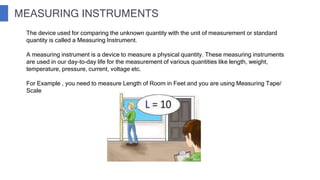
The device used for comparing the unknown quantity with the unit of measurement or standard
quantity is called a Measuring Instrument.
A measuring instrument is a device to measure a physical quantity. These measuring instruments
are used in our day-to-day life for the measurement of various quantities like length, weight,
temperature, pressure, current, voltage etc.
For Example , you need to measure Length of Room in Feet and you are using Measuring Tape/
Scale
IMPORTANCE OF MEASURING INSTRUMENT
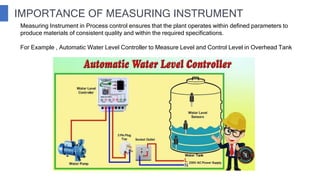
Measuring Instrument in Process control ensures that the plant operates within defined parameters to
produce materials of consistent quality and within the required specifications.
For Example , Automatic Water Level Controller to Measure Level and Control Level in Overhead Tank
MEASURING INSTRUMENTS TYPES
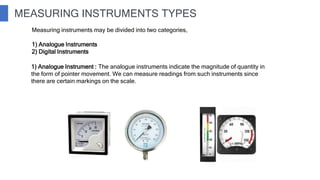
Measuring instruments may be divided into two categories,
1) Analogue Instruments
2) Digital Instruments
1) Analogue Instrument : The analogue instruments indicate the magnitude of quantity in
the form of pointer movement. We can measure readings from such instruments since
there are certain markings on the scale.
MEASURING INSTRUMENTS TYPES
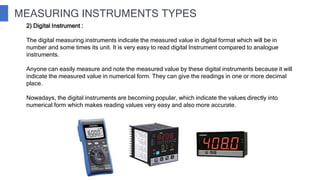
2) Digital Instrument :
The digital measuring instruments indicate the measured value in digital format which will be in
number and some times its unit. It is very easy to read digital Instrument compared to analogue
instruments.
Anyone can easily measure and note the measured value by these digital instruments because it will
indicate the measured value in numerical form. They can give the readings in one or more decimal
place.
Nowadays, the digital instruments are becoming popular, which indicate the values directly into
numerical form which makes reading values very easy and also more accurate.
TRANSDUCERS
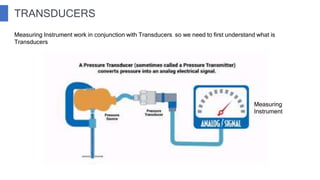
Measuring Instrument work in conjunction with Transducers so we need to first understand what is
Transducers
Measuring
Instrument
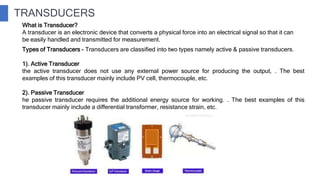
Types of Transducers - Transducers are classified into two types namely active & passive transducers.
1). Active Transducer
the active transducer does not use any external power source for producing the output, . The best
examples of this transducer mainly include PV cell, thermocouple, etc.
2). Passive Transducer
he passive transducer requires the additional energy source for working. . The best examples of this
transducer mainly include a differential transformer, resistance strain, etc.
What is Transducer?
A transducer is an electronic device that converts a physical force into an electrical signal so that it can
be easily handled and transmitted for measurement.
TRANSDUCERS
MEASURING INSTRUMENTS
There are Various Types of Industrial Digital Measuring Instrument
Industrial Measuring
Instrument
Transmitters Indicators Controllers
Multichannel
Measuring/Recording
Instrument
There are Various Types of Measuring Parameters.
• Thermocouple( milli volt)
• RTD (Resistance)
• DC Voltage( 0-10 VDC)
• DC Current ( 4-20 mA)
• AC Current
• AC Voltage
• Digital Input
• Pulse Input
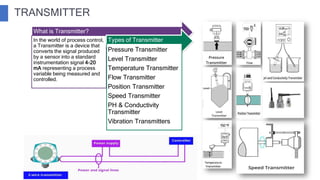
TRANSMITTER
What is Transmitter?
In the world of process control,
a Transmitter is a device that
converts the signal produced
by a sensor into a standard
instrumentation signal 4-20
mA representing a process
variable being measured and
controlled.
Types of Transmitter
Pressure Transmitter
Level Transmitter
Temperature Transmitter
Flow Transmitter
Position Transmitter
Speed Transmitter
PH & Conductivity
Transmitter
Vibration Transmitters
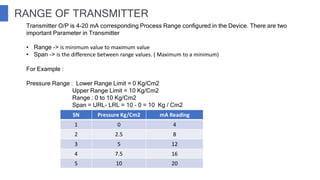
RANGE OF TRANSMITTER
Transmitter O/P is 4-20 mA corresponding Process Range configured in the Device. There are two
important Parameter in Transmitter
• Range -> is minimum value to maximum value
• Span -> is the difference between range values. ( Maximum to a minimum)
For Example :
Pressure Range : Lower Range Limit = 0 Kg/Cm2
Upper Range Limit = 10 Kg/Cm2
Range : 0 to 10 Kg/Cm2
Span = URL- LRL = 10 - 0 = 10 Kg / Cm2
SN Pressure Kg/Cm2 mA Reading
1 0 4
2 2.5 8
3 5 12
4 7.5 16
5 10 20
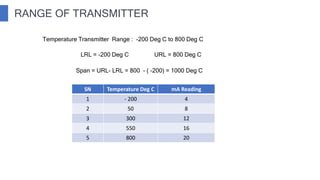
RANGE OF TRANSMITTER
LRL = -200 Deg C URL = 800 Deg C
Span = URL- LRL = 800 - ( -200) = 1000 Deg C
Temperature Transmitter Range : -200 Deg C to 800 Deg C
SN Temperature Deg C mA Reading
1 - 200 4
2 50 8
3 300 12
4 550 16
5 800 20
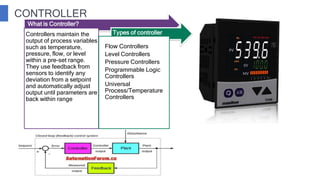
CONTROLLER
What is Controller?
Controllers maintain the
output of process variables
such as temperature,
pressure, flow, or level
within a pre-set range.
They use feedback from
sensors to identify any
deviation from a setpoint
and automatically adjust
output until parameters are
back within range
Types of controller
Flow Controllers
Level Controllers
Pressure Controllers
Programmable Logic
Controllers
Universal
Process/Temperature
Controllers
VARIOUS INDICATORS
Process Automation
409 6IN
408 2IN
LPI-1-XP-LED
40005E
1008S-XP
1008S
409
1006H
CDU LCD
FDU
Pharma Sector
Industry 4.0/ IIOT
408-M
LC5296H
CDU LED
LPI-1-LED 406
409 4IN
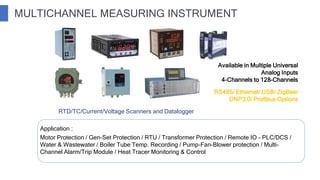
MULTICHANNEL MEASURING INSTRUMENT
RTD/TC/Current/Voltage Scanners and Datalogger
RS485/ Ethernet/ USB/ ZigBee/
DNP3.0/ Profibus Options
Application :
Motor Protection / Gen-Set Protection / RTU / Transformer Protection / Remote IO - PLC/DCS /
Water & Wastewater / Boiler Tube Temp. Recording / Pump-Fan-Blower protection / Multi-
Channel Alarm/Trip Module / Heat Tracer Monitoring & Control
Available in Multiple Universal
Analog Inputs
4-Channels to 128-Channels
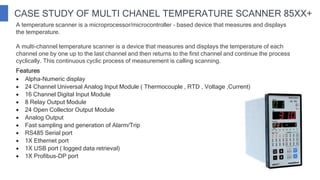
CASE STUDY OF MULTI CHANEL TEMPERATURE SCANNER 85XX+
 Alpha-Numeric display
 24 Channel Universal Analog Input Module ( Thermocouple , RTD , Voltage ,Current)
 16 Channel Digital Input Module
 8 Relay Output Module
 24 Open Collector Output Module
 Analog Output
 Fast sampling and generation of Alarm/Trip
 RS485 Serial port
 1X Ethernet port
 1X USB port ( logged data retrieval)
 1X Profibus-DP port
A temperature scanner is a microprocessor/microcontroller - based device that measures and displays
the temperature.
A multi-channel temperature scanner is a device that measures and displays the temperature of each
channel one by one up to the last channel and then returns to the first channel and continue the process
cyclically. This continuous cyclic process of measurement is calling scanning.
Features
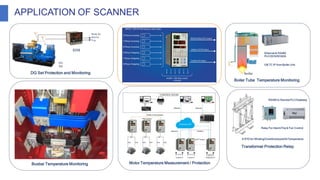
APPLICATION OF SCANNER
8208
DG
Set
Relay for
Alarm/
Trip
DG Set Protection and Monitoring
Busbar Temperature Monitoring
128 TC IP from Boiler Unit
Ethernet & RS485
PLC/DCS/SCADA
Boiler Tube Temperature Monitoring
Transformer Protection Relay
Motor Temperature Measurement / Protection
8 RTD for Winding/Core/Enclosure/Oil Temperature
RS485 to Remote PLC/Gateway
Relay For Alarm/Trip & Fan Control
THANK YOU

Measuring Instrument and communicaiton protocol

  • 1.
  • 2.
    MEASURING INSTRUMENTS The deviceused for comparing the unknown quantity with the unit of measurement or standard quantity is called a Measuring Instrument. A measuring instrument is a device to measure a physical quantity. These measuring instruments are used in our day-to-day life for the measurement of various quantities like length, weight, temperature, pressure, current, voltage etc. For Example , you need to measure Length of Room in Feet and you are using Measuring Tape/ Scale
  • 3.
    IMPORTANCE OF MEASURINGINSTRUMENT Measuring Instrument in Process control ensures that the plant operates within defined parameters to produce materials of consistent quality and within the required specifications. For Example , Automatic Water Level Controller to Measure Level and Control Level in Overhead Tank
  • 4.
    MEASURING INSTRUMENTS TYPES Measuringinstruments may be divided into two categories, 1) Analogue Instruments 2) Digital Instruments 1) Analogue Instrument : The analogue instruments indicate the magnitude of quantity in the form of pointer movement. We can measure readings from such instruments since there are certain markings on the scale.
  • 5.
    MEASURING INSTRUMENTS TYPES 2)Digital Instrument : The digital measuring instruments indicate the measured value in digital format which will be in number and some times its unit. It is very easy to read digital Instrument compared to analogue instruments. Anyone can easily measure and note the measured value by these digital instruments because it will indicate the measured value in numerical form. They can give the readings in one or more decimal place. Nowadays, the digital instruments are becoming popular, which indicate the values directly into numerical form which makes reading values very easy and also more accurate.
  • 6.
    TRANSDUCERS Measuring Instrument workin conjunction with Transducers so we need to first understand what is Transducers Measuring Instrument
  • 7.
    Types of Transducers- Transducers are classified into two types namely active & passive transducers. 1). Active Transducer the active transducer does not use any external power source for producing the output, . The best examples of this transducer mainly include PV cell, thermocouple, etc. 2). Passive Transducer he passive transducer requires the additional energy source for working. . The best examples of this transducer mainly include a differential transformer, resistance strain, etc. What is Transducer? A transducer is an electronic device that converts a physical force into an electrical signal so that it can be easily handled and transmitted for measurement. TRANSDUCERS
  • 8.
    MEASURING INSTRUMENTS There areVarious Types of Industrial Digital Measuring Instrument Industrial Measuring Instrument Transmitters Indicators Controllers Multichannel Measuring/Recording Instrument There are Various Types of Measuring Parameters. • Thermocouple( milli volt) • RTD (Resistance) • DC Voltage( 0-10 VDC) • DC Current ( 4-20 mA) • AC Current • AC Voltage • Digital Input • Pulse Input
  • 9.
    TRANSMITTER What is Transmitter? Inthe world of process control, a Transmitter is a device that converts the signal produced by a sensor into a standard instrumentation signal 4-20 mA representing a process variable being measured and controlled. Types of Transmitter Pressure Transmitter Level Transmitter Temperature Transmitter Flow Transmitter Position Transmitter Speed Transmitter PH & Conductivity Transmitter Vibration Transmitters
  • 10.
    RANGE OF TRANSMITTER TransmitterO/P is 4-20 mA corresponding Process Range configured in the Device. There are two important Parameter in Transmitter • Range -> is minimum value to maximum value • Span -> is the difference between range values. ( Maximum to a minimum) For Example : Pressure Range : Lower Range Limit = 0 Kg/Cm2 Upper Range Limit = 10 Kg/Cm2 Range : 0 to 10 Kg/Cm2 Span = URL- LRL = 10 - 0 = 10 Kg / Cm2 SN Pressure Kg/Cm2 mA Reading 1 0 4 2 2.5 8 3 5 12 4 7.5 16 5 10 20
  • 11.
    RANGE OF TRANSMITTER LRL= -200 Deg C URL = 800 Deg C Span = URL- LRL = 800 - ( -200) = 1000 Deg C Temperature Transmitter Range : -200 Deg C to 800 Deg C SN Temperature Deg C mA Reading 1 - 200 4 2 50 8 3 300 12 4 550 16 5 800 20
  • 12.
    CONTROLLER What is Controller? Controllersmaintain the output of process variables such as temperature, pressure, flow, or level within a pre-set range. They use feedback from sensors to identify any deviation from a setpoint and automatically adjust output until parameters are back within range Types of controller Flow Controllers Level Controllers Pressure Controllers Programmable Logic Controllers Universal Process/Temperature Controllers
  • 13.
    VARIOUS INDICATORS Process Automation 4096IN 408 2IN LPI-1-XP-LED 40005E 1008S-XP 1008S 409 1006H CDU LCD FDU Pharma Sector Industry 4.0/ IIOT 408-M LC5296H CDU LED LPI-1-LED 406 409 4IN
  • 14.
    MULTICHANNEL MEASURING INSTRUMENT RTD/TC/Current/VoltageScanners and Datalogger RS485/ Ethernet/ USB/ ZigBee/ DNP3.0/ Profibus Options Application : Motor Protection / Gen-Set Protection / RTU / Transformer Protection / Remote IO - PLC/DCS / Water & Wastewater / Boiler Tube Temp. Recording / Pump-Fan-Blower protection / Multi- Channel Alarm/Trip Module / Heat Tracer Monitoring & Control Available in Multiple Universal Analog Inputs 4-Channels to 128-Channels
  • 15.
    CASE STUDY OFMULTI CHANEL TEMPERATURE SCANNER 85XX+  Alpha-Numeric display  24 Channel Universal Analog Input Module ( Thermocouple , RTD , Voltage ,Current)  16 Channel Digital Input Module  8 Relay Output Module  24 Open Collector Output Module  Analog Output  Fast sampling and generation of Alarm/Trip  RS485 Serial port  1X Ethernet port  1X USB port ( logged data retrieval)  1X Profibus-DP port A temperature scanner is a microprocessor/microcontroller - based device that measures and displays the temperature. A multi-channel temperature scanner is a device that measures and displays the temperature of each channel one by one up to the last channel and then returns to the first channel and continue the process cyclically. This continuous cyclic process of measurement is calling scanning. Features
  • 16.
    APPLICATION OF SCANNER 8208 DG Set Relayfor Alarm/ Trip DG Set Protection and Monitoring Busbar Temperature Monitoring 128 TC IP from Boiler Unit Ethernet & RS485 PLC/DCS/SCADA Boiler Tube Temperature Monitoring Transformer Protection Relay Motor Temperature Measurement / Protection 8 RTD for Winding/Core/Enclosure/Oil Temperature RS485 to Remote PLC/Gateway Relay For Alarm/Trip & Fan Control
  • 17.