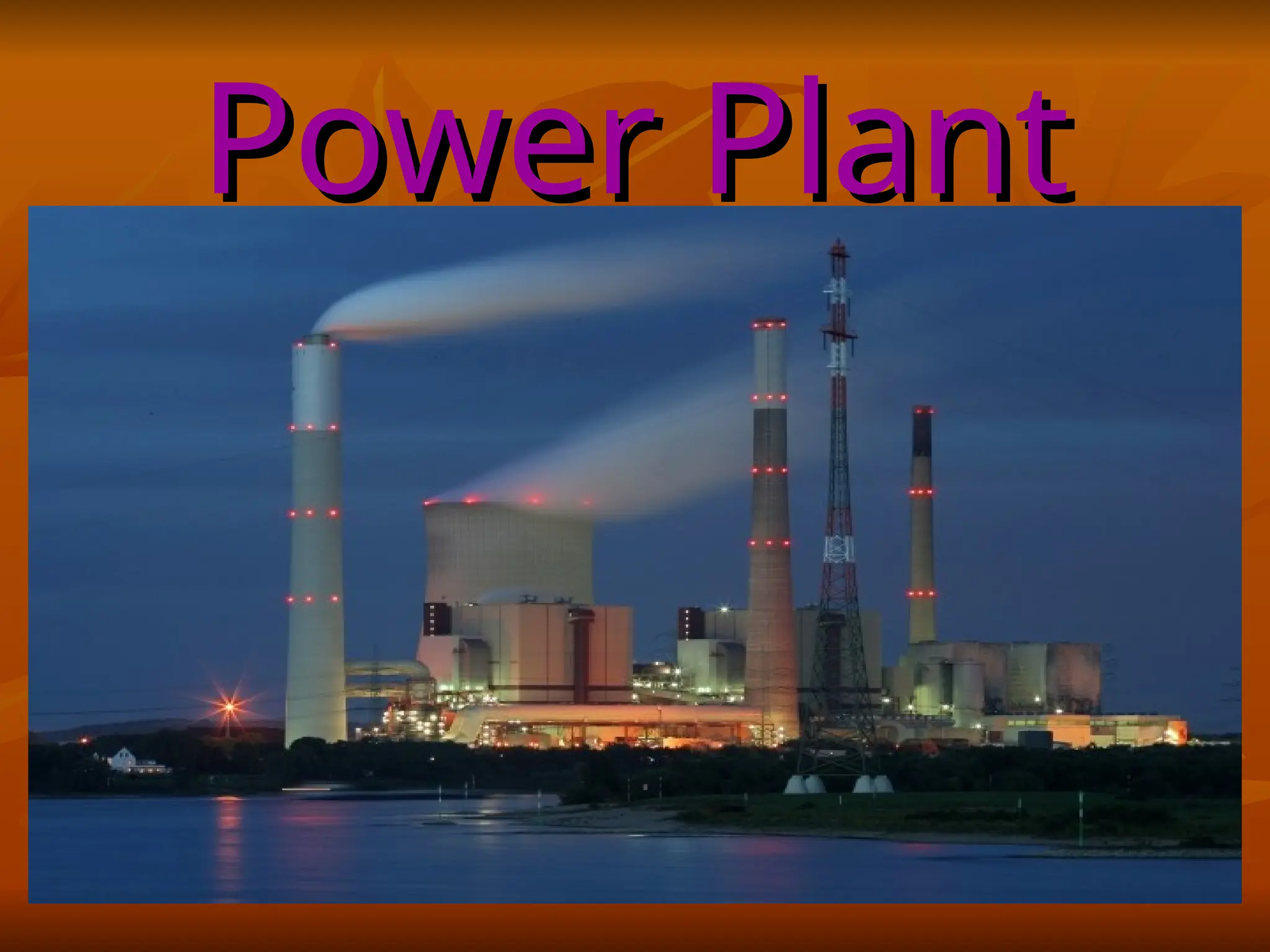
Power Plant
Power Plant
Definition
Definition
A power station (also referred to as a
generating station, power plant, powerhouse or
generating plant) is an industrial facility for
the generation of electric power.
Hydraulic Energy / Thermal Energy -> Mechanical Energy -> Electrical Energy
Unit collection of Power Plant
 There may be several units which are
There may be several units which are
described below –
described below –
1.
1. Energy source (Heat, wind, water etc.)
Energy source (Heat, wind, water etc.)
2.
2. Turbine
Turbine
3. Generator (
3. Generator (a rotating machine that converts
a rotating machine that converts
mechanical power into electrical power by
creating relative motion between a magnetic
field and a conductor
field and a conductor)
)
Types of Power Plant
1. On the Basis of Primary Source / Fuel –
(a.) Nuclear Power Plants
(b.) Geothermal Power Plants
(c.) Fossil-Fuel Power Plants
(d.) Biomass-Fuelled Power Plants
(e.) Solar Thermal Power Plants
2.On the Basis of Prime Mover
(a.) Steam Turbine Power Plants
(b.) Gas Turbine Power Plants
(c.) Combined Cycle Power Plants
(d.) Internal combustion reciprocating engines are used for small
cogeneration plants likes - Hospitals, office buildings,
industrial plants, and other critical facilities.
(e.) Micro turbines, Stirling engine and internal combustion
reciprocating engines are low-cost solutions for using
opportunity fuels, such as landfill gas, digester gas from water
treatment plants and waste gas from oil production
treatment plants and waste gas from oil production.
.
3. On the Basis of Duty
(a.) Base Load Power Plants
(a.) Base Load Power Plants -
- Base Load Power Plants run nearly
Base Load Power Plants run nearly
continually to provide that component of system load that doesn't vary
during a day or week.
(b.) Peaking Power Plants
(b.) Peaking Power Plants -
- Peaking power plants meet the daily peak
Peaking power plants meet the daily peak
load, which may only be for a one or two hours each day. While their
incremental operating cost is always higher than base load plants
(c.) Load Following Power Plants
(c.) Load Following Power Plants -
- Load following power plants can
Load following power plants can
economically follow the variations in the daily and weekly load, at lower
cost than peaking plants and with more flexibility than base load plants.
Performance Efficiencies
 All thermal power plants produce waste heat
All thermal power plants produce waste heat
energy as a by product of the useful electrical
energy produced. The amount of waste heat
energy equals or exceeds the amount of energy
converted into useful electricity .
converted into useful electricity . Gas-fired
Gas-fired
power plants
power plants can achieve
can achieve “50%”
“50%” conversion
conversion
efficiency while
efficiency while coal and oil plants
coal and oil plants achieve
achieve
around
around “30–49%”.
“30–49%”.
Cooling Process / Cooling Tower
(a.) Water Cooled
(a.) Water Cooled
(b.) Mechanical Induced
Draft Wet Cooling
Draft Wet Cooling
(c.) Air Cooled
(c.) Air Cooled
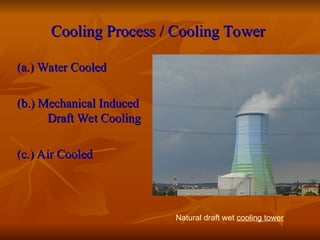
Natural draft wet cooling tower
(a.) Water Cooled -
(a.) Water Cooled - many nuclear power plants and large fossil
many nuclear power plants and large fossil
fuel-fired power plants use large hyperboloid chimney - like structures that
release the waste heat to the ambient atmosphere by the evaporation of water.
(b.) Mechanical Induced Draft Wet Cooling -
(b.) Mechanical Induced Draft Wet Cooling - Many power
Many power plants use
plants use
fans to provide air movement upward through down coming water, and are not
hyperboloid chimney-like structures.
(c.) Air Cooled
(c.) Air Cooled –
– In areas with restricted water use, a dry cooling tower or
In areas with restricted water use, a dry cooling tower or
directly air-cooled radiators may be necessary. These coolers have lower
efficiency and higher energy consumption to drive fans, compared to a typical
wet, evaporative cooling tower.
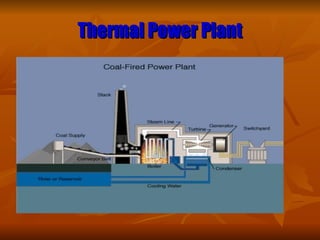
Thermal Power Plant
Thermal Power Plant
Thermal Power Plant
Thermal Power Plant
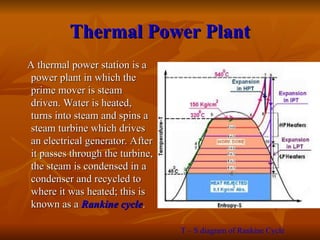
A thermal power station is a
power plant in which the
prime mover is steam
driven. Water is heated,
turns into steam and spins a
steam turbine which drives
an electrical generator. After
it passes through the turbine,
the steam is condensed in a
condenser and recycled to
where it was heated; this is
known as a
known as a Rankine cycle
Rankine cycle.
.
T – S diagram of Rankine Cycle
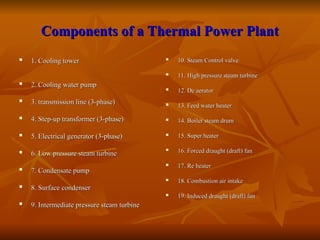
Components of a Thermal Power Plant

1. Cooling tower
1. Cooling tower

2. Cooling water pump

3. transmission line (3-phase)

4. Step-up transformer (3-phase)

5. Electrical generator (3-phase)

6. Low pressure steam turbine

7. Condensate pump
7. Condensate pump

8. Surface condenser

9. Intermediate pressure steam turbine

10. Steam Control valve

11. High pressure steam turbine

12. De aerator
12. De aerator

13. Feed water heater

14. Boiler steam drum

15. Super heater
15. Super heater

16. Forced draught (draft) fan

17. Re heater
17. Re heater

18. Combustion air intake

19. Induced draught (draft) fan
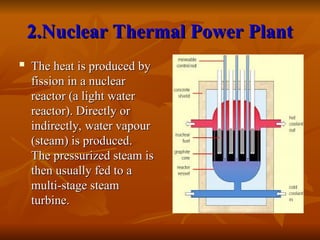
2.Nuclear Thermal Power Plant
 The heat is produced by
The heat is produced by
fission in a nuclear
reactor (a light water
reactor). Directly or
indirectly, water vapour
(steam) is produced.
The pressurized steam is
then usually fed to a
multi-stage steam
multi-stage steam
turbine.
turbine.
Nuclear Reactors
Nuclear Reactors
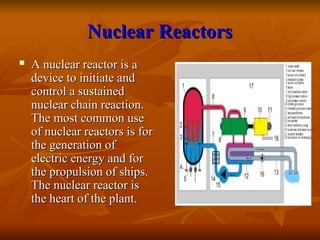
 A nuclear reactor is a
A nuclear reactor is a
device to initiate and
control a sustained
control a sustained
nuclear chain reaction.
The most common use
The most common use
of nuclear reactors is for
the generation of
the generation of
electric energy and for
the propulsion of ships.
The nuclear reactor is
the heart of the plant.
Hydraulic Power Plant / Hydroelectricity
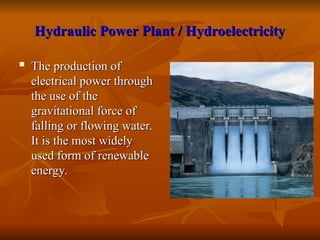
 The production of
The production of
electrical power through
the use of the
the use of the
gravitational force of
falling or flowing water.
It is the most widely
used form of renewable
energy.
energy.
Generating Methods of Hydroelectricity
 Conventional ( dams )
Conventional ( dams ) -
- Most hydroelectric power comes from
Most hydroelectric power comes from
the potential energy of dammed water driving a water turbine and
generator.
generator.
 Pumped-Storage -
Pumped-Storage - This method produces electricity to supply high
This method produces electricity to supply high
peak demands by moving water between reservoirs at different elevations.
 Run-of-the-River -
Run-of-the-River - Run of the river hydropower could provide
Run of the river hydropower could provide
potential to drive the turbine.
 Tide
Tide -
- A tidal power plant makes use of the daily rise and fall of ocean
A tidal power plant makes use of the daily rise and fall of ocean
water due to tides.
water due to tides.
 Underground -
Underground - A
An underground power station makes use of a large
n underground power station makes use of a large
natural height difference between two waterways, such as a waterfall or
mountain lake.
mountain lake.
Geothermal Power Plant
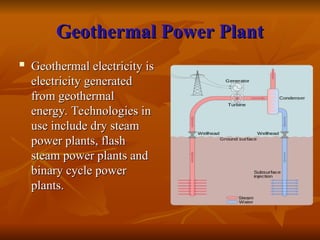
 Geothermal electricity is
Geothermal electricity is
electricity generated
from geothermal
from geothermal
energy. Technologies in
use include dry steam
power plants, flash
power plants, flash
steam power plants and
binary cycle power
binary cycle power
plants.
plants.
Types of Geothermal Power Plant
(1.) Dry Steam Power Plant -
(1.) Dry Steam Power Plant -They directly use geothermal steam of 150°C or
They directly use geothermal steam of 150°C or
greater to turn turbines.
(2.) Flash Steam Power Plants -
(2.) Flash Steam Power Plants - Flash steam plants pull deep, high-pressure
Flash steam plants pull deep, high-pressure
hot water into lower-pressure tanks and use the resulting flashed steam to drive
turbines. They require fluid temperatures of at least 180°C, usually more.
(3.)Binary Cycle Power Plants -
(3.)Binary Cycle Power Plants - The moderately hot geothermal water is
The moderately hot geothermal water is
passed by a secondary fluid with a much lower boiling point than water. This
causes the secondary fluid to flash vaporize, which then drives the turbines.
For more visit
For more visit
www.studyhubz.com
www.studyhubz.com
Thank You
Thank You
A Power Point Presentation By
Yogendra Singh Shekhawat
B. Tech, Mechanical Engineering

powerplant-140710033945-alwayphpapp01.ppt

  • 1.
  • 2.
    Definition Definition A power station(also referred to as a A power station (also referred to as a generating station, power plant, powerhouse or generating station, power plant, powerhouse or generating plant) is an industrial facility for generating plant) is an industrial facility for the generation of electric power. the generation of electric power. Hydraulic Energy / Thermal Energy -> Mechanical Energy -> Electrical Energy Hydraulic Energy / Thermal Energy -> Mechanical Energy -> Electrical Energy
  • 3.
    Unit collection ofPower Plant Unit collection of Power Plant  There may be several units which are There may be several units which are described below – described below – 1. 1. Energy source (Heat, wind, water etc.) Energy source (Heat, wind, water etc.) 2. 2. Turbine Turbine 3. Generator ( 3. Generator (a rotating machine that converts a rotating machine that converts mechanical power into electrical power by mechanical power into electrical power by creating relative motion between a magnetic creating relative motion between a magnetic field and a conductor field and a conductor) )
  • 4.
    Types of PowerPlant Types of Power Plant 1. On the Basis of Primary Source / Fuel – 1. On the Basis of Primary Source / Fuel – (a.) Nuclear Power Plants (a.) Nuclear Power Plants (b.) Geothermal Power Plants (b.) Geothermal Power Plants (c.) Fossil-Fuel Power Plants (c.) Fossil-Fuel Power Plants (d.) Biomass-Fuelled Power Plants (d.) Biomass-Fuelled Power Plants (e.) Solar Thermal Power Plants (e.) Solar Thermal Power Plants
  • 5.
    2.On the Basisof Prime Mover 2.On the Basis of Prime Mover (a.) Steam Turbine Power Plants (a.) Steam Turbine Power Plants (b.) Gas Turbine Power Plants (b.) Gas Turbine Power Plants (c.) Combined Cycle Power Plants (c.) Combined Cycle Power Plants (d.) Internal combustion reciprocating engines are used for small (d.) Internal combustion reciprocating engines are used for small cogeneration plants likes - Hospitals, office buildings, cogeneration plants likes - Hospitals, office buildings, industrial plants, and other critical facilities. industrial plants, and other critical facilities. (e.) Micro turbines, Stirling engine and internal combustion (e.) Micro turbines, Stirling engine and internal combustion reciprocating engines are low-cost solutions for using reciprocating engines are low-cost solutions for using opportunity fuels, such as landfill gas, digester gas from water opportunity fuels, such as landfill gas, digester gas from water treatment plants and waste gas from oil production treatment plants and waste gas from oil production. .
  • 6.
    3. On theBasis of Duty 3. On the Basis of Duty (a.) Base Load Power Plants (a.) Base Load Power Plants - - Base Load Power Plants run nearly Base Load Power Plants run nearly continually to provide that component of system load that doesn't vary continually to provide that component of system load that doesn't vary during a day or week. during a day or week. (b.) Peaking Power Plants (b.) Peaking Power Plants - - Peaking power plants meet the daily peak Peaking power plants meet the daily peak load, which may only be for a one or two hours each day. While their load, which may only be for a one or two hours each day. While their incremental operating cost is always higher than base load plants incremental operating cost is always higher than base load plants (c.) Load Following Power Plants (c.) Load Following Power Plants - - Load following power plants can Load following power plants can economically follow the variations in the daily and weekly load, at lower economically follow the variations in the daily and weekly load, at lower cost than peaking plants and with more flexibility than base load plants. cost than peaking plants and with more flexibility than base load plants.
  • 7.
    Performance Efficiencies Performance Efficiencies All thermal power plants produce waste heat All thermal power plants produce waste heat energy as a by product of the useful electrical energy as a by product of the useful electrical energy produced. The amount of waste heat energy produced. The amount of waste heat energy equals or exceeds the amount of energy energy equals or exceeds the amount of energy converted into useful electricity . converted into useful electricity . Gas-fired Gas-fired power plants power plants can achieve can achieve “50%” “50%” conversion conversion efficiency while efficiency while coal and oil plants coal and oil plants achieve achieve around around “30–49%”. “30–49%”.
  • 8.
    Cooling Process /Cooling Tower Cooling Process / Cooling Tower (a.) Water Cooled (a.) Water Cooled (b.) Mechanical Induced (b.) Mechanical Induced Draft Wet Cooling Draft Wet Cooling (c.) Air Cooled (c.) Air Cooled Natural draft wet cooling tower
  • 9.
    (a.) Water Cooled- (a.) Water Cooled - many nuclear power plants and large fossil many nuclear power plants and large fossil fuel-fired power plants use large hyperboloid chimney - like structures that fuel-fired power plants use large hyperboloid chimney - like structures that release the waste heat to the ambient atmosphere by the evaporation of water. release the waste heat to the ambient atmosphere by the evaporation of water. (b.) Mechanical Induced Draft Wet Cooling - (b.) Mechanical Induced Draft Wet Cooling - Many power Many power plants use plants use fans to provide air movement upward through down coming water, and are not fans to provide air movement upward through down coming water, and are not hyperboloid chimney-like structures. hyperboloid chimney-like structures. (c.) Air Cooled (c.) Air Cooled – – In areas with restricted water use, a dry cooling tower or In areas with restricted water use, a dry cooling tower or directly air-cooled radiators may be necessary. These coolers have lower directly air-cooled radiators may be necessary. These coolers have lower efficiency and higher energy consumption to drive fans, compared to a typical efficiency and higher energy consumption to drive fans, compared to a typical wet, evaporative cooling tower. wet, evaporative cooling tower.
  • 10.
  • 11.
    Thermal Power Plant ThermalPower Plant A thermal power station is a A thermal power station is a power plant in which the power plant in which the prime mover is steam prime mover is steam driven. Water is heated, driven. Water is heated, turns into steam and spins a turns into steam and spins a steam turbine which drives steam turbine which drives an electrical generator. After an electrical generator. After it passes through the turbine, it passes through the turbine, the steam is condensed in a the steam is condensed in a condenser and recycled to condenser and recycled to where it was heated; this is where it was heated; this is known as a known as a Rankine cycle Rankine cycle. . T – S diagram of Rankine Cycle
  • 12.
    Components of aThermal Power Plant Components of a Thermal Power Plant  1. Cooling tower 1. Cooling tower  2. Cooling water pump 2. Cooling water pump  3. transmission line (3-phase) 3. transmission line (3-phase)  4. Step-up transformer (3-phase) 4. Step-up transformer (3-phase)  5. Electrical generator (3-phase) 5. Electrical generator (3-phase)  6. Low pressure steam turbine 6. Low pressure steam turbine  7. Condensate pump 7. Condensate pump  8. Surface condenser 8. Surface condenser  9. Intermediate pressure steam turbine 9. Intermediate pressure steam turbine  10. Steam Control valve 10. Steam Control valve  11. High pressure steam turbine 11. High pressure steam turbine  12. De aerator 12. De aerator  13. Feed water heater 13. Feed water heater  14. Boiler steam drum 14. Boiler steam drum  15. Super heater 15. Super heater  16. Forced draught (draft) fan 16. Forced draught (draft) fan  17. Re heater 17. Re heater  18. Combustion air intake 18. Combustion air intake  19. Induced draught (draft) fan 19. Induced draught (draft) fan
  • 13.
    2.Nuclear Thermal PowerPlant 2.Nuclear Thermal Power Plant  The heat is produced by The heat is produced by fission in a nuclear fission in a nuclear reactor (a light water reactor (a light water reactor). Directly or reactor). Directly or indirectly, water vapour indirectly, water vapour (steam) is produced. (steam) is produced. The pressurized steam is The pressurized steam is then usually fed to a then usually fed to a multi-stage steam multi-stage steam turbine. turbine.
  • 14.
    Nuclear Reactors Nuclear Reactors A nuclear reactor is a A nuclear reactor is a device to initiate and device to initiate and control a sustained control a sustained nuclear chain reaction. nuclear chain reaction. The most common use The most common use of nuclear reactors is for of nuclear reactors is for the generation of the generation of electric energy and for electric energy and for the propulsion of ships. the propulsion of ships. The nuclear reactor is The nuclear reactor is the heart of the plant. the heart of the plant.
  • 15.
    Hydraulic Power Plant/ Hydroelectricity Hydraulic Power Plant / Hydroelectricity  The production of The production of electrical power through electrical power through the use of the the use of the gravitational force of gravitational force of falling or flowing water. falling or flowing water. It is the most widely It is the most widely used form of renewable used form of renewable energy. energy.
  • 16.
    Generating Methods ofHydroelectricity Generating Methods of Hydroelectricity  Conventional ( dams ) Conventional ( dams ) - - Most hydroelectric power comes from Most hydroelectric power comes from the potential energy of dammed water driving a water turbine and the potential energy of dammed water driving a water turbine and generator. generator.  Pumped-Storage - Pumped-Storage - This method produces electricity to supply high This method produces electricity to supply high peak demands by moving water between reservoirs at different elevations. peak demands by moving water between reservoirs at different elevations.  Run-of-the-River - Run-of-the-River - Run of the river hydropower could provide Run of the river hydropower could provide potential to drive the turbine. potential to drive the turbine.  Tide Tide - - A tidal power plant makes use of the daily rise and fall of ocean A tidal power plant makes use of the daily rise and fall of ocean water due to tides. water due to tides.  Underground - Underground - A An underground power station makes use of a large n underground power station makes use of a large natural height difference between two waterways, such as a waterfall or natural height difference between two waterways, such as a waterfall or mountain lake. mountain lake.
  • 17.
    Geothermal Power Plant GeothermalPower Plant  Geothermal electricity is Geothermal electricity is electricity generated electricity generated from geothermal from geothermal energy. Technologies in energy. Technologies in use include dry steam use include dry steam power plants, flash power plants, flash steam power plants and steam power plants and binary cycle power binary cycle power plants. plants.
  • 18.
    Types of GeothermalPower Plant Types of Geothermal Power Plant (1.) Dry Steam Power Plant - (1.) Dry Steam Power Plant -They directly use geothermal steam of 150°C or They directly use geothermal steam of 150°C or greater to turn turbines. greater to turn turbines. (2.) Flash Steam Power Plants - (2.) Flash Steam Power Plants - Flash steam plants pull deep, high-pressure Flash steam plants pull deep, high-pressure hot water into lower-pressure tanks and use the resulting flashed steam to drive hot water into lower-pressure tanks and use the resulting flashed steam to drive turbines. They require fluid temperatures of at least 180°C, usually more. turbines. They require fluid temperatures of at least 180°C, usually more. (3.)Binary Cycle Power Plants - (3.)Binary Cycle Power Plants - The moderately hot geothermal water is The moderately hot geothermal water is passed by a secondary fluid with a much lower boiling point than water. This passed by a secondary fluid with a much lower boiling point than water. This causes the secondary fluid to flash vaporize, which then drives the turbines. causes the secondary fluid to flash vaporize, which then drives the turbines.
  • 19.
    For more visit Formore visit www.studyhubz.com www.studyhubz.com Thank You Thank You A Power Point Presentation By A Power Point Presentation By Yogendra Singh Shekhawat Yogendra Singh Shekhawat B. Tech, Mechanical Engineering B. Tech, Mechanical Engineering