Drug Resistant Tuberculosis
Dr Tarun Kumar(PG IIIA)
Moderator – Dr Neelima Jain
It is defined as a documented microbiological confirmation
of resistance of an isolate of acid fast bacilli to the standard
first line and /or second line antitubercular drugs,by an
accredited laboratory.(RNTCP quality-assured culture &
DST laboratory) and by a RNTCP-endorsed testing method.
• Monoresistance:resistance to a single first line anti
tubercular drug only.
• Poly drug resistance:resistance to more than one first line
anti tubercular drugs(other than rifampicin and isoniazid)
• Rifampicin resistance: resistance to rifampicin detected by
using phenotypic or genotypic methods with or without
resistance to other anti-TB drugs.
Definition And Types
• Multidrug resistance(MDR)- Resistant to Isoniazid
& Rifampicin.
• Extensive drug-resistant(XDR)- MDR TB +
Resistant to fluoroquinolones (FQs) or at least
one of the second line injectable drugs(SLI).
• Mixed pattern drug resistance TB- H mono-poly
DR-TB with additional resistance to FQ and/or SLI
and/ or Lzd based on LPA and/or LC-DST will be
classified as mixed pattern DR-TB.
Epidemiology
• As per WHO,105 countries have reported XDR-TB
cases until 2015 and about 9.7% of MDR TB cases
were suffering from XDR TB in 2015
• According to WHO Global TB Report 2017 there
are around 4,90,000 MDR TB cases globally. Out
of which only 28% have been diagnosed whereas
rest are not proven due to lack of culture & drug-
susceptiblity testing in most settings worldwide.
Almost half of these(47%) cases are in India ,
China and the Russian Federation.
• WHO Global TB Report 2017, estimated
prevalence of MDR TB in india around
1,47,000 that is around 11 patients per
100000 population annually.
• Around 2.8% of new cases have been found
to suffer from MDR TB
• 12 % of previously treated cases found to have
MDR TB
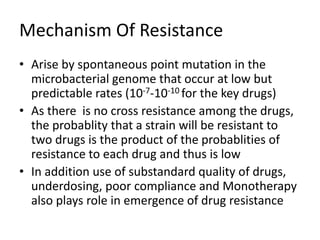
Mechanism Of Resistance
• Arise by spontaneous point mutation in the
microbacterial genome that occur at low but
predictable rates (10-7-10-10 for the key drugs)
• As there is no cross resistance among the drugs,
the probablity that a strain will be resistant to
two drugs is the product of the probablities of
resistance to each drug and thus is low
• In addition use of substandard quality of drugs,
underdosing, poor compliance and Monotherapy
also plays role in emergence of drug resistance
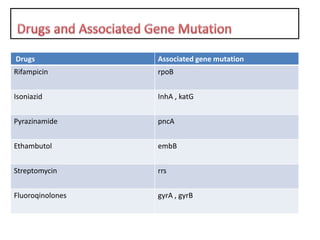
Drugs Associated gene mutation
Rifampicin rpoB
Isoniazid InhA , katG
Pyrazinamide pncA
Ethambutol embB
Streptomycin rrs
Fluoroqinolones gyrA , gyrB
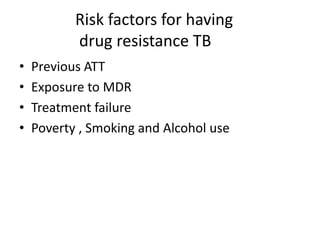
Risk factors for having
drug resistance TB
• Previous ATT
• Exposure to MDR
• Treatment failure
• Poverty , Smoking and Alcohol use
DIAGNOSIS
Diagnosis
• Diagnostic tests of drug resistance TB are
based on its phenotypic and genotypic
characteristics Of Mycobacterium
tuberculosis(Mtb)
• Phenotypic tests depend upon isolation of
Mtb and performing drug susceptiblity
testing(DST) on solid or liquid culture media.
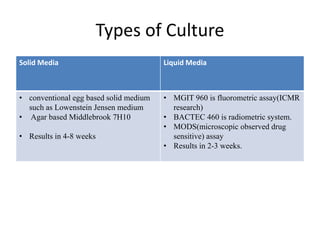
Types of Culture
Solid Media Liquid Media
• conventional egg based solid medium
such as Lowenstein Jensen medium
• Agar based Middlebrook 7H10
• Results in 4-8 weeks
• MGIT 960 is fluorometric assay(ICMR
research)
• BACTEC 460 is radiometric system.
• MODS(microscopic observed drug
sensitive) assay
• Results in 2-3 weeks.
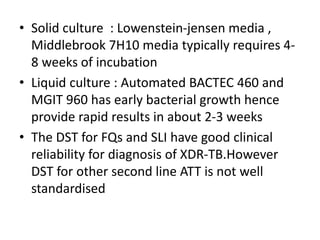
• Solid culture : Lowenstein-jensen media ,
Middlebrook 7H10 media typically requires 4-
8 weeks of incubation
• Liquid culture : Automated BACTEC 460 and
MGIT 960 has early bacterial growth hence
provide rapid results in about 2-3 weeks
• The DST for FQs and SLI have good clinical
reliability for diagnosis of XDR-TB.However
DST for other second line ATT is not well
standardised
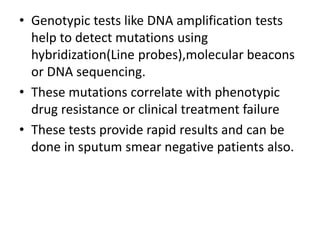
• Genotypic tests like DNA amplification tests
help to detect mutations using
hybridization(Line probes),molecular beacons
or DNA sequencing.
• These mutations correlate with phenotypic
drug resistance or clinical treatment failure
• These tests provide rapid results and can be
done in sputum smear negative patients also.
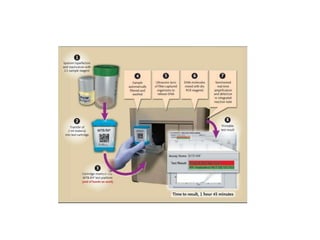
CBNAAT (Cartridge based Nucleic acid amplification
test) Xpert MTB/RIF :
• Semi quantitative nested real time PCR in vitro
diagnostic test
• Detects TB as well as Rifampicin resistance(rpoB
mutation) in less than 2 hr
• Has minimal biosafety and training requirements
• Test is applicable to both respiratory and
nonrespiratory specimens except blood,urine,and
stool.
• Has sensitivity of 98% among AFB positive cases
and 70% among AFB negative cases
Recommendation for CBNAAT in
RNTCP Guidelines
• TB suspected in PLHIV(persons living with HIV).
• All smear positive patients with risk for drug resistance
• All smear negative cases where chest x-ray is
suggestive of TB.
• Non responders to treatment and DR-TB contacts
• In all presumptive cases of extrapulmonary TB.
• In pediatric TB,who are able to give good quality
specimen CBNAAT is preferable.
LIMITATIONS-
• The shelf life of the cartridges is only 18
months
• A very stable electricity supply is required
• The instrument needs to be calibrated annually
• The cost of the test is high
• The temperature ceiling is critical
Line Probe Assay(LPA)
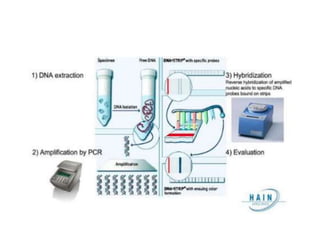
• This is again PCR based hybridization.
• Hybridize amplified DNA products with
oligonucleotide probes ,which correlate with
select gene mutations and expressed as
coloured bands on the strips.
• Provides rapid diagnosis of R and H resistance
as well as resistance to FQs and SLID.
• Results in 72 hours
• MTBDRsl- Newer generation genotype test
approved by WHO(Hain Lifesciences) for slDST
in high burden countries
• The assay detects resistance to second line drugs
like fluoroquinolones and second line injectables
and it may be used as an initial test for second
line drug resistance
• Sensivity & Specificity of 70.9% & 98.8% in
detecting XDR TB on indirect and 69.4% &
99.4% respectively on direct(sputum smear
positive samples)
MTBDRsl Assay
• RNTCP guidelines also recommend MTBDRsl
assays for rapid detection of XDR TB cases among
MDR TB hence better treatment outcomes.
Limitations:
• They have an open tube format ,which can lead
to cross contamination
• Must include biosafety precaution
• Appropriate training of laboratory staff required
TREATMENT
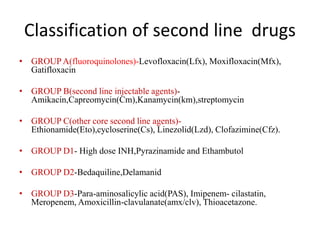
Classification of second line drugs
• GROUP A(fluoroquinolones)-Levofloxacin(Lfx), Moxifloxacin(Mfx),
Gatifloxacin
• GROUP B(second line injectable agents)-
Amikacin,Capreomycin(Cm),Kanamycin(km),streptomycin
• GROUP C(other core second line agents)-
Ethionamide(Eto),cycloserine(Cs), Linezolid(Lzd), Clofazimine(Cfz).
• GROUP D1- High dose INH,Pyrazinamide and Ethambutol
• GROUP D2-Bedaquiline,Delamanid
• GROUP D3-Para-aminosalicylic acid(PAS), Imipenem- cilastatin,
Meropenem, Amoxicillin-clavulanate(amx/clv), Thioacetazone.
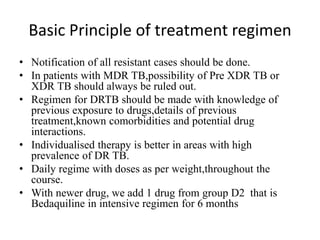
Basic Principle of treatment regimen
• Notification of all resistant cases should be done.
• In patients with MDR TB,possibility of Pre XDR TB or
XDR TB should always be ruled out.
• Regimen for DRTB should be made with knowledge of
previous exposure to drugs,details of previous
treatment,known comorbidities and potential drug
interactions.
• Individualised therapy is better in areas with high
prevalence of DR TB.
• Daily regime with doses as per weight,throughout the
course.
• With newer drug, we add 1 drug from group D2 that is
Bedaquiline in intensive regimen for 6 months
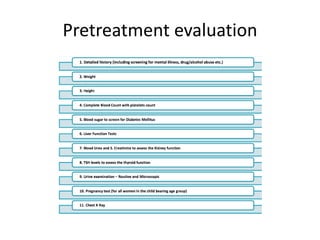
Pretreatment evaluation
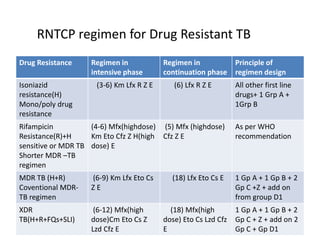
Drug Resistance Regimen in
intensive phase
Regimen in
continuation phase
Principle of
regimen design
Isoniazid
resistance(H)
Mono/poly drug
resistance
(3-6) Km Lfx R Z E (6) Lfx R Z E All other first line
drugs+ 1 Grp A +
1Grp B
Rifampicin
Resistance(R)+H
sensitive or MDR TB
Shorter MDR –TB
regimen
(4-6) Mfx(highdose)
Km Eto Cfz Z H(high
dose) E
(5) Mfx (highdose)
Cfz Z E
As per WHO
recommendation
MDR TB (H+R)
Coventional MDR-
TB regimen
(6-9) Km Lfx Eto Cs
Z E
(18) Lfx Eto Cs E 1 Gp A + 1 Gp B + 2
Gp C +Z + add on
from group D1
XDR
TB(H+R+FQs+SLI)
(6-12) Mfx(high
dose)Cm Eto Cs Z
Lzd Cfz E
(18) Mfx(high
dose) Eto Cs Lzd Cfz
E
1 Gp A + 1 Gp B + 2
Gp C + Z + add on 2
Gp C + Gp D1
RNTCP regimen for Drug Resistant TB
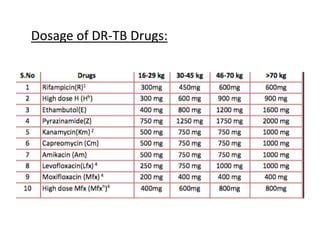
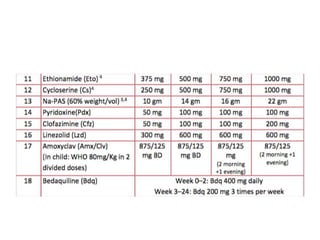
Dosage of DR-TB Drugs:
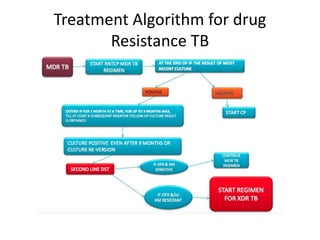
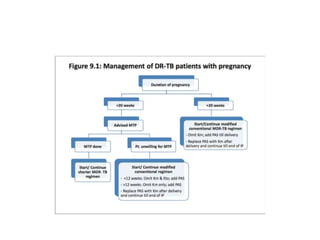
Treatment Algorithm for drug
Resistance TB
FOLLOW UP
• The most important objective evidence of
response to M/XDR TB treatment is the
conversion of positive sputum culture to
negative.
• Smear conversion is less reliable than culture
conversion as culture reflects viability of tubercle
bacilli and is a more accurate reflection of
response to treatment.
• Patients will be considered culture converted
after having two consecutive negative cultures
taken at least one month apart.
• One sputum sample will be collected and
cultured at least 30 days apart from 3rd to 7th
month of treatment (at the end of the months
3,4,5,6, and 7) and at 3-monthly intervals from
the 9th month onwards till completion of
treatment.
• Long term follow up after completion of
treatment sputum culture repeated at 6,12,18
and 24 months.
• On follow up if sputum culture is found to be
positive at 6 months or later, repeat DST for
second line drugs to decide on further course
of action.
• DST for other additional second line drugs
may also be done if laboratory facilities
available to guide treatment.
Extension of treatment:
• MDR TB – IP can be extended for maximum 3
months (max 9 months)
• XDR TB – IP can be extended for maximum 6
months (max 12 months)
Treatment modification
Renal modification:
• Drugs, which might require dose or interval
adjustment in presence of mild to moderate
renal impairment are ethambutol, quinolones,
cycloserine and PAS in addition to
aminoglycosides
• Blood and serum creatinine monitoring should
be done every month for the first 3 months
and then every 3 months
Hepatic modification:
• In the RNTCP Regimen for MDR TB,
Pyrazinamide, PAS and Ethionamide are
potentially hepatotoxic drugs.
• The further management should be on the
same guidelines as in non- DR-TB patients
In presence of Seizure Disorder:
• Among second line drugs Cycloserine,
Ethionamide and fluoroquinolones have been
associated with seizures, and hence should be
used carefully amongst MDR-TB patients with
history of seizures
• Pyridoxine should be given with Cycloserine to
prevent seizures
• Cycloserine should however be avoided in
patients with active seizure disorders that are not
well controlled with medication.
Pshycosis:
• Fluoroquinolones, Cycloserine and Ethionomide
have been associated with psychosis.
• Cycloserine may cause severe psychosis and
depression leading to suicidal tendencies.
• If patient on Cycloserine therapy develops
psychosis, anti-psychotic treatment should be
started and Cycloserine therapy should be
temporarily suspended.
• Pyridoxine prophylaxis may minimize risk of
neurologic and psychiatric adverse reactions.
Newer approach
BEDAQUILINE:- a diarylquinoline that targets mycobacterial
ATP synthase enzyme thereby limiting energy
replenishment to MTB in body.It has strong bactericidal and
sterilizing action.
- RNTCP has made this drug available at 6 centres for now,as
an “add on drug” and not as replacement under Conditional
Access Programme(CAP)
- It has been approved in patients aged more than 18 years
with pulmonary MDR TB.
- Non pregnant females on non hormonal birth control
measures, willing to continue the same throughout the
therapy or have entered in their menopause for at least 2
years can be enrolled for the therapy.
- If patient has stable arrythmia ,then a cardiac
clearance is mandatory prior to therapy.
- Recommended oral dose is 400 mg once daily for
2 weeks,followed by 200 mg 3 times a week for
22 weeks with food.
- Indoor monitoring for initial 2 weeks on
Bedaquiline is preferred as QTc prolongation is a
known side effect.
- Drugs prolonging QTc interval should be best
avoided while patient is on Bedaquiline.
DELAMANID:- is a nitro –dihydro-imidazooxazole
derivative which inhibits the mycolic acid
synthesis.It is known to cause sputum conversion
in 2 months.
• Recommended dose is 100 mg twice daily orally
for 6 months added to an ongoing regimen.
• Similar side effect is noted with QTc interval
prolongation.Thus,patients should be monitored
for the same.
• Currently not available in India.
In DR-TB patients with localized disease, surgery, as an adjunct to
chemotherapy, can improve outcomes provided skilled thoracic surgeons and
excellent postoperative care is available. When unilateral resectable disease is
present, surgery should be considered in the following cases:
• absence of clinical or bacteriological response to chemotherapy despite
six to nine months of treatment with effective anti-TB drugs;
• High risk of failure or relapse due to high degree of resistance or extensive
parenchymal involvement;
• Morbid complications of parenchymal disease e.g. haemoptysis,
bronchiectasis, broncho-pleural fistula, or empyema;
• Recurrence of positive culture status during course of treatment; and
• Relapse after completion of anti-TB treatment.
WHO has recommended surgical procedures like wedge resections or
lobectomy in patients with localized lesions.
NIKSHAY:
NIKSHAY is the platform for the National Tuberculosis
Programme Surveillance System.This is a web based
solution created by RNTCP for monitoring of all TB
patients effectively
By ensuring 100% notification of TB patients at diagnosis
(microbiologically confirmed and clinically diagnosed),the
programme envisions continuous monitoring and
treatment adherence for all TB patients registered with e-
NIKSHAY, enabling tracking of all registered TB patients
across TB elimination lifecycle, geographies, transfers and
referrals.
Take Home Message
FIND , TREAT, CURE RESISTANT TB
• DR TB is a man-made problem....It is costly,deadly,debilitating, and
the biggest threat to our current TB control strategies.
• Pace of diagnostic evaluation should be escalated even more to
catch the danger at its earliest
• Prompt initiation of an appropriate regime, in adequate doses, for
the recommended duration are all important links towards a vision
of TB free India.
• Close follow up of patients is must.
• XDR TB can be prevented by proper and delegent treatment of
MDR TB
• Two new drugs have been added in the armamentarium of
antitubercular drugs named Bedaquiline and Delamanid
• NIKSHAY is a web based solution created by RNTCP for
monitoring of all TB patients effectively
Mdr tb seminar

Mdr tb seminar

  • 1.
    Drug Resistant Tuberculosis DrTarun Kumar(PG IIIA) Moderator – Dr Neelima Jain
  • 2.
    It is definedas a documented microbiological confirmation of resistance of an isolate of acid fast bacilli to the standard first line and /or second line antitubercular drugs,by an accredited laboratory.(RNTCP quality-assured culture & DST laboratory) and by a RNTCP-endorsed testing method. • Monoresistance:resistance to a single first line anti tubercular drug only. • Poly drug resistance:resistance to more than one first line anti tubercular drugs(other than rifampicin and isoniazid) • Rifampicin resistance: resistance to rifampicin detected by using phenotypic or genotypic methods with or without resistance to other anti-TB drugs. Definition And Types
  • 3.
    • Multidrug resistance(MDR)-Resistant to Isoniazid & Rifampicin. • Extensive drug-resistant(XDR)- MDR TB + Resistant to fluoroquinolones (FQs) or at least one of the second line injectable drugs(SLI). • Mixed pattern drug resistance TB- H mono-poly DR-TB with additional resistance to FQ and/or SLI and/ or Lzd based on LPA and/or LC-DST will be classified as mixed pattern DR-TB.
  • 4.
    Epidemiology • As perWHO,105 countries have reported XDR-TB cases until 2015 and about 9.7% of MDR TB cases were suffering from XDR TB in 2015 • According to WHO Global TB Report 2017 there are around 4,90,000 MDR TB cases globally. Out of which only 28% have been diagnosed whereas rest are not proven due to lack of culture & drug- susceptiblity testing in most settings worldwide. Almost half of these(47%) cases are in India , China and the Russian Federation.
  • 5.
    • WHO GlobalTB Report 2017, estimated prevalence of MDR TB in india around 1,47,000 that is around 11 patients per 100000 population annually. • Around 2.8% of new cases have been found to suffer from MDR TB • 12 % of previously treated cases found to have MDR TB
  • 6.
    Mechanism Of Resistance •Arise by spontaneous point mutation in the microbacterial genome that occur at low but predictable rates (10-7-10-10 for the key drugs) • As there is no cross resistance among the drugs, the probablity that a strain will be resistant to two drugs is the product of the probablities of resistance to each drug and thus is low • In addition use of substandard quality of drugs, underdosing, poor compliance and Monotherapy also plays role in emergence of drug resistance
  • 7.
    Drugs Associated genemutation Rifampicin rpoB Isoniazid InhA , katG Pyrazinamide pncA Ethambutol embB Streptomycin rrs Fluoroqinolones gyrA , gyrB
  • 8.
    Risk factors forhaving drug resistance TB • Previous ATT • Exposure to MDR • Treatment failure • Poverty , Smoking and Alcohol use
  • 9.
  • 10.
    Diagnosis • Diagnostic testsof drug resistance TB are based on its phenotypic and genotypic characteristics Of Mycobacterium tuberculosis(Mtb) • Phenotypic tests depend upon isolation of Mtb and performing drug susceptiblity testing(DST) on solid or liquid culture media.
  • 11.
    Types of Culture SolidMedia Liquid Media • conventional egg based solid medium such as Lowenstein Jensen medium • Agar based Middlebrook 7H10 • Results in 4-8 weeks • MGIT 960 is fluorometric assay(ICMR research) • BACTEC 460 is radiometric system. • MODS(microscopic observed drug sensitive) assay • Results in 2-3 weeks.
  • 12.
    • Solid culture: Lowenstein-jensen media , Middlebrook 7H10 media typically requires 4- 8 weeks of incubation • Liquid culture : Automated BACTEC 460 and MGIT 960 has early bacterial growth hence provide rapid results in about 2-3 weeks • The DST for FQs and SLI have good clinical reliability for diagnosis of XDR-TB.However DST for other second line ATT is not well standardised
  • 13.
    • Genotypic testslike DNA amplification tests help to detect mutations using hybridization(Line probes),molecular beacons or DNA sequencing. • These mutations correlate with phenotypic drug resistance or clinical treatment failure • These tests provide rapid results and can be done in sputum smear negative patients also.
  • 14.
    CBNAAT (Cartridge basedNucleic acid amplification test) Xpert MTB/RIF : • Semi quantitative nested real time PCR in vitro diagnostic test • Detects TB as well as Rifampicin resistance(rpoB mutation) in less than 2 hr • Has minimal biosafety and training requirements • Test is applicable to both respiratory and nonrespiratory specimens except blood,urine,and stool. • Has sensitivity of 98% among AFB positive cases and 70% among AFB negative cases
  • 16.
    Recommendation for CBNAATin RNTCP Guidelines • TB suspected in PLHIV(persons living with HIV). • All smear positive patients with risk for drug resistance • All smear negative cases where chest x-ray is suggestive of TB. • Non responders to treatment and DR-TB contacts • In all presumptive cases of extrapulmonary TB. • In pediatric TB,who are able to give good quality specimen CBNAAT is preferable.
  • 17.
    LIMITATIONS- • The shelflife of the cartridges is only 18 months • A very stable electricity supply is required • The instrument needs to be calibrated annually • The cost of the test is high • The temperature ceiling is critical
  • 18.
    Line Probe Assay(LPA) •This is again PCR based hybridization. • Hybridize amplified DNA products with oligonucleotide probes ,which correlate with select gene mutations and expressed as coloured bands on the strips. • Provides rapid diagnosis of R and H resistance as well as resistance to FQs and SLID. • Results in 72 hours
  • 19.
    • MTBDRsl- Newergeneration genotype test approved by WHO(Hain Lifesciences) for slDST in high burden countries • The assay detects resistance to second line drugs like fluoroquinolones and second line injectables and it may be used as an initial test for second line drug resistance • Sensivity & Specificity of 70.9% & 98.8% in detecting XDR TB on indirect and 69.4% & 99.4% respectively on direct(sputum smear positive samples) MTBDRsl Assay
  • 21.
    • RNTCP guidelinesalso recommend MTBDRsl assays for rapid detection of XDR TB cases among MDR TB hence better treatment outcomes. Limitations: • They have an open tube format ,which can lead to cross contamination • Must include biosafety precaution • Appropriate training of laboratory staff required
  • 22.
  • 23.
    Classification of secondline drugs • GROUP A(fluoroquinolones)-Levofloxacin(Lfx), Moxifloxacin(Mfx), Gatifloxacin • GROUP B(second line injectable agents)- Amikacin,Capreomycin(Cm),Kanamycin(km),streptomycin • GROUP C(other core second line agents)- Ethionamide(Eto),cycloserine(Cs), Linezolid(Lzd), Clofazimine(Cfz). • GROUP D1- High dose INH,Pyrazinamide and Ethambutol • GROUP D2-Bedaquiline,Delamanid • GROUP D3-Para-aminosalicylic acid(PAS), Imipenem- cilastatin, Meropenem, Amoxicillin-clavulanate(amx/clv), Thioacetazone.
  • 24.
    Basic Principle oftreatment regimen • Notification of all resistant cases should be done. • In patients with MDR TB,possibility of Pre XDR TB or XDR TB should always be ruled out. • Regimen for DRTB should be made with knowledge of previous exposure to drugs,details of previous treatment,known comorbidities and potential drug interactions. • Individualised therapy is better in areas with high prevalence of DR TB. • Daily regime with doses as per weight,throughout the course. • With newer drug, we add 1 drug from group D2 that is Bedaquiline in intensive regimen for 6 months
  • 25.
  • 26.
    Drug Resistance Regimenin intensive phase Regimen in continuation phase Principle of regimen design Isoniazid resistance(H) Mono/poly drug resistance (3-6) Km Lfx R Z E (6) Lfx R Z E All other first line drugs+ 1 Grp A + 1Grp B Rifampicin Resistance(R)+H sensitive or MDR TB Shorter MDR –TB regimen (4-6) Mfx(highdose) Km Eto Cfz Z H(high dose) E (5) Mfx (highdose) Cfz Z E As per WHO recommendation MDR TB (H+R) Coventional MDR- TB regimen (6-9) Km Lfx Eto Cs Z E (18) Lfx Eto Cs E 1 Gp A + 1 Gp B + 2 Gp C +Z + add on from group D1 XDR TB(H+R+FQs+SLI) (6-12) Mfx(high dose)Cm Eto Cs Z Lzd Cfz E (18) Mfx(high dose) Eto Cs Lzd Cfz E 1 Gp A + 1 Gp B + 2 Gp C + Z + add on 2 Gp C + Gp D1 RNTCP regimen for Drug Resistant TB
  • 27.
  • 29.
    Treatment Algorithm fordrug Resistance TB
  • 31.
    FOLLOW UP • Themost important objective evidence of response to M/XDR TB treatment is the conversion of positive sputum culture to negative. • Smear conversion is less reliable than culture conversion as culture reflects viability of tubercle bacilli and is a more accurate reflection of response to treatment. • Patients will be considered culture converted after having two consecutive negative cultures taken at least one month apart.
  • 32.
    • One sputumsample will be collected and cultured at least 30 days apart from 3rd to 7th month of treatment (at the end of the months 3,4,5,6, and 7) and at 3-monthly intervals from the 9th month onwards till completion of treatment. • Long term follow up after completion of treatment sputum culture repeated at 6,12,18 and 24 months.
  • 33.
    • On followup if sputum culture is found to be positive at 6 months or later, repeat DST for second line drugs to decide on further course of action. • DST for other additional second line drugs may also be done if laboratory facilities available to guide treatment.
  • 34.
    Extension of treatment: •MDR TB – IP can be extended for maximum 3 months (max 9 months) • XDR TB – IP can be extended for maximum 6 months (max 12 months)
  • 35.
    Treatment modification Renal modification: •Drugs, which might require dose or interval adjustment in presence of mild to moderate renal impairment are ethambutol, quinolones, cycloserine and PAS in addition to aminoglycosides • Blood and serum creatinine monitoring should be done every month for the first 3 months and then every 3 months
  • 36.
    Hepatic modification: • Inthe RNTCP Regimen for MDR TB, Pyrazinamide, PAS and Ethionamide are potentially hepatotoxic drugs. • The further management should be on the same guidelines as in non- DR-TB patients
  • 37.
    In presence ofSeizure Disorder: • Among second line drugs Cycloserine, Ethionamide and fluoroquinolones have been associated with seizures, and hence should be used carefully amongst MDR-TB patients with history of seizures • Pyridoxine should be given with Cycloserine to prevent seizures • Cycloserine should however be avoided in patients with active seizure disorders that are not well controlled with medication.
  • 38.
    Pshycosis: • Fluoroquinolones, Cycloserineand Ethionomide have been associated with psychosis. • Cycloserine may cause severe psychosis and depression leading to suicidal tendencies. • If patient on Cycloserine therapy develops psychosis, anti-psychotic treatment should be started and Cycloserine therapy should be temporarily suspended. • Pyridoxine prophylaxis may minimize risk of neurologic and psychiatric adverse reactions.
  • 39.
    Newer approach BEDAQUILINE:- adiarylquinoline that targets mycobacterial ATP synthase enzyme thereby limiting energy replenishment to MTB in body.It has strong bactericidal and sterilizing action. - RNTCP has made this drug available at 6 centres for now,as an “add on drug” and not as replacement under Conditional Access Programme(CAP) - It has been approved in patients aged more than 18 years with pulmonary MDR TB. - Non pregnant females on non hormonal birth control measures, willing to continue the same throughout the therapy or have entered in their menopause for at least 2 years can be enrolled for the therapy.
  • 40.
    - If patienthas stable arrythmia ,then a cardiac clearance is mandatory prior to therapy. - Recommended oral dose is 400 mg once daily for 2 weeks,followed by 200 mg 3 times a week for 22 weeks with food. - Indoor monitoring for initial 2 weeks on Bedaquiline is preferred as QTc prolongation is a known side effect. - Drugs prolonging QTc interval should be best avoided while patient is on Bedaquiline.
  • 41.
    DELAMANID:- is anitro –dihydro-imidazooxazole derivative which inhibits the mycolic acid synthesis.It is known to cause sputum conversion in 2 months. • Recommended dose is 100 mg twice daily orally for 6 months added to an ongoing regimen. • Similar side effect is noted with QTc interval prolongation.Thus,patients should be monitored for the same. • Currently not available in India.
  • 42.
    In DR-TB patientswith localized disease, surgery, as an adjunct to chemotherapy, can improve outcomes provided skilled thoracic surgeons and excellent postoperative care is available. When unilateral resectable disease is present, surgery should be considered in the following cases: • absence of clinical or bacteriological response to chemotherapy despite six to nine months of treatment with effective anti-TB drugs; • High risk of failure or relapse due to high degree of resistance or extensive parenchymal involvement; • Morbid complications of parenchymal disease e.g. haemoptysis, bronchiectasis, broncho-pleural fistula, or empyema; • Recurrence of positive culture status during course of treatment; and • Relapse after completion of anti-TB treatment. WHO has recommended surgical procedures like wedge resections or lobectomy in patients with localized lesions.
  • 43.
    NIKSHAY: NIKSHAY is theplatform for the National Tuberculosis Programme Surveillance System.This is a web based solution created by RNTCP for monitoring of all TB patients effectively By ensuring 100% notification of TB patients at diagnosis (microbiologically confirmed and clinically diagnosed),the programme envisions continuous monitoring and treatment adherence for all TB patients registered with e- NIKSHAY, enabling tracking of all registered TB patients across TB elimination lifecycle, geographies, transfers and referrals.
  • 44.
    Take Home Message FIND, TREAT, CURE RESISTANT TB • DR TB is a man-made problem....It is costly,deadly,debilitating, and the biggest threat to our current TB control strategies. • Pace of diagnostic evaluation should be escalated even more to catch the danger at its earliest • Prompt initiation of an appropriate regime, in adequate doses, for the recommended duration are all important links towards a vision of TB free India. • Close follow up of patients is must. • XDR TB can be prevented by proper and delegent treatment of MDR TB • Two new drugs have been added in the armamentarium of antitubercular drugs named Bedaquiline and Delamanid • NIKSHAY is a web based solution created by RNTCP for monitoring of all TB patients effectively